
As UK Build to Rent investment surges toward £5.7 billion in 2026, institutional investors face a critical challenge: securing optimal yields in stabilising rental markets requires meticulous property assessment. Building Surveys for Institutional Buy-to-Let in Recovering Markets: Due Diligence for Professional Landlord Yields has emerged as the cornerstone of smart investment strategy, protecting capital while maximising long-term returns in an evolving landscape where supply constraints meet moderating rental growth[1].
With 146,728 Build to Rent homes completed in 2025—a 13.4% increase year-on-year—pension funds and institutional players increasingly recognise that thorough building surveys represent not merely a compliance exercise, but a strategic imperative for portfolio performance[1]. As average rents forecast to rise 2-2.5% in 2026, down from recent peaks, professional landlords must leverage comprehensive due diligence to identify properties offering sustainable yields amidst market normalisation[4].

Key Takeaways
- Institutional investment in UK Build to Rent is projected to reach £5.7 billion in 2026, requiring robust building survey protocols to protect capital and optimise yields[1]
- Comprehensive RICS Level 3 building surveys identify hidden defects that can erode rental income by 15-30% through unexpected maintenance costs and tenant turnover
- Recovering markets with stabilising 2-2.5% rental growth demand enhanced due diligence to distinguish properties with sustainable yields from those facing structural liabilities[4]
- Supply shortages—with rental stock a third lower than a decade ago—create opportunities for investors who conduct thorough surveys to secure quality assets in constrained markets[3]
- Professional building surveys provide actionable data on maintenance reserves, capital expenditure forecasts, and compliance requirements essential for institutional portfolio management
Understanding the 2026 Buy-to-Let Landscape: Market Recovery and Investor Opportunities
The UK rental market in 2026 presents a unique inflection point for institutional investors. After years of rapid rental growth driven by acute supply shortages, the market is entering what industry analysts describe as a "calmer period" characterised by more sustainable, predictable returns[4]. This stabilisation doesn't signal weakness—rather, it represents maturation that favours professional landlords with sophisticated asset selection strategies.
Current Market Dynamics Shaping Investment Decisions
The fundamental supply-demand imbalance continues to underpin the sector's attractiveness. With available rental homes remaining a third lower than ten years ago, structural undersupply creates a floor beneath rental values even as growth rates moderate[3]. For institutional investors, this environment demands precision: identifying properties that will deliver consistent yields requires understanding not just location and demographics, but the physical condition and long-term viability of building assets.
Pension funds and institutional players view Build to Rent as offering predictable income streams through long-term rental yields, but this predictability depends entirely on accurate assessment of property condition[1]. A building with deferred maintenance, structural issues, or compliance gaps can quickly transform projected yields into costly liabilities.
The Role of Building Surveys in Recovering Markets
In recovering markets, where rental growth decelerates but remains positive, the margin for error narrows. Building Surveys for Institutional Buy-to-Let in Recovering Markets: Due Diligence for Professional Landlord Yields becomes the critical differentiator between portfolios that meet performance targets and those that underdeliver due to unforeseen capital expenditure.
Professional surveys provide three essential functions:
- Risk Mitigation: Identifying structural defects, damp issues, or building safety concerns before acquisition
- Financial Planning: Quantifying maintenance reserves and capital expenditure requirements over 5-10 year horizons
- Yield Optimisation: Ensuring properties meet quality standards that minimise tenant turnover and void periods
The emphasis on "maintaining a high standard of living requires ongoing inspections, proactive maintenance and robust reporting" reflects industry recognition that asset quality directly correlates with tenant retention and rental sustainability[1].
Essential Components of Building Surveys for Institutional Buy-to-Let Properties
Institutional investors require survey protocols that exceed standard residential assessments. A comprehensive RICS Level 3 building survey provides the detailed analysis necessary for portfolio-scale decision-making, examining every accessible element of a property's construction and condition.
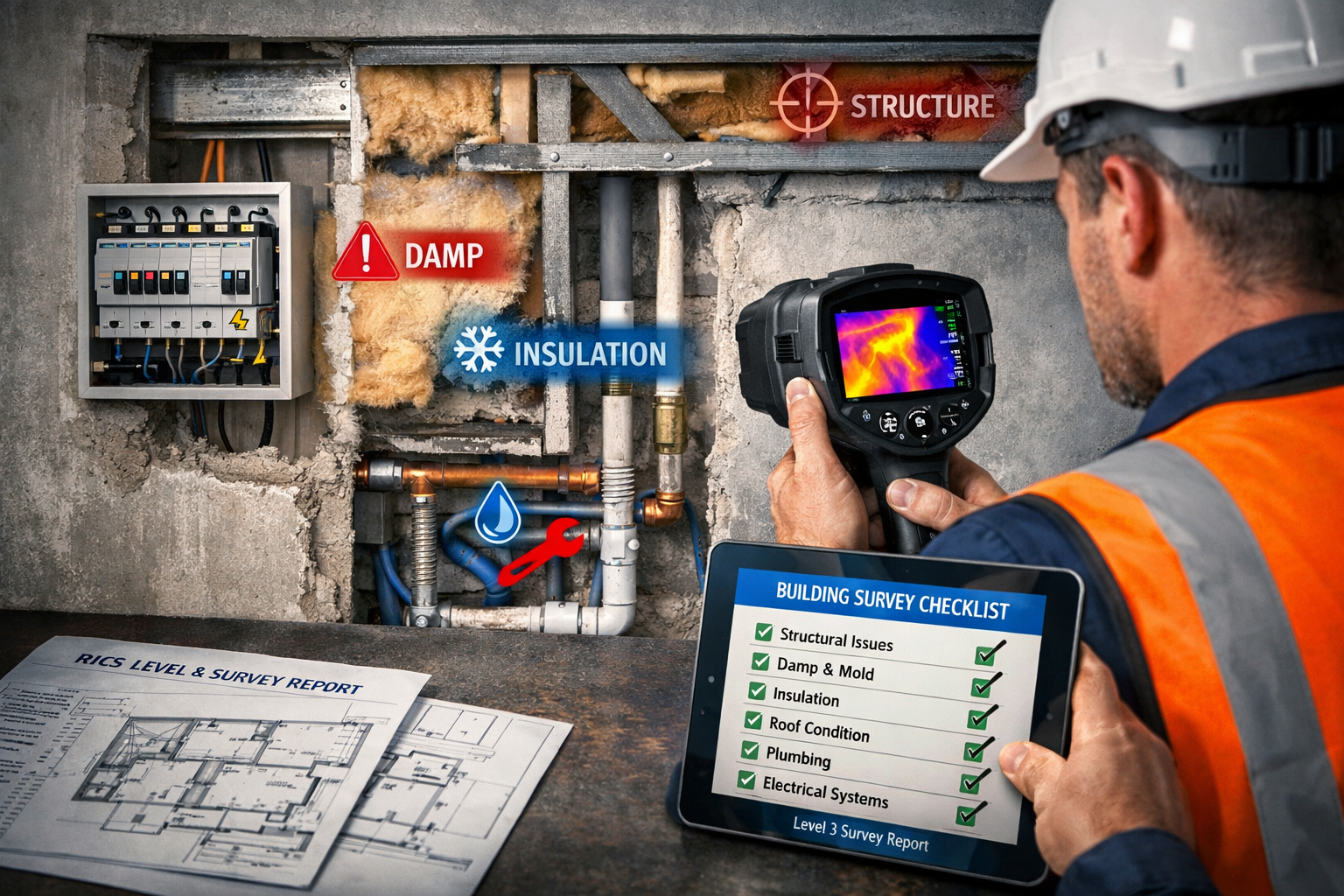
Structural Integrity Assessment 🏗️
The foundation of any building survey focuses on structural elements that determine long-term viability:
- Load-bearing walls and foundations: Identifying settlement, subsidence, or structural movement that could require costly underpinning
- Roof structure and coverings: Assessing remaining lifespan, water ingress risks, and replacement costs
- Floor joists and suspended floors: Detecting rot, insect infestation, or inadequate support
- External walls and damp-proof courses: Evaluating cavity wall ties, render condition, and moisture barriers
For institutional portfolios, structural issues represent the highest-cost risks. A building survey that identifies foundation movement early can prevent acquisition of assets requiring six-figure remediation.
Building Services and Compliance Evaluation
Modern buy-to-let properties must meet stringent regulatory standards. Survey protocols must assess:
| Building System | Key Assessment Areas | Yield Impact |
|---|---|---|
| Electrical Systems | Consumer unit compliance, circuit capacity, periodic testing certificates | Non-compliant systems require immediate remediation before letting |
| Plumbing & Heating | Boiler efficiency, pipework condition, water pressure, legionella risk | Inefficient systems increase tenant complaints and energy costs |
| Fire Safety | Smoke/CO detectors, fire doors, escape routes, compartmentation | Regulatory non-compliance prevents letting and attracts penalties |
| Energy Performance | EPC rating, insulation standards, glazing efficiency | Properties below EPC 'C' face letting restrictions from 2025 |
| Ventilation | Condensation control, mechanical ventilation, air quality | Poor ventilation drives damp issues and tenant dissatisfaction |
The 17.6% increase in schemes with detailed planning permission in 2025 indicates many new-build opportunities, but even modern developments require verification of building control compliance and warranty coverage[1].
Defect Identification and Cost Quantification
Professional surveys must move beyond identifying issues to quantifying financial implications. Building Surveys for Institutional Buy-to-Let in Recovering Markets: Due Diligence for Professional Landlord Yields demands clear categorisation of defects:
Category 1 Defects ⚠️ (Immediate Action Required)
- Structural instability requiring urgent shoring or repair
- Active water ingress causing progressive damage
- Dangerous electrical installations
- Fire safety non-compliance
- Severe damp or fungal decay
Category 2 Defects 🔍 (Planned Maintenance Required)
- Roof coverings nearing end of serviceable life (3-5 years)
- Aging building services requiring replacement within investment horizon
- Minor structural movement requiring monitoring
- External decoration and weatherproofing needs
Category 3 Observations ✓ (Routine Maintenance)
- Cosmetic repairs and decoration
- Minor adjustments to fixtures and fittings
- Preventative maintenance recommendations
Each category carries different implications for yield calculations. Category 1 defects may render a property unsuitable for institutional investment without significant price negotiation, while Category 2 issues inform capital expenditure reserves and lifecycle costing.
Due Diligence Checklists for High-Volume Institutional Investors
Institutional investors managing multi-property portfolios require standardised survey protocols that enable consistent assessment across diverse assets. The following checklists reflect RICS best practice adapted for the specific demands of Building Surveys for Institutional Buy-to-Let in Recovering Markets: Due Diligence for Professional Landlord Yields.

Pre-Acquisition Survey Checklist
Phase 1: Desktop Due Diligence 📋
- Review planning history and building control approvals
- Obtain previous survey reports and structural engineer assessments
- Check building insurance claims history
- Verify EPC rating and energy efficiency documentation
- Examine lease terms, service charge arrangements, and management structure
- Identify any dilapidations issues from previous tenancies
- Review local authority environmental health records
Phase 2: Physical Inspection Protocol 🔎
- Engage RICS-qualified surveyor with commercial/multi-let experience
- Conduct comprehensive RICS commercial building survey for larger blocks
- Perform intrusive investigations for suspected defects (with vendor permission)
- Commission specialist reports: structural engineer, damp specialist, electrical testing
- Document photographic evidence of all defects and observations
- Test representative sample of building services and installations
- Assess accessibility and compliance with current building regulations
Phase 3: Financial Quantification 💰
- Obtain detailed cost estimates for all Category 1 and 2 defects
- Calculate 10-year capital expenditure forecast for major building elements
- Estimate annual maintenance reserve requirements
- Model impact of remediation costs on projected yields
- Factor void periods required for major works
- Assess insurance premium implications of identified risks
- Calculate net present value of maintenance liabilities
Ongoing Portfolio Management Surveys
For existing portfolios, proactive survey regimes protect asset values and tenant satisfaction:
Annual Inspection Programme
- Visual condition surveys of all properties
- Testing of fire safety systems and emergency lighting
- Electrical installation condition reports (every 5 years minimum)
- Gas safety certificates (annual requirement)
- Legionella risk assessments and water testing
- Energy efficiency reviews and upgrade opportunities
Periodic Comprehensive Surveys (Every 3-5 Years)
- Full RICS Level 3 building surveys to identify developing defects
- Structural movement monitoring where previous concerns identified
- Roof surveys to assess remaining lifespan and plan replacements
- Building fabric assessments for external decoration and weatherproofing cycles
- Review of building services efficiency and replacement planning
Tenant Turnover Survey Protocol
Between tenancies, targeted surveys ensure properties remain lettable and compliant:
- Check-in/check-out condition reports with photographic evidence
- Identification of tenant-caused damage versus fair wear and tear
- Testing of all appliances and building services
- Verification of smoke/CO detector functionality
- Assessment of decoration standards and letting readiness
- Compliance verification: EPC, gas safety, electrical safety, legionella
- Opportunity assessment for value-adding improvements
This systematic approach aligns with industry recognition that "maintaining a high standard of living requires ongoing inspections, proactive maintenance and robust reporting" throughout the investment lifecycle[1].
Leveraging Survey Data to Optimise Professional Landlord Yields
The true value of comprehensive building surveys emerges when survey data informs strategic investment decisions. In 2026's recovering market, where rental growth moderates to 2-2.5%, Building Surveys for Institutional Buy-to-Let in Recovering Markets: Due Diligence for Professional Landlord Yields transforms from cost centre to competitive advantage[4].
Yield Protection Through Risk-Adjusted Pricing
Survey findings enable sophisticated investors to negotiate acquisition prices that reflect true asset condition. Consider two identical properties in the same location:
Property A: Survey identifies £45,000 in deferred maintenance (roof replacement, boiler upgrade, damp remediation)
Property B: Survey confirms excellent condition with minimal capital expenditure forecast
Even if both properties command identical rents, Property A requires significantly lower acquisition price to deliver equivalent yields after accounting for capital expenditure. Professional investors use survey data to calculate risk-adjusted offers that protect target returns.
Capital Expenditure Planning and Reserve Allocation
Institutional portfolios require predictable cash flow management. Comprehensive surveys provide the data foundation for:
- 10-year capital expenditure forecasts for major building elements (roofs, boilers, windows, external decoration)
- Maintenance reserve calculations based on actual building condition rather than generic assumptions
- Lifecycle costing models that optimise timing of replacements versus repairs
- Budget allocation across portfolios to smooth capital expenditure peaks
This planning capability proves particularly valuable in recovering markets where rental growth may not keep pace with construction cost inflation. Knowing precise maintenance requirements enables realistic yield projections that account for total cost of ownership.
Tenant Retention and Void Period Minimisation
Properties in excellent condition achieve superior tenant retention, directly impacting yields. Survey-driven maintenance programmes that address issues proactively—before tenants complain—create competitive advantages:
- Reduced void periods: Well-maintained properties let faster in competitive markets
- Premium rental positioning: Properties demonstrably superior to market average command rental premiums
- Lower tenant acquisition costs: Longer tenancies reduce marketing and turnover expenses
- Positive reputation building: Professional management attracts quality tenants through word-of-mouth
With rental stock remaining constrained, properties that offer genuine quality stand out. Surveys identify opportunities to exceed tenant expectations through targeted improvements.
Compliance Risk Management
Regulatory compliance represents a non-negotiable aspect of professional landlord operations. Building surveys verify:
✅ Electrical Safety Standards: Compliance with Electrical Safety Standards in the Private Rented Sector (England) Regulations 2020
✅ Gas Safety: Annual gas safety certificates and appliance servicing
✅ Energy Performance: EPC minimum ratings and upgrade pathways
✅ Fire Safety: Smoke and carbon monoxide detector requirements, fire door specifications
✅ HMO Licensing: Additional requirements for houses in multiple occupation
✅ Decent Homes Standard: Compliance with statutory minimum standards
Non-compliance can result in letting prohibition, financial penalties, and reputational damage. For institutional investors, survey-verified compliance protects both yields and brand reputation.
Advanced Survey Techniques for Complex Institutional Portfolios
Large-scale institutional investors benefit from deploying advanced survey methodologies that enhance efficiency and data quality across portfolios.
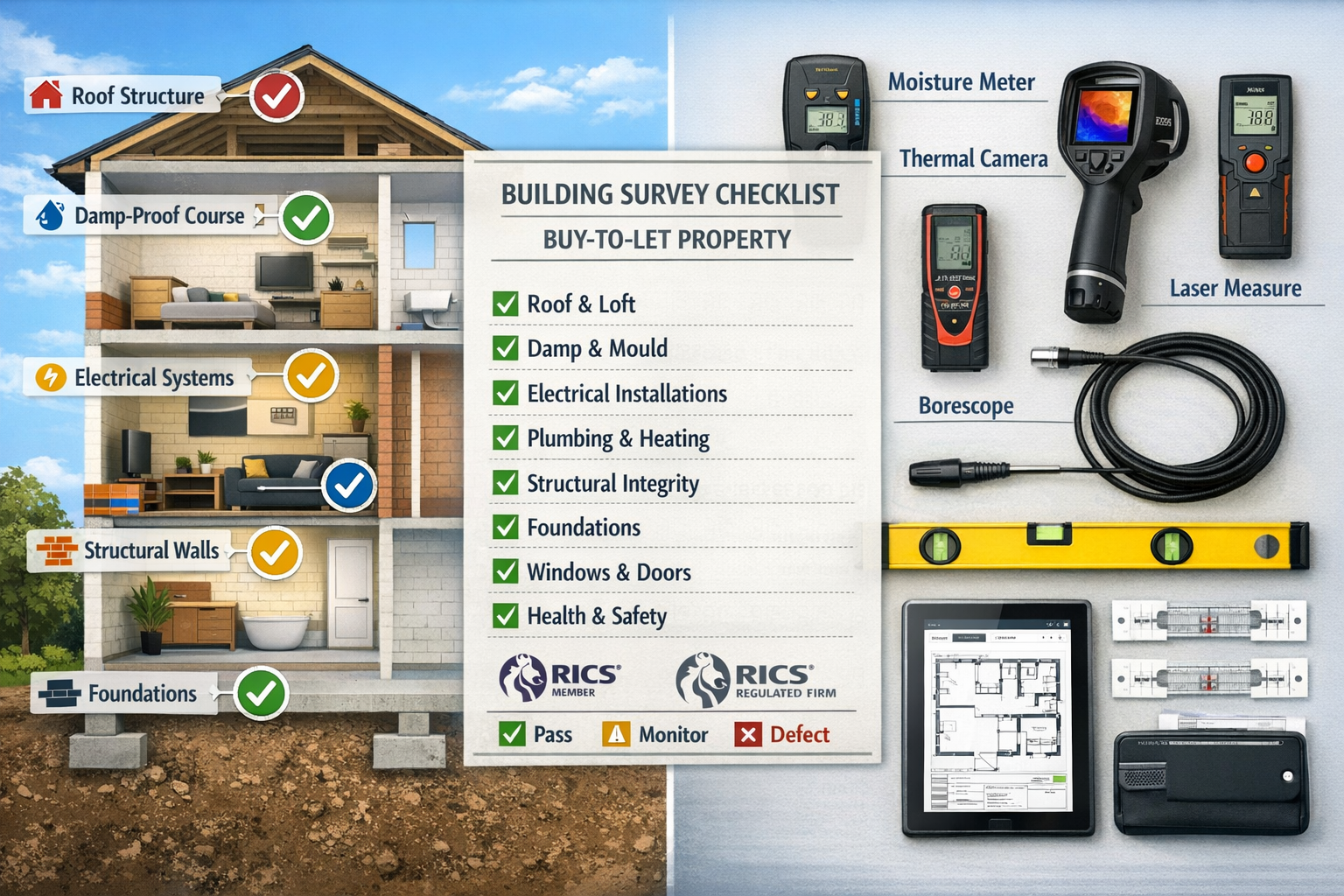
Technology-Enhanced Survey Protocols
Modern survey techniques leverage technology to improve accuracy and enable data-driven portfolio management:
Thermal Imaging Surveys 🌡️
Infrared thermography identifies:
- Hidden moisture ingress and damp penetration
- Insulation deficiencies and thermal bridging
- Air leakage points affecting energy efficiency
- Heating system distribution issues
Drone Roof Inspections 🚁
Unmanned aerial vehicles enable:
- Safe inspection of high-level roofs without scaffolding
- Detailed photographic documentation of roof condition
- Identification of blocked gutters, damaged flashings, and vegetation growth
- Cost-effective surveys of large multi-storey buildings
Moisture Mapping Technology 💧
Advanced damp surveys using:
- Capacitance meters for non-destructive moisture detection
- Hygrometers measuring relative humidity in building fabric
- Calcium carbide testing for precise moisture content quantification
- Borescope inspections of concealed wall cavities
Digital Survey Platforms 📱
Cloud-based survey management systems provide:
- Standardised data collection templates ensuring consistency
- Real-time photo and annotation upload from site
- Automated report generation with defect categorisation
- Portfolio-wide analytics identifying common issues across holdings
- Integration with maintenance management and financial systems
Specialist Assessments for Specific Risks
Certain building types or conditions warrant specialist investigation beyond standard surveys:
Structural Engineer Reports
Required when surveys identify:
- Significant cracking or structural movement
- Subsidence or foundation settlement
- Structural alterations requiring load calculations
- Unusual construction methods or materials
Professional structural engineer reports provide definitive assessment of structural adequacy and remediation specifications.
Environmental and Contamination Surveys
For properties with industrial heritage or specific risks:
- Asbestos surveys and management plans
- Contaminated land assessments
- Radon testing in high-risk geological areas
- Japanese knotweed and invasive species surveys
Building Pathology Investigations
When defects require detailed diagnosis:
- Timber decay and insect infestation analysis
- Concrete carbonation and reinforcement corrosion testing
- Masonry deterioration and salt contamination assessment
- Render and external coating failure investigation
Portfolio-Scale Data Analytics
Institutional investors with substantial holdings benefit from aggregating survey data to identify patterns and optimise maintenance strategies:
Predictive Maintenance Modelling
Analysing survey data across portfolios reveals:
- Common failure modes for specific building types or ages
- Optimal timing for preventative interventions versus reactive repairs
- Cost-benefit analysis of upgrade programmes
- Risk scoring enabling prioritisation of capital allocation
Benchmarking and Performance Metrics
Survey data enables comparison of:
- Maintenance cost per unit across different property types
- Defect frequency by building age, construction type, and location
- Energy efficiency performance relative to portfolio averages
- Tenant satisfaction correlation with building condition metrics
Strategic Asset Management
Comprehensive survey databases inform:
- Hold/sell/improve decisions based on capital expenditure requirements
- Portfolio composition optimisation balancing risk and return
- Acquisition criteria refinement based on historical performance data
- Insurance negotiation using detailed risk profiles
Integrating Survey Findings into Investment Decision Frameworks
For Building Surveys for Institutional Buy-to-Let in Recovering Markets: Due Diligence for Professional Landlord Yields to deliver maximum value, survey findings must integrate seamlessly into broader investment analysis.
Yield Calculation Adjustments
Standard yield calculations based solely on purchase price and rental income overlook total cost of ownership. Survey-informed models incorporate:
Adjusted Net Yield Formula:
Adjusted Net Yield = (Annual Rent - Management Costs - Maintenance Reserve - Void Allowance - Compliance Costs) / (Purchase Price + Immediate Remediation Costs)
Survey findings directly inform:
- Maintenance Reserve: Based on actual building condition and lifecycle forecasting
- Immediate Remediation Costs: Category 1 and urgent Category 2 defects
- Void Allowance: Adjusted for time required to complete essential works
- Compliance Costs: Specific upgrades required to meet regulatory standards
This approach provides realistic yield projections that account for property-specific circumstances rather than generic assumptions.
Risk-Adjusted Return Modelling
Institutional investors employ sophisticated risk frameworks where survey findings influence:
Risk Rating Factors:
- Structural condition: Properties with identified movement or foundation issues carry higher risk scores
- Building services age: Aging mechanical and electrical systems increase probability of failure
- Compliance gaps: Properties requiring significant upgrades face regulatory risk
- Maintenance backlog: Deferred maintenance indicates higher near-term capital requirements
Higher risk ratings either exclude properties from acquisition or require higher target yields to compensate for uncertainty.
Portfolio Diversification Strategy
Survey data enables strategic portfolio construction balancing:
New-Build vs. Existing Stock
- New-build properties offer warranty protection and lower near-term maintenance
- Existing stock may offer superior locations but require capital expenditure reserves
- Optimal portfolios blend both based on survey-informed lifecycle cost analysis
Geographic and Building Type Diversification
- Survey findings reveal regional variations in building quality and maintenance standards
- Different construction types (Victorian conversion, post-war block, modern development) carry distinct risk profiles
- Diversification reduces concentration risk from common defects affecting similar properties
Exit Strategy Planning
Survey data informs not just acquisition but eventual disposal:
- Capital expenditure timing: Scheduling major works to optimise sale value
- Condition improvement programmes: Targeted upgrades maximising return on investment
- Documentation maintenance: Comprehensive survey records demonstrate professional management to future purchasers
- Warranty and guarantee preservation: Ensuring remediation works maintain transferable warranties
Selecting Qualified Surveyors for Institutional Buy-to-Let Assessments
The quality of survey outcomes depends fundamentally on surveyor expertise. Institutional investors should engage chartered surveyors with specific qualifications:
Essential Surveyor Credentials
RICS Membership and Accreditation 🎓
- Registered valuers with Royal Institution of Chartered Surveyors
- Specialist accreditation in building surveying or residential property
- Professional indemnity insurance adequate for portfolio values
- Continuing professional development in current building regulations
Relevant Experience Requirements
- Demonstrated experience with multi-let residential properties
- Understanding of institutional investor requirements and reporting standards
- Knowledge of Build to Rent sector-specific considerations
- Track record with similar property types and construction methods
Technical Competencies
- Ability to identify and diagnose complex building defects
- Understanding of structural engineering principles
- Knowledge of building services systems and compliance requirements
- Familiarity with modern survey technologies (thermal imaging, moisture detection)
Surveyor Engagement Best Practices
Clear Scope Definition
Institutional investors should specify:
- Survey level required (Level 2 homebuyer versus Level 3 building survey)
- Specific areas of concern requiring detailed investigation
- Reporting format and data requirements for portfolio systems
- Turnaround time expectations balancing thoroughness with acquisition timelines
Access Arrangements
- Coordination with vendors or current occupiers for comprehensive access
- Permission for intrusive investigations where warranted
- Arrangements for specialist access equipment (scaffolding, cherry pickers)
- Vacant possession timing for thorough internal inspection
Reporting Requirements
Institutional reports should include:
- Executive summary with clear acquisition recommendations
- Defect categorisation with cost estimates and urgency ratings
- 10-year capital expenditure forecast
- Compliance verification checklist
- Photographic appendix with annotated images
- Specialist report integration (structural, electrical, damp)
Conclusion: Building Survey Excellence as Competitive Advantage in 2026
As UK Build to Rent investment approaches £5.7 billion in 2026, the institutional investors who thrive will be those who recognise that Building Surveys for Institutional Buy-to-Let in Recovering Markets: Due Diligence for Professional Landlord Yields represents far more than regulatory compliance—it constitutes a strategic competitive advantage in an increasingly sophisticated market[1].
With rental growth moderating to sustainable 2-2.5% levels, the margin for error narrows[4]. Properties burdened with hidden defects, deferred maintenance, or compliance gaps will underperform, eroding yields through unexpected capital expenditure and tenant dissatisfaction. Conversely, portfolios built on comprehensive due diligence and proactive maintenance will deliver the predictable, long-term returns that pension funds and institutional investors demand[1].
The chronic supply shortage—with rental stock remaining a third below historical levels—ensures continued demand for quality accommodation[3]. Professional landlords who leverage thorough building surveys to identify and secure well-maintained properties position themselves to capture premium rents, achieve superior tenant retention, and build sustainable competitive moats.
Actionable Next Steps for Institutional Investors 🎯
Immediate Actions:
- Audit existing survey protocols against the comprehensive checklists outlined above, identifying gaps in current due diligence processes
- Engage RICS-qualified surveyors with demonstrated expertise in multi-let residential properties for upcoming acquisitions
- Implement portfolio-wide condition surveys for existing holdings to identify deferred maintenance and prioritise capital allocation
Strategic Initiatives:
4. Develop standardised survey data collection systems enabling portfolio-wide analytics and benchmarking
5. Integrate survey findings into financial models, adjusting yield calculations to reflect total cost of ownership
6. Establish proactive maintenance programmes based on survey-identified lifecycle forecasts rather than reactive repairs
Long-Term Positioning:
7. Build relationships with specialist surveyors covering structural engineering, building pathology, and compliance verification
8. Invest in technology platforms for survey data management and predictive maintenance modelling
9. Create competitive advantage through demonstrable asset quality and professional management standards
The 17.6% increase in schemes with detailed planning permission signals continued pipeline growth[1]. Investors who master Building Surveys for Institutional Buy-to-Let in Recovering Markets: Due Diligence for Professional Landlord Yields will be best positioned to capitalise on these opportunities, building portfolios that deliver sustainable returns throughout market cycles.
Professional building surveys transform from cost to investment—protecting capital, optimising yields, and establishing the foundation for long-term success in the UK's evolving rental landscape. The question for institutional investors is not whether to conduct comprehensive surveys, but how quickly they can elevate survey protocols to match the sophistication of their investment strategies.
For expert guidance on comprehensive building surveys tailored to institutional buy-to-let portfolios, compare different types of survey to determine the optimal approach for your investment objectives.
References
[1] Uk Build To Rent Investment Forecast 2026 – https://propertyportfolioinvestor.co.uk/news/uk-build-to-rent-investment-forecast-2026/
[3] Why The Uk Rental Market Is Poised For Growth In 2026 Rightmoves Positive Outlook For Property Investors – https://blog.magnateassets.com/why-the-uk-rental-market-is-poised-for-growth-in-2026-rightmoves-positive-outlook-for-property-investors
[4] Buy To Let Market To Enter Calmer Period In 2026 As Rental Growth Slows – https://www.buyassociationgroup.com/en-gb/news/buy-to-let-market-to-enter-calmer-period-in-2026-as-rental-growth-slows/
