
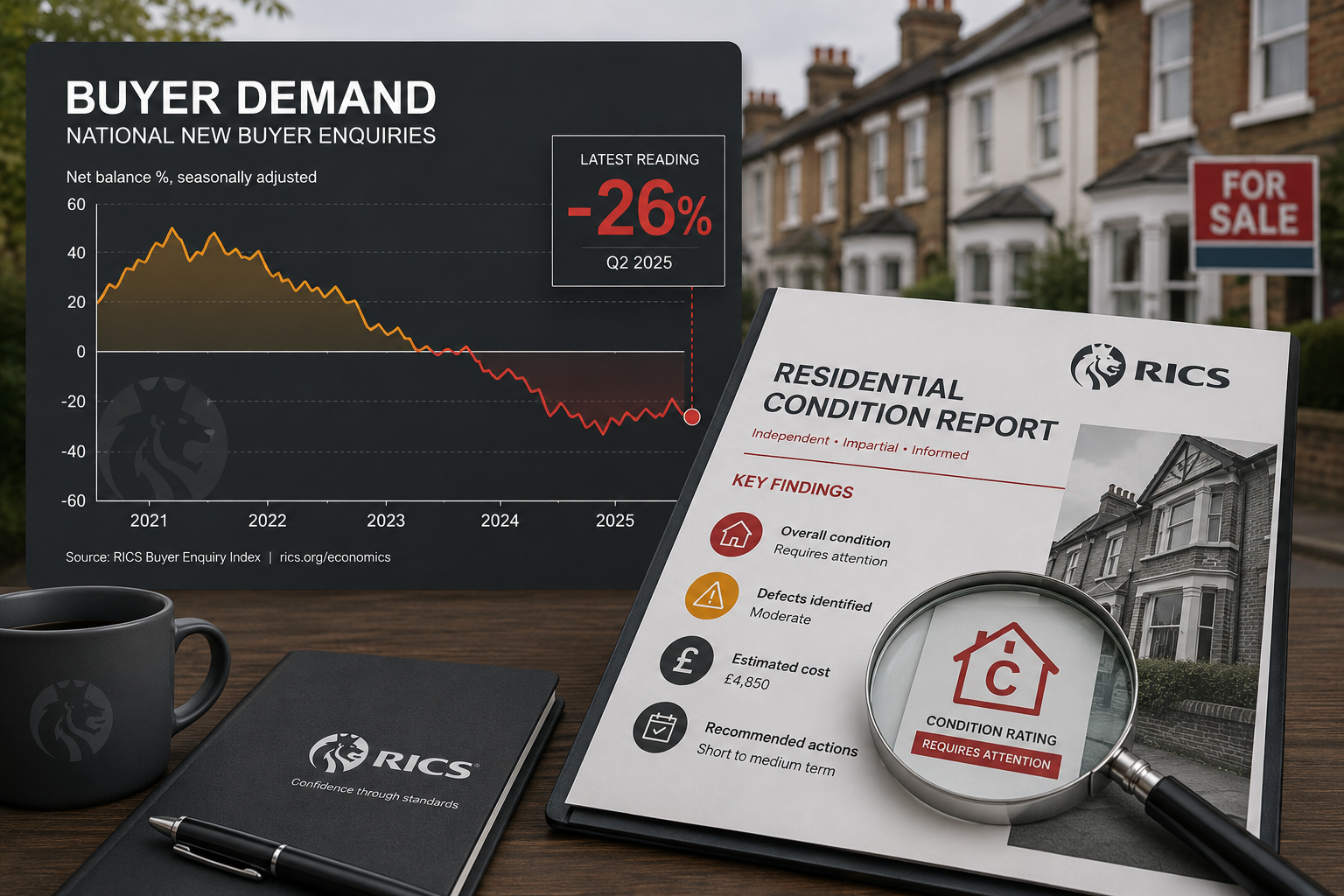
Buyer enquiries across the UK residential market fell by 26% in February 2026 — the sharpest single-month decline in recent memory — driven by geopolitical uncertainty and persistent interest rate anxiety [1]. For sellers, that statistic is not just a warning sign; it is a direct call to action. In a market where cautious buyers are walking away from deals at the first hint of ambiguity, building survey strategies for sellers in Q2 2026 cautious markets represent one of the most powerful tools available to protect sale values, reduce fall-throughs, and restore buyer confidence through proactive condition reports.
This article explains exactly how sellers can take control of the survey process, which survey types deliver the greatest strategic value, and how to use condition reports as a competitive differentiator in a market that rewards transparency.
Key Takeaways
- Buyer demand dropped 26% in February 2026, making proactive seller surveys a critical tool for reducing fall-throughs and renegotiation risk.
- Seller-commissioned condition reports signal transparency and can significantly accelerate buyer decision-making in a cautious market.
- RICS Level 2 and Level 3 surveys are the most strategically valuable options for most residential sellers, with costs ranging from £400 to over £1,500.
- Modern surveys now incorporate drone inspections, thermal imaging, and 3D modelling, providing richer data that builds buyer trust.
- Regional expertise matters: surveyors with local market knowledge provide more accurate assessments and better support pricing decisions amid regional price divergence.
Why Q2 2026 Demands a Different Seller Strategy
The Real Estate Roundtable's Q2 2026 Sentiment Index scored 63, placing the market firmly in a "holding pattern." Capital conditions are improving, but transaction activity remains sluggish and pricing uncertainty is widespread [7]. Buyers who do remain active are more risk-averse than at any point in the past five years. They scrutinise every detail, and they are far more likely to withdraw or renegotiate after a negative survey result.
The traditional approach — waiting for a buyer to commission their own survey — is now a liability.
When a buyer's surveyor uncovers an unexpected defect, sellers lose negotiating leverage entirely. The buyer holds the report, controls the narrative, and typically demands a price reduction that exceeds the actual cost of the repair. Worse, the uncertainty can cause the buyer to withdraw altogether, resetting the sale process at considerable cost in time and money.
Demand for building surveys is projected to increase by 14% in Spring 2026, even as buyer numbers contract [1]. This tells a clear story: the buyers who remain in the market are conducting more thorough due diligence, not less. Sellers who meet that diligence with pre-prepared, professional condition reports are far better positioned to convert serious enquiries into completed transactions.
"In a cautious market, information asymmetry works against the seller. A proactive condition report closes that gap and signals confidence in the property's integrity."
Understanding RICS Survey Levels: Choosing the Right Report for Your Property
The Royal Institution of Chartered Surveyors (RICS) defines three survey levels, each suited to different property types and seller objectives [2].
| Survey Level | Best For | Typical Cost | Scope |
|---|---|---|---|
| Level 1 – Condition Report | New builds, modern properties in good condition | From £300 | Basic traffic-light condition ratings |
| Level 2 – HomeBuyer Report | Standard properties in reasonable condition | £400 – £1,000 | Visible defects, market valuation, legal issues |
| Level 3 – Building Survey | Older, larger, or significantly altered properties | £1,500+ | Comprehensive structural and condition analysis |
For most sellers operating in Q2 2026, the Level 2 HomeBuyer Report or Level 3 Building Survey will provide the greatest strategic value. A Level 1 Condition Report, while useful for straightforward modern properties, rarely provides enough detail to meaningfully reassure a cautious buyer [3].
Sellers of Victorian terraces, Edwardian semis, or any property that has undergone significant extension or alteration should strongly consider commissioning a Level 3 building survey before listing. The comprehensive analysis this provides — covering structural integrity, roof condition, damp, drainage, and more — gives buyers the depth of information they need to proceed with confidence.
For properties in standard condition, a RICS Level 2 HomeBuyer Survey strikes the right balance between cost and credibility. It covers all visible defects, provides a market valuation, and flags any legal issues that may affect the transaction.
To understand the practical differences between these options, the Level 2 vs Level 3 survey comparison guide provides a clear breakdown of which report suits which property type.
How Seller-Commissioned Surveys Work: Legal Considerations and Reliance Letters
A seller-commissioned survey is not a standard practice in the UK, but it is entirely legitimate and increasingly common in cautious markets [4]. The key legal point sellers must understand is this: the surveyor's duty of care runs to the party who commissioned the report — the seller — unless a formal reliance letter is issued.
A reliance letter extends the surveyor's duty of care to the buyer, meaning the buyer can rely on the report's findings for legal purposes. Without this letter, a buyer cannot take legal action against the surveyor if the report later proves inaccurate. This distinction matters enormously for buyer confidence.
Steps to make a seller-commissioned survey credible and usable:
- Engage a RICS-accredited chartered surveyor with demonstrable local expertise.
- Request a reliance letter that can be extended to prospective buyers.
- Ensure the survey is conducted at the appropriate level for the property type.
- Disclose the survey report openly to all serious enquirers.
- Address any flagged defects before listing, or price the property to reflect them transparently.
Sellers who follow this process effectively neutralise one of the most common reasons for post-offer renegotiation: the surprise defect. When buyers know exactly what they are purchasing, they are far more likely to proceed at the agreed price.
Building Survey Strategies for Sellers in Q2 2026 Cautious Markets: Practical Implementation

Implementing effective building survey strategies for sellers in Q2 2026 cautious markets requires more than simply ordering a report. The timing, preparation, and presentation of the survey all influence its impact on buyer confidence.
Timing the Survey Correctly
Commission the survey before listing, not after an offer is received. Pre-listing surveys allow sellers to:
- Identify and repair defects before they become negotiating leverage for buyers.
- Set an asking price that accurately reflects the property's condition.
- Provide the report as part of the marketing pack from day one.
Scheduling comprehensive inspections immediately after offer acceptance is a common alternative, but in a market where buyer resolve is fragile, waiting until that stage introduces unnecessary risk [8]. A buyer who receives a negative survey result after making an offer is already emotionally invested — and that emotional pressure can lead to either a significant price reduction demand or a withdrawal.
Preparing the Property for Survey
Thorough preparation reduces the number of flagged items and demonstrates to buyers that the property has been well maintained [5].
Pre-survey preparation checklist:
- Clear access to loft spaces, underfloor areas, and outbuildings.
- Ensure all rooms, cupboards, and service areas are accessible.
- Fix obvious minor defects: dripping taps, cracked tiles, broken guttering.
- Gather documentation for any previous work: planning permissions, building regulations certificates, warranties.
- Provide records for boiler servicing, electrical inspections (EICR), and gas safety certificates.
- Address any visible damp or condensation issues and provide context where remedial work has already been carried out.
A well-prepared property signals to both the surveyor and the eventual buyer that the seller is organised, transparent, and confident in the property's condition.
Addressing Specific Risk Areas
In Q2 2026, buyers are particularly sensitive to issues that carry open-ended cost implications. The areas most likely to trigger buyer hesitation include:
- Roof condition: A professional roof survey can provide a standalone detailed assessment where the main survey identifies concerns.
- Structural movement: Where cracking or subsidence is suspected, a structural engineer's report provides the definitive assessment buyers need.
- Damp and timber: Specialist damp surveys can distinguish between active penetrating damp and historic staining, preventing unnecessary buyer alarm.
- Energy performance: With rising energy costs, buyers increasingly factor in thermal efficiency. Modern surveys now incorporate thermal imaging assessments that identify heat loss, insulation gaps, and potential energy upgrade costs [6].
Addressing these areas proactively — either through remediation or through specialist reports that contextualise the findings — removes the most common triggers for buyer withdrawal.
Leveraging Technology to Strengthen Condition Reports
Modern building surveys in 2026 are significantly more informative than their predecessors, thanks to the integration of digital tools that provide clearer, more verifiable insights into property condition [6].
Key technologies now used in professional surveys:
- Drone inspections: Allow surveyors to assess roof structures, chimney stacks, and high-level external elements without scaffolding, producing photographic and video evidence.
- Thermal imaging cameras: Identify heat loss, moisture ingress, and insulation deficiencies invisible to the naked eye.
- Laser measurement tools: Provide precise floor area calculations and detect structural deformation.
- 3D building models: Create digital representations of the property that buyers can review alongside the written report.
These technologies do more than improve accuracy. They produce visual evidence that buyers can review and understand without specialist knowledge. A report accompanied by drone footage of a sound roof or thermal images confirming dry walls is far more persuasive than a written statement alone.
Sellers should specifically request surveyors who utilise these tools, and confirm that the resulting report will include visual evidence alongside the written findings. For sellers in London and the surrounding regions, the complete guide to building surveyors in London provides detailed guidance on selecting a surveyor with the right technological capabilities.
Regional Divergence and the Importance of Local Expertise
One of the defining features of the Q2 2026 market is widening regional price divergence. Buyer confidence varies significantly between locations, and the factors driving caution in one area may be entirely different from those affecting another [9]. A seller in a commuter belt town faces different buyer concerns than a seller in a city centre apartment block or a rural village.
Surveyors with genuine local expertise are better equipped to:
- Contextualise defects within local market norms (e.g., a particular construction type common to the area).
- Provide valuations that reflect local price trends rather than national averages.
- Identify region-specific risks such as flood zones, mining subsidence, or proximity to development sites.
- Advise on the level of survey most appropriate for properties typical to that locality.
For sellers in specific regions, working with chartered surveyors who have deep local knowledge — such as those serving Chiswick, Putney, or Godalming — ensures that condition reports carry the contextual authority that cautious buyers require.
Regional expertise also matters when addressing legislative risks. Building regulations, permitted development rights, and planning history can all affect a property's marketability. A surveyor familiar with the local planning authority's approach can flag potential issues before they derail a transaction.
Building Survey Strategies for Sellers in Q2 2026 Cautious Markets: Presenting Reports to Buyers

A well-executed survey is only as effective as its presentation. Sellers who commission condition reports but fail to use them strategically in the sales process leave significant value on the table.
Best practices for presenting seller-commissioned surveys:
- Include the report in the marketing pack from the moment the property is listed. Buyers who receive a condition report upfront are more likely to make offers without lengthy due diligence delays.
- Highlight the positives explicitly. If the survey confirms a sound roof, dry walls, and a recently updated electrical system, these points should feature in the property description and agent briefings.
- Be transparent about flagged issues. A report that acknowledges a minor defect and documents the remediation work carried out is more credible than one that appears to show a perfect property. Buyers in 2026 are sophisticated enough to be suspicious of reports with no findings whatsoever.
- Offer to extend the reliance letter to serious buyers. This formal step demonstrates confidence in the report's accuracy and significantly increases buyer willingness to proceed without commissioning a duplicate survey.
- Make the surveyor available for questions. Some chartered surveyors will agree to a brief call with prospective buyers to clarify findings. This level of transparency is highly unusual and, in a cautious market, exceptionally persuasive.
The importance of a survey home report for homeowners is well established from the buyer's perspective. Sellers who understand and leverage that importance gain a measurable advantage in competitive listings.
Cost-Benefit Analysis: Is a Seller Survey Worth the Investment?
Survey costs represent a meaningful upfront expense. A Level 3 Building Survey can cost £1,500 or more, while a Level 2 HomeBuyer Report typically ranges from £400 to £1,000 [3]. For sellers, the question is straightforward: does this investment protect more value than it costs?
The answer, in Q2 2026, is almost certainly yes — for the following reasons:
- Fall-through prevention: The average cost of a failed property transaction in the UK — including legal fees, survey costs, and time lost — is estimated at over £2,500 per party. A seller survey that prevents even one fall-through more than pays for itself.
- Renegotiation protection: Buyers who discover defects through their own survey typically demand price reductions of two to three times the actual repair cost. A seller survey that identifies and addresses defects beforehand eliminates this leverage entirely.
- Faster completion: Properties with pre-prepared condition reports typically progress through the conveyancing process more quickly, reducing the period during which a buyer can develop cold feet.
- Stronger asking price justification: A clean or well-contextualised survey report provides objective evidence to support the asking price, reducing the scope for speculative low offers.
For sellers uncertain about which survey level is appropriate for their property, the house survey checklist provides a practical starting point for assessing condition before engaging a surveyor.
Conclusion: Turning Market Caution into a Competitive Advantage
The Q2 2026 property market is not a market in which sellers can afford to be passive. With buyer enquiries down 26% and the Sentiment Index confirming a holding pattern, the sellers who succeed will be those who actively reduce buyer risk rather than waiting for buyers to discover it themselves [1][7].
Building survey strategies for sellers in Q2 2026 cautious markets are not merely a defensive measure — they are a proactive competitive strategy. A well-commissioned, professionally presented condition report signals confidence, demonstrates transparency, and gives buyers the certainty they need to proceed in an uncertain environment.
Actionable next steps for sellers:
- Engage a RICS-accredited chartered surveyor with local expertise to commission a pre-listing survey at the appropriate level for your property type.
- Prepare the property thoroughly before the survey date — clear access, fix minor defects, and gather all relevant documentation.
- Address any significant findings before listing, or obtain specialist reports that contextualise them accurately.
- Request a reliance letter and include the condition report in your marketing pack from day one.
- Brief your estate agent on the survey's positive findings so these are communicated clearly to prospective buyers.
- Consider specialist assessments for roof, structural, or damp concerns where the main survey identifies potential issues.
In a market where buyer confidence is the scarcest commodity, the sellers who invest in proactive condition reports are the ones most likely to achieve their asking price, on their timeline, with the fewest complications.
References
[1] Level 3 Building Surveys In Cautious Q2 2026 Markets Rics Tools To Counter 26 Buyer Demand Dip – https://manchestersurveyors.com/level-3-building-surveys-in-cautious-q2-2026-markets-rics-tools-to-counter-26-buyer-demand-dip/?utm_source=openai
[2] Do I Need A House Survey Uk 2026 – https://valuq.co.uk/insights/do-i-need-a-house-survey-uk-2026?utm_source=openai
[3] Survey Costs What Sellers Should Know – https://getpine.co.uk/guides/survey-costs-what-sellers-should-know?utm_source=openai
[4] Seller Commissioned Survey Explained – https://getpine.co.uk/guides/seller-commissioned-survey-explained?utm_source=openai
[5] Prepare Home Buyer Survey – https://getpine.co.uk/guides/prepare-home-buyer-survey?utm_source=openai
[6] Current Trends In Building Surveying Whats Changing In 2026 – https://www.asg-consulting.co.uk/learning-and-resources/current-trends-in-building-surveying-whats-changing-in-2026?utm_source=openai
[7] The Real Estate Roundtable Q2 2026 Sentiment Index Shows Market In Holding Pattern As Capital Improves But Transactions Lag – https://www.rer.org/the-real-estate-roundtable-q2-2026-sentiment-index-shows-market-in-holding-pattern-as-capital-improves-but-transactions-lag/?utm_source=openai
[8] Level 3 Rics Building Surveys In Flat Price Markets Enhancing Certainty From February 2026 Rics Insights – https://nottinghillsurveyors.com/blog/level-3-rics-building-surveys-in-flat-price-markets-enhancing-certainty-from-february-2026-rics-insights?utm_source=openai
[9] Navigating Rics February 2026 Market Volatility Building Survey Demand Strategies When Buyer Enquiries Drop 26 And Regional Price Divergence Widens – https://www.canterburysurveyors.com/blog/navigating-rics-february-2026-market-volatility-building-survey-demand-strategies-when-buyer-enquiries-drop-26-and-regional-price-divergence-widens/?utm_source=openai
