
{"cover":"Professional landscape format (1536×1024) hero image with bold text overlay: 'Party Wall Awards & Awaab's Law 2026: Electrical Hazards in Shared Walls' in extra large 72pt white bold sans-serif font with dark semi-transparent overlay box, centered upper third. Background shows a cross-section architectural illustration of a terraced UK brick party wall with exposed electrical conduit, wiring, and fire-stopping layers visible, flanked by two adjacent properties. Color palette: deep navy blue, white, amber accent. Editorial quality, magazine cover aesthetic, high contrast, professional photography style.","content":["Landscape format (1536×1024) editorial illustration showing a UK party wall surveyor in a hard hat and hi-vis vest examining exposed electrical wiring inside a shared brick wall cavity, with a clipboard showing a Schedule of Condition report and a party wall award document. The scene is set in a semi-detached terraced house interior. Warm amber lighting highlights the wiring hazard. Color palette: brick red, navy, white. Professional, documentary photography style, wide-angle perspective from floor level looking upward.","Landscape format (1536×1024) infographic-style image showing a vertical timeline flowchart of Awaab's Law 2026 Phase 2 compliance steps for electrical hazards in party walls: icons for 24-hour emergency response, 10-day investigation, 5-day make-safe, and remediation completion. Clean flat-design illustration on a dark navy background with amber and white text labels. Each step shown as a connected node with clock icons and wall cross-section diagrams. No people, purely diagrammatic, top-down bird's-eye layout, professional legal compliance aesthetic.","Landscape format (1536×1024) close-up overhead shot of a solicitor's desk with a drafted Party Wall Award document prominently displayed, showing clauses about electrical hazard remediation and schedule of condition. Beside it: a surveyor's schedule of condition report with annotated photographs of a shared wall, a pen, and a small architectural model of two adjoining terraced houses. Soft directional office lighting, shallow depth of field, muted tones of cream, grey and navy. Professional legal documentation aesthetic, editorial quality."]
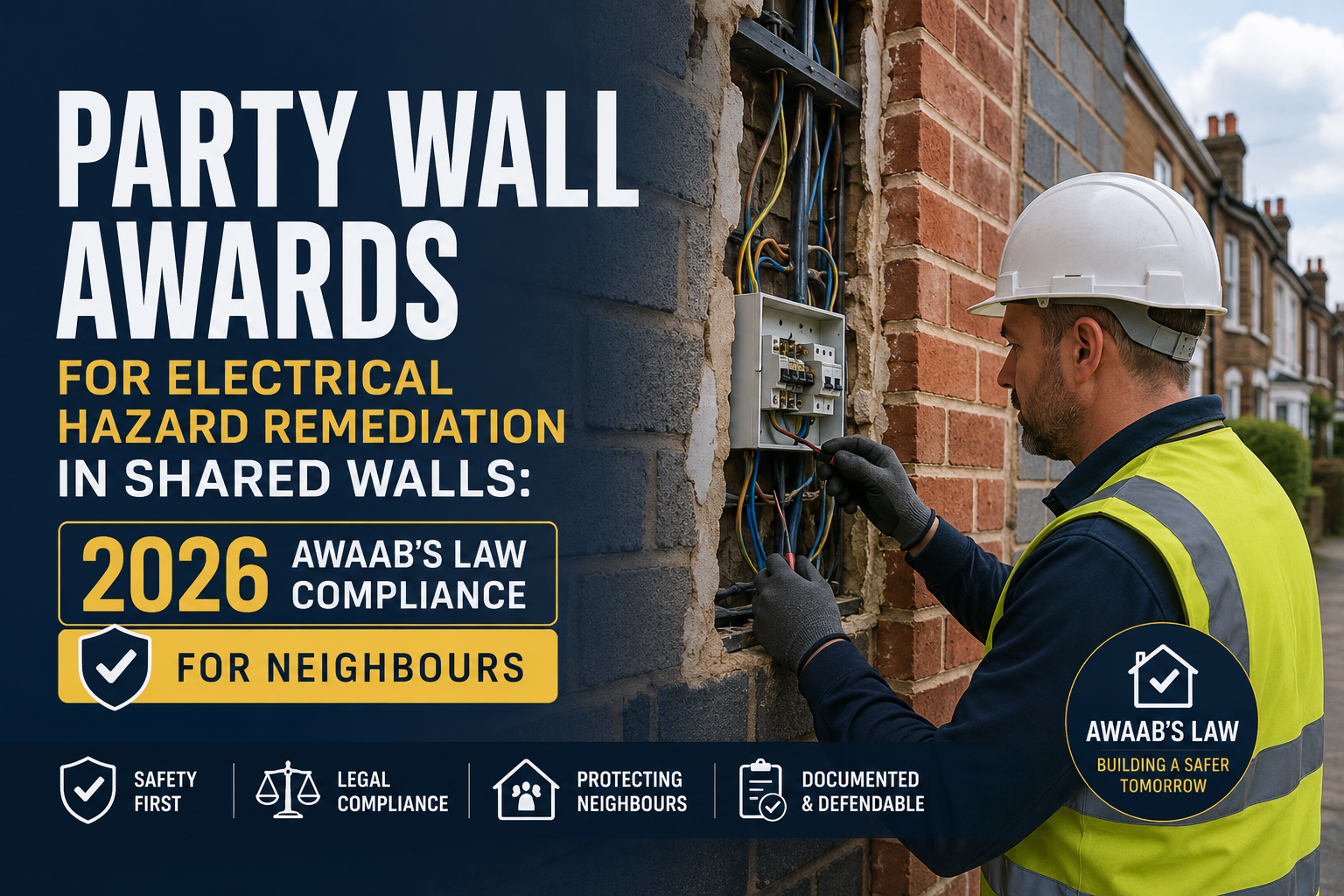
Electrical faults hidden inside shared walls are responsible for a significant proportion of domestic fires in England each year — yet the legal framework governing who fixes them, who pays, and how quickly, has rarely been more complex or more consequential than it is right now. From 2026, Awaab's Law Phase 2 brings electrical hazards firmly within a strict statutory repair timetable for social landlords. When those hazards sit inside a party wall — a structure shared between two properties — the remediation works almost always require a formal Party Wall Award. Understanding how Party Wall Awards for Electrical Hazard Remediation in Shared Walls intersect with 2026 Awaab's Law compliance for neighbours is now essential knowledge for landlords, surveyors, and affected residents alike.
Key Takeaways
- Awaab's Law Phase 2 (2026) extends mandatory repair timeframes to electrical and fire hazards, including those arising in shared or party walls in social housing.
- Where remediation works affect a party wall, a formal Party Wall Award is typically required under the Party Wall etc. Act 1996 before works begin.
- Emergency electrical hazards in shared walls must be investigated and actioned within 24 hours under Awaab's Law; significant risks must be made safe within 5 working days.
- A Schedule of Condition, prepared before works start, is a critical document for protecting both the building owner and the adjoining owner from disputed damage claims.
- Social landlords, managing agents, and their surveyors must coordinate Awaab's Law timelines with the party wall notice and award process to avoid legal exposure on both fronts.
What Awaab's Law 2026 Means for Electrical Hazards in Shared Walls
The Phased Introduction of Awaab's Law
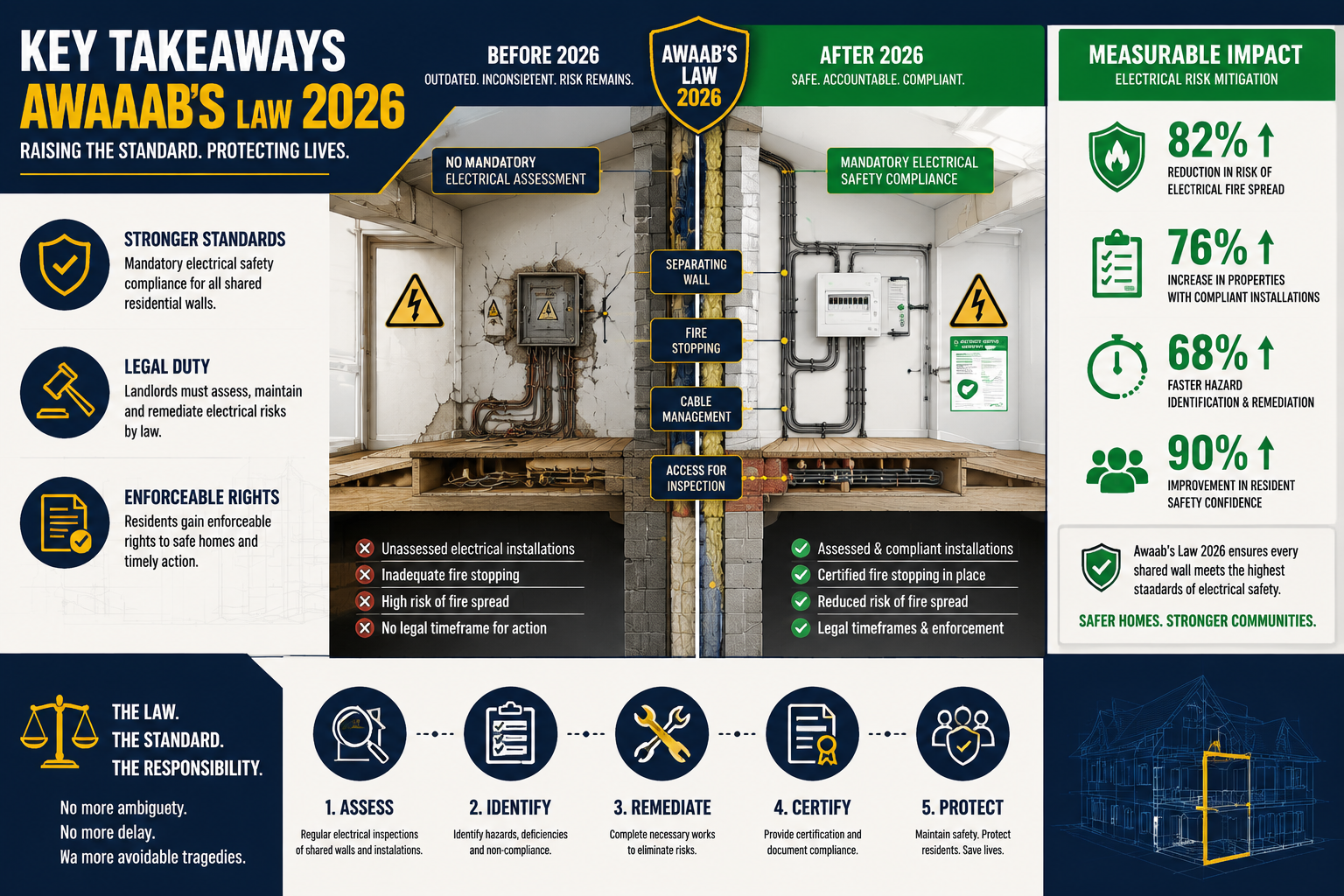
Awaab's Law — named after two-year-old Awaab Ishak, who died in 2020 as a result of mould exposure in a social housing flat — was introduced through the Social Housing (Regulation) Act 2023. Its provisions are being phased in through secondary legislation. Phase 1 came into force on 27 October 2025, covering emergency hazards and significant damp and mould [5]. Phase 2, expected in 2026, extends the regime to a broader set of hazards including electrical hazards, fire hazards, structural failures, extreme temperatures, and falls [7].
This phased approach is deliberate. It gives social landlords time to prepare compliance systems, but it also signals that the government regards electrical hazards as a priority requiring the same urgency as damp and mould. Industry guidance published ahead of Phase 2 confirms that electrical hazards — including those arising from defective wiring, failing consumer units, and compromised fire-stopping within walls — will be brought into scope [9].
How the Time Limits Apply
The statutory timeframes under Awaab's Law are strict and non-negotiable [1]:
| Situation | Required Action | Timeframe |
|---|---|---|
| Potential hazard reported | Investigate | Within 10 working days |
| Investigation complete | Written summary to resident | Within 3 working days |
| Significant risk of harm found | Make property safe | Within 5 working days |
| Emergency hazard identified | Investigate and action emergency repairs | Within 24 hours |
| Property cannot be made safe in time | Provide alternative accommodation | At landlord's expense |
For electrical hazards — which can escalate rapidly to fire risk — the 24-hour emergency threshold is particularly significant. Parliamentary debate in June 2025 confirmed that the government expects these timelines to apply to electrical risks including those in walls and voids [2].
When Party Walls Are in Scope
The statutory guidance for social landlords is clear: Awaab's Law applies where a hazard arises from "a deficiency in the social home or other building or land for which the social landlord is responsible" [1]. Party walls between two flats in a block, or between two terraced houses both owned by a registered provider, fall squarely within this definition. Where a landlord owns or controls a party wall — and where defective wiring, compromised fire-stopping, or failing electrical installations within that wall create a hazard — the landlord is responsible for remediation within the statutory timeframes [1].
This is a significant shift. Previously, the ambiguity around shared structures often led to delays. Awaab's Law removes that ambiguity for social landlords, at least in terms of their duty to act.
Party Wall Awards for Electrical Hazard Remediation: The Legal Framework
Why a Party Wall Award Is Required
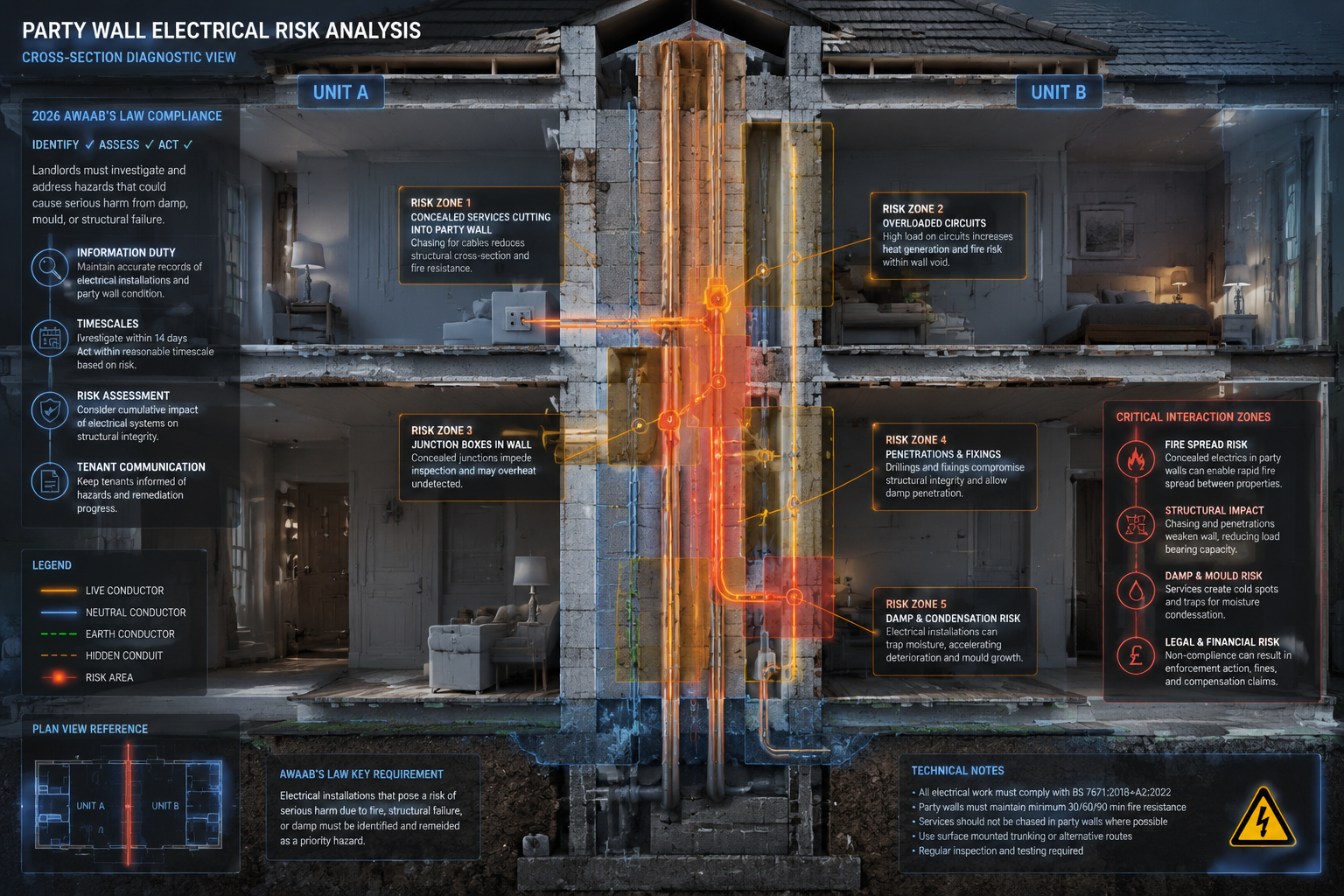
The Party Wall etc. Act 1996 governs any works that affect a party wall — a wall shared between two properties, or a wall that stands on the boundary between them. Where a social landlord (or any building owner) needs to open up, repair, or re-wire within a party wall, those works fall within the Act's scope. Proceeding without following the correct statutory process exposes the building owner to injunctions, damages claims, and significant delay.
For a comprehensive overview of how the award process works in practice, see this complete guide to party wall awards for UK property owners.
The key steps are:
- Serve a Party Structure Notice on the adjoining owner, setting out the intended works.
- Allow the statutory response period (typically 14 days) for the adjoining owner to consent or dissent.
- If the adjoining owner dissents (or does not respond), appoint party wall surveyors — one for each party, or an agreed surveyor for both.
- The surveyors draw up a Party Wall Award — a legally binding document that sets out the scope, method, and timing of works, and the rights and responsibilities of both parties.
- Works proceed in accordance with the Award.
For electrical hazard remediation in shared walls, this process must be completed before any intrusive works begin. Understanding when a party wall agreement is legally required in the UK is the essential first step for any landlord facing this situation.
Tension Between Awaab's Law Timelines and the Party Wall Process
Here lies the central practical challenge. Awaab's Law demands action within hours or days. The party wall process — in its standard form — takes weeks. This tension is real, and it requires careful management.
However, there are important nuances:
- For emergency stabilisation (making the property safe, isolating a faulty circuit, or providing temporary protection), works that do not physically affect the party wall structure can often proceed immediately without a party wall award.
- The Party Wall Act includes provisions for urgent works in certain circumstances, and surveyors experienced in this area can expedite the award process significantly.
- A Schedule of Condition can be prepared at very short notice, often within 24 to 48 hours, to protect all parties before emergency works begin.
Social landlords should not interpret Awaab's Law as a licence to bypass the Party Wall Act. Instead, they should build the party wall process into their hazard response protocols, so that when Phase 2 electrical hazards arise, the machinery is already in motion.
For guidance on the full scope of what party wall surveyors do in these situations, the responsibilities, costs, and legal requirements for party wall surveyors are worth reviewing in detail.
What the Party Wall Award Should Cover for Electrical Remediation
A well-drafted Party Wall Award for electrical hazard remediation in a shared wall should address the following:
- Scope of works: Precise description of which sections of the party wall will be opened up, and what electrical components will be repaired or replaced.
- Method statement: How the works will be carried out, including protection of the adjoining property, management of dust and debris, and reinstatement of finishes.
- Working hours: Times during which intrusive works may take place, to minimise disruption to neighbours.
- Access rights: Conditions under which the building owner's contractors may access the adjoining property, if required.
- Responsibility for costs: Typically the building owner bears all costs, but the Award should make this explicit.
- Dispute resolution: The mechanism by which any disputes arising during works will be resolved.
- Schedule of Condition: Incorporated by reference, this document records the pre-works state of the adjoining property.
For those unfamiliar with the structure of these documents, a party wall contract guide and award template provides a useful starting framework.
Drafting Schedules of Condition to Protect Adjoining Owners
What Is a Schedule of Condition?
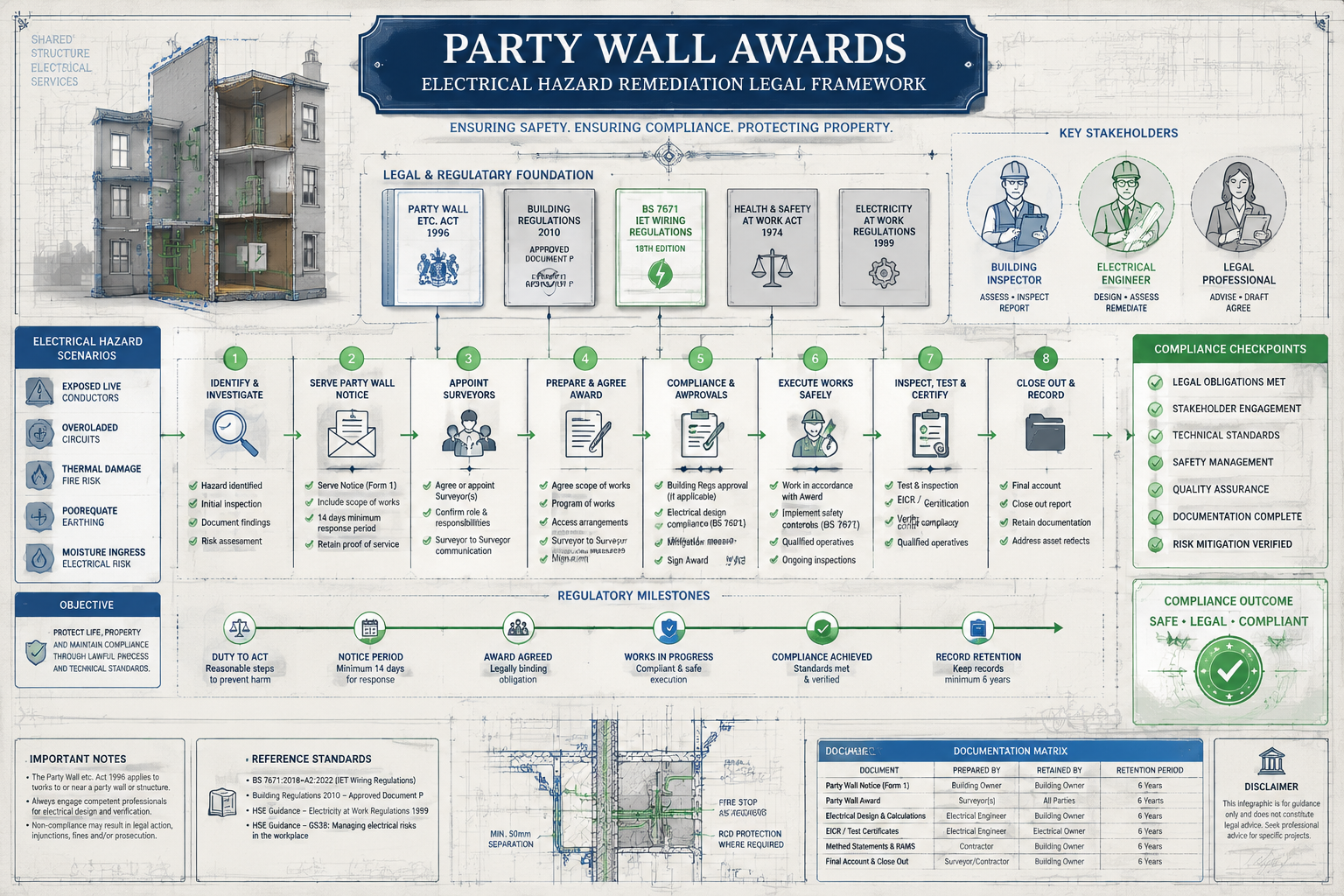
A Schedule of Condition is a detailed, photographic and written record of the state of an adjoining property — or specific elements of it — immediately before party wall works begin. It is not legally required by the Party Wall Act, but it is widely regarded as best practice, and in the context of electrical hazard remediation it is arguably indispensable.
Without a Schedule of Condition, any crack, stain, or damage discovered after works are complete becomes a disputed question: was it caused by the works, or was it pre-existing? With a Schedule in place, that question is largely answered by the documentary record.
Why Schedules of Condition Matter More for Electrical Remediation
Electrical remediation in party walls is inherently more disruptive than many other party wall works. It typically involves:
- Chasing (cutting channels) into plasterwork to access wiring.
- Opening up sections of wall to inspect or replace conduit and cables.
- Disturbing fire-stopping materials, which must then be reinstated to the required standard.
- Vibration and dust affecting the adjoining property's finishes, ceilings, and decorations.
Each of these activities carries a real risk of causing incidental damage to the neighbouring property. A thorough Schedule of Condition, prepared before works begin, gives the adjoining owner confidence that any genuine damage will be acknowledged and remedied — and protects the building owner from spurious claims.
Key elements of a robust Schedule of Condition for electrical remediation works:
- Photographic record of all walls, ceilings, and floors adjacent to the party wall on the adjoining side.
- Written description of any pre-existing cracks, staining, or damage.
- Record of the condition of electrical fittings, sockets, and switches on the adjoining side.
- Note of any pre-existing damp, mould, or discolouration that could be confused with post-works damage.
- Date, time, and surveyor's signature.
Timing the Schedule of Condition Under Awaab's Law Pressure
Given Awaab's Law's tight timelines, the Schedule of Condition must be prepared as quickly as possible. In practice, this means:
- The moment a potential electrical hazard in a party wall is identified, the landlord should notify their party wall surveyor.
- The surveyor should attend to prepare the Schedule of Condition at the earliest opportunity — ideally before any intrusive investigation works begin.
- Where emergency isolation of a circuit is required within 24 hours, the Schedule should be prepared concurrently or immediately afterwards, before any further works proceed.
This rapid-response approach requires landlords to have pre-agreed arrangements with experienced party wall surveyors. Ad hoc appointments in a crisis invariably take longer and cost more.
For those wanting to understand the broader party wall process before a hazard arises, the comprehensive guide to the Party Wall etc. Act 1996 is an authoritative starting point.
Practical Compliance Steps for Social Landlords in 2026
Building a Compliant Response Protocol
Social landlords whose stock includes properties with shared party walls should establish a written protocol that integrates both Awaab's Law obligations and Party Wall Act requirements. A practical protocol should include:
- Hazard triage: A clear decision tree for classifying reported electrical issues as emergency, significant risk, or routine.
- Surveyor on call: A pre-agreed arrangement with a chartered party wall surveyor who can attend at short notice.
- Notice templates: Pre-drafted Party Structure Notices ready for rapid service on adjoining owners.
- Resident communication: Standard letters explaining to affected residents and neighbours what is happening and why.
- Contractor readiness: Approved contractors with experience of working in occupied party wall situations.
The Birketts Awaab's Law Guide, published ahead of Phase 1, emphasises that landlords who have not yet built compliance systems face significant regulatory and reputational risk [3].
What Adjoining Owners (Neighbours) Should Know
If a social landlord serves a Party Structure Notice on a private homeowner or another landlord because electrical hazard remediation is required in the shared wall, the adjoining owner has rights:
- The right to appoint their own party wall surveyor (at the building owner's expense in most cases).
- The right to have a Schedule of Condition prepared before works begin.
- The right to inspect the Award before works start.
- The right to compensation for any damage caused by the works.
Adjoining owners who are unsure whether they can refuse or delay works should read the guidance on whether a neighbour can legally refuse a party wall agreement. In short, where works are required to address a genuine safety hazard, the scope for delay is limited — but the adjoining owner's procedural rights remain fully intact.
The Role of the Party Wall Surveyor
Party wall surveyors play a central coordinating role in electrical hazard remediation cases. They must:
- Assess whether proposed remediation works fall within the scope of the Party Wall Act.
- Serve or receive notices on behalf of their appointing owner.
- Inspect the party wall and adjoining property to inform the Award.
- Draft an Award that is proportionate, clear, and enforceable.
- Resolve any disputes that arise during or after works.
For a detailed explanation of these responsibilities, the guide to party wall surveyor roles and legal requirements covers the full scope of their duties.
Conclusion
The convergence of Awaab's Law Phase 2 in 2026 and the established requirements of the Party Wall etc. Act 1996 creates a genuinely demanding compliance environment for social landlords dealing with electrical hazards in shared walls. The law now demands fast action — in some cases within 24 hours — while also requiring that the rights of adjoining owners are fully respected through the party wall award process.
Actionable next steps for landlords and property managers:
- Audit your housing stock now to identify properties where electrical installations in party walls may be at or near end of life.
- Establish a pre-agreed relationship with a chartered party wall surveyor who can respond rapidly to electrical hazard notifications.
- Prepare template Party Structure Notices and Schedule of Condition protocols so that paperwork does not become the bottleneck in an emergency.
- Train housing officers and maintenance teams to recognise when a reported electrical fault may involve a party wall, triggering both Awaab's Law and Party Wall Act obligations simultaneously.
- Communicate proactively with adjoining owners — whether private homeowners or fellow social landlords — so that the party wall process does not become adversarial.
For tailored advice on party wall awards and compliance in your specific situation, contact the team at Notting Hill Surveyors — experienced chartered surveyors who can guide you through both the Awaab's Law timeline and the party wall award process from first notice to final reinstatement.
References
[1] Awaab's Law Guidance For Social Landlords Timeframes For Repairs In The Social Rented Sector – https://www.gov.uk/government/publications/awaabs-law-guidance-for-social-landlords/awaabs-law-guidance-for-social-landlords-timeframes-for-repairs-in-the-social-rented-sector
[2] Housing Safety "Awaab's Law" And Electrical Checks (Hansard, 25 June 2025) – https://hansard.parliament.uk/Commons/2025-06-25/debates/25062534000008/HousingSafety%E2%80%9CAwaab%E2%80%99SLaw%E2%80%9DAndElectricalChecks
[3] Birketts Awaab's Law Guide – https://www.birketts.co.uk/app/uploads/2025/10/Birketts-Awaabs-Law-Guide.pdf
[4] Awaab's Law – Axis CLC – https://www.axisclc.com/news/awaabs-law/
[5] How Awaab's Law Changes The Rules On Hazards In Social Housing – Shelter England – https://england.shelter.org.uk/professional_resources/news_and_updates/how_awaabs_law_changes_the_rules_on_hazards_in_social_housing
[6] Awaab's Law Is Here: The Surveyors' Guide For Compliance – https://www.surventrix.com/blog/awaabs-law-is-here-the-surveyors-guide-for-compliance
[7] Awaab's Law – Apizee – https://www.apizee.com/awaabs-law.php
[9] Awaab's Law Fire Safety 2026 – https://geminiampm.co.uk/awaabs-law-fire-safety-2026/
[10] Awaab's Law: A New Dawn For Tenant Safety – https://beale-law.com/article/awaabs-law-a-new-dawn-for-tenant-safety/
