
Fewer than 1 in 5 private rental properties in England currently meet all Housing Health and Safety Rating System (HHSRS) standards for temperature control and structural integrity — yet from 2026, landlords face legally enforceable remediation timelines under Awaab's Law for precisely these hazards. The extension of Awaab's Law into the private rented sector (PRS) marks a fundamental shift in how building surveyors must approach excess temperature and structural collapse hazards: Building survey checklists for Awaab's Law 2026 private sector extensions are no longer a best-practice recommendation but a compliance requirement.
This article sets out the practical assessment frameworks, checklist structures, and documentation protocols that surveyors, landlords, and letting agents need to understand before these obligations take full effect.
Key Takeaways
- Awaab's Law 2026 private sector extensions now prescribe excess temperature and structural collapse as enforceable hazards requiring documented survey responses.
- RICS Level 3 building surveys are the recommended standard for high-risk properties under the new framework.
- Thermal imaging cameras are now considered essential, not optional, equipment for compliance-grade surveys.
- Surveyors must produce HHSRS-rated reports with remediation timescales and emergency response triggers.
- Letting agents and landlords need structured hazard-response workflows to avoid enforcement action.
What Awaab's Law 2026 Private Sector Extensions Actually Change
Awaab's Law originated from the tragic death of two-year-old Awaab Ishak in 2020, caused by prolonged exposure to mould in a social housing property. The Social Housing (Regulation) Act 2023 introduced legally binding remediation timelines for social landlords. The 2026 extensions bring equivalent obligations into the private rented sector, significantly broadening the scope of hazards covered.
Phase 1, effective from May 2026, prioritises damp and mould hazards [5]. However, subsequent phases are structured to incorporate a wider range of HHSRS hazards, including excess cold, excess heat, and structural collapse [6]. This phased approach means surveyors working in the PRS must be ready to assess and document these hazards now, not when enforcement catches up.
The core legal change is this: where a prescribed hazard is identified, landlords must respond within defined timeframes. Emergency hazards — those presenting an immediate risk to life — require action within 24 hours. Urgent hazards require a written response within 14 days. This creates a direct dependency on the quality of the survey report, because the hazard category assigned by the surveyor determines which timeline applies [3].
"The hazard category assigned in the survey report is no longer administrative — it is the legal trigger for a landlord's remediation obligation."
For surveyors, this means that vague or insufficiently evidenced reports carry professional and legal risk. For landlords and letting agents, it means that commissioning a thorough, compliant survey is not optional expenditure — it is legal protection.
Excess Temperature Hazard Assessments: What the Checklist Must Cover
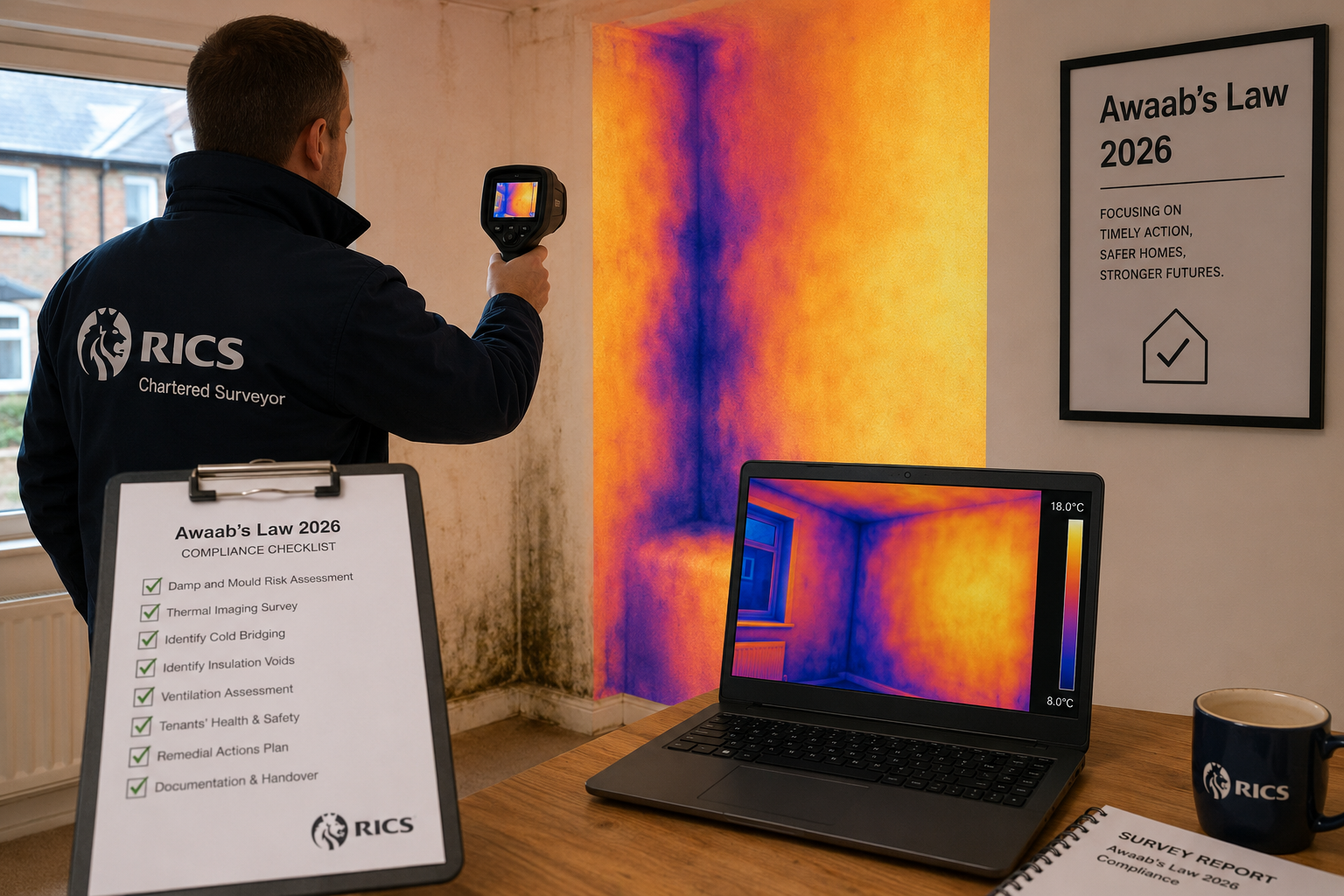
Excess temperature encompasses two distinct HHSRS hazards: excess cold (indoor temperatures falling below 16 degrees Celsius in living areas) and excess heat (sustained indoor temperatures exceeding 35 degrees Celsius). Both are now within scope for Awaab's Law 2026 private sector extensions, and both require structured assessment protocols [2].
Heating System Adequacy
The checklist for excess cold must begin with a systematic review of the heating infrastructure. Surveyors should assess:
- Boiler age, condition, and output capacity relative to the property's heat loss profile
- Radiator sizing and distribution across all habitable rooms
- Thermostat and controls functionality, including programmability
- Fuel supply reliability (gas, electric, oil, heat pump)
- Evidence of heating failure history from landlord records or visible signs of emergency repairs
A property with a boiler over 15 years old, inadequate radiator coverage in bedrooms, or no thermostatic controls in individual rooms is likely to present a Category 1 excess cold hazard under HHSRS scoring.
Insulation and Thermal Envelope
Insulation quality is central to both excess cold and excess heat assessments. Surveyors must evaluate:
- Loft insulation depth (current minimum standard is 270mm mineral wool)
- Wall insulation — cavity fill status, solid wall insulation presence or absence
- Floor insulation at ground level
- Window glazing — single, double, or triple glazing; frame condition and draughtproofing
- Door seals and threshold draught exclusion
Thermal imaging cameras are now considered essential equipment for compliance-grade surveys [4]. A thermal camera identifies insulation voids, cold bridging at junctions, and heat loss pathways that are invisible to the naked eye. The thermal images must be included in the survey report as documented evidence, not simply referenced in narrative text [2].
Ventilation and Overheating Risk
For excess heat assessments, ventilation adequacy is the primary variable. The checklist should include:
- Window openable area relative to floor area (minimum 1/20th of floor area is the standard reference)
- Mechanical ventilation or air conditioning presence and condition
- Roof space ventilation in top-floor flats
- Solar gain exposure — south-facing glazing without shading is a significant overheating risk factor
- Thermal mass of the building fabric
Properties in urban heat island locations, top-floor flats with flat roofs, and homes with large south-facing glazing but no external shading are statistically the highest-risk for excess heat hazards.
For a detailed understanding of how these assessments fit within a full structural survey, the RICS Level 3 building survey guide provides a useful reference framework.
Structural Collapse Hazard Checklists Under Awaab's Law 2026
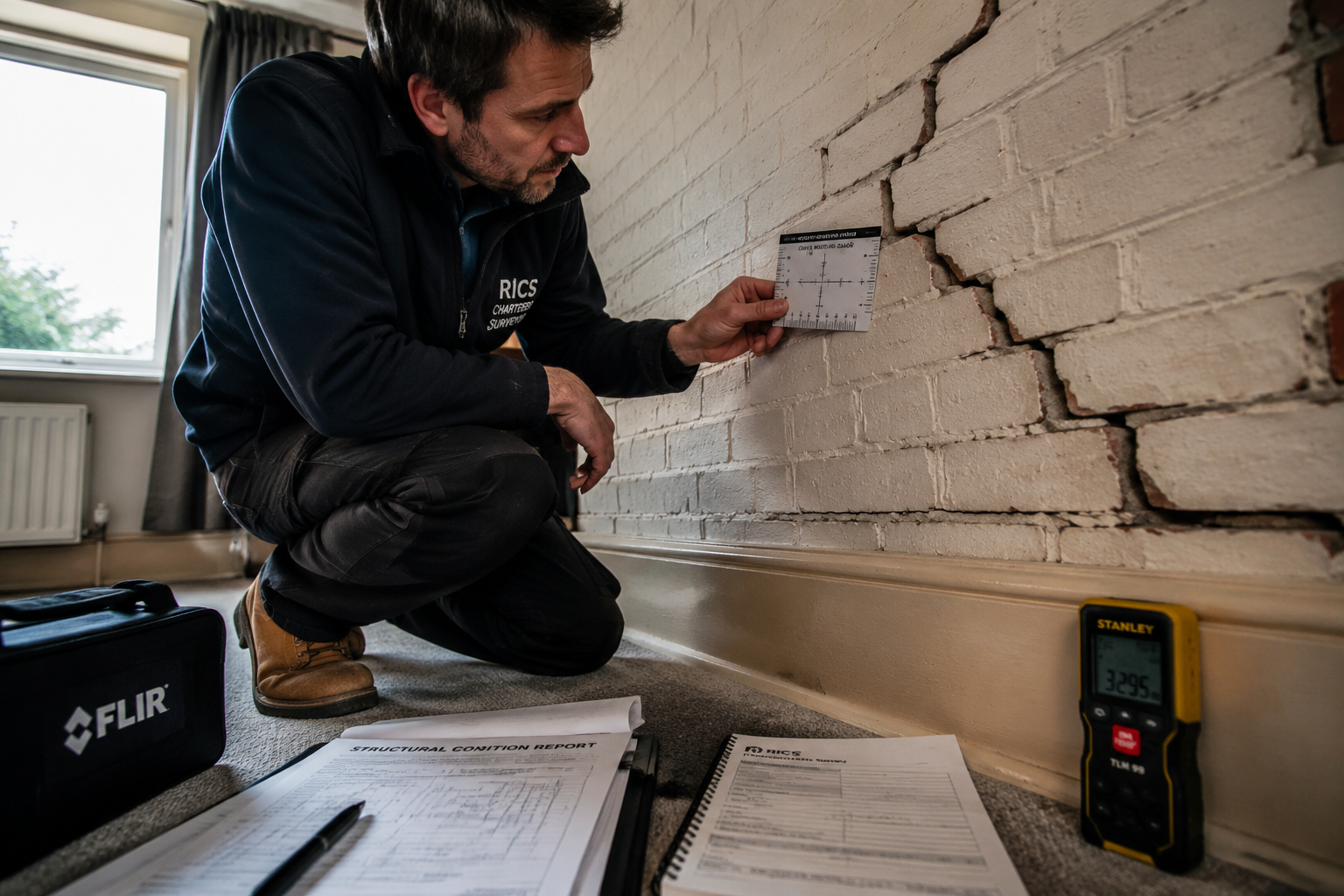
Structural collapse is among the most serious HHSRS hazards. Under the Awaab's Law 2026 private sector extensions framework, surveyors are required to assess external and internal structural elements using a systematic, documented approach [1]. The RICS now mandates Level 3 building surveys for high-risk properties specifically to ensure that structural collapse risks are identified and reported to the required standard.
A Level 3 building survey is the most thorough inspection available and is the appropriate tool for properties showing signs of structural distress, non-standard construction, or significant age-related deterioration.
External Structural Assessment Checklist
Foundations and Ground Movement
- Evidence of differential settlement (stepped cracking in brickwork, sloping floors)
- Proximity of trees to foundations (root-related heave or subsidence)
- Drainage condition adjacent to foundations
- Ground conditions — clay soils, made ground, or previous industrial use
Masonry and External Walls
- Crack mapping: location, orientation, width, and pattern of all visible cracks
- Bulging or bowing of external walls
- Condition of pointing and mortar joints
- Lintel condition above openings
- Evidence of previous underpinning or structural repair
Roof Structure
- Visible sagging or deflection of ridge, rafters, or purlins
- Condition of wall plates and joist bearings
- Evidence of spread (outward movement of roof feet)
- Condition of chimney stacks and parapet walls
For properties with complex roof structures, a specialist roof survey may be required alongside the main building survey.
Internal Structural Assessment Checklist
Load-Bearing Walls
- Identification of load-bearing walls versus partition walls
- Evidence of unauthorised removal or alteration of load-bearing elements
- Cracking patterns at wall-ceiling and wall-floor junctions
- Condition of steel or concrete lintels over internal openings
Floors and Ceilings
- Deflection or bounce in timber floors
- Evidence of joist rot, beetle infestation, or fire damage
- Condition of concrete slab floors — cracking, heave, or settlement
- Ceiling condition — sagging plasterwork, evidence of water ingress weakening
Basements and Substructure
- Evidence of water ingress or flooding
- Condition of retaining walls
- Structural condition of basement ceiling (ground floor joists)
Advanced Survey Tools for Structural Assessment
Beyond visual inspection, the following tools are recommended for compliance-grade structural surveys:
| Tool | Application |
|---|---|
| Thermal imaging camera | Identifies hidden voids, moisture, and structural anomalies |
| Ground-penetrating radar | Assesses foundation depth and substructure condition |
| Crack monitoring gauges | Documents crack progression over time |
| Borescope camera | Inspects inaccessible cavities and voids |
| Moisture meter | Identifies water ingress affecting structural elements |
Ground-penetrating radar is particularly valuable for properties where foundation type is unknown or where subsidence is suspected [1]. For properties with known or suspected subsidence, a dedicated subsidence survey provides the specialist assessment that a standard building survey may not fully address.
Documentation Standards and HHSRS Reporting Requirements
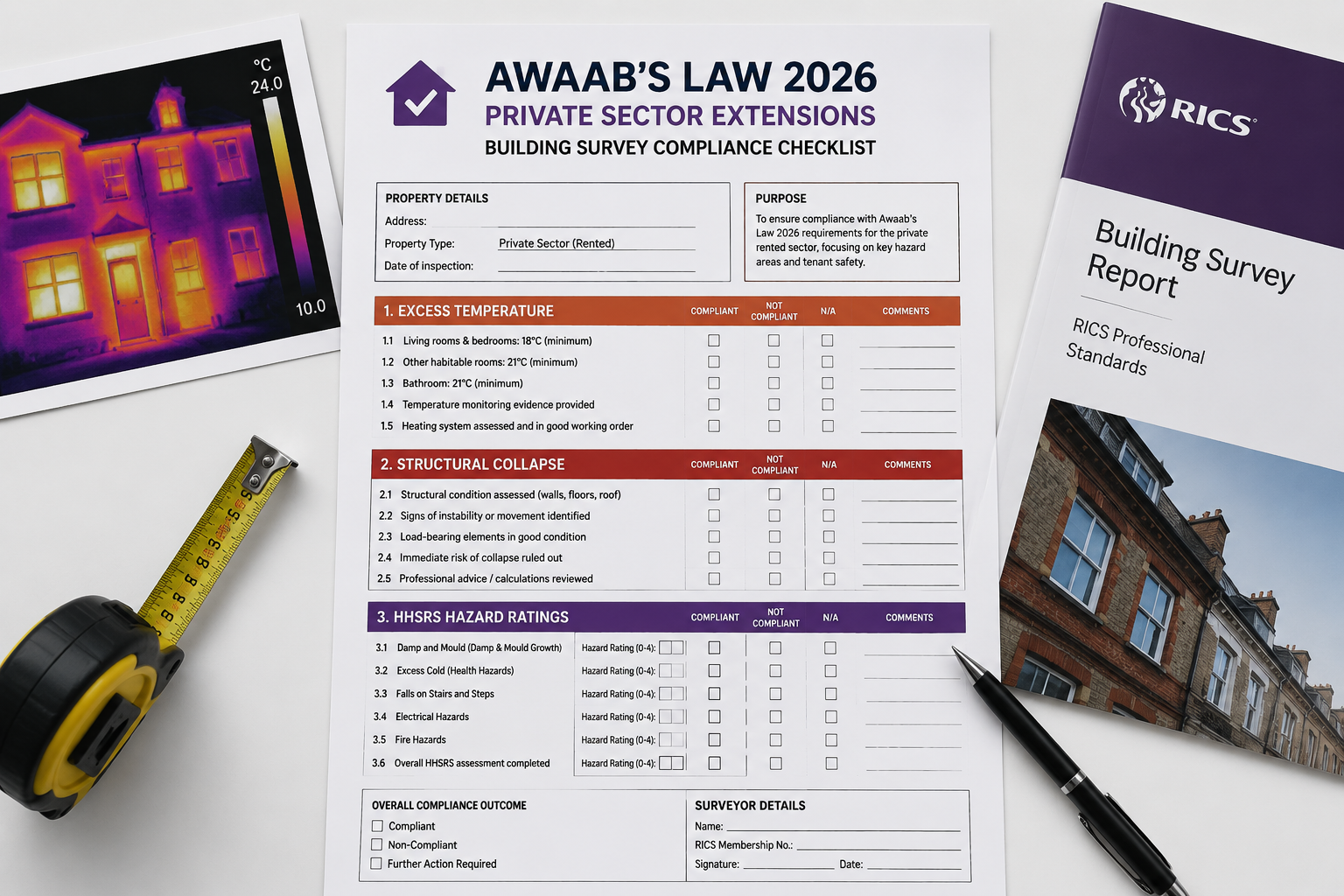
The quality of documentation produced by the surveyor is the foundation of compliance under Awaab's Law 2026. A report that identifies a hazard but fails to categorise it correctly, or omits remediation timescales, does not fulfil the legal requirement — and leaves both the surveyor and the landlord exposed [3].
What the Survey Report Must Include
Under the expanded Awaab's Law framework, survey reports for excess temperature and structural collapse hazards must contain:
- Hazard identification — precise description of the defect or condition observed
- HHSRS category rating — Category 1 (serious and immediate risk) or Category 2 (significant but not immediate)
- Evidence documentation — photographs, thermal images, crack maps, moisture readings
- Likelihood and harm outcome scores — the HHSRS scoring methodology requires both to be calculated
- Recommended remedial actions — specific, not generic, with indicative costs where possible
- Timescales — whether the hazard triggers emergency (24-hour), urgent (14-day), or standard response requirements
- Emergency response trigger statement — a clear declaration where a Category 1 hazard is present
Surveyors should refer to the full structural survey sample guide for a practical illustration of how these reporting elements are structured in a professional report.
Letting Agent Compliance Workflows
Letting agents managing PRS properties have a distinct operational role in the Awaab's Law compliance chain. Once a survey report is received, agents need structured workflows to ensure:
- Hazard triage — identifying which findings trigger legal response timescales
- Landlord notification — written communication of hazard findings within defined timeframes
- Contractor instruction — documented commissioning of remediation works
- Reinspection scheduling — confirming remediation has resolved the identified hazard
- Tenant communication — keeping occupants informed throughout the process [5]
Agents who fail to act on survey findings within the prescribed timescales face enforcement action from local housing authorities, including improvement notices and civil penalties.
Non-Standard Construction Properties
Properties built using non-standard construction methods — including prefabricated concrete, steel frame, or timber frame systems — present elevated structural collapse risk and require specialist assessment. These properties often have structural vulnerabilities that are not apparent from standard visual inspection and may require engineering input alongside the survey [1].
For guidance on surveying these property types, the non-standard construction assessment service provides specialist support for surveyors and landlords dealing with complex structural scenarios.
Practical Implementation: Preparing for Awaab's Law 2026 Compliance
Landlords and letting agents operating in the PRS should treat 2026 as a transition year requiring active preparation rather than a deadline to react to. The following steps represent a practical compliance pathway:
Step 1: Audit the existing portfolio
Commission Level 2 or Level 3 building surveys across all managed properties, prioritising those built before 1980, those with known repair histories, and top-floor flats with flat roofs.
Step 2: Identify high-risk properties
Use survey findings to categorise properties by hazard risk. Properties with Category 1 HHSRS hazards for excess temperature or structural collapse require immediate action regardless of enforcement timelines.
Step 3: Commission specialist surveys where needed
Where standard surveys identify potential structural issues, commission specialist structural engineers or subsidence surveys to provide the depth of assessment required for HHSRS scoring.
Step 4: Implement remediation programmes
Address Category 1 hazards first. Develop a costed, scheduled programme for Category 2 hazards, with documented evidence of the programme in place.
Step 5: Establish reinspection cycles
Awaab's Law compliance is not a one-time event. Establish annual or biennial reinspection cycles to ensure that remediated hazards do not recur and that new hazards are identified promptly.
Surveyors looking to understand how different survey levels compare for PRS compliance purposes can review the comparison of different survey types to select the most appropriate inspection for each property type.
Conclusion
The extension of Awaab's Law into the private rented sector in 2026 creates a clear and enforceable framework for addressing excess temperature and structural collapse hazards. Building survey checklists for Awaab's Law 2026 private sector extensions are the practical tool through which surveyors translate legal obligation into documented, actionable findings.
The key actions for surveyors, landlords, and letting agents are straightforward:
- Commission RICS Level 3 surveys for all high-risk properties before enforcement phases take effect
- Equip surveys with thermal imaging and advanced diagnostic tools to produce evidence-grade reports
- Ensure all reports include HHSRS category ratings, remediation timescales, and emergency response triggers
- Implement structured letting agent workflows to act on survey findings within legal timeframes
- Treat non-standard construction and older properties as priority cases for specialist assessment
The legal framework is in place. The survey checklists are defined. The remaining variable is whether landlords and their advisors act proactively or wait for enforcement to force the issue. For those managing PRS portfolios, the cost of a compliant survey is a fraction of the cost of an improvement notice, civil penalty, or — most critically — a preventable harm to a tenant.
References
[1] Building Survey Protocols For Structural Collapse Risks Awaabs Law 2026 Extensions And High Risk Property Assessments – https://nottinghillsurveyors.com/blog/building-survey-protocols-for-structural-collapse-risks-awaabs-law-2026-extensions-and-high-risk-property-assessments?utm_source=openai
[2] Building Surveys For Expanded Awaabs Law Hazards 2026 Protocols For Excess Temperature And Fire Risks In Private Rentals – https://wimbledonsurveyors.com/building-surveys-for-expanded-awaabs-law-hazards-2026-protocols-for-excess-temperature-and-fire-risks-in-private-rentals/?utm_source=openai
[3] Awaabs Law 2026 Extensions Building Surveyors Guide To Assessing Excess Cold Fire And Electrical Hazards In Prs Properties – https://www.canterburysurveyors.com/blog/awaabs-law-2026-extensions-building-surveyors-guide-to-assessing-excess-cold-fire-and-electrical-hazards-in-prs-properties/?utm_source=openai
[4] Building Survey Protocols For Excess Temperature And Falls Hazards Awaabs Law 2026 Expansion Beyond Damp And Mould – https://wimbledonsurveyors.com/building-survey-protocols-for-excess-temperature-and-falls-hazards-awaabs-law-2026-expansion-beyond-damp-and-mould/?utm_source=openai
[5] Awaabs Law Private Rented Sector Letting Agents Workflow – https://www.proplio.co/blog/awaabs-law-private-rented-sector-letting-agents-workflow?utm_source=openai
[6] Awaabs Law Extensions 2026 Building Survey Protocols For Damp Mould And New Hazards In Private Rentals – https://kingstonsurveyors.com/awaabs-law-extensions-2026-building-survey-protocols-for-damp-mould-and-new-hazards-in-private-rentals/?utm_source=openai
