
{"cover":"Professional landscape format (1536×1024) hero image with bold text overlay: 'Level 3 Building Surveys for Timber-Framed Homes: Detecting Rot & Subsidence in Damp 2026 Climates' in extra large 70pt white bold sans-serif font with dark semi-transparent overlay box, centered upper third. Background shows a weathered oak-framed period home exterior in heavy rain, visible timber joints darkened with moisture, misty grey-green English countryside behind. Color scheme: deep charcoal, white text, amber accent lines. Magazine cover editorial quality, high contrast, dramatic lighting.","content":["Landscape format (1536×1024) detailed illustration showing a RICS chartered surveyor in high-visibility vest using a professional moisture meter probe on exposed timber wall studs inside a damp timber-framed house, with thermal imaging camera mounted on tripod nearby showing heat map of moisture ingress on laptop screen. Visible rot on lower wall plate timber, condensation on windows, grey overcast light through single-pane glazing. Close-up technical detail, editorial documentary style, muted blue-grey tones with amber meter readout highlight.","Landscape format (1536×1024) split-composition image: left half shows macro close-up of active dry rot fungus fruiting body (Serpula lacrymans) with characteristic rust-orange spore dust on cracked timber joist in dark subfloor void; right half shows surveyor drone hovering outside a timber-framed cottage roof inspecting ridge tiles and lead flashing, overcast sky, rain-wet roof surface. Bold dividing line between panels. Technical annotation arrows pointing to defect zones. Editorial quality, cool blue-grey palette, high detail.","Landscape format (1536×1024) overhead flat-lay style infographic composition showing a Level 3 building survey defect schedule document on a wooden desk alongside a subsidence crack monitor gauge, moisture reading printout, structural engineer's sketch of timber frame with annotated movement cracks, and a pen. Soft window light casting shadows. Background texture of aged oak timber planks. Color palette: warm cream, charcoal annotations, deep green accents. Professional editorial quality, clean and authoritative."]
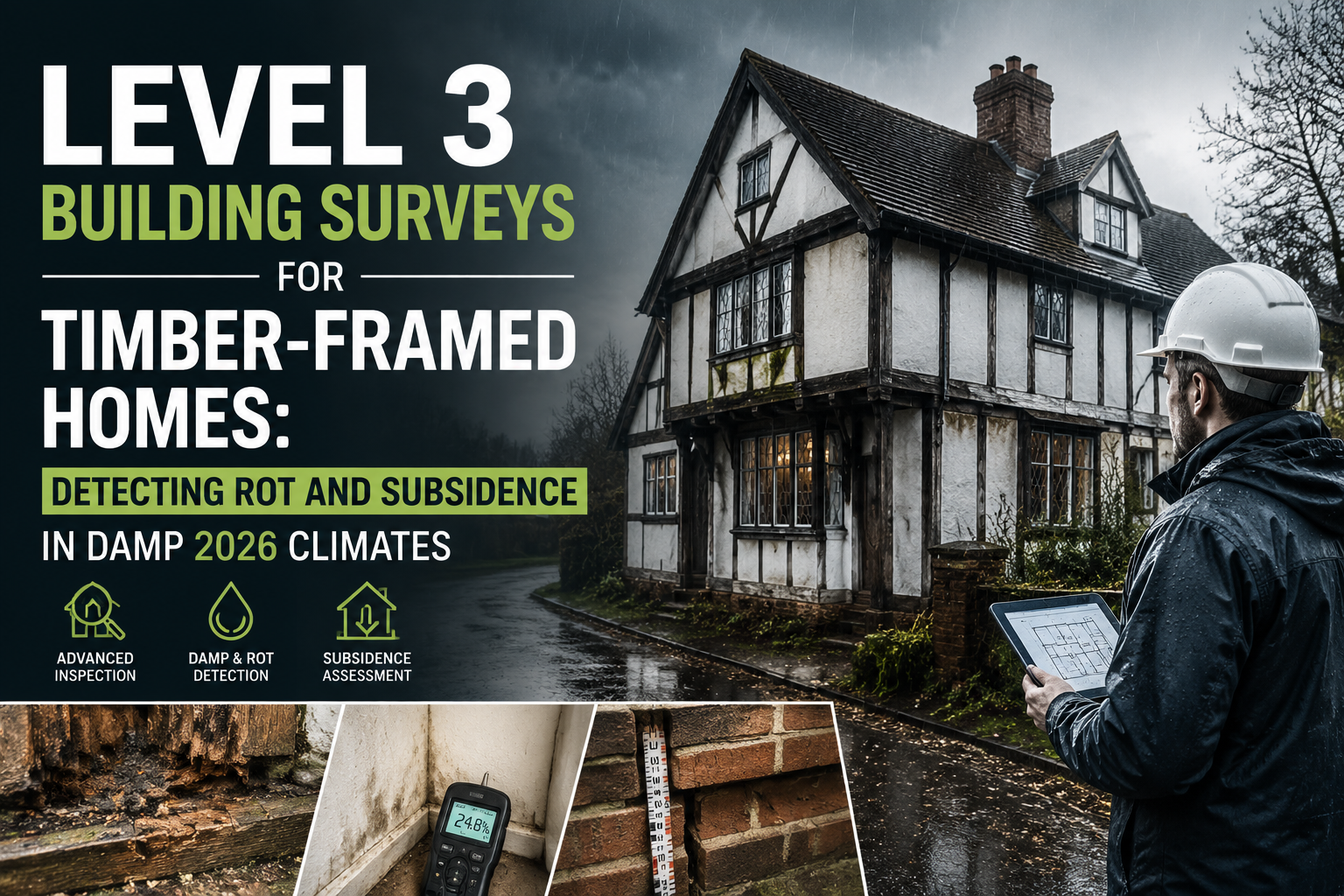
Approximately 20% of all UK timber-framed homes show active signs of moisture-related decay at any given time — a figure that has risen sharply as erratic weather patterns deliver longer wet seasons and more intense rainfall events across Britain. For buyers, owners, and lenders dealing with these properties, Level 3 Building Surveys for Timber-Framed Homes: Detecting Rot and Subsidence in Damp 2026 Climates have become not just advisable but essential. The combination of organic building materials, complex structural systems, and a persistently damp climate creates a risk profile that standard homebuyer reports simply cannot address.
Key Takeaways
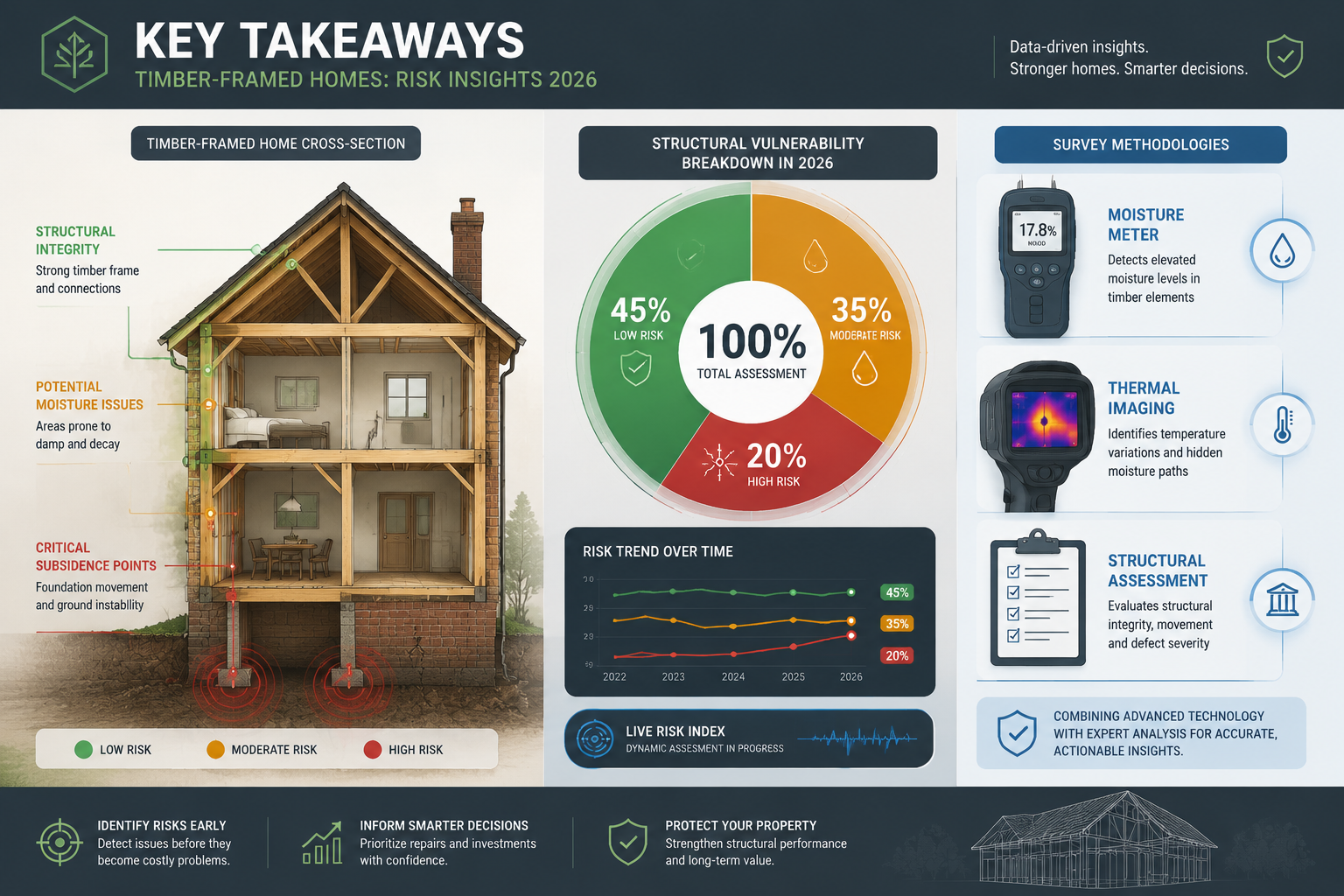
- A Level 3 Building Survey is the most thorough RICS-accredited inspection available and is strongly recommended for all timber-framed homes, particularly older or non-standard structures.
- Wet rot, dry rot, and woodworm are the primary timber defects detected, with moisture ingress being the root cause in the majority of cases.
- Subsidence in timber-framed homes often presents differently from masonry buildings, requiring specialist interpretation of cracking patterns and frame distortion.
- Advanced tools including moisture meters, thermal imaging cameras, and drone inspections are now standard practice in quality Level 3 surveys conducted in 2026.
- The cost of a Level 3 survey — typically between £700 and £1,200 — is consistently outweighed by the cost of undetected structural repairs.
Why Timber-Framed Homes Demand a Higher Level of Scrutiny
Timber-framed construction has been used in Britain for centuries, from medieval oak-frame hall houses to the post-war prefabricated timber systems of the 1950s and 1960s, right through to modern structural insulated panel (SIP) builds. Each era brings its own vulnerabilities, and each responds differently to sustained moisture exposure.
Unlike masonry walls, timber structural members can absorb and retain water over long periods before visible symptoms appear. By the time a homeowner notices a soft floor joist or a bowing wall stud, the underlying fungal decay may already have compromised the structural integrity of a significant area. This delayed visibility is precisely why Level 3 Building Surveys for Timber-Framed Homes are categorised differently from Level 2 homebuyer reports.
A Level 2 survey is appropriate for newer, standard-construction properties in reasonable condition. It provides a visual inspection and condition ratings but does not include the detailed analysis, material testing, or extended commentary that a Level 3 survey delivers. For a comparison of what each level covers and when to choose one over the other, see this Level 2 vs Level 3 survey guide.
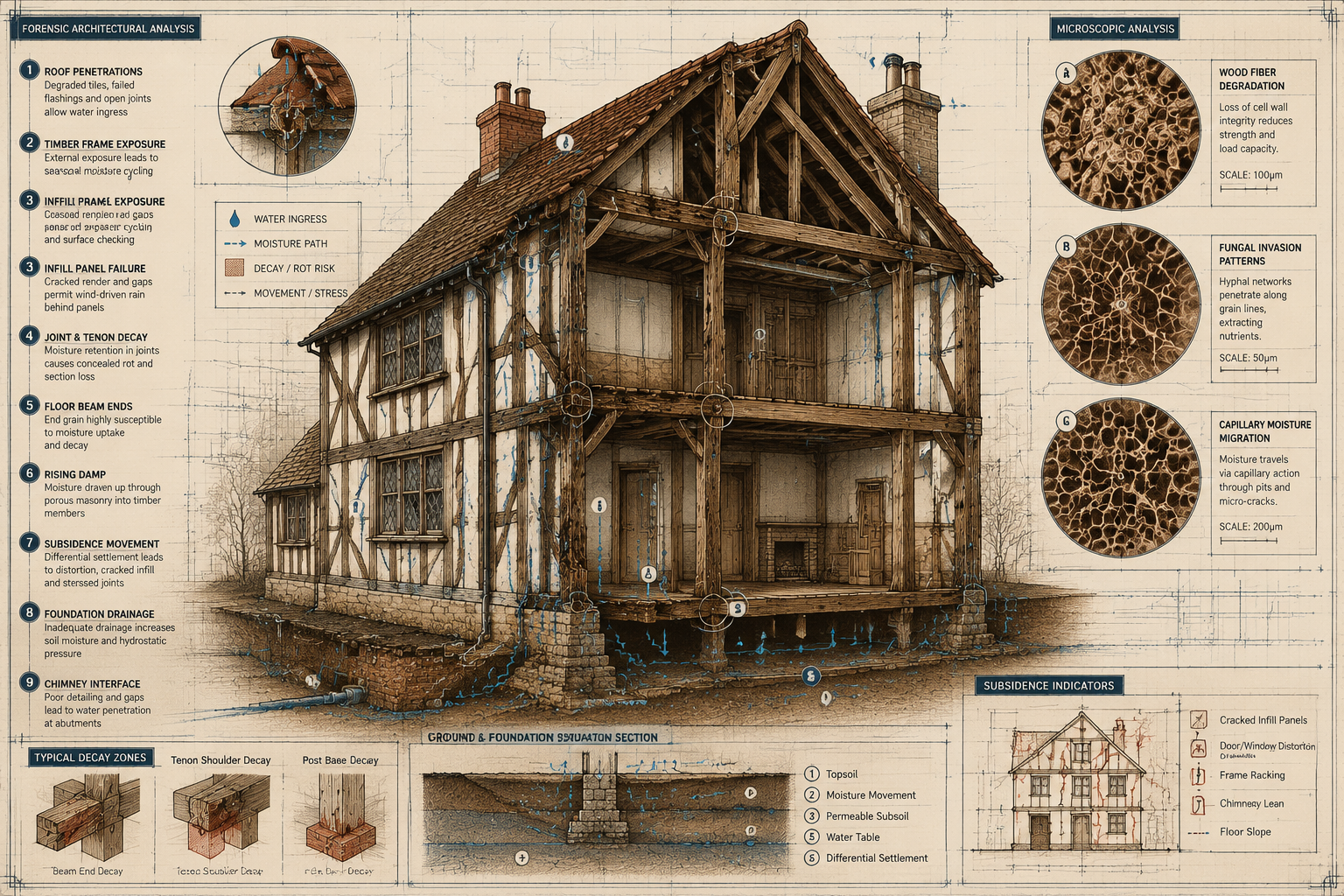
The key structural vulnerabilities in timber-framed homes include:
- Wall plates and sole plates sitting at or near ground level, where rising damp is most active
- Roof timbers exposed to wind-driven rain through failing flashings or ridge tiles
- Floor joists in suspended timber floors with inadequate sub-floor ventilation
- Window and door frames where paintwork failure allows sustained moisture ingress
- Internal stud walls concealing moisture-laden insulation
Level 3 surveys are explicitly recommended for older properties, non-standard construction types, and any building that has been significantly altered or extended [4]. Timber-framed homes meet all three criteria in many cases.
What Level 3 Building Surveys for Timber-Framed Homes Cover in Practice
A Level 3 Building Survey — also known as a Full Structural Survey or RICS Building Survey — examines all accessible parts of a property in detail. This includes roofs, walls, floors, windows, doors, chimneys, outbuildings, and all structural elements [1]. The surveyor produces a written report that describes the condition of each element, identifies defects, explains their likely cause, and recommends remedial action or further specialist investigation.
For timber-framed homes specifically, the survey scope expands to include:
| Inspection Area | Primary Risk | Survey Method |
|---|---|---|
| Roof timbers and rafters | Wet rot, dry rot, beetle infestation | Visual, probe testing, moisture meter |
| Wall frame studs and bracing | Moisture ingress, frame distortion | Moisture meter, thermal imaging |
| Floor joists and sub-floor void | Wet rot, inadequate ventilation | Visual inspection, probe testing |
| Window and door frames | Wet rot at sills and cills | Visual, moisture meter readings |
| External cladding and render | Trapped moisture, penetrating damp | Visual, moisture meter, drone |
| Foundation zone timbers | Rising damp, ground contact rot | Visual, probe testing |
"The most dangerous defects in timber-framed homes are the ones you cannot see from the surface. A Level 3 survey is designed to look past the finish and into the structure."
Identifying Rot: Wet Rot, Dry Rot, and the Conditions That Cause Them
Wet rot is caused by fungi that thrive in timber with a moisture content above approximately 20%. It leads to softening, discolouration, and a loss of structural strength, most commonly in areas of persistent moisture exposure such as window frames, floor joists, and roof timbers [5]. Wet rot is typically localised — eliminate the moisture source and the fungal activity stops.
Dry rot (Serpula lacrymans) is considerably more serious. Despite the name, it requires moisture to establish, but once active it can spread through masonry and across dry materials, sending out mycelium strands in search of new timber to colonise. In a timber-framed home, dry rot can travel from an infected floor void into wall framing, across mortar joints, and into roof timbers with alarming speed. Level 3 surveys assess for the characteristic rust-coloured spore dust, white mycelium growth, and the cuboidal cracking pattern that distinguishes dry rot from wet rot [2].
Woodworm — the larval stage of several wood-boring beetle species — is a third category of timber defect. Exit holes, frass (fine powdery dust), and weakened timber surfaces are the primary indicators. While woodworm is rarely structurally critical on its own, it frequently co-exists with damp conditions and can accelerate decay in already-weakened timbers.
Moisture content thresholds that surveyors use as benchmarks:
- Below 18%: Timber is generally safe from fungal decay
- 18-20%: Borderline; monitor and improve ventilation
- Above 20%: Active risk of wet rot; remedial action required
- Above 28%: Conditions suitable for dry rot establishment
Subsidence in Timber-Framed Homes: A Different Set of Warning Signs
Subsidence in masonry buildings typically presents as diagonal cracking at corners of openings, tapering cracks wider at the top, and door or window frames that have racked out of square. In timber-framed homes, the picture is more complex.
Because the timber frame itself has some inherent flexibility, early-stage subsidence or differential settlement may not produce the dramatic cracking seen in brick or stone walls. Instead, surveyors look for:
- Racking of the frame: Wall panels leaning out of vertical, visible as a lean in the overall structure
- Distortion at joints: Mortice-and-tenon or modern connector joints pulling apart or crushing
- Floor slope and bounce: Uneven floor levels and excessive deflection in floor joists
- Roof ridge sagging: A bowing ridge line indicating foundation movement or rafter spread
- Diagonal cracking in plasterboard or render: Particularly at corners of window and door openings in the cladding layer
Subsidence in timber-framed homes is often linked to tree root activity, clay shrinkage in dry summers followed by swelling in wet winters, or inadequate foundation depth in older structures. A structural survey will document crack widths, monitor points, and recommend specialist geotechnical investigation where movement appears active.
Advanced Detection Methods Used in 2026 Level 3 Surveys
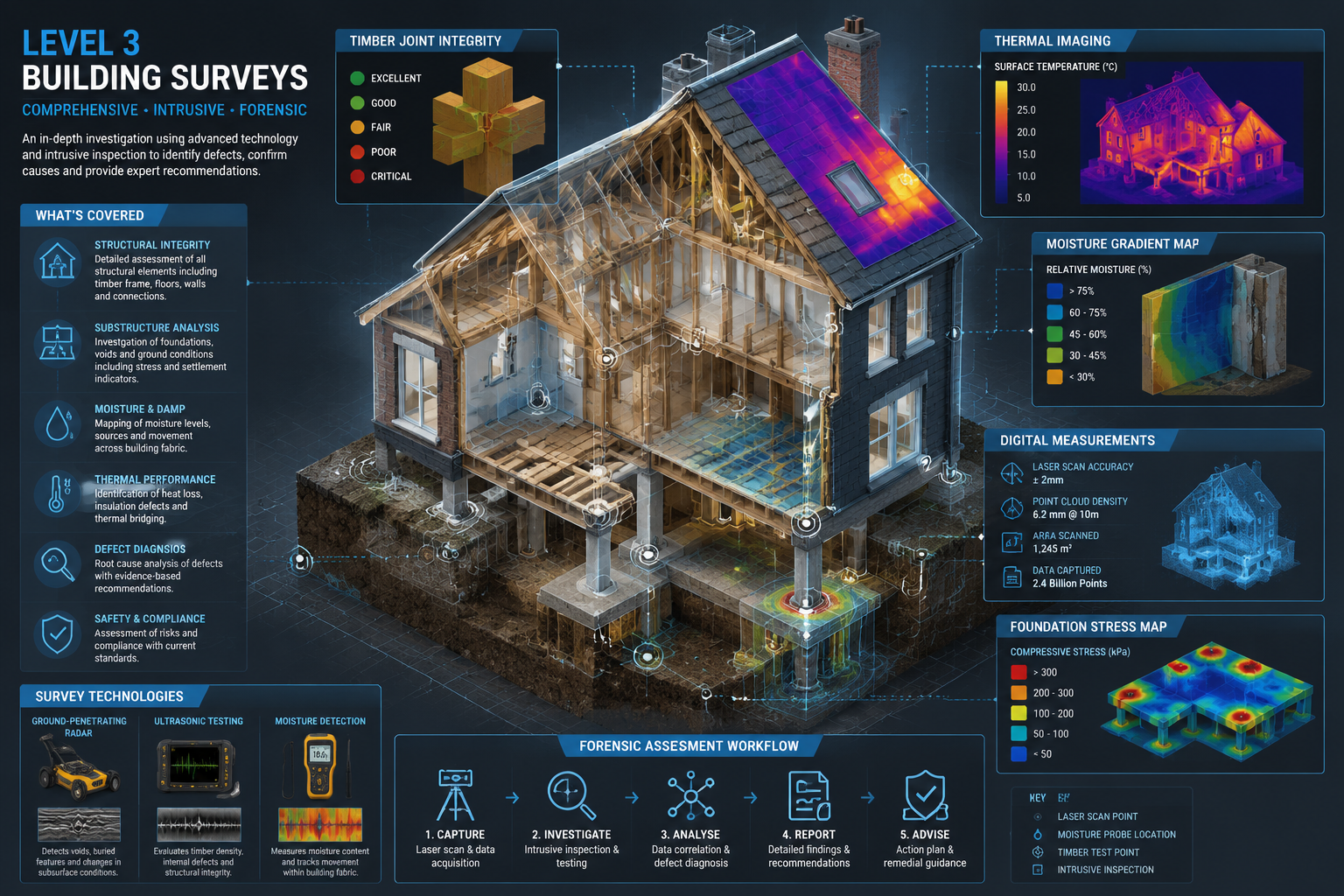
The 2026 climate context is not simply a backdrop — it is an active driver of survey methodology. Wetter winters, higher average humidity, and more frequent periods of sustained rainfall have pushed surveyors to adopt more sophisticated detection tools as standard practice rather than optional extras [8].
Moisture Metering and Hygrometric Surveys
Professional-grade moisture meters used in Level 3 surveys fall into two categories: pin-type meters that penetrate the timber surface to measure electrical resistance (directly correlated to moisture content), and non-invasive radio-frequency meters that read moisture levels through finishes and plaster without drilling.
A thorough timber-framed home survey will use both types systematically across all accessible timber elements. Readings are recorded at multiple points and mapped against the property plan to identify moisture gradients — areas where moisture content rises as you move toward a particular wall, floor edge, or roof junction. This mapping approach is far more informative than a single-point reading and allows the surveyor to trace moisture pathways back to their source.
For properties with suspected damp issues, a specialist damp survey may be recommended as a follow-up to the Level 3 report, providing laboratory-grade analysis of salt contamination and hygroscopic moisture.
Thermal Imaging Cameras
Thermal imaging detects temperature differentials across surfaces. In a timber-framed wall, moisture-laden areas retain heat differently from dry timber, creating a visible thermal signature even when the surface finish appears intact. This technology is particularly valuable for:
- Identifying cold bridges where insulation has failed or been omitted
- Locating hidden moisture behind plasterboard linings
- Detecting areas of air infiltration that increase condensation risk
- Mapping the extent of wet rot or dry rot spread beyond the visible surface
Modern Level 3 surveys increasingly incorporate thermal imaging as a standard tool rather than a specialist add-on [8]. The data produced can be overlaid on floor plans to create a comprehensive moisture risk map of the property.
Drone Inspections for Roof and High-Level Structures
Timber-framed homes often feature complex rooflines — hipped roofs, dormers, catslide extensions, and multiple valley junctions — that are difficult or impossible to inspect safely from a ladder. Drone-mounted cameras with high-resolution zoom capability allow surveyors to inspect:
- Ridge tile condition and mortar pointing
- Lead flashing at chimney stacks and valley junctions
- Condition of timber barge boards and fascias
- Evidence of moss or lichen growth indicating sustained moisture retention
- Cracking or displacement in external render or cladding at high level
For a roof survey component within a Level 3 inspection, drone access provides documentation quality that ground-level observation simply cannot match. Images are included in the survey report and provide a permanent record of condition at the time of inspection.
RICS Defect Schedules for Period Timber Structures
RICS guidance requires Level 3 surveyors to produce a structured defect schedule that categorises findings by condition rating:
- Condition Rating 1: No repair currently needed; monitor at normal maintenance intervals
- Condition Rating 2: Defects that need repairing or replacing but are not considered serious or urgent
- Condition Rating 3: Defects that are serious and/or require urgent repair, replacement, or further investigation
For period timber-framed structures — typically pre-1919 buildings using green oak or elm framing — the defect schedule must address the interaction between original materials and later interventions. Cement render applied over breathable lime plaster, for example, traps moisture within the wall structure and is a documented cause of accelerated timber decay [6]. Properties with defective external render are significantly more likely to experience damp problems, making thorough inspection of the wall envelope a priority in any Level 3 survey of a period timber property.
Cost, Value, and What Happens After the Survey
As of 2026, a Level 3 Building Survey for a timber-framed home typically costs between £700 and £1,200, depending on property size, location, age, and complexity [7]. This is higher than a Level 2 homebuyer report, which generally falls in the £400-£700 range. However, the cost differential is consistently justified by the depth of information provided.
Consider the financial context:
- Dry rot treatment in a timber-framed home can cost between £3,000 and £15,000 depending on the extent of spread
- Subsidence underpinning for a timber-framed structure can exceed £30,000
- Re-rendering a property to address moisture ingress typically costs £5,000-£15,000
- Replacing a structurally compromised roof in a period timber property can reach £25,000+
A Level 3 survey that identifies any one of these issues before exchange of contracts gives the buyer negotiating leverage, the option to withdraw, or the information needed to budget accurately for remediation. For buyers considering whether a more detailed inspection is warranted, this guide to understanding what surveyors look for in a house survey provides useful background on inspection priorities.
Instructing a Qualified Surveyor
Not all surveyors have equal experience with timber-framed construction. When commissioning a Level 3 survey for a timber-framed home, buyers should confirm that the surveyor:
- Holds RICS membership (MRICS or FRICS) and is regulated accordingly
- Has specific experience with the construction type and era of the property
- Uses moisture metering and thermal imaging as standard tools
- Can arrange or recommend drone inspection for complex rooflines
- Will provide a written report with clear condition ratings, photographic evidence, and remedial recommendations
For those unfamiliar with how to verify professional credentials, this guide to checking surveyor qualifications in the UK outlines the key steps. The RICS register is publicly searchable and provides confirmation of current membership status.
After the Report: Acting on Findings
A Level 3 survey report is not a pass-or-fail document. It is a detailed condition assessment that informs decision-making. Common next steps following a survey that identifies significant timber or structural defects include:
- Obtain specialist contractor quotes for the defects identified in Condition Rating 3
- Commission a specialist damp and timber report if the surveyor recommends further investigation
- Renegotiate the purchase price based on documented repair costs
- Request that the vendor undertakes remedial works prior to exchange
- Withdraw from the purchase if the scale of defects exceeds acceptable risk or budget
It is worth noting that a survey report does not expire immediately, but conditions in a timber-framed home can change rapidly — particularly during a wet season. If more than three to four months pass between survey and completion, a re-inspection of high-risk areas is advisable.
Conclusion
Level 3 Building Surveys for Timber-Framed Homes: Detecting Rot and Subsidence in Damp 2026 Climates represent the most rigorous and appropriate form of pre-purchase or pre-renovation inspection available for this property type. The combination of organic materials, complex structural systems, and Britain's increasingly wet weather creates a risk environment where surface-level assessments are inadequate.
Actionable next steps for anyone dealing with a timber-framed property:
- Commission a Level 3 Building Survey from a RICS-accredited surveyor with specific timber-frame experience before exchanging contracts
- Confirm that the survey scope includes moisture metering, thermal imaging, and drone inspection of the roof
- Review the defect schedule carefully, paying particular attention to Condition Rating 3 items
- Follow up any recommendations for specialist damp or structural investigation promptly
- Use the survey findings as a negotiating tool or a remediation budget, not simply as a checklist
For a full overview of RICS building survey services and what to expect from a Level 3 inspection, qualified chartered surveyors can provide guidance tailored to the specific property and location. The cost of a thorough survey is always modest relative to the cost of discovering serious structural defects after completion.
References
[1] Summary Of Whats Included In A Level 3 Rics Building Survey – https://www.hughes-surveyors.com/summary-of-whats-included-in-a-level-3-rics-building-survey/?utm_source=openai
[2] What Defects Do Level 3 Surveys Find – https://austenmay.co.uk/blog/what-defects-do-level-3-surveys-find?utm_source=openai
[3] What Is A Level 3 Building Survey – https://www.wignalls.land/news/what-is-a-level-3-building-survey/?utm_source=openai
[4] Is A Level 3 Survey Worth It Heres When To Choose One – https://lmsurveyors.co.uk/is-a-level-3-survey-worth-it-heres-when-to-choose-one/?utm_source=openai
[5] Wet Rot Timber How To Spot Why It Happens Homes Most At Risk – https://residentialsurveying.co.uk/blog/survey-red-flags%7Cdamp-problems-in-houses%7Ctimber-defects-and-damp-problems/wet-rot-timber-how-to-spot-why-it-happens-homes-most-at-risk?utm_source=openai
[6] Damp Problems Caused By External Render – https://www.petercox.com/blog/damp-problems-caused-by-external-render/?utm_source=openai
[7] Building Survey Checklists For Bungalow Purchases 2026 Rics Guidance On Structural Risks And Costs – https://nottinghillsurveyors.com/blog/building-survey-checklists-for-bungalow-purchases-2026-rics-guidance-on-structural-risks-and-costs?utm_source=openai
[8] Level 3 Building Surveys For Bungalows In Subsidence Prone Areas 2026 Regional Protocols – https://manchestersurveyors.com/level-3-building-surveys-for-bungalows-in-subsidence-prone-areas-2026-regional-protocols/?utm_source=openai
[9] Level 3 Home Survey – https://dunfordpenrosesurveyors.com/level-3-home-survey/?utm_source=openai
