
Nearly 40% of residential property transactions in the UK encounter unexpected defect-related costs after completion, according to industry estimates. As machine learning tools become embedded in professional surveying workflows, the question is no longer whether AI belongs in building surveys, but how it must be governed. The answer, as of March 2026, comes directly from the Royal Institution of Chartered Surveyors. The RICS global standard on responsible AI use sets binding rules for every member and regulated firm worldwide, reshaping how AI-Driven Defect Prediction in Building Surveys: RICS March 2026 Responsible Use Standards for Valuation Accuracy is defined, delivered, and documented in practice [1].
Key Takeaways
- The RICS March 2026 AI standard is mandatory for all RICS members and regulated firms globally, covering defect prediction, valuation modeling, and report generation.
- Surveyors must maintain professional oversight of all AI outputs and cannot delegate accountability to automated systems.
- Clients must be informed in writing about AI use and given the option to limit or opt out of AI-assisted services.
- Firms are required to maintain AI risk registers, conduct due diligence, and update professional indemnity arrangements to cover AI-assisted work.
- The standard will be reviewed regularly to keep pace with rapidly evolving AI technologies.
What the RICS March 2026 AI Standard Actually Requires
The RICS launched its landmark global standard on responsible AI use to address a clear gap: AI tools were proliferating across the surveying profession without consistent governance or ethical guardrails [1]. The standard became effective in March 2026 and applies to all RICS members and regulated firms, regardless of firm size or geography.
At its core, the standard rests on five principles:
- Ethical use: AI must not introduce bias into valuations or defect assessments.
- Transparency: Clients and stakeholders must know when AI is involved.
- Professional oversight: Surveyors remain fully accountable for all outputs.
- Governance: Firms must document AI systems, risks, and policies formally.
- Responsible development: Any AI tool built or customised in-house must be designed with identified risks and benefits from the outset [3].
"Surveyors are required to assess the reliability of AI outputs and remain accountable for all work, applying professional skepticism and expertise throughout the surveying process." – RICS Responsible Use of AI Standard [1]
This is not a voluntary code of conduct. Non-compliance carries the same professional consequences as any other breach of RICS standards, including disciplinary proceedings and reputational damage [7].
Governance and Risk Documentation
Firms must implement clear written policies on data usage and AI system governance. A formal risk register is required, capturing each AI tool in use, its purpose, known limitations, and the controls in place to manage errors [1]. Due diligence procedures must be established before any new AI system is deployed, covering data quality, vendor reliability, and the potential for discriminatory or inaccurate outputs.
This governance requirement is particularly significant for firms using third-party AI platforms, where the underlying model may not be fully transparent. Surveyors cannot simply trust a vendor's marketing claims; they must verify that the tool meets professional standards before relying on its outputs in client-facing work.
How AI-Driven Defect Prediction Works in Building Surveys
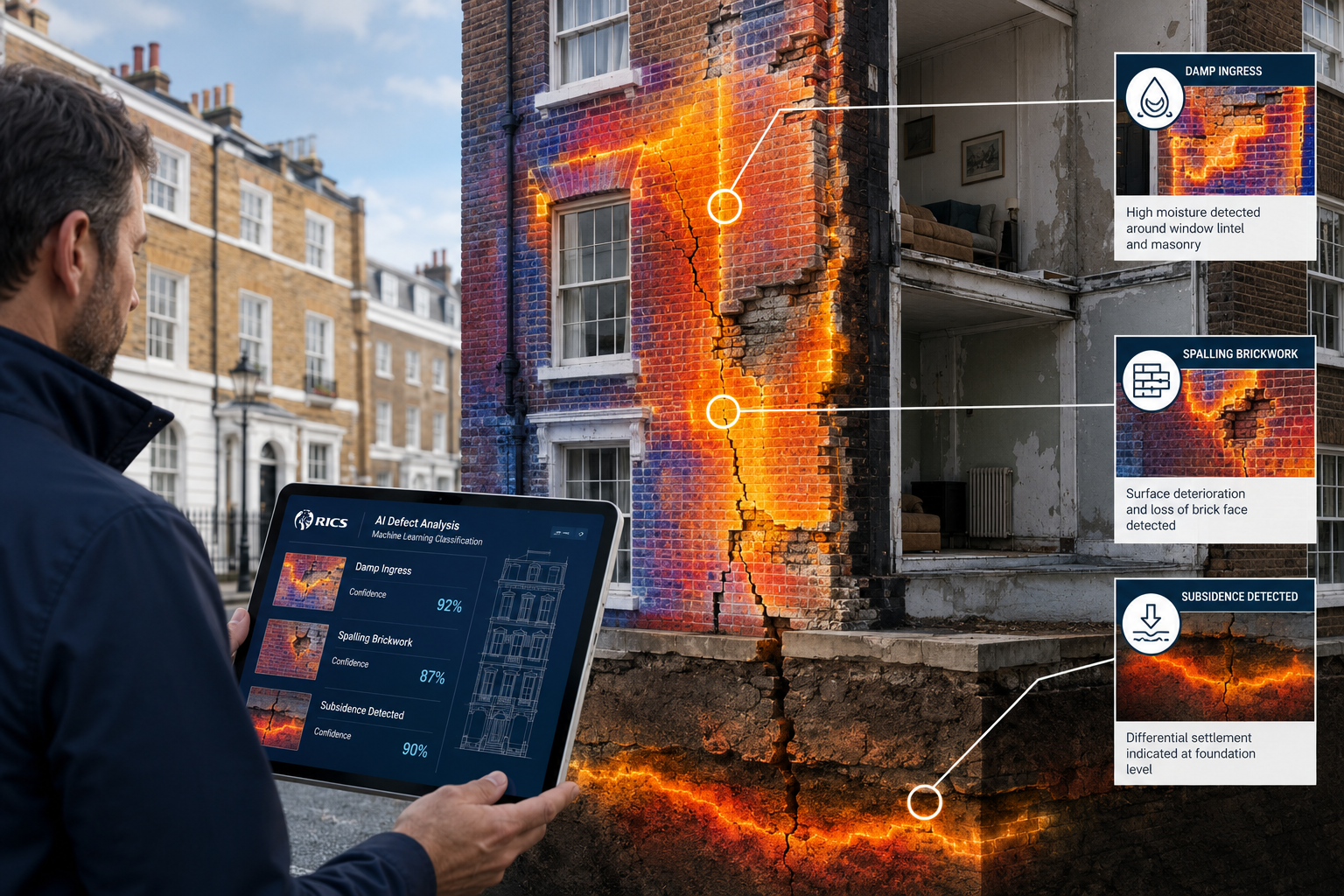
AI defect prediction tools typically analyse visual data, thermal imaging, and historical building records to flag potential issues such as damp penetration, structural cracking, spalling brickwork, and corrosion [4]. In a practical building survey context, a surveyor might use a tablet-based AI tool during a site inspection that cross-references photographic captures against a trained defect database, generating a probability score for each identified anomaly.
For clients commissioning a Level 3 building survey, AI-assisted defect prediction can add genuine value by:
- Reducing the risk of missed defects in complex or large properties
- Providing consistent defect classification across multiple surveyors
- Generating structured data that feeds directly into valuation models
- Flagging high-risk areas for more detailed manual inspection
However, the accuracy of any AI output is directly dependent on the quality of the input data. A poorly lit photograph, incomplete historical records, or a training dataset that under-represents certain building types can all produce unreliable results [4]. This is precisely why the RICS standard places human oversight at the centre of the process, not as an afterthought.
Defect Types AI Tools Currently Target
| Defect Category | AI Detection Method | Accuracy Dependency |
|---|---|---|
| Damp and moisture ingress | Thermal imaging analysis | Image resolution, ambient temperature |
| Structural cracking | Visual pattern recognition | Lighting conditions, crack width |
| Corrosion and spalling | Colour and texture analysis | Surface cleanliness, image angle |
| Subsidence indicators | Historical data correlation | Data completeness, local soil records |
| Roof deterioration | Aerial and drone imagery | Coverage, weather conditions |
Surveyors working on commercial building surveys face additional complexity, as larger and more varied structures generate more data points and require AI tools trained on commercial rather than residential building stock.
AI in Report Generation
Beyond defect detection, AI tools are increasingly used to streamline report writing. Platforms can summarise site notes, measurements, and photographic evidence into structured draft reports, significantly reducing the time between inspection and delivery [4]. For surveyors handling high volumes of building surveys, this efficiency gain is commercially meaningful.
The RICS standard is clear, however: a surveyor must review, verify, and take full professional responsibility for every AI-generated report before it reaches a client. Automated drafts are a starting point, not a finished product [1].
RICS March 2026 Responsible Use Standards: Transparency and Client Communication
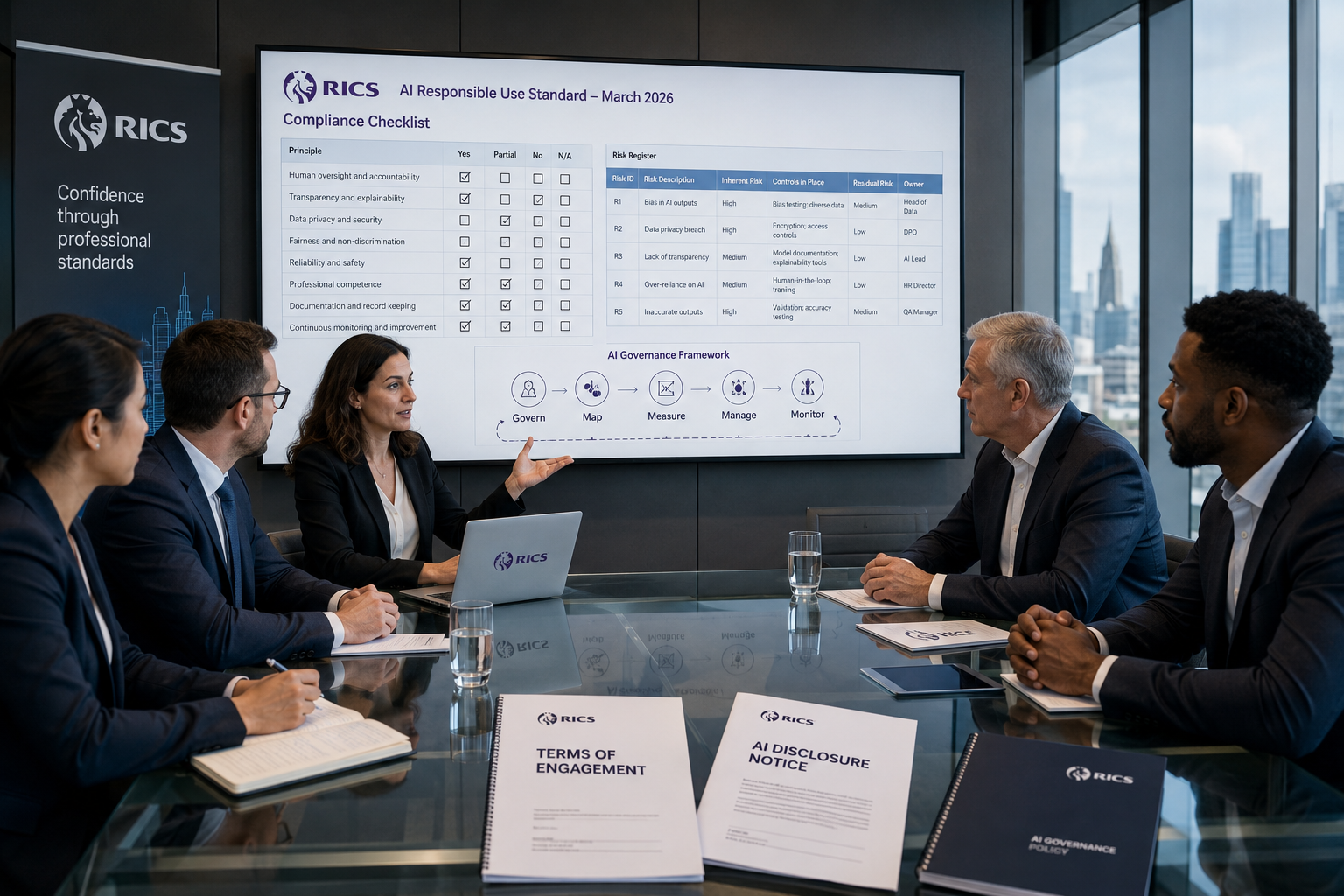
One of the most operationally significant requirements within the RICS March 2026 Responsible Use Standards for Valuation Accuracy framework concerns client disclosure. Firms must inform clients in writing, before engagement begins, that AI tools may be used in the delivery of their survey or valuation [2]. This disclosure must include:
- A clear explanation of how AI is being used
- The potential impact of AI on service delivery and outputs
- The client's right to limit or opt out of AI-assisted services entirely
This opt-out provision is notable. It means that firms cannot simply embed AI into their standard workflow and assume client consent. A client who declines AI assistance must still receive a fully compliant survey, delivered through traditional professional methods.
For firms offering services such as dilapidations surveys or valuation services, updating standard terms of engagement to include these disclosures is an immediate compliance priority.
What Clients Should Expect to See
A compliant terms of engagement document, as of March 2026, should include:
- Identification of AI tools used in the survey process by category (e.g., defect detection, report drafting, valuation modeling)
- Data handling explanation covering how property data and images are processed and stored
- Opt-out mechanism with a clear process for clients who wish to exclude AI from their service
- Accountability statement confirming that a named RICS-qualified professional retains full responsibility for all outputs
Clients who are unsure whether their surveyor is compliant with these requirements should ask directly before signing any engagement letter.
Valuation Accuracy: How AI Changes the Numbers
The intersection of AI defect prediction and property valuation is where the March 2026 standards have the most direct financial implications. Defects identified through AI-assisted surveys can materially affect valuation outcomes, particularly for older properties where latent defects are common.
A well-calibrated AI defect prediction tool can improve valuation accuracy by ensuring that defects are consistently identified and priced into the assessment. Conversely, an over-reliant or poorly governed AI system can introduce systematic errors, either overstating defect severity and suppressing values unfairly, or missing defects entirely and producing inflated valuations [5].
The RICS standard addresses this risk through its requirement for professional skepticism. Surveyors must not accept AI outputs at face value. They must apply their own expertise to assess whether the AI's findings are plausible given the property's age, construction type, location, and condition [1].
For properties with non-standard construction, this is especially important. AI tools trained primarily on conventional brick-and-block construction may produce unreliable outputs when applied to timber-framed, steel-framed, or prefabricated buildings. Surveyors working on non-standard construction properties should treat AI defect outputs with particular caution until specialist training datasets are more widely available.
Impact on Valuation Reports
When AI defect data is incorporated into a valuation, the report must clearly distinguish between AI-generated findings and those based on direct professional observation. This transparency requirement protects both the client and the surveyor in the event of a dispute.
For those seeking a Level 3 building survey and valuation, the combination of AI defect prediction and chartered surveyor oversight represents the most thorough approach currently available, provided the RICS standards are followed rigorously.
Practical Compliance: Implementation Checklist for Surveyors
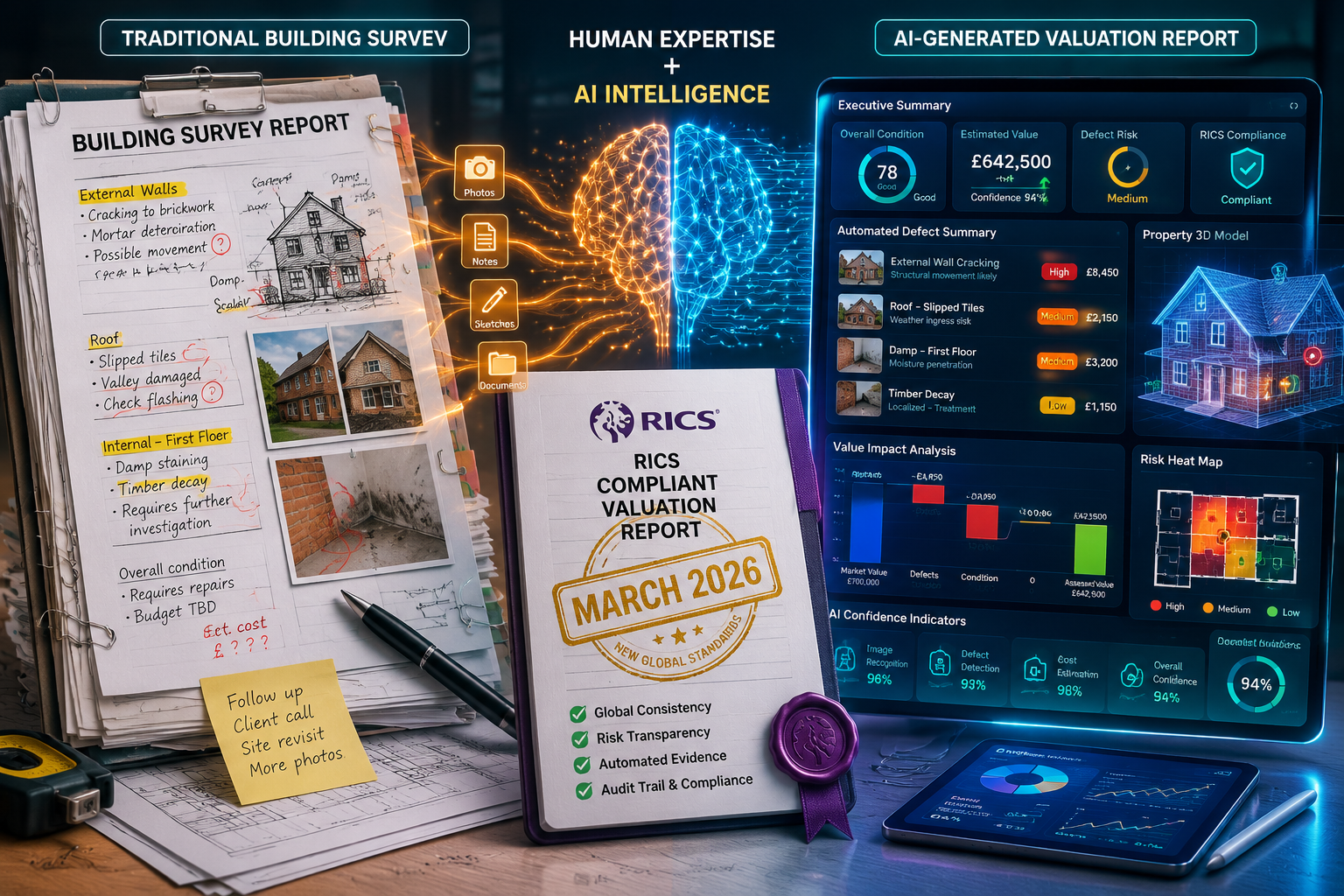
Meeting the requirements of the AI-Driven Defect Prediction in Building Surveys: RICS March 2026 Responsible Use Standards for Valuation Accuracy framework requires structured action across several areas of practice [6]. The following checklist reflects the key compliance steps identified by RICS and legal commentators.
Firm-Level Compliance Actions
- Maintain a written AI system inventory listing every AI tool used in survey and valuation work, including vendor details and version numbers
- Establish a formal risk register for each AI tool, updated at least annually or when the tool is significantly updated
- Update terms of engagement to include mandatory AI disclosure language and opt-out provisions
- Review and update professional indemnity insurance arrangements to confirm coverage extends to AI-assisted services [7]
- Appoint a named individual responsible for AI governance within the firm
- Conduct staff training on the limitations of AI tools and the professional obligations that apply when using them
Surveyor-Level Compliance Actions
- Apply professional skepticism to all AI-generated defect findings before including them in reports
- Document the basis for accepting or overriding AI outputs in survey notes
- Ensure that AI-generated report drafts are reviewed and amended as necessary before client delivery
- Confirm that client disclosure has been provided and acknowledged before using AI tools on any instruction
Ongoing Obligations
RICS has confirmed that the standard will be reviewed and updated regularly to reflect the rapid evolution of AI technologies [8]. Firms should monitor RICS communications for updates and treat compliance as a continuous process rather than a one-time implementation exercise.
Surveyor Sentiment and the Road Ahead
Not all surveyors have embraced AI tools with equal enthusiasm. Research into surveyor attitudes reveals a clear pattern: interest in AI for efficiency gains, combined with genuine concern about reliability, bias, and professional accountability [5]. Many surveyors are particularly wary when AI tools are presented without clear documentation of their limitations or evidence of compliance with professional standards.
This skepticism is professionally healthy. The RICS March 2026 standard effectively institutionalises it by requiring surveyors to maintain critical oversight rather than deferring to algorithmic outputs. The standard does not discourage AI adoption; it channels it through a framework that protects clients, surveyors, and the integrity of the profession.
For firms that have already invested in AI platforms, the compliance burden is manageable but real. Updating policies, training staff, and revising client documentation requires time and resource. For firms that have not yet engaged with AI tools, the standard provides a clear framework for doing so responsibly when the time comes [7].
The legal risk dimension should not be underestimated. A surveyor who relies on an AI defect prediction tool without adequate oversight, and whose client subsequently suffers financial loss as a result of a missed or misclassified defect, faces the same professional liability as if the error had been made manually. The AI tool is not a defence; the surveyor's professional judgment remains the standard against which performance is measured [7].
Conclusion
The RICS March 2026 standard on responsible AI use marks a turning point for the surveying profession. AI-Driven Defect Prediction in Building Surveys: RICS March 2026 Responsible Use Standards for Valuation Accuracy is no longer a theoretical concept; it is a mandatory compliance framework with direct implications for how surveys are conducted, how valuations are reported, and how clients are engaged.
The standard's core message is straightforward: AI is a tool, not a replacement for professional judgment. Surveyors who use AI responsibly, with proper governance, transparent client communication, and rigorous oversight, stand to deliver more accurate and consistent services. Those who treat AI as a shortcut, or who fail to implement the required governance structures, face significant professional, legal, and reputational risk.
Actionable next steps for surveyors and firms in 2026:
- Audit all AI tools currently in use and build a formal written inventory.
- Update terms of engagement to include RICS-compliant AI disclosure language before the next client instruction.
- Establish or update a risk register covering each AI tool's limitations and controls.
- Confirm professional indemnity coverage extends to AI-assisted services.
- Schedule staff training on AI limitations and professional oversight obligations.
- Monitor RICS for updates to the standard as AI technology continues to evolve.
For clients, the practical takeaway is equally clear: ask your surveyor how AI is being used in your survey, confirm that they are RICS-compliant, and exercise your right to an opt-out if you have concerns. Whether you are commissioning a residential building survey or a complex commercial property assessment, the March 2026 standards exist to protect your interests as much as the profession's integrity.
References
[1] RICS Launches Landmark Global Standard On Responsible Use Of AI In Surveying – https://www.rics.org/news-insights/rics-launches-landmark-global-standard-on-responsible-use-of-ai-in-surveying
[2] How RICS New Responsible Use Of AI Standard Will Reshape Building Surveys And Valuation Reports – https://www.canterburysurveyors.com/blog/how-rics-new-responsible-use-of-ai-standard-will-reshape-building-surveys-and-valuation-reports/
[3] Responsible Use Of AI – https://www.rics.org/profession-standards/rics-standards-and-guidance/conduct-competence/responsible-use-of-ai
[4] RUAI Case Studies 06 – https://www.rics.org/profession-standards/rics-standards-and-guidance/conduct-competence/responsible-use-of-ai/ruai-case-studies-06
[5] What Surveyors Think AI – https://ww3.rics.org/uk/en/modus/technology-and-data/surveying-tools/what-surveyors-think-ai.html
[6] Valuation Impacts Of RICS AI Standards On Level 3 Building Surveys March 2026 Compliance Checklist – https://kingstonsurveyors.com/valuation-impacts-of-rics-ai-standards-on-level-3-building-surveys-march-2026-compliance-checklist/
[7] RICS Sets The Standard Responsible AI Use Becomes Mandatory In Surveying – https://beale-law.com/article/rics-sets-the-standard-responsible-ai-use-becomes-mandatory-in-surveying/
[8] AI Responsible Use Standard – https://ww3.rics.org/uk/en/journals/construction-journal/ai-responsible-use-standard.html
