
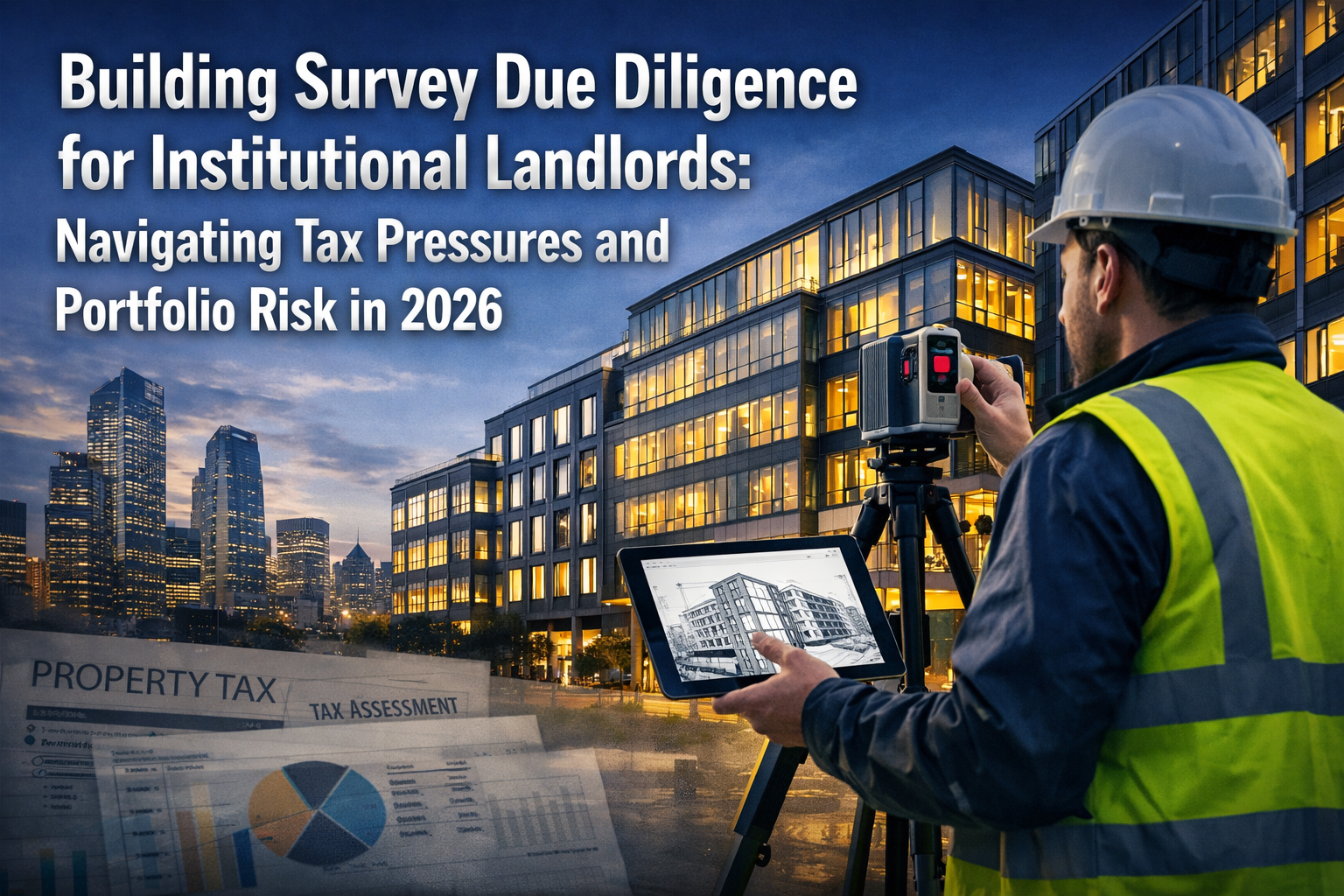
The commercial real estate landscape has transformed dramatically. Institutional landlords managing multi-property portfolios now face a perfect storm: rising property tax assessments, stricter regulatory compliance requirements, and heightened scrutiny from lenders and insurers. As Building Survey Due Diligence for Institutional Landlords: Navigating Tax Pressures and Portfolio Risk in 2026 becomes more complex than ever, the stakes for missing critical structural defects or boundary issues have never been higher. With new survey standards taking effect in February 2026 and tax bills intensifying across major markets, institutional investors need robust protocols to protect their portfolios and maintain competitive returns.
Key Takeaways
- ✅ New 2026 ALTA/NSPS survey standards require enhanced documentation of encroachments, boundary discrepancies, and property conditions—directly impacting institutional due diligence processes [1]
- 📊 Enhanced disclosure requirements now mandate clearer reporting of Relative Positional Precision (RPP) and boundary relationships, increasing transparency but also revealing more potential risks [5]
- 💰 Rising tax pressures combined with stricter survey standards mean institutional landlords must implement more comprehensive building assessment protocols across their portfolios
- 🏢 Multi-property portfolios assembled over time face particular vulnerability to boundary gaps, overlaps, and undocumented shared-use areas now more likely to be identified [1]
- ⚡ Early coordination among legal counsel, surveyors, and title companies is critical to avoid delays that impact financing milestones and acquisition timelines [1]
Understanding the 2026 Survey Standards Revolution
What Changed on February 23, 2026
The commercial real estate industry experienced a significant shift when the 2026 ALTA/NSPS survey standards officially took effect on February 23, 2026, replacing the 2021 version as the authoritative national standard [1]. For institutional landlords conducting due diligence across multiple properties, these changes represent more than administrative updates—they fundamentally alter how property risks are identified, documented, and disclosed.
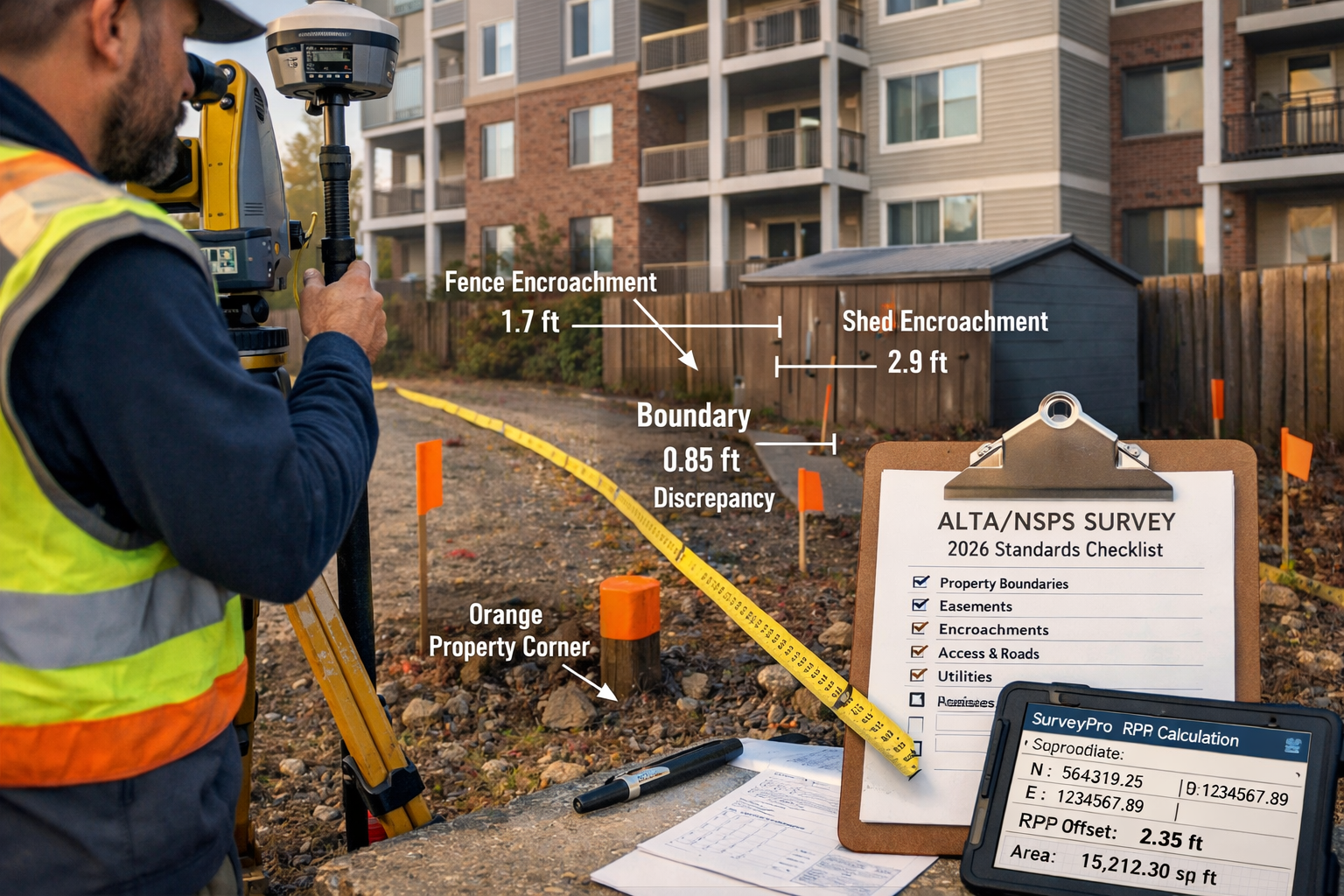
Table A Item 20 stands out as a notable new addition that requires surveyors to provide a summary table of observed conditions and potential encroachments directly on the survey itself [1]. This includes:
- 🏗️ Building encroachments onto adjacent parcels
- 🚗 Parking and driveway intrusions across property lines
- 🚶 Undocumented access or shared-use areas
- 📏 Boundary discrepancies and measurement gaps
For institutional portfolios with dozens or hundreds of properties, this enhanced transparency creates both opportunities and challenges. While better information supports smarter investment decisions, it also means more potential issues will surface during RICS commercial building surveys that could affect valuations and underwriting.
Enhanced Precision and Boundary Reporting
The 2026 standards introduce refined Relative Positional Precision (RPP) reporting requirements that clarify the expected accuracy of boundary locations [5]. Surveyors must now provide clearer disclosure showing how the surveyed property relates to adjoining parcels, including identifiable gaps or overlaps—particularly important for multi-parcel institutional campuses assembled over time through various acquisitions [1].
This means boundary discrepancies are now more likely to be identified and documented during due diligence than under previous standards [1]. While this increased transparency benefits long-term risk management, it can also complicate acquisition timelines and require additional legal resolution before closing.
Utility Documentation and Record Research
Updated standards require clearer utility locate documentation and improved record research requirements as part of core due diligence obligations [5]. This strengthens lender and title insurer confidence in property condition assessment—a critical factor for institutional landlords seeking favorable financing terms across their portfolios.
The enhanced utility documentation is particularly relevant for properties with:
- Complex underground infrastructure
- Shared utility easements across multiple parcels
- Historical development with incomplete as-built records
- Environmental remediation or monitoring systems
Transition Period Considerations
Survey contracts signed after February 23, 2026 must comply with the new 2026 standards. However, contracts signed before that date but completed after may use the 2021 standards if clearly documented with the client and title company [4]. This creates potential compliance variation through early 2026 that institutional landlords must carefully manage across their acquisition pipelines.
Best practice recommendation: Specify 2026 standard compliance in all new survey engagement letters, regardless of contract signing date, to ensure consistency across portfolio due diligence processes.
Building Survey Due Diligence for Institutional Landlords: Portfolio-Wide Risk Assessment Strategies
The Tax Pressure Context
Institutional landlords face mounting pressure from multiple directions in 2026. Property tax assessments have increased significantly across major markets, while operating expenses continue to rise [7]. At the same time, lenders and insurers demand more comprehensive property condition documentation to support underwriting decisions.
This convergence makes building survey due diligence not just a transaction requirement but a strategic portfolio management tool. Identifying structural defects, compliance gaps, and boundary issues early prevents costly surprises that erode returns and complicate asset management.
Multi-Property Assessment Protocols
For institutional landlords managing portfolios of commercial, residential, or mixed-use properties, standardized assessment protocols ensure consistent risk evaluation across all assets. Key components include:
1. Comprehensive Structural Condition Surveys
Stock condition surveys provide systematic assessment of building fabric, mechanical systems, and compliance status across multiple properties. These surveys should document:
- Structural integrity and visible defects
- Building envelope condition and weatherproofing
- Mechanical, electrical, and plumbing systems status
- Fire safety and accessibility compliance
- Estimated repair and replacement costs over 5-10 year horizon
2. Boundary and Title Verification
The enhanced 2026 ALTA/NSPS standards make boundary verification more critical than ever. Institutional portfolios assembled through multiple acquisitions over years or decades may have:
- Overlapping property descriptions from different survey eras
- Undocumented easements or shared access arrangements
- Encroachments that went unnoticed under previous survey standards
- Title defects that affect marketability or development potential
Early coordination among legal counsel, title companies, and surveyors is now critical to avoid delays impacting construction schedules, regulatory approvals, and financing milestones [1].
3. Specialized Defect Investigation
When initial surveys identify potential issues, specific defect surveys provide focused investigation of particular concerns. Common applications include:
- Structural movement or settlement patterns
- Damp and moisture intrusion
- Roofing and weatherproofing failures
- Foundation and subsidence issues
For properties showing signs of structural distress, subsidence surveys and monitoring surveys establish baseline conditions and track changes over time.
4. Dilapidations and Lease-End Planning
For institutional landlords with commercial tenants, dilapidations surveys document property condition at lease commencement and termination. Understanding dilapidations surveys as a tenant and landlord's essential guide helps protect asset value and avoid disputes.
Risk Stratification and Prioritization
Not all properties in an institutional portfolio carry equal risk. Effective due diligence protocols stratify assets based on:
| Risk Factor | High Priority | Medium Priority | Lower Priority |
|---|---|---|---|
| Property Age | Pre-1980 construction | 1980-2000 construction | Post-2000 construction |
| Acquisition History | Multiple ownership changes | Single previous owner | New development |
| Structural Concerns | Visible defects or movement | Minor cosmetic issues | No apparent issues |
| Regulatory Compliance | Non-conforming use or modifications | Partial compliance | Fully compliant |
| Boundary Complexity | Multi-parcel assemblage | Shared access/utilities | Simple single parcel |
| Tax Assessment | Recent significant increase | Stable assessment | Declining assessment |
High-priority properties warrant comprehensive Level 3 building surveys that provide detailed condition assessment and defect analysis. Medium-priority assets may be adequately served by Level 2 surveys, while lower-risk properties might only require basic condition reporting.
Technology Integration for Portfolio Management
Modern institutional landlords leverage technology platforms to manage survey data across their portfolios. Best practices include:
- Centralized digital repositories for all survey reports, drawings, and supporting documentation
- GIS mapping systems that visualize property boundaries, easements, and encroachments across the portfolio
- Condition assessment databases that track defects, repairs, and capital expenditure forecasts
- Automated compliance tracking for regulatory requirements, insurance renewals, and survey update cycles
Navigating Tax Pressures and Portfolio Risk Through Strategic Survey Planning

The Financial Impact of Survey Due Diligence
Comprehensive building survey due diligence represents an upfront investment that delivers multiple financial benefits:
1. Improved Acquisition Pricing
Detailed condition information discovered during due diligence provides negotiating leverage. Identifying significant structural defects, compliance gaps, or boundary issues before closing allows institutional buyers to:
- Negotiate purchase price reductions reflecting repair costs
- Request seller remediation of critical issues
- Structure holdbacks or escrows for unresolved concerns
- Walk away from transactions with unacceptable risk profiles
2. More Accurate Capital Planning
Survey findings inform long-term capital expenditure planning across the portfolio. Understanding the condition and remaining useful life of major building systems prevents budget surprises and supports strategic asset management decisions.
3. Enhanced Financing Terms
Lenders and title insurers widely rely on ALTA/NSPS surveys to confirm boundaries, access, and property conditions [5]. Comprehensive survey documentation that meets or exceeds the 2026 standards strengthens lender confidence and may support:
- Lower interest rates reflecting reduced risk
- Higher loan-to-value ratios
- Streamlined underwriting processes
- Reduced title insurance premiums
4. Property Tax Appeal Support
Detailed condition documentation from building surveys can support property tax appeals when assessments appear excessive relative to actual property condition. Survey evidence of structural defects, deferred maintenance, or functional obsolescence provides objective support for valuation adjustments.
Compliance and Regulatory Risk Management
The 2026 survey standards' enhanced disclosure requirements align with broader trends toward increased transparency and accountability in commercial real estate [7]. Institutional landlords must ensure their due diligence processes address:
Building Safety and Structural Integrity
Recent high-profile building failures have heightened regulatory scrutiny of structural condition reporting. Comprehensive surveys should document:
- Foundation and structural frame condition
- Building envelope integrity and weatherproofing
- Fire safety systems and compartmentation
- Accessibility compliance with current standards
Environmental and Sustainability Requirements
Growing emphasis on environmental performance and sustainability creates new due diligence requirements. Survey protocols should assess:
- Energy efficiency and thermal performance
- Water management and drainage systems
- Hazardous materials presence (asbestos, lead, etc.)
- Climate resilience and flood risk
Lease Compliance and Tenant Obligations
For properties with existing tenants, survey due diligence should verify:
- Tenant compliance with lease maintenance obligations
- Permitted alterations and improvements
- Restoration requirements at lease termination
- Outstanding dilapidations liabilities
Coordinating the Due Diligence Team
Effective Building Survey Due Diligence for Institutional Landlords: Navigating Tax Pressures and Portfolio Risk in 2026 requires coordination among multiple specialists:
Core Team Members:
- 🏗️ Chartered Building Surveyors – Lead condition assessment and defect investigation
- 📐 Land Surveyors – Conduct boundary surveys meeting 2026 ALTA/NSPS standards
- ⚖️ Legal Counsel – Review title, easements, and survey-revealed legal issues
- 💼 Title Companies – Coordinate survey requirements and insurance underwriting
- 🔧 Specialist Engineers – Investigate structural, mechanical, or environmental concerns
- 💰 Valuation Surveyors – Assess impact of survey findings on property value
Best Practice Coordination Protocols:
- Early engagement – Initiate survey work immediately upon contract execution to maximize time for issue resolution [1]
- Clear scope definition – Specify 2026 standard compliance and required Table A items in engagement letters
- Regular communication – Establish weekly status calls during active due diligence periods
- Centralized document management – Use shared platforms for real-time survey document access
- Issue escalation procedures – Define thresholds and processes for material findings requiring immediate attention
Portfolio-Wide Survey Update Cycles
Beyond acquisition due diligence, institutional landlords benefit from periodic portfolio-wide survey updates. Recommended cycles include:
| Survey Type | Recommended Frequency | Purpose |
|---|---|---|
| Boundary/Title Surveys | Every 5-10 years or upon adjacent property development | Verify boundaries remain accurate; identify new encroachments |
| Condition Surveys | Every 3-5 years | Update capital planning forecasts; identify emerging defects |
| Compliance Audits | Every 2-3 years | Ensure ongoing regulatory compliance; identify changing requirements |
| Specialized Investigations | As needed based on condition monitoring | Investigate specific concerns or deterioration patterns |
Regular survey updates support proactive asset management, prevent small issues from becoming major problems, and maintain comprehensive documentation for financing and disposition activities.
Practical Implementation: Building Your Due Diligence Framework
Step 1: Establish Portfolio Survey Standards
Create written standards that define survey requirements for different property types and transaction contexts. Standards should specify:
- Minimum survey scope for acquisitions, refinancing, and periodic reviews
- Required compliance with 2026 ALTA/NSPS standards and relevant Table A items
- Approved surveyor qualifications and professional credentials
- Documentation format and deliverable requirements
- Review and approval processes
Step 2: Build Your Surveyor Network
Develop relationships with qualified surveying professionals across your portfolio's geographic footprint. For UK-based portfolios, work with chartered surveyors holding relevant RICS accreditations.
Consider establishing preferred vendor agreements that provide:
- Priority scheduling for time-sensitive transactions
- Consistent pricing across multiple properties
- Standardized reporting formats
- Portfolio-wide data integration capabilities
Step 3: Integrate Survey Data into Decision Processes
Ensure survey findings flow into key decision points:
- Acquisition committees receive comprehensive survey summaries highlighting material risks
- Asset management teams use condition data to prioritize capital improvements
- Finance teams incorporate survey-based capital forecasts into budgets and valuations
- Legal teams address survey-revealed title and boundary issues proactively
Step 4: Monitor and Adapt
The 2026 survey standards represent the current state of practice, but requirements will continue evolving. Stay informed about:
- Regulatory changes affecting property condition disclosure
- Lender and insurer requirement updates
- Technology advances in survey methods and documentation
- Industry best practices and peer approaches
"Early coordination among legal counsel, title companies, and surveyors is now critical to avoid delays impacting construction schedules, regulatory approvals, and financing milestones." [1]
Step 5: Leverage Survey Findings for Value Creation
View survey due diligence as an opportunity, not just a cost. Survey findings can identify:
- Value-add opportunities – Underdeveloped parcels or expansion possibilities
- Operational improvements – Energy efficiency upgrades with strong ROI
- Risk mitigation – Preventive maintenance that avoids costly failures
- Portfolio optimization – Properties requiring disposition versus hold strategies
Conclusion
Building Survey Due Diligence for Institutional Landlords: Navigating Tax Pressures and Portfolio Risk in 2026 has become more sophisticated and demanding than ever before. The new ALTA/NSPS survey standards effective February 23, 2026 bring enhanced transparency and disclosure requirements that fundamentally change how property risks are identified and documented [1]. Combined with rising tax pressures and heightened lender scrutiny, institutional landlords must implement robust, portfolio-wide survey protocols to protect their investments and maintain competitive returns.
The key to success lies in treating building survey due diligence as a strategic asset management tool rather than a transaction formality. Comprehensive condition assessment, boundary verification, and compliance documentation provide the foundation for informed acquisition decisions, accurate capital planning, and effective risk management across multi-property portfolios.
Actionable Next Steps
For Institutional Landlords:
- ✅ Review and update your due diligence standards to ensure compliance with 2026 ALTA/NSPS requirements
- 📋 Conduct portfolio-wide survey audits to identify properties requiring updated boundary or condition surveys
- 🤝 Establish relationships with qualified chartered surveyors capable of handling multi-property engagements
- 💻 Implement technology platforms for centralized survey data management and portfolio-wide analysis
- 📊 Integrate survey findings into capital planning, budgeting, and asset management processes
For Properties Under Acquisition:
- 🔍 Engage surveyors early in the due diligence period to maximize time for issue investigation and resolution
- 📝 Specify 2026 standards compliance in all survey engagement letters and title company instructions
- 👥 Coordinate closely among legal counsel, surveyors, and title companies throughout the process
- ⚠️ Escalate material findings immediately to decision-makers for evaluation and negotiation
- 📁 Maintain comprehensive documentation of all survey work for future reference and portfolio management
The commercial real estate market in 2026 demands excellence in due diligence. Institutional landlords who invest in comprehensive building survey protocols position themselves to navigate tax pressures, manage portfolio risk effectively, and capitalize on opportunities their competitors might miss. The enhanced transparency required by the 2026 survey standards ultimately serves the long-term interests of sophisticated investors who value accurate information over pleasant surprises.
Whether you're acquiring a single trophy asset or managing a diverse portfolio across multiple markets, partnering with experienced professionals who understand both the technical requirements and strategic implications of building survey due diligence is essential. The upfront investment in thorough assessment pays dividends through better pricing, informed capital planning, enhanced financing terms, and reduced long-term risk exposure.
References
[1] New 2026 Alta Nsps Survey Standards What Developers And Counsel Should Know – https://hallrender.com/2026/02/23/new-2026-alta-nsps-survey-standards-what-developers-and-counsel-should-know/
[2] 2026 Alta Updates Key Impacts Financial Institutions – https://www.gfrlaw.com/what-we-do/insights/2026-alta-updates-key-impacts-financial-institutions
[3] January 2026 – https://www.aia.org/resource-center/consensus-construction-forecast/january-2026
[4] 2026 Alta Nsps Standards Now In Effect – https://www.bealsandthomas.com/post/2026-alta-nsps-standards-now-in-effect
[5] Alta Nsps Land Title Surveys 2026 Standards – https://cretelligent.com/alta-nsps-land-title-surveys-2026-standards/
[6] Us Real Estate Market Outlook 2026 – https://www.cbre.com/insights/books/us-real-estate-market-outlook-2026
[7] Commercial Real Estate Outlook – https://www.deloitte.com/us/en/insights/industry/financial-services/commercial-real-estate-outlook.html
[8] 2026 Demands Better Commercial Property Management To Stay Ahead – https://cove.is/blog-press/2026-demands-better-commercial-property-management-to-stay-ahead
[9] Alta Nsps Land Title Surveys – https://www.partneresi.com/services/land-surveying-zoning/alta-nsps-land-title-surveys/
[10] The Ripple Effects Of Banning Institutional Purchases Of Single Family Rentals – https://www.brookings.edu/articles/the-ripple-effects-of-banning-institutional-purchases-of-single-family-rentals/
