
Landlords and building surveyors across England now face unprecedented liability exposure. With Awaab's Law Phase 2 enforcement beginning in 2026, the private rented sector (PRS) must comply with strict timelines for documenting and remedying fire hazards, electrical risks, and structural defects—or face regulatory action and potential criminal penalties. The legislation, born from the tragic death of two-year-old Awaab Ishak due to prolonged mould exposure, has evolved far beyond its original damp and mould focus to encompass a comprehensive range of life-threatening hazards.
Building Survey Defect Documentation Under Awaab's Law 2026: Fire, Electrical, and Structural Hazard Protocols for PRS Properties represents a fundamental shift in how property professionals must approach rental property inspections. The new requirements demand systematic identification, detailed documentation, and rapid remediation of hazards that previously received less urgent attention. For surveyors conducting RICS building surveys, these protocols introduce specific documentation standards and strict compliance timelines that transform routine inspections into legally binding hazard assessments.
Key Takeaways
- Phase 2 of Awaab's Law expands to cover fire, electrical, and structural hazards in social housing from 2026, with PRS implications following [4]
- Fire hazards require 15-day remediation timelines, including defective fire doors and inadequate escape routes [2]
- Electrical hazards range from exposed wiring to overloaded circuits, demanding comprehensive testing and documentation [8]
- Emergency structural hazards must be investigated within 24 hours of identification, with immediate safety measures [4]
- Building surveyors need updated protocols for systematic defect documentation that meets regulatory standards and protects against liability
Understanding Awaab's Law 2026 Phase 2 Expansion
Awaab's Law, embedded in Clause 42 of the Social Housing (Regulation) Act 2023 and the Hazards in Social Housing (Prescribed Requirements) Act 2025, fundamentally restructures landlord obligations for hazard management [7]. While Phase 1 focused exclusively on damp and mould, Phase 2 dramatically expands the scope to include eight additional hazard categories that pose immediate threats to tenant safety.
The Phase 2 hazards now covered under mandatory timeframes include:
- 🔥 Fire hazards (defective fire doors, blocked escape routes, inadequate detection systems)
- ⚡ Electrical hazards (faulty wiring, overloaded circuits, non-compliant installations)
- 🥶 Excess cold (inadequate heating, poor insulation, thermal deficiencies)
- 🥵 Excess heat (inadequate ventilation, overheating risks)
- 🪜 Falls on level surfaces and stairs (trip hazards, defective handrails, unsafe steps)
- 🏗️ Structural collapse and falling elements (compromised load-bearing structures, loose fixtures)
- 💥 Explosions (gas leaks, faulty appliances, combustible material storage)
- 🚿 Domestic hygiene and personal sanitation (inadequate facilities, contamination risks)
The legislation establishes three distinct response timelines based on hazard severity [4]:
| Hazard Category | Investigation Timeline | Remediation Timeline |
|---|---|---|
| Emergency hazards | 24 hours | Immediate action required |
| Phase 2 hazards (fire, electrical, thermal) | 5 working days | 15 calendar days |
| Significant damp and mould | 10 working days | 14 calendar days |
For building surveyors conducting Level 3 building surveys, these timelines create new documentation requirements. Every identified hazard must be categorized by severity, assigned a compliance timeline, and tracked through to resolution. This represents a significant departure from traditional survey reporting, which typically provided recommendations without legally mandated action deadlines.
The Ministry of Housing, Communities and Local Government published the latest amendment on October 27, 2025, clarifying that while initial enforcement targets social housing providers, PRS landlords should anticipate similar requirements as Phase 3 rolls out from 2027 onwards [7]. Proactive surveyors are already adapting their protocols to meet these emerging standards.
Fire Hazard Identification and Documentation Protocols
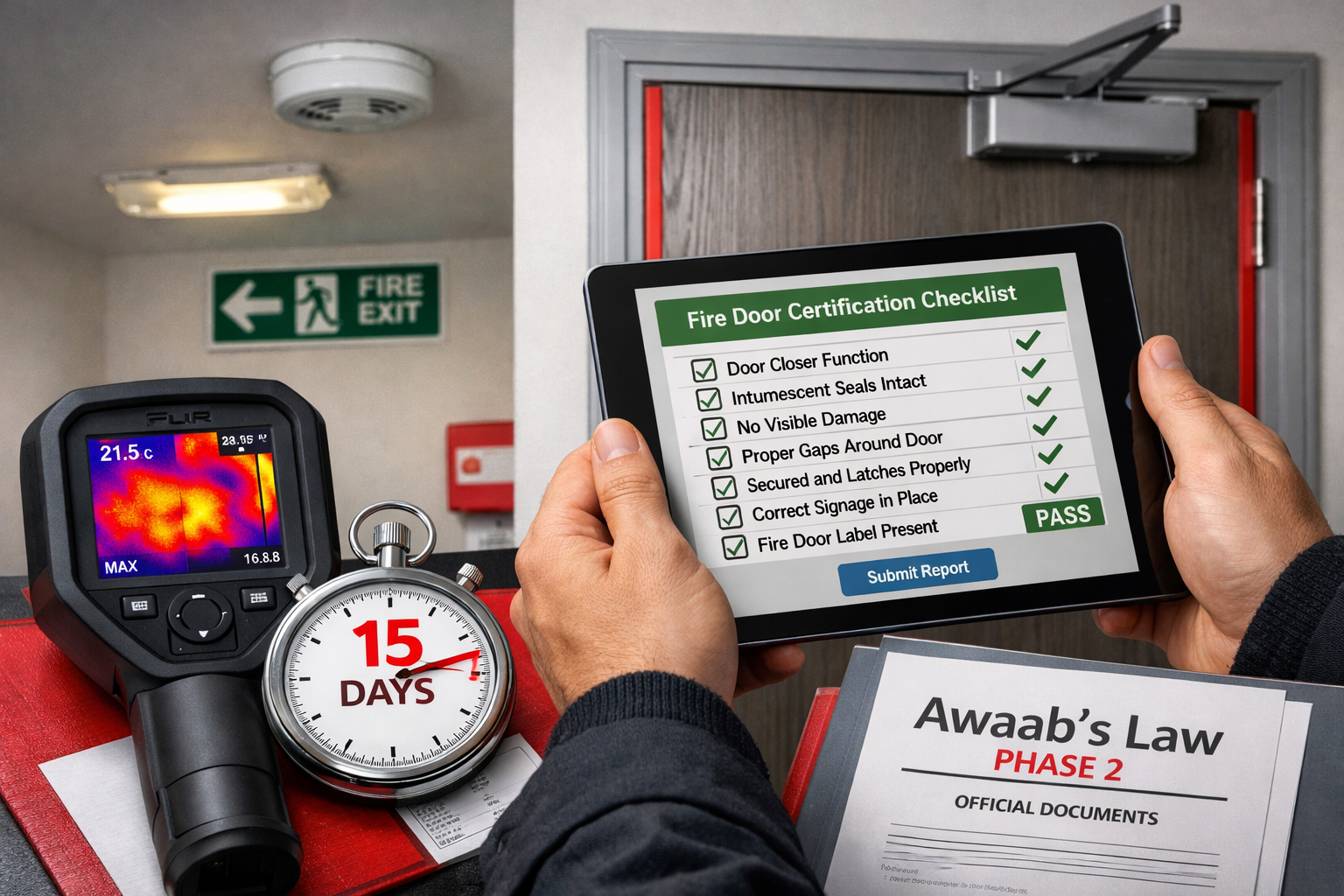
Fire hazards represent one of the most critical categories under Building Survey Defect Documentation Under Awaab's Law 2026: Fire, Electrical, and Structural Hazard Protocols for PRS Properties. The 15-day remediation timeline for fire safety defects leaves minimal room for delays, making accurate initial documentation essential [2].
Critical Fire Hazard Categories
Building surveyors must systematically assess and document the following fire-related defects:
Fire Door Compliance 🚪
- Intumescent strips condition and placement
- Self-closing mechanism functionality
- Door fit and gap measurements (maximum 4mm tolerance)
- Fire rating certification and labeling
- Damage to door structure or glazing
Fire doors reported as hazards must be replaced or repaired within 15 days under Phase 2 requirements [2]. Surveyors should photograph each fire door from multiple angles, document certification labels, and test closing mechanisms with standardized procedures.
Escape Route Assessment 🏃
- Clear, unobstructed escape paths from all habitable rooms
- Emergency lighting functionality and coverage
- Exit signage visibility and illumination
- Travel distances to final exits
- Secondary escape route availability
Detection and Alarm Systems 🔔
- Smoke detector placement and coverage (every floor, hallways, bedrooms)
- Carbon monoxide detector installation near combustion appliances
- Alarm interconnection and power source verification
- Testing dates and maintenance records
- Audibility levels throughout property
Fire Separation and Compartmentation 🧱
- Integrity of fire-resistant walls and ceilings
- Proper sealing of service penetrations
- Fire stopping around pipes, cables, and ducts
- Loft space compartmentation in multi-unit buildings
Documentation Standards for Fire Hazards
Professional surveyors conducting commercial building surveys or residential inspections must adopt enhanced documentation protocols:
Photographic Evidence Requirements:
- Wide-angle context shots showing room layout and escape routes
- Close-up detail images of specific defects
- Measurement verification photos with rulers or measuring tapes
- Before-and-after documentation for remediation tracking
- Thermal imaging for fire spread risk assessment
Written Documentation Elements:
- Precise location descriptions (floor, room, wall orientation)
- Hazard severity classification (emergency, high, medium, low)
- Compliance timeline assignment
- Recommended remedial actions with specification details
- Cost estimates for repairs or replacements
- Priority ranking when multiple hazards exist
Digital Documentation Systems:
Building surveyors increasingly rely on specialized software that integrates with Awaab's Law compliance requirements [7]. These systems enable:
- Automated hazard categorization based on HHSRS (Housing Health and Safety Rating System) criteria
- Timeline tracking with automated reminders for landlord compliance
- Photographic evidence storage with geolocation and timestamp metadata
- Report generation in formats acceptable to local authorities
- Audit trails for regulatory inspection purposes
For properties with multiple fire hazards, surveyors must establish clear prioritization. A defective fire door in a single escape route constitutes an emergency requiring 24-hour investigation, while a missing smoke detector in a secondary bedroom may fall under the standard 15-day timeline.
Electrical Hazard Assessment and Structural Defect Protocols

Building Survey Defect Documentation Under Awaab's Law 2026: Fire, Electrical, and Structural Hazard Protocols for PRS Properties places particular emphasis on electrical and structural hazards due to their potential for catastrophic failure. Electrical hazards range from obvious dangers like exposed wiring to subtle risks such as overloaded circuits [8], requiring specialized testing equipment and technical expertise.
Comprehensive Electrical Hazard Documentation
Visible Electrical Defects:
- Exposed or damaged wiring and cables
- Cracked or broken socket outlets and switches
- Scorch marks indicating overheating or arcing
- Missing cover plates on junction boxes
- Inadequate cable protection in high-traffic areas
- Water ingress near electrical installations
Hidden Electrical Risks:
- Overloaded circuits exceeding rated capacity
- Inadequate earthing and bonding
- Obsolete wiring systems (rubber insulation, aluminum conductors)
- Non-compliant consumer units lacking RCD protection
- Undersized cables for connected loads
- Shared neutral conductors in multi-circuit installations
Surveyors conducting building surveys must coordinate with qualified electricians for comprehensive electrical testing. The Electrical Installation Condition Report (EICR) becomes a critical component of Awaab's Law compliance documentation, with findings directly informing hazard categorization.
Electrical Testing Requirements:
| Test Type | Purpose | Documentation Required |
|---|---|---|
| Visual inspection | Identify obvious defects | Photographic evidence, defect schedule |
| Continuity testing | Verify protective conductor integrity | Test results with readings, circuit identification |
| Insulation resistance | Detect deteriorated insulation | Megohm readings per circuit |
| RCD functionality | Confirm trip times and sensitivity | Trip time measurements, test button verification |
| Polarity verification | Ensure correct wiring connections | Circuit diagram with test confirmations |
Properties presenting electrical hazards under Awaab's Law face the 15-day remediation timeline [2]. However, surveyors must immediately flag emergency situations such as:
- Live exposed conductors accessible to occupants
- Severe overheating with active arcing or sparking
- Complete loss of RCD protection in wet areas
- Electrical installations submerged or severely water-damaged
These emergency conditions trigger the 24-hour investigation requirement [4], demanding immediate landlord notification and potential property evacuation recommendations.
Structural Hazard Identification Protocols
Structural collapse and falling elements represent one of the most severe hazard categories under Phase 2 expansion. Building surveyors must systematically assess load-bearing elements, structural movement indicators, and deterioration patterns that compromise building integrity.
Primary Structural Concerns:
Foundation and Subsidence Issues 🏚️
- Crack patterns indicating differential settlement
- Door and window frame distortion
- Floor level variations and slopes
- External ground level changes adjacent to foundations
- Drainage defects causing soil erosion
- Tree root damage to foundation zones
Professional drainage surveys often reveal underlying causes of structural movement, particularly where defective drains saturate foundation soils.
Load-Bearing Element Assessment 🏗️
- Beam and joist deflection or sagging
- Cracked or spalled concrete in structural members
- Corroded steel supports and lintels
- Timber decay in load-bearing walls and floors
- Masonry deterioration affecting structural walls
- Inadequate support for structural modifications
Falling Element Hazards ⚠️
- Loose or detached ceiling materials
- Unstable chimney stacks and parapet walls
- Defective render and external cladding
- Unsecured heavy fixtures and fittings
- Deteriorated balcony structures
- Compromised roof coverings
Surveyors must employ multiple assessment techniques for comprehensive structural documentation:
Visual Inspection Methods:
- Systematic room-by-room examination
- External elevation surveys from ground and elevated positions
- Roof space inspection for structural frame condition
- Underfloor void examination where accessible
Instrumental Assessment:
- Crack width measurement with graduated scales
- Level surveys detecting floor and ceiling slopes
- Moisture meter readings identifying decay risks
- Thermal imaging revealing hidden structural defects
- Borescope inspection of concealed spaces
Monitoring Protocols:
For properties with active structural movement, surveyors should recommend crack monitoring systems with:
- Baseline measurements and photographic documentation
- Tell-tale installation across significant cracks
- Regular re-inspection schedules (typically 3-6 month intervals)
- Seasonal variation analysis
- Structural engineer referral for progressive movement
Properties may present fire, electrical, thermal, and structural hazards simultaneously, requiring coordinated assessment [5]. Surveyors must recognize interdependencies—for example, structural cracks may expose electrical wiring to moisture ingress, creating combined electrical and structural hazards.
Integrated Documentation Systems
Building Survey Defect Documentation Under Awaab's Law 2026: Fire, Electrical, and Structural Hazard Protocols for PRS Properties demands coordinated documentation across all hazard categories. Professional surveyors should implement integrated reporting systems that:
Cross-Reference Related Hazards:
- Link structural water ingress to electrical safety concerns
- Connect fire separation defects to structural modifications
- Associate thermal performance issues with structural air leakage
- Correlate hygiene hazards with structural dampness
Prioritize Remediation Sequences:
- Identify hazards requiring immediate attention (24-hour timeline)
- Sequence repairs logically (structural before decorative)
- Highlight hazards where delayed action increases risk
- Recommend temporary safety measures during remediation
Maintain Compliance Audit Trails:
- Record initial identification dates for timeline calculation
- Document landlord notification with proof of delivery
- Track remediation progress with interim inspections
- Verify completion with photographic evidence
- Archive all documentation for regulatory review
For surveyors working across multiple properties, digital management systems prove essential [7]. These platforms enable:
- Centralized hazard tracking across entire property portfolios
- Automated compliance deadline monitoring
- Standardized reporting templates meeting regulatory requirements
- Collaborative workflows between surveyors, landlords, and contractors
- Regulatory submission capabilities for local authority reporting
The stock condition survey methodology, traditionally used for large property portfolios, adapts well to Awaab's Law compliance. By systematically documenting building elements and their condition, surveyors create comprehensive baseline records that facilitate ongoing hazard monitoring.
Legal Implications and Professional Liability Considerations
The expansion of Awaab's Law creates significant liability exposure for both landlords and building surveyors. Professional surveyors must understand their legal obligations and potential consequences of inadequate documentation.
Surveyor Professional Responsibilities:
Building surveyors conducting inspections under Awaab's Law protocols assume heightened professional duties:
- Duty of Care: Comprehensive hazard identification using appropriate expertise and equipment
- Competence Standards: Maintaining current knowledge of HHSRS criteria and Awaab's Law requirements
- Documentation Standards: Creating defensible records meeting regulatory and legal scrutiny
- Timely Reporting: Ensuring landlords receive hazard notifications within timeframes enabling compliance
- Expert Witness Capability: Preparing documentation suitable for potential legal proceedings [5]
Surveyors who fail to identify reportable hazards may face:
- Professional negligence claims from injured tenants
- Regulatory action from RICS or other professional bodies
- Exclusion from insurance coverage for substandard work
- Reputational damage affecting future business opportunities
Landlord Enforcement Consequences:
Under Awaab's Law, landlords failing to meet prescribed timelines face:
- Rent Repayment Orders: Tenants may claim up to 12 months' rent back
- Unlimited Fines: Courts may impose financial penalties without upper limits
- Criminal Prosecution: Severe or repeated violations may result in criminal charges
- Housing Ombudsman Investigations: Formal complaints and published findings
- Local Authority Enforcement: Improvement notices, prohibition orders, or licensing restrictions
The 15-day timeline for fire and electrical hazards [2] leaves minimal margin for delays. Surveyors must ensure their reporting processes enable landlords to:
- Receive hazard notifications within 24-48 hours of inspection
- Obtain contractor quotes and schedule repairs within 5-7 days
- Complete remediation work within the remaining timeline
- Arrange verification inspections before deadline expiration
Best Practice Documentation Standards
Professional surveyors should adopt enhanced documentation protocols that exceed minimum requirements:
Comprehensive Photographic Records:
- Minimum 3 photographs per identified hazard (wide, medium, close-up)
- Consistent lighting and exposure for accurate representation
- Measurement references in frame (rulers, measuring tapes)
- Timestamp and geolocation metadata embedded
- RAW format archiving for evidential quality
Detailed Written Descriptions:
- Precise measurements (not "approximately" or "around")
- Specific material identification (not generic terms)
- Objective condition assessments (avoiding subjective language)
- Clear hazard severity justifications referencing HHSRS criteria
- Unambiguous remediation recommendations with specifications
Standardized Reporting Templates:
- Consistent hazard categorization across all surveys
- Automated timeline calculation from identification date
- Mandatory fields preventing incomplete documentation
- Version control for report amendments
- Digital signatures and professional certification
Quality Assurance Processes:
- Peer review of hazard classifications before report finalization
- Technical specialist consultation for complex defects
- Compliance checklist verification before client delivery
- Regular training updates on regulatory changes
- Documentation audits sampling completed surveys
Surveyors conducting RICS Level 3 building surveys should integrate Awaab's Law protocols into their standard methodologies, ensuring every inspection meets the heightened documentation standards regardless of whether immediate enforcement applies.
Coordinating Multi-Hazard Assessments in PRS Properties
Properties rarely present single isolated hazards. Building Survey Defect Documentation Under Awaab's Law 2026: Fire, Electrical, and Structural Hazard Protocols for PRS Properties requires holistic assessment recognizing how different hazard categories interact and compound risks.
Common Multi-Hazard Scenarios
Scenario 1: Structural Dampness with Electrical and Fire Implications
A property with rising damp affecting ground floor walls may simultaneously present:
- Structural hazard: Timber floor joist decay compromising load-bearing capacity
- Electrical hazard: Socket outlets on damp walls creating shock and fire risks
- Fire hazard: Compromised fire resistance in affected walls
- Hygiene hazard: Mould growth and sanitation concerns
Surveyors must document each hazard separately while noting their interconnections. The remediation sequence becomes critical—electrical isolation must precede structural repairs, which must precede fire protection restoration.
Scenario 2: Thermal Performance Deficiencies Creating Multiple Risks
Inadequate heating and insulation may generate:
- Excess cold hazard: Insufficient heating capacity for winter temperatures
- Damp and mould hazard: Condensation from thermal bridging
- Structural hazard: Freeze-thaw damage to external masonry
- Fire hazard: Unsafe portable heater use by cold tenants
Professional damp surveys often reveal these interconnected issues, requiring coordinated remediation addressing root causes rather than symptoms.
Scenario 3: Structural Modifications Compromising Safety Systems
Unauthorized alterations may create cascading hazards:
- Structural hazard: Removed load-bearing walls without adequate support
- Fire hazard: Compromised fire separation between units
- Electrical hazard: Extended circuits beyond safe capacity
- Falls hazard: Modified staircases with non-compliant dimensions
Surveyors must recognize modification patterns and systematically assess their safety implications across all hazard categories.
Integrated Assessment Methodologies
Systematic Room-by-Room Evaluation:
Professional surveyors should adopt structured inspection sequences ensuring comprehensive coverage:
- External envelope assessment (structure, weatherproofing, fire separation)
- Roof space inspection (structure, insulation, electrical routing, fire stopping)
- Room-by-room interior survey (all hazard categories per space)
- Service installations review (electrical, heating, water, gas)
- External areas evaluation (access, drainage, structural stability)
Specialist Coordination:
Complex properties require multi-disciplinary assessment teams:
- Structural engineers for significant movement or load-bearing concerns
- Electrical contractors for EICR testing and hidden wiring assessment
- Fire safety consultants for complex compartmentation and means of escape
- Damp specialists for moisture investigation and remediation specification
- Thermal imaging technicians for concealed defect detection
Surveyors should maintain professional networks enabling rapid specialist deployment when inspections reveal issues beyond general surveying competence.
Digital Documentation and Workflow Management
Modern surveying practice increasingly relies on integrated digital platforms [7] that facilitate:
Mobile Data Capture:
- Tablet-based inspection apps with offline functionality
- Voice-to-text hazard descriptions for efficient field documentation
- Instant photo capture with automatic report integration
- Digital sketches and annotations on floor plans
- Barcode/QR code tracking for specific building elements
Cloud-Based Collaboration:
- Real-time hazard identification shared with landlords
- Contractor access to defect specifications and locations
- Progress tracking with photographic evidence uploads
- Automated compliance deadline reminders
- Regulatory reporting capabilities
Analytics and Benchmarking:
- Portfolio-wide hazard pattern identification
- Predictive maintenance scheduling based on defect trends
- Compliance performance metrics across property types
- Cost analysis for remediation planning
- Risk scoring for insurance and investment purposes
For surveyors managing multiple PRS properties, these systems provide essential efficiency gains while maintaining documentation quality and regulatory compliance.
Future Regulatory Trajectory and Preparation Strategies
Awaab's Law represents an evolving regulatory framework with clear expansion plans. Phase 3, scheduled for 2027 onwards, will extend requirements to all remaining HHSRS hazards excluding overcrowding [4]. Building surveyors must anticipate and prepare for these coming changes.
Anticipated Phase 3 Expansions
While specific timelines await confirmation, Phase 3 is expected to incorporate:
- Collision and entrapment hazards (doors, windows, architectural features)
- Lighting deficiencies affecting safety and security
- Noise exposure from building services or external sources
- Entry by intruders (security of doors, windows, access points)
- Uncombusted fuel gas (ventilation, appliance safety)
- Volatile organic compounds (building materials, treatments)
- Crowding and space (room sizes, occupancy standards)
- Food safety (kitchen facilities, storage, preparation areas)
- Water supply (quality, pressure, contamination risks)
Professional surveyors should proactively develop assessment protocols for these anticipated hazard categories, positioning themselves as early adopters when regulations formalize.
Private Rented Sector Implications
While current enforcement focuses on social housing, PRS landlords face inevitable regulatory convergence. Forward-thinking property professionals recognize that:
- Tenant expectations increasingly demand social housing safety standards
- Insurance providers may require Awaab's Law-compliant documentation
- Local authorities can apply existing HHSRS powers with Awaab's Law precedents
- Litigation trends favor tenants citing social housing safety standards
- Property values increasingly reflect compliance status and hazard exposure
Surveyors serving PRS clients should recommend voluntary adoption of Awaab's Law protocols, creating competitive advantages through:
- Enhanced tenant satisfaction and retention
- Reduced liability exposure and insurance premiums
- Improved property values and marketability
- Proactive compliance positioning ahead of regulatory expansion
- Documented duty of care for legal protection
Professional Development and Competency Maintenance
Building Survey Defect Documentation Under Awaab's Law 2026: Fire, Electrical, and Structural Hazard Protocols for PRS Properties demands ongoing professional development in:
Technical Knowledge Areas:
- HHSRS assessment methodology and scoring
- Fire safety engineering principles and regulations
- Electrical installation standards (BS 7671 18th Edition)
- Structural assessment techniques and failure modes
- Building pathology and defect diagnosis
- Thermal performance evaluation and building physics
Regulatory Compliance:
- Awaab's Law statutory requirements and guidance
- Social Housing (Regulation) Act 2023 provisions
- Building Safety Act 2022 implications
- Housing Health and Safety Rating System updates
- Local authority enforcement practices
Digital Competencies:
- Survey software platforms and mobile applications
- Photographic documentation and editing techniques
- Thermal imaging interpretation and analysis
- Report generation and template customization
- Data management and cybersecurity practices
Professional bodies including RICS offer specialized training programs addressing Awaab's Law compliance. Surveyors should pursue:
- Formal CPD courses with certification
- Webinars and technical briefings on regulatory updates
- Peer learning groups sharing practical experiences
- Conference attendance for industry best practice exchange
- Technical literature review maintaining current knowledge
Building Surveyor Liability Management
Prudent surveyors implement comprehensive risk management strategies:
Professional Indemnity Insurance:
- Policy coverage explicitly including Awaab's Law compliance work
- Adequate coverage limits reflecting potential claim values
- Retroactive coverage for past surveys under evolving standards
- Regular policy review as regulatory landscape changes
Terms of Engagement:
- Clear scope definitions specifying inspection limitations
- Explicit hazard identification and reporting protocols
- Timeline responsibilities and client obligations
- Disclaimer clauses for concealed or inaccessible defects
- Professional standard references (RICS guidance, Awaab's Law requirements)
Quality Management Systems:
- Documented procedures for all survey types
- Standardized checklists preventing omissions
- Peer review requirements for complex assessments
- Complaint handling and corrective action processes
- Regular internal audits verifying compliance
Client Communication:
- Transparent discussions of Awaab's Law implications
- Written confirmation of hazard notifications and timelines
- Follow-up documentation tracking remediation progress
- Professional advice on compliance strategies
- Clear distinction between surveyor observations and client responsibilities
Surveyors offering property certification services should integrate Awaab's Law compliance verification into their standard offerings, creating additional value streams while supporting client regulatory obligations.
Conclusion
Building Survey Defect Documentation Under Awaab's Law 2026: Fire, Electrical, and Structural Hazard Protocols for PRS Properties represents a transformative shift in property inspection standards. The expansion from damp and mould to comprehensive hazard coverage—including fire safety, electrical risks, and structural integrity—demands enhanced surveyor competencies, systematic documentation protocols, and integrated assessment methodologies.
The strict enforcement timelines (24 hours for emergencies, 15 days for Phase 2 hazards) leave minimal margin for inadequate documentation or delayed reporting. Professional surveyors must adopt digital tools, standardized templates, and quality assurance processes ensuring every inspection meets regulatory requirements and provides defensible evidence of comprehensive hazard assessment.
Actionable Next Steps for Building Surveyors
Immediate Actions (Within 30 Days):
✅ Review and update survey templates incorporating Awaab's Law hazard categories and compliance timelines
✅ Audit existing professional indemnity insurance ensuring coverage for Awaab's Law compliance work
✅ Implement digital documentation systems enabling efficient photographic evidence capture and report generation
✅ Establish specialist networks for electrical testing, structural engineering, and fire safety consultation
✅ Develop client communication materials explaining Awaab's Law implications and surveyor services
Medium-Term Development (3-6 Months):
📚 Complete formal CPD training on HHSRS assessment, Awaab's Law requirements, and hazard identification
🔧 Acquire specialized equipment including thermal imaging cameras, moisture meters, and electrical testing devices
📋 Create standardized inspection checklists for systematic multi-hazard property assessment
🤝 Build relationships with local authorities understanding enforcement approaches and reporting expectations
💼 Develop Awaab's Law compliance service offerings for PRS landlords seeking proactive hazard management
Long-Term Strategic Positioning (12+ Months):
🎯 Position as Awaab's Law compliance specialists through thought leadership and case study development
🏆 Pursue advanced certifications in building pathology, fire safety, or electrical inspection
📊 Implement portfolio management systems for landlords with multiple properties requiring ongoing compliance
🌐 Establish digital presence highlighting Awaab's Law expertise and compliance capabilities
🔄 Monitor Phase 3 developments and prepare assessment protocols for anticipated hazard expansions
The regulatory landscape continues evolving, with Phase 3 expansion to all HHSRS hazards scheduled for 2027 and inevitable extension to the private rented sector. Surveyors who proactively adopt comprehensive hazard assessment protocols position themselves as essential partners for landlords navigating increasingly complex compliance obligations.
For property professionals seeking to understand the full scope of building assessment requirements, our comprehensive guide to Level 3 building surveys provides detailed context for the most thorough inspection methodology. When comparing survey options, reviewing Level 2 vs Level 3 survey differences helps determine appropriate inspection depth for specific property circumstances.
The message is clear: Building Survey Defect Documentation Under Awaab's Law 2026 is not merely a regulatory checkbox—it represents a fundamental commitment to tenant safety, professional excellence, and proactive risk management in an increasingly regulated property sector. Surveyors embracing these standards today will lead the industry tomorrow.
References
[1] Awaabs Law A Letting Agents Guide – https://blog.goodlord.co/awaabs-law-a-letting-agents-guide
[2] What Is Awaabs Law And What Do You Need To Do – https://selo.global/what-is-awaabs-law-and-what-do-you-need-to-do/
[3] Awaabs Law Policy Web Version 10 – https://www.southernhousing.org.uk/media/cxvlllnp/awaabs-law-policy-web-version-10.pdf
[4] Awaabs Law Guidance For Social Landlords Timeframes For Repairs In The Social Rented Sector – https://www.gov.uk/government/publications/awaabs-law-guidance-for-social-landlords/awaabs-law-guidance-for-social-landlords-timeframes-for-repairs-in-the-social-rented-sector
[5] Expert Witness Preparation For Awaabs Law 2026 Expansions Testifying On New Rental Hazards Like Fire And Electrical Risks – https://nottinghillsurveyors.com/blog/expert-witness-preparation-for-awaabs-law-2026-expansions-testifying-on-new-rental-hazards-like-fire-and-electrical-risks
[6] Social Housing – https://theindependentlandlord.com/resources/property-investors-glossary/social-housing/
[7] How Digital Tools Help Social Landlords Meet Awaabs Law – https://www.trimble.com/blog/construction/en-US/article/how-digital-tools-help-social-landlords-meet-awaabs-law
[8] Awaabs Law 2026 Hazard Expansions Surveyor Protocols For Electrical Fire And Excess Heat Risks In Rentals – https://nottinghillsurveyors.com/blog/awaabs-law-2026-hazard-expansions-surveyor-protocols-for-electrical-fire-and-excess-heat-risks-in-rentals
