
The Housing Ombudsman reported a 42% increase in hazard-related complaints during the first quarter of 2026, with fire safety and electrical risks now accounting for nearly one-third of all disputes under Awaab's Law expansions. This dramatic shift has transformed the landscape for expert witnesses, who must now navigate a significantly broader range of hazards beyond the original focus on damp and mould. Expert Witness Preparation for Awaab's Law 2026 Expansions: Testifying on New Rental Hazards like Fire and Electrical Risks has become essential for chartered surveyors and property professionals facing courtroom scrutiny over compliance with the expanded legislation.[2]
Since October 2025, Awaab's Law became legally enforceable for social housing providers, establishing strict investigation and repair timelines.[2] The 2026 Phase 2 expansion broadened the scope to include fire safety, electrical hazards, excess cold, excess heat, and falls on stairs and baths—creating new challenges for expert witnesses who must demonstrate technical competence across multiple hazard categories.[4]
Key Takeaways
- Expanded hazard scope: Awaab's Law 2026 now covers fire safety, electrical risks, excess heat, excess cold, and falls hazards—requiring expert witnesses to prepare evidence across multiple technical disciplines
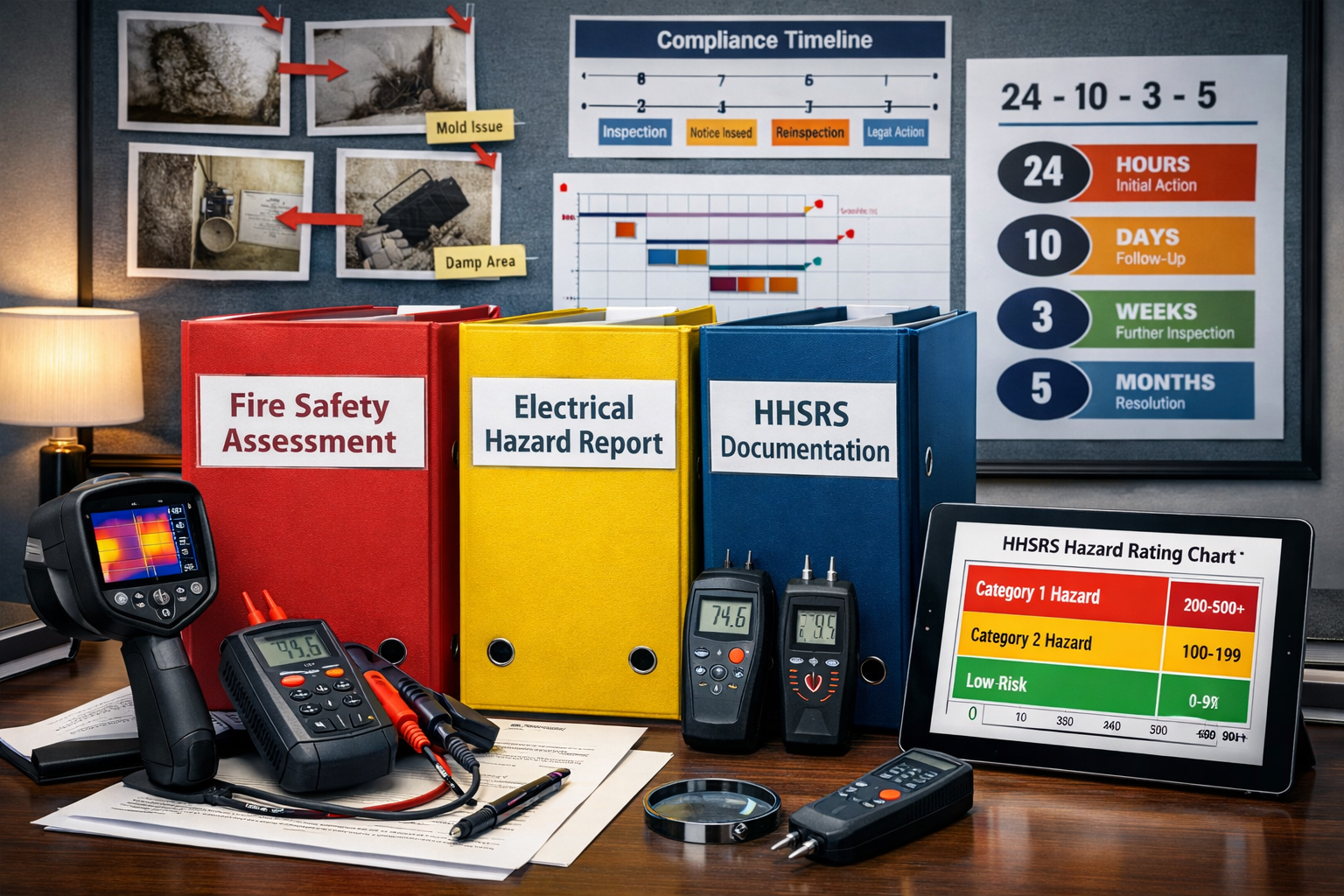
- Strict compliance timelines: The 24-10-3-5 framework mandates 24 hours for emergency investigations, creating tight deadlines for expert assessments and testimony preparation
- Evidence package requirements: Comprehensive documentation including HHSRS ratings, thermal imaging, electrical testing data, and photographic evidence is essential for withstanding cross-examination
- RICS-backed protocols: Following established surveyor protocols and professional standards strengthens expert witness credibility in Awaab's Law disputes
- Increased litigation workload: Surveyors' expert witness responsibilities have grown significantly, with fire and electrical hazards now representing major areas of legal challenge
Understanding the 2026 Awaab's Law Expansions and Their Impact on Expert Testimony
The legislative evolution of Awaab's Law represents a fundamental shift in how rental property hazards are assessed and remediated. Named after two-year-old Awaab Ishak, who died from prolonged exposure to mould in social housing, the law initially focused on damp and mould conditions. However, the 2026 Phase 2 expansion dramatically broadened its scope to address nearly all Housing Health and Safety Rating System (HHSRS) hazards.[2]
The 24-10-3-5 Response Framework
Expert witnesses must thoroughly understand the compliance timelines that form the backbone of Awaab's Law enforcement:
| Timeline | Requirement | Expert Witness Implication |
|---|---|---|
| 24 hours | Investigate and 'make safe' emergency hazards | Rapid assessment protocols required |
| 10 working days | Investigate significant hazards | Standard inspection timeframe |
| 3 working days | Provide written investigation findings | Documentation must be court-ready |
| 5 working days | Begin remedial works | Expert must verify commencement |
This framework creates significant pressure on expert witnesses to deliver rapid, accurate assessments that can withstand legal scrutiny. The 24-hour emergency response requirement for fire and electrical hazards means experts must be prepared to conduct urgent inspections and provide immediate technical opinions.[2]
New Hazard Categories Requiring Expert Testimony
The 2026 expansions introduced several hazard categories that demand specialized knowledge:
🔥 Fire Safety Hazards: Including inadequate fire detection systems, blocked escape routes, combustible materials near ignition sources, and non-compliant fire doors
⚡ Electrical Hazards: Covering exposed wiring, overloaded circuits, outdated electrical installations, missing RCD protection, and faulty consumer units
🌡️ Excess Heat and Cold: Addressing inadequate insulation, heating system failures, and thermal comfort issues
⚠️ Falls Hazards: Examining stairway conditions, bathroom safety, and trip hazards
By 2027, the law is expected to encompass nearly all 29 HHSRS hazards, further expanding the scope of potential expert testimony.[2] This progression means expert witnesses must maintain current knowledge across an increasingly broad technical spectrum.
Evidence-Gathering Protocols for Expert Witness Preparation for Awaab's Law 2026 Expansions: Testifying on New Rental Hazards like Fire and Electrical Risks
Successful expert witness testimony in Awaab's Law disputes requires meticulous evidence collection that meets both legal and technical standards. The evidence package must be comprehensive enough to withstand rigorous cross-examination while remaining accessible to non-technical legal professionals and judges.[6]
Core Documentation Requirements
Expert witnesses preparing for Awaab's Law testimony must compile a complete evidence package that includes:
Technical Assessment Documentation
- Complete HHSRS hazard ratings with detailed scoring methodology
- Photographic evidence with timestamps and location metadata
- Thermal imaging data for heat, cold, and electrical hazard identification
- Electrical testing certificates and circuit analysis reports
- Fire risk assessment documentation following BS 9999 or BS 9991 standards
- Ventilation and air quality measurements
Compliance Verification Records
- Building Regulations compliance checks (Parts B, P, L, and F)
- Electrical Installation Condition Reports (EICR) with detailed observations
- Fire safety equipment testing records
- Previous inspection reports and maintenance logs
- Correspondence demonstrating landlord notification timelines
Contextual Information
- Property layout plans with hazard locations marked
- Tenant complaint history and response timelines
- Comparable property standards in the local area
- Regulatory guidance documents and technical standards applied
The chartered surveyor's role has evolved to encompass these expanded documentation requirements, with surveyors' workload increasing significantly due to Awaab's Law compliance demands.[5]
Fire Safety Evidence Collection Protocols
Fire hazards under Awaab's Law require specific evidence-gathering approaches:
Detection and Alarm Systems
- Document the type, location, and condition of all smoke and heat detectors
- Test functionality and record battery status or mains connection
- Verify compliance with BS 5839 standards for fire detection systems
- Photograph any missing, damaged, or improperly located detectors
- Check interconnection between detectors in multi-story properties
Escape Routes and Emergency Exits
- Measure and photograph all escape routes and doorways
- Document any obstructions, locked doors, or inadequate signage
- Verify fire door specifications and self-closing mechanisms
- Check emergency lighting functionality and battery backup
- Assess window opening mechanisms as potential emergency exits
Fire Spread and Containment
- Identify combustible materials stored near heat sources
- Examine cavity barriers and fire-stopping in walls and ceilings
- Document the condition of fire-resistant construction elements
- Assess kitchen safety, including proximity of combustibles to cooking appliances
- Review electrical appliance placement and fire risk factors
Updated surveyor protocols specifically address these fire safety assessment requirements under the 2026 expansions.[1]
Electrical Hazard Documentation Standards
Electrical hazards present unique challenges for expert witnesses, requiring both visual inspection and technical testing:
Visual Inspection Evidence
- Exposed wiring, damaged cables, or missing cable protection
- Overloaded socket outlets with multiple adapters
- Damaged switches, sockets, or electrical accessories
- Signs of overheating (discoloration, burning smells, melted plastic)
- Inadequate earthing or bonding arrangements
- DIY electrical work not compliant with Part P Building Regulations
Technical Testing Documentation
- Earth loop impedance test results
- RCD (Residual Current Device) trip time measurements
- Insulation resistance testing data
- Polarity verification results
- Circuit continuity testing records
- Thermal imaging showing electrical hotspots
Regulatory Compliance Assessment
- EICR classification codes (C1, C2, C3, FI)
- BS 7671 (IET Wiring Regulations) compliance evaluation
- Part P Building Regulations compliance verification
- Identification of immediate dangers requiring 24-hour response
- Recommendations for remedial works with priority classifications
The comprehensive building survey approach provides a framework for systematic electrical hazard assessment that meets expert witness standards.
Cross-Examination Preparation and Testimony Strategies for Expanded Hazards
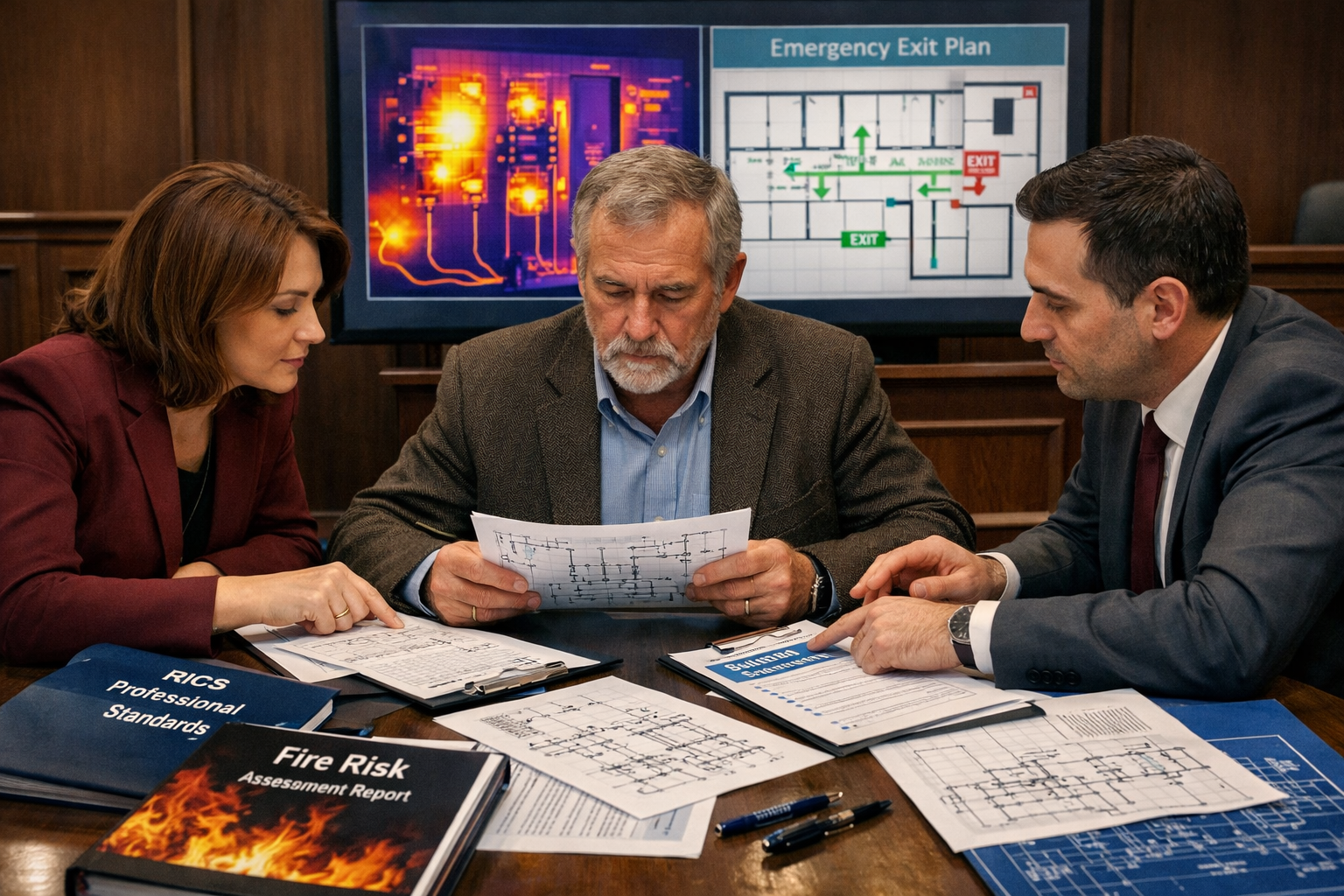
The courtroom environment presents unique challenges for expert witnesses testifying on Awaab's Law compliance. Legal representatives for both landlords and tenants will scrutinize technical opinions, methodology, and professional qualifications. Preparation must address both technical accuracy and communication effectiveness.
Anticipating Common Cross-Examination Challenges
Expert witnesses should prepare for several predictable lines of questioning:
Qualification Challenges
- "What specific training have you received in fire risk assessment?"
- "How many electrical hazard cases have you personally inspected?"
- "Are you qualified to assess thermal comfort standards?"
- "What continuing professional development have you completed on Awaab's Law?"
Methodology Questions
- "Why did you classify this as a Category 1 rather than Category 2 hazard?"
- "What alternative explanations did you consider for the electrical fault?"
- "How do you account for seasonal variations in your excess heat assessment?"
- "What margin of error exists in your thermal imaging data?"
Timeline and Causation Issues
- "Can you definitively state when this fire hazard first developed?"
- "How do you distinguish between landlord negligence and tenant misuse?"
- "What evidence proves the hazard existed before the tenant's complaint?"
- "Could the electrical issue have developed after the inspection deadline?"
Preparing detailed responses to these questions, supported by documented evidence and recognized technical standards, strengthens testimony credibility.
RICS-Backed Case Examples and Precedents
Drawing on established case examples enhances expert witness authority. While specific Awaab's Law cases are still developing, several precedent areas inform testimony preparation:
Fire Safety Case Study: Blocked Fire Escape Route
A 2025 social housing case involved a ground-floor flat where the landlord stored maintenance equipment in the communal hallway, blocking the fire escape route. The expert witness successfully demonstrated:
- Non-compliance with Fire Safety Order 2005 requirements
- HHSRS Category 1 hazard classification for fire spread
- Photographic evidence showing progressive accumulation over three months
- Landlord's failure to respond within the 24-hour emergency timeframe
- Comparable properties in the area maintaining clear escape routes
The court accepted the expert's evidence package, which included timestamped photographs, fire risk assessment documentation, and clear reference to regulatory standards.
Electrical Hazard Case Study: Outdated Consumer Unit
An expert witness testified in a dispute involving an electrical consumer unit without RCD protection, installed before 2008 regulations. The successful testimony included:
- EICR documentation showing C2 (potentially dangerous) classification
- Explanation of why older installations require upgrading under current standards
- Thermal imaging evidence showing circuit overheating
- Clear communication of risk to non-electrical professionals
- Reference to BS 7671 18th Edition requirements
The expert effectively explained that while the installation may have been compliant when installed, current safety standards require RCD protection, particularly in rental properties.
Excess Heat Case Study: Inadequate Ventilation
A top-floor flat experienced summer temperatures exceeding 30°C due to inadequate roof insulation and ventilation. The expert witness demonstrated:
- Temperature logging data over multiple days
- Comparison with thermal comfort standards (CIBSE Guide A)
- Assessment of health impacts on vulnerable occupants
- Landlord's failure to investigate within the 10-working-day timeframe
- Cost-effective remediation options available to the landlord
This case established that excess heat qualifies as a significant hazard under the 2026 expansions, requiring formal investigation and remediation.[3]
Communication Strategies for Technical Concepts
Expert witnesses must translate complex technical information into accessible language for judges, magistrates, and juries. Effective strategies include:
Visual Communication Tools
- Annotated photographs with clear hazard identification
- Color-coded floor plans showing hazard locations
- Simplified diagrams explaining electrical circuits or fire spread
- Before-and-after comparison images
- Charts showing temperature data or timeline compliance
Analogies and Plain Language
- Comparing RCD protection to a "safety switch that prevents electric shock"
- Describing fire doors as "barriers that buy time for safe escape"
- Explaining thermal imaging as "seeing heat patterns invisible to the naked eye"
- Relating HHSRS scores to "risk levels from low to immediate danger"
Structured Testimony Format
- State qualifications and relevant experience clearly
- Explain the inspection methodology used
- Present findings in logical sequence
- Reference specific regulatory standards
- Provide clear opinions with supporting evidence
- Acknowledge limitations or uncertainties honestly
The expert witness services provided by qualified surveyors follow these established communication protocols to ensure testimony effectiveness.
Building Comprehensive Evidence Packages for Multiple Hazard Categories
The expansion of Awaab's Law to cover multiple hazard types requires expert witnesses to develop integrated evidence packages that address interconnected risks. A single property may present fire, electrical, thermal, and structural hazards simultaneously, requiring coordinated assessment and documentation.
Integrated Hazard Assessment Methodology
Phase 1: Initial Property Survey
Conduct a comprehensive walkthrough identifying all potential hazards across categories. Document:
- General property condition and maintenance standards
- Occupant vulnerability factors (children, elderly, disabled residents)
- Previous complaint history and landlord responses
- Access to relevant property documentation and records
Phase 2: Hazard-Specific Technical Assessment
For each identified hazard category, conduct detailed technical evaluation:
Fire Hazards
- Detection and alarm system testing
- Escape route measurement and documentation
- Fire door inspection and functionality testing
- Combustible material identification
- Fire spread risk assessment
Electrical Hazards
- Visual inspection of all accessible electrical installations
- EICR commissioning or review
- Thermal imaging of electrical equipment
- Circuit loading assessment
- Earthing and bonding verification
Thermal Hazards (Excess Heat/Cold)
- Temperature logging over representative periods
- Insulation effectiveness assessment
- Heating system functionality testing
- Ventilation adequacy evaluation
- Thermal imaging for heat loss or gain patterns
Falls Hazards
- Stairway dimensions and handrail assessment
- Bathroom safety feature evaluation
- Floor surface condition and trip hazard identification
- Lighting adequacy assessment
Phase 3: HHSRS Hazard Rating Application
Apply the Housing Health and Safety Rating System methodology to each identified hazard:
- Determine the likelihood of harm occurring (Class I-IV)
- Assess the potential severity of harm (Classes A-D)
- Calculate the hazard score using HHSRS guidance
- Classify as Category 1 (score 1,000+) or Category 2 (score below 1,000)
- Document vulnerable groups at particular risk
Phase 4: Compliance Timeline Verification
Map landlord actions against the 24-10-3-5 framework:
- Document when the tenant first reported the hazard
- Verify landlord's investigation timeline
- Assess whether emergency hazards were made safe within 24 hours
- Check if written findings were provided within 3 working days
- Confirm if remedial works began within 5 working days
This systematic approach ensures no hazard category is overlooked and provides a defensible methodology for cross-examination.
Technology Tools for Evidence Documentation
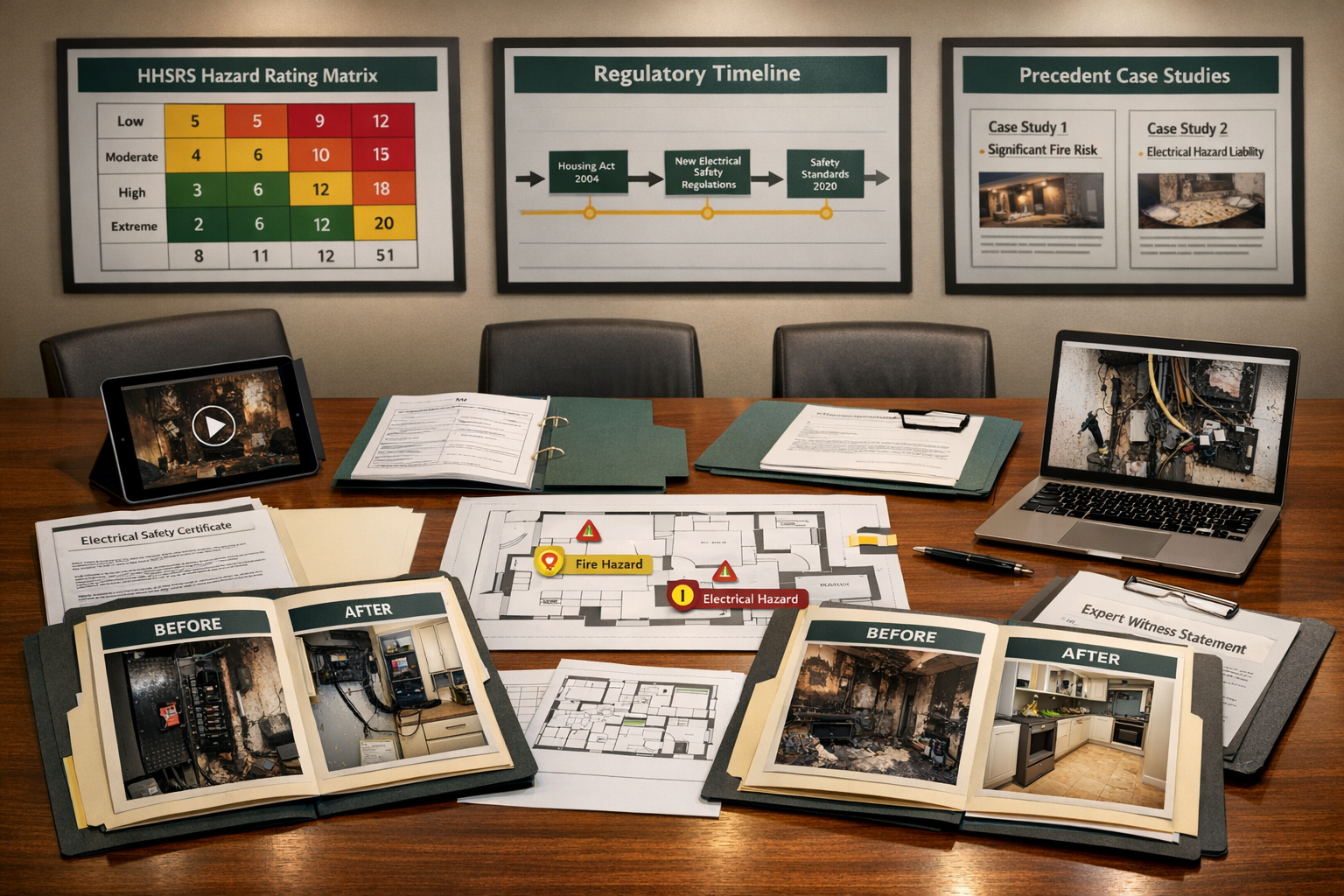
Modern expert witnesses leverage technology to enhance evidence quality and presentation:
Digital Documentation Tools
- 📱 Smartphone apps: Timestamped photographs with GPS location data
- 🌡️ Data loggers: Continuous temperature and humidity monitoring
- 📹 Video documentation: Walkthrough recordings showing hazard context
- 🗂️ Cloud storage: Secure evidence management and version control
- 📊 Database systems: Hazard tracking and compliance monitoring
Specialized Assessment Equipment
- Thermal imaging cameras: Identifying electrical hotspots, insulation defects, and thermal bridging
- Electrical testing equipment: Multifunction testers for comprehensive EICR data
- Moisture meters: Documenting damp conditions related to fire and electrical risks
- Light meters: Assessing adequate lighting for falls hazard prevention
- Laser measuring devices: Accurate dimensional documentation for escape routes and stairways
Presentation and Reporting Software
- Professional report templates following RICS guidance
- Evidence annotation tools for clear hazard identification
- Timeline visualization software for compliance tracking
- Comparative analysis tools for demonstrating standards
- Court-ready presentation formats
The building survey checklist approach provides a foundation for systematic evidence gathering across multiple hazard categories.
Professional Standards and Ethical Considerations
Expert witnesses must maintain strict adherence to professional standards throughout the evidence-gathering and testimony process:
RICS Practice Standards
- Follow RICS Guidance Note: Surveyors Acting as Expert Witnesses
- Maintain professional indemnity insurance with expert witness coverage
- Complete continuing professional development (CPD) on relevant topics
- Declare any conflicts of interest immediately
- Provide impartial opinions regardless of who instructs the expert
Ethical Obligations
- Independence: Serve the court, not the instructing party
- Objectivity: Base opinions solely on evidence and technical standards
- Transparency: Disclose methodology, limitations, and uncertainties
- Competence: Only accept instructions within areas of genuine expertise
- Honesty: Acknowledge when evidence is inconclusive or ambiguous
Record-Keeping Requirements
- Maintain detailed contemporaneous notes from inspections
- Preserve all raw data, photographs, and test results
- Document communications with instructing parties
- Retain evidence for potential future reference or challenge
- Follow data protection requirements for tenant information
These standards protect both the expert witness's professional reputation and the integrity of the legal process.
Preparing for Phase 3 Expansion: Future-Proofing Expert Witness Capabilities
With Phase 3 expansion expected by 2027 to encompass nearly all 29 HHSRS hazards, expert witnesses must begin preparing now for an even broader scope of testimony requirements.[2] This forward-looking approach ensures continued competence and marketability in an evolving legal landscape.
Additional Hazard Categories on the Horizon
The anticipated Phase 3 expansion will likely require expert testimony on:
- Radon gas exposure: Requiring specialized testing and risk assessment
- Asbestos contamination: Demanding accredited surveyor qualifications
- Lead paint hazards: Particularly in pre-1970s properties
- Noise pollution: Assessing acoustic standards and health impacts
- Overcrowding: Evaluating space standards and occupancy limits
- Sanitation hazards: Examining bathroom and kitchen facilities
- Water supply issues: Assessing quality, pressure, and availability
- Lighting deficiencies: Evaluating natural and artificial lighting adequacy
- Structural collapse risks: Requiring structural engineering expertise
- Collision and entrapment hazards: Assessing door and window safety
Expert witnesses should begin acquiring knowledge and qualifications in these areas to maintain comprehensive service offerings.
Professional Development Priorities
Technical Training
- Advanced HHSRS assessment courses
- Specialized fire risk assessor qualifications (e.g., Level 4 Diploma)
- Electrical inspection certification (e.g., City & Guilds 2391)
- Thermal comfort and energy efficiency training
- Building pathology courses addressing multiple hazard types
Legal and Procedural Knowledge
- Expert witness training courses
- Court procedure and evidence law fundamentals
- Cross-examination skills workshops
- Report writing for legal proceedings
- Understanding of Housing Ombudsman processes
Technology Competence
- Thermal imaging interpretation certification
- Building information modeling (BIM) for hazard visualization
- Data analysis and presentation software skills
- Digital evidence management systems
- Remote inspection and virtual testimony capabilities
The professional qualifications verification process helps ensure expert witnesses maintain current credentials across expanding hazard categories.
Building a Defensible Expert Witness Practice
Establishing a robust expert witness practice requires systematic business development:
Reputation Building
- Publish technical articles on Awaab's Law compliance
- Present at professional conferences and seminars
- Develop case study portfolios (with appropriate confidentiality)
- Maintain RICS expert witness directory listing
- Cultivate relationships with legal professionals
Quality Assurance Systems
- Implement peer review processes for complex cases
- Maintain evidence management protocols
- Develop standardized reporting templates
- Create checklists for each hazard category
- Establish continuing education tracking systems
Risk Management
- Ensure adequate professional indemnity insurance limits
- Maintain detailed records of all instructions and opinions
- Seek legal advice on complex ethical situations
- Decline instructions outside areas of genuine competence
- Document decision-making processes thoroughly
Practice Development
- Specialize in specific hazard categories for differentiation
- Build multidisciplinary teams for complex cases
- Develop relationships with specialist consultants
- Create efficient workflows for rapid response requirements
- Invest in technology and equipment for evidence gathering
The commercial building survey expertise developed for larger properties translates well to complex multi-hazard residential assessments under Awaab's Law.
Conclusion
Expert Witness Preparation for Awaab's Law 2026 Expansions: Testifying on New Rental Hazards like Fire and Electrical Risks represents a critical evolution in property professional responsibilities. The expanded scope of hazards—from fire safety and electrical risks to thermal comfort and falls prevention—demands comprehensive technical knowledge, meticulous evidence gathering, and effective courtroom communication skills.
The 24-10-3-5 compliance framework creates tight deadlines for assessment and documentation, requiring expert witnesses to maintain rapid-response capabilities while ensuring evidence quality meets legal standards. Success in this environment depends on systematic evidence-gathering protocols, adherence to RICS professional standards, and the ability to translate complex technical concepts into accessible language for legal professionals and courts.
Actionable Next Steps
For surveyors and property professionals seeking to develop expert witness capabilities for Awaab's Law disputes:
- Assess current competencies across all expanded hazard categories and identify knowledge gaps requiring professional development
- Invest in specialized training for fire risk assessment, electrical inspection, and HHSRS methodology
- Develop evidence-gathering protocols specific to each hazard type, incorporating appropriate technology and documentation standards
- Build case study portfolios demonstrating expertise across multiple hazard categories
- Establish relationships with legal professionals specializing in housing law and tenant rights
- Implement quality assurance systems for evidence management and report preparation
- Prepare for Phase 3 expansion by beginning training in additional HHSRS hazard categories anticipated for 2027
The expanding scope of Awaab's Law creates significant opportunities for qualified expert witnesses who can demonstrate comprehensive technical knowledge, professional credibility, and effective testimony skills. By implementing rigorous evidence-gathering protocols and maintaining current professional development, surveyors can position themselves as authoritative voices in this critical area of housing safety and tenant protection.
For professional expert witness services or to discuss specific Awaab's Law compliance challenges, contact qualified chartered surveyors with expertise in rental property hazard assessment and legal testimony.
References
[1] Awaabs Law 2026 Hazard Expansions Surveyor Protocols For Electrical Fire And Excess Heat Risks In Rentals – https://nottinghillsurveyors.com/blog/awaabs-law-2026-hazard-expansions-surveyor-protocols-for-electrical-fire-and-excess-heat-risks-in-rentals
[2] Preparing For Awaabs Law A Practical Guide To Uk Social Housing Compliance – https://www.netcall.com/blog/preparing-for-awaabs-law-a-practical-guide-to-uk-social-housing-compliance/
[3] Awaabs Law Timeframes And The Dfg – https://www.foundations.uk.com/awaabs-law-timeframes-and-the-dfg/
[4] Awaabs Law A Broader Legislative Shift – https://www.arkconsultancy.co.uk/news-article/awaabs-law-a-broader-legislative-shift/
[5] Awaabs Law What Property Managers And Surveyors Must Know – https://www.howdengroup.com/uk-en/awaabs-law-what-property-managers-and-surveyors-must-know
[6] Expert Witness Preparation For Awaabs Law Expansion Disputes 2026 Hazard Assessments In Rental Valuations – https://nottinghillsurveyors.com/blog/expert-witness-preparation-for-awaabs-law-expansion-disputes-2026-hazard-assessments-in-rental-valuations
