
Social housing providers face a seismic shift in compliance obligations: by 2026, Awaab's Law will expand beyond damp and mould to encompass electrical hazards, fire risks, and excess heat conditions—hazards that collectively account for thousands of tenant injuries annually. For surveyors conducting inspections in rental properties, this regulatory evolution demands immediate protocol updates and comprehensive training in hazard identification methodologies.
The Awaab's Law 2026 Hazard Expansions: Surveyor Protocols for Electrical, Fire, and Excess Heat Risks in Rentals represents a fundamental transformation in how property professionals assess tenant safety. While Phase 1 of Awaab's Law came into force on 27 October 2025, focusing primarily on damp, mould, and emergency hazards[3], Phase 2's 2026 implementation will introduce stringent timeframes for addressing thermal comfort failures, electrical defects, and fire safety deficiencies. This article provides chartered surveyors with actionable inspection frameworks, RICS-aligned checklists, and compliance strategies to navigate these expanded obligations.
Key Takeaways
- ⚡ Phase 2 expansion: Awaab's Law will extend in 2026 to cover excess cold, excess heat, and fire risks where they present significant harm to tenants[3]
- ⏱️ Strict timeframes apply: Landlords must investigate hazards within 14 days of awareness, with remedial work beginning within 7 days for significant hazards or 24 hours for emergencies[1][3]
- 🔍 Person-centred assessments: Hazard evaluations must consider individual tenant vulnerabilities, potentially classifying conditions as hazardous even when they wouldn't meet Category 1 HHSRS thresholds[3]
- 📋 Enhanced surveyor accountability: Professional reports will carry increased legal weight in enforcement actions, requiring comprehensive documentation standards
- 🏘️ Current scope limitations: Regulations currently apply only to social housing, though potential private sector expansion could significantly increase surveyor workloads[1]
Understanding Awaab's Law 2026 Hazard Expansions: Surveyor Protocols for Electrical, Fire, and Excess Heat Risks in Rentals
The Legislative Evolution and Timeline
Awaab's Law emerged from tragedy—the preventable death of two-year-old Awaab Ishak from prolonged mould exposure in social housing. The legislation's phased implementation reflects the government's commitment to comprehensive tenant protection. Phase 1, which became operational on 27 October 2025, established mandatory timeframes for addressing damp, mould, and all emergency hazards in the social rented sector[3].
Phase 2's 2026 expansion represents a critical evolution. The new regulations will specifically target excess cold, excess heat, and fire risks where these conditions pose significant harm to occupants[3]. This expansion acknowledges that tenant safety extends beyond moisture-related issues to encompass thermal comfort and fire protection—areas where surveyor expertise becomes indispensable.
The person-centred approach embedded in Phase 2 protocols fundamentally changes hazard assessment methodology. Unlike traditional Housing Health and Safety Rating System (HHSRS) evaluations that apply standardized criteria, Awaab's Law requires surveyors to consider individual tenant circumstances[3]. A temperature that might be tolerable for a healthy adult could constitute a significant hazard for an elderly resident with cardiovascular conditions or an infant with developing thermoregulation systems.
Mandatory Timeframes and Compliance Requirements
The Awaab's Law 2026 Hazard Expansions: Surveyor Protocols for Electrical, Fire, and Excess Heat Risks in Rentals operates within rigid temporal constraints that surveyors must understand thoroughly:
Investigation Phase ⏰
- Landlords have 14 days from becoming aware of a potential hazard to complete their investigation[1][3]
- This investigation must determine whether the condition constitutes a significant or emergency hazard
- Surveyor reports commissioned during this phase must be delivered promptly to avoid compliance breaches
Action Phase 🔧
- Once a significant hazard is confirmed, remedial work must begin within 7 days[3]
- Emergency hazards require action within 24 hours[1][3]
- "Begin" means physical commencement of repairs, not merely scheduling or planning
Preventative Work 🛡️
- Social landlords must initiate supplementary preventative measures within 5 working days of investigation conclusion[3]
- Physical preventative work must commence within 12 weeks if not started during the initial remedial phase[3]
These timeframes create significant pressure on surveyor availability and report turnaround. Properties requiring RICS building surveys Level 3 assessments must be prioritized to ensure landlords can meet their statutory obligations.
Surveyor Protocols for Electrical Hazard Identification in Rental Properties
Electrical Risk Assessment Framework
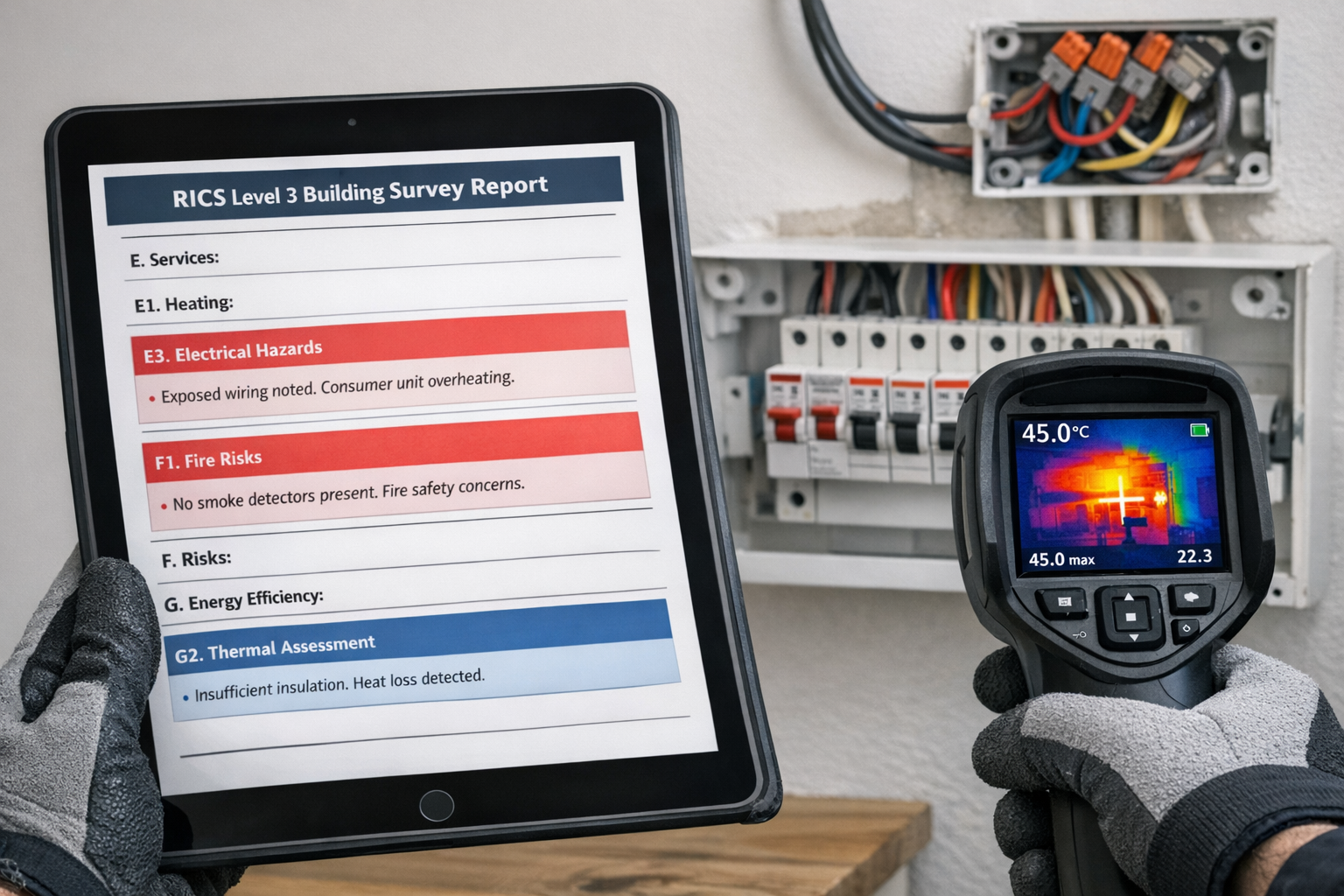
Electrical hazards in rental properties range from obvious dangers like exposed wiring to subtle risks such as overloaded circuits and inadequate earthing. The Awaab's Law 2026 Hazard Expansions: Surveyor Protocols for Electrical, Fire, and Excess Heat Risks in Rentals require surveyors to adopt systematic electrical safety evaluations that go beyond visual inspections.
Primary Electrical Hazards to Document ⚡
| Hazard Category | Assessment Criteria | Documentation Requirements |
|---|---|---|
| Consumer Unit Compliance | Age, RCD protection, labeling accuracy | Photograph, test results, compliance date |
| Fixed Wiring Condition | Insulation degradation, cable routing, junction box security | Thermal imaging, resistance testing |
| Socket Outlet Safety | Overloading indicators, physical damage, heat signatures | Thermal scan results, load calculations |
| Earthing & Bonding | Continuity testing, cross-bonding presence, resistance values | Test certificates, measurement records |
| Portable Appliance Risks | Landlord-supplied equipment condition, PAT testing status | PAT certificates, visual condition reports |
Surveyors conducting building surveys must recognize that electrical hazards often manifest through secondary indicators. Discolored socket faceplates suggest overheating, while frequently tripping RCDs indicate circuit faults requiring immediate investigation.
RICS-Aligned Electrical Inspection Protocols
Professional surveyors should implement a tiered electrical assessment approach:
Level 1: Visual Inspection 👁️
- Consumer unit condition and labeling
- Visible wiring damage or non-compliant installations
- Socket and switch condition assessment
- Identification of DIY electrical work
- Presence of outdated systems (fuse boxes, rubber-insulated cables)
Level 2: Non-Invasive Testing 🔍
- Thermal imaging to identify hot spots indicating electrical resistance issues
- Voltage drop testing at distant outlets
- RCD trip time verification
- Polarity verification at accessible outlets
- Earth loop impedance testing where accessible
Level 3: Invasive Investigation 🔧
- Recommended when Level 1 or 2 assessments identify potential hazards
- Requires qualified electrician collaboration
- Full Electrical Installation Condition Report (EICR) commissioning
- Circuit integrity testing
- Insulation resistance measurement
The surveyor's role isn't to replicate an EICR but to identify indicators requiring specialist electrical assessment. However, understanding electrical testing fundamentals ensures appropriate recommendations and accurate hazard classification.
Documentation Standards for Electrical Hazards
Awaab's Law compliance hinges on robust documentation. When electrical hazards are identified during specific defect surveys, surveyors must provide:
✅ Photographic Evidence: Clear images showing the hazard context, with date stamps and location references
✅ Hazard Classification: Assessment of whether the condition constitutes a significant or emergency hazard
✅ Vulnerability Assessment: Consideration of tenant circumstances (children, elderly, disabled occupants)
✅ Remedial Recommendations: Specific actions required, not generic statements
✅ Timeline Implications: Clear indication of whether the 7-day or 24-hour response applies
✅ Specialist Referrals: Recommendations for EICR or specialist electrical investigation where appropriate
Reports must avoid ambiguous language. Instead of "the consumer unit appears old," state "the consumer unit lacks RCD protection required by current regulations, presenting a significant electrical shock hazard requiring replacement within the 7-day statutory timeframe."
Fire Safety and Excess Heat Risk Protocols Under Awaab's Law 2026
Fire Hazard Assessment Methodology
Fire safety evaluation under the Awaab's Law 2026 Hazard Expansions: Surveyor Protocols for Electrical, Fire, and Excess Heat Risks in Rentals extends beyond smoke alarm presence to encompass comprehensive fire risk identification. Surveyors must evaluate both active fire prevention measures and passive fire protection systems.
Critical Fire Safety Assessment Components 🔥
-
Detection Systems
- Smoke alarm presence, positioning, and functionality
- Heat detector installation in kitchens
- Interconnected alarm systems in multi-story properties
- Battery condition or mains power verification
- Alarm age and replacement requirements (10-year maximum lifespan)
-
Escape Route Integrity
- Unobstructed egress paths from all habitable rooms
- Window opening restrictions in upper floors
- Door functionality and lock accessibility
- Emergency lighting in communal areas
- External escape route accessibility
-
Fire Spread Prevention
- Fire door condition and self-closing mechanism functionality
- Intumescent strip integrity
- Cavity barrier presence in concealed spaces
- Combustible material storage near ignition sources
- Kitchen extraction system condition
-
Ignition Source Management
- Electrical hazards (covered in previous section)
- Gas appliance condition and ventilation
- Heating system safety
- Portable heater risks
- Cooking equipment safety
When conducting homebuyer surveys, fire safety elements should be systematically documented. The person-centred approach requires special attention to properties housing vulnerable occupants—elderly residents may have reduced mobility affecting escape capability, while families with young children face heightened risks from inadequate detection systems.
Excess Heat Risk Evaluation Protocols
Excess heat hazards represent a relatively novel consideration for many surveyors, yet climate change and improving building airtightness make overheating an increasingly critical tenant welfare issue. The 2026 expansion of Awaab's Law acknowledges that excessive indoor temperatures can cause serious health consequences, particularly for vulnerable populations[3].
Thermal Comfort Assessment Framework 🌡️
| Assessment Element | Measurement Criteria | Hazard Threshold Indicators |
|---|---|---|
| Peak Temperature | Maximum recorded temperature during warm periods | >28°C in living spaces, >26°C in bedrooms |
| Duration | Hours exceeding comfort thresholds | >5% of annual occupied hours above thresholds |
| Ventilation Provision | Openable window area, mechanical ventilation capacity | <5% of floor area, inadequate purge ventilation |
| Solar Gain Control | External shading, glazing specification, orientation | Extensive south/west glazing without shading |
| Cooling Options | Tenant ability to achieve thermal comfort | No effective cooling strategy available |
Surveyors should employ thermal imaging technology to identify heat accumulation zones. Properties with extensive glazing, inadequate ventilation, and dark external finishes present elevated overheating risks. Loft conversions and top-floor flats require particular scrutiny, as these spaces experience the most severe heat gain.
The person-centred assessment approach is crucial for excess heat evaluation. A temperature tolerable for a healthy adult may constitute a significant hazard for:
- Elderly residents with impaired thermoregulation 👵
- Infants and young children with developing temperature control 👶
- Individuals with cardiovascular conditions 💓
- Residents taking medications affecting heat tolerance 💊
- Pregnant women experiencing elevated metabolic heat production 🤰
Documentation should include seasonal considerations. A property assessed in winter may conceal severe summer overheating risks, necessitating recommendations for seasonal re-evaluation or thermal modeling.
Integrated Fire and Thermal Risk Documentation
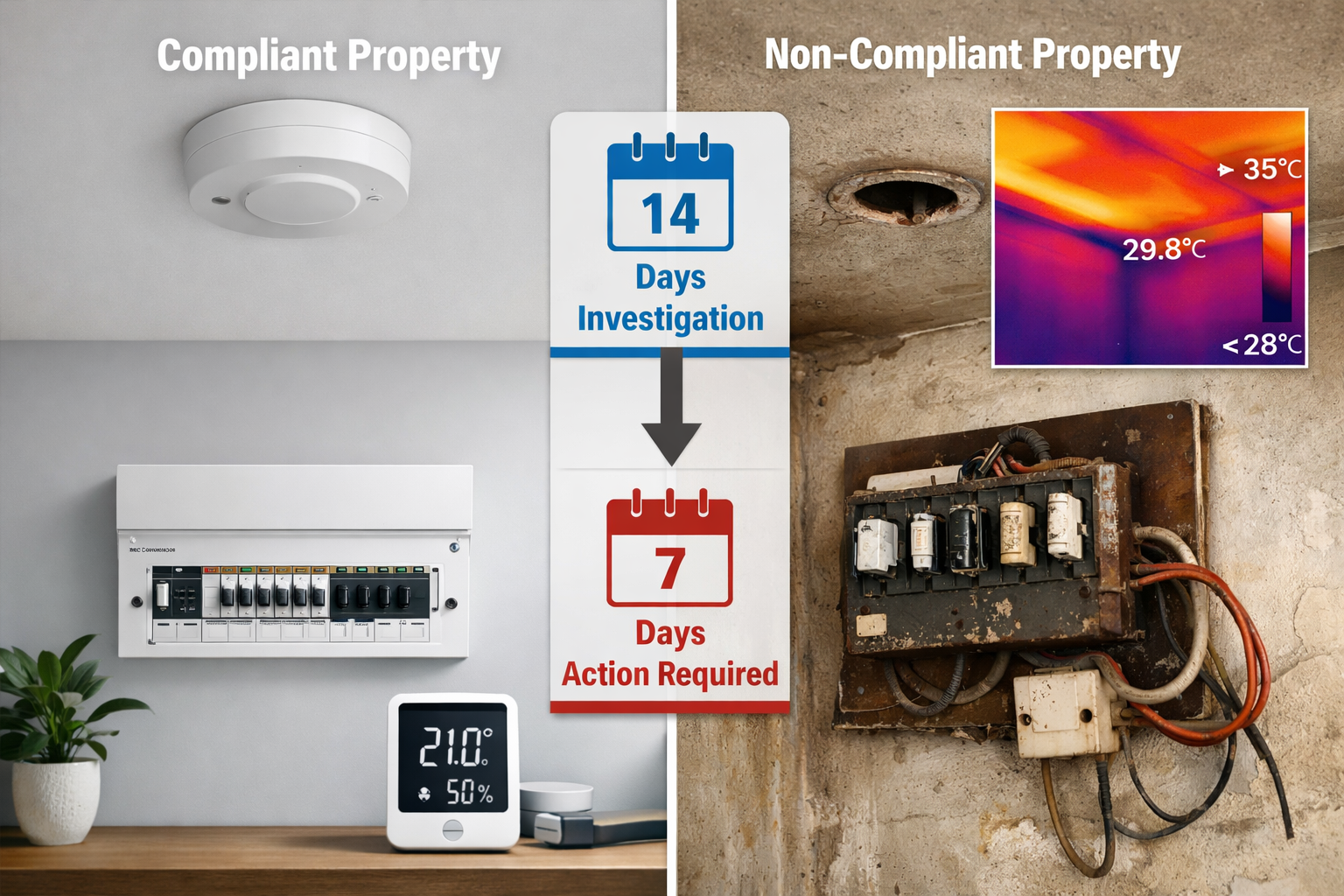
The interconnection between fire safety and thermal comfort creates documentation complexities. Properties with inadequate ventilation may simultaneously present excess heat risks and increased fire hazards due to occupant-installed portable cooling equipment. Surveyors must document these compound risks comprehensively.
Integrated Assessment Checklist 📋
🔍 Detection & Alarm Systems
- Smoke alarm quantity, positioning, and functionality
- Heat detector presence in appropriate locations
- Carbon monoxide detector installation near combustion appliances
- System age and maintenance records
🚪 Escape & Access
- Primary and secondary escape route viability
- Window opening restrictions and emergency egress
- Door condition and lock accessibility
- Communal area fire safety provisions
🌡️ Thermal Environment
- Peak temperature measurement or estimation
- Ventilation adequacy assessment
- Solar gain control evaluation
- Cooling provision availability
⚡ Ignition Sources
- Electrical system safety (cross-reference electrical assessment)
- Gas appliance condition and certification
- Heating system integrity
- Portable appliance risks
🛡️ Fire Containment
- Fire door condition and compliance
- Cavity barrier presence
- Compartmentation integrity
- Material combustibility assessment
When preparing reports for chartered surveyors in London or other urban areas where property density increases fire risks, particular attention should be paid to compartmentation and escape route adequacy.
Implementing RICS-Compliant Inspection Frameworks for Awaab's Law Compliance
Level 3 Building Survey Adaptations for Hazard Identification
The Awaab's Law 2026 Hazard Expansions: Surveyor Protocols for Electrical, Fire, and Excess Heat Risks in Rentals necessitate enhanced Level 3 building survey methodologies. Traditional surveys focused primarily on structural integrity and building fabric condition; the expanded hazard categories require systematic tenant safety evaluations integrated throughout the inspection process.
Enhanced Survey Components for Awaab's Law Compliance 🏠
Pre-Inspection Preparation
- Review tenant vulnerability information (where provided by landlord)
- Identify property-specific risk factors (age, construction type, previous hazard reports)
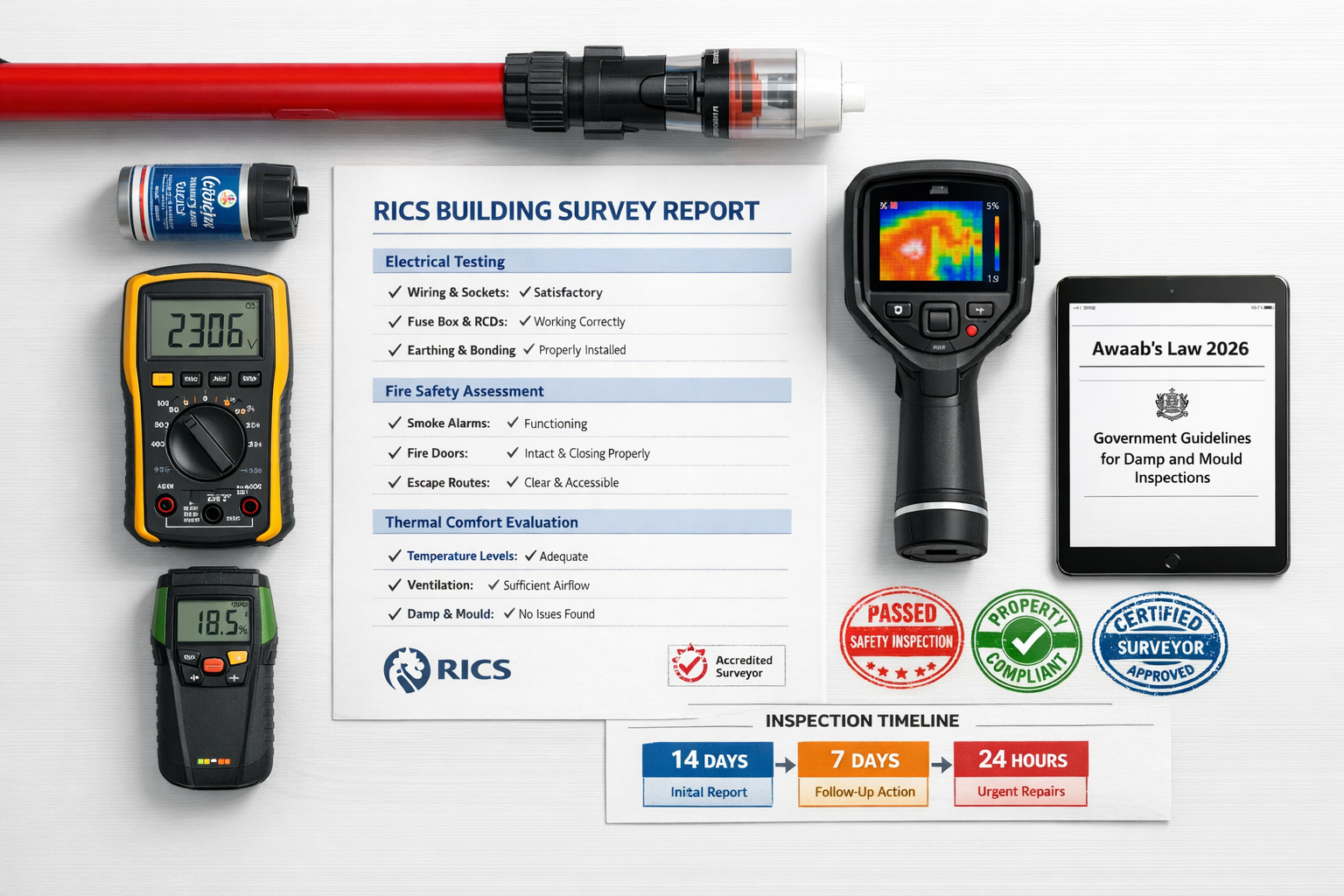
- Prepare specialized equipment (thermal imaging camera, electrical testing devices, moisture meters)
- Obtain relevant documentation (previous EICR, gas safety certificates, fire risk assessments)
On-Site Inspection Sequence
- External Assessment: Identify factors affecting internal thermal environment (orientation, glazing extent, shading, ventilation provisions)
- Electrical Distribution: Consumer unit assessment, visible wiring evaluation, socket condition survey
- Fire Safety Systems: Detection equipment verification, escape route assessment, fire door evaluation
- Thermal Environment: Temperature measurement, ventilation adequacy, heat source identification
- Integrated Risk Assessment: Compound hazard identification, vulnerability consideration, priority ranking
Post-Inspection Analysis
- Hazard classification against HHSRS and Awaab's Law criteria
- Person-centred vulnerability assessment application
- Timeline determination (emergency, significant, or preventative action required)
- Specialist investigation recommendations
- Compliance pathway documentation
Surveyors operating across regions—from chartered surveyors in Hampshire to chartered surveyors in Essex—should develop standardized templates that ensure consistent hazard identification while allowing property-specific adaptation.
Technology Integration for Enhanced Hazard Detection
Modern surveying technology significantly enhances hazard identification accuracy and documentation quality. The following tools should be considered essential for Awaab's Law compliance inspections:
Essential Technology Toolkit 🔧
| Technology | Application | Hazard Detection Benefit |
|---|---|---|
| Thermal Imaging Camera | Surface temperature mapping | Identifies electrical hot spots, thermal bridges, overheating zones, insulation defects |
| Moisture Meter | Material moisture content measurement | Detects hidden dampness contributing to mould growth and electrical risks |
| Digital Manometer | Pressure differential testing | Assesses ventilation system performance and air leakage |
| Electrical Testing Equipment | Basic electrical safety verification | Identifies polarity issues, earth continuity problems, voltage irregularities |
| Environmental Data Logger | Temperature and humidity monitoring | Provides objective thermal comfort data over extended periods |
| Digital Documentation Platform | Real-time report compilation | Ensures comprehensive hazard documentation with location tagging |
Thermal imaging proves particularly valuable for identifying hidden hazards. Electrical resistance issues manifest as heat signatures before causing visible damage, while thermal bridges and insulation defects contributing to excess heat or cold become immediately apparent. When conducting RICS specific defect surveys, thermal imaging provides objective evidence supporting hazard classifications.
Report Structure and Content Requirements
Awaab's Law compliance reports must deliver clarity, actionability, and legal robustness. Ambiguous findings or vague recommendations undermine landlord compliance efforts and potentially expose surveyors to professional liability.
Mandatory Report Sections 📄
1. Executive Summary
- Immediate hazards requiring emergency response (24-hour timeline)
- Significant hazards requiring action within 7 days
- Preventative recommendations for hazard recurrence prevention
- Overall compliance status assessment
2. Property and Occupancy Context
- Property description and construction details
- Tenant vulnerability factors (anonymized but specific)
- Previous hazard history and remedial work
- Relevant certification status (EICR, gas safety, EPC)
3. Detailed Hazard Findings
For each identified hazard:
- Hazard Description: Precise location and nature of the defect
- Photographic Evidence: Multiple angles with scale references
- Hazard Classification: Emergency, significant, or preventative category
- Vulnerability Assessment: How tenant circumstances affect hazard severity
- Health Impact: Potential consequences if unaddressed
- Statutory Timeline: Specific compliance deadline applicable
- Remedial Specification: Detailed repair requirements, not generic recommendations
- Estimated Costs: Realistic budget expectations for landlord planning
4. Specialist Recommendations
- EICR requirements for electrical concerns
- Gas Safe engineer assessment needs
- Structural engineer referrals for building fabric issues
- Environmental health officer notifications where appropriate
5. Compliance Pathway
- Prioritized action sequence
- Timeline management strategy
- Monitoring and verification recommendations
- Preventative maintenance protocols
Reports should employ clear visual hierarchy with color-coded hazard severity indicators. Properties assessed by chartered surveyors in Central London or other high-density areas may require additional fire safety emphasis given the increased risks in multi-occupancy buildings.
Dispute Prevention and Professional Liability Management
Common Compliance Challenges and Resolution Strategies
The Awaab's Law 2026 Hazard Expansions: Surveyor Protocols for Electrical, Fire, and Excess Heat Risks in Rentals introduce potential friction points between landlords, tenants, and surveyors. Understanding common disputes enables proactive risk management.
Frequent Dispute Scenarios ⚠️
1. Hazard Classification Disagreements
- Issue: Landlord disputes surveyor's assessment that a condition constitutes a significant hazard
- Prevention: Provide detailed HHSRS scoring rationale and person-centred vulnerability assessment
- Resolution: Offer second opinion pathway while maintaining professional standards
2. Timeline Feasibility Concerns
- Issue: Landlord claims 7-day remedial timeline is practically impossible
- Prevention: Distinguish between "begin work" and "complete work" requirements
- Resolution: Document realistic phased approaches that satisfy statutory commencement requirements
3. Scope Boundary Questions
- Issue: Uncertainty about whether Awaab's Law applies to specific property types or tenancy arrangements
- Prevention: Clearly state regulatory applicability in report introduction
- Resolution: Reference government guidance[3] and recommend legal clarification where ambiguity exists
4. Cost-Benefit Challenges
- Issue: Landlord questions proportionality of recommended remedial work
- Prevention: Provide cost estimates and explain health consequences of non-compliance
- Resolution: Offer alternative remedial approaches meeting minimum safety standards
5. Tenant Cooperation Issues
- Issue: Access difficulties preventing comprehensive assessment
- Prevention: Document access limitations and their impact on assessment completeness
- Resolution: Recommend follow-up inspection protocols and interim precautionary measures
Surveyors should maintain detailed contemporaneous notes documenting their assessment methodology, observations, and professional judgments. This documentation proves invaluable if disputes escalate to formal proceedings.
Professional Indemnity Considerations
The expanded surveyor accountability under Awaab's Law increases professional liability exposure. Reports carrying legal weight in enforcement actions demand enhanced quality assurance and appropriate insurance coverage[1].
Risk Management Best Practices 🛡️
✅ Competency Verification: Ensure continuing professional development includes Awaab's Law training and hazard assessment methodologies
✅ Scope Definition: Clearly articulate inspection limitations and areas requiring specialist assessment
✅ Evidence Standards: Maintain photographic, measurement, and observational records exceeding minimum requirements
✅ Peer Review: Implement internal quality assurance for complex or high-risk assessments
✅ Insurance Adequacy: Verify professional indemnity coverage specifically addresses statutory compliance reporting
✅ Template Consistency: Use standardized report structures ensuring no mandatory elements are omitted
✅ Timeline Documentation: Record inspection dates, report delivery dates, and landlord notification dates
✅ Limitation Clauses: Include appropriate disclaimers about assessment scope while maintaining professional obligations
Surveyors should consult with professional indemnity insurers about coverage adequacy for Awaab's Law compliance work. Some policies may require endorsement or premium adjustment to reflect the increased regulatory exposure.
Collaboration with Specialist Professionals
The multidisciplinary nature of expanded hazard categories necessitates effective collaboration with electrical contractors, fire safety consultants, and building services engineers. Surveyors should develop referral networks ensuring landlords can quickly access qualified specialists.
Specialist Collaboration Framework 🤝
Electrical Hazards
- Maintain relationships with qualified electricians holding current Part P certification
- Establish clear referral protocols for EICR commissioning
- Develop communication templates ensuring specialists understand Awaab's Law timeline requirements
Fire Safety Risks
- Connect with fire risk assessors holding relevant qualifications (e.g., IFE membership)
- Coordinate assessments to avoid duplication while ensuring comprehensive coverage
- Clarify respective scope boundaries in reports
Thermal Environment Issues
- Engage building services engineers for complex overheating assessments
- Consider thermal modeling specialists for properties with significant solar gain
- Collaborate with ventilation specialists for mechanical system evaluations
Clear delineation of professional responsibilities protects all parties. The surveyor's role involves hazard identification and initial assessment; specialist consultants provide detailed technical evaluation and remedial design. Reports should explicitly state where specialist investigation is recommended rather than attempting comprehensive technical assessment beyond the surveyor's competency.
Future Regulatory Developments and Sector Expansion Implications
Potential Private Rental Sector Extension
While current Awaab's Law provisions apply exclusively to social housing, significant pressure exists for private rental sector extension[1]. Such expansion would dramatically increase surveyor workload and create new compliance challenges.
Implications of Private Sector Extension 🏘️
Volume Impact
- Private rented sector comprises approximately 4.4 million households in England
- Potential inspection demand could overwhelm surveyor capacity
- Prioritization frameworks would become essential
Compliance Complexity
- Private landlords typically have fewer resources than housing associations
- Smaller portfolio landlords may lack hazard awareness and management systems
- Enforcement mechanisms would require significant local authority capacity expansion
Market Dynamics
- Increased compliance costs could accelerate landlord exits from the sector
- Rental supply constraints might intensify in areas with older housing stock
- Property values could reflect compliance status and remedial work requirements
Surveyors should monitor regulatory consultations and prepare operational scaling strategies anticipating potential sector expansion. Developing efficient inspection protocols and leveraging technology for rapid assessment will prove crucial if private sector obligations materialize.
Emerging Hazard Categories and Assessment Methodologies
Climate change, evolving building technologies, and emerging health research may drive further hazard category expansions beyond the 2026 additions. Surveyors should anticipate potential future requirements:
Potential Future Hazard Categories 🔮
- Indoor Air Quality: Particulate matter, VOC concentrations, ventilation effectiveness
- Electromagnetic Field Exposure: Concerns about electrical infrastructure proximity
- Water Quality: Lead pipes, legionella risks, contamination pathways
- Noise Pollution: Sound insulation adequacy, external noise intrusion
- Accessibility Barriers: Hazards specific to disabled occupants
Proactive surveyors will develop competency in these emerging areas, positioning themselves as comprehensive tenant safety specialists rather than traditional building fabric assessors.
Technology Evolution and Assessment Automation
Artificial intelligence, sensor networks, and data analytics promise to transform hazard assessment methodologies. Future surveyor protocols may incorporate:
Emerging Assessment Technologies 🤖
- Continuous Monitoring Systems: IoT sensors providing real-time temperature, humidity, and air quality data
- AI-Assisted Image Analysis: Automated hazard identification from photographic surveys
- Predictive Maintenance Algorithms: Machine learning models forecasting hazard emergence before critical thresholds
- Digital Twin Integration: Virtual property models enabling remote assessment and scenario testing
- Blockchain Compliance Records: Immutable audit trails for inspection history and remedial work verification
Surveyors should engage with these technological developments, understanding both their potential and limitations. Technology enhances but doesn't replace professional judgment, particularly in person-centred vulnerability assessments requiring human empathy and contextual understanding.
Conclusion
The Awaab's Law 2026 Hazard Expansions: Surveyor Protocols for Electrical, Fire, and Excess Heat Risks in Rentals represent a fundamental evolution in tenant safety regulation and surveyor professional responsibilities. The expansion from damp and mould to encompass electrical hazards, fire risks, and thermal comfort issues acknowledges the multifaceted nature of housing health impacts and demands comprehensive assessment methodologies.
Surveyors must adapt their inspection protocols, documentation standards, and professional competencies to meet these enhanced obligations. The strict statutory timeframes—14 days for investigation, 7 days to begin remedial work for significant hazards, and 24 hours for emergencies—create operational pressures requiring efficient processes and clear communication with landlords and specialist consultants.
The person-centred assessment approach distinguishes Awaab's Law from traditional HHSRS evaluations, requiring surveyors to consider individual tenant vulnerabilities when classifying hazards. This nuanced methodology better protects at-risk populations while increasing assessment complexity and documentation requirements.
Actionable Next Steps for Surveyors
Immediate Actions 📋
- Update inspection templates to incorporate electrical, fire, and thermal hazard assessment sections
- Invest in essential technology including thermal imaging cameras and electrical testing equipment
- Complete targeted training on Awaab's Law requirements, HHSRS scoring, and person-centred assessments
- Review professional indemnity insurance to ensure adequate coverage for compliance reporting
- Develop specialist referral networks for electrical, fire safety, and building services consultants
Medium-Term Development 🎯
- Establish quality assurance protocols ensuring consistent hazard identification and classification
- Create landlord education resources explaining compliance obligations and timeline requirements
- Monitor regulatory developments regarding potential private sector extension
- Build competency in emerging hazard categories anticipating future regulatory expansions
- Implement digital documentation systems improving report quality and delivery speed
Strategic Positioning 🚀
- Differentiate services by offering comprehensive Awaab's Law compliance packages
- Develop ongoing monitoring services for landlords requiring regular hazard assessments
- Engage with technology providers offering assessment automation and continuous monitoring solutions
- Contribute to professional discourse through RICS working groups and industry publications
- Anticipate market evolution as compliance requirements reshape rental sector dynamics
The 2026 hazard expansions create both challenges and opportunities for surveying professionals. Those who proactively develop robust assessment protocols, invest in appropriate technology, and maintain rigorous documentation standards will position themselves as essential partners in landlord compliance efforts while advancing the fundamental goal of safe, healthy rental housing for all tenants.
For comprehensive property assessments incorporating these expanded hazard protocols, consult chartered surveyors with demonstrated Awaab's Law expertise and RICS accreditation.
References
[1] Awaabs Law Surveyors – https://goreport.com/awaabs-law-surveyors/
[2] Awaabs Law Damp Mould Survey Compliance Guide – https://www.swiftreporter.com/blog/awaabs-law-damp-mould-survey-compliance-guide
[3] Awaabs Law Guidance For Social Landlords Timeframes For Repairs In The Social Rented Sector – https://www.gov.uk/government/publications/awaabs-law-guidance-for-social-landlords/awaabs-law-guidance-for-social-landlords-timeframes-for-repairs-in-the-social-rented-sector
[4] Awaabs Law What Property Managers And Surveyors Must Know – https://www.howdengroup.com/uk-en/awaabs-law-what-property-managers-and-surveyors-must-know
[5] Awaabs Law 2026 Social Landlords Housing Associations – https://www.villageheating.co.uk/awaabs-law-2026-social-landlords-housing-associations/
