
The 2026 expansion of Awaab's Law introduces five new hazard categories that will generate an estimated 40% increase in landlord-tenant disputes requiring expert witness testimony, fundamentally reshaping how property professionals approach rental valuations and compliance assessments. As Phase 2 implementation extends beyond damp and mould to encompass excess cold or heat, falls and structural hazards, fire safety risks, and electrical hazards, expert witnesses must now master a complex framework of emergency response timeframes, person-centred assessment methodologies, and valuation adjustment protocols.[1]
Expert Witness Preparation for Awaab's Law Expansion Disputes: 2026 Hazard Assessments in Rental Valuations demands a sophisticated understanding of both technical hazard evaluation and the legal standards governing landlord obligations. The "reasonable lessor" knowledge test and documented investigation requirements create new evidentiary standards that property professionals must navigate when providing expert testimony in valuation disputes.
Key Takeaways
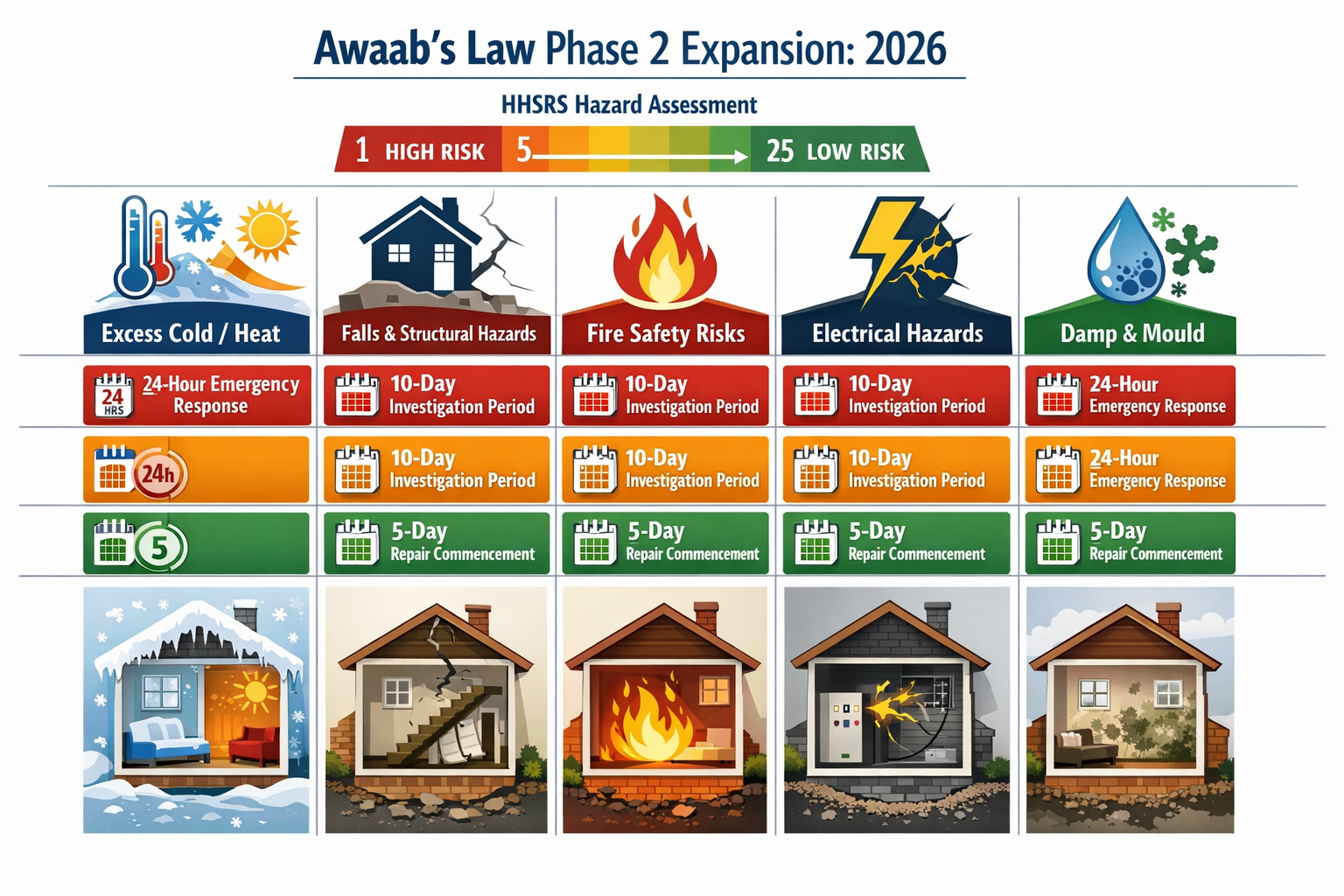
- Five hazard categories now trigger strict compliance timeframes: emergency hazards require 24-hour response, while serious hazards demand 10-day investigation and 5-day repair commencement[5]
- Person-centred assessments consider tenant vulnerabilities, meaning category 2 HHSRS hazards may constitute serious risks requiring expert evaluation beyond standard classifications[4]
- Rental valuations face significant adjustments due to compliance costs, enforcement exposure, and potential rent loss when properties become uninhabitable[2]
- Expert witnesses must provide RICS-aligned evidence demonstrating reasonable lessor knowledge standards and documented investigation findings within 3-working-day reporting requirements[5]
- Documentation protocols create new evidentiary trails that expert witnesses must analyze when assessing landlord compliance and valuation impacts in dispute proceedings
Understanding the 2026 Expansion of Awaab's Law: New Hazard Categories
The 2026 expansion represents the most comprehensive recalibration of rental property obligations in recent UK housing law history. While Phase 1 focused exclusively on damp and mould hazards, Phase 2 extends landlord responsibilities across five distinct hazard categories that significantly broaden the scope of potential disputes requiring expert witness testimony.[1]
The Five Expanded Hazard Categories
Excess Cold or Excessive Heat ❄️🔥
Properties lacking adequate heating systems or experiencing dangerous temperature extremes now trigger specific investigation and repair obligations. Expert witnesses must assess thermal performance, heating system adequacy, and insulation standards when evaluating compliance.
Falls and Structural Hazards 🏚️
Structural defects, unstable stairs, deteriorating balconies, and other fall risks require immediate attention. This category demands structural engineering expertise combined with valuation knowledge to assess repair costs and property value impacts.
Fire Safety Risks 🔥
Fire detection systems, escape routes, fire-resistant materials, and compartmentation standards all fall under this expanded category. Expert witnesses must demonstrate knowledge of fire safety regulations and their intersection with property valuations.
Electrical Hazards ⚡
Faulty wiring, inadequate electrical installations, and non-compliant electrical systems constitute serious hazards requiring rapid response. Electrical safety certificates and testing protocols become critical evidence in disputes.
Original Damp and Mould 💧
The foundational Phase 1 category remains, with established protocols serving as the template for expanded hazard categories.
Emergency vs. Serious Hazard Classifications
The legislation establishes two-tier response requirements that expert witnesses must understand thoroughly:
| Hazard Classification | Response Timeframe | Investigation Period | Repair Commencement |
|---|---|---|---|
| Emergency Hazards | 24 hours to make safe[5] | Immediate | Within 24 hours |
| Serious Hazards | Acknowledge immediately | 10 working days[5] | 5 working days after investigation[5] |
These timeframes create measurable compliance standards that expert witnesses can evaluate objectively when assessing whether landlords met their legal obligations. The distinction between emergency and serious classifications often becomes a central dispute point requiring expert testimony.
Expert Witness Preparation for Awaab's Law Expansion Disputes: Evidence Documentation Standards
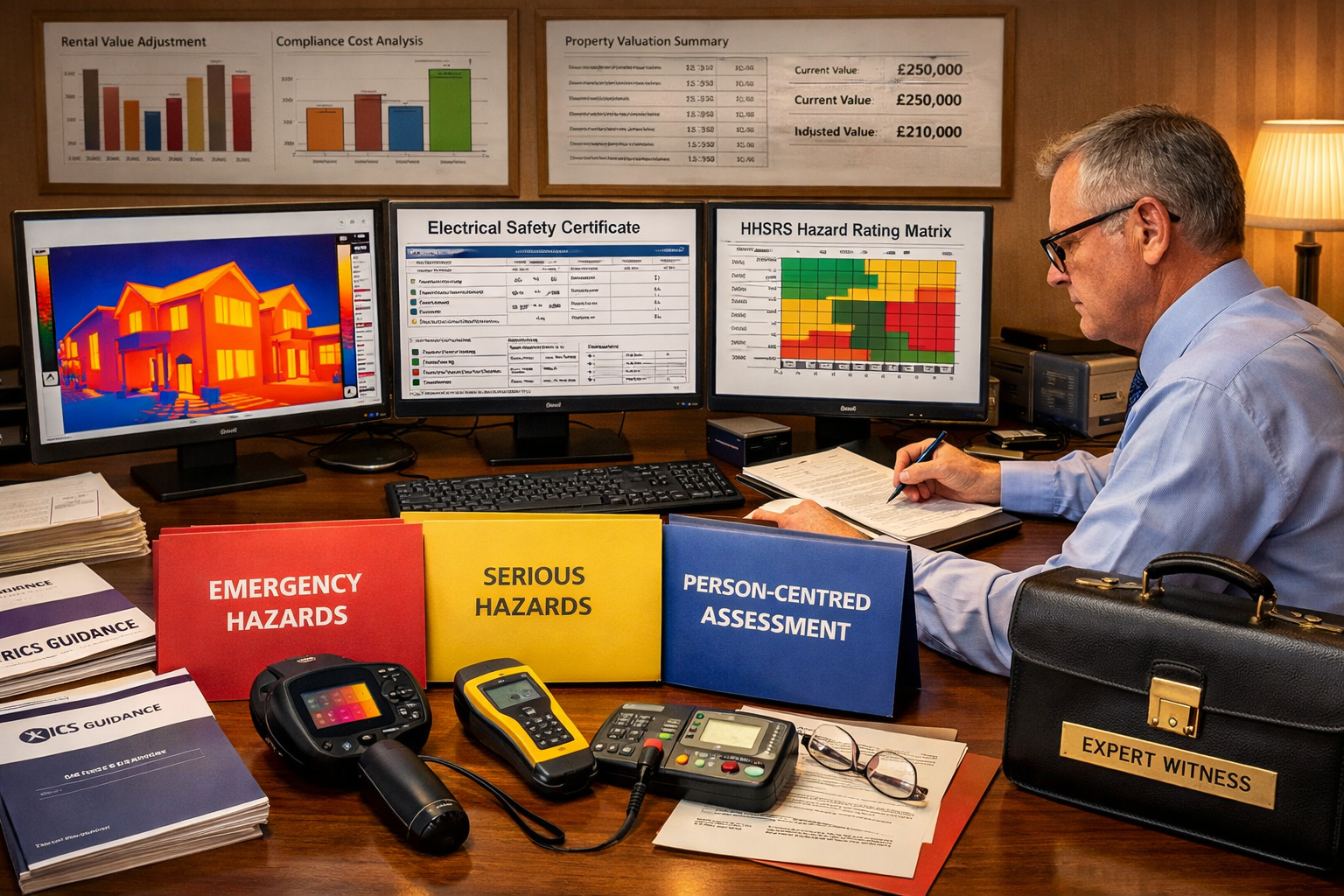
Preparing defensible expert witness testimony for Awaab's Law disputes requires mastering the documented evidence trail that the legislation mandates. The 3-working-day written summary requirement creates a paper trail that expert witnesses must analyze when evaluating landlord compliance.[5]
The Reasonable Lessor Knowledge Standard
Expert witnesses must apply the "reasonable lessor" test when evaluating whether landlords met their obligations. This objective standard considers what knowledge a reasonable landlord would possess regarding:
- Tenant health and circumstances that affect hazard severity[2]
- Property condition through regular inspection protocols
- Hazard indicators that would be apparent to competent property managers
- Industry standards for maintenance and safety compliance
The reasonable lessor standard provides expert witnesses with an objective framework for evaluating landlord conduct rather than subjective interpretations of responsibility. When preparing expert witness reports, professionals must demonstrate how their assessment aligns with this established legal test.
Person-Centred Assessment Methodology
The legislation requires person-centred assessments that consider individual tenant circumstances—a significant departure from purely property-focused evaluations.[4] Expert witnesses must evaluate:
- Tenant age and developmental vulnerabilities (children, elderly residents)
- Health conditions that increase hazard susceptibility (respiratory conditions, mobility limitations)
- Household composition affecting risk exposure
- Duration of exposure to hazardous conditions
This approach means that hazards classified as category 2 under the Housing Health and Safety Rating System (HHSRS) may constitute serious risks requiring urgent response when tenant circumstances elevate vulnerability. Expert witnesses must demonstrate competency in both HHSRS technical assessment and person-centred risk evaluation.
Documentation Requirements for Expert Analysis
Expert witnesses must analyze three critical documentation elements when evaluating compliance:
1. Initial Complaint Documentation 📋
The tenant's original hazard report establishes the timeline for landlord response obligations. Expert witnesses must verify when landlords received notice and whether acknowledgment occurred within required timeframes.
2. Investigation Findings Summary 🔍
Landlords must provide written investigation summaries within 3 working days of completing their assessment.[5] Expert witnesses evaluate whether these summaries demonstrate adequate investigation scope, technical competency, and accurate hazard identification.
3. Repair Commencement Evidence 🔧
Documentation proving repairs began within 5 working days after investigation completion (for serious hazards) provides objective evidence of compliance or breach. Expert witnesses must assess whether documented actions constitute genuine repair commencement versus superficial gestures.
RICS Professional Standards in Awaab's Law Disputes
Expert witnesses must align their assessments with RICS professional standards to ensure testimony withstands cross-examination. This includes:
- Following RICS guidance on property inspection protocols
- Applying consistent valuation methodologies from RICS registered valuers
- Documenting assessment procedures comprehensively
- Maintaining professional indemnity insurance
- Declaring any conflicts of interest
Expert witnesses should reference established RICS frameworks when explaining their methodology, similar to approaches used in matrimonial valuations and other dispute contexts where professional standards govern expert testimony.
2026 Hazard Assessments in Rental Valuations: Financial Impact Analysis
Expert Witness Preparation for Awaab's Law Expansion Disputes: 2026 Hazard Assessments in Rental Valuations requires sophisticated financial analysis demonstrating how hazard compliance affects property values. The Renters' Rights Act 2026, effective 1 May 2026, has triggered "the most significant recalibration of UK rental property valuations," creating substantial valuation adjustment requirements.[6]
Valuation Adjustment Categories
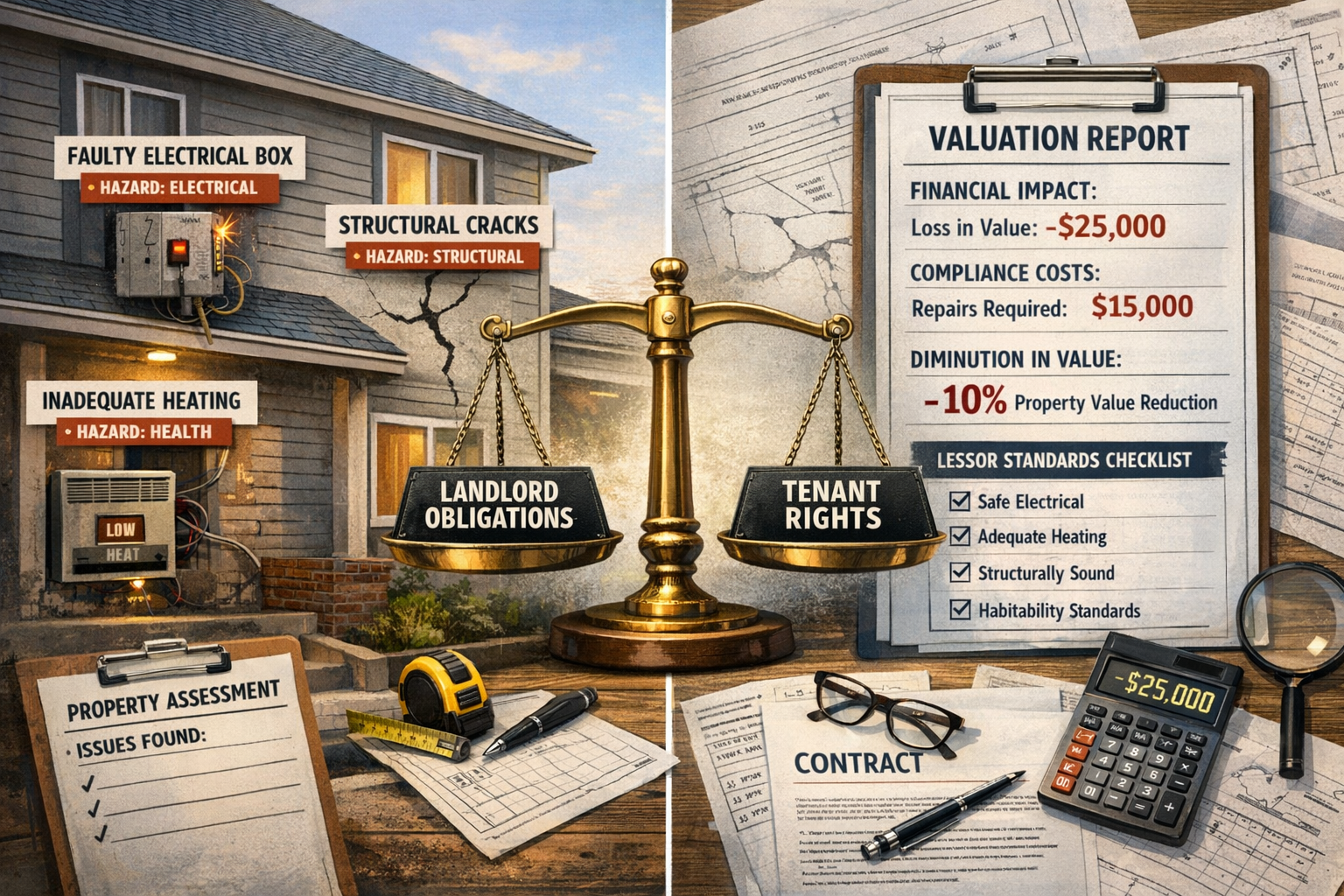
Expert witnesses must quantify four distinct valuation impacts when assessing Awaab's Law compliance:
1. Immediate Compliance Costs 💰
Direct repair and remediation expenses required to address identified hazards. These costs reduce property value through:
- Emergency repair expenditure
- Investigation and assessment fees
- Specialist contractor costs
- Compliance certification expenses
2. Enforcement Exposure ⚖️
Non-compliance creates financial liabilities that expert witnesses must factor into valuations:
- Enforcement orders requiring specific actions
- Compensation payments to affected tenants[2]
- Legal costs from tribunal proceedings[2]
- Potential criminal penalties for serious breaches
3. Rent Loss Periods 📉
Properties may become uninhabitable during remediation, creating rental income loss that affects investment valuations.[2] Expert witnesses must calculate:
- Duration of necessary repairs
- Tenant relocation requirements
- Void period costs
- Re-letting expenses
4. Diminution in Value 📊
Long-term value impacts from compliance obligations affect investment property valuations. Expert witnesses assess:
- Increased maintenance reserves required
- Insurance premium adjustments
- Marketability impacts from compliance history
- Buyer perception of regulatory risk
Comparative Valuation Methodology
Expert witnesses should employ before-and-after valuation comparisons demonstrating the specific impact of Awaab's Law compliance issues. This methodology, similar to approaches used in freehold valuations, provides clear financial quantification of hazard impacts.
The valuation adjustment framework should consider:
- Comparable properties with similar hazard profiles
- Market rent adjustments reflecting compliance status
- Yield compression from increased regulatory risk
- Capital value impacts from remediation costs
Third-Party Contractor Responsibility
A critical principle for expert witness analysis: landlords remain responsible for Awaab's Law compliance even when engaging third-party contractors.[2] This means expert witnesses must evaluate:
- Whether landlords exercised reasonable oversight of contractors
- If contractor selection demonstrated due diligence
- Whether monitoring systems detected non-compliance
- If landlords responded appropriately to contractor failures
This principle prevents landlords from deflecting responsibility through contractor arrangements, creating clear accountability standards that expert witnesses can apply objectively.
Transitional Arrangement Complexities
Government guidance addresses transitional arrangements during the 2026 implementation period, creating potential dispute areas requiring expert interpretation.[2] Expert witnesses must understand:
- Which hazard complaints fall under Phase 1 vs. Phase 2 requirements
- How pre-existing hazards are treated under new timeframes
- Whether landlords receive grace periods for compliance
- How ongoing remediation projects are evaluated
These transitional issues often generate disputes where expert testimony clarifies the applicable standards and reasonable landlord expectations during the implementation period.
Building Defensible Cases: Evidence Collection and Presentation
Expert witnesses must develop comprehensive evidence packages that withstand rigorous cross-examination in Awaab's Law disputes. This requires systematic evidence collection, rigorous analysis, and clear presentation aligned with legal standards.
Technical Assessment Protocols
Hazard Identification and Classification 🔬
Expert witnesses must conduct thorough property inspections using:
- Thermal imaging cameras for temperature and moisture detection
- Electrical testing equipment for safety verification
- Structural assessment tools for stability evaluation
- Environmental monitoring for air quality and ventilation
These technical assessments should follow protocols similar to those used in Level 3 building surveys, providing comprehensive property condition analysis.
HHSRS Scoring Methodology 📈
Expert witnesses must demonstrate competency in Housing Health and Safety Rating System scoring, including:
- Likelihood of occurrence calculations
- Harm outcome assessments
- Category 1 vs. Category 2 classifications
- Person-centred risk adjustments[4]
Photographic and Video Evidence 📸
Visual documentation provides compelling evidence of hazard conditions. Expert witnesses should compile:
- Time-stamped photographs showing hazard severity
- Video walkthroughs demonstrating property conditions
- Before-and-after documentation of remediation work
- Comparative images from similar properties
Expert Report Structure
Effective expert witness reports for Awaab's Law disputes should follow this structure:
Executive Summary
Concise overview of key findings, conclusions, and valuation impacts (1-2 pages maximum)
Expert Qualifications
Professional credentials, relevant experience, RICS membership, and specialist expertise in hazard assessment and valuation
Instructions and Scope
Clear statement of instructions received, scope of investigation, and any limitations on assessment
Factual Background
Chronology of events, property details, tenant circumstances, and complaint documentation
Technical Assessment
Detailed hazard evaluation, HHSRS scoring, person-centred risk analysis, and compliance evaluation against Awaab's Law timeframes
Valuation Analysis
Financial impact quantification, comparable evidence, adjustment methodology, and diminution in value calculations
Conclusions
Clear opinions on compliance status, reasonable lessor standards, and valuation impacts
Appendices
Supporting documentation, technical specifications, photographic evidence, and relevant standards
This structure mirrors best practices from valuation reports while incorporating the specific requirements of Awaab's Law dispute contexts.
Cross-Examination Preparation
Expert witnesses must prepare for rigorous cross-examination by:
Anticipating Challenges 🎯
Identify potential weaknesses in methodology, alternative interpretations of evidence, and competing expert opinions
Supporting Every Conclusion 📚
Ensure every opinion has documented evidence, technical justification, and professional standards support
Maintaining Professional Objectivity ⚖️
Demonstrate independence from instructing parties, acknowledge limitations, and present balanced analysis
Explaining Technical Concepts Clearly 💡
Translate complex technical assessments into accessible language for tribunal members and judges
Collaboration with Legal Teams
Expert witnesses should work closely with instructing solicitors to:
- Understand the specific legal issues in dispute
- Identify critical evidence gaps requiring investigation
- Coordinate evidence presentation strategies
- Prepare joint statements with opposing experts where appropriate
This collaborative approach, similar to processes used in party wall disputes, ensures expert evidence aligns with legal strategy while maintaining professional independence.
Case Study Scenarios: Applying Expert Witness Principles
Scenario 1: Emergency Electrical Hazard Dispute
Situation: Tenant reports exposed wiring in bathroom creating shock risk. Landlord responds within 48 hours rather than required 24 hours.[5]
Expert Witness Analysis:
- Classify exposed wiring as emergency hazard requiring 24-hour response
- Document 48-hour actual response time from complaint records
- Assess whether hazard was "made safe" versus fully remediated
- Calculate tenant exposure risk during 24-48 hour period
- Evaluate reasonable lessor knowledge of electrical system condition
- Quantify valuation impact from compliance breach and enforcement risk
Key Evidence: Electrical safety certificate history, tenant complaint documentation, contractor response records, photographic evidence of hazard severity
Scenario 2: Excess Cold with Vulnerable Tenant
Situation: Elderly tenant with respiratory condition reports inadequate heating during winter months. Landlord argues heating system meets minimum standards but investigation takes 15 working days.[5]
Expert Witness Analysis:
- Apply person-centred assessment considering tenant age and health vulnerability[4]
- Evaluate whether category 2 HHSRS hazard becomes serious risk due to tenant circumstances
- Assess 15-day investigation timeframe against 10-day requirement[5]
- Calculate temperature readings against minimum standards
- Determine reasonable lessor knowledge of tenant health circumstances
- Quantify rental value adjustment for inadequate heating and compliance breach
Key Evidence: Heating system specifications, temperature monitoring data, tenant medical documentation, investigation timeline records, comparable property heating standards
Scenario 3: Structural Hazard Valuation Dispute
Situation: Subsidence causes structural cracking creating fall hazards. Landlord commences repairs 8 working days after investigation completion, exceeding 5-day requirement.[5]
Expert Witness Analysis:
- Classify structural cracking severity under falls and structural hazards category
- Document investigation completion date and repair commencement date
- Assess whether 8-day delay constitutes material breach
- Evaluate structural repair costs and property value impact
- Determine whether property remained habitable during delay
- Calculate diminution in value from structural issues and compliance breach
Key Evidence: Structural engineer reports, repair cost estimates, timeline documentation, property valuation comparisons, habitability assessments
These scenarios demonstrate how expert witnesses must integrate technical assessment, legal compliance evaluation, and valuation analysis when preparing testimony for Awaab's Law disputes. Similar analytical approaches apply across various valuation contexts where expert testimony supports dispute resolution.
Future-Proofing Expert Witness Practice for Evolving Regulations
The 2026 expansion of Awaab's Law represents an ongoing evolution of rental property regulation. Expert witnesses must adopt continuous professional development strategies to maintain competency as legislation develops.
Staying Current with Regulatory Changes
Expert witnesses should:
- Monitor government guidance updates on Awaab's Law implementation and transitional arrangements[2]
- Track tribunal decisions establishing precedents for reasonable lessor standards and compliance interpretation
- Participate in RICS working groups developing professional guidance for hazard assessment and valuation adjustments
- Attend specialist training on emerging hazard categories and assessment methodologies
- Review enforcement action reports from housing regulators to understand compliance trends
Building Specialist Expertise
Expert witnesses can differentiate themselves by developing specialist knowledge in specific hazard categories:
- Thermal performance specialists focusing on excess cold/heat assessments
- Electrical safety experts with advanced certification in electrical hazard evaluation
- Structural engineers specializing in falls and structural hazard assessment
- Fire safety consultants with expertise in fire risk evaluation and compliance
This specialization approach, similar to niche expertise in areas like probate valuations or shared ownership valuations, enhances expert witness credibility and effectiveness.
Technology Integration
Modern expert witness practice should leverage technology tools for enhanced assessment and evidence presentation:
- Thermal imaging software for temperature and moisture analysis
- 3D property scanning for comprehensive condition documentation
- Digital evidence management systems for organizing documentation
- Valuation modeling software for financial impact calculations
- Virtual tribunal presentation tools for remote expert testimony
Professional Network Development
Expert witnesses benefit from collaborative professional networks including:
- Other expert witnesses for peer review and joint statement preparation
- Legal professionals specializing in landlord-tenant disputes
- Technical specialists providing complementary expertise
- Industry associations offering continuing education and standards development
These networks provide knowledge sharing, quality assurance, and professional development opportunities that enhance expert witness effectiveness.
Conclusion
Expert Witness Preparation for Awaab's Law Expansion Disputes: 2026 Hazard Assessments in Rental Valuations demands a sophisticated integration of technical assessment competency, legal knowledge, and valuation expertise. The 2026 expansion to five hazard categories—excess cold/heat, falls and structural hazards, fire safety risks, electrical hazards, and damp/mould—creates significant new dispute territory requiring expert testimony.[1]
The 24-hour emergency response requirement and 10-day investigation timeframe with 5-day repair commencement establish measurable compliance standards that expert witnesses can evaluate objectively.[5] The person-centred assessment approach requires expert witnesses to consider tenant vulnerabilities when evaluating hazard severity, moving beyond purely technical HHSRS classifications.[4]
Expert witnesses must master the reasonable lessor knowledge standard and analyze the documented evidence trail created by 3-working-day written summary requirements.[2][5] Valuation impacts from compliance costs, enforcement exposure, rent loss periods, and diminution in value require sophisticated financial analysis demonstrating the economic consequences of Awaab's Law breaches.
Actionable Next Steps
For Property Professionals Developing Expert Witness Capabilities:
- Obtain specialist training in HHSRS assessment methodology and person-centred risk evaluation
- Develop technical competency in hazard identification using thermal imaging, electrical testing, and structural assessment tools
- Study tribunal decisions establishing precedents for reasonable lessor standards and compliance interpretation
- Build evidence documentation protocols aligned with Awaab's Law timeframe requirements and written summary standards
- Establish professional networks with legal specialists, technical experts, and other expert witnesses
- Invest in technology tools for comprehensive property assessment and evidence presentation
- Pursue RICS certification and maintain continuing professional development in rental property regulation
For Landlords and Property Managers:
- Implement robust hazard monitoring systems across all five expanded hazard categories
- Establish documented investigation protocols meeting 10-day and 3-day reporting requirements
- Develop emergency response procedures for 24-hour hazard mitigation
- Maintain comprehensive property condition records demonstrating reasonable lessor knowledge
- Engage qualified surveyors for regular property assessments and compliance verification
For Legal Professionals:
- Identify expert witnesses with demonstrated competency in Awaab's Law compliance assessment and rental valuations
- Develop evidence collection strategies capturing the documented trail required for dispute proceedings
- Coordinate expert witness instructions clearly defining scope, timeline, and specific legal issues
- Prepare cross-examination strategies addressing technical assessment methodology and valuation assumptions
The 2026 expansion of Awaab's Law represents a fundamental shift in rental property regulation, creating substantial demand for expert witnesses who can provide RICS-aligned, defensible evidence in valuation disputes. Property professionals who develop comprehensive expertise in hazard assessment, compliance evaluation, and valuation adjustment methodologies will find significant opportunities to support dispute resolution through expert testimony.
By mastering the technical, legal, and financial dimensions of Awaab's Law compliance, expert witnesses can provide invaluable clarity in disputes while advancing professional standards that protect both tenant welfare and property owner rights. The framework established in 2026 will likely continue evolving, making continuous professional development and adaptability essential characteristics of effective expert witness practice in this emerging field.
References
[1] Awaabs Law Timeline – https://www.glplaw.com/2026/01/23/awaabs-law-timeline/
[2] Awaabs Law Comes Into Force What Does It Mean For Construction – https://www.trowers.com/insights/2025/november/awaabs-law-comes-into-force-what-does-it-mean-for-construction
[3] Awaab S Law What It Means For Landlords Tenants How Nuven Surveyors Can Help – https://www.nuvensurveyors.co.uk/blog/awaab-s-law-what-it-means-for-landlords-tenants-how-nuven-surveyors-can-help/
[4] Awaabs Law Guidance For Social Landlords Timeframes For Repairs In The Social Rented Sector – https://www.gov.uk/government/publications/awaabs-law-guidance-for-social-landlords/awaabs-law-guidance-for-social-landlords-timeframes-for-repairs-in-the-social-rented-sector
[5] Awaabs Law What You Need To Know – https://hamlins.com/insight/awaabs-law-what-you-need-to-know/
[6] Valuation Adjustments For Renters Rights Act 2026 How Building Surveyors Must Assess Landlord Tenant Compliance – https://nottinghillsurveyors.com/blog/valuation-adjustments-for-renters-rights-act-2026-how-building-surveyors-must-assess-landlord-tenant-compliance
