
Between November 2025 and February 2026, the Property Ombudsman received 58% more complaints than during the same period the previous year — a surge directly attributed to heightened tenant awareness following the Renters' Rights Act [4]. That single statistic explains why expert witness roles in private rented sector ombudsman disputes, and the building survey evidence produced under 2026 reforms, have become one of the most consequential areas of practice for chartered surveyors in England today.
The abolition of Section 21 "no-fault" evictions, mandatory Private Rented Sector (PRS) Database registration, and a new tiered penalty structure have reshaped the dispute landscape overnight. Landlords, agents, and tenants now routinely require independent technical evidence to resolve disagreements that range from alleged hazards and disrepair to deposit deductions and compliance failures. This guide explains what that evidence must look like, how it must be structured, and what surveyors need to do to meet the demands of the new regime.
Key Takeaways
- The Renters' Rights Act 2026 has driven a 58% surge in ombudsman complaints, making competent expert witness evidence more critical than ever.
- Mandatory PRS Database registration carries fines of up to £40,000, and expert surveyors are central to defending or challenging compliance assessments.
- RICS updated its Accredited Expert Witness Service register in March 2026, introducing formal voluntary standards and a minimum 20-hour annual CPD requirement.
- CPR Part 35-compliant report structures are now the baseline expectation for building survey evidence submitted to the PRS Ombudsman.
- AI-assisted valuation data appears in over 60% of property disputes, and surveyors must now address this evidence under the RICS "Responsible Use of Artificial Intelligence" standard.
The New Dispute Landscape: Why 2026 Changed Everything
The Renters' Rights Act fundamentally altered the power dynamics of the private rented sector. Section 21 "no-fault" evictions are gone. In their place sits a mandatory grounds-based possession system, a new PRS Ombudsman with statutory authority, and a database requiring landlords to register property details, safety certifications, and compliance records by late 2026 [1].
For surveyors, the practical consequence is clear: disputes that previously ended with a landlord serving notice now proceed to adjudication. The ombudsman must weigh competing factual claims about property condition, regulatory compliance, and financial loss. Without independent technical evidence, neither party can adequately support their position.
The key changes driving demand for expert witnesses include:
- Abolition of Section 21 creating a contested possession environment
- Mandatory PRS Database registration with fines up to £40,000 for non-compliance [1]
- The Decent Homes Standard extended to the private rented sector
- A tiered penalty structure where serious offences attract maximum financial sanctions [5]
- Statutory ombudsman membership now compulsory for all private landlords
The Property Ombudsman has publicly welcomed the new tenant protections while acknowledging the need to help landlords adapt to extensive regulatory change [8]. That adaptation, in many cases, will require professional surveying input.
What Expert Witnesses Actually Do in PRS Ombudsman Cases
An expert witness in a PRS ombudsman dispute is not an advocate. Their duty runs to the ombudsman — not to the party who instructed them. This distinction, emphasised by RICS and rooted in Civil Procedure Rules (CPR) Part 35, is the foundation of credible expert evidence [7].
In practice, expert witnesses in these disputes are called upon to perform several distinct functions:
Condition Assessment and Defect Analysis
The most common instruction involves assessing the physical condition of a rental property. This means distinguishing between:
- Fair wear and tear — the gradual deterioration expected from normal occupation
- Tenant-caused damage — deterioration beyond what reasonable use would produce
- Landlord disrepair — failures to maintain the property to the required standard [5]
A Level 3 building survey provides the most thorough framework for this kind of assessment, examining structural elements, roof coverings, drainage, damp, and internal finishes in detail. Where a dispute centres on the extent and cause of defects, this depth of investigation is often necessary to produce defensible conclusions.
Compliance and Regulatory Assessment
Under the 2026 reforms, expert witnesses are also asked to evaluate whether landlords and agents have complied with statutory requirements. This includes assessing whether:
- Gas safety, electrical installation condition, and energy performance certificates are current
- The property meets the Decent Homes Standard
- Possession procedures followed the correct statutory grounds
- PRS Database entries accurately reflect the property's condition and certification status [5]
Fines of up to £40,000 for serious non-compliance mean the financial stakes of these assessments are substantial [1]. An expert's opinion on whether a landlord's record-keeping was adequate, or whether a reported defect met the threshold for statutory intervention, can determine the outcome of a case.
Valuation and Financial Loss Evidence
Disputes frequently involve quantifying financial loss — whether that is the cost of remedial works, a reduction in rental value during a period of disrepair, or the value of a deposit deduction. Surveyors providing this evidence must be familiar with both valuation methodology and the specific requirements of CPR Part 35 [3].
For a thorough understanding of how dilapidations surveys inform financial assessments in tenancy disputes, the principles are directly applicable to ombudsman proceedings.
Building CPR-Compliant Reports for the PRS Ombudsman
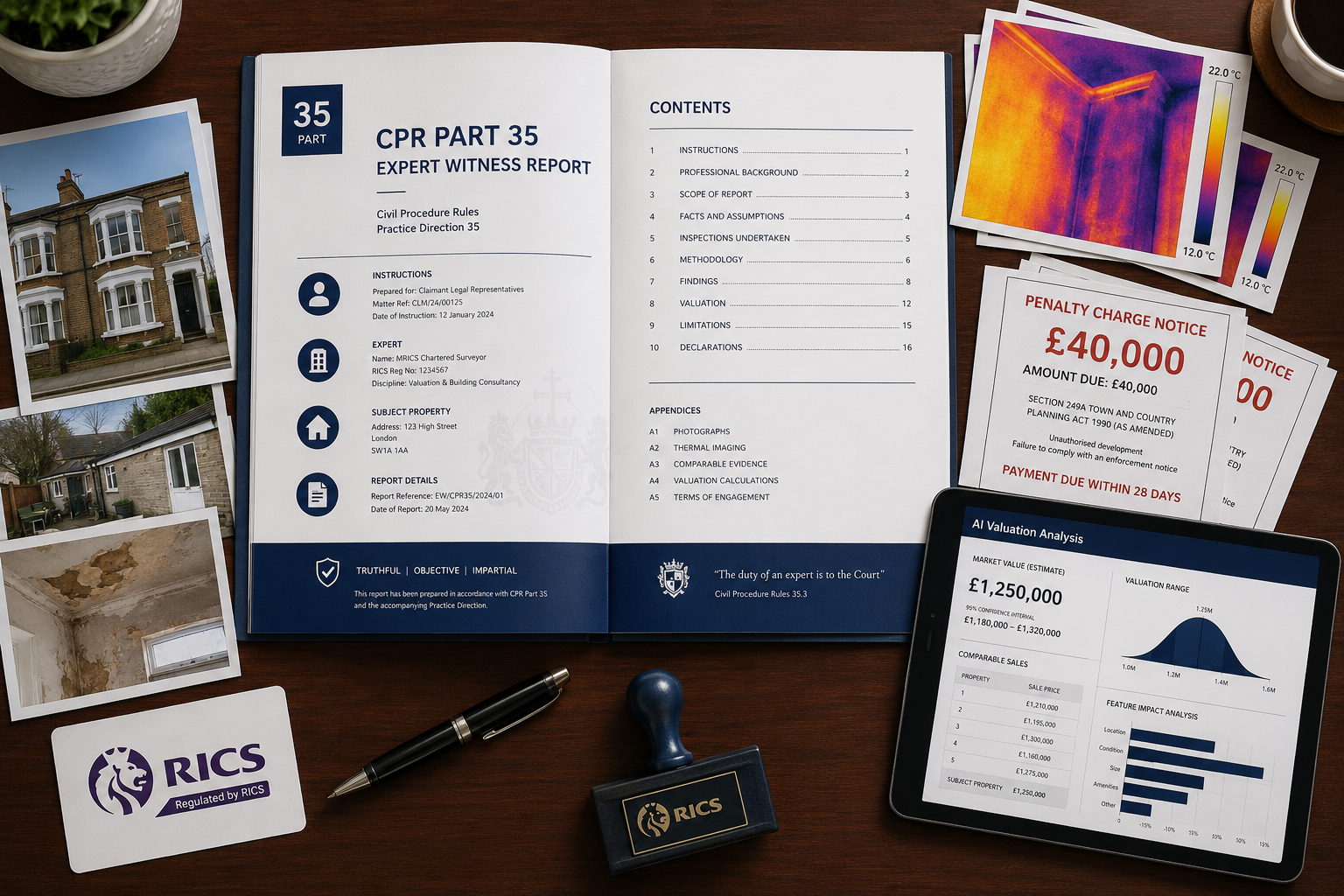
The structure of an expert witness report is not optional. CPR Part 35 sets out mandatory requirements, and the PRS Ombudsman expects submissions that meet these standards. A report that fails on procedural grounds will be given reduced weight — or disregarded entirely.
Mandatory Report Components
| Component | Requirement |
|---|---|
| Statement of Truth | Confirming the expert's duty to the court/ombudsman |
| Qualifications and Experience | Demonstrating relevant expertise in the defect type |
| Instructions Received | Summary of the questions the expert was asked to address |
| Facts and Assumptions | Clear separation of observed facts from assumptions |
| Analysis and Opinion | Reasoned conclusions tied to evidence |
| Limitations | Acknowledgement of what could not be assessed |
| Declaration of Independence | Confirmation the report is not influenced by the instructing party |
RICS updated its Accredited Expert Witness Service (EWAS) register in March 2026, establishing formal voluntary standards for chartered surveyors providing expert evidence in civil proceedings [2]. These standards reinforce the CPR framework and add RICS-specific requirements around methodology transparency and professional conduct.
Addressing AI-Generated Evidence
Over 60% of property disputes now involve algorithmically generated valuation data [3]. This creates a specific challenge for expert witnesses: how to engage with AI-produced evidence in a way that is both technically credible and procedurally compliant.
RICS introduced its "Responsible Use of Artificial Intelligence" standard in March 2026. Under this standard, surveyors presenting AI-assisted evidence must:
- Disclose the AI tool used and its limitations
- Explain how the output was verified against manual analysis
- Confirm that the expert's professional judgement — not the algorithm — forms the opinion [3]
Failure to address AI-generated data in opposing submissions can undermine an expert's credibility. Surveyors must be prepared to cross-examine algorithmic outputs with the same rigour applied to traditional comparable evidence.
RICS Standards and Professional Development Requirements in 2026
The 2026 reforms have raised the bar for who can credibly act as an expert witness in PRS ombudsman disputes. RICS now mandates that expert witnesses demonstrate specific experience in relevant defect types and construction methodologies [6]. Generic surveying experience is no longer sufficient.
Key professional requirements include:
- A minimum of 20 hours of continuing professional development annually, focused specifically on expert witness skills and legal procedures [6]
- Demonstrated experience in the specific defect category relevant to the dispute (damp, structural movement, fire safety, etc.)
- Familiarity with the Renters' Rights Act 2026, the Decent Homes Standard, and PRS Database compliance requirements
- Registration on the RICS EWAS register for those regularly providing expert evidence [2]
RICS members considering expert witness services must be fully aware of the role's complexities, including the potential for intense scrutiny and the absolute requirement for impartiality [7]. An expert who appears to advocate for their instructing party risks having their evidence dismissed and their professional standing questioned.
Surveyors who want to understand the broader scope of their professional obligations should review what a surveyor does across roles and responsibilities — a useful baseline for those expanding into expert witness work.
Common Dispute Types and the Evidence They Require
Damp, Mould, and Hazard Disputes
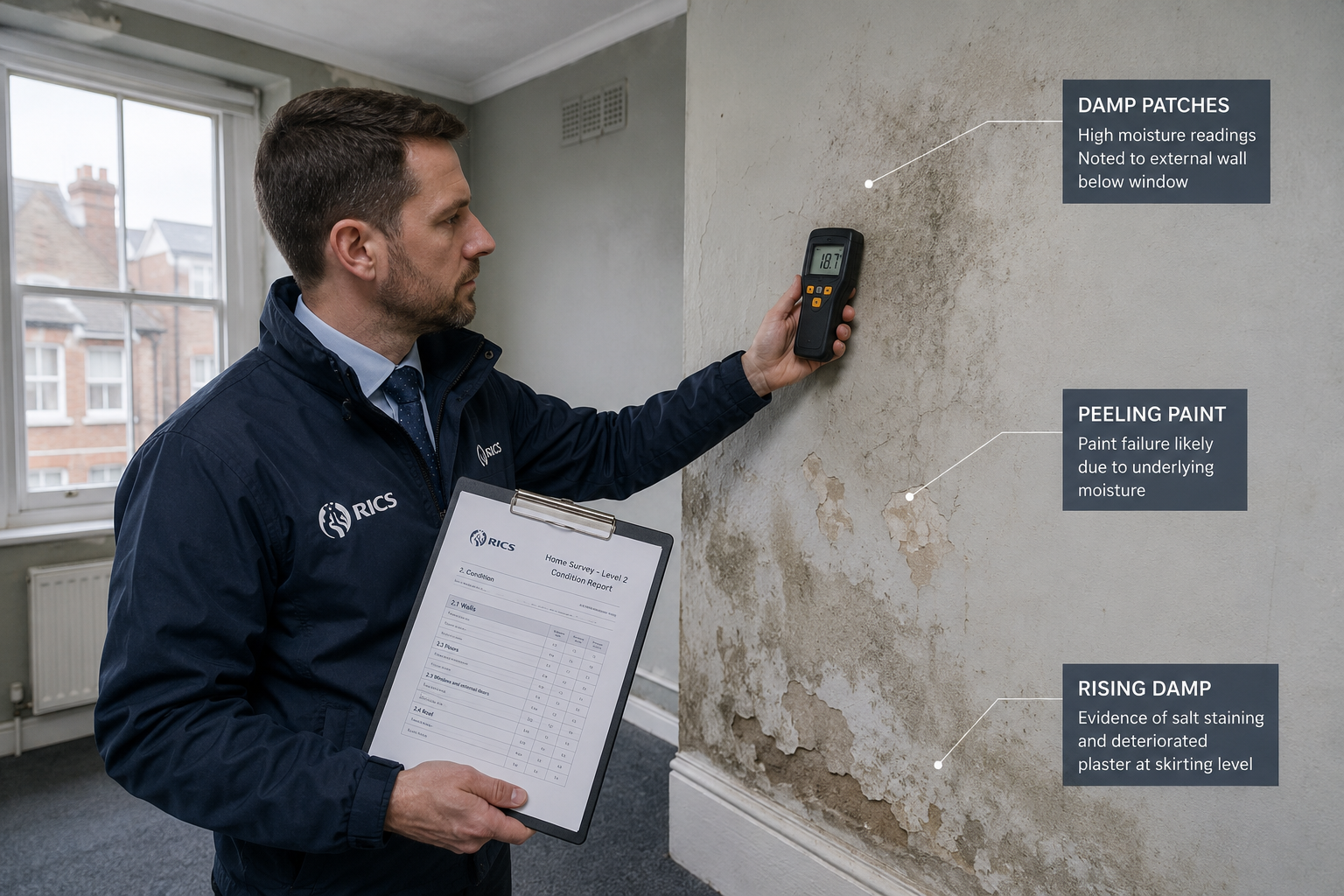
These are among the most contested categories in PRS ombudsman cases. Following the Awaab's Law provisions embedded in the Renters' Rights Act, landlords face strict timelines for investigating and remedying damp and mould. Expert witnesses must:
- Identify the source of moisture (rising damp, penetrating damp, condensation, or plumbing failure)
- Assess whether the condition constitutes a Category 1 hazard under the Housing Health and Safety Rating System (HHSRS)
- Quantify the remedial works required and their cost
A specialist damp survey provides the technical foundation for this analysis, using moisture meters, thermal imaging, and visual inspection to produce defensible conclusions.
Structural Defects and Disrepair
Where disputes involve structural movement, roof failure, or significant disrepair, the expert witness must demonstrate that their assessment methodology is appropriate for the complexity of the defect. A structural survey — examining foundations, load-bearing elements, and the building envelope — provides the depth of investigation required to support expert opinions in these cases.
Deposit Deductions and End-of-Tenancy Condition
Deposit disputes remain the highest volume category in ombudsman caseloads. Expert witnesses are asked to assess the condition of a property at the end of a tenancy against its condition at the start, using:
- Check-in and check-out inventories
- Photographic evidence
- Independent inspection findings
- Schedules of dilapidations [5]
The dilapidations survey framework is directly applicable here, providing a structured methodology for separating fair wear and tear from compensable damage.
Practical Guidance for Landlords, Tenants, and Agents
Understanding expert witness roles in private rented sector ombudsman disputes under the 2026 reforms is not just a matter for surveyors. Landlords, tenants, and managing agents all need to know how to engage with this process effectively.
For landlords:
- Commission a pre-tenancy condition report from a qualified chartered surveyor to establish a defensible baseline
- Maintain PRS Database records accurately and update them promptly when certifications are renewed
- If a dispute arises, instruct an expert witness early — before positions become entrenched
- Do not instruct a surveyor who will simply support your position; the ombudsman will identify advocacy and discount the evidence
For tenants:
- Document property condition at the start of the tenancy with dated photographs
- Report defects in writing and retain copies of all correspondence
- If a landlord disputes your account of the property's condition, a condition survey from an independent surveyor provides the technical evidence needed to support your complaint
For managing agents:
- Ensure all compliance certifications are current and accurately recorded on the PRS Database
- Understand that the tiered penalty structure means regulatory failures carry significant financial consequences [5]
- Where disputes involve complex technical questions, refer to a chartered surveyor rather than attempting to resolve condition disputes through inventory clerks alone
For those involved in disputes where shared structures are relevant, understanding how party wall surveyors resolve property disputes provides useful context on the impartial expert model that the PRS ombudsman process mirrors.
Conclusion
Expert witness roles in private rented sector ombudsman disputes, and the building survey evidence produced under 2026 reforms, sit at the intersection of technical expertise, legal procedure, and regulatory compliance. The Renters' Rights Act has not simply added new rules — it has created a dispute environment where the quality of independent professional evidence will determine outcomes for landlords, tenants, and agents alike.
Actionable next steps:
- Surveyors: Register with the RICS EWAS, complete the mandatory 20-hour annual CPD requirement, and ensure your reports meet CPR Part 35 requirements before accepting expert witness instructions.
- Landlords: Audit your PRS Database registration now, commission a pre-tenancy condition survey for all new lettings, and identify a qualified expert witness before disputes arise.
- Tenants: Document property condition thoroughly at the start and end of every tenancy. If a dispute involves technical questions about defects or hazards, seek independent surveying advice.
- Agents: Review your compliance procedures against the Renters' Rights Act 2026 requirements, paying particular attention to the tiered penalty structure and the Decent Homes Standard.
The ombudsman process is designed to be accessible — but the evidence it relies upon must be technically rigorous. In 2026, that means commissioning expert building survey evidence that is impartial, CPR-compliant, and grounded in current RICS standards.
References
[1] Expert Witness Valuations For Prs Database Compliance Disputes Defending Assessments Post Renters Rights Act Registration – https://manchestersurveyors.com/expert-witness-valuations-for-prs-database-compliance-disputes-defending-assessments-post-renters-rights-act-registration/?utm_source=openai
[2] Building Surveyors As Expert Witnesses Evidence Standards For Construction Claims And Dilapidations In 2026 – https://wimbledonsurveyors.com/building-surveyors-as-expert-witnesses-evidence-standards-for-construction-claims-and-dilapidations-in-2026/?utm_source=openai
[3] Expert Witness Roles Under New Rics Ai Standards 2026 Cpr Protocols For Tech Enhanced Valuation Evidence – https://manchestersurveyors.com/expert-witness-roles-under-new-rics-ai-standards-2026-cpr-protocols-for-tech-enhanced-valuation-evidence/?utm_source=openai
[4] Renters Rights Effect Drives Unprecedented Demand Dispute Resolution – https://www.tpos.co.uk/2026/03/renters-rights-effect-drives-unprecedented-demand-dispute-resolution/?utm_source=openai
[5] Expert Witness Roles In Private Rented Sector Ombudsman Disputes Preparing For Renters Rights Act 2026 Cases – https://kingstonsurveyors.com/expert-witness-roles-in-private-rented-sector-ombudsman-disputes-preparing-for-renters-rights-act-2026-cases/?utm_source=openai
[6] Expert Witness Roles In New Build Defect Disputes Rics Standards For 2026 Warranty Claims – https://manchestersurveyors.com/expert-witness-roles-in-new-build-defect-disputes-rics-standards-for-2026-warranty-claims/?utm_source=openai
[7] Expert Witness Duties Responsibilities – https://ww3.rics.org/uk/en/journals/built-environment-journal/expert-witness-duties-responsibilities.html?utm_source=openai
[8] Ombudsman Welcomes Rental Reforms – https://www.tpos.co.uk/2026/04/ombudsman-welcomes-rental-reforms/?utm_source=openai
