
Fewer than 5% of private rental sector (PRS) properties in England that fail Housing Health and Safety Rating System (HHSRS) assessments ever reach formal tribunal proceedings — yet since Awaab's Law came into force, that number is rising sharply. Expert Witness Roles in Awaab's Law PRS Hazard Disputes: Preparing Evidence for New Excess Cold and Fire Risks Post-2026 have moved from a niche specialism into a front-line professional responsibility for chartered surveyors across England and Wales. The expanded hazard categories introduced post-2026, particularly excess cold and fire risks, demand a level of evidentiary rigour that many practitioners are still catching up with.
Key Takeaways
- Awaab's Law post-2026 extends mandatory hazard enforcement to excess cold and fire risks in private rented properties, significantly increasing the volume and complexity of tribunal disputes.
- Expert witnesses must comply with Civil Procedure Rules (CPR) Part 35, RICS professional standards, and HHSRS methodology to produce credible, court-ready evidence.
- An expert's primary duty is to the tribunal, not to the instructing party — impartiality is non-negotiable under RICS protocols.
- Thermal imaging, moisture mapping, and AI-assisted analysis are transforming evidence quality, but professional judgment remains paramount.
- Continuous professional development (CPD) in multi-hazard assessment and cross-examination technique is now essential for surveyors accepting expert witness instructions.
Understanding Awaab's Law and Its Post-2026 Hazard Extensions
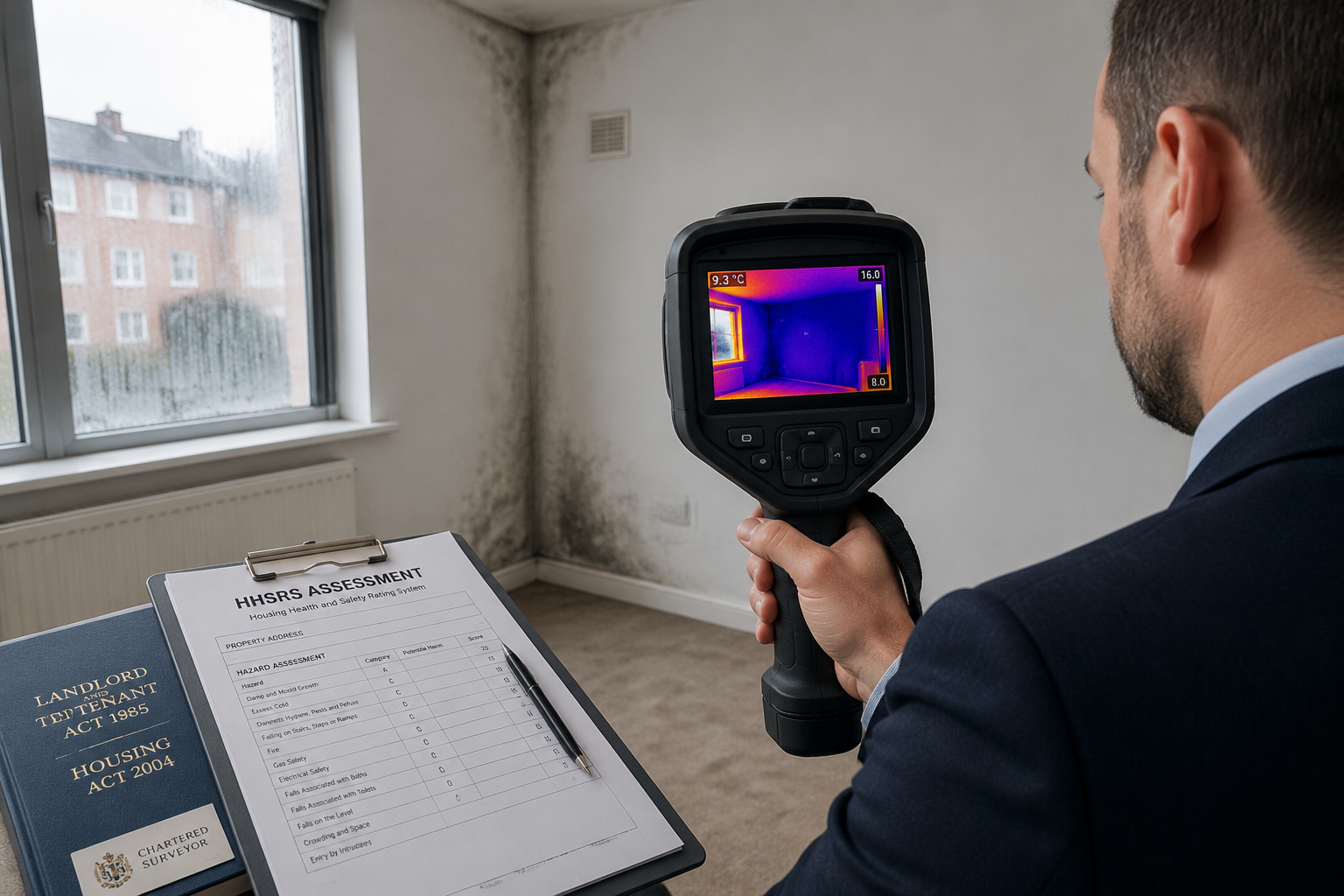
Awaab's Law takes its name from Awaab Ishak, a two-year-old boy who died in 2020 as a direct result of prolonged exposure to mould and damp in a social housing flat in Rochdale. The legislation, embedded within the Social Housing (Regulation) Act 2023 and subsequently extended to the private rented sector, imposes strict statutory timelines on landlords to investigate and remediate hazards. From 2026 onwards, the scope of mandatory enforcement has broadened considerably, bringing excess cold and fire risks firmly within the regulated hazard framework [1].
For expert witnesses operating in PRS dispute resolution, this expansion is significant. Where previously a surveyor might be instructed primarily on damp and mould cases, post-2026 instructions now routinely cover:
- Excess cold — inadequate heating systems, poor thermal insulation, cold bridging, and single-glazed windows in older stock
- Fire risks — defective electrical installations, blocked escape routes, absent or non-functional smoke detection, and combustible materials in communal areas
- Structural collapse — deteriorating load-bearing elements linked to long-term disrepair
- Explosion hazards — faulty gas appliances requiring Gas Safe registered engineer collaboration [4]
Understanding the HHSRS methodology is foundational. The system evaluates 29 potential hazards by calculating a likelihood score multiplied by a harm weighting, producing a banded risk rating. Expert witnesses must demonstrate command of this framework in every report they produce, as tribunals now treat HHSRS compliance as a baseline requirement rather than an optional enhancement [2].
For surveyors unfamiliar with the breadth of technical assessments now required, reviewing what surveyors do across their roles and responsibilities provides useful context on the professional landscape.
The Legal Framework Governing Expert Witness Roles in Awaab's Law PRS Hazard Disputes
CPR Part 35 Compliance
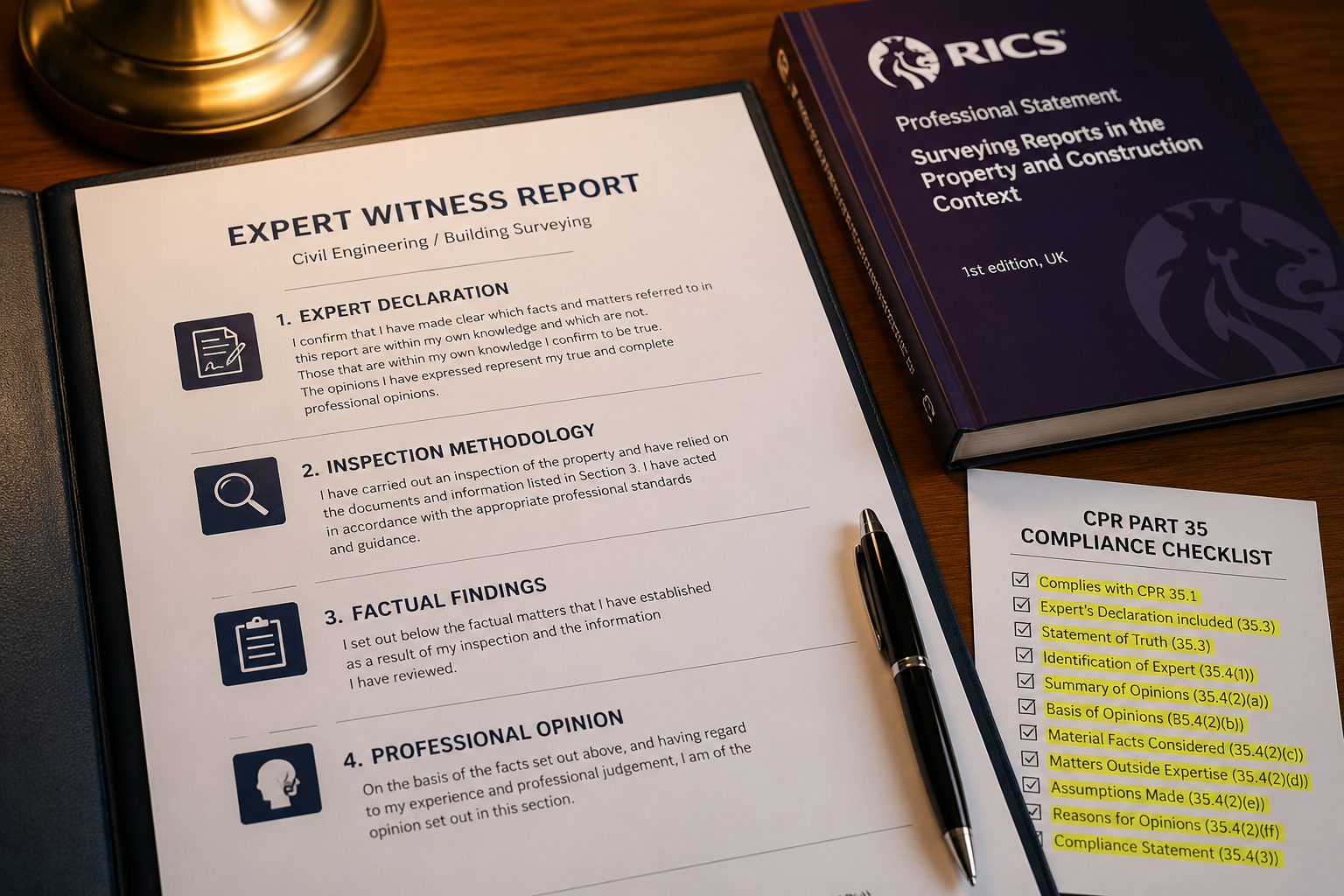
Expert witnesses in England and Wales are bound by Civil Procedure Rules Part 35, which governs the duties, form, and content of expert evidence. The overriding obligation is clear: the expert's duty is to the court or tribunal, not to the party that instructed and is paying them. This principle is reinforced by RICS protocols, which require that fees are never contingent on case outcomes and that the expert maintains full independence from litigation results [2].
A CPR Part 35-compliant expert report must include:
| Report Element | Requirement |
|---|---|
| Expert's declaration | Signed statement of independence and understanding of duties |
| Qualifications and experience | Relevant credentials and specialism |
| Inspection methodology | Dates, access conditions, equipment used |
| Factual findings | Objective observations, photographic evidence |
| Professional opinion | Clearly separated from facts, with reasoning |
| Statement of truth | Signed confirmation of accuracy |
Failure to separate factual findings from professional opinion is one of the most common grounds on which opposing counsel challenges expert evidence in housing tribunal proceedings [1].
RICS Professional Standards
The RICS Guidance Note on Expert Witness Services sets out enhanced reporting standards that go beyond CPR Part 35 minimums. Reports must be structured to withstand rigorous cross-examination, which in post-2026 Awaab's Law cases increasingly involves technical challenges to thermal imaging data, HHSRS scoring methodology, and the causal link between landlord inaction and tenant harm [1].
Surveyors accepting expert witness instructions should also be familiar with the RICS "Surveying Safely" guidance, particularly where inspections involve hazardous conditions such as properties with suspected structural instability or fire-damaged elements.
For those considering the full scope of professional responsibilities involved, the complete guide to what a party wall surveyor does, including roles and legal requirements, illustrates how legal frameworks shape surveying practice more broadly.
Preparing Evidence for Excess Cold and Fire Risks: Practical Standards
Excess Cold Evidence Preparation
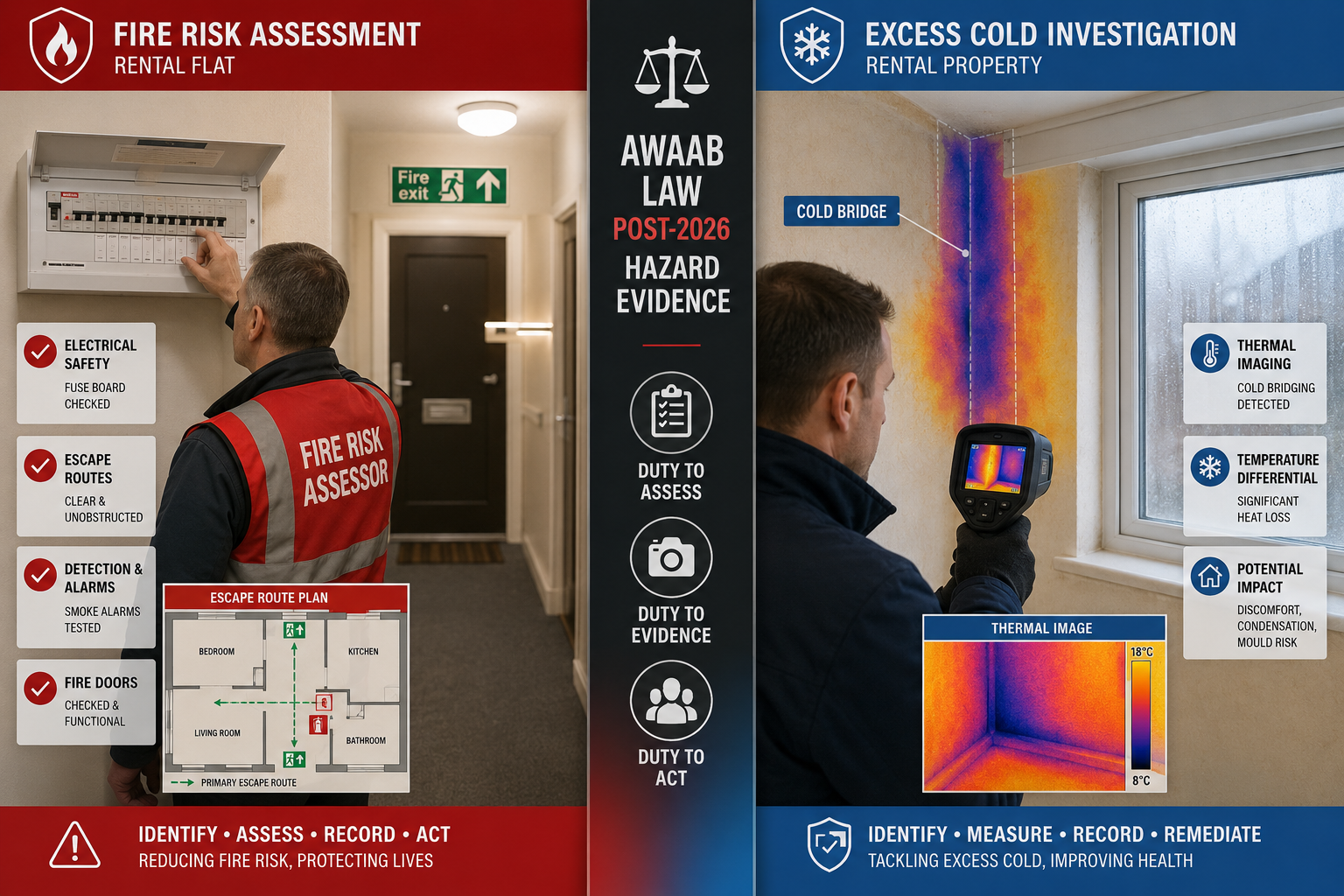
Excess cold is classified as a Category 1 hazard under HHSRS when it poses a significant risk of harm to the most vulnerable occupants — typically the elderly, very young children, or those with respiratory conditions. Post-2026, expert witnesses are expected to produce evidence that goes well beyond a visual inspection note.
Core evidence components for excess cold cases include:
- Thermal imaging surveys using calibrated infrared cameras, producing documented heat-loss maps of walls, floors, and ceilings
- U-value calculations for external walls, roofs, and glazing
- Boiler and heating system inspection records, including efficiency ratings and age
- Internal temperature monitoring logs over a minimum representative period
- Moisture mapping to distinguish condensation-driven cold from structural damp
Emerging technologies are transforming the quality of this evidence. Thermal imaging cameras, moisture mapping systems, and AI-assisted analysis tools can enhance both the precision and the defensibility of expert findings [3]. However, a critical professional principle applies: technology supplements professional judgment, it does not replace it. A tribunal will scrutinise the expert's interpretation of data as much as the data itself.
When instructing a chartered surveyor for an Awaab's Law dispute, landlords and tenants alike should confirm that the surveyor holds specific competency in HHSRS assessment and thermal diagnostics.
Fire Risk Evidence Preparation
Fire safety expert witnesses are among the most sought-after specialists in post-2026 PRS disputes [5]. Their evidence typically addresses:
- Fire origin and cause analysis — particularly relevant where a fire has already occurred
- Fire protection engineering — adequacy of passive and active fire suppression measures
- Life safety evaluations — escape route viability, door fire ratings, alarm coverage
- Code compliance — alignment with Regulatory Reform (Fire Safety) Order 2005 and post-Grenfell secondary legislation
"Opinions provided by expert witnesses must be grounded in verifiable evidence rather than speculation. Proper evidence collection, documentation, and adherence to chain of custody protocols are essential to maintain credibility." [2]
For fire risk cases, interdisciplinary coordination is frequently required. Electrical installation condition reports (EICRs) from qualified electricians, gas safety certificates from Gas Safe registered engineers, and structural assessments from building engineers may all need to be integrated into a single coherent expert report [4]. The expert witness must be capable of synthesising these inputs without overstepping the boundaries of their own specialism.
Surveyors who also undertake dilapidation surveys will recognise the overlap between disrepair documentation and hazard evidence — both require methodical condition recording with clear photographic schedules.
Impartiality, Professional Liability, and Risk Management
Maintaining Independence Under Pressure
In contested Awaab's Law disputes, expert witnesses frequently face pressure — sometimes subtle, sometimes explicit — from instructing parties who have a financial stake in the outcome. RICS protocols are unambiguous: the expert's primary duty is to the tribunal [2]. Any departure from this principle risks not only the credibility of the evidence but also the expert's professional standing.
Practical steps to maintain documented independence include:
- Retaining all correspondence with the instructing party
- Documenting any requests to modify opinions and the expert's response
- Ensuring the fee agreement contains no performance-related element
- Disclosing any prior relationship with the instructing party in the report itself
Professional Liability Exposure Post-2026
The expanded scope of Awaab's Law materially increases professional liability exposure for expert witnesses [3]. An inadequate or inaccurate expert report can lead to:
- Negligence claims — where a party suffers financial loss as a result of flawed expert testimony
- RICS disciplinary action — including suspension or removal from the register
- Reputational damage — in a specialist market where repeat instructions depend on credibility
Maintaining adequate professional indemnity (PI) insurance is essential. Surveyors should review their PI policy limits specifically in light of Awaab's Law instructions, as the damages at stake in PRS hazard disputes — particularly where personal injury or death is alleged — can be substantial.
For surveyors who also provide schedule of condition guidance or stock condition surveys for landlords, it is worth noting that pre-tenancy condition records can become critical evidence in subsequent Awaab's Law disputes. Thorough documentation at the outset of a tenancy can either support or undermine a landlord's defence.
Expert Witness Roles in Awaab's Law PRS Hazard Disputes: Building Competency Post-2026
Continuous Professional Development Requirements
Remaining effective as an expert witness in Awaab's Law disputes is not a static achievement. The legislative landscape, tribunal procedures, and assessment technologies are all evolving rapidly. RICS and the broader surveying profession now expect practitioners to demonstrate ongoing CPD in the following areas [3]:
- Multi-hazard HHSRS assessment techniques
- Updated knowledge of Awaab's Law enforcement mechanisms and statutory timelines
- Cross-examination technique and tribunal advocacy skills
- Collaborative practice with fire engineers, gas engineers, and structural specialists
- Ethical obligations under CPR Part 35 and RICS standards
Structuring the Expert Report for Maximum Credibility
A well-structured expert report in an Awaab's Law excess cold or fire risk case follows a logical hierarchy that mirrors the tribunal's decision-making process:
- Instructions and scope — what the expert was asked to assess and by whom
- Methodology — how the inspection was conducted, what equipment was used, what records were reviewed
- Factual findings — a neutral, evidence-based account of conditions observed
- HHSRS assessment — scored hazard evaluation with full workings shown
- Professional opinion — the expert's conclusions, clearly labelled as opinion
- Recommendations — remediation steps, where instructed to provide them
- Expert declaration and statement of truth
This structure ensures that the report is both CPR Part 35-compliant and resistant to the most common lines of cross-examination challenge [1].
Surveyors who carry out RICS home surveys will be familiar with the discipline of structured condition reporting. Expert witness reports demand a higher degree of legal precision, but the underlying methodology — systematic inspection, evidence-based findings, professional judgment — is consistent.
Interdisciplinary Coordination in Complex Cases
No single expert can credibly cover every hazard category that Awaab's Law now encompasses. In cases involving explosion risks or structural collapse alongside excess cold and fire, the lead expert witness must coordinate effectively with other specialists [4]. This coordination requires:
- Clear agreement on scope boundaries between disciplines
- Consistent factual records to avoid contradictory findings
- A single point of integration for the tribunal report
- Documented chain of custody for all physical evidence and test results
Surveyors who also undertake structural engineering assessments are well-positioned to act as lead coordinators in complex multi-hazard cases, provided they maintain clear boundaries between their own expert opinion and the opinions of co-instructed specialists.
Conclusion
Expert Witness Roles in Awaab's Law PRS Hazard Disputes: Preparing Evidence for New Excess Cold and Fire Risks Post-2026 represent one of the most demanding and consequential areas of surveying practice in 2026. The stakes — for tenants living in hazardous conditions, for landlords facing enforcement action, and for the expert witnesses whose professional reputations depend on the quality of their evidence — have never been higher.
Actionable next steps for surveyors and property professionals:
- Review current RICS guidance on expert witness services and confirm CPR Part 35 compliance in all report templates
- Invest in thermal imaging and moisture mapping equipment, and obtain certified training in their use for HHSRS evidence purposes
- Audit professional indemnity insurance coverage specifically for Awaab's Law dispute instructions
- Build relationships with Gas Safe engineers, fire safety engineers, and structural specialists to support multi-hazard coordination
- Undertake targeted CPD on HHSRS scoring methodology, Awaab's Law statutory timelines, and cross-examination technique
- Ensure all pre-tenancy condition records are thorough and photographic, as these routinely become evidence in subsequent disputes
The surveyors who invest in these competencies now will be best placed to serve the courts, the profession, and ultimately the tenants whose safety Awaab's Law was designed to protect.
References
[1] Expert Witness Challenges In Awaabs Law 2026 Hazard Extensions Evidence Standards For Excess Cold Falls And Fire Risks – https://wimbledonsurveyors.com/expert-witness-challenges-in-awaabs-law-2026-hazard-extensions-evidence-standards-for-excess-cold-falls-and-fire-risks/?utm_source=openai
[2] Expert Witness Challenges In Awaabs Law 2026 Disputes Testifying On Expanded Hazards In Rental Valuations – https://manchestersurveyors.com/expert-witness-challenges-in-awaabs-law-2026-disputes-testifying-on-expanded-hazards-in-rental-valuations/?utm_source=openai
[3] Expert Witness Roles In Awaabs Law 2026 Disputes Testifying On Expanded Hazards In Private Rental Properties – https://kingstonsurveyors.com/expert-witness-roles-in-awaabs-law-2026-disputes-testifying-on-expanded-hazards-in-private-rental-properties/?utm_source=openai
[4] Explosion And Structural Collapse Hazards Under Awaabs Law Expert Witness Strategies For Prs Dispute Resolution – https://princesurveyors.co.uk/blog/explosion-and-structural-collapse-hazards-under-awaabs-law-expert-witness-strategies-for-prs-dispute-resolution/?utm_source=openai
[5] Fire Safety – https://www.expertinstitute.com/expert-witness/fire-safety/?utm_source=openai
