
Only 37% of UK homeowners planning renovation work know they are legally required to notify their neighbours under the Party Wall etc. Act 1996 — and even fewer understand what the process will cost them. The average £1000 party wall agreement costs in 2026: fee benchmarks, who pays, and cost-saving tactics are more nuanced than most guides admit. Surveyor hourly rates now range from £90 to £450 [4], and a straightforward loft conversion can balloon into a £5,000+ dispute if the wrong approach is taken from the start. This guide cuts through the confusion with precise fee data, clear responsibility rules, and proven strategies to keep costs under control.
Key Takeaways 📌
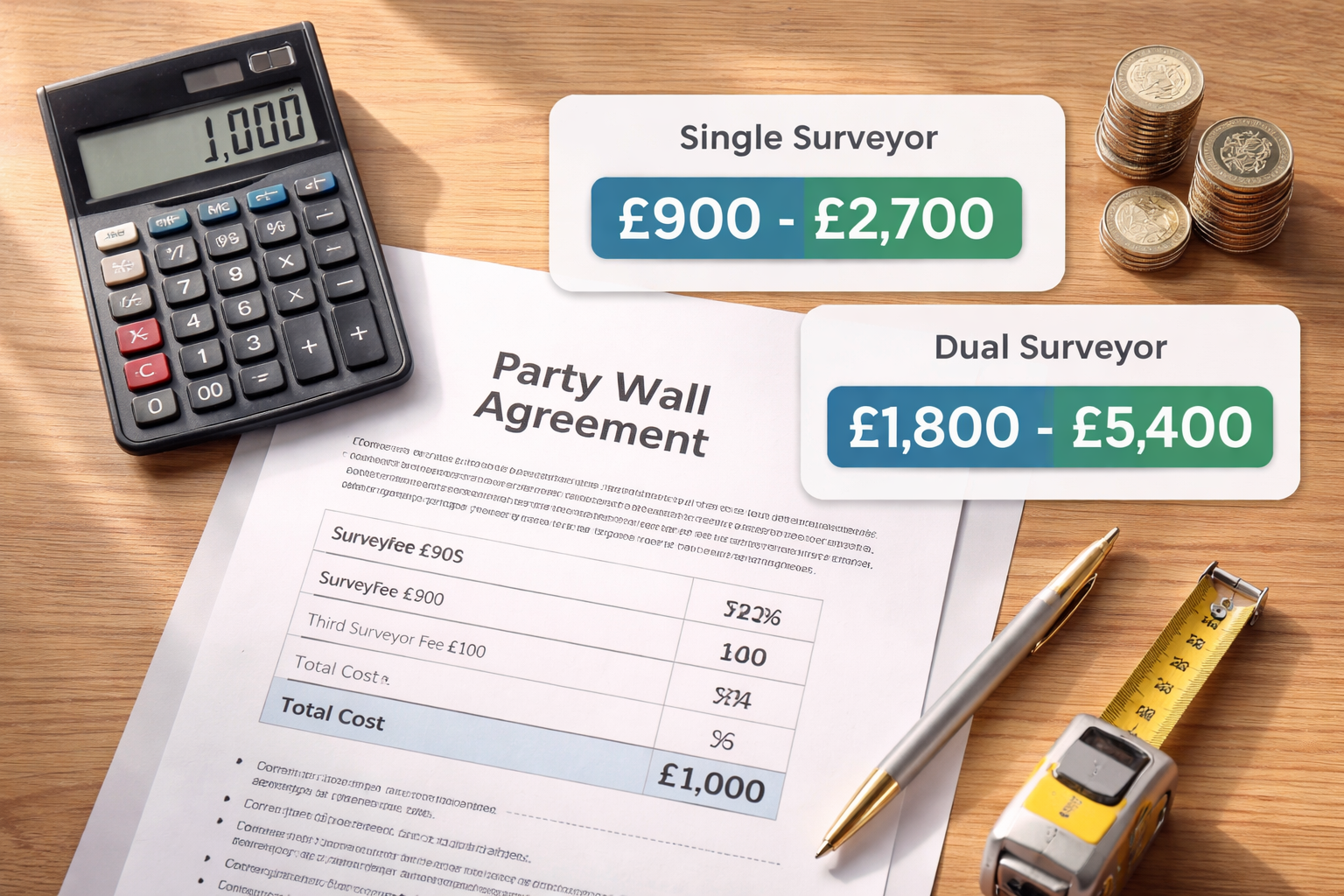
- Standard party wall agreements cost £900–£2,700 with a single surveyor; dual-surveyor arrangements double that to £1,800–£5,400.
- The building owner pays all surveyor fees in the vast majority of cases — not the neighbour.
- Appointing an agreed surveyor (one professional acting for both parties) is the single most effective cost-saving tactic available.
- Project type drives cost: loft conversions sit at the lower end (£900–£1,200), while basement works can exceed £10,000 in complex scenarios.
- Getting two or three quotes before instructing a surveyor is essential — fees vary significantly between practitioners.
Understanding the £1,000 Benchmark: What Does a Party Wall Agreement Actually Cost?
The £1,000 figure cited across most 2026 cost guides represents the floor price for a standard, uncomplicated party wall agreement — not the average across all project types. In practice, costs depend heavily on:
- Project complexity (loft conversion vs. basement excavation)
- Number of adjoining owners affected
- Whether one or two surveyors are appointed
- Geographic location (London rates are typically 20–30% higher than regional averages)
Fee Ranges by Appointment Type
| Appointment Type | Typical Cost Range | Best For |
|---|---|---|
| Single (agreed) surveyor | £900 – £2,700 | Amicable neighbours, simple works |
| Two surveyors (one each) | £1,800 – £5,400 | Contested or complex cases |
| Three surveyors (third surveyor added) | £3,000 – £8,000+ | Formal disputes requiring arbitration |
[1][3]
For simple agreements — such as a straightforward rear extension affecting one adjoining owner — costs average £800 to £1,500 per adjoining property owner. Complex cases involving multiple adjoining owners or significant structural works can push fees to £2,000–£3,000 or more [2].
💬 "The cheapest party wall agreement is the one that avoids a dispute entirely. An agreed surveyor acting for both sides can cut costs almost in half."
To understand whether your project even requires a formal agreement, the complete guide to party wall surveys provides a clear overview of when the Act applies.
Surveyor Hourly Rates and Fee Breakdown: Where the Money Goes
Understanding the average £1000 party wall agreement costs in 2026 requires breaking down what surveyors actually charge for. Most fees are not quoted as a single flat rate — they are built from several component services.
Current Surveyor Hourly Rates (2026)
Surveyor hourly rates have risen sharply in recent years:
- Entry-level / regional surveyors: £90–£150 per hour
- Mid-range practitioners: £150–£250 per hour
- Senior / London-based specialists: £250–£450 per hour [4]
Checkatrade cites £200 per hour as the current average surveyor rate, with party wall surveys typically requiring 1–3 hours depending on property size and complexity [5].
Itemised Fee Breakdown
| Service | Typical Cost |
|---|---|
| Initial consultation | £150 – £350 |
| Survey and report preparation | £500 – £1,000 |
| Schedule of condition report | £450+ (excl. VAT) |
| Party wall notice fees | £65+ (excl. VAT) |
| Dispute resolution / negotiation | £100 – £200 per hour |
[5][6]
The schedule of condition report is a particularly important cost to anticipate. This document records the pre-existing state of the adjoining property before works begin — it protects both parties if damage claims arise later. Skipping it to save money is a false economy.
For a detailed look at what a party wall award covers and how it is structured, reviewing the formal guidance is strongly recommended before instructing a surveyor.
Cost by Project Type: Loft Conversions to Basement Works
Not all party wall work is priced equally. The nature of the construction determines how much professional time is required — and therefore how much homeowners pay.
🏠 Loft Conversions (Lowest Cost Category)
- Single surveyor: £900 – £1,200
- Checkatrade average: £1,575 [5]
- Loft conversions typically affect only the party wall at roof level and involve relatively predictable structural interventions.
🏗️ Rear and Side Extensions (Medium Complexity)
- Single surveyor: £1,200 – £1,500
- Checkatrade average: £2,025 [5]
- Extensions often require excavation close to boundary walls and may affect more than one adjoining owner, increasing costs.
🏚️ Basement Conversions (Highest Cost Category)
- Single surveyor: £1,800 – £2,700
- Two surveyors: £3,600 – £5,400
- Complex multi-owner scenarios: £10,000 – £15,000+ [1][3]
Basement works carry the highest risk of structural damage to neighbouring properties. Surveyors must spend significantly more time on inspections, monitoring, and report preparation — costs reflect this.
For projects involving shared structures, understanding party wall and shared chimney obligations can help homeowners anticipate additional notice requirements.
Who Pays for a Party Wall Agreement? Responsibilities Explained
This is one of the most searched questions in the party wall space — and the answer is clearer than most people expect.
The General Rule
The building owner (the person carrying out the works) pays all party wall surveyor fees. This applies to:
- Their own appointed surveyor's fees
- The adjoining owner's appointed surveyor's fees
- Any third surveyor fees if a dispute escalates [1][3]
The logic is straightforward: the building owner is the party creating the disruption and legal obligation. The neighbour should not be financially penalised for asserting their legal rights under the Act.
The Exception: Enclosure Scenarios
There is one notable exception. When a neighbour benefits from shared use of a party wall — for example, by using an existing garden wall as part of their own new extension — they may be required to contribute proportionally to the cost of the wall. This is known as the "enclosure" provision under the Party Wall etc. Act 1996.
For a full breakdown of cost responsibilities, the dedicated guide on who pays for a party wall surveyor covers every scenario in detail.
What Happens When Neighbours Dispute Fees?
If an adjoining owner believes surveyor fees are unreasonable, they can refer the matter to the third surveyor — a pre-selected independent professional named in the party wall award. The third surveyor's decision on fees is binding on both parties.
Cost-Saving Tactics: How to Reduce Party Wall Agreement Expenses
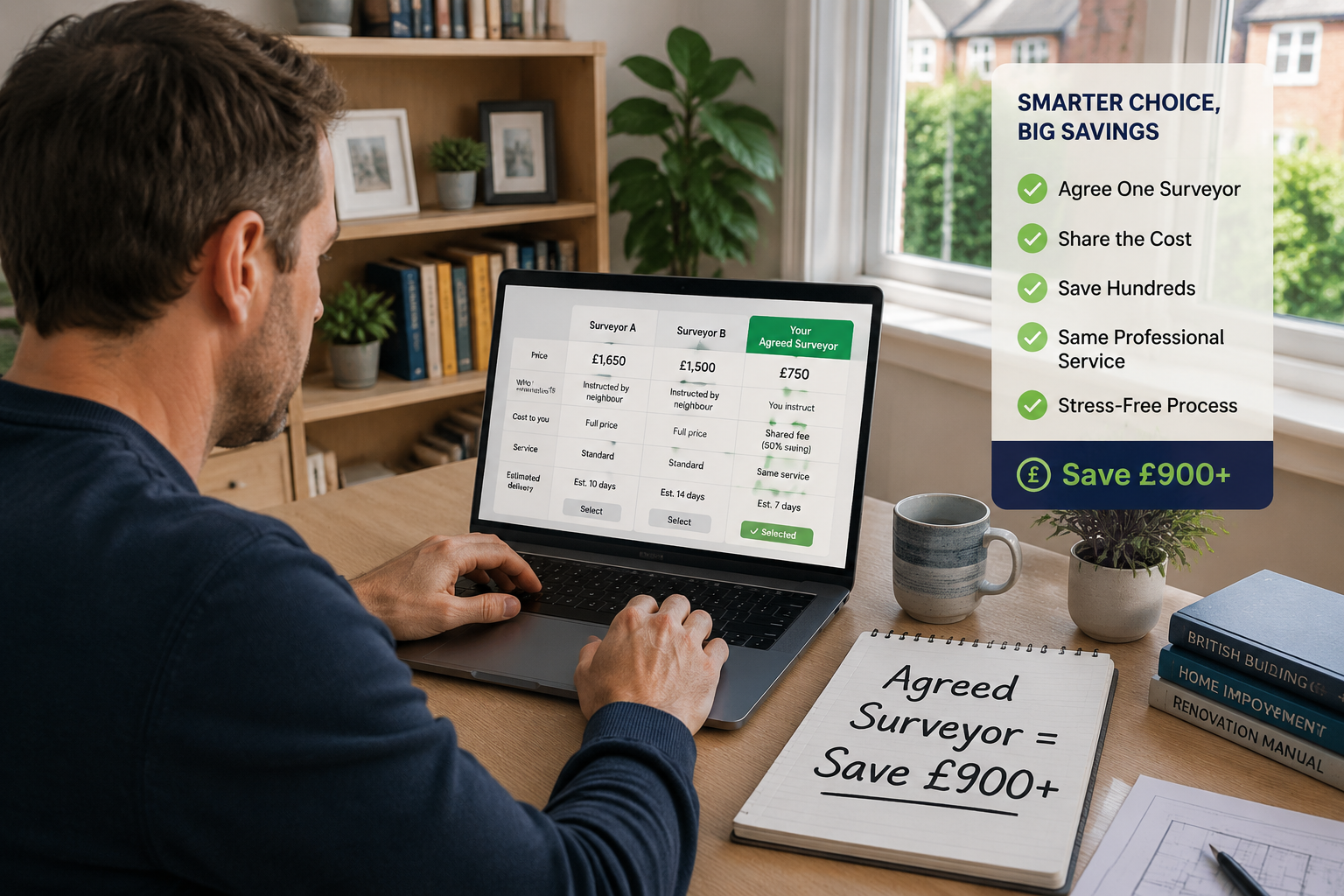
Applying the average £1000 party wall agreement costs in 2026 as a baseline, there are several proven strategies to keep fees at the lower end of the range.
✅ 1. Appoint an Agreed Surveyor
The single most effective cost-saving tactic is appointing one surveyor to act for both the building owner and the adjoining owner. This is called an "agreed surveyor" arrangement.
- Saves: £900 – £2,700 compared to dual-surveyor appointments
- Requirement: Both parties must consent to the arrangement
- Risk: If a dispute later arises, a new surveyor may need to be appointed
This approach works best when neighbours have a cooperative relationship and the works are straightforward.
✅ 2. Serve Notices Early and Correctly
Errors in party wall notices cause delays — and delays cost money. Serving a valid notice at least two months before work begins (or one month for certain works) gives all parties adequate time to respond without triggering additional professional intervention.
Understanding party wall act notices before serving them can prevent costly procedural mistakes.
✅ 3. Get Multiple Quotes
Survey Merchant recommends obtaining two or three estimates before instructing a surveyor [3]. Fees vary significantly between practitioners — even within the same geographic area. A surveyor charging £200/hour versus £350/hour for the same job represents a substantial saving over a 5-hour engagement.
✅ 4. Consider a DIY Notice (With Caution)
For very simple projects where neighbours are cooperative, it may be possible to handle the notice process without a surveyor. However, this carries risk — an incorrectly drafted notice can be invalid, restarting the statutory clock. The guide on party wall agreements without a surveyor explains when this is viable and when professional involvement is essential.
✅ 5. Resolve Disputes Before They Escalate
Every hour spent in formal dispute resolution adds £100–£200 to the bill [6]. Proactive communication with neighbours before serving notices — explaining the works, sharing plans, and addressing concerns early — dramatically reduces the likelihood of a contested response.
✅ 6. Use a Local Surveyor
London-based surveyors typically charge premium rates. For properties near the capital but outside Zone 1–2, instructing a local party wall surveyor with lower overheads can reduce hourly rates by 15–25% without sacrificing expertise.
When Costs Escalate: Red Flags to Watch For
Even with the best planning, some situations push party wall costs well above the £1,000 benchmark. Homeowners should budget for higher fees if any of the following apply:
| Scenario | Potential Additional Cost |
|---|---|
| Multiple adjoining owners (e.g., terraced row) | +£800–£2,000 per additional owner |
| Basement or underpinning works | +£1,000–£5,000 |
| Neighbour appoints their own surveyor | +£900–£2,700 |
| Third surveyor required for dispute | +£1,500–£3,000 |
| Structural monitoring required during works | +£500–£2,000 |
For projects involving structural complexity, understanding the roles and responsibilities of party wall surveyors helps homeowners set realistic expectations about professional time commitments.
Do You Actually Need a Party Wall Agreement?
Before budgeting for any of these costs, it is worth confirming whether the Party Wall etc. Act 1996 applies to the planned works. Not every building project triggers the Act.
Works that typically require a party wall agreement include:
- 🔨 Building on or near a party wall
- ⛏️ Excavating within 3–6 metres of a neighbouring building
- 🏗️ Loft conversions involving the party wall
- 🏚️ Basement conversions with underpinning
Works that typically do NOT require an agreement:
- Internal alterations with no structural impact on shared walls
- Fencing or garden boundary changes (unless a party wall is involved)
- Superficial repairs to a party wall
The complete guide to whether you need a party wall agreement provides a definitive checklist for homeowners unsure of their obligations.
Conclusion: Taking Control of Party Wall Costs in 2026
The average £1000 party wall agreement costs in 2026 serve as a useful starting point — but the real figure for any given project depends on complexity, location, and the relationship between neighbours. Fees can stay as low as £800 for a simple loft conversion handled by an agreed surveyor, or climb to £15,000 for a contested basement excavation involving multiple parties.
Actionable Next Steps ✅
- Confirm whether your project triggers the Act using the resources linked above before spending anything.
- Speak to your neighbour early — a cooperative response can save thousands in dual-surveyor fees.
- Request at least three quotes from qualified party wall surveyors before instructing anyone.
- Explore the agreed surveyor route if your neighbour is willing — it is the most reliable cost-saving mechanism available.
- Budget for a schedule of condition report from the outset — skipping it creates greater financial risk than the cost of the report itself.
- Serve notices correctly and on time to avoid procedural delays that add professional hours to the bill.
Party wall agreements are a legal requirement, not an optional formality. Approaching the process with accurate cost expectations and a clear strategy turns what many homeowners dread into a manageable, predictable expense.
References
[1] Party Wall Surveyor Cost – https://hoa.org.uk/advice/guides-for-homeowners/i-am-improving/party-wall-surveyor-cost/
[2] Party Wall Surveyor Cost – https://hardingsurveyors.co.uk/party-wall-matters/party-wall-surveyor-cost
[3] Party Wall Surveyor Cost Analysis How Much Does A Party Wall Agreement Cost – https://www.surveymerchant.com/blog/party-wall-surveyor-cost-analysis-how-much-does-a-party-wall-agreement-cost
[4] Party Wall Surveyor Costs – https://www.designingbuildings.co.uk/wiki/Party%20Wall%20Surveyor%20Costs
[5] Party Wall Surveyor Cost – https://www.checkatrade.com/blog/cost-guides/party-wall-surveyor-cost/
[6] Party Wall Surveyors Cost – https://www.mybuilder.com/architectural-services/price-guides/party-wall-surveyors-cost
