
Roughly 3.5 million privately rented homes in England are estimated to fall below an EPC Band C — and with Awaab's Law expanding in 2026 to cover excess cold hazards, the thermal performance of party walls is no longer just an energy efficiency concern. It is a legal compliance issue. Party Wall Surveys for Excess Cold Hazards Under Awaab's Law 2026: Surveyor Protocols for Insulation Defects and Valuation Adjustments in PRS Properties sit at the crossroads of building law, landlord obligation, and RICS-standard practice — and surveyors who are not yet adapting their protocols risk leaving clients exposed to enforcement action, neighbour disputes, and significant valuation penalties.
Key Takeaways 📋
- Awaab's Law Phase 2 (2026) extends hazard coverage to excess cold, meaning insulation defects in party walls can now trigger formal repair obligations and legal liability.
- RICS-compliant party wall surveys must now incorporate HHSRS (Housing Health and Safety Rating System) excess cold assessments as a standard protocol element.
- Insulation defects — including missing cavity fill, absent dry-lining, and cold bridge junctions at party wall interfaces — are classified as deficiencies under current Awaab's Law guidance.
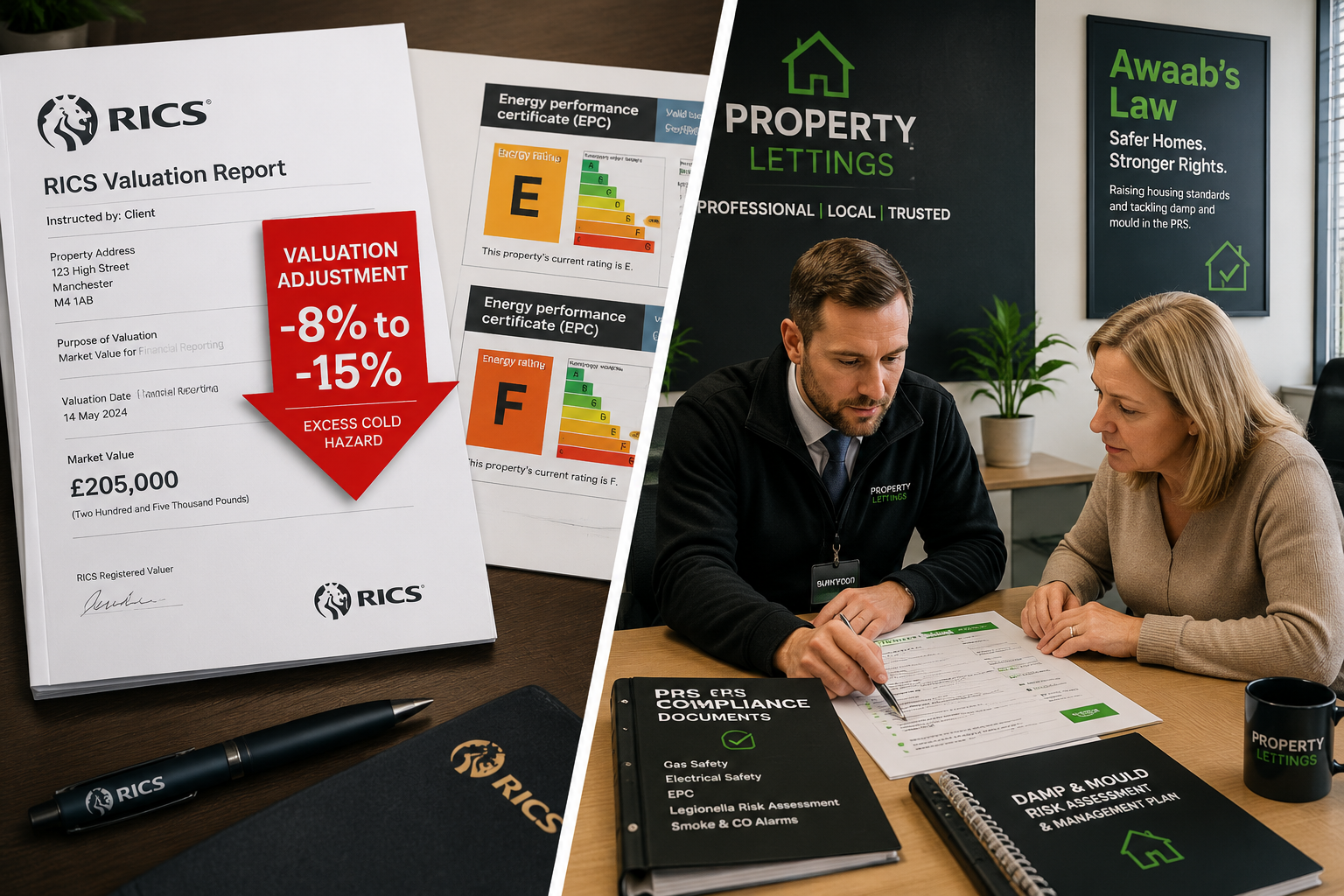
- PRS property valuations face downward adjustments of 8–15% where Category 1 excess cold hazards are identified and unresolved.
- Emergency cold hazard timelines may require landlords to act within 24 hours, placing urgent pressure on surveyors to produce actionable reports quickly.
Understanding Awaab's Law Phase 2 and Its Impact on Excess Cold
Awaab's Law Phase 1 entered force on 27 October 2025, mandating strict investigation and repair timelines for damp and mould in the social rented sector [5]. That milestone was significant — but Phase 2 is arguably more far-reaching. The government has confirmed plans to extend Awaab's Law in 2026 to cover additional household hazards including excess cold, excess heat, and fire safety [3].
For surveyors working in the private rented sector (PRS), this matters enormously. While Phase 1 focused on social housing, consultation is actively ongoing regarding the extension of Awaab's Law obligations to PRS landlords [3]. The direction of travel is clear: thermal hazards, including those arising from insulation defects in and around party walls, will fall within the scope of mandatory remediation timelines.
What Counts as an Excess Cold Hazard?
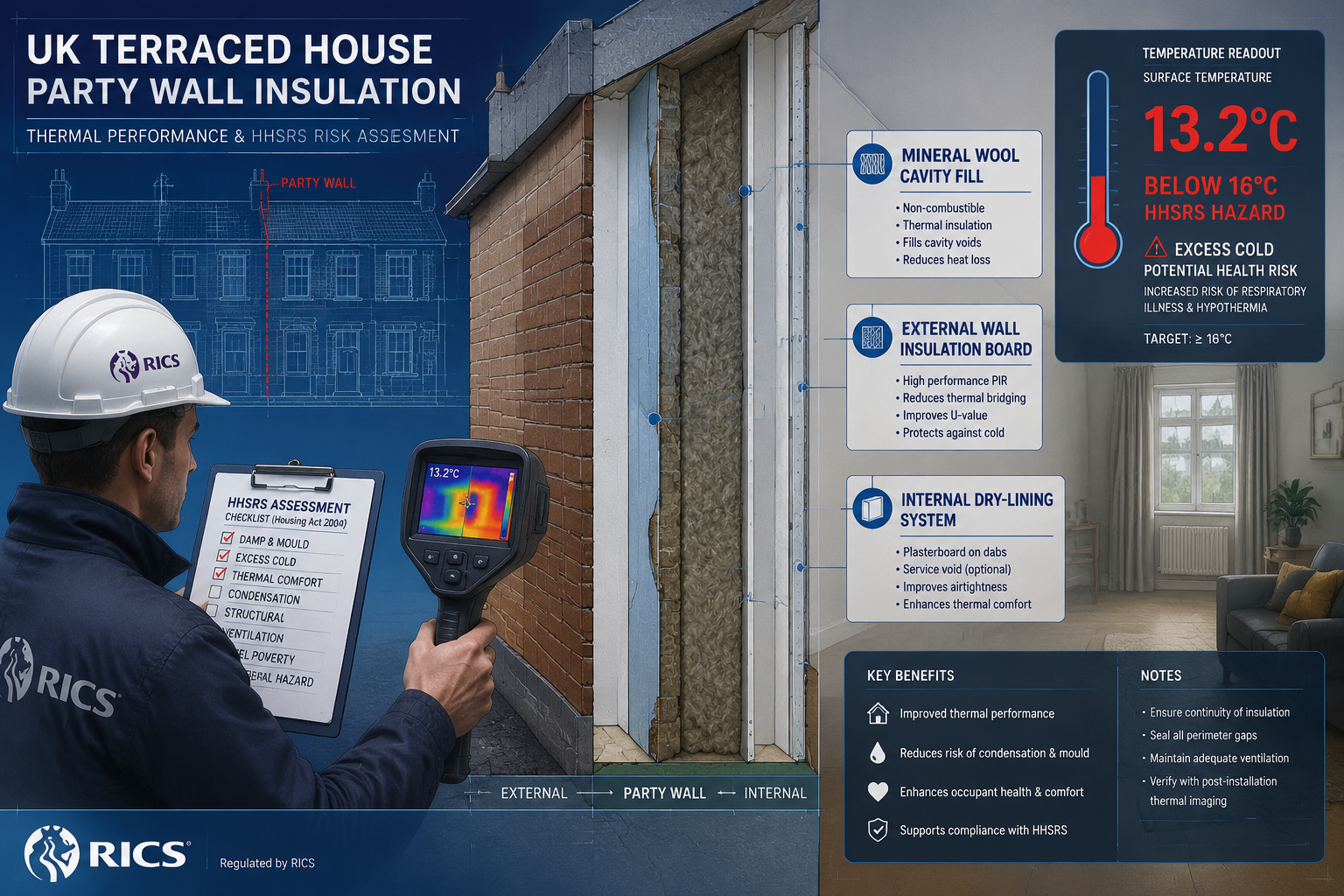
Under the HHSRS framework, an excess cold hazard arises when a dwelling cannot maintain an adequate internal temperature — typically a minimum of 18°C in living areas and 21°C in bathrooms — during cold weather conditions. The primary causes include:
| Cause | Party Wall Relevance |
|---|---|
| Missing or degraded cavity wall insulation | Direct — shared cavity walls between PRS and adjoining properties |
| Absent internal dry-lining | Party wall surfaces acting as cold bridges |
| Poor junction detailing at party wall/external wall interface | Thermal bypass and cold bridge formation |
| Inadequate EWI (External Wall Insulation) | Incomplete system coverage at party wall abutments |
| Defective window/door reveals at party wall returns | Localised cold spots and condensation |
Current Awaab's Law guidance already classifies lack of thermal insulation in the structure of a home as a defect where it contributes to prescribed hazards [6]. The extension to excess cold in 2026 means this classification will apply directly to cold-related insulation failures.
💬 "Insulation defects are no longer just an EPC rating problem — under Awaab's Law Phase 2, they become a prescribed hazard deficiency with mandatory repair timelines attached."
Party Wall Surveys for Excess Cold Hazards Under Awaab's Law 2026: Updated Surveyor Protocols
The intersection of the Party Wall etc. Act 1996 and Awaab's Law creates a genuinely novel compliance landscape. When a building owner proposes works to a party wall — whether cavity fill injection, external wall insulation, or internal dry-lining — those works directly affect the thermal performance of shared structures. Surveyors must now assess not only structural impact but also thermal hazard implications for both the building owner and the adjoining occupier.
For a comprehensive overview of what party wall surveyors are responsible for, see this guide on what a party wall surveyor does, their roles, responsibilities, and legal requirements.
RICS-Compliant Inspection Checklist for Excess Cold Assessments 🔍
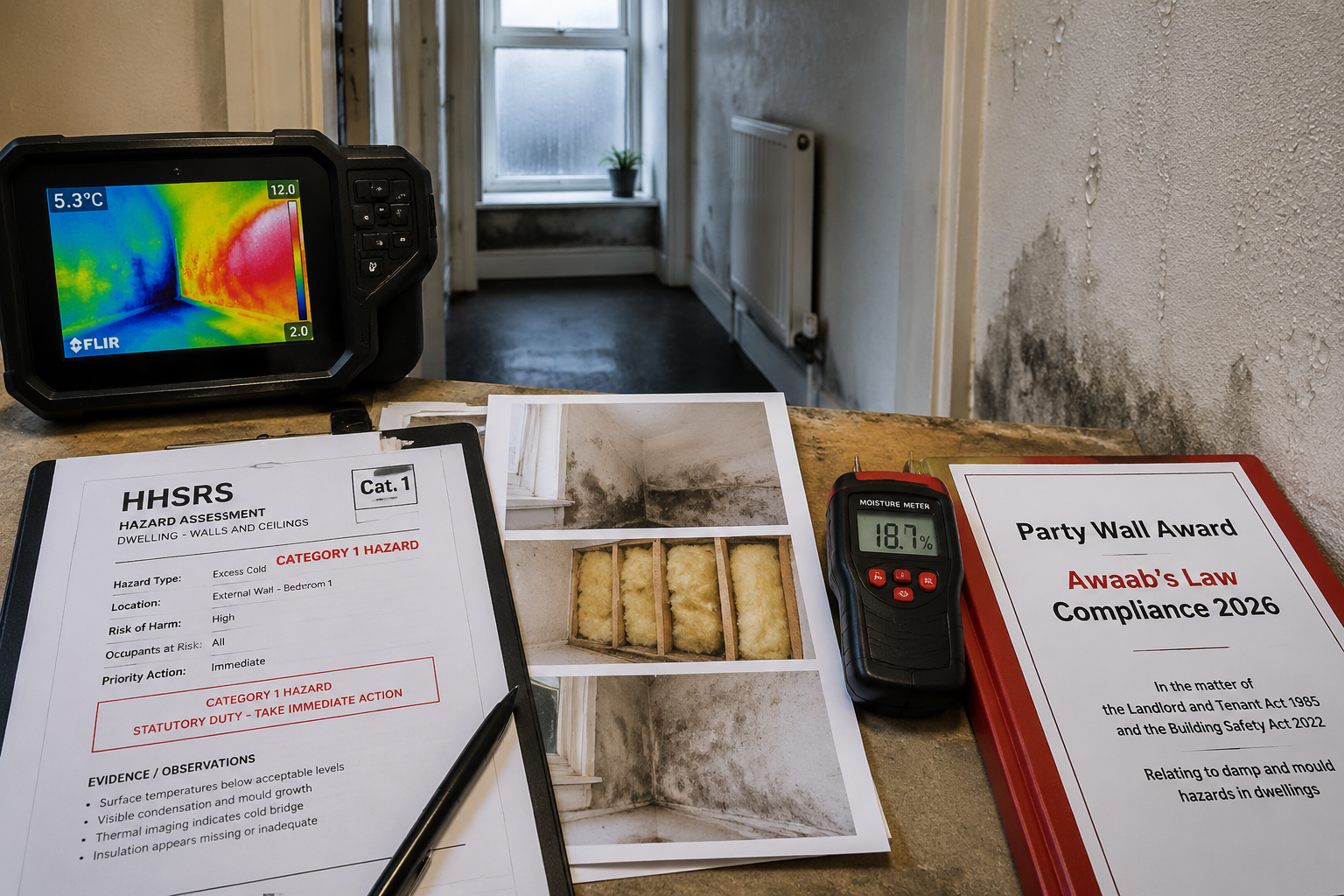
Updated protocols for party wall surveys involving insulation works should now incorporate the following checklist elements:
1. Pre-Works Thermal Baseline Assessment
- Thermal imaging survey of party wall surfaces (both sides where access permits)
- HHSRS excess cold scoring using SAP/RdSAP data or in-situ U-value measurement
- Documentation of existing insulation type, thickness, and condition
- Identification of cold bridges at junctions, reveals, and structural penetrations
2. Party Wall Notice and Award Considerations
- Does the proposed insulation work constitute a "notifiable" party wall operation? (Cavity fill injection and EWI systems that affect the party wall line typically do)
- Is the adjoining owner's property at risk of increased cold hazard exposure as a result of the works? (e.g., removal of existing internal lining)
- Schedule of Condition documentation must include thermal performance indicators, not just structural condition
3. During-Works Staged Inspections
- Verification that EWI systems are delivered as fully designed, third-party certified systems with proper junction detailing at party wall abutments [2]
- Confirmation of weathering details and cavity closure at party wall/external wall interfaces
- On-site technical oversight at critical stages: substrate preparation, insulation board fixing, render coat application
4. Post-Works Verification
- Repeat thermal imaging to confirm cold bridge elimination
- HHSRS excess cold re-scoring to confirm hazard category reduction
- Confirmation that party wall award conditions have been satisfied
For guidance on understanding the party wall process step by step, including how awards are structured, surveyors and landlords should review current RICS practice notes alongside Awaab's Law Phase 2 guidance.
Specific Protocols for EWI Systems on Party Wall Structures
External Wall Insulation is increasingly the remediation route of choice for solid-walled PRS properties. However, EWI applied to party wall-adjacent elevations carries specific technical risks that surveyors must address [2]:
- Thermal bypass at the party wall/EWI junction if the insulation system does not return adequately around the party wall head
- Interstitial condensation risk where EWI is applied without addressing party wall cold bridges
- Fire performance at party wall cavity barriers (relevant to both Awaab's Law fire safety provisions and Building Regulations Part B)
- Differential movement between EWI on the building owner's property and the uninsulated party wall face of the adjoining property
⚠️ Critical point: Well-designed EWI reduces condensation and mould risk, improves resident health and comfort, lowers energy bills, and supports long-term building asset performance [2]. Poorly designed EWI at party wall junctions can do the opposite — creating new cold bridges and triggering Awaab's Law liability rather than resolving it.
For detailed guidance on party wall insulation works and surveyor obligations, including how insulation projects interact with party wall notices and awards, specialist advice is essential before works begin.
Valuation Adjustments in PRS Properties: How Excess Cold Hazards Affect Property Worth
The financial consequences of unresolved excess cold hazards in PRS properties are substantial — and in 2026, they are becoming more quantifiable as Awaab's Law creates a clearer legal liability framework [1].
How Surveyors Should Approach Valuation Adjustments
When conducting a RICS valuation of a PRS property where an excess cold hazard has been identified — or where insulation defects are present that are likely to trigger Awaab's Law obligations — the following valuation adjustment framework applies:
| Hazard Severity | HHSRS Category | Indicative Valuation Adjustment |
|---|---|---|
| Minor insulation deficiency (Category 2) | Low likelihood/severity | -2% to -5% |
| Significant cold bridge at party wall | Category 2 approaching Category 1 | -5% to -8% |
| Category 1 excess cold hazard (unresolved) | High likelihood/severity | -8% to -15% |
| Category 1 with enforcement notice issued | Formal legal liability | -15% to -20%+ |
These adjustments reflect:
- Remediation cost deductions (cost to cure the insulation defect)
- Rental income risk (potential rent reduction, void periods during remediation, or rent repayment orders)
- Legal liability premium (risk of enforcement action, civil claims, or Awaab's Law prosecution)
- Marketability discount (reduced pool of buyers/investors willing to acquire a property with known Awaab's Law exposure)
Impact on PRS Investment Portfolios
For portfolio landlords, the cumulative valuation impact of excess cold hazards across multiple properties can be severe. A portfolio of 20 PRS properties, each carrying a 10% valuation discount due to unresolved insulation defects, represents a material reduction in asset value and borrowing capacity.
Surveyors conducting RICS building surveys at Level 3 for PRS acquisitions should now routinely include:
- HHSRS excess cold scoring as a standard report section
- Identification of party wall insulation defects and their Awaab's Law implications
- Estimated remediation costs for insulation defects (including EWI system costs where applicable)
- Commentary on the likelihood of Awaab's Law enforcement action given the property's current thermal performance
💬 "A PRS property with an unresolved Category 1 excess cold hazard is not just a compliance problem — it is a valuation problem, a financing problem, and increasingly, a reputational problem for landlords."
Repair Timelines and Their Valuation Implications
The emergency response timeline established under Awaab's Law — 24 hours for emergency hazards [3] — has direct valuation implications. Where a surveyor identifies an excess cold hazard that could be classified as an emergency (e.g., a property with no functional heating and severe insulation failure during winter), the landlord's obligation to act within 24 hours creates immediate financial exposure.
For non-emergency Category 1 hazards, the investigation and repair timelines established under Phase 1 (and expected to carry over to Phase 2 excess cold provisions) are:
- Investigation: Within a defined short period of a complaint being made
- Emergency repairs: Within 24 hours
- Urgent repairs: Within a defined period (expected to be days to weeks)
- Standard repairs: Within a reasonable timeframe (expected to be weeks to months)
Surveyors must document these timelines in party wall awards and building survey reports to ensure landlords understand their obligations and the financial consequences of non-compliance [6].
Party Wall Surveys for Excess Cold Hazards Under Awaab's Law 2026: Neighbour Dispute Resolution and Practical Guidance
The party wall framework adds a layer of complexity to Awaab's Law compliance that is often overlooked. When insulation works are required to remediate an excess cold hazard, those works may well affect an adjoining owner's property — triggering party wall notice requirements, potential disputes, and the need for an agreed or appointed surveyor.
When Party Wall Notices Are Required for Insulation Remediation
Not all insulation works require a party wall notice — but many do. Key triggers include:
- Cavity wall insulation injection through a party wall (Section 2 works under the 1996 Act)
- EWI systems that involve cutting into or fixing to the party wall
- Internal dry-lining that involves making good to the party wall face
- Any works that cut into or expose the party wall during insulation installation
Where a notice is required, the adjoining owner has the right to dissent and appoint a surveyor. This can delay remediation works — potentially placing the building owner landlord in breach of Awaab's Law repair timelines while the party wall dispute is resolved [1].
For landlords and surveyors navigating this tension, understanding what happens if there is no party wall agreement and the risks of proceeding without one is critical — particularly where Awaab's Law timelines create pressure to act quickly.
Resolving Disputes Where Insulation Works Are Contested
Where an adjoining owner contests insulation works that are required for Awaab's Law compliance, the party wall surveyor(s) must balance:
- The building owner's legal obligation to remediate the excess cold hazard
- The adjoining owner's right to protect their property from damage or disruption
- The technical requirements for a compliant insulation system
In practice, a well-drafted Party Wall Award can resolve most disputes by:
- Specifying the insulation system design and installation methodology
- Requiring staged inspections and thermal performance verification
- Establishing liability for any damage caused to the adjoining property
- Setting out a programme of works that minimises disruption
For expert guidance on RICS party wall surveyors and dispute resolution, specialist input at an early stage can prevent costly delays and legal complications.
Surveyor Accreditation and Competency Requirements
With Awaab's Law Phase 2 introducing new technical requirements, surveyors conducting party wall surveys for excess cold hazards should demonstrate:
- RICS membership with relevant building surveying competencies
- HHSRS assessment training and familiarity with excess cold scoring methodology
- Thermal imaging competency (or access to a qualified thermographer)
- Knowledge of EWI system design standards and third-party certification requirements [2]
- Awareness of Awaab's Law Phase 2 provisions and their interaction with the Party Wall etc. Act 1996
Surveyors uncertain about the cost implications of party wall surveys in the context of Awaab's Law compliance works should provide clients with clear fee estimates that reflect the additional thermal assessment and staged inspection requirements now expected under updated protocols.
Conclusion: Actionable Next Steps for Surveyors and PRS Landlords ✅
The convergence of Awaab's Law Phase 2 and party wall legislation in 2026 creates both challenge and opportunity. Surveyors who adapt their protocols now — incorporating HHSRS excess cold assessments, thermal imaging, and EWI system verification into standard party wall survey practice — will be well positioned to serve a PRS market that urgently needs this expertise.
For PRS landlords, the priority actions are:
- Commission a thermal assessment of all PRS properties with party walls, identifying insulation defects and HHSRS excess cold scores before enforcement action is triggered
- Review party wall obligations for any planned insulation remediation works — serve notices early to avoid timeline conflicts with Awaab's Law repair obligations
- Obtain RICS valuations that reflect current Awaab's Law exposure, so that portfolio values and lending arrangements reflect actual risk
- Engage a specialist surveyor with Awaab's Law Phase 2 competency before undertaking any EWI or cavity insulation works on party wall structures
For surveyors, the priority actions are:
- Update survey report templates to include HHSRS excess cold sections and party wall thermal performance commentary
- Invest in thermal imaging capability — either in-house or through a certified thermographer partnership
- Review EWI system design standards and ensure party wall award conditions adequately address junction detailing and certification requirements
- Stay current with Phase 2 guidance as it is published, and update client advice accordingly
The stakes are high — but so is the opportunity to provide genuinely valuable, legally sound guidance at a moment when the PRS sector needs it most.
References
[1] Awaabs Law Extensions To Prs In 2026 Party Wall And Building Survey Protocols For New Hazard Categories – https://nottinghillsurveyors.com/blog/awaabs-law-extensions-to-prs-in-2026-party-wall-and-building-survey-protocols-for-new-hazard-categories
[2] Awaabs Law Damp Mould External Wall Insulation – https://ewipro.com/2026/02/02/awaabs-law-damp-mould-external-wall-insulation/
[3] Awaabs Law Tackling Damp Mould And Insulation Choices – https://www.rockwool.com/uk/education-and-training/blog/awaabs-law-tackling-damp-mould-and-insulation-choices/
[4] Is The Government Prepared For Awaabs Law – https://builders.org.uk/is-the-government-prepared-for-awaabs-law/
[5] Building Surveys For Damp And Mould Post Awaabs Law Expansion Protocols For Identifying Prescribed Hazards In 2026 – https://nottinghillsurveyors.com/blog/building-surveys-for-damp-and-mould-post-awaabs-law-expansion-protocols-for-identifying-prescribed-hazards-in-2026
[6] Awaabs Law Guidance For Social Landlords Timeframes For Repairs In The Social Rented Sector – https://www.gov.uk/government/publications/awaabs-law-guidance-for-social-landlords/awaabs-law-guidance-for-social-landlords-timeframes-for-repairs-in-the-social-rented-sector
