
Over 40% of contested party wall disputes that escalate to the Third Surveyor or court in the UK now involve a simultaneous right to light claim — yet most development teams only discover this overlap after works have already begun. This collision of two distinct but deeply intertwined legal frameworks is creating a surge in expert witness instructions across London and the South East in 2026, and the surveyors who thrive are those who master both disciplines simultaneously.
Navigating Expert Witness Challenges in Right to Light and Party Wall Overlaps: Surveyor Strategies for 2026 Development Disputes demands more than technical knowledge. It requires a precise understanding of Civil Procedure Rules (CPR), RICS measurement standards, 3D modelling evidence, and the litigation dynamics that determine whether a dispute settles or ends up before a judge. This article breaks down the core challenges, the tools available, and the strategic approaches that expert witnesses are deploying right now to protect their clients — and their own professional credibility.
Key Takeaways
- 🏗️ Loft conversions with steel beam insertions are the single biggest driver of combined party wall and right to light expert witness instructions in 2026 [2].
- ⚖️ CPR Part 35 compliance is non-negotiable — courts are increasingly critical of expert reports that fail to meet independence and format standards.
- 📐 Waldram diagrams and 3D BIM modelling are now considered best practice evidence tools in right to light litigation, replacing older 2D methods.
- 🔗 Party wall and right to light claims overlap more often than developers expect, and failing to address both simultaneously can be catastrophic for a project.
- 🤝 Early engagement and proactive scheduling of conditions remain the most effective strategies for avoiding costly litigation.
Why Right to Light and Party Wall Claims Collide in 2026
The UK's built environment is under extraordinary pressure. Planning permissions for urban densification — basement extensions, loft conversions, rear additions, and infill developments — are being granted at record rates across London boroughs. The result is a predictable clash: works that trigger the Party Wall etc. Act 1996 almost always involve structural changes that alter the massing of a building, and altered massing means altered daylight.
Right to light is an easement — a legal right for a property to receive natural light through defined apertures, typically acquired after 20 years of uninterrupted use under the Prescription Act 1832. It is entirely separate from planning law and operates independently of any party wall award. This is where developers frequently come unstuck.
💡 Pull Quote: "A party wall award gives you permission to build — it does not give you permission to obstruct your neighbour's ancient light. These are two entirely different legal conversations."
The most common scenario in 2026 involves a developer who has diligently served party wall notices, appointed surveyors, and obtained a party wall award — only to face an injunction from an adjoining owner claiming that the approved works will extinguish or substantially interfere with their right to light. The party wall process offers no defence against a right to light claim.
For a deeper understanding of how party wall disputes arise and escalate, see this comprehensive guide to party wall dispute resolution.
The Expert Witness Challenges in Right to Light and Party Wall Overlaps: Surveyor Strategies for 2026 Development Disputes
The Dual-Hat Problem: When One Surveyor Wears Two Hats
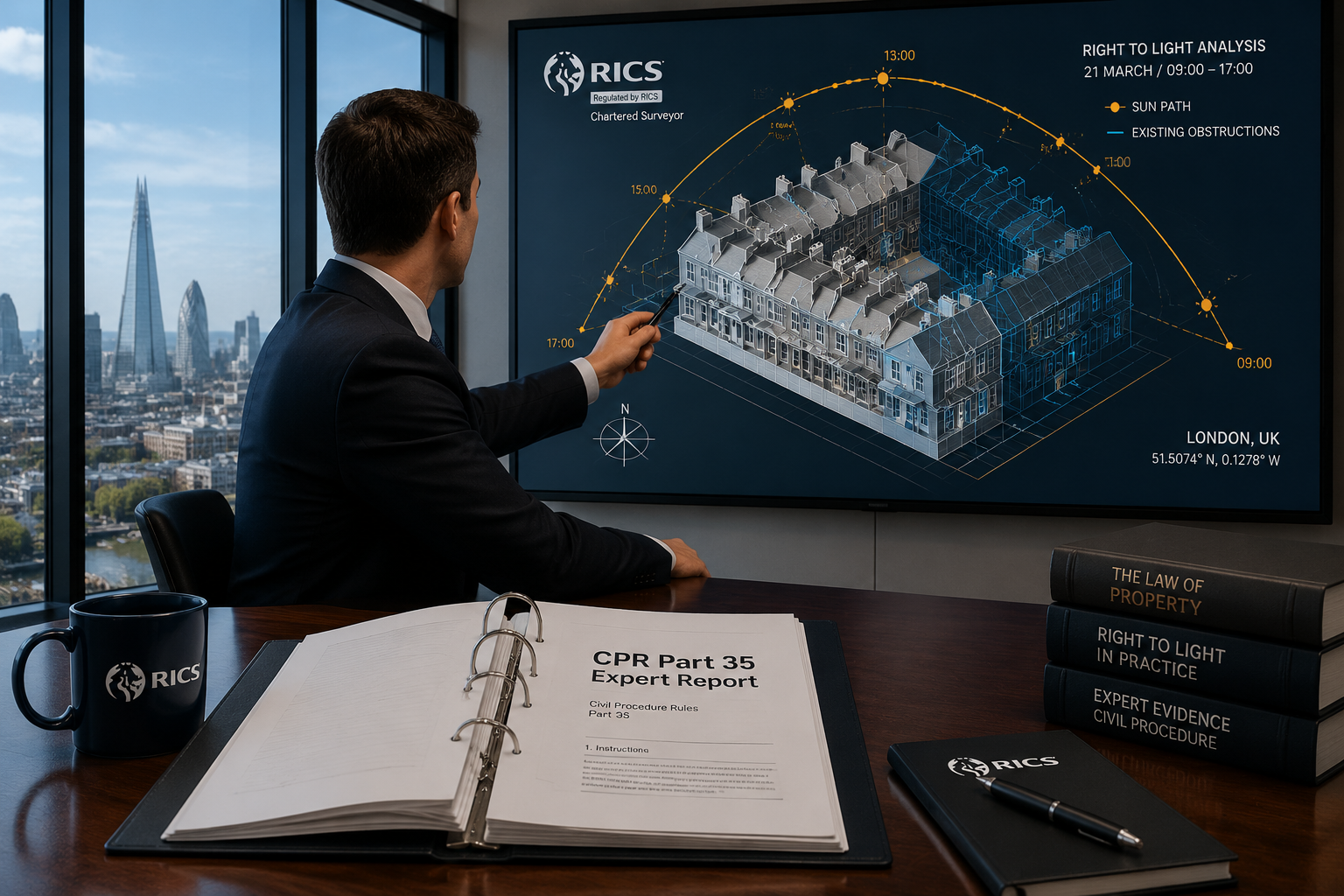
One of the defining expert witness challenges in right to light and party wall overlaps is the dual-hat problem. A party wall surveyor appointed under the Act has a quasi-judicial role — they must act impartially and in accordance with the Act, not as an advocate for the appointing party. An expert witness in litigation, by contrast, owes their primary duty to the court, not the client.
When the same surveyor is asked to act as both the party wall surveyor and the expert witness in related litigation, serious professional conflicts arise. RICS guidance is clear: these roles should be separated wherever possible. In practice, this means development teams in 2026 are increasingly appointing separate specialists — one for the party wall process and one to serve as the independent expert witness on right to light and structural impact.
CPR Part 35: The Rules That Make or Break Expert Evidence
Expert witnesses in UK litigation are governed by Civil Procedure Rules Part 35, which imposes strict requirements on the format, content, and independence of expert reports. Courts in 2026 have shown little patience for reports that:
- Advocate for the instructing party rather than assisting the court
- Lack a signed declaration of independence
- Fail to distinguish clearly between fact and opinion
- Omit material facts that are adverse to the instructing party's case
A well-structured CPR Part 35-compliant expert report in a combined right to light and party wall dispute will typically include:
| Section | Content |
|---|---|
| Expert's qualifications | RICS membership, relevant experience |
| Instructions received | Summary of what the expert was asked |
| Methodology | Waldram analysis, BIM modelling, site measurements |
| Factual findings | Existing light levels, party wall condition |
| Opinion | Impact of proposed/completed works |
| Declaration | Statement of independence per CPR 35.3 |
Understanding what a party wall surveyor does in London provides essential context for understanding where the party wall role ends and the expert witness role begins.
Loft Conversions: The 2026 Flashpoint
Industry data confirms that loft conversions featuring steel beam insertions and wall plate modifications are the most common type of works generating expert witness instructions in 2026 [2]. These projects are particularly problematic because:
- Steel RSJ beams often require notching or bearing into party walls, triggering the Act
- Raising the ridge line or adding a mansard roof significantly increases building height and bulk
- New dormer windows on rear elevations can themselves obstruct the light of neighbouring properties
- The works are sequential — structural interventions happen fast, often before right to light surveys are commissioned
By the time a right to light expert is instructed, the steel may already be in. This creates a fait accompli scenario that courts have historically been willing to address with mandatory injunctions requiring demolition — a catastrophic outcome for any developer.
RICS Measurement Tools and 3D Modelling Evidence
The Waldram Diagram: Still the Gold Standard
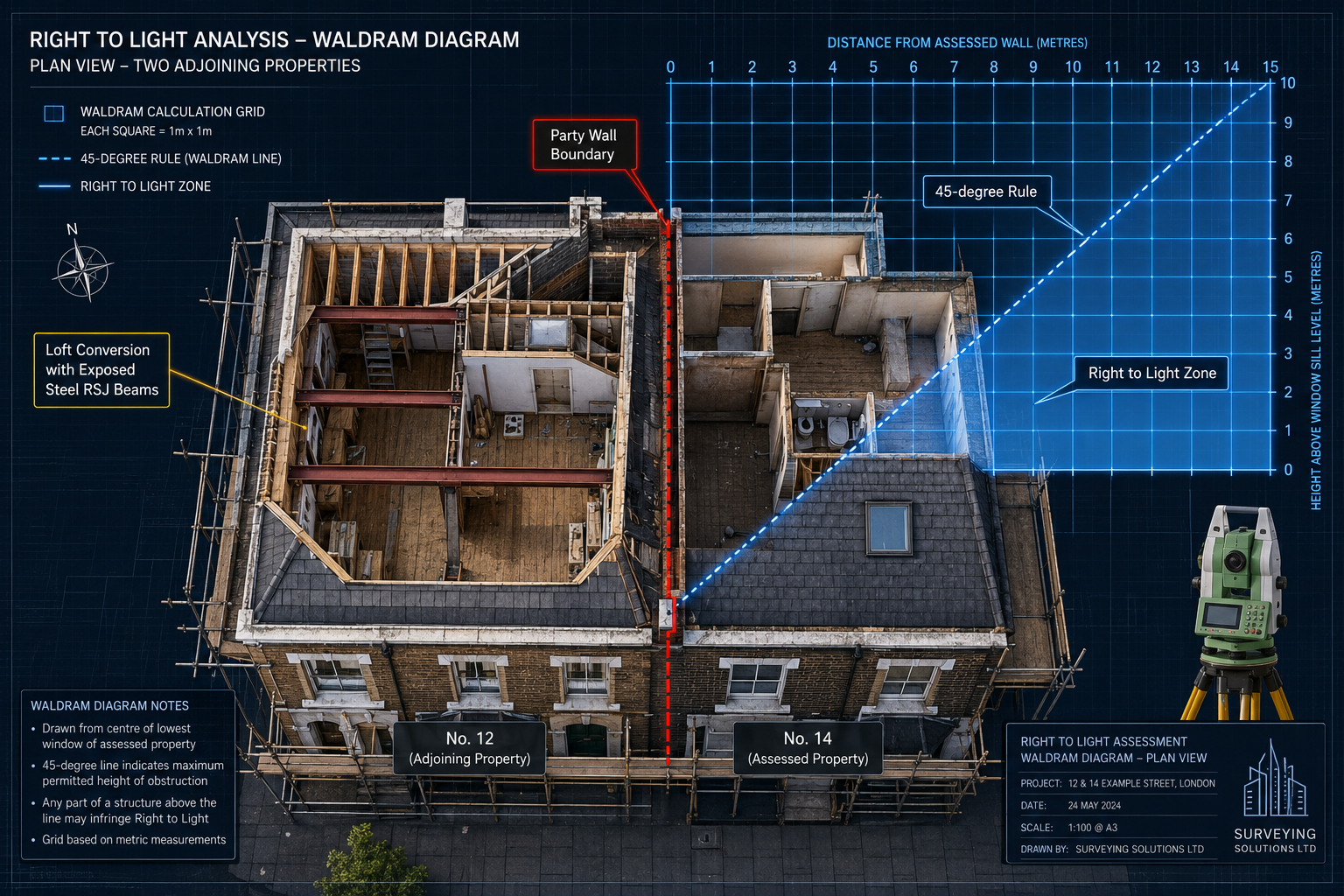
The Waldram diagram remains the primary measurement tool for quantifying right to light in UK litigation. Developed in the early 20th century, it translates the geometry of a window and the obstructing development into a percentage figure representing the proportion of sky visible from the working plane (typically 850mm above floor level).
The key threshold in English law is the "50/50 rule": if less than 0.2% of the sky factor remains visible, or if the well-lit area of a room falls below 50% of its total area, the court is likely to find an actionable nuisance. Expert witnesses must be able to explain this methodology clearly to non-specialist judges and counsel.
However, the Waldram diagram has limitations. It is inherently two-dimensional and struggles to capture complex urban geometries, multiple light sources, or the cumulative impact of several developments. This is where 3D modelling has become essential.
3D BIM Modelling: The New Evidentiary Standard
Building Information Modelling (BIM) tools — including software such as Revit, AutoCAD, and specialist right to light platforms — are now widely accepted in UK courts as supplementary evidence. In 2026, the most compelling expert reports combine:
- ✅ Traditional Waldram analysis (for legal threshold compliance)
- ✅ 3D rendered models showing pre- and post-development light levels
- ✅ Daylight and sunlight assessments per BRE Report 209 methodology
- ✅ Photographic evidence from site visits
- ✅ Drone survey imagery showing existing building relationships
Drone surveys have become particularly valuable for capturing accurate existing conditions in dense urban environments. For surveyors working on complex London sites, drone survey services can provide the aerial perspective that ground-level photography simply cannot.
Schedules of Condition: The Party Wall Expert's Best Friend
On the party wall side, the Schedule of Condition is the document that most frequently becomes the centrepiece of expert witness evidence. A properly executed Schedule of Condition, prepared before works commence, records the exact pre-works state of the adjoining owner's property. When damage is alleged, the Schedule becomes the baseline against which all claims are measured.
Expert witnesses in 2026 are increasingly using photogrammetry — the creation of accurate 3D models from photographs — to produce Schedules of Condition that are virtually irrefutable. Traditional photographic schedules, while still acceptable, are being challenged by opposing experts who argue that photographs can be misleading about depth, scale, and existing crack widths.
For guidance on how Schedules of Condition function within the party wall process, see this detailed schedule of condition guidance.
Surveyor Strategies for 2026 Development Disputes: Practical Approaches
Strategy 1: Commission a Right to Light Search Before Serving Party Wall Notices
The single most effective strategy available to developers in 2026 is sequencing. A right to light search — typically a desktop assessment of neighbouring properties' windows, their age, and the likely impact of the proposed development — should be commissioned before party wall notices are served, not after.
This allows the development team to:
- Identify high-risk windows and apertures early
- Modify the scheme to reduce light impact before it becomes a legal dispute
- Negotiate voluntary agreements with neighbours from a position of knowledge
- Instruct expert witnesses proactively rather than reactively
Strategy 2: Negotiate a Right to Light Release Agreement
Where a right to light risk is identified, the most cost-effective resolution is almost always a negotiated release agreement with the affected neighbour. This is a contractual agreement — separate from the party wall award — in which the neighbour consents to the development in exchange for financial compensation.
Expert witnesses play a crucial role here: their preliminary assessment of the light impact provides the evidential basis for the compensation negotiation. A well-reasoned expert opinion can prevent a dispute from escalating to litigation entirely.
Understanding when a party wall agreement is legally required is the first step — but savvy developers go further and address right to light simultaneously.
Strategy 3: Use the Third Surveyor Mechanism Strategically
The Party Wall etc. Act 1996 provides for a Third Surveyor — an independent surveyor selected by the two party wall surveyors to resolve disputes between them. In complex cases involving right to light overlaps, the Third Surveyor's determination can sometimes address structural matters that have a bearing on the light dispute.
However, it is critical to understand that the Third Surveyor's jurisdiction is strictly limited to matters arising under the Act. Right to light is not within that jurisdiction. Attempting to resolve right to light issues through the party wall mechanism is a common and costly mistake.
For a full explanation of how party wall disputes are resolved, including the Third Surveyor process, see this complete guide to resolving party wall disputes.
Strategy 4: Prepare for the Hot-Tubbing of Experts
UK courts increasingly use concurrent expert evidence — colloquially known as "hot-tubbing" — in property disputes. Under this procedure, expert witnesses from both sides give evidence simultaneously, answering the judge's questions together and responding to each other's positions in real time.
For surveyors acting as expert witnesses in 2026, this means:
- 🎯 Reports must be watertight — weaknesses will be exposed immediately
- 🎯 Methodology must be defensible under cross-examination from a fellow expert
- 🎯 The expert must be able to concede appropriate points without undermining their core opinion
- 🎯 Communication skills matter as much as technical expertise
The expert who cannot explain a Waldram diagram to a non-technical judge in plain English is at a serious disadvantage, regardless of how technically correct their analysis may be.
Strategy 5: Document Everything with a Proactive Party Wall Award
A comprehensive party wall award that includes detailed working method statements, hours of working, vibration limits, and dust control measures creates a contractual framework that is invaluable if litigation follows. Expert witnesses who helped draft the award are well-positioned to explain its provisions and demonstrate compliance — or non-compliance — in subsequent proceedings.
Common Pitfalls That Undermine Expert Witness Credibility
Even experienced surveyors make mistakes when transitioning into the expert witness role. The most damaging errors in 2026 include:
| Pitfall | Why It Matters | How to Avoid It |
|---|---|---|
| Advocacy over independence | Destroys credibility with the court | Remember: duty is to the court, not the client |
| Outdated methodology | Opposing expert will highlight it | Use current BRE and RICS guidance |
| Incomplete site inspection | Factual gaps undermine opinion | Conduct thorough, documented site visits |
| Failing to address contrary evidence | Appears partisan | Engage with all material facts |
| Poor report structure | Judge cannot follow reasoning | Follow CPR Part 35 format precisely |
| Overstating certainty | Exposed in cross-examination | Use appropriate qualifying language |
Understanding what a party wall surveyor does — including their legal obligations and professional standards — is the foundation upon which expert witness credibility is built.
The Regulatory Landscape in 2026
RICS has continued to update its guidance on expert witness practice, with a renewed emphasis on proportionality — the principle that the cost and complexity of expert evidence should be proportionate to the value of the dispute. In lower-value cases, courts are increasingly directing parties to use single joint experts rather than appointing competing experts.
For right to light and party wall overlaps, however, the technical complexity typically justifies separate expert appointments. The key regulatory developments shaping practice in 2026 include:
- Updated RICS Guidance Note on Expert Witness — reinforcing CPR Part 35 obligations
- BRE Report 209 (5th Edition) — the updated daylight and sunlight methodology now referenced in most expert reports
- Practice Direction 35 — courts are applying this more strictly, particularly regarding the content of experts' declarations
- Pre-action protocols — parties are expected to exchange expert evidence before issuing proceedings, increasing the importance of early expert instruction
Conclusion: Actionable Next Steps for Surveyors and Developers
The intersection of right to light and party wall law is one of the most technically demanding areas of UK property practice in 2026. The expert witness challenges in right to light and party wall overlaps are not going away — if anything, the pressure of urban densification will intensify them further. But the surveyor strategies for 2026 development disputes are clear, and they reward those who act early, document thoroughly, and communicate with precision.
Actionable next steps:
- ✅ Commission a right to light search at the earliest stage of any development that increases building height or bulk — before party wall notices are served.
- ✅ Separate the party wall surveyor and expert witness roles to avoid professional conflicts and protect the credibility of both.
- ✅ Invest in 3D BIM modelling and photogrammetric Schedules of Condition — these are now the expected standard in contested cases.
- ✅ Train for hot-tubbing — practise explaining technical methodology in plain language, because expert evidence is increasingly given concurrently.
- ✅ Engage specialist legal counsel early — the interaction between party wall awards and right to light easements requires lawyers who understand both frameworks.
- ✅ Review CPR Part 35 compliance before every report is finalised — the declaration of independence is not a formality.
The disputes of 2026 will be won and lost on the quality of expert evidence. Surveyors who master the overlap between party wall practice and right to light law — and who can present that mastery in a CPR-compliant, court-ready format — will be the professionals that developers, lawyers, and courts turn to when the stakes are highest.
References
[2] Party Wall Expert Witness Reports Lessons From Recent Uk Litigation And Rics Best Practices – https://nottinghillsurveyors.com/blog/party-wall-expert-witness-reports-lessons-from-recent-uk-litigation-and-rics-best-practices
