
Fewer than 90 days after the RICS Responsible AI Standard took effect on 9 March 2026, UK tribunals and courts are already grappling with a question that no precedent fully answers: when an AI model produces a property valuation that ends up in dispute, who — or what — does the expert witness actually defend? The answer, under the new mandatory framework, is unambiguous: the surveyor does. Every piece of professional advice, regardless of the tools used to generate it, remains the personal and professional responsibility of the chartered surveyor who signs the report [1]. That single principle is reshaping how expert witnesses prepare, present, and protect AI-assisted valuation evidence in 2026.
This article examines the Expert Witness Protocols for AI-Generated Evidence Challenges in Valuation Disputes: RICS March 2026 Standards Compliance in detail — covering the legal framework, governance obligations, courtroom strategy, and the practical steps surveyors must take to remain compliant and credible.
Key Takeaways 📋
- The RICS Responsible AI Standard (effective 9 March 2026) is mandatory for all members and regulated firms, establishing that surveyors — not AI tools — remain accountable for every valuation opinion [1].
- CPR Part 35 obligations apply fully to AI-assisted reports; expert witnesses must be able to explain, justify, and defend any algorithmically generated figure in cross-examination.
- Governance requirements include risk registers, responsible-use policies, and procurement due diligence for every AI tool used in a professional context [1].
- Transparency with clients and courts is a core pillar of the standard — undisclosed AI use in expert reports creates significant professional and legal risk [1].
- Dedicated RICS guidance on AI in real estate valuation is expected following a Q2 2026 public consultation, which will add further specificity to existing obligations [3].
The Legal Landscape: CPR Part 35 Meets Algorithmic Valuation
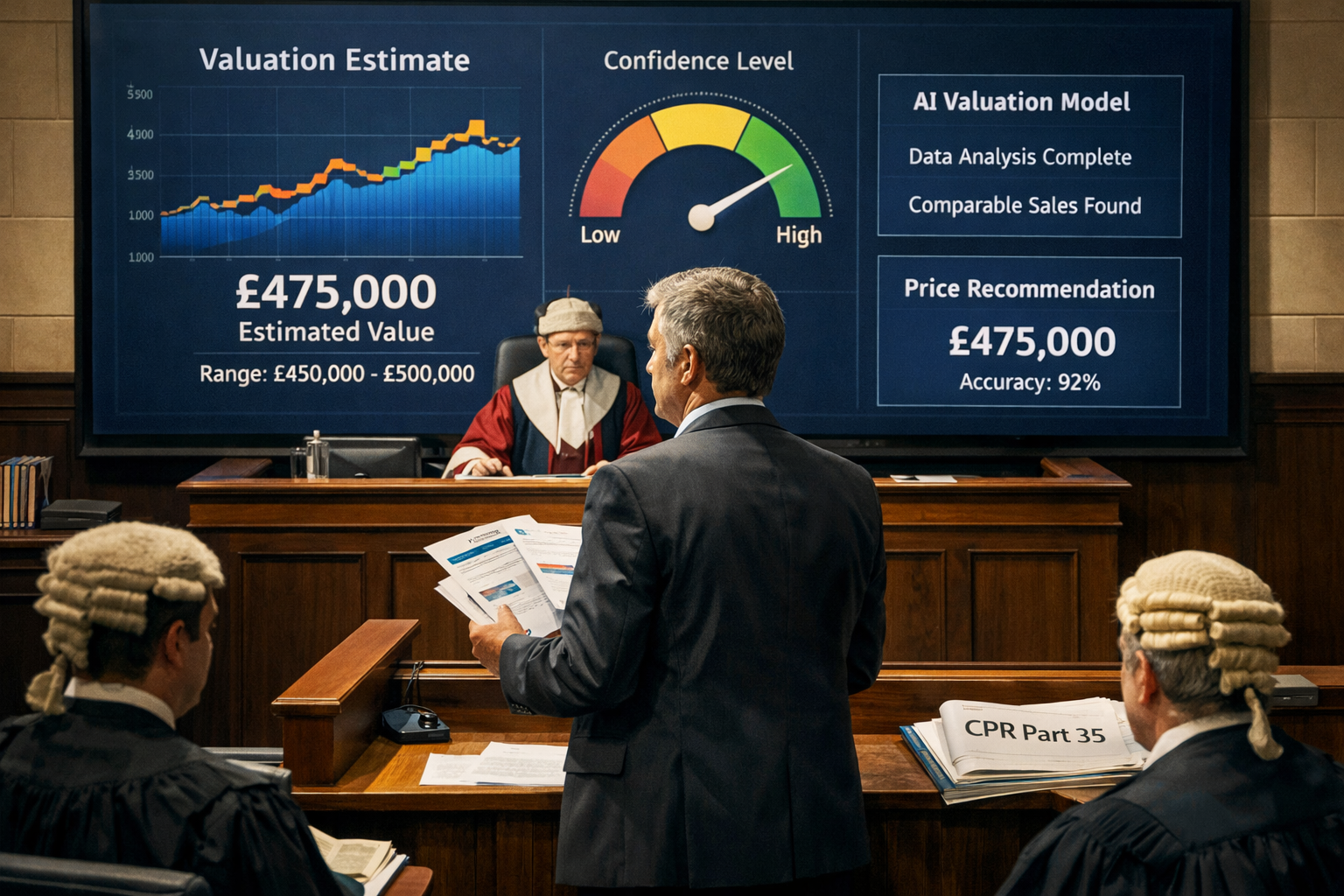
What CPR Part 35 Demands of Expert Witnesses
The Civil Procedure Rules Part 35 framework has governed expert witness conduct in England and Wales for decades. Its core duty — that the expert's overriding obligation is to the court, not to the instructing party — has not changed. What has changed in 2026 is the nature of the evidence being defended.
Under CPR Part 35.3, an expert must be able to confirm that their report contains the truth, the whole truth, and nothing but the truth. When an Automated Valuation Model (AVM) or AI-assisted tool contributes to a figure in that report, the expert witness faces three distinct challenges:
- Explainability — Can the surveyor articulate how the AI reached its output?
- Verifiability — Can the methodology be independently tested or replicated?
- Accountability — Has the surveyor exercised sufficient professional judgment to own the conclusion?
Courts are increasingly asking these questions. In valuation disputes involving lease extensions, matrimonial settlements, or commercial property assessments, opposing counsel now routinely probe whether the expert actually formed an independent opinion or simply adopted an algorithmic output.
The RICS March 2026 Standard: A Direct Response
The RICS Responsible AI Standard, effective 9 March 2026, provides the profession's formal answer. It mandates that the surveyor remains accountable for every piece of professional advice, regardless of the tools used to produce it [1]. This is not a soft recommendation — it is a binding professional standard for all RICS members and regulated firms.
💬 "AI assists professional practice but does not replace it." — RICS Responsible AI Standard, 2026 [1]
For expert witnesses, this creates a clear compliance baseline: any AI-generated figure that appears in an expert report must have been reviewed, tested, and endorsed by the surveyor's own professional judgment before it is submitted to the court.
Understanding the RICS March 2026 Governance Framework for AI in Valuation
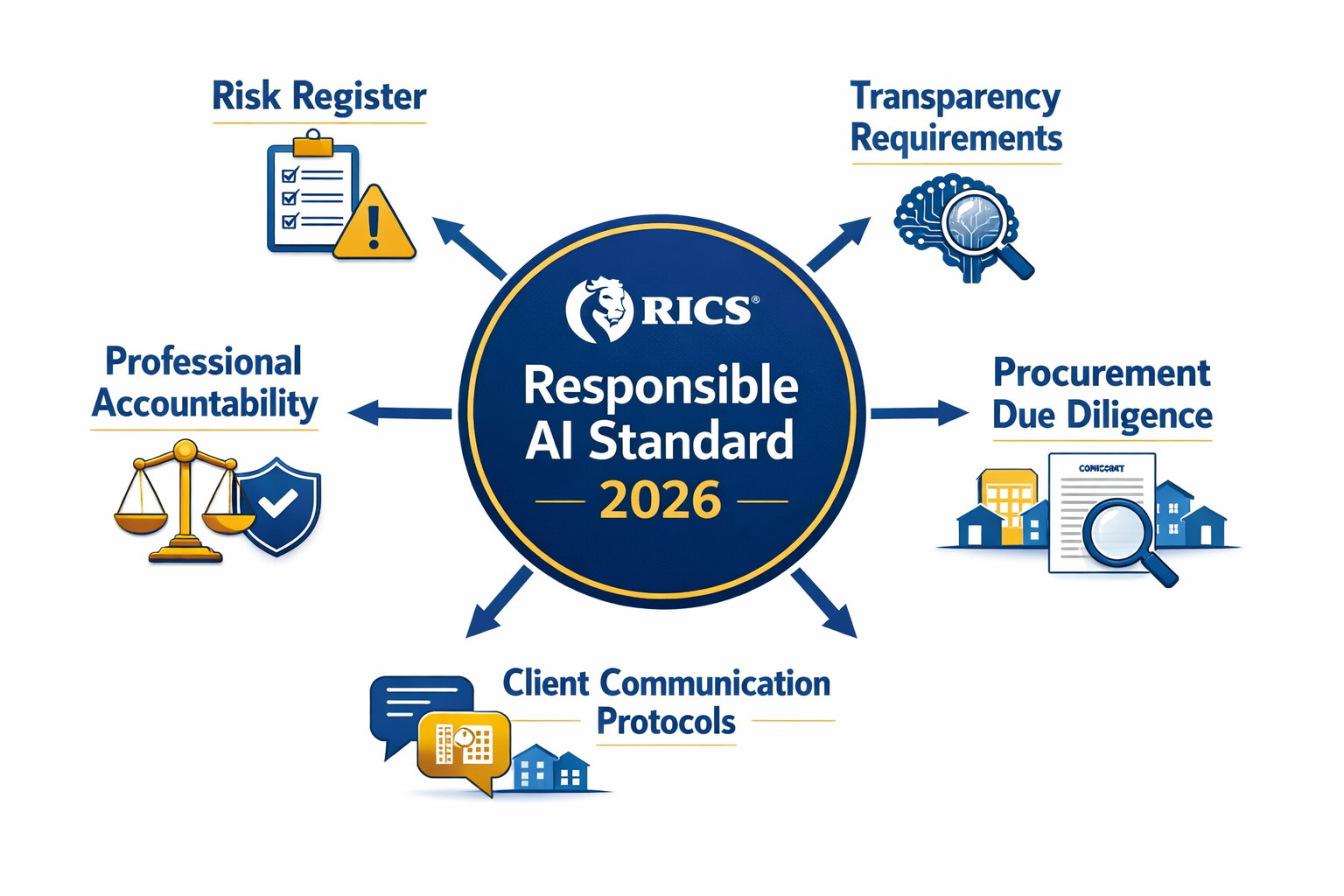
Four Pillars of the Standard
The RICS Responsible AI Standard organises its requirements around four core areas [1]:
| Pillar | Core Requirement | Expert Witness Implication |
|---|---|---|
| Governance & Risk Management | Risk registers, responsible-use policies, procurement due diligence | Document AI tools used in every instruction |
| Professional Judgment & Oversight | Surveyors must review and validate AI outputs | Cannot adopt AVM figures without independent analysis |
| Transparency & Client Communication | Disclose AI use to clients and relevant parties | Disclose in expert reports submitted to courts |
| Responsible AI Development | Firms must assess AI tools before deployment | Procurement records become part of compliance audit trail |
For firms providing RICS valuation services and expert witness work, each pillar generates specific documentation obligations that must be in place before an instruction is accepted.
Risk Registers and Procurement Due Diligence
The governance pillar requires firms to maintain risk registers covering every AI tool used in professional practice [1]. For an expert witness practice, this means:
- Listing each AVM or AI-assisted tool by name and version
- Recording the tool's known limitations, confidence intervals, and data sources
- Documenting the procurement due diligence process, including how the tool was assessed for accuracy and bias
- Reviewing and updating the register at defined intervals
This documentation is not merely administrative. In a disputed valuation, opposing counsel may seek disclosure of the firm's AI governance records to test whether the expert followed a compliant process. A well-maintained risk register becomes a shield; an absent one becomes a liability.
Transparency and Disclosure in Expert Reports
The transparency pillar is arguably the most immediately relevant to expert witnesses [1]. Undisclosed use of AI in a court-submitted report risks:
- Breach of CPR Part 35 duties of candour
- RICS disciplinary proceedings for non-compliance with the mandatory standard
- Adverse judicial comment that undermines the expert's credibility on all issues
Best practice in 2026 is to include a dedicated AI Disclosure Statement in every expert report where AI tools contributed to the analysis. This statement should identify the tool used, the nature of its contribution, the limitations acknowledged, and the independent steps taken by the surveyor to validate the output.
For Red Book valuations that feed into dispute proceedings, this disclosure obligation runs in parallel with RICS Valuation — Global Standards requirements, creating a layered compliance environment.
Expert Witness Protocols for AI-Generated Evidence Challenges in Valuation Disputes: Practical Application

Defending Surveyor Judgment Against Automated Models
The most challenging scenario for an expert witness in 2026 is not using an AI tool — it is defending a conclusion that differs from what the AI produced. Courts and opposing parties may argue that a qualified AVM represents objective market data, making any departure from its output appear subjective or self-serving.
Effective expert witness protocols for navigating this challenge include:
🔍 Step 1: Document the AI output in full
Preserve the raw AVM or AI output, including confidence intervals, comparable data sets used, and any flags or caveats generated by the model. This forms the baseline against which professional judgment is applied.
📋 Step 2: Conduct an independent comparables analysis
The surveyor must identify and analyse comparable transactions independently. Where these differ from the AI's data set, the differences must be explained — not assumed to be errors in the AI.
🏠 Step 3: Apply property-specific adjustments
AI models cannot inspect a property. Factors such as condition, layout, non-standard construction, or access issues require physical inspection and professional judgment. For properties with specific defect issues, a specific defect survey may be necessary to support the expert's adjustments.
⚖️ Step 4: Record the reasoning chain
Every departure from the AI output must be supported by a documented reasoning chain. This is the expert's intellectual property — the professional judgment that the RICS standard mandates and that CPR Part 35 requires.
📄 Step 5: Prepare for cross-examination on methodology
Expert witnesses should anticipate questions including:
- "Did you use an AI tool to assist in this valuation?"
- "What weight did you give to its output?"
- "Why does your figure differ from the model's output?"
- "Has your firm complied with the RICS March 2026 AI standard?"
Challenging Opposing AI Evidence
Expert witness protocols also apply when the opposing party relies on AI-generated valuation evidence. The RICS March 2026 framework provides a structured basis for challenge [1]:
- Governance challenge: Has the opposing expert's firm maintained a compliant risk register and responsible-use policy?
- Accountability challenge: Did the opposing expert exercise independent professional judgment, or did they simply adopt the AI output?
- Transparency challenge: Was the use of AI disclosed in the report as required by the standard?
- Methodology challenge: Are the AI tool's data sources, training data, and known limitations disclosed and appropriate for the subject property?
For disputes involving lease extension valuations or matrimonial valuations, where relatively small differences in opinion can have significant financial consequences, these challenges can be decisive.
The Forthcoming RICS AI in Valuation Guidance
RICS has confirmed that dedicated global practice guidance on "Artificial Intelligence in real estate valuation" is scheduled for public consultation in Q2 2026 (April–June), with publication expected later in the year [3]. This forthcoming guidance is expected to provide:
- Specific protocols for AVM use in formal valuation contexts
- Minimum standards for AI tool validation before use in regulated valuations
- Guidance on disclosure language for valuation reports
- Sector-specific considerations for residential, commercial, and specialist property
Expert witnesses and their firms should monitor this consultation closely. Engaging with the consultation process — by submitting responses — is itself a form of professional development that demonstrates commitment to responsible AI practice.
Compliance Checklist: Expert Witness Protocols for AI-Generated Evidence Challenges in Valuation Disputes: RICS March 2026 Standards Compliance
For practitioners providing expert witness services in valuation disputes, the following checklist consolidates the key compliance actions required under the March 2026 framework:
Firm-Level Obligations ✅
- Maintain an up-to-date AI risk register covering all tools used in professional practice [1]
- Implement a written responsible-use policy for AI in valuation work [1]
- Conduct and document procurement due diligence for each AI tool [1]
- Train all fee-earners on the RICS Responsible AI Standard requirements
- Establish a review cycle for AI governance documentation
Instruction-Level Obligations ✅
- Identify at the outset whether AI tools will be used in the instruction
- Record the specific AI tool(s) used, including version and data sources
- Document the AI output in full, including confidence intervals and caveats
- Conduct independent analysis to validate or adjust the AI output
- Record the professional reasoning chain for any departures from AI output
Report-Level Obligations ✅
- Include an AI Disclosure Statement where AI tools contributed to the analysis
- Confirm that all opinions expressed represent the expert's independent professional judgment
- Ensure the report complies with CPR Part 35 requirements in full
- For Red Book valuations, ensure compliance with RICS Valuation — Global Standards
Cross-Examination Preparation ✅
- Prepare clear, accessible explanations of AI tool methodology
- Be ready to explain the limitations of the AI tool used
- Document why the expert's conclusion may differ from the AI output
- Anticipate governance-based challenges from opposing counsel
Broader Implications: The RICS Valuation Compliance Framework
The RICS Valuation Compliance Framework Pilot, running alongside the new AI standard, adds a further layer of accountability for firms delivering valuation services [2]. Under this pilot, firms are subject to enhanced monitoring of their valuation processes — including the tools and methodologies used to generate opinions of value.
For expert witnesses, the intersection of the Compliance Framework and the AI Standard creates a comprehensive audit environment. Firms that have not aligned their processes with both frameworks by mid-2026 face meaningful regulatory exposure.
The cost of valuation work — in terms of time, documentation, and professional indemnity insurance — is rising in this environment. However, the firms that invest in robust AI governance now are building a competitive advantage: the ability to demonstrate compliance when it matters most, in the witness box.
Conclusion: Actionable Next Steps for Expert Witnesses in 2026
The arrival of the RICS Responsible AI Standard on 9 March 2026 marks a genuine inflection point for expert witness practice in valuation disputes. The framework is clear: AI is a tool, the surveyor is the professional, and the court expects both to be understood and defended with equal rigour [1].
Immediate Actions for Practitioners 🎯
-
Audit your AI tool inventory today. If your firm uses any AVM, machine learning tool, or AI-assisted platform in valuation work, it must appear on a compliant risk register immediately [1].
-
Draft or update your AI disclosure template. Every expert report involving AI-assisted analysis needs a standardised disclosure statement. Draft this now, before the next instruction arrives.
-
Review your CPR Part 35 compliance process in light of the new AI accountability requirements. Ensure your statement of truth covers AI-assisted elements of the report.
-
Monitor the Q2 2026 RICS consultation on AI in real estate valuation [3]. Engage with the consultation to shape guidance that will affect your practice.
-
Invest in cross-examination preparation specifically focused on AI methodology. The questions are coming — practitioners who have rehearsed clear, confident answers will outperform those who have not.
-
Seek specialist support where needed. For complex disputes involving RICS valuations or party wall matters, working with experienced chartered surveyors who understand both the technical and regulatory landscape is essential.
The surveyors who thrive in this new environment will be those who treat the RICS March 2026 AI standard not as a compliance burden, but as a framework for demonstrating the irreplaceable value of professional judgment — in court, and everywhere else.
References
[1] RICS First Ever Standard On Responsible AI Use Now In Effect – https://www.rics.org/news-insights/rics-first-ever-standard-on-responsible-ai-use-now-in-effect
[2] The Valuation Compliance Framework Pilot Key Information – https://www.rics.org/profession-standards/rics-standards-and-guidance/sector-standards/valuation-standards/the-valuation-compliance-framework-pilot-key-information
[3] AI In Real Estate Valuation – https://www.rics.org/profession-standards/rics-standards-and-guidance/sector-standards/valuation-standards/ai-in-real-estate-valuation
[4] RICS Introduces Mandatory AI Standard For Surveyors: What Insurers And Their Clients Need To Know – https://cms.law/en/gbr/legal-updates/rics-introduces-mandatory-ai-standard-for-surveyors-what-insurers-and-their-clients-need-to-know
