
By 2026, more than one in three new cars registered in the UK is fully electric — yet millions of terraced and semi-detached homeowners still face a surprisingly thorny legal puzzle: who owns the wall the charger goes on, and who pays when it fails? Party Wall Awards for Shared EV Charging Installations: RICS Cost Allocation Protocols and Structural Safeguards in 2026 sit at the intersection of property law, electrical engineering, and neighbour relations — a combination that demands careful professional guidance.
This article unpacks how party wall surveyors are drafting awards specifically for communal EV charger setups, how RICS cost allocation protocols divide financial responsibility, and what structural safeguards protect both adjoining owners from costly disputes down the line.
Key Takeaways 🔑
- Party wall awards are legally binding documents that can — and increasingly do — govern shared EV charging installations on boundary walls.
- RICS cost allocation protocols provide a structured framework for splitting installation, maintenance, and repair costs between adjoining owners.
- Structural safeguards such as schedules of condition and cable conduit specifications must be embedded in every award to protect both parties.
- The UK government's EV Chargepoint Grant covers up to £350 per installation (75% of costs), but does not resolve cost-splitting between neighbours — that requires a formal agreement [3].
- Engaging a qualified party wall surveyor before any work begins is the single most effective way to prevent costly disputes.
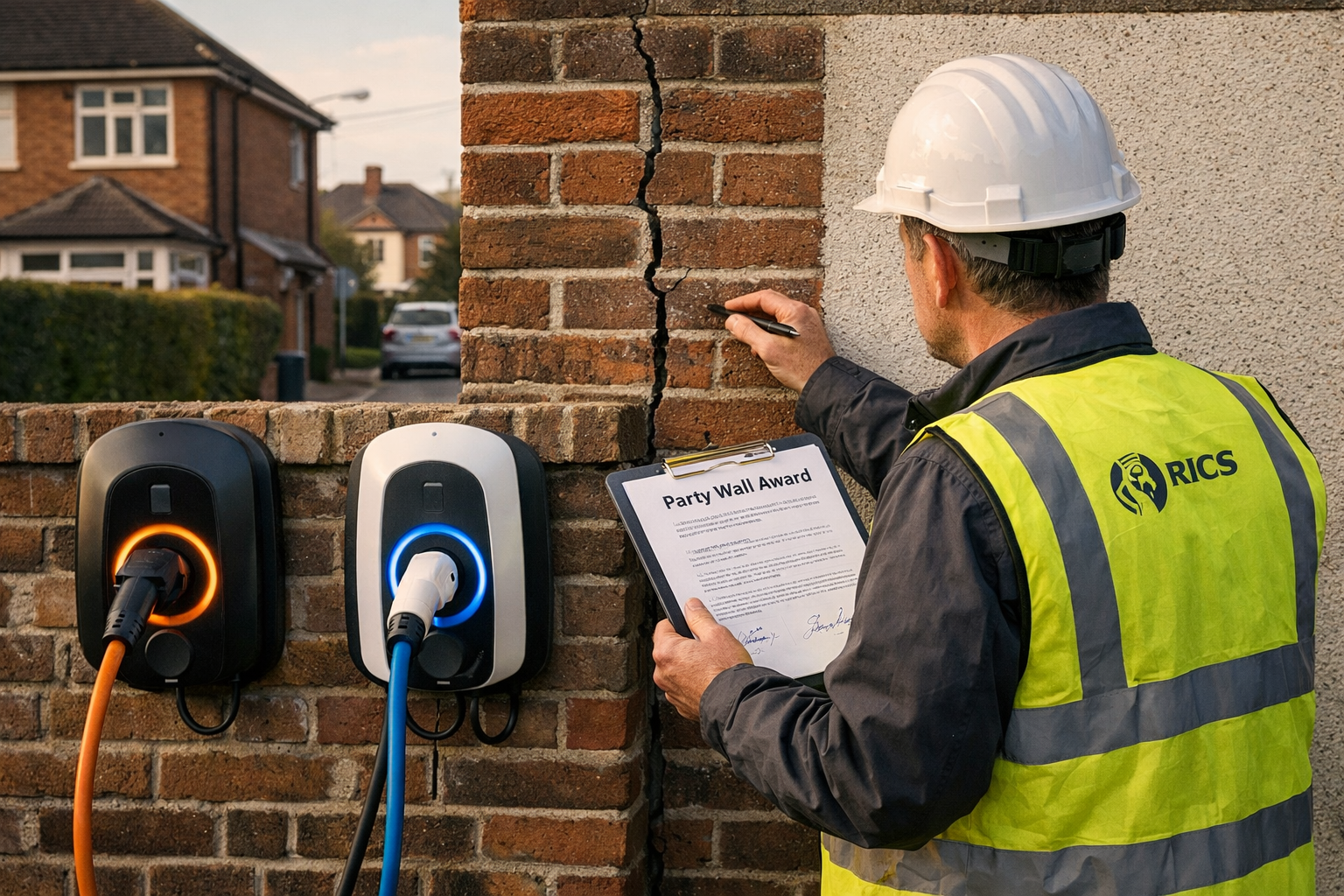
Why Shared EV Charging on Party Walls Is a 2026 Legal Flashpoint
The Party Wall etc. Act 1996 was written long before electric vehicles became mainstream. It was designed to manage excavations, extensions, and structural alterations — not the routing of high-voltage cables through shared masonry. Yet in 2026, this legislation is precisely the framework surveyors are adapting to handle a wave of EV-related boundary disputes.
What Triggers the Party Wall Act for EV Installations?
Not every EV charger installation requires a party wall award. The Act is triggered when proposed works affect a party structure — typically a shared wall, floor, or fence. For EV charging, the Act becomes relevant when:
- A charger is to be physically mounted on a party wall
- Cable conduits must pass through shared masonry
- Groundworks for underground cabling come within 3 metres of a neighbour's foundations (the so-called 3-metre rule)
- A new electricity supply point requires cutting into a shared structure
When any of these conditions apply, the building owner must serve formal notice on the adjoining owner. If consent is not given within 14 days, a dispute is deemed to have arisen and surveyors must be appointed. For a full breakdown of when formal notices are legally required, see this guide on when a party wall agreement is legally required in the UK.
💡 Pull Quote: "A party wall award for an EV charger is not bureaucratic overkill — it is the legal instrument that prevents a £500 installation from becoming a £50,000 dispute."
The Leasehold Complication
For blocks of flats and leasehold properties, the picture is more complex. Freeholders and management companies typically require a Licence to Alter before any EV charging point is installed, and lease variations may be necessary if the installation is classified as an "improvement" rather than routine maintenance [3]. In these settings, a party wall award may sit alongside — not replace — leasehold consents.
RICS Cost Allocation Protocols: How Surveyors Split the Bill
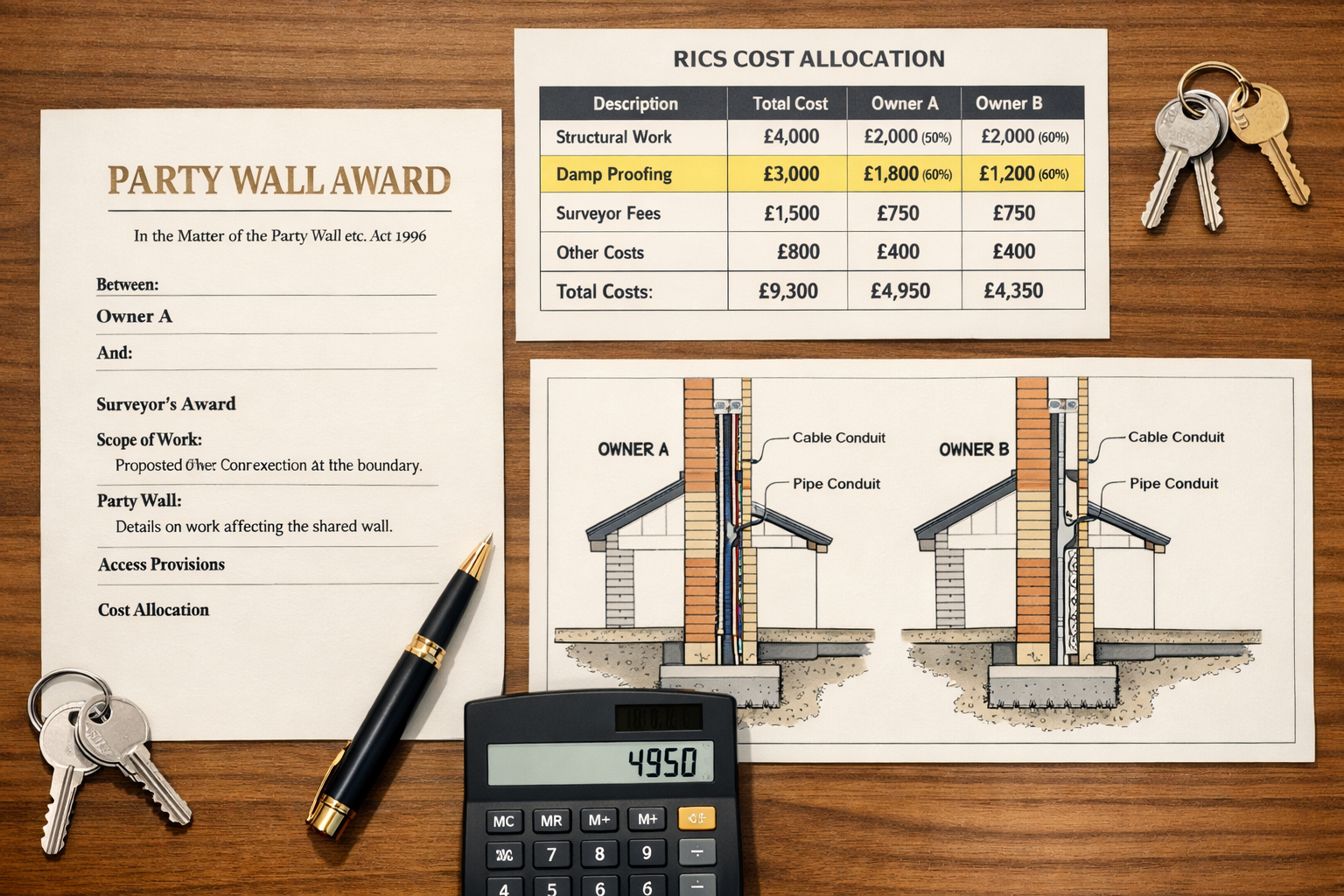
The Royal Institution of Chartered Surveyors (RICS) does not publish a single prescriptive formula for splitting EV charging costs between neighbours. Instead, RICS-accredited surveyors apply established cost allocation principles drawn from party wall practice, adapting them to the specific facts of each installation. Understanding these protocols is central to Party Wall Awards for Shared EV Charging Installations: RICS Cost Allocation Protocols and Structural Safeguards in 2026.
The Core Principle: Benefit Proportionality
RICS guidance on party wall matters consistently applies the principle that costs should follow benefit. Where both owners will use and benefit from a shared charging installation, costs are typically split proportionally. Where only one owner benefits, that owner bears the full cost — including any remediation costs for damage to the shared structure.
Common Cost Allocation Models in 2026
| Scenario | Typical Cost Split | Notes |
|---|---|---|
| Both owners install chargers simultaneously | 50/50 for shared infrastructure | Each owner pays for their own unit |
| One owner installs, neighbour gains future access right | 70/30 or 60/40 | Access right documented in award |
| One owner installs, neighbour has no benefit | 100/0 | Building owner pays all costs |
| Shared cable run, separate meters | 50/50 for conduit; individual metering costs separate | Meter costs borne individually |
| Structural repair triggered by installation | 100% building owner unless pre-existing defect | Schedule of condition is critical |
What the Award Must Specify 📋
A well-drafted party wall award for an EV installation should include:
- Scope of works — precise description of cable routes, fixings, and penetrations through the party wall
- Cost responsibility matrix — who pays for installation, commissioning, ongoing maintenance, and eventual removal
- Access rights — when and how the building owner (and their contractors) may access shared areas
- Insurance obligations — minimum liability cover required during and after installation
- Reinstatement obligations — what happens to the wall if the charger is removed or the property is sold
- Dispute resolution mechanism — the agreed process if costs are disputed post-installation
For a detailed template and guidance on what a legally sound award contains, see this party wall award guidance resource, and review a party wall contract guide and award template for practical drafting examples.
Government Grants and Cost Recovery
The UK government's EV Chargepoint Grant funds up to 75% of installation costs, capped at £350 per installation including VAT [3]. This grant applies per chargepoint, not per property — meaning in a shared installation scenario, both owners may independently claim if each has a dedicated unit. However, the grant does not resolve how shared infrastructure costs (conduit runs, electrical upgrades, wall penetrations) are divided. That is precisely where the party wall award earns its value.
🔑 Key Point: Grant funding reduces the total cost burden but does not substitute for a legally binding cost allocation agreement between neighbours.
The Cost of Getting It Wrong
The cost of a party wall process is typically far lower than the cost of resolving a dispute after the fact. Surveyor fees for a straightforward EV-related party wall award typically range from £800 to £2,000 per surveyor, depending on complexity. Contrast this with the legal costs of a contested dispute, which can exceed £15,000 — before any remediation works are factored in.
Structural Safeguards: Protecting the Party Wall During and After Installation
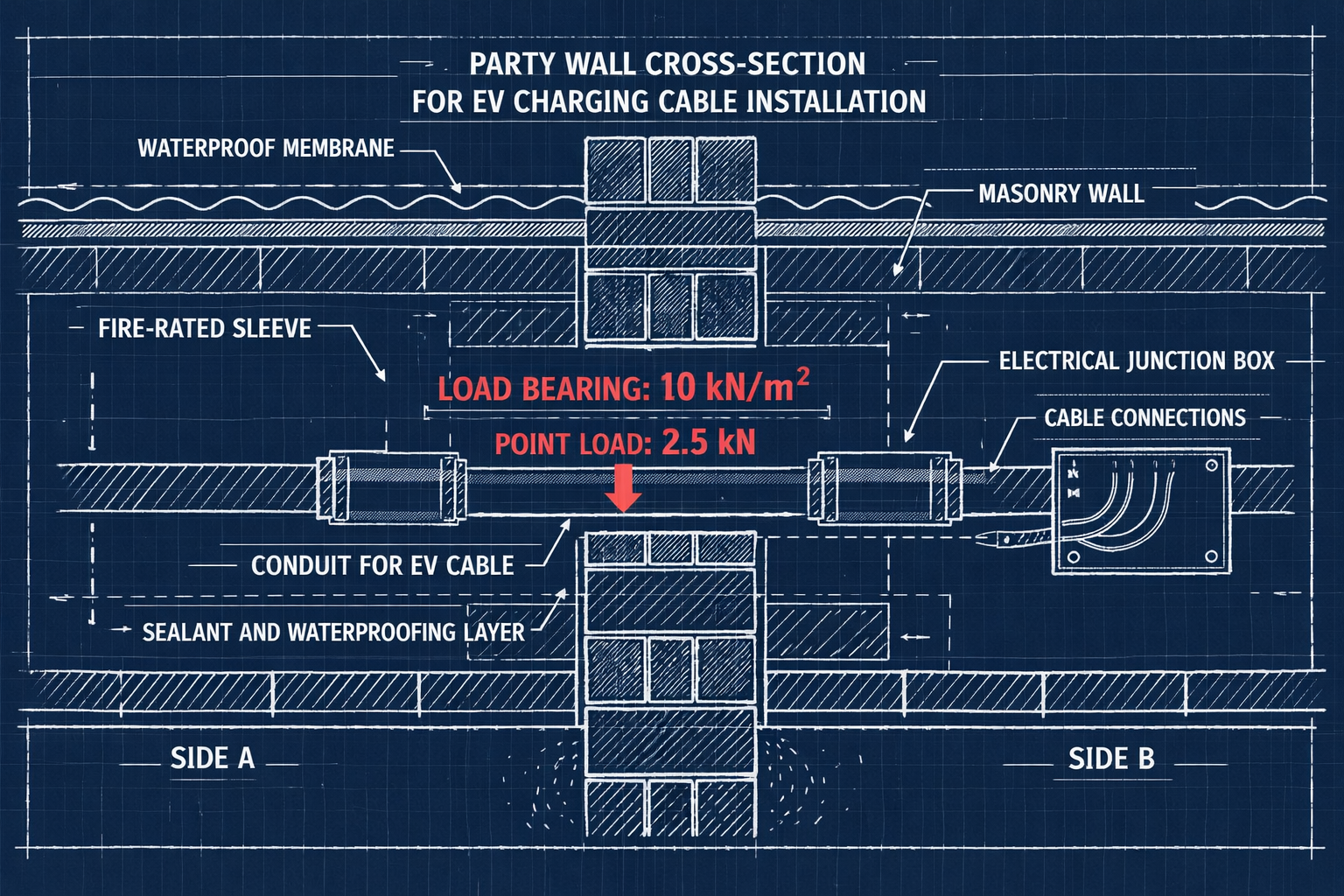
The structural integrity of a party wall is a shared asset. Any penetration — even a small cable conduit — can compromise fire resistance, moisture resistance, and load-bearing capacity if not properly specified and executed. Party Wall Awards for Shared EV Charging Installations: RICS Cost Allocation Protocols and Structural Safeguards in 2026 must therefore include robust technical provisions, not just financial ones.
Pre-Works: The Schedule of Condition
Before any drilling or fixing begins, a schedule of condition should be prepared. This is a photographic and written record of the party wall's existing state — cracks, damp patches, previous repairs, and structural anomalies. It serves as the baseline against which any post-works damage is assessed.
Without a schedule of condition, an adjoining owner who notices new cracking after installation has no objective evidence to prove the works caused the damage. With one, liability is clear. Learn more about schedule of condition reports and how they protect both parties.
Technical Specifications the Award Should Mandate
A competent party wall surveyor — ideally one with knowledge of electrical installations — will ensure the award specifies:
🔧 Cable and Conduit Requirements:
- Use of fire-rated conduit sleeves through masonry (typically intumescent-lined)
- Minimum conduit diameter to accommodate future cable upgrades
- Sealing requirements at both faces of the wall (fire and moisture)
- Prohibition on surface-mounted cables on the party wall face without written consent
⚡ Electrical Load Considerations:
- Confirmation that the shared wall's electrical loading capacity has been assessed
- Requirement for a qualified electrician's sign-off (Part P certification)
- Specification of RCD protection and earthing arrangements
🏗️ Structural Integrity:
- Maximum core drill diameter permitted without structural engineer's sign-off
- Requirement for a structural survey if the wall is of non-standard construction or historic fabric
- Prohibition on cutting through load-bearing elements without prior consent
RICS has highlighted the importance of careful technical assessment when retrofitting services into existing structures, particularly in older or historic buildings where masonry may be more vulnerable [4].
During Works: Monitoring and Access
The award should specify:
- Notice periods before works commence (typically 48–72 hours for non-emergency works)
- The adjoining owner's right to have their surveyor present during penetration works
- Dust and vibration mitigation measures
- Working hours restrictions
Post-Works: Ongoing Rights and Obligations
Once the charger is installed, the award should address:
- Maintenance access — the building owner's right to access the party wall for charger maintenance, with reasonable notice
- Shared infrastructure maintenance — who is responsible for inspecting and maintaining shared conduit runs
- Sale of property — whether the award binds successors in title (it should, and it does under the Act)
- Removal obligations — reinstatement of the wall to its original condition if the charger is decommissioned
For properties with shared chimneys or other complex shared structures, the principles applied to party wall shared chimneys offer useful precedent for how surveyors handle ongoing access and maintenance rights.
Choosing the Right Surveyor for EV-Related Party Wall Awards
Not all party wall surveyors have equal experience with EV installations. In 2026, this is a rapidly evolving specialism. When selecting a surveyor, look for:
- RICS membership — the baseline professional standard
- Experience with services installations — not just structural works
- Familiarity with BS 7671 (IET Wiring Regulations) or willingness to work alongside a qualified electrician
- Local knowledge — understanding of local authority requirements for EV infrastructure
For guidance on finding the right professional, see this resource on RICS party wall surveyors and expert guidance for property disputes.
Agreed Surveyor vs. Two Surveyors
Under the Party Wall etc. Act 1996, both owners can agree to appoint a single agreed surveyor — a cost-effective option for straightforward EV installations where both parties are cooperative. Alternatively, each owner appoints their own surveyor, and the two appoint a third surveyor as umpire if needed.
For most EV charging party wall matters, the agreed surveyor route is appropriate and significantly reduces costs and timescales.
Practical Steps for Adjoining Owners in 2026
Whether acting as the building owner (the one installing the charger) or the adjoining owner (the neighbour), here is a clear action plan:
For the Building Owner:
- ✅ Determine whether works affect the party wall (consult a surveyor early)
- ✅ Serve the correct party wall notice — typically a Party Structure Notice
- ✅ Allow the 14-day consent period before proceeding
- ✅ Commission a schedule of condition before works begin
- ✅ Ensure the party wall award is signed before any drilling or fixing
For the Adjoining Owner:
- ✅ Do not ignore a party wall notice — respond within 14 days
- ✅ Request a schedule of condition to protect your position
- ✅ Appoint your own surveyor if you have concerns about the proposed works
- ✅ Check that the award addresses your future rights regarding the shared infrastructure
- ✅ Confirm the award is registered with your solicitor in case of future property sale
Conclusion: Turning a Legal Obligation into a Shared Opportunity
The shift to electric vehicles is reshaping how neighbours interact with their shared boundaries. A party wall award for a shared EV charging installation is not just a legal formality — it is a practical tool that protects both owners, allocates costs fairly, and ensures the structural integrity of a shared asset for years to come.
Party Wall Awards for Shared EV Charging Installations: RICS Cost Allocation Protocols and Structural Safeguards in 2026 represent one of the most practical applications of century-old property law to a very modern challenge. When handled correctly, they transform a potential flashpoint into a cooperative arrangement that adds value to both properties.
Actionable Next Steps:
- 🔍 Get a professional assessment — have a RICS-accredited surveyor evaluate whether your proposed EV installation triggers the Party Wall Act
- 📄 Serve notice early — allow enough time for the formal process before your planned installation date
- 🤝 Talk to your neighbour first — many disputes are avoided through early, open conversation
- 📋 Commission a schedule of condition — protect yourself regardless of which side of the wall you are on
- 💰 Check grant eligibility — confirm whether the UK EV Chargepoint Grant applies to your installation before committing to costs [3]
The legal framework exists. The professional expertise is available. The only variable is whether property owners choose to use them proactively — or wait until a dispute forces their hand.
References
[1] Ev Charger Rebates And Incentives Guide – https://www.ampup.io/blog/ev-charger-rebates-and-incentives-guide
[2] Ev Charging Station Cost Usa – https://trendxinsights.com/blogs/ev-charging-station-cost-usa/
[3] Installing Electric Vehicle Charging Points At Blocks Of Flats – https://www.coles-miller.co.uk/blog/installing-electric-vehicle-charging-points-at-blocks-of-flats
[4] Retrofitting Historic Buildings Sustainably – https://ww3.rics.org/uk/en/journals/built-environment-journal/retrofitting-historic-buildings-sustainably.html
[5] Scheduled – https://www.rics.org/training-events/online-training/scheduled
[6] highergov – https://www.highergov.com/sl/contract-opportunities/ev/
[7] Posts – https://ev-charging-stations.org/posts/
[8] 863ea987 6d3e Ed11 9daf 001dd805ec0b – https://evp.nc.gov/_entity/annotation/e087f618-d239-f111-88b3-001dd802e1e9/863ea987-6d3e-ed11-9daf-001dd805ec0b?t=1776297600288
