
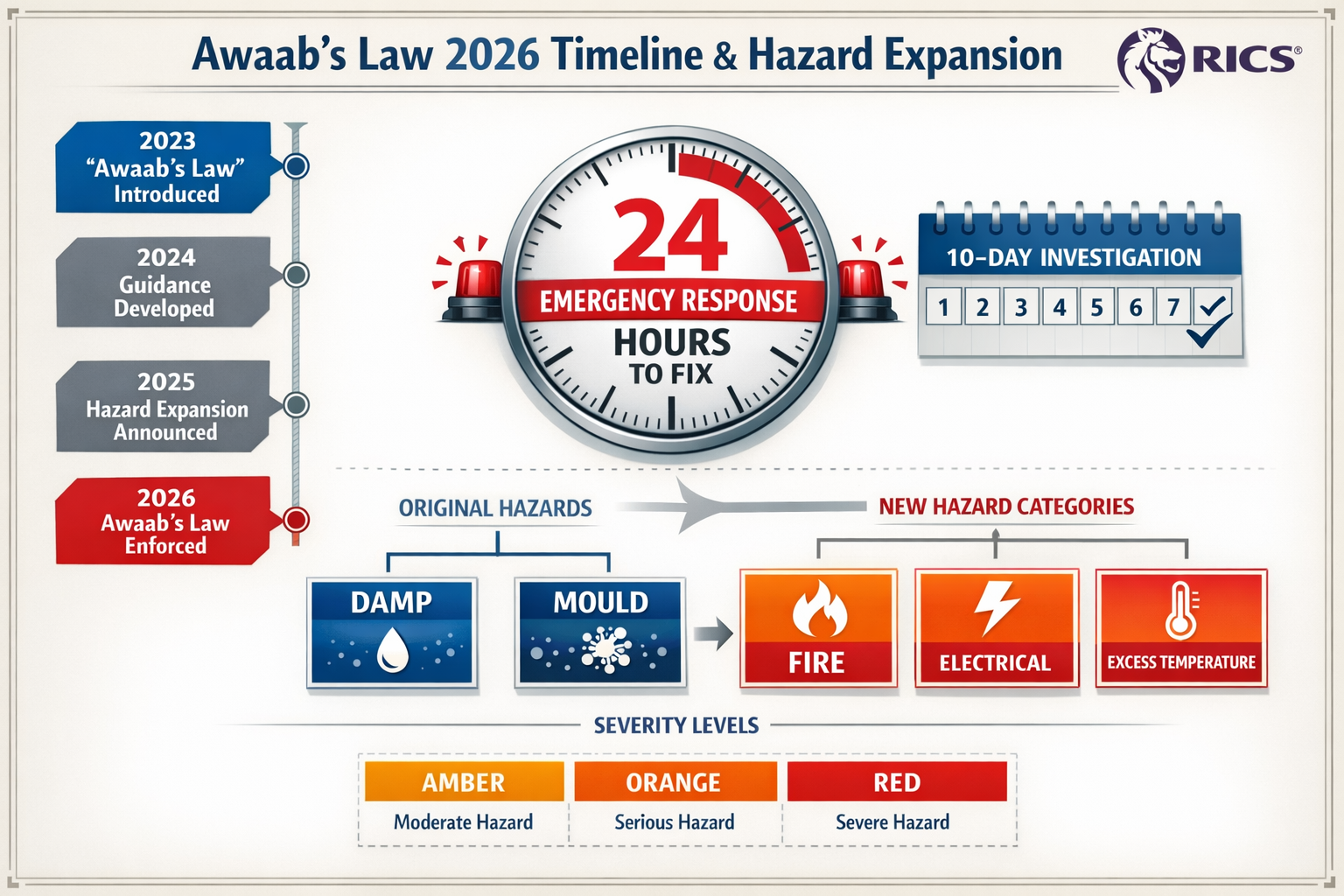
Awaab's Law expanded in 2026 to cover the private rental sector (PRS), introducing mandatory timelines for addressing excess temperature hazards alongside fire and electrical risks. This legislative shift has created an immediate demand for expert witnesses who can navigate RICS evidence standards while defending landlords in an emerging wave of tenant disputes. For surveyors and property professionals, understanding the protocols for documenting, assessing, and testifying on these new hazard categories has become essential to professional practice.
The expansion of Expert Witness Protocols for Excess Temperature Hazards Under Awaab's Law 2026: RICS Evidence Standards in PRS Disputes represents a fundamental change in how rental property compliance is evaluated and litigated. With emergency hazards requiring investigation within 24 hours and significant hazards within 10 working days, the evidentiary burden on landlords has intensified dramatically [4]. Expert witnesses must now prepare comprehensive assessment packages that meet both legal and professional standards while addressing temperature-related risks that were previously outside the scope of housing health and safety enforcement.
Key Takeaways
- Emergency response protocols: Awaab's Law 2026 mandates 24-hour investigation timelines for emergency hazards and 10 working days for significant hazards, requiring expert witnesses to document rapid assessment methodologies [4]
- Expanded hazard scope: Excess temperature hazards now fall under the same regulatory framework as fire and electrical risks, demanding specialized thermal assessment protocols and evidence standards [3]
- RICS compliance requirements: Expert witnesses must adhere to formal RICS expert witness standards while adapting documentation practices to address temperature-specific measurement and valuation impacts [5]
- Evidence package essentials: Comprehensive assessment packages should include timestamped thermal imaging, before-and-after valuation comparisons, and detailed compliance documentation to support tribunal proceedings [1]
- Professional liability considerations: Surveyors providing expert witness services face enhanced regulatory scrutiny through RICS Practice Alerts and must maintain clear separation between advisory and expert witness roles [6]
Understanding Awaab's Law 2026 Expansion to Excess Temperature Hazards
Awaab's Law originated as a response to tragic housing failures involving damp and mould, but its 2026 expansion to the private rental sector has broadened the legislative scope considerably. The law now encompasses fire risks, electrical hazards, and excess temperature conditions that pose health threats to tenants [3]. This expansion reflects growing recognition that thermal discomfort and overheating present genuine health risks, particularly during increasingly frequent heatwaves and in poorly ventilated properties.
Defining Excess Temperature Hazards in the PRS Context
Excess temperature hazards refer to conditions where indoor temperatures reach levels that pose health risks to occupants. Unlike damp and mould, which have established assessment frameworks, temperature hazards require new measurement protocols and threshold definitions. The law does not specify exact temperature thresholds, leaving expert witnesses to apply professional judgment based on:
- Duration of exposure to elevated temperatures
- Vulnerable occupant considerations (elderly, young children, health conditions)
- Property design factors affecting heat retention and ventilation
- Seasonal variations and climate context
- Available mitigation measures and their effectiveness
Expert witnesses must document these factors systematically to establish whether a hazard exists and whether the landlord's response met statutory obligations. This requires familiarity with thermal comfort standards, building physics, and health impact assessments that extend beyond traditional surveying competencies.
Statutory Timelines and Compliance Obligations
The 24-hour emergency response requirement and 10 working day investigation timeline create strict evidentiary demands [4]. Expert witnesses evaluating landlord compliance must reconstruct response timelines with precision, documenting:
- Initial hazard notification date and method (written, verbal, electronic)
- Landlord acknowledgment and investigation commencement
- Assessment activities undertaken (site visits, measurements, specialist consultations)
- Remedial action implementation or justification for delays
- Verification of hazard resolution through follow-up assessment
These timelines become critical in disputes where tenants claim landlords failed to meet statutory obligations. Expert witnesses must evaluate whether investigations were adequate in scope and whether proposed remedies addressed the underlying hazard effectively.
For properties requiring comprehensive assessment beyond temperature concerns, professionals often recommend a RICS Building Survey to identify all potential hazards systematically.
Expert Witness Protocols for Excess Temperature Hazards Under Awaab's Law 2026: Documentation and Assessment Standards
Effective expert witness practice in temperature hazard disputes requires rigorous documentation protocols that satisfy both RICS professional standards and legal evidentiary requirements. The challenge lies in translating technical temperature data into compelling evidence that demonstrates compliance or breach of statutory duties.
Thermal Assessment Methodologies and Equipment Standards
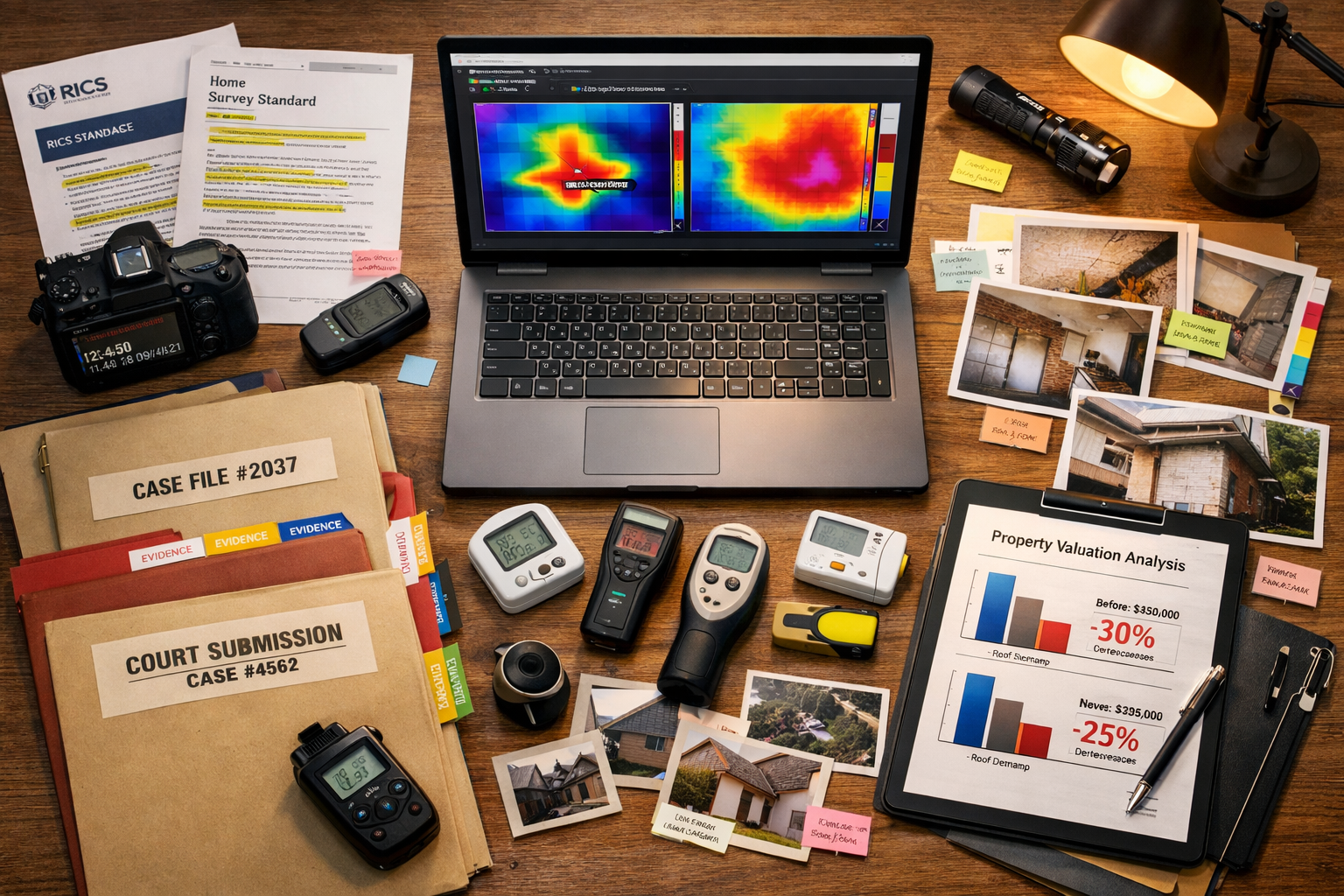
Temperature hazard assessment demands specialized equipment and standardized measurement protocols. Expert witnesses should employ:
🌡️ Thermal Imaging Cameras: Infrared thermography provides visual evidence of temperature distribution, hot spots, and thermal bridging. Images must be timestamped and calibrated to ambient conditions [1].
📊 Data Logging Equipment: Continuous temperature monitoring over representative periods (typically 7-14 days) establishes patterns and peak temperature events. Logs should capture:
- Hourly temperature readings
- Humidity levels (affecting perceived temperature)
- External temperature for comparison
- Occupancy patterns during monitoring
🔍 Ventilation Assessment Tools: Airflow measurements and ventilation effectiveness testing help establish whether inadequate ventilation contributes to excess temperature conditions.
📸 Photographic Documentation: Timestamped photographs should document property orientation, window configurations, shading availability, insulation conditions, and any factors affecting heat gain or dissipation.
Evidence Package Components for PRS Disputes
A comprehensive evidence package for Expert Witness Protocols for Excess Temperature Hazards Under Awaab's Law 2026: RICS Evidence Standards in PRS Disputes should include:
| Evidence Component | Purpose | Key Requirements |
|---|---|---|
| Site Inspection Report | Document property conditions and hazard assessment | Detailed description of property layout, orientation, construction, ventilation systems, and temperature measurement locations |
| Thermal Data Analysis | Establish temperature patterns and exceedance events | Graphical presentation of temperature trends, comparison to comfort standards, statistical analysis of peak events |
| Photographic Evidence | Visual documentation of conditions | Timestamped images showing property features, thermal imaging results, ventilation provisions, and any remedial works |
| Regulatory Compliance Assessment | Evaluate landlord response against statutory timelines | Timeline reconstruction, documentation review, assessment of investigation adequacy and remedial action appropriateness |
| Valuation Impact Analysis | Quantify financial consequences of hazard | Before-and-after valuation comparison demonstrating market value impact of compliance issues [2] |
| Expert Opinion Statement | Professional conclusions on hazard severity and compliance | Clear statement of findings, reasoning, and conclusions regarding statutory obligations |
This structured approach ensures that expert evidence meets the comprehensiveness expected in tribunal proceedings while maintaining RICS professional standards [5].
RICS Expert Witness Standards Application
RICS has established formal standards for surveyors acting as expert witnesses in civil proceedings [5]. These standards emphasize:
⚖️ Independence and Objectivity: Expert witnesses owe their primary duty to the tribunal, not to the instructing party. This requires clear separation between advisory services to landlords and expert witness functions.
📋 Competence and Expertise: Experts must possess appropriate qualifications and experience in the specific hazard category. Temperature hazard assessment may require additional training beyond general surveying competencies.
📝 Report Quality Standards: Expert reports must be clear, comprehensive, and address all relevant issues. They should:
- State the expert's qualifications and experience
- Identify the scope of instructions
- Present facts separately from opinion
- Acknowledge uncertainties or limitations
- Include a statement of truth
🎯 Proportionality: Evidence should be proportionate to the dispute value and complexity. Excessive investigation costs relative to claim values may attract criticism.
RICS issues Practice Alerts to members regarding their obligations when providing expert witness services [6]. Surveyors should review current alerts before accepting expert witness instructions to ensure compliance with evolving professional requirements.
When disputes involve party wall matters alongside temperature hazards, expert witnesses must coordinate assessments to address all relevant issues comprehensively.
RICS Evidence Standards in PRS Disputes: Valuation Methodology and Case Preparation
The financial impact of temperature hazards on rental property values requires specialized valuation methodology that expert witnesses can defend under cross-examination. Expert Witness Protocols for Excess Temperature Hazards Under Awaab's Law 2026: RICS Evidence Standards in PRS Disputes demand rigorous before-and-after valuation comparisons that isolate the specific impact of compliance failures.
Before-and-After Valuation Comparison Methodology
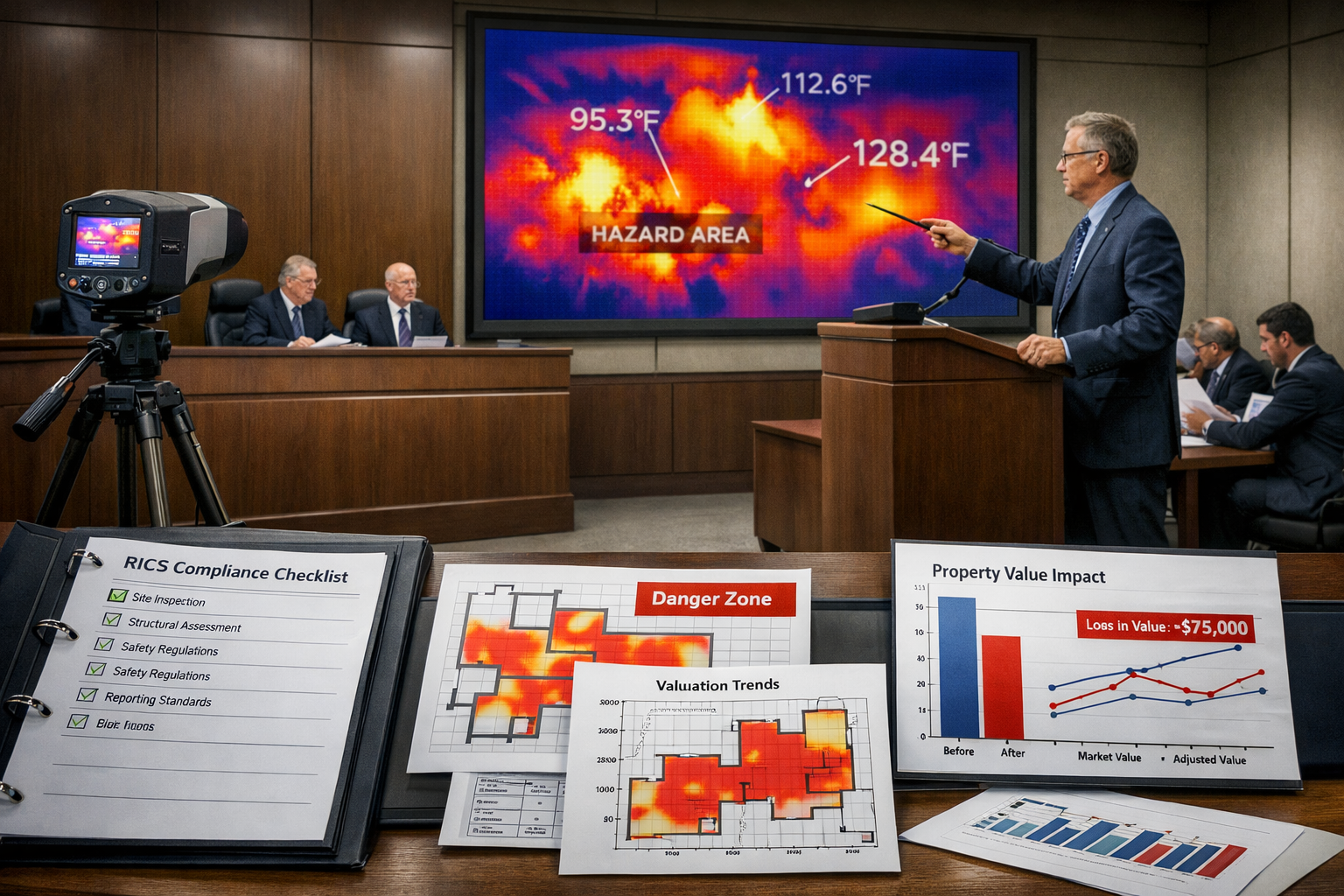
Expert witnesses should employ comparative valuation methodology to demonstrate the market value impact of temperature hazard compliance issues [2]. This approach involves:
Step 1: Establish Baseline Valuation – Determine the property's market value assuming full compliance with Awaab's Law and absence of temperature hazards. This requires comparable property analysis and adjustment for property-specific features.
Step 2: Identify Hazard-Related Value Impacts – Quantify the value reduction attributable specifically to:
- Excess temperature conditions and associated health risks
- Landlord compliance failures and reputational damage
- Required remedial works and associated costs
- Tenant demand reduction for properties with documented hazards
- Potential enforcement action and legal costs
Step 3: Calculate Net Value Impact – Express the difference as both absolute value reduction and percentage diminution. This quantification supports damages claims and settlement negotiations.
Step 4: Consider Temporal Factors – Account for the duration of non-compliance and whether remedial action has been completed. Ongoing hazards have different valuation impacts than resolved issues.
This methodology provides defensible financial evidence that tribunals can apply to determine appropriate remedies or damages. Expert witnesses should be prepared to justify all assumptions and adjustments under cross-examination.
For properties with multiple valuation considerations, such as shared ownership arrangements, experts must address how temperature hazards interact with other value factors.
Case Preparation Tactics for Tribunal Proceedings
Effective case preparation distinguishes competent expert witnesses from exceptional ones. Key tactics include:
📚 Comprehensive Document Review: Before site inspection, review all available documentation including:
- Tenancy agreements and correspondence
- Hazard notification records
- Landlord investigation reports and contractor quotes
- Previous survey reports or compliance certificates
- Local authority enforcement notices
🗓️ Timeline Reconstruction: Create a detailed chronology of events from initial hazard identification through remedial action. This timeline becomes the framework for evaluating statutory compliance.
🔬 Technical Research: Research relevant technical standards, guidance documents, and case law precedents. Temperature hazard assessment may require reference to:
- CIBSE thermal comfort guidance
- Public Health England heat-health guidance
- Building Regulations ventilation standards
- Previous tribunal decisions on similar hazards
💬 Anticipate Cross-Examination: Identify potential weaknesses in your analysis and prepare robust responses. Common challenges include:
- Measurement methodology and equipment calibration
- Sample period representativeness
- Alternative causation theories
- Proportionality of proposed remedies
🤝 Coordinate with Legal Team: While maintaining independence, expert witnesses should understand the legal framework and procedural requirements of the specific tribunal. This coordination ensures evidence is presented effectively.
📊 Visual Evidence Preparation: Prepare clear, professional visual aids including:
- Annotated site plans showing measurement locations
- Thermal imaging comparisons
- Temperature trend graphs
- Photographic evidence compilations
- Valuation comparison charts
The goal is to present complex technical evidence in an accessible format that tribunal members can readily understand and apply to their decision-making.
Common Pitfalls and Professional Liability Considerations
Expert witnesses face several common pitfalls when addressing temperature hazards under Awaab's Law:
❌ Scope Creep: Expanding beyond the specific instructions to address unrelated property issues. Maintain clear boundaries on the scope of expert opinion.
❌ Advocacy: Adopting an adversarial tone or appearing to advocate for the instructing party. Expert witnesses must maintain objectivity and acknowledge evidence that contradicts their conclusions.
❌ Inadequate Investigation: Failing to conduct sufficient site investigation or technical analysis to support conclusions. Rushed assessments undermine credibility.
❌ Overconfidence: Expressing certainty where genuine uncertainty exists. Expert witnesses should acknowledge limitations and alternative interpretations.
❌ Regulatory Non-Compliance: Failing to adhere to RICS expert witness standards or current Practice Alerts [6]. Professional discipline may result from standards breaches.
Surveyors should maintain appropriate professional indemnity insurance that covers expert witness activities and should document all aspects of their investigation and reasoning process thoroughly.
For complex cases involving multiple property issues, comprehensive assessment through services like commercial building surveys may be necessary to establish the full context of temperature hazards.
Emerging Trends and Future Developments in Temperature Hazard Litigation
The expansion of Awaab's Law to cover excess temperature hazards in 2026 represents the beginning of an evolving regulatory landscape rather than a settled framework. Expert witnesses should anticipate several emerging trends:
🌡️ Threshold Standardization: Regulatory authorities may develop specific temperature thresholds and measurement protocols as case law accumulates. Expert witnesses should monitor guidance updates from RICS, local authorities, and tribunal decisions.
📱 Technology Integration: Smart home temperature monitoring systems and IoT sensors will increasingly provide continuous data streams that expert witnesses must interpret. This technology shift will require new competencies in data analysis and sensor validation.
⚖️ Intersecting Regulations: Temperature hazards intersect with energy efficiency requirements, building regulations, and climate adaptation policies. Expert witnesses must understand how these regulatory frameworks interact and potentially conflict.
🏘️ Portfolio-Level Compliance: Large landlords managing multiple properties will face portfolio-level compliance challenges. Expert witnesses may be called to assess systematic compliance failures rather than isolated property issues.
💰 Insurance Market Response: Professional indemnity and landlord insurance markets will adapt to temperature hazard risks. Expert witnesses may need to address insurance coverage issues in their evidence.
Surveyors providing expert witness services should invest in continuing professional development focused on thermal comfort assessment, building physics, and emerging regulatory requirements. Professional organizations like RICS will likely develop specialized guidance and training programs as the case law develops.
For property owners concerned about compliance across multiple properties, understanding what chartered surveyors do can help identify appropriate expertise for comprehensive assessment programs.
Practical Guidance for Landlords and Property Managers
While this article focuses on expert witness protocols, landlords and property managers can take proactive steps to minimize temperature hazard disputes:
✅ Preventive Assessment: Commission thermal comfort assessments before hazards are reported, particularly for properties with known ventilation limitations or solar gain issues.
✅ Rapid Response Systems: Establish internal protocols that ensure hazard reports trigger immediate investigation within statutory timelines [4].
✅ Documentation Culture: Maintain comprehensive records of all maintenance activities, tenant communications, and hazard investigations. These records become critical evidence if disputes arise.
✅ Remedial Action Planning: When temperature hazards are identified, develop and document clear remedial action plans with realistic timelines and interim mitigation measures.
✅ Expert Consultation: Engage qualified surveyors early in the investigation process rather than waiting for disputes to escalate. Early expert involvement can prevent litigation entirely.
Properties with complex structural issues may benefit from specialized assessments such as subsidence surveys to identify underlying factors contributing to temperature hazards.
Conclusion
The expansion of Awaab's Law to cover excess temperature hazards in the private rental sector has created new challenges and obligations for landlords, tenants, and the expert witnesses who evaluate compliance disputes. Expert Witness Protocols for Excess Temperature Hazards Under Awaab's Law 2026: RICS Evidence Standards in PRS Disputes require rigorous documentation, specialized technical assessment, and adherence to professional standards that extend beyond traditional surveying practice.
Expert witnesses must master thermal assessment methodologies, understand statutory compliance timelines, and prepare comprehensive evidence packages that satisfy both legal and professional requirements. The before-and-after valuation comparison methodology provides defensible financial evidence, while structured case preparation tactics ensure expert testimony withstands cross-examination scrutiny.
As the regulatory landscape continues to evolve, surveyors providing expert witness services must commit to ongoing professional development and maintain awareness of emerging guidance from RICS and regulatory authorities. The intersection of temperature hazards with broader housing quality, energy efficiency, and climate adaptation policies will create increasingly complex disputes requiring sophisticated expert analysis.
Actionable Next Steps
For surveyors seeking to develop expert witness competencies in temperature hazard assessment:
- Review RICS expert witness standards and current Practice Alerts to ensure compliance with professional obligations [5][6]
- Invest in thermal assessment training including thermography certification and building physics education
- Develop standardized documentation templates for temperature hazard investigations that satisfy evidentiary requirements
- Build relationships with legal practitioners specializing in housing and landlord-tenant disputes to understand tribunal procedures
- Monitor case law developments as tribunals establish precedents for temperature hazard interpretation under Awaab's Law
- Maintain appropriate professional indemnity insurance covering expert witness activities
- Consider specialist accreditation in thermal comfort assessment and building pathology
For landlords and property managers, proactive engagement with qualified surveyors before disputes arise remains the most effective strategy for managing temperature hazard risks while ensuring tenant safety and regulatory compliance.
The evolution of Expert Witness Protocols for Excess Temperature Hazards Under Awaab's Law 2026: RICS Evidence Standards in PRS Disputes will continue throughout 2026 and beyond as case law accumulates and professional guidance develops. Surveyors who position themselves at the forefront of this emerging practice area will find significant demand for their specialized expertise in an increasingly complex regulatory environment.
References
[1] Expert Witness Preparation For Awaabs Law 2026 Expansions Testifying On New Rental Hazards Like Fire And Electrical Risks – https://nottinghillsurveyors.com/blog/expert-witness-preparation-for-awaabs-law-2026-expansions-testifying-on-new-rental-hazards-like-fire-and-electrical-risks
[2] Expert Witness Preparation For Awaabs Law Expansion Disputes 2026 Hazard Assessments In Rental Valuations – https://nottinghillsurveyors.com/blog/expert-witness-preparation-for-awaabs-law-expansion-disputes-2026-hazard-assessments-in-rental-valuations
[3] Awaabs Law 2026 Hazard Expansions Surveyor Protocols For Electrical Fire And Excess Heat Risks In Rentals – https://nottinghillsurveyors.com/blog/awaabs-law-2026-hazard-expansions-surveyor-protocols-for-electrical-fire-and-excess-heat-risks-in-rentals
[4] Awaabs Law – https://www.rics.org/news-insights/awaabs-law
[5] Surveyors Acting As Expert Witnesses – https://www.rics.org/profession-standards/rics-standards-and-guidance/sector-standards/dispute-resolution-standards/surveyors-acting-as-expert-witnesses
[6] Regulation Practice Alerts – https://www.rics.org/regulation/how-we-regulate/regulation-practice-alerts
