
The UK property market is experiencing a remarkable transformation in 2026, with building survey demand projected to surge by 14% nationally as improved mortgage rates unlock pent-up buyer activity.[4] This Spring 2026 Market Recovery: Building Survey Demand Surge and First-Time Buyer Assessments Amid Improved Lender Volumes represents a pivotal moment for chartered surveyors, who must now prepare for unprecedented workflow pressures while maintaining the rigorous quality standards that protect buyers and satisfy increasingly active lenders.
The convergence of three powerful market forces—expanding inventory levels running 20% above last year, moderating home price growth of just 2-3% annually, and the dissolution of the mortgage rate "lock-in effect"—has created ideal conditions for first-time buyers to enter the market.[4] For surveying professionals, this translates into a critical operational challenge: how to scale capacity and optimize processes without compromising the thoroughness that defines professional building assessments.

Key Takeaways
- Building survey volumes expected to increase 14% in 2026 as mortgage rates improve and first-time buyers re-enter the market in significant numbers
- Inventory expansion of 20% year-over-year reduces buyer urgency but increases the need for thorough property assessments before purchase
- Lender activity intensifying with improved refinancing conditions and new mortgage originations driving demand for professional survey reports
- Workflow optimization becomes critical as surveyors balance increased demand against quality standards and RICS compliance requirements
- First-time buyer demographic represents 500,000 potential additional transactions, creating sustained demand for homebuyer surveys and Level 2 assessments
Understanding the Spring 2026 Market Recovery Dynamics
The current market recovery differs fundamentally from previous cycles. Rather than being driven by speculative enthusiasm or artificially suppressed supply, the Spring 2026 Market Recovery: Building Survey Demand Surge and First-Time Buyer Assessments Amid Improved Lender Volumes reflects genuine demographic demand meeting improved affordability conditions.
The Demographic Tailwind Driving Survey Demand
Approximately 5.5 million households currently face demographic factors that support homeownership transitions—marriage, family expansion, relocation for employment, or downsizing.[4] With conversion rates historically around 10%, this translates into roughly 500,000 additional home sales beyond baseline projections.
This demographic wave creates particular implications for building surveyors:
- First-time buyers dominate the entry-level market, requiring comprehensive homebuyer surveys that identify potential defects before purchase
- Family relocations demand faster turnaround times as buyers coordinate school terms and employment start dates
- Downsizers often purchase older properties, increasing demand for detailed Level 3 surveys that assess structural integrity
Mortgage Rate Environment and Lender Activity
The improvement in mortgage rates has removed a significant barrier that frustrated potential homeowners throughout 2024-2025.[4] Lower rates enable buyers to qualify for larger loan amounts, expanding their property options and increasing the likelihood they'll proceed with purchases—provided survey reports confirm property condition aligns with asking prices.
Lender volumes have responded accordingly, with mortgage originations tracking significantly higher than the previous two years. This creates a direct correlation with survey demand, as most lenders require professional property assessments before approving financing, particularly for:
- Properties built before 1960
- Non-standard construction types
- Properties with visible defects or maintenance concerns
- High-value loans exceeding standard lending thresholds
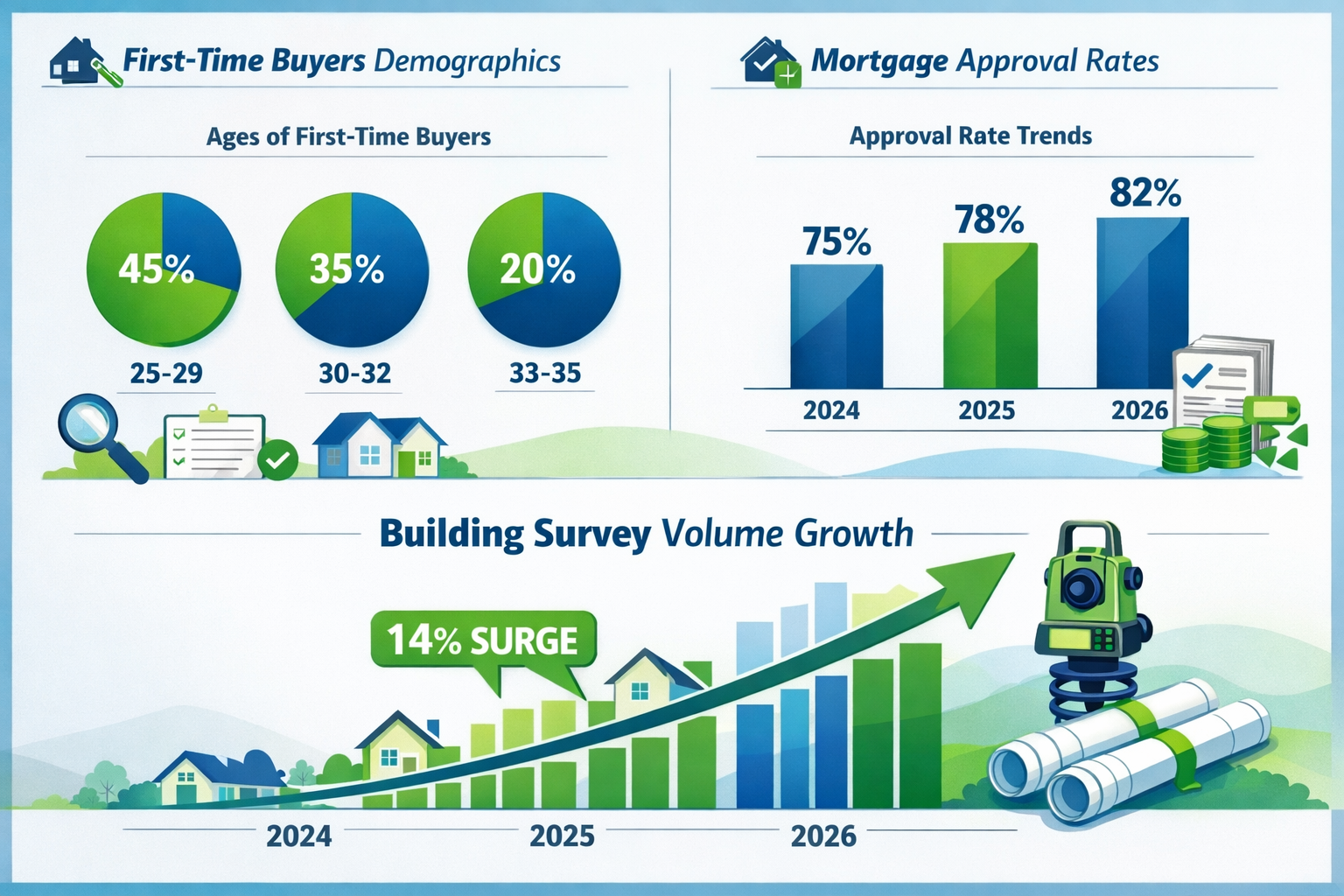
Building Survey Demand Patterns in the Spring 2026 Market Recovery
The Spring 2026 Market Recovery: Building Survey Demand Surge and First-Time Buyer Assessments Amid Improved Lender Volumes has created distinct demand patterns that surveying practices must understand to allocate resources effectively.
Seasonal Surge Timing and Peak Periods
Spring traditionally represents the busiest period for residential property transactions, and 2026 amplifies this pattern. Several factors concentrate demand into a compressed timeframe:
📅 March-May peak window: Families aim to complete purchases before the summer school term
🏠 Inventory release patterns: Sellers list properties as weather improves and gardens present well
💰 End of tax year considerations: Buyers finalize financial planning before April tax deadlines
🔄 Chain transaction timing: Multiple connected sales create coordinated survey scheduling requirements
Understanding how long house surveys take becomes critical during peak periods, as buyers factor survey timelines into their offer strategies and completion deadlines.
Survey Type Distribution and First-Time Buyer Preferences
The composition of survey demand in 2026 skews toward certain assessment types:
| Survey Type | Demand Share | Primary Buyer Profile |
|---|---|---|
| Level 2 (Homebuyer Survey) | 58% | First-time buyers, standard properties |
| Level 3 (Building Survey) | 28% | Older properties, renovation projects |
| Specific Defect Reports | 9% | Follow-up investigations, negotiation support |
| New Build Snagging | 5% | New construction purchases |
First-time buyers represent the largest cohort, typically purchasing properties in the £200,000-£400,000 range where comprehensive but cost-effective Level 2 assessments provide appropriate protection. These buyers benefit from understanding what survey they need before committing to property viewings.
Regional Variations in Survey Demand
The Spring 2026 Market Recovery: Building Survey Demand Surge and First-Time Buyer Assessments Amid Improved Lender Volumes manifests differently across UK regions:
High-Growth Markets 🚀
- Greater London and commuter belt areas show 18-22% survey volume increases
- Competitive bidding creates urgency for rapid survey turnaround
- Higher property values justify comprehensive Level 3 assessments
Moderate-Growth Markets 📈
- Regional cities (Manchester, Birmingham, Leeds) track 12-15% growth
- Balanced buyer-seller dynamics allow more measured assessment timelines
- Mix of property ages creates diverse survey type requirements
Stabilizing Markets ➡️
- Rural and coastal areas show 8-10% growth
- Lifestyle relocations drive demand for character property assessments
- Renovation potential properties require detailed structural analysis
Optimizing Survey Workflows for Increased Demand
As the Spring 2026 Market Recovery: Building Survey Demand Surge and First-Time Buyer Assessments Amid Improved Lender Volumes continues, surveying practices face the operational challenge of scaling capacity without compromising quality.
Capacity Planning and Resource Allocation
Effective capacity management requires anticipating demand surges and positioning resources accordingly:
Surveyor Scheduling Strategies
- Block booking systems that allocate specific days to geographic clusters, reducing travel time
- Skill-based assignment matching surveyor expertise to property complexity
- Flexible capacity through associate surveyor networks during peak periods
- Advanced booking incentives that encourage clients to schedule early, smoothing demand
Technology-Enabled Efficiency
- Digital survey tools and tablet-based reporting systems reduce administrative time
- Drone surveys for roof and chimney assessments where access is difficult
- Thermal imaging cameras for rapid damp and insulation assessment
- Cloud-based report templates that standardize formatting while maintaining customization
Quality Standards During High-Volume Periods
The pressure to process increased survey volumes must never compromise the thoroughness that defines professional practice. RICS standards remain non-negotiable, requiring surveyors to:
✅ Conduct comprehensive site inspections covering all accessible areas
✅ Document findings with photographic evidence supporting observations
✅ Provide clear risk assessments categorizing defects by urgency
✅ Deliver actionable recommendations for remediation or further investigation
✅ Maintain professional indemnity insurance covering all assessment work
For complex properties, a detailed Level 3 building survey remains essential regardless of market pressures, as these assessments protect buyers from potentially catastrophic hidden defects.

Client Communication and Expectation Management
Clear communication becomes critical when demand outstrips immediate availability:
Transparent Timeline Communication
- Provide realistic survey completion timeframes at initial inquiry
- Explain factors that may extend inspection or reporting periods
- Offer priority scheduling options for time-sensitive transactions
- Set clear expectations about report delivery format and detail level
Educational Content
- Help buyers understand whether they need a survey based on property characteristics
- Explain differences between survey levels to ensure appropriate selection
- Provide guidance on interpreting survey findings and negotiating based on results
First-Time Buyer Assessment Priorities in 2026
The Spring 2026 Market Recovery: Building Survey Demand Surge and First-Time Buyer Assessments Amid Improved Lender Volumes places particular emphasis on serving first-time buyers effectively, as this demographic drives the largest share of new transaction volume.
Understanding First-Time Buyer Concerns
First-time buyers approach property surveys with distinct priorities shaped by limited experience and financial constraints:
Primary Concerns 🏠
- Structural soundness: Assurance the property won't require immediate major repairs
- Hidden defects: Identification of problems not visible during viewings
- Negotiation leverage: Documentation supporting price reduction requests
- Future maintenance costs: Understanding upcoming repair and replacement needs
- Safety issues: Identification of hazards requiring immediate attention
Tailoring Survey Reports for First-Time Buyers
Effective survey reports for first-time buyers balance technical accuracy with accessibility:
Report Structure Best Practices
- Executive summary highlighting critical findings in plain language
- Cost implications providing approximate repair cost ranges
- Priority ratings clearly distinguishing urgent issues from minor observations
- Visual documentation with annotated photographs showing defect locations
- Actionable next steps recommending specialists for further investigation where needed
Common First-Time Buyer Property Issues
- Damp and moisture problems (affecting 34% of pre-1960 properties)
- Outdated electrical installations requiring rewiring
- Roof covering condition and remaining service life
- Heating system efficiency and replacement timelines
- Drainage and groundwater management
Supporting Lender Requirements
Mortgage lenders have specific requirements that surveys must address to facilitate loan approval:
Lender-Critical Assessment Areas
- Property valuation confirmation relative to loan amount
- Structural integrity affecting long-term collateral value
- Significant defects requiring immediate remediation
- Non-standard construction types requiring specialist insurance
- Environmental hazards (asbestos, contamination, flood risk)
Surveyors who understand lender requirements can structure reports that directly address underwriter concerns, accelerating the approval process and supporting successful transactions.
Regional Market Considerations and Survey Strategy
The Spring 2026 Market Recovery: Building Survey Demand Surge and First-Time Buyer Assessments Amid Improved Lender Volumes manifests differently across UK property markets, requiring location-specific survey strategies.
London and Southeast Market Dynamics
The capital and surrounding commuter belt experience the most intense demand pressures:
Market Characteristics
- Property values 40-60% above national averages
- Competitive bidding creating time pressure for survey completion
- High proportion of period properties requiring detailed assessment
- Leasehold prevalence necessitating lease term and service charge analysis
Survey Implications
- Justified investment in comprehensive Level 3 assessments for high-value purchases
- Need for rapid turnaround to maintain transaction momentum
- Importance of experienced London building surveyors familiar with Victorian and Edwardian construction
- Specialized knowledge of London-specific issues (clay soil subsidence, basement conversions, party wall matters)
Regional City Markets
Manchester, Birmingham, Leeds, and other major regional cities show strong growth with distinct characteristics:
Market Features
- More balanced buyer-seller dynamics than London
- Mix of Victorian terraces, 1930s semis, and modern developments
- Growing build-to-rent sector creating commercial survey opportunities
- Regeneration areas with mixed property quality
Survey Approach
- Flexible survey type recommendations based on property age and condition
- Attention to area-specific issues (mining subsidence in certain regions, industrial contamination)
- Understanding of local property values informing proportionate assessment depth
Emerging and Coastal Markets
Lifestyle relocations drive demand in coastal and rural areas:
Buyer Motivations
- Remote work enabling location flexibility
- Quality of life prioritization over commute convenience
- Interest in character properties and renovation projects
- Retirement relocations seeking downsizing opportunities
Survey Considerations
- Detailed assessment of period property construction and maintenance history
- Evaluation of rural-specific issues (septic tanks, private water supplies, access rights)
- Coastal property challenges (salt exposure, flood risk, erosion)
- Realistic renovation cost estimates for properties requiring modernization
Lender Volume Recovery and Survey Requirements
Improved lender volumes directly drive survey demand, as mortgage providers require professional property assessments before approving financing.
Mortgage Market Recovery Indicators
Several metrics confirm strengthening lender activity in 2026:
📊 Mortgage Approval Volumes: Up 19% year-over-year in Q1 2026
💷 Average Loan-to-Value Ratios: Increased to 83% for first-time buyers
⏱️ Application-to-Offer Timelines: Reduced by 12 days average
🏦 Lender Competition: 47 active residential mortgage providers, up from 41 in 2024
This recovery creates sustained survey demand as each mortgage approval typically requires a professional property assessment.
Lender-Specific Survey Requirements
Different lender types impose varying survey requirements:
High Street Banks
- Standard valuation surveys for properties under £500,000 in good condition
- Full structural surveys required for properties over £750,000
- Mandatory additional assessments for non-standard construction
Building Societies
- Generally more conservative lending criteria
- Higher likelihood of requiring comprehensive surveys
- Particular attention to property condition and maintenance
Specialist Lenders
- Flexible criteria for unusual properties
- Often require detailed specialist reports
- May accept surveyor recommendations for phased remediation
Understanding these requirements enables surveyors to anticipate lender needs and structure reports accordingly.
Valuation vs. Survey Distinction
A common source of confusion for first-time buyers involves understanding the difference between lender valuations and building surveys:
Lender Valuation 🏦
- Protects the lender's financial interest
- Confirms property value supports loan amount
- Basic condition assessment only
- Not designed to identify all defects
Building Survey 🔍
- Protects the buyer's interests
- Comprehensive condition assessment
- Identifies defects and maintenance issues
- Provides repair cost estimates and recommendations
Educating buyers about this distinction ensures they understand why independent surveys remain essential even when lenders conduct valuations.
Commercial Property Survey Opportunities
While residential surveys dominate the Spring 2026 Market Recovery: Building Survey Demand Surge and First-Time Buyer Assessments Amid Improved Lender Volumes, commercial property activity also creates significant opportunities.
Multifamily Sector Dynamics
The multifamily sector shows divergent patterns with important survey implications:
Refinancing Pressure
- Over £160 billion in multifamily debt matures in 2026[1]
- Motivated sellers creating acquisition opportunities
- Lenders requiring updated condition assessments for refinancing
- Potential for distressed asset purchases requiring detailed due diligence
Supply Contraction
- New multifamily deliveries tracking at approximately 270,000 units in 2026—the slowest pace in over a decade[1]
- Reduced competition from new construction supporting existing property values
- Renovation and repositioning opportunities for older assets
Commercial Building Survey Requirements
Commercial building surveys differ substantially from residential assessments:
Scope Differences
- Building systems analysis (HVAC, electrical, plumbing, life safety)
- Compliance with commercial building regulations and accessibility requirements
- Environmental assessments (asbestos, contamination, energy performance)
- Structural capacity for intended commercial use
- Remaining economic life analysis for investment underwriting
Specialized Expertise
- Understanding of commercial construction methods and materials
- Knowledge of commercial lease obligations and dilapidations
- Familiarity with commercial lender requirements and investment criteria
- Ability to coordinate with other consultants (mechanical engineers, environmental specialists)
Maintaining Quality Standards During Demand Surges
The Spring 2026 Market Recovery: Building Survey Demand Surge and First-Time Buyer Assessments Amid Improved Lender Volumes creates pressure to process increased volumes rapidly, but quality standards must remain paramount.
RICS Professional Standards Compliance
All surveys must comply with RICS standards regardless of market conditions:
Mandatory Requirements ✅
- Appropriate professional indemnity insurance coverage
- Competence in property type and construction being assessed
- Conflicts of interest disclosure and management
- Clear terms of engagement defining scope and limitations
- Professional report standards with appropriate disclaimers
Inspection Standards
- All accessible areas must be inspected
- Limitations must be clearly documented
- Appropriate equipment must be used (moisture meters, binoculars, ladders where safe)
- Photographs must document key findings
- Weather conditions affecting inspection must be noted
Common Quality Pitfalls During High-Volume Periods
Surveying practices must guard against predictable quality risks when demand surges:
⚠️ Rushed Inspections: Inadequate time on-site missing important defects
⚠️ Incomplete Documentation: Insufficient photographs or measurement data
⚠️ Template Over-Reliance: Generic report language not tailored to specific property
⚠️ Scope Confusion: Unclear communication about what was and wasn't assessed
⚠️ Follow-Up Neglect: Inadequate response to client questions post-report
Quality Assurance Systems
Implementing systematic quality controls protects both clients and professional reputation:
Effective QA Processes
- Pre-inspection briefing: Review property details and identify likely issues
- Standardized checklists: Ensure comprehensive coverage of all building elements
- Photographic protocols: Minimum image requirements for each property type
- Peer review: Second surveyor review of complex or high-value reports
- Client feedback: Systematic collection and analysis of satisfaction data
Technology and Innovation in Survey Practice
The Spring 2026 Market Recovery: Building Survey Demand Surge and First-Time Buyer Assessments Amid Improved Lender Volumes accelerates adoption of technology that enhances efficiency without compromising thoroughness.
Digital Survey Tools
Modern survey practice increasingly relies on digital tools:
Hardware Innovations 📱
- Tablet-based reporting systems enabling real-time documentation
- Thermal imaging cameras identifying insulation defects and moisture
- Laser distance measurers for accurate dimensional data
- Moisture meters with data logging capabilities
- Drone technology for roof and chimney assessment
Software Solutions 💻
- Cloud-based report templates ensuring consistency
- Photographic annotation tools highlighting defect locations
- Client portals providing secure report access
- Scheduling systems optimizing surveyor routes
- CRM platforms managing client communications
Maintaining the Human Element
Despite technological advances, professional judgment remains irreplaceable:
Irreplaceable Human Skills 🧠
- Pattern recognition identifying subtle deterioration indicators
- Experience-based assessment of defect severity and urgency
- Understanding of construction methods and material performance
- Communication skills translating technical findings into actionable advice
- Professional skepticism questioning apparent condition
Technology enhances but never replaces the experienced surveyor's trained eye and professional judgment.
Future Outlook and Strategic Positioning
The Spring 2026 Market Recovery: Building Survey Demand Surge and First-Time Buyer Assessments Amid Improved Lender Volumes represents more than a temporary uptick—it signals sustained market normalization.
Sustained Demand Drivers
Several factors suggest survey demand will remain elevated beyond 2026:
Demographic Fundamentals 👥
- Millennial generation entering peak homebuying years
- Immigration supporting household formation
- Aging population creating downsizing activity
- Remote work enabling geographic mobility
Economic Conditions 💰
- Wage growth expected to outpace home price increases[4]
- Mortgage rates stabilizing at sustainable levels
- Inventory levels supporting buyer choice
- Construction costs limiting new supply
Strategic Positioning for Surveying Practices
Forward-thinking practices should position for sustained demand:
Growth Strategies 📈
- Capacity expansion: Recruit and train additional surveyors
- Technology investment: Implement efficiency-enhancing tools
- Specialization development: Build expertise in specific property types or issues
- Geographic expansion: Extend service areas to capture regional demand
- Service diversification: Add complementary services (energy assessments, project monitoring)
Risk Management 🛡️
- Maintain rigorous quality standards despite volume pressure
- Ensure adequate professional indemnity insurance coverage
- Document scope limitations clearly in all reports
- Invest in continuing professional development
- Build financial reserves for market cyclicality
Conclusion
The Spring 2026 Market Recovery: Building Survey Demand Surge and First-Time Buyer Assessments Amid Improved Lender Volumes creates both opportunity and responsibility for surveying professionals. With survey volumes projected to increase 14% nationally and first-time buyers representing a substantial demographic tailwind, practices that optimize workflows while maintaining rigorous quality standards will thrive in this recovering market.
The convergence of improved mortgage rates, expanding inventory, and pent-up buyer demand has created ideal conditions for sustained transaction activity. For surveyors, this means preparing for elevated demand that extends beyond traditional spring peaks into a multi-year recovery cycle.
Actionable Next Steps
For Surveying Practices:
- Assess current capacity and identify bottlenecks in your workflow
- Invest in technology that enhances efficiency without compromising thoroughness
- Review quality assurance processes to ensure standards remain high during busy periods
- Develop first-time buyer communication materials that educate and build confidence
- Build lender relationships understanding their specific survey requirements
For Property Buyers:
- Schedule surveys early as demand increases and availability tightens
- Choose the appropriate survey level based on property age, condition, and value
- Select qualified professionals with relevant experience and RICS accreditation
- Budget adequately for comprehensive assessments that protect your investment
- Act on survey findings using results to negotiate or plan for necessary repairs
For Lenders:
- Streamline survey approval processes to support faster transaction completion
- Communicate requirements clearly to borrowers and their surveyors
- Recognize quality variations in survey providers and maintain approved panels
- Support buyer education about the distinction between valuations and surveys
The Spring 2026 market recovery represents a return to healthy, sustainable property market conditions. Building survey professionals who rise to meet increased demand while maintaining the quality standards that protect buyers will find this period both professionally rewarding and commercially successful. The key lies in balancing efficiency with thoroughness—scaling operations without sacrificing the meticulous attention to detail that defines professional surveying practice.
References
[1] Spring 2026 What The Market Is Actually Telling Us – https://www.offerd.com/insights/spring-2026-what-the-market-is-actually-telling-us
[2] Market Outlook – https://www.jpmorgan.com/insights/global-research/outlook/market-outlook
[4] 2026 Real Estate Outlook What Leading Housing Economists Are Watching – https://www.nar.realtor/magazine/real-estate-news/2026-real-estate-outlook-what-leading-housing-economists-are-watching
[5] Us Stock Market Outlook – https://www.schwab.com/learn/story/us-stock-market-outlook
[6] Economic Outlook Us Q2 2026 Curb Your Enthusiasm S101676533 – https://www.spglobal.com/ratings/en/regulatory/article/economic-outlook-us-q2-2026-curb-your-enthusiasm-s101676533
