
The tragic death of two-year-old Awaab Ishak from prolonged mould exposure in 2020 catalyzed legislative reform that fundamentally altered landlord obligations and tenant remedies in the UK rental sector. By 2026, Awaab's Law has expanded beyond its initial focus on damp and mould to encompass fire safety, electrical hazards, and structural deficiencies—creating unprecedented demand for expert witness testimony in rental valuation disputes. As enforcement mechanisms strengthen and tenant compensation claims multiply, Expert Witness Valuations in Awaab's Law Disputes: Building Evidentiary Cases When Hazard Non-Compliance Triggers Rent Reduction Claims has emerged as a specialized practice area requiring both technical property assessment expertise and sophisticated understanding of evolving legal standards[1].
The legislation, which received Royal Assent following its February 2023 announcement, establishes strict timeframes for landlords to investigate and remediate reported hazards—with significant financial penalties for non-compliance[7]. This regulatory framework transforms property hazards from maintenance issues into quantifiable financial liabilities, making expert valuation evidence critical to determining appropriate rent reductions and compensation awards.
Key Takeaways
- Expanded hazard scope: Awaab's Law now covers fire, electrical, and structural risks beyond original damp and mould provisions, requiring expert witnesses to assess diverse property defects[4]
- Person-centered assessment: Expert valuations must consider individual tenant circumstances and vulnerabilities when evaluating hazard severity and rental value impact[2]
- Reasonable lessor test: Expert witnesses apply objective standards considering what a reasonable landlord should have done given tenant-specific circumstances[3]
- Evidentiary requirements: Successful rent reduction claims require robust documentation linking hazard non-compliance to quantifiable diminution in rental value
- Compensation pathways: Expert testimony supports both retrospective rent reduction claims and prospective remediation enforcement under strengthened 2026 provisions
Understanding Awaab's Law Framework and Expert Witness Requirements
Legislative Evolution and Current Scope
Awaab's Law represents a fundamental shift in how rental property hazards are assessed and remediated. The legislation originally focused on damp and mould conditions following the coroner's inquest into Awaab Ishak's death, which found that prolonged exposure to mould in his family's housing association property directly caused his fatal respiratory condition[1].
By 2026, the scope has expanded significantly to include:
- 🔥 Fire safety hazards including inadequate escape routes and faulty detection systems
- ⚡ Electrical risks such as outdated wiring, exposed connections, and non-compliant installations
- 🏚️ Structural deficiencies affecting building integrity and occupant safety
- 💧 Damp and mould (original focus area with enhanced enforcement)
The legislation establishes mandatory investigation and remediation timeframes that landlords must meet upon receiving tenant hazard reports. Social housing providers face particularly strict deadlines, while private landlords operate under slightly extended but still enforceable timelines[6].
The Expert Witness Role in Awaab's Law Disputes
Expert witnesses in Awaab's Law cases serve multiple critical functions:
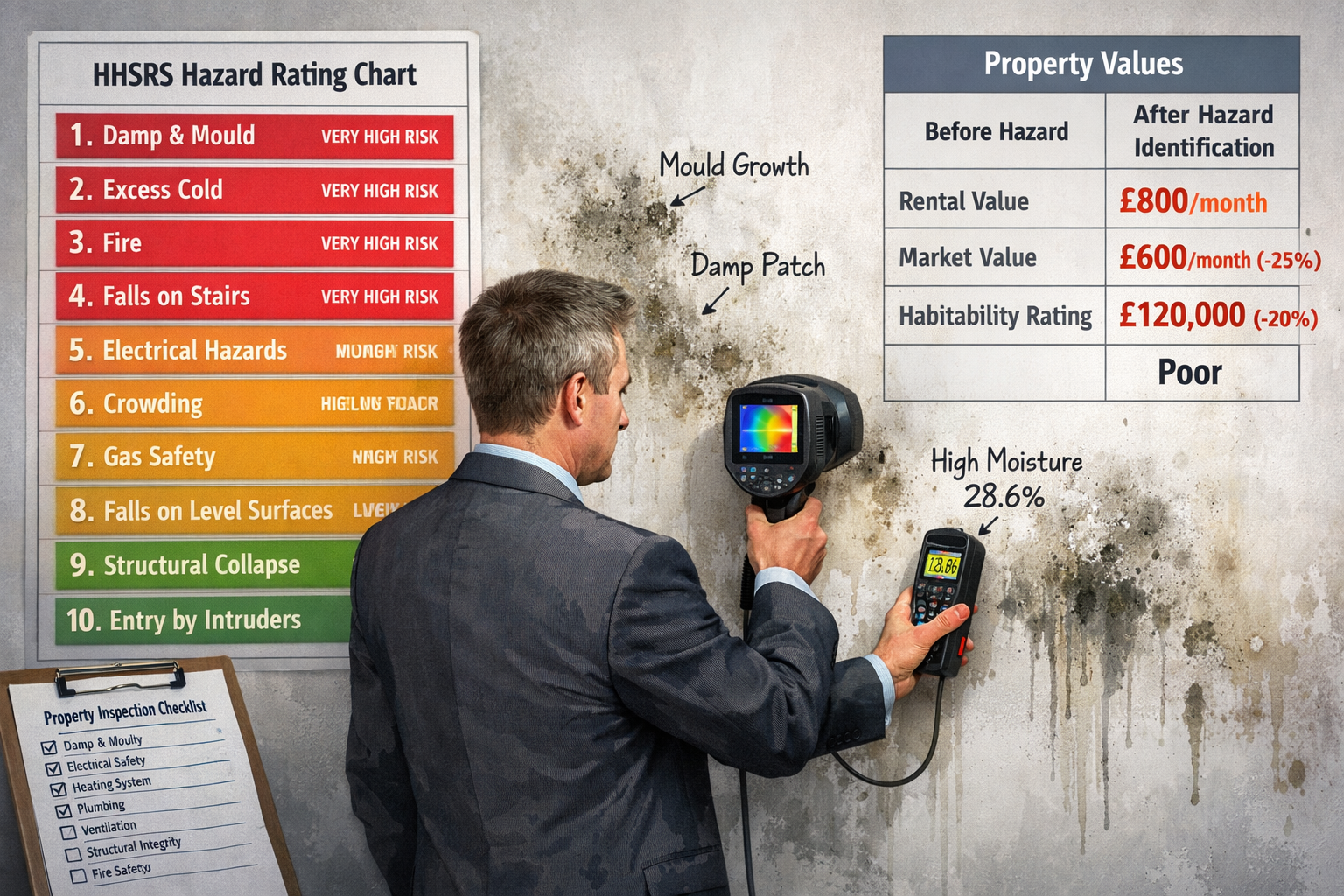
Hazard Identification and Classification: Experts must accurately identify property hazards and classify them according to the Housing Health and Safety Rating System (HHSRS). This involves determining whether conditions constitute Category 1 (serious and immediate hazards) or Category 2 (less serious but still significant) defects[2].
Causation Analysis: Expert testimony establishes causal links between landlord non-compliance and tenant harm. This requires demonstrating that hazards existed, were reported (or should have been apparent), and that the landlord failed to meet statutory remediation obligations.
Valuation Impact Assessment: Perhaps most critically for rent reduction claims, experts must quantify how identified hazards diminished the property's rental value. This involves comparing the actual rental value of the defective property against what a comparable hazard-free property would command in the same market[3].
Timeline Documentation: Experts create detailed chronologies showing when hazards arose, when landlords were notified, and how long non-compliance persisted—essential for calculating retrospective rent reductions.
The "Reasonable Lessor" Test in Expert Assessments
A cornerstone of Expert Witness Valuations in Awaab's Law Disputes: Building Evidentiary Cases When Hazard Non-Compliance Triggers Rent Reduction Claims is applying the "reasonable lessor" test. This objective standard evaluates whether a landlord's actions (or inactions) met the standard of care expected from a reasonable property owner in similar circumstances[3].
The test considers:
| Factor | Assessment Criteria |
|---|---|
| Knowledge | What the landlord knew or should have known about the hazard |
| Tenant Circumstances | Vulnerability factors including age, health conditions, mobility limitations |
| Remediation Feasibility | Available solutions, costs, and implementation timeframes |
| Communication | Landlord responsiveness to tenant reports and concerns |
| Industry Standards | Compliance with HHSRS guidelines and sector best practices |
Importantly, the reasonable lessor test is objective but contextual—it doesn't simply ask what this particular landlord did, but what a reasonable landlord should have done given the specific tenant's circumstances[2].
Person-Centered Hazard Assessment: Building Evidence for Vulnerable Tenants
Understanding the Person-Centered Approach
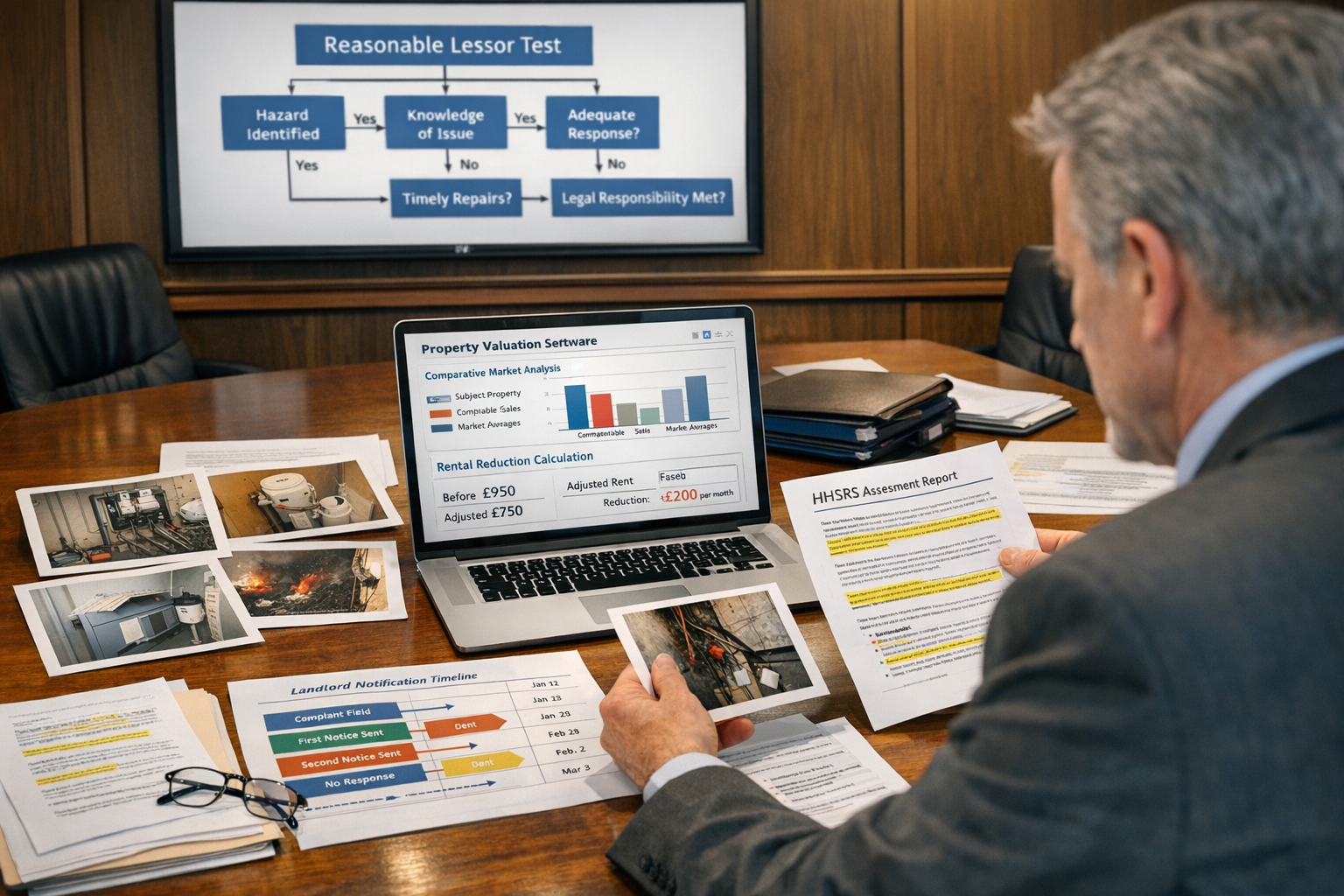
Awaab's Law employs a person-centered approach that fundamentally changes how hazards are evaluated. Unlike traditional property assessments that apply uniform standards, this methodology recognizes that identical physical conditions pose different risk levels depending on occupant characteristics[2].
This approach means:
✅ A hazard need not reach Category 1 severity under standard HHSRS criteria if particular tenants face heightened vulnerability
✅ Expert witnesses must investigate and document tenant-specific circumstances that elevate risk
✅ Valuation impacts may be greater when hazards affect vulnerable occupants, justifying higher rent reductions
Vulnerability Factors in Expert Assessments
Expert witnesses building evidentiary cases must thoroughly document vulnerability factors:
Age-Related Vulnerabilities:
- Young children (particularly under 5) with developing respiratory systems
- Elderly tenants with compromised immune function or mobility limitations
- Pregnant women facing elevated health risks from environmental hazards
Health Condition Vulnerabilities:
- Pre-existing respiratory conditions (asthma, COPD, bronchitis)
- Immune system disorders
- Cardiovascular conditions
- Mental health conditions exacerbated by poor housing quality
Situational Vulnerabilities:
- Disabilities affecting hazard perception or escape capability
- Language barriers impacting hazard reporting
- Economic constraints limiting alternative housing options
When building Expert Witness Valuations in Awaab's Law Disputes: Building Evidentiary Cases When Hazard Non-Compliance Triggers Rent Reduction Claims, documenting these factors becomes essential to demonstrating why a particular hazard warranted urgent remediation and justifies significant rent reduction.
Evidentiary Requirements for Person-Centered Claims
To successfully establish person-centered hazard claims, expert witnesses must compile comprehensive evidence portfolios:
Medical Documentation: GP records, hospital admissions, specialist reports linking health deterioration to property conditions. Expert witnesses should coordinate with medical professionals to establish causation between environmental hazards and tenant health impacts.
Photographic and Video Evidence: Time-stamped visual documentation showing hazard progression. This proves particularly valuable when landlords claim hazards were minor or recently developed.
Communication Records: Complete correspondence between tenants and landlords, including initial hazard reports, follow-up requests, and landlord responses (or lack thereof). These establish knowledge and timeline elements critical to the reasonable lessor test.
Comparative Market Analysis: Valuation evidence demonstrating rental value of comparable hazard-free properties versus the subject property's diminished value during non-compliance periods.
Quantifying Rental Value Reduction: Methodologies and Best Practices
Valuation Approaches in Hazard Non-Compliance Cases
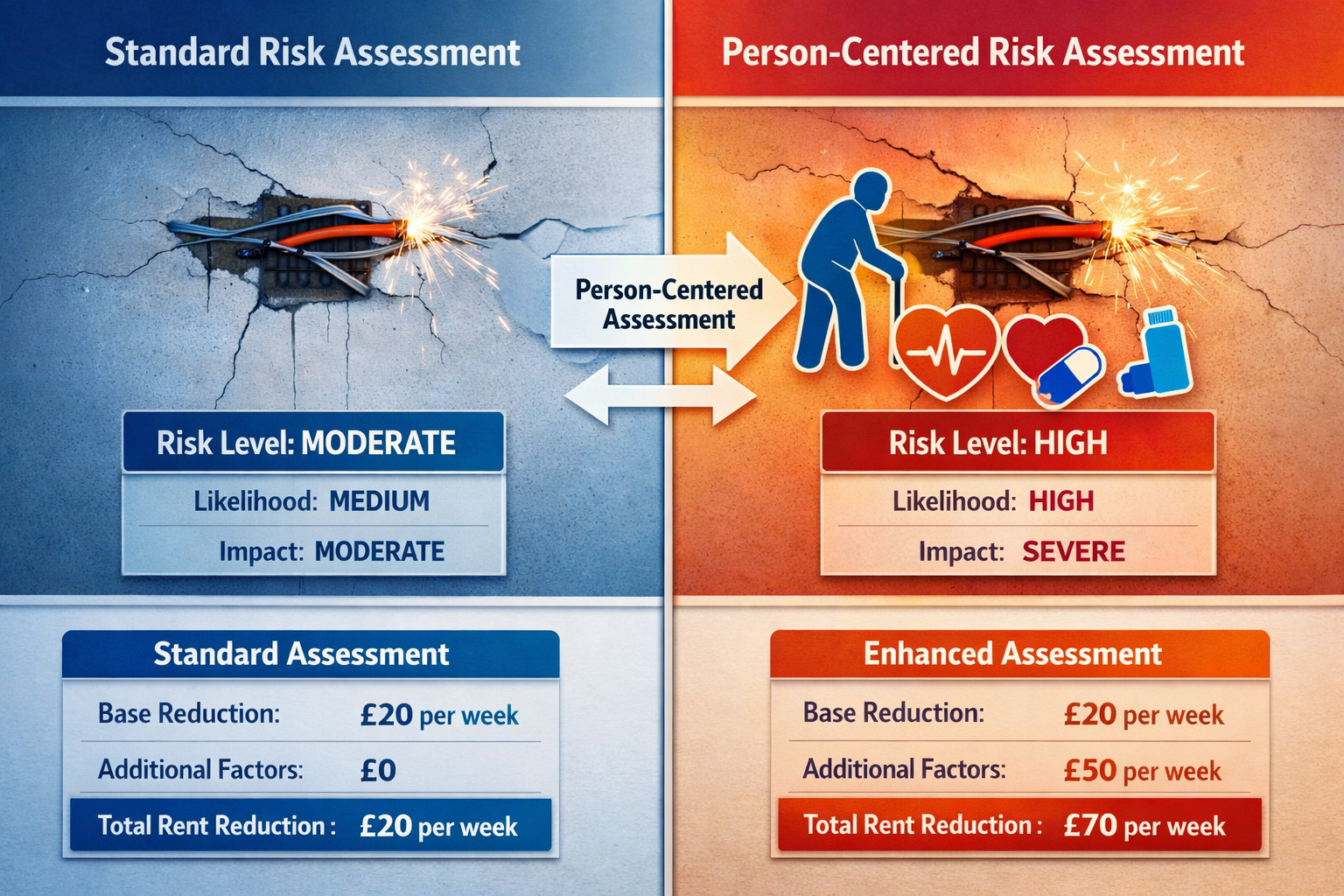
Expert witnesses employ several methodologies when quantifying rental value reductions caused by hazard non-compliance:
1. Comparative Market Analysis (CMA)
This approach compares the subject property against similar hazard-free properties in the same market. The expert identifies comparable rentals and adjusts for differences, isolating the value impact attributable to the hazard.
Strengths: Grounded in actual market data; defensible in court; aligns with standard RICS valuation principles
Challenges: Finding truly comparable properties; accounting for market fluctuations during extended non-compliance periods
2. Percentage Diminution Method
Experts apply percentage reductions to the property's market rent based on hazard severity and impact on habitability. Industry standards suggest:
- Minor hazards (limited impact, single room affected): 10-20% reduction
- Moderate hazards (significant discomfort, multiple rooms affected): 20-40% reduction
- Severe hazards (substantial health risk, major habitability impact): 40-70% reduction
- Critical hazards (immediate danger, property effectively uninhabitable): 70-100% reduction
3. Cost-to-Cure Analysis
This method calculates remediation costs and applies them as a rental value adjustment. If £5,000 in repairs are needed and the property rents for £1,200 monthly, the expert might calculate the monthly impact based on amortizing repair costs over a reasonable period.
4. Amenity Loss Assessment
For hazards that don't render properties uninhabitable but significantly reduce enjoyment, experts quantify the loss of specific amenities. For example, severe damp making a bedroom unusable effectively reduces a 3-bedroom property to a 2-bedroom property, with corresponding rental value impact.
Building Robust Evidentiary Cases
Successful Expert Witness Valuations in Awaab's Law Disputes: Building Evidentiary Cases When Hazard Non-Compliance Triggers Rent Reduction Claims requires meticulous evidence compilation:
Step 1: Comprehensive Property Inspection
Conduct thorough inspections documenting all hazards using professional equipment:
- Thermal imaging cameras for damp and insulation issues
- Moisture meters for quantifying dampness levels
- Electrical testing equipment for safety compliance
- Photographic documentation with scale references
Similar to approaches used in commercial building surveys, systematic documentation creates defensible evidence.
Step 2: Timeline Construction
Create detailed chronologies showing:
- When hazards first appeared (or should have been apparent)
- Dates of tenant reports and landlord notifications
- Landlord response actions and timeframes
- Statutory deadline violations
- Duration of non-compliance
Step 3: Market Research
Compile comparable rental data showing:
- Similar properties in the same location
- Rental rates during the relevant time period
- Adjustments for property differences
- Market trend analysis
Step 4: Calculation Documentation
Provide transparent calculations showing:
- Base rental value (hazard-free)
- Percentage or absolute reduction applied
- Justification for reduction magnitude
- Total retrospective rent reduction claim
- Ongoing reduction until remediation
Step 5: Report Preparation
Prepare comprehensive expert reports following RICS standards for expert witnesses, including:
- Executive summary of findings
- Methodology explanation
- Detailed findings and analysis
- Valuation calculations with supporting data
- Professional qualifications and independence declaration
Common Valuation Challenges and Solutions
Challenge: Landlords claiming hazards were tenant-caused
Solution: Document pre-tenancy conditions, maintenance records, and structural causes (e.g., building defects causing damp rather than tenant lifestyle factors)
Challenge: Disputes over hazard severity
Solution: Apply objective HHSRS criteria, reference industry standards, and document health impacts with medical evidence
Challenge: Calculating reductions for multiple overlapping hazards
Solution: Assess cumulative impact rather than simply adding individual percentages; consider whether hazards compound or remain independent
Challenge: Determining appropriate reduction duration
Solution: Establish clear start dates (when landlord had knowledge) and end dates (when effective remediation occurred, not merely when work commenced)
Expanded Hazard Categories: Fire, Electrical, and Structural Risks
Fire Safety Hazards Under Awaab's Law 2026
The expansion of Awaab's Law to include fire safety hazards creates new evidentiary requirements for expert witnesses. Fire-related non-compliance encompasses:
Detection and Alarm Systems: Absence or malfunction of smoke detectors, inadequate coverage, expired equipment
Escape Routes: Blocked or inadequate emergency exits, insufficient escape windows in upper floors, locked escape routes
Fire Doors: Missing or damaged fire doors in multi-occupancy buildings, improper seals, removed self-closing mechanisms
Electrical Fire Risks: Overloaded circuits, damaged wiring, non-compliant installations creating ignition risks
Expert witnesses must demonstrate how fire safety deficiencies diminish rental value. This involves:
- Risk quantification: Calculating probability and potential severity of fire events
- Regulatory compliance assessment: Comparing property conditions against Fire Safety Order requirements
- Market impact analysis: Determining how fire safety concerns affect tenant willingness to pay
- Remediation cost evaluation: Assessing reasonable costs for compliance
Electrical Hazard Assessments
Electrical hazards represent a significant expansion area under the 2026 provisions[4]. Common issues include:
- Outdated wiring systems (pre-1970s installations lacking modern safety features)
- Absence of RCD (Residual Current Device) protection
- Exposed wiring and damaged outlets
- Overloaded circuits and inadequate capacity
- Non-compliant DIY electrical work
Expert witnesses must possess or coordinate with qualified electricians holding relevant certifications. Electrical hazard valuations consider:
Immediate Safety Risk: Properties with dangerous electrical conditions may warrant 60-80% rental reductions until remediation
Compliance Costs: Rewiring costs can be substantial (£3,000-£10,000+ depending on property size), impacting valuation calculations
Insurance Implications: Electrical non-compliance may void insurance, creating additional tenant risk that affects rental value
Structural Deficiency Evaluations
Structural hazards under Awaab's Law include:
- Subsidence and settlement causing structural instability
- Roof defects allowing water ingress
- Wall and foundation cracks compromising building integrity
- Floor structural issues creating collapse risks
- Balcony and external structure failures
Similar to methodologies used in party wall dispute assessments, structural hazard evaluations require:
Engineering Assessment: Coordination with structural engineers to determine severity
Progressive Monitoring: Documentation of whether defects are stable or worsening
Remediation Complexity: Analysis of repair feasibility and costs
Interim Risk Management: Evaluation of temporary measures and their adequacy
Litigation Support and Courtroom Testimony
Preparing Expert Reports for Awaab's Law Claims
Expert reports in Expert Witness Valuations in Awaab's Law Disputes: Building Evidentiary Cases When Hazard Non-Compliance Triggers Rent Reduction Claims must meet stringent legal standards:
Independence and Objectivity: Experts owe their primary duty to the court, not the instructing party. Reports must clearly state this and avoid advocacy.
Qualifications: Include detailed CV showing relevant experience, professional memberships (RICS, CIEH), and specific expertise in hazard assessment and valuation.
Methodology Transparency: Explain all approaches used, why they were selected, and any limitations or assumptions.
Evidence Base: Reference all source materials, inspection findings, comparable data, and regulatory standards.
Conclusions: Provide clear, unequivocal opinions on hazard severity, landlord compliance, and rental value impact.
Effective Courtroom Testimony
When providing testimony in Awaab's Law disputes, expert witnesses should:
Prepare Thoroughly: Review all case materials, refresh knowledge of relevant regulations, anticipate cross-examination challenges
Communicate Clearly: Avoid excessive jargon; explain technical concepts in accessible terms for judges and juries
Maintain Objectivity: Acknowledge limitations in evidence; concede valid points raised by opposing counsel
Support Opinions: Reference specific evidence, industry standards, and professional experience when explaining conclusions
Stay Within Expertise: Clearly delineate boundaries of professional competence; defer to other experts on matters outside core expertise
Coordinating with Legal Teams
Effective expert witness work requires close coordination with solicitors and barristers:
- Early Engagement: Involvement during evidence gathering ensures critical information isn't overlooked
- Clear Instructions: Ensure letter of instruction clearly defines scope and specific questions to address
- Regular Communication: Update legal teams on findings and potential challenges
- Trial Preparation: Participate in witness preparation sessions and trial strategy discussions
- Post-Testimony Support: Remain available for clarification and rebuttal evidence if needed
Future Developments and Emerging Issues in Awaab's Law Valuations
Anticipated Legislative Refinements
As Awaab's Law matures through 2026 and beyond, several developments will affect expert witness practice:
Standardized Assessment Protocols: Regulatory bodies may develop more prescriptive hazard assessment methodologies, reducing valuation variability
Expanded Hazard Categories: Future amendments may include additional hazards such as noise pollution, overcrowding, and security deficiencies
Enhanced Enforcement: Stronger penalties and streamlined enforcement mechanisms will increase dispute volume and raise stakes for accurate valuations
Data Transparency Requirements: Landlords may face mandatory hazard disclosure obligations, creating new evidentiary sources for expert witnesses
Technology Integration in Hazard Assessment
Emerging technologies are transforming expert witness practice:
Digital Documentation: 3D scanning and virtual property tours create comprehensive records of property conditions
Environmental Monitoring: IoT sensors providing continuous data on temperature, humidity, air quality, and other hazard indicators
AI-Assisted Analysis: Machine learning algorithms identifying patterns in hazard development and predicting remediation costs
Blockchain Evidence Chains: Immutable records of property conditions and landlord notifications
Expert witnesses must adapt to these technological developments while maintaining professional judgment and avoiding over-reliance on automated systems.
Professional Development Requirements
Practitioners specializing in Expert Witness Valuations in Awaab's Law Disputes: Building Evidentiary Cases When Hazard Non-Compliance Triggers Rent Reduction Claims should pursue:
- Continuing professional development in HHSRS assessment
- Training on person-centered hazard evaluation methodologies
- Updates on evolving case law and regulatory guidance
- Cross-disciplinary knowledge in health impacts, building science, and legal procedures
- Expert witness skills development including courtroom testimony techniques
Conclusion
The expansion of Awaab's Law to encompass fire, electrical, and structural hazards alongside the original damp and mould provisions has created a complex landscape for rental property disputes in 2026. Expert witnesses play an indispensable role in these cases, providing the technical assessment and valuation evidence necessary to establish landlord non-compliance and quantify appropriate tenant compensation.
Expert Witness Valuations in Awaab's Law Disputes: Building Evidentiary Cases When Hazard Non-Compliance Triggers Rent Reduction Claims requires a sophisticated blend of property assessment expertise, regulatory knowledge, and litigation support skills. The person-centered approach mandated by the legislation demands that experts look beyond standardized hazard ratings to consider individual tenant vulnerabilities and circumstances.
Actionable Next Steps
For Property Professionals: Develop specialized expertise in Awaab's Law hazard assessment by pursuing relevant training, building relationships with legal practitioners in housing litigation, and staying current with regulatory developments.
For Landlords: Engage qualified experts proactively to identify and remediate hazards before they trigger disputes. Early expert involvement in property maintenance programs can prevent costly litigation.
For Tenants and Advocates: Understand that robust expert evidence is essential to successful rent reduction claims. Engage qualified expert witnesses early in the process to properly document hazards and calculate appropriate compensation.
For Legal Practitioners: Instruct experts with specific Awaab's Law experience who understand both the technical assessment requirements and the evidentiary standards necessary for successful litigation outcomes.
As enforcement mechanisms strengthen and case law develops, the demand for expert witness services in Awaab's Law disputes will continue growing. Property professionals who develop expertise in this specialized area will find themselves well-positioned to support the critical work of ensuring rental property safety and tenant protection in the years ahead.
References
[1] Awaabs Law Housing Disrepair Claims – https://www.expertcourtreports.co.uk/blog/awaabs-law-housing-disrepair-claims/
[2] 99171 Expert Evidence In Housing Conditions Claims – https://www.localgovernmentlawyer.co.uk/housing-law/315-housing-features/99171-expert-evidence-in-housing-conditions-claims
[3] Expert Witness Preparation For Awaabs Law Expansion Disputes 2026 Hazard Assessments In Rental Valuations – https://nottinghillsurveyors.com/blog/expert-witness-preparation-for-awaabs-law-expansion-disputes-2026-hazard-assessments-in-rental-valuations
[4] Expert Witness Preparation For Awaabs Law 2026 Expansions Testifying On New Rental Hazards Like Fire And Electrical Risks – https://nottinghillsurveyors.com/blog/expert-witness-preparation-for-awaabs-law-2026-expansions-testifying-on-new-rental-hazards-like-fire-and-electrical-risks
[6] Awaabs Law Transitional Arrangements – https://www.sussexdampexperts.com/awaabs-law-transitional-arrangements/
[7] Awaabs Law Guide – https://anthonygold.co.uk/insight/awaabs-law-guide/
