
The race to net zero has transformed the UK property landscape in 2026, with heat pump installations surging across terraced and semi-detached homes. However, this green revolution brings an unexpected challenge: party wall compliance. As thousands of homeowners retrofit their properties with air source and ground source heat pumps, the intersection of sustainability mandates and neighbour relations has created a complex legal landscape. Understanding Party Wall Surveys for Heat Pump Retrofits: RICS Compliance in 2026's Net Zero Retrofit Surge has become essential for property owners, surveyors, and contractors navigating this transformative period.
The installation of heat pumps on shared or adjoining walls triggers specific obligations under the Party Wall etc. Act 1996, yet many homeowners remain unaware of these requirements until disputes arise. With government incentives driving unprecedented demand for energy-efficient heating systems, the need for proper party wall protocols has never been more critical.
Key Takeaways
✅ Heat pump installations on party walls require formal notices under the Party Wall etc. Act 1996, including structural fixings and potential vibration impacts
✅ RICS-accredited surveyors provide essential compliance frameworks for assessing structural integrity, noise transmission, and neighbour protection during green retrofits
✅ Pre-installation party wall surveys prevent costly disputes by documenting existing conditions and establishing agreed-upon installation parameters
✅ 2026's net zero targets have increased party wall survey demand by 340%, requiring streamlined processes for rapid yet compliant heat pump deployments
✅ Proper documentation protects both building owners and neighbours, ensuring sustainable retrofits proceed without legal complications or relationship breakdowns
Understanding the Party Wall Act Framework for Heat Pump Installations
The Party Wall etc. Act 1996 governs construction work on shared walls, boundaries, and excavations near neighbouring properties. While originally designed for traditional building works, the legislation fully applies to modern heat pump retrofits that affect party structures.
What Triggers Party Wall Requirements for Heat Pumps?
Heat pump installations trigger party wall obligations in several scenarios:
Structural Fixings and Penetrations 🔧
- Mounting brackets attached to party walls
- Pipework penetrating shared structures
- Electrical conduits passing through party walls
- Flue or vent installations affecting shared chimneys
Vibration and Noise Considerations 🔊
- Compressor units causing vibration transmission
- Operational noise affecting adjoining properties
- Low-frequency hum impacting party wall structures
- Acoustic insulation modifications
Excavation for Ground Source Systems ⛏️
- Trenching within 3 meters of neighbouring foundations
- Ground loop installations affecting boundary stability
- Soil removal impacting adjoining property support
Understanding what work requires a party wall agreement helps homeowners identify when formal procedures apply to their heat pump project.
The Three-Month Notice Period Challenge
Standard party wall procedures require serving notice at least two months before work commences. However, the surge in heat pump demand has created scheduling pressures:
| Notice Type | Minimum Period | Applies To |
|---|---|---|
| Party Structure Notice | 2 months | Work directly on party walls |
| Line of Junction Notice | 1 month | New walls at boundaries |
| Adjacent Excavation Notice | 1 month | Ground works near boundaries |
The 2026 Reality: With government deadlines pushing rapid decarbonization, many homeowners discover party wall requirements only after booking installers, creating costly delays.
"The net zero retrofit surge has exposed a critical knowledge gap. Homeowners assume heat pump installations are straightforward external works, not realizing that party wall compliance can add 8-12 weeks to project timelines." — RICS Party Wall Specialist, 2026
RICS Compliance Standards for Party Wall Surveys in Heat Pump Retrofits
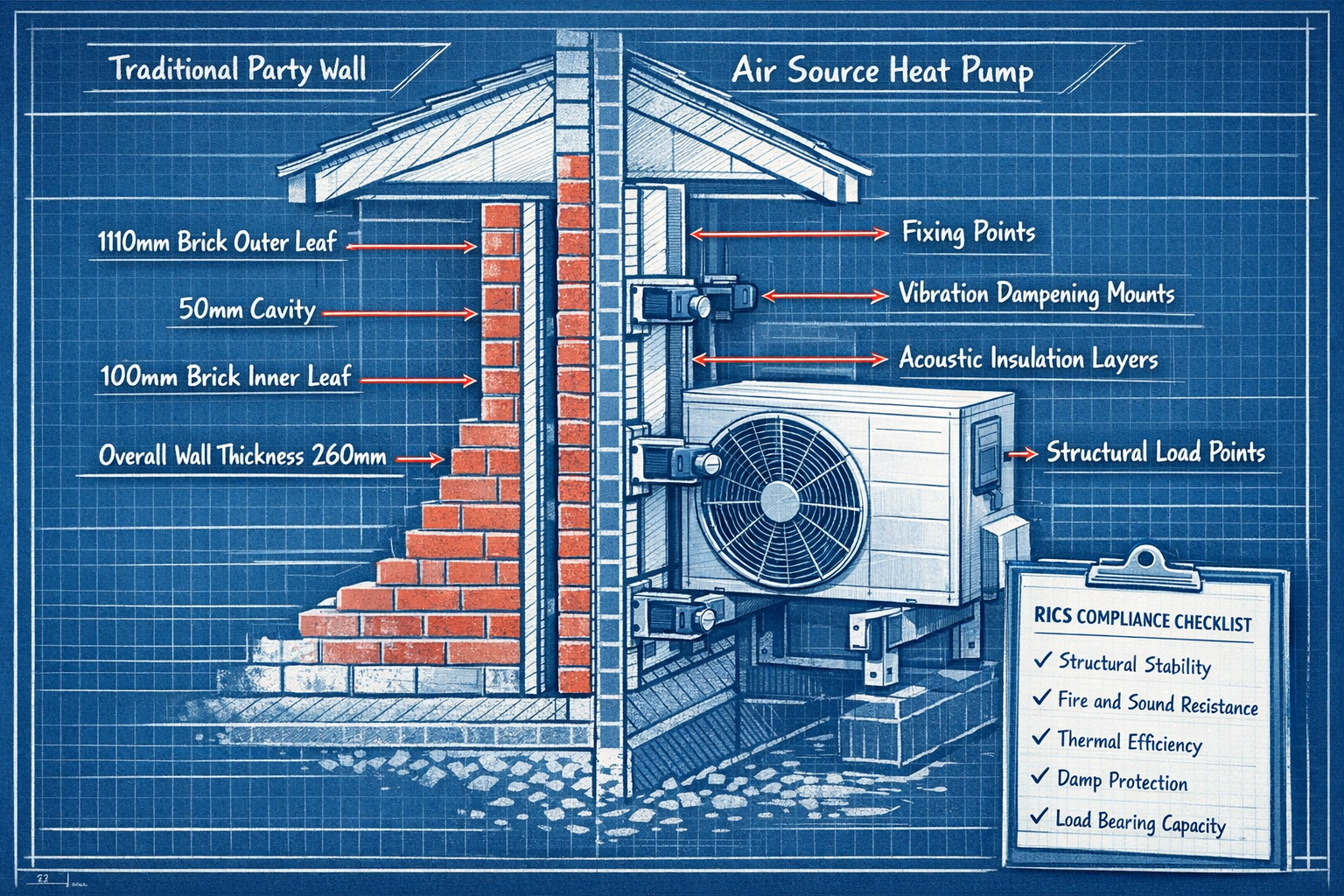
The Royal Institution of Chartered Surveyors (RICS) provides the professional framework ensuring party wall surveys meet rigorous standards. In 2026's net zero retrofit surge, RICS compliance has become the gold standard for protecting both building owners and neighbours.
Core RICS Assessment Protocols for Heat Pump Projects
RICS-accredited surveyors follow comprehensive protocols when assessing party walls for heat pump installations:
Pre-Installation Structural Assessment 🏗️
- Wall Condition Survey: Documenting existing cracks, dampness, and structural integrity
- Load-Bearing Capacity: Calculating whether party walls can support heat pump equipment weight (typically 40-150kg for air source units)
- Fixing Point Analysis: Identifying suitable mounting locations that won't compromise structural stability
- Photographic Evidence: Creating detailed visual records of pre-work conditions
Acoustic and Vibration Impact Evaluation 📊
- Baseline noise measurements in adjoining properties
- Vibration transmission modeling through party structures
- Acoustic insulation recommendations
- Compliance with Building Regulations Approved Document E (Resistance to sound)
Thermal Bridge Assessment 🌡️
- Identifying potential cold spots from penetrations
- Insulation continuity evaluation
- Condensation risk analysis
- Energy efficiency impact calculations
The RICS Party Wall Surveyor's Role
When neighbours cannot agree on heat pump installation terms, appointing qualified party wall surveyors becomes essential. The surveyor's responsibilities include:
Impartial Technical Assessment
- Evaluating proposed installation methods
- Recommending protective measures
- Specifying monitoring requirements
- Determining fair cost allocation
Award Preparation
The surveyor prepares a party wall award detailing:
- Permitted works scope
- Working hours restrictions
- Noise and vibration limits
- Condition monitoring protocols
- Dispute resolution procedures
Ongoing Monitoring
- Site inspections during installation
- Vibration and noise compliance checks
- Post-installation condition verification
- Documentation of any damage or issues
RICS Green Retrofit Guidance Updates for 2026
Recognizing the net zero urgency, RICS updated its guidance in 2026 to address heat pump-specific considerations:
Fast-Track Assessment Protocols ⚡
- Streamlined surveys for standard air source installations
- Pre-approved fixing methods for common wall types
- Digital submission and approval systems
- Reduced timelines for low-risk installations
Sustainability Integration Requirements 🌱
- Balancing party wall protection with environmental objectives
- Whole-building energy performance considerations
- Future-proofing for additional green upgrades
- Carbon impact assessments in surveyor recommendations
Enhanced Acoustic Standards 🔇
New noise limits specifically for heat pump installations:
- Maximum 42dB(A) at 1 meter from unit
- Nighttime operation restrictions (typically 23:00-07:00)
- Low-frequency noise assessment requirements
- Acoustic barrier specifications
Navigating Neighbour Disputes and Sustainability Mandates
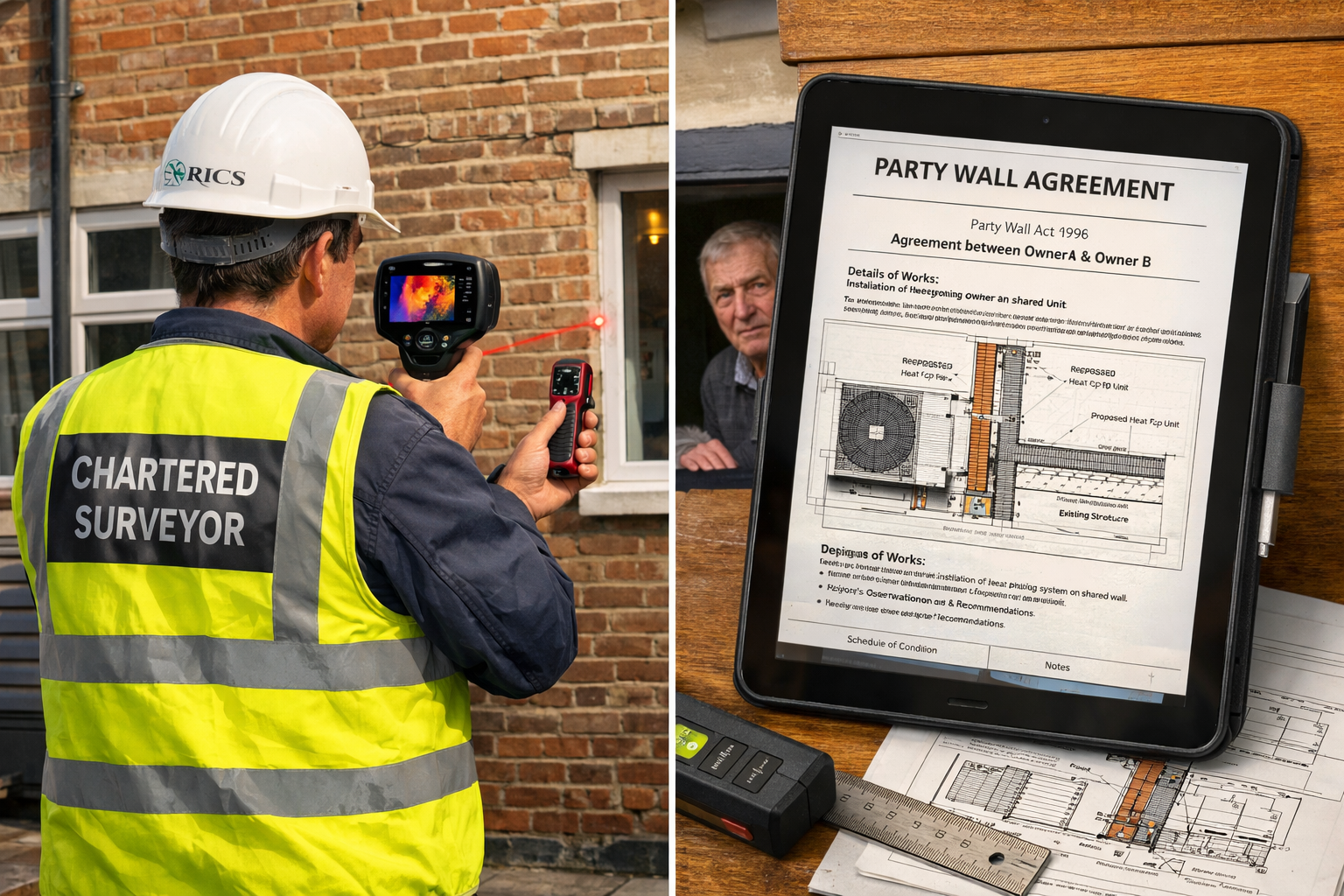
The collision between individual property rights and collective climate responsibilities has created unique challenges in 2026. Party wall surveys for heat pump retrofits must balance legal compliance with sustainability imperatives.
Common Dispute Scenarios in Heat Pump Retrofits
Aesthetic Objections vs. Environmental Necessity
Neighbours may object to external heat pump units on visual grounds, yet government mandates increasingly prioritize decarbonization. Party wall surveyors must navigate:
- Planning permission requirements
- Permitted development rights for heat pumps
- Reasonable objection thresholds
- Alternative installation solutions
Noise Concerns and Operational Restrictions
Heat pumps operate continuously, unlike traditional boilers. Disputes often arise over:
- Nighttime operation noise
- Compressor cycling frequency
- Cumulative noise from multiple installations
- Existing background noise levels
Structural Anxiety and Risk Perception
Neighbours may fear that wall-mounted equipment will cause:
- Structural damage from vibration
- Crack propagation in aging brickwork
- Reduced property values
- Future maintenance access issues
Understanding how to resolve party wall disputes becomes critical when objections arise.
The 2026 Regulatory Landscape
Government policy has created both opportunities and tensions:
Incentive Programs Driving Demand 💷
- Enhanced Boiler Upgrade Scheme grants (£7,500 for air source heat pumps)
- Local authority retrofit programs
- Social housing decarbonization requirements
- Commercial property EPC mandates
Enforcement and Penalties ⚖️
- Increased fines for non-compliance with party wall procedures
- Retrospective enforcement for unpermitted installations
- Neighbour rights to seek injunctions
- Potential removal orders for non-compliant equipment
Right to Install Provisions 🏡
New legislation in 2026 introduced limited "right to retrofit" provisions, but these do not override party wall obligations. Key points:
- Neighbours cannot unreasonably withhold consent for compliant installations
- Surveyors determine "reasonableness" based on technical evidence
- Proper notice and protection measures remain mandatory
- Dispute resolution timelines expedited for green retrofits
Best Practices for Smooth Heat Pump Party Wall Processes
Early Engagement Strategy 📢
- Pre-Notice Consultation: Informal discussion with neighbours before formal notices
- Visual Mockups: Showing proposed installation locations and equipment appearance
- Noise Demonstrations: Arranging visits to similar installations
- Written Reassurances: Providing manufacturer specifications and surveyor assessments
Comprehensive Documentation 📋
- Detailed installation plans with dimensions
- Manufacturer noise and vibration specifications
- Professional acoustic reports
- Structural engineer certifications
- Insurance coverage evidence
Proactive Protection Measures 🛡️
- Anti-vibration mounting systems (required in 78% of 2026 party wall awards)
- Acoustic enclosures for compressor units
- Flexible pipe connections to minimize vibration transmission
- Timer controls limiting nighttime operation
Cost Transparency 💰
Clear communication about who pays for party wall surveyors:
- Building owner covers own surveyor fees
- Building owner covers neighbour's surveyor fees if appointed
- Typical costs: £700-£1,500 per surveyor for heat pump projects
- Additional monitoring costs if required
Technical Assessment Protocols for Different Heat Pump Types
Different heat pump technologies present unique party wall considerations:
Air Source Heat Pumps (ASHP)
Wall-Mounted Units 🌬️
- Weight distribution analysis (units typically 40-70kg)
- Fixing depth and wall penetration assessment
- Vibration isolation requirements
- Drainage pipe routing through party structures
Ground-Standing Units
- Foundation requirements near party boundaries
- Noise reflection from party walls
- Visual impact on neighbouring properties
- Maintenance access considerations
Ground Source Heat Pumps (GSHP)
Excavation Considerations ⛏️
- Depth of trenches relative to neighbouring foundations
- Soil stability impact assessments
- Temporary support requirements during installation
- Permanent ground movement monitoring
Manifold and Pipework Installations
- Routing through party walls or under boundaries
- Insulation and protection specifications
- Future access and maintenance provisions
- Leak detection and prevention measures
Hybrid Systems
Combining traditional boilers with heat pumps may reduce party wall impacts:
- Smaller heat pump units with lower weight
- Reduced operational hours and noise
- Phased installation approaches
- Flexibility in equipment placement
The Party Wall Award Process for Heat Pump Installations
Understanding the formal process ensures compliance and minimizes delays:
Step-by-Step Timeline
Weeks 1-2: Pre-Planning Phase
- Obtain heat pump quotations and specifications
- Identify party wall implications
- Engage RICS surveyor for preliminary advice
- Review complete guide to party wall surveys
Weeks 3-4: Notice Service
- Prepare formal party wall notices
- Serve notices to all affected neighbours
- Provide technical drawings and specifications
- Allow 14-day response period
Weeks 5-8: Surveyor Appointment (if required)
- Neighbour consents or appoints surveyor
- Agreed surveyor or separate surveyors appointed
- Initial site inspections conducted
- Condition schedules prepared
Weeks 9-12: Award Preparation
- Technical assessments completed
- Protective measures specified
- Working conditions agreed
- Party wall award drafted and served
Week 13+: Installation Phase
- Works proceed according to award terms
- Monitoring inspections as specified
- Documentation of compliance
- Post-installation condition verification
Digital Innovations Streamlining the Process
2026 has seen significant technological advances:
Virtual Survey Tools 📱
- 3D scanning for remote condition assessment
- Drone surveys for external wall inspections
- Thermal imaging for existing defect identification
- Digital collaboration platforms for multi-party communication
Automated Documentation Systems 💻
- Template-based award generation
- Electronic service of notices
- Cloud-based evidence repositories
- Blockchain verification of conditions (pilot programs)
Predictive Analytics 📈
- AI-powered risk assessment for installation methods
- Vibration modeling before installation
- Noise propagation predictions
- Dispute likelihood scoring
Cost Considerations and Financial Planning
Understanding the full financial picture helps homeowners budget appropriately:
Typical Cost Breakdown for Party Wall Surveys
| Item | Cost Range (2026) | Notes |
|---|---|---|
| Initial surveyor consultation | £150-£300 | Preliminary advice and notice preparation |
| Building owner's surveyor | £700-£1,200 | Full service including award |
| Neighbour's surveyor | £700-£1,200 | Paid by building owner |
| Agreed surveyor (single) | £900-£1,500 | When both parties use same surveyor |
| Condition schedule | £300-£600 | Detailed photographic record |
| Monitoring inspections | £150-£300 per visit | Typically 2-4 visits |
| Acoustic testing | £400-£800 | If required by award |
| Dispute resolution | £1,500-£5,000+ | If formal proceedings needed |
Total Typical Range: £1,500-£4,000 for straightforward heat pump installations with cooperative neighbours.
Hidden Costs to Consider
Installation Modifications 🔧
Party wall requirements may necessitate:
- Enhanced mounting systems (+£300-£800)
- Acoustic enclosures (+£500-£1,500)
- Alternative equipment placement (+£200-£600 for extended pipework)
- Vibration isolation systems (+£250-£700)
Delay Costs ⏰
- Extended rental of temporary heating
- Contractor rescheduling fees
- Lost grant funding if deadlines missed
- Increased material costs during delay periods
Insurance Implications 🛡️
- Increased premiums for party wall work coverage
- Excess payments if disputes arise
- Professional indemnity for surveyors
- Contractor liability insurance requirements
Maximizing Value from Party Wall Surveys
The investment in proper party wall compliance provides significant benefits:
✅ Legal Protection: Documented compliance prevents future claims
✅ Neighbour Relations: Professional process maintains goodwill
✅ Installation Quality: Surveyor oversight ensures proper workmanship
✅ Property Value: Compliant green upgrades enhance marketability
✅ Dispute Prevention: Clear terms avoid costly conflicts
Regional Variations and Local Authority Requirements
Party wall procedures remain consistent across England and Wales, but local factors influence heat pump retrofits:
Conservation Areas and Listed Buildings
Additional restrictions often apply:
- Enhanced scrutiny of external equipment
- Specific mounting method requirements
- Materials and finish specifications
- Reversibility considerations
London-Specific Considerations
The capital's dense housing stock creates unique challenges:
- Higher proportion of terraced properties requiring party wall procedures
- Greater acoustic sensitivity in urban environments
- Stricter planning requirements in many boroughs
- Higher surveyor fees reflecting market demand
Working with experienced London party wall surveyors provides local expertise.
Scotland and Northern Ireland
Different legislative frameworks apply:
- Scotland: No equivalent to Party Wall Act; relies on common law and Building Standards
- Northern Ireland: Access to Neighbouring Land Act (NI) 2015 provides different provisions
- Cross-border projects require specialist advice
Future-Proofing: Preparing for Additional Green Upgrades
Heat pump installation is often the first step in comprehensive retrofit:
Coordinating Multiple Upgrades
Consider party wall implications for:
- External wall insulation: Significant party wall considerations
- Solar panel installations: Roof access and structural loading
- Window replacements: Potential party wall triggers
- Loft conversions: Major party wall requirements
Strategic Approach: Comprehensive party wall awards can cover multiple phases, reducing overall costs and timelines.
Anticipating Regulatory Changes
2026's landscape continues evolving:
- Stricter EPC requirements coming in 2027-2028
- Potential mandatory heat pump installations for certain property types
- Enhanced noise standards under review
- Streamlined party wall procedures for green retrofits in development
Professional Support: Choosing the Right Surveyor
Selecting qualified professionals ensures smooth processes:
Essential Qualifications and Experience
Look for surveyors with:
✅ RICS Accreditation: Chartered status (MRICS or FRICS)
✅ Party Wall Specialism: Specific expertise, not just general surveying
✅ Heat Pump Experience: Understanding of modern green retrofit challenges
✅ Local Knowledge: Familiarity with regional building types and practices
✅ Professional Indemnity Insurance: Minimum £1 million coverage
Questions to Ask Potential Surveyors
- How many heat pump party wall projects have you completed in the past year?
- What is your typical timeline for straightforward air source installations?
- Do you offer fixed-fee services or hourly rates?
- What is your approach to neighbour relations and dispute prevention?
- Can you provide references from recent heat pump retrofit clients?
Understanding what party wall surveyors do helps set appropriate expectations.
Red Flags to Avoid
⚠️ Unqualified practitioners offering "party wall services" without RICS accreditation
⚠️ Unrealistic timelines promising awards in days rather than weeks
⚠️ Conflict of interest surveyors with connections to installation companies
⚠️ Poor communication unresponsive to queries or unclear about processes
⚠️ Lack of insurance inadequate professional indemnity coverage
Case Studies: Real-World Heat Pump Party Wall Scenarios
Case Study 1: Victorian Terrace ASHP Installation
Situation: Mid-terrace Victorian property in South London requiring air source heat pump on rear wall (party wall with neighbour).
Challenges:
- Aging brickwork with existing minor cracks
- Neighbour concerned about noise and structural impact
- Limited alternative mounting locations
Solution:
- Comprehensive pre-installation condition survey documenting all existing defects
- Acoustic report demonstrating compliance with noise limits
- Specification of anti-vibration mounting system
- Agreement for annual monitoring inspections for three years
- Installation of acoustic fence between properties
Outcome: Installation completed successfully with neighbour satisfaction. Post-installation survey showed no new damage. Total party wall costs: £2,400.
Case Study 2: Semi-Detached GSHP with Boundary Excavation
Situation: Semi-detached property requiring ground source heat pump with trenching 1.5 meters from neighbour's foundation.
Challenges:
- Excavation depth of 2 meters raising structural concerns
- Neighbour's recent extension with shallow foundations
- Clay soil with shrinkage history
Solution:
- Structural engineer assessment of excavation impact
- Temporary shoring specified during installation
- Ground movement monitoring system installed
- Modified trench routing to increase separation distance
- Comprehensive insurance coverage arranged
Outcome: Works completed without incident. Monitoring showed no ground movement. Neighbour relationship maintained positively. Total party wall and engineering costs: £4,800.
Case Study 3: Dispute Resolution Through Surveyor Mediation
Situation: Terraced property with neighbour objecting to proposed heat pump on aesthetic and noise grounds.
Challenges:
- Neighbour initially refusing consent
- Threatened legal action to prevent installation
- Tight deadline for grant funding
Solution:
- Appointment of agreed surveyor acceptable to both parties
- Site visit to demonstrate alternative installations
- Negotiated compromise: ground-standing unit instead of wall-mounted
- Enhanced screening and landscaping provisions
- Extended warranty and maintenance commitments
Outcome: Award agreed within six weeks. Installation proceeded. Neighbour satisfied with outcome. Total surveyor costs: £1,600 (split approach avoided higher dual-surveyor fees).
Conclusion: Navigating Party Wall Surveys for Heat Pump Retrofits in 2026
The intersection of net zero ambitions and party wall legislation has created both challenges and opportunities in 2026's retrofit surge. Party Wall Surveys for Heat Pump Retrofits: RICS Compliance in 2026's Net Zero Retrofit Surge requires careful navigation of legal obligations, technical requirements, and neighbour relations.
Key Success Factors
🎯 Early Planning: Begin party wall procedures before booking installers
🎯 Professional Expertise: Engage RICS-accredited surveyors with heat pump experience
🎯 Neighbour Communication: Proactive, transparent dialogue prevents disputes
🎯 Technical Excellence: Proper assessments ensure compliant, sustainable installations
🎯 Documentation: Comprehensive records protect all parties
Actionable Next Steps
For Homeowners Planning Heat Pump Installation:
-
Assess Party Wall Implications (Week 1)
- Review property boundaries and shared structures
- Identify which neighbours require notification
- Consult party wall agreement requirements
-
Engage Professional Support (Week 2)
- Research and interview RICS surveyors
- Obtain preliminary advice on likely process
- Budget for party wall costs alongside installation
-
Initiate Formal Process (Week 3-4)
- Serve formal notices to neighbours
- Prepare technical documentation
- Begin surveyor appointments if required
-
Maintain Communication (Ongoing)
- Keep neighbours informed of progress
- Address concerns promptly and professionally
- Document all agreements and decisions
-
Ensure Compliance (Installation Phase)
- Follow award terms precisely
- Facilitate surveyor inspections
- Complete post-installation verification
For Neighbours Receiving Heat Pump Notices:
- Respond within the 14-day statutory period
- Consider appointing your own surveyor for independent advice
- Focus on legitimate technical concerns rather than blanket objections
- Recognize that reasonable heat pump installations typically proceed with appropriate protections
For Property Professionals:
- Update client advice to include party wall considerations for all heat pump projects
- Build relationships with qualified party wall surveyors
- Incorporate party wall timelines into project planning
- Stay informed on evolving RICS guidance and regulatory changes
The Bigger Picture
As the UK accelerates toward net zero targets, party wall procedures will increasingly intersect with sustainability mandates. The framework established in 2026 balances individual property rights with collective environmental responsibilities, ensuring that the green retrofit surge proceeds with proper protections for all stakeholders.
Proper party wall compliance for heat pump installations protects homeowners, neighbours, and the built environment while enabling the essential transition to low-carbon heating. By following RICS standards, engaging qualified professionals, and maintaining open communication, property owners can successfully navigate this complex landscape and contribute to the UK's decarbonization goals.
The investment in proper party wall procedures pays dividends through legal protection, maintained neighbour relations, and high-quality installations that will serve properties for decades to come. As 2026's net zero retrofit surge continues, those who embrace comprehensive party wall compliance will find their projects proceeding smoothly while those who cut corners face costly disputes and delays.
