
The intersection of building safety legislation and property law has created unprecedented challenges for high-rise building owners in 2026. As remediation works accelerate across the UK to address cladding defects and fire safety concerns, Party Wall Surveys for High-Rise Remediation Works: Navigating Building Safety Act Requirements in 2026 has become essential knowledge for property professionals, building owners, and residents alike. The complexity of coordinating extensive structural modifications while respecting neighbouring property rights demands careful planning, expert guidance, and thorough understanding of both the Party Wall etc. Act 1996 and the Building Safety Act 2022.
The urgency surrounding these works cannot be overstated. With insurers and lenders demanding comprehensive safety documentation at every renewal and transaction, building owners face mounting pressure to complete remediation projects swiftly while maintaining legal compliance on all fronts.
Key Takeaways
- Dual compliance is mandatory: High-rise remediation works must satisfy both Party Wall Act protocols and Building Safety Act Gateway processes simultaneously
- Early neighbour engagement prevents delays: Serving party wall notices at least two months before commencing works avoids costly disputes and project interruptions
- Professional surveyors are essential: Qualified party wall surveyors navigate complex disputes, prepare awards, and ensure legal protection throughout remediation projects
- Documentation requirements have intensified: Digital record-keeping systems and comprehensive safety cases are now expected across most building types, not just Higher-Risk Buildings
- Mid-rise buildings face similar pressures: Insurers increasingly treat mid-rise blocks with cladding issues like higher-risk buildings, extending compliance expectations beyond legal thresholds[1]
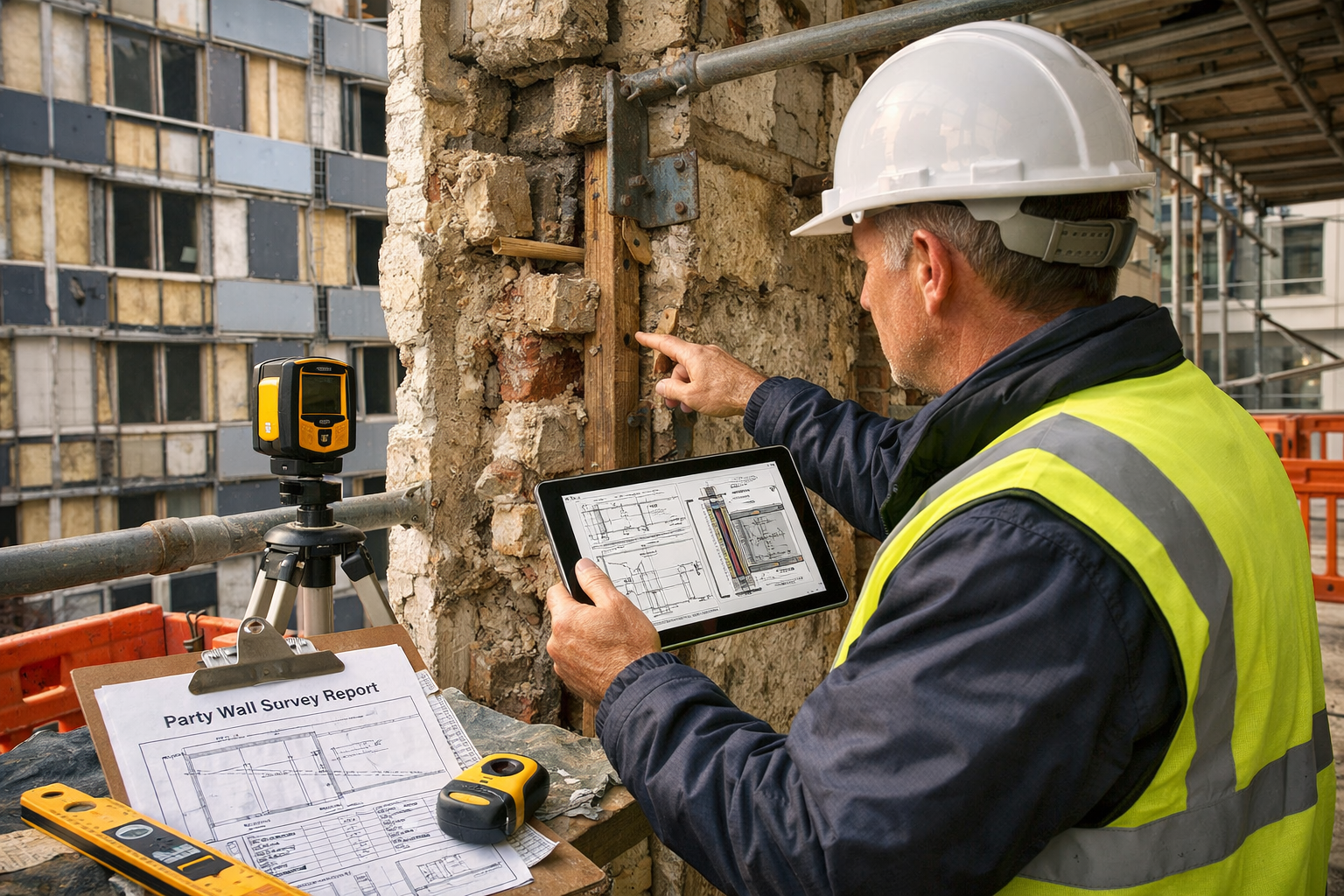
Understanding the Legal Framework for Party Wall Surveys in High-Rise Remediation
The Party Wall etc. Act 1996: Foundation of Shared Boundary Rights
The Party Wall etc. Act 1996 remains the cornerstone legislation governing works affecting shared walls, boundaries, and structures between adjoining properties. When remediation works involve modifications to party walls—common in high-rise buildings where structural elements are shared between multiple units or adjacent buildings—strict notification procedures must be followed.
Key scenarios requiring party wall procedures during remediation include:
- Removing or replacing external cladding attached to party walls
- Installing new fire barriers or cavity barriers within shared structures
- Excavating near foundations that support adjoining properties
- Strengthening structural elements that form part of party walls
- Creating new openings or modifying existing ones in shared walls
The Party Wall Act protocols require building owners to serve formal notices to adjoining owners at least two months before starting work. This timeline can significantly impact remediation project schedules, making early planning crucial.
The Building Safety Act 2022: Heightened Scrutiny for High-Rise Buildings
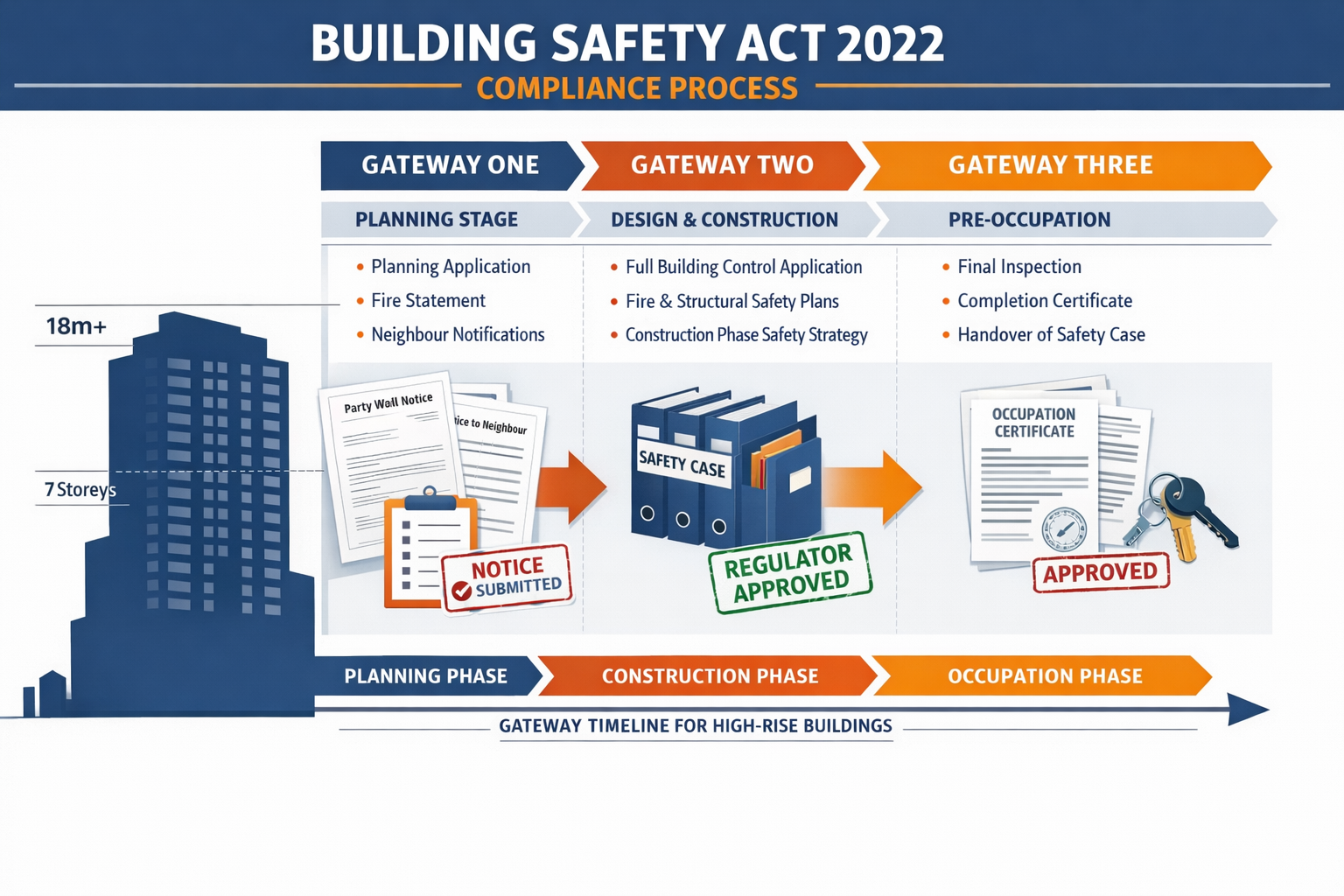
The Building Safety Act 2022 introduced comprehensive reforms specifically targeting Higher-Risk Buildings (HRBs)—residential buildings over 18 meters or seven storeys. The Act establishes a three-stage Gateway process that applies rigorous oversight throughout design, construction, and occupation phases.
The Gateway process includes:
- Gateway One: Planning permission stage requiring initial safety considerations
- Gateway Two: Pre-construction phase demanding detailed safety case documentation
- Gateway Three: Pre-occupation stage requiring final safety verification
For remediation works on existing high-rise buildings, Gateway Two and Three requirements apply when works constitute significant modifications. This creates a complex regulatory landscape where party wall surveying obligations intersect with Building Safety Act compliance.
The Convergence Challenge: When Two Regulatory Regimes Collide
The practical challenge for building owners in 2026 lies in coordinating these separate but overlapping legal requirements. Party wall procedures protect individual property rights and ensure fair compensation for any damage or inconvenience. Meanwhile, Building Safety Act requirements focus on collective safety and regulatory oversight.
Critical coordination points include:
- Timing notice periods to align with Gateway submission deadlines
- Ensuring party wall awards don't conflict with approved safety case specifications
- Managing multiple surveyor appointments alongside Building Safety Regulator interactions
- Coordinating access requirements for both party wall inspections and regulatory compliance checks
By 2026, most insurers and lenders request full documentation packs at each renewal, sale, or remortgage, extending beyond strict legal requirements to mid-rise blocks[1]. This commercial reality means that even buildings below the 18-meter threshold may face similar compliance pressures, making comprehensive party wall documentation increasingly valuable.
Party Wall Surveys for High-Rise Remediation Works: Essential Procedures and Timelines
Serving Party Wall Notices: The Critical First Step
The remediation process begins with identifying all adjoining owners who must receive party wall notices. In high-rise buildings, this can be complex due to:
- Multiple ownership structures: Individual leaseholders, freeholders, management companies, and head lessees
- Vertical and horizontal adjacency: Properties above, below, and beside the works
- Shared service corridors: Common areas with multiple stakeholders
Writing effective party wall letters requires precise technical descriptions of proposed works, accurate identification of affected structures, and clear timelines. For remediation projects, notices should specifically detail:
- Cladding removal and replacement methods
- Scaffolding attachment points to party walls
- Temporary support structures affecting shared elements
- Anticipated noise, vibration, and access requirements
- Expected duration and phasing of works
The 14-Day Response Window and Surveyor Appointments
Once notices are served, adjoining owners have 14 days to respond. Three outcomes are possible:
- Consent: Adjoining owner agrees in writing, allowing works to proceed without formal award
- Dissent: Adjoining owner objects or fails to respond, triggering the dispute resolution process
- Counter-notice: Adjoining owner requests additional works at the building owner's expense
When dissent occurs—common in complex remediation projects—both parties must appoint surveyors. The building owner can appoint their chosen surveyor, while the adjoining owner may either appoint their own or agree to use the same surveyor (an "Agreed Surveyor" arrangement).
Professional party wall surveyors play crucial roles by:
- Conducting pre-works condition surveys of adjoining properties
- Preparing detailed schedules of condition with photographs and measurements
- Negotiating terms of access and working hours
- Drafting party wall awards that legally bind all parties
- Resolving disputes through impartial technical assessment
Party Wall Awards: The Binding Agreement
The party wall award is a legally binding document that sets out the rights and responsibilities of all parties. For high-rise remediation works, awards typically include:
Technical specifications:
- Detailed descriptions of permitted works
- Construction methods and materials
- Structural protection measures
- Monitoring and inspection protocols
Access arrangements:
- Permitted entry times and locations
- Notice requirements for access
- Security and safety provisions
- Compensation for inconvenience
Financial provisions:
- Cost allocation between parties
- Security for expenses (if required)
- Compensation for loss or damage
- Surveyor fee arrangements
Awards must be served at least seven days before works commence, adding another critical deadline to project timelines. Understanding when party wall agreements are legally required prevents costly delays and legal complications.
Timeline Integration with Gateway Processes
Coordinating party wall procedures with Building Safety Act Gateway submissions requires careful project management. A typical timeline might look like:
| Milestone | Timeframe | Key Activities |
|---|---|---|
| Gateway Two submission | Month 1 | Submit safety case to Building Safety Regulator |
| Party wall notices served | Month 2 | Serve notices to all adjoining owners |
| Response period | Month 2-3 | Await responses, appoint surveyors if needed |
| Award preparation | Month 3-4 | Conduct surveys, negotiate terms, draft awards |
| Award service | Month 4 | Serve awards at least 7 days before start |
| Gateway Two approval | Month 4-5 | Receive regulatory approval to proceed |
| Works commence | Month 5 | Begin remediation with all approvals in place |
This integrated approach ensures that party wall processes don't delay critical safety works while maintaining full legal compliance.
Navigating Disputes and Neighbour Notifications During Remediation Projects
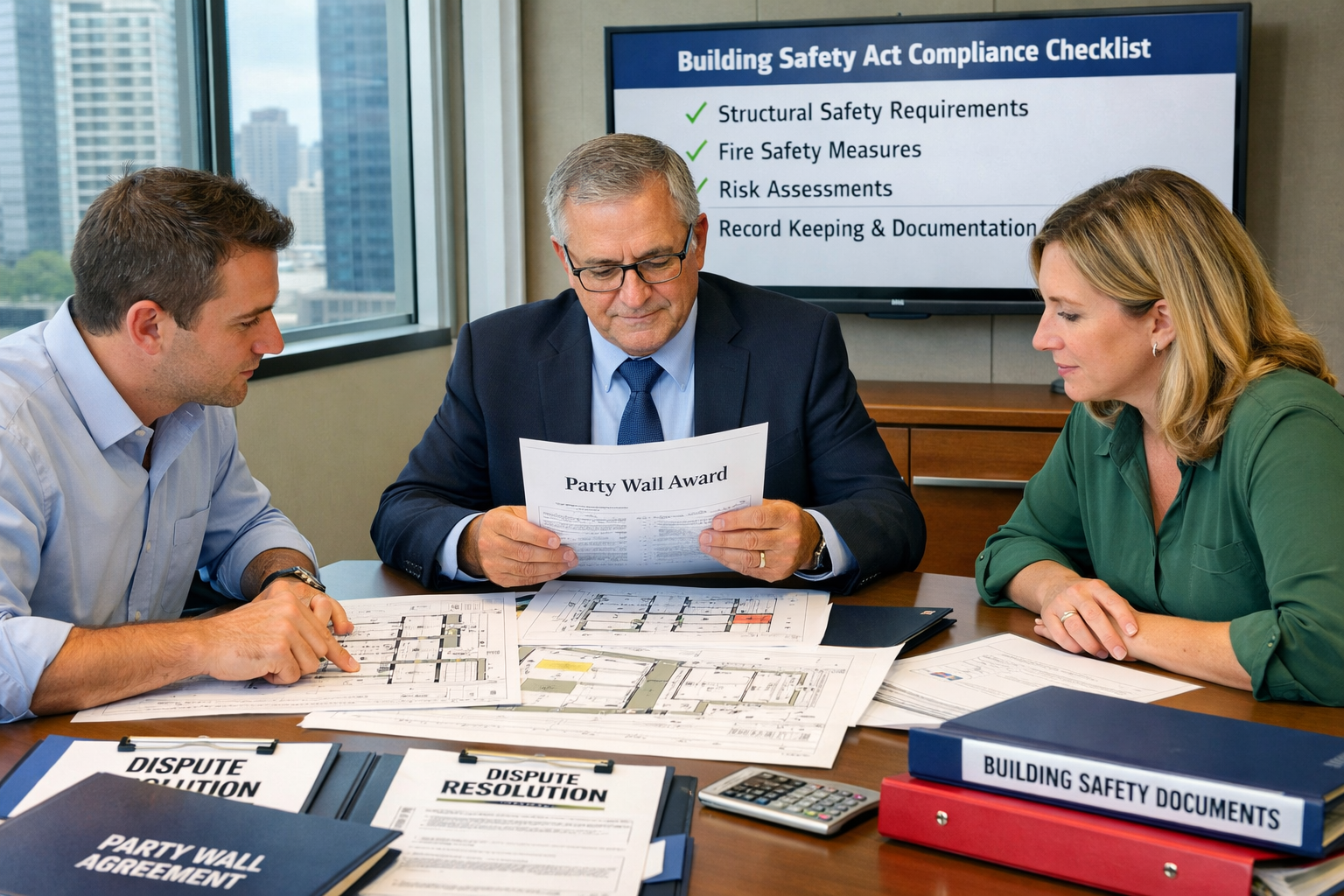
Common Sources of Dispute in High-Rise Remediation
Party wall disputes during remediation works often arise from:
Access concerns: Residents worried about contractors entering their homes, especially in occupied buildings where works may continue for months or years.
Noise and disruption: Extended periods of drilling, cutting, and construction activity affecting quality of life, particularly for home workers and families with young children.
Safety fears: Concerns about dust, debris, fire risks, and structural stability during works, especially given the underlying safety issues that prompted remediation.
Property value impact: Worries about marketability and valuation during and after works, with some owners fearing stigma associated with remediation projects.
Loss of amenity: Restricted access to balconies, reduced natural light due to scaffolding, and loss of parking or communal facilities during construction.
These concerns are legitimate and must be addressed through transparent communication and fair compensation arrangements. Resolving party wall disputes requires empathy, technical expertise, and creative problem-solving.
The Role of the Third Surveyor in Complex Disputes
When appointed surveyors cannot reach agreement on award terms, either party can request appointment of a Third Surveyor. This independent professional reviews the dispute and makes a binding determination.
Third Surveyor involvement is increasingly common in high-rise remediation projects due to:
- Technical complexity of works
- High financial stakes
- Multiple conflicting interests
- Novel construction methods
- Uncertainty about long-term impacts
The Third Surveyor's decision is final and can only be challenged through formal appeals processes, making their appointment a serious step that both parties should consider carefully.
Neighbour Notification Beyond Party Wall Requirements
The Building Safety Act introduces additional notification requirements for Higher-Risk Buildings. Accountable Persons (typically building owners or management companies) must establish effective resident engagement systems, including:
Mandatory information provision:
- Clear explanations of planned works and safety rationale
- Regular progress updates throughout the project
- Accessible complaints and feedback mechanisms
- Safety information and emergency procedures
Resident engagement strategies:
- Regular meetings with residents' associations
- Dedicated liaison officers for remediation projects
- Digital platforms for document sharing and updates
- Translation services for diverse communities
These requirements complement but don't replace party wall notification obligations. Building owners must ensure compliance with both regimes, recognizing that party wall procedures focus on individual property rights while Building Safety Act engagement addresses collective safety concerns.
Damage Claims and Dispute Resolution Mechanisms
Despite careful planning, damage to property during party wall works can occur. Remediation projects involving heavy machinery, structural modifications, and prolonged construction activity carry inherent risks.
Effective damage management includes:
- Comprehensive pre-works surveys: Detailed photographic and written records of existing conditions in all potentially affected properties
- Regular monitoring: Periodic inspections during works to identify emerging issues early
- Rapid response protocols: Clear procedures for reporting and addressing damage claims
- Insurance arrangements: Appropriate coverage for party wall liabilities and contractor risks
- Post-works verification: Final surveys comparing conditions before and after works
Party wall awards should specify dispute resolution procedures, typically involving the appointed surveyors as first-line arbitrators. This mechanism provides faster, more cost-effective resolution than court proceedings.
Managing Multiple Stakeholder Interests
High-rise remediation projects often involve numerous stakeholders with competing interests:
- Leaseholders: Concerned about costs, disruption, and property values
- Freeholders: Focused on legal compliance and minimizing liability
- Management companies: Balancing operational continuity with safety obligations
- Lenders: Requiring evidence of compliance for mortgage purposes
- Insurers: Demanding comprehensive documentation and risk mitigation
- Contractors: Needing clear access and working arrangements
- Regulators: Enforcing Building Safety Act requirements
Successful projects recognize these diverse perspectives and create governance structures that facilitate communication, decision-making, and dispute resolution. RICS party wall surveyors bring professional standards and ethical frameworks that help navigate these complex stakeholder relationships.
Digital Documentation and the "Golden Thread" Requirement
Digital Record Systems in 2026
By 2026, digital record systems—often called the "golden thread" of building information—have become standard practice across many building types. While legally mandated only for Higher-Risk Buildings, many mid-rise and low-rise blocks are adopting digital systems for plans, drawings, fire risk assessments, maintenance schedules, inspection logs, and contractor records[1].
For party wall matters, digital documentation offers significant advantages:
Enhanced accessibility: All parties can access current information remotely, reducing disputes arising from information gaps.
Version control: Clear tracking of document revisions prevents confusion about which specifications apply.
Audit trails: Complete records of communications, decisions, and approvals support dispute resolution and regulatory compliance.
Integration capabilities: Party wall documentation can link to broader building safety records, creating comprehensive project histories.
Party Wall Documentation Within Safety Cases
Building Safety Act compliance requires comprehensive safety cases demonstrating how buildings will be designed, constructed, maintained, and managed safely. For remediation projects, safety cases must address:
- Identification of all building safety risks
- Control measures to eliminate or minimize risks
- Competence of all persons involved in works
- Coordination arrangements between multiple parties
- Change management procedures
Party wall awards and associated documentation form part of this broader safety case, demonstrating:
Stakeholder engagement: Evidence of proper notification and consultation with adjoining owners.
Risk assessment: Consideration of how works might affect neighbouring properties and mitigation measures.
Competence verification: Appointment of qualified surveyors and contractors with appropriate expertise.
Monitoring arrangements: Inspection and reporting protocols throughout the works.
This integration means that party wall procedures are no longer viewed as purely legal formalities but as integral components of comprehensive building safety management.
Cost Implications and Fee Structures
The cost of party wall procedures varies significantly based on project complexity, number of adjoining owners, and whether disputes arise. For high-rise remediation works, typical costs include:
Surveyor fees:
- Building owner's surveyor: £1,500-£5,000+ depending on building size and complexity
- Adjoining owner's surveyor: £800-£3,000 per property
- Third Surveyor (if required): £2,000-£10,000+
Additional costs:
- Schedule of condition surveys: £300-£800 per property
- Monitoring inspections during works: £200-£500 per visit
- Damage rectification: Variable, depending on extent and nature
- Legal fees (if disputes escalate): £5,000-£50,000+
Building owners typically bear all reasonable surveyor fees under the Party Wall Act, making early engagement and dispute avoidance financially advantageous. However, these costs are minor compared to potential delays, legal challenges, or safety compliance failures.
Practical Guidance for Building Owners and Managers
Assembling the Right Professional Team
Successful navigation of Party Wall Surveys for High-Rise Remediation Works: Navigating Building Safety Act Requirements in 2026 demands a multidisciplinary professional team:
Core team members:
- Party wall surveyor: Manages all party wall procedures and awards
- Building surveyor: Oversees technical aspects of remediation works
- Principal Designer: Coordinates health and safety throughout the project
- Principal Contractor: Executes works in compliance with all approvals
- Building Safety Regulator liaison: Manages Gateway submissions and regulatory communications
- Legal advisor: Provides guidance on complex compliance issues
- Resident engagement coordinator: Maintains communication with occupants
This team should be assembled early in the project planning phase, ideally before Gateway One submissions, to ensure integrated planning and avoid coordination failures.
Proactive Communication Strategies
Effective communication prevents many disputes before they arise. Best practices include:
Pre-notice consultation: Informal discussions with adjoining owners before serving formal notices can identify concerns early and build goodwill.
Clear, accessible documentation: Technical information should be translated into plain language for non-specialist audiences.
Regular updates: Scheduled communications keeping all parties informed of progress, changes, and upcoming milestones.
Accessible contact points: Dedicated phone lines, email addresses, and office hours for questions and concerns.
Visual aids: Diagrams, photographs, and videos helping stakeholders understand proposed works and their impacts.
These strategies complement formal party wall procedures and Building Safety Act requirements, creating a culture of transparency and collaboration.
Avoiding Common Pitfalls
Experience from remediation projects across the UK highlights recurring mistakes that building owners should avoid:
❌ Late notice service: Waiting until Gateway approvals are received before serving party wall notices creates avoidable delays.
❌ Incomplete identification of adjoining owners: Missing even one affected party can derail entire projects.
❌ Inadequate pre-works surveys: Insufficient documentation of existing conditions leads to disputed damage claims.
❌ Poor contractor briefing: Contractors unaware of party wall obligations may violate award terms, triggering disputes.
❌ Neglecting mid-rise buildings: Assuming party wall procedures are unnecessary for buildings below 18 meters can prove costly when insurers demand comprehensive documentation[1].
✅ Best practice: Engage qualified professionals early, maintain comprehensive documentation, communicate proactively, and treat all stakeholders with respect and transparency.
Insurance and Indemnity Considerations
Appropriate insurance coverage is essential for high-rise remediation projects involving party wall works:
Key policies include:
- Public liability insurance: Covering injury or damage to third parties
- Professional indemnity insurance: Protecting against surveyor negligence claims
- Contractor all-risks insurance: Covering damage during construction
- Defects liability insurance: Addressing post-completion issues
Party wall awards should specify insurance requirements and verification procedures, ensuring adequate protection for all parties. Building owners should verify that contractors and surveyors maintain current, adequate coverage before works commence.
Future Trends and Evolving Compliance Landscape
Extending Requirements to Mid-Rise Buildings
A significant trend in 2026 is the de facto extension of Higher-Risk Building standards to mid-rise blocks. Insurers are treating many mid-rise buildings with cladding, complex geometry, or mixed systems similarly to HRBs, creating compliance pressures even when legal duties differ[1].
This means that party wall procedures for remediation works on buildings between 11 and 18 meters increasingly mirror those for taller structures, including:
- Enhanced documentation requirements
- More rigorous safety case expectations
- Digital record-keeping systems
- Comprehensive stakeholder engagement
Building owners should anticipate these requirements rather than waiting for formal regulatory changes, as commercial pressures from insurers and lenders are driving compliance ahead of legislation.
Technology Integration and Innovation
Emerging technologies are transforming party wall surveying and building safety compliance:
Building Information Modeling (BIM): 3D models integrating party wall boundaries, structural elements, and remediation plans provide unprecedented clarity for all stakeholders.
Drone surveys: Aerial inspection of high-rise exteriors reduces access requirements and provides detailed visual documentation.
Digital twin technology: Virtual replicas of buildings enable simulation of remediation works and their impacts on adjoining properties.
Blockchain documentation: Immutable records of notices, awards, and approvals enhance transparency and reduce disputes.
These innovations complement traditional surveying methods, offering enhanced accuracy, efficiency, and stakeholder engagement.
Professional Development and Competence
The Building Safety Act places significant emphasis on competence of all persons involved in building work. For party wall surveyors working on remediation projects, this means:
- Enhanced training in building safety legislation
- Understanding of fire engineering principles
- Knowledge of modern cladding systems and remediation techniques
- Familiarity with Gateway processes and regulatory requirements
- Continuing professional development in evolving standards
Professional bodies including RICS (Royal Institution of Chartered Surveyors) and the Faculty of Party Wall Surveyors are updating guidance and training programs to address these evolving competence requirements.
Conclusion
Party Wall Surveys for High-Rise Remediation Works: Navigating Building Safety Act Requirements in 2026 represents one of the most complex challenges facing building owners, managers, and professionals in the UK property sector. The intersection of established party wall procedures with new building safety regulations creates a demanding compliance landscape that requires expertise, planning, and coordination.
Key success factors include:
🔑 Early engagement: Begin party wall procedures and Gateway submissions simultaneously, allowing adequate time for all processes.
🔑 Professional expertise: Appoint qualified surveyors and consultants with specific experience in high-rise remediation projects.
🔑 Comprehensive documentation: Maintain detailed records throughout the project, integrating party wall documentation with broader safety cases.
🔑 Proactive communication: Engage with all stakeholders transparently, addressing concerns before they escalate into formal disputes.
🔑 Integrated planning: Coordinate party wall timelines with Gateway processes, construction schedules, and resident engagement requirements.
The stakes are high. Failure to properly address party wall obligations can result in costly delays, legal disputes, and even injunctions halting critical safety works. Conversely, well-managed party wall procedures protect all parties' interests, facilitate smooth project delivery, and demonstrate the comprehensive stakeholder engagement expected under modern building safety frameworks.
Actionable Next Steps
For building owners planning remediation works:
- Conduct initial assessments: Identify all party wall implications early in project planning
- Appoint qualified surveyors: Engage experienced party wall professionals before formal design work begins
- Develop integrated timelines: Map party wall procedures against Gateway submission schedules
- Establish communication protocols: Create systems for resident engagement that satisfy both party wall and Building Safety Act requirements
- Review insurance coverage: Ensure adequate protection for all party wall and remediation risks
- Document everything: Implement digital record systems that support both party wall awards and building safety golden thread requirements
For adjoining owners receiving party wall notices:
- Seek professional advice: Consider appointing your own surveyor to protect your interests
- Document existing conditions: Take photographs and notes of your property's current state
- Respond within deadlines: Ensure timely responses to notices to preserve your rights
- Engage constructively: Work collaboratively with building owners while protecting your legitimate interests
- Understand your rights: Familiarize yourself with party wall procedures and available dispute resolution mechanisms
The remediation of high-rise buildings with safety defects is one of the most important construction challenges of this decade. By properly navigating party wall requirements alongside Building Safety Act compliance, the property sector can deliver these essential works while respecting individual property rights and maintaining the trust of all stakeholders. The complexity is significant, but with proper professional guidance and careful planning, successful outcomes are achievable.
References
[1] Building Safety Compliance Heightened What 2026 Could Look Like – https://www.flat-living.co.uk/building-safety-compliance-heightened-what-2026-could-look-like/
[2] Party Wall Surveying Surge In 2026 Loft Conversions Navigating High Demand Compliance During Housing Uptick – https://nottinghillsurveyors.com/blog/party-wall-surveying-surge-in-2026-loft-conversions-navigating-high-demand-compliance-during-housing-uptick
