
London's property market faces unprecedented challenges in 2026, with buyer confidence wavering and valuation pressures mounting across the capital's flat sector. The Evergreen RICS Valuation Methods for Stabilising London Flats: 2026 Market Protocols represent a critical framework for navigating these turbulent waters, offering surveyors and property professionals proven techniques that withstand market volatility while addressing contemporary issues like post-budget tax impacts and cladding concerns.
Recent data reveals that 83% of offers on homes priced near £2 million came in below threshold in February 2026, highlighting the urgent need for robust valuation methodologies [3]. As the South of England experiences slower recovery compared to other regions, establishing reliable, enduring valuation protocols has never been more essential for maintaining market stability and protecting both buyers and lenders.

Key Takeaways
- RICS valuation standards provide three core methodologies—Comparison, Investment, and Residual—that remain effective despite 2026 market fluctuations
- Leasehold complexities and cladding issues require specialized valuation adjustments specific to London's multi-storey flat market
- Post-budget tax changes have created new valuation considerations, particularly for properties approaching the £2 million threshold
- Professional RICS valuers employ stabilization techniques that account for buyer confidence shifts and regional recovery disparities
- Documentation protocols in 2026 demand enhanced transparency around building safety certificates and long-term maintenance costs
Understanding RICS Valuation Fundamentals for London Flats

The Royal Institution of Chartered Surveyors (RICS) establishes the gold standard for property valuation across the United Kingdom. Their comprehensive framework, commonly known as the Red Book, provides methodologies that have proven resilient through multiple market cycles. For London flats specifically, these protocols require careful adaptation to address the unique characteristics of leasehold properties, multi-storey buildings, and the capital's distinctive market dynamics.
The Three Pillars of RICS Valuation Methodology
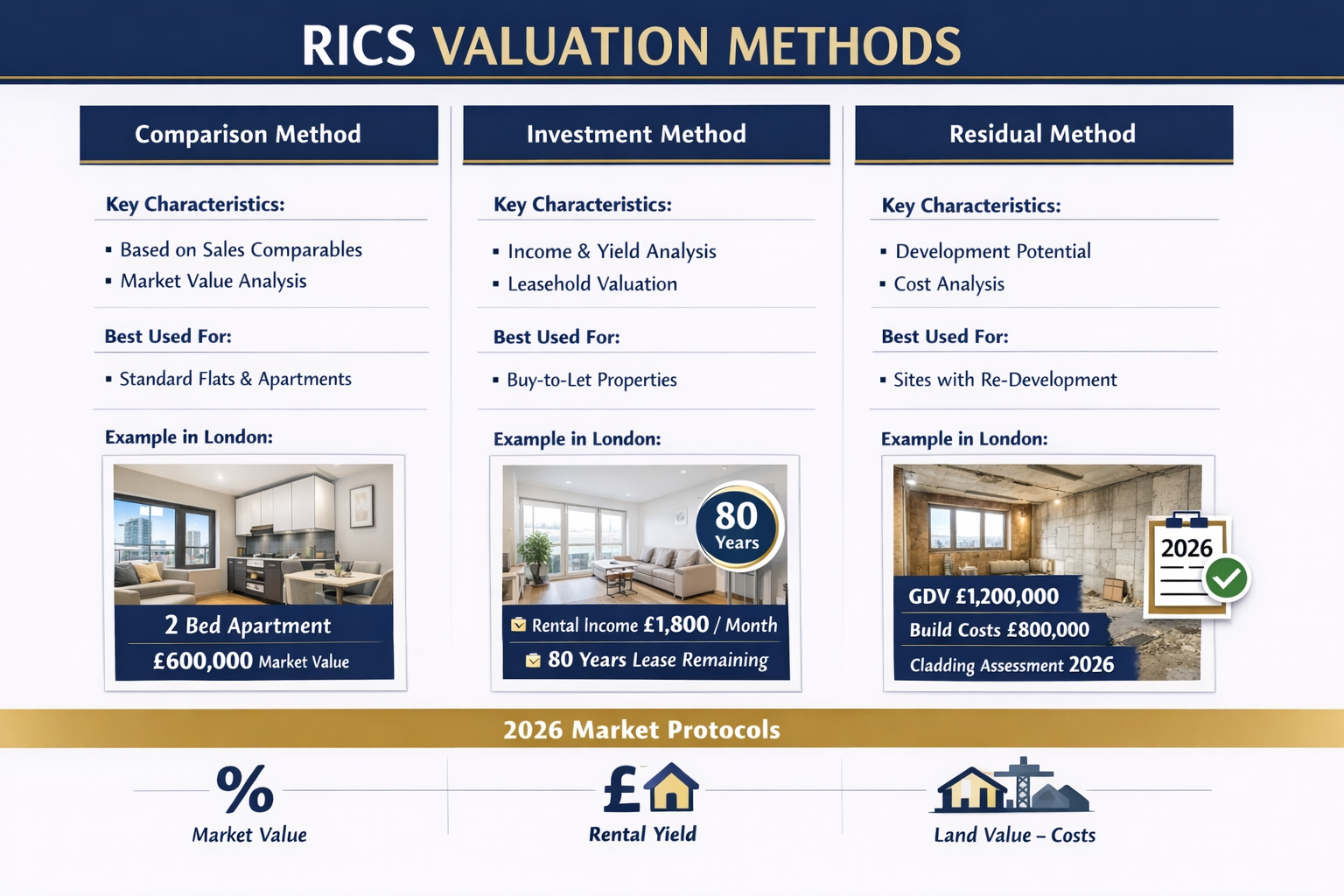
Comparison Method forms the foundation of most residential flat valuations in London. This approach analyzes recent sales of similar properties within the same area, adjusting for differences in size, condition, lease length, and amenities. In 2026, this method requires particular attention to market timing, as transaction volumes and pricing have shown significant volatility [3].
Investment Method proves especially relevant for rental properties and buy-to-let flats. This technique calculates value based on rental income potential, applying appropriate capitalization rates that reflect current market yields. With rental demand remaining robust in 2026 despite broader market uncertainties [4], this methodology provides crucial insights for investor-focused valuations.
Residual Method applies primarily to properties requiring significant refurbishment or conversion. This approach calculates the current value by estimating the completed development value and deducting all costs, including construction, professional fees, finance charges, and developer's profit. For London flats with cladding remediation requirements, this method has gained increased importance.
RICS Standards Specific to Multi-Storey Residential Blocks
The RICS valuation standards address specific considerations for multi-storey residential buildings, which dominate London's flat market [2]. These protocols require valuers to assess:
- Building safety compliance including fire safety measures and cladding materials
- Service charge histories and reserve fund adequacy
- Management company effectiveness and lease administration quality
- Shared ownership structures and their impact on marketability
- Planning restrictions affecting future alterations or extensions
Professional chartered surveyors in Central London must integrate these factors into their valuation assessments, ensuring comprehensive risk evaluation that protects all stakeholders.
Evergreen RICS Valuation Methods for Stabilising London Flats: 2026 Market Protocols in Practice
The application of Evergreen RICS Valuation Methods for Stabilising London Flats: 2026 Market Protocols requires understanding how traditional methodologies adapt to current market conditions. These protocols emphasize consistency, transparency, and risk-adjusted analysis that accounts for both immediate market pressures and long-term value sustainability.
Implementing Comparison Method Adjustments for 2026 Conditions
The Comparison Method remains the most widely used approach for London flat valuations, but 2026 market conditions demand sophisticated adjustments:
Market Timing Considerations 📊
- Properties sold in Q4 2025 versus Q1 2026 may reflect different buyer confidence levels
- Transactions completed before versus after recent budget announcements require separate analysis
- Regional variations between North and South London recovery patterns must inform comparable selection
Leasehold-Specific Adjustments 🏢
Leasehold properties require particular attention to lease length, with values declining significantly once remaining terms drop below 80 years. The formula for lease extension costs and marriage value calculations directly impacts flat valuations. Professional valuers must account for:
| Remaining Lease Term | Typical Value Impact | Extension Urgency |
|---|---|---|
| 90+ years | Minimal discount | Low priority |
| 80-90 years | 5-10% reduction | Moderate |
| 70-80 years | 10-20% reduction | High |
| Below 70 years | 20-40% reduction | Critical |
For detailed guidance on leasehold considerations, freehold valuation resources provide valuable context for understanding the comparative value implications.
Cladding and Building Safety Valuation Protocols
The cladding crisis continues to impact London flat valuations significantly in 2026. Evergreen RICS Valuation Methods for Stabilising London Flats: 2026 Market Protocols incorporate specific assessment criteria:
EWS1 Form Status ⚠️
- Properties with satisfactory EWS1 certificates maintain full market value
- Buildings requiring remediation face valuation reductions of 20-50% depending on remediation timelines
- Flats in buildings over 18 meters without certification may be unmortgageable, severely impacting value
Building Safety Fund Eligibility
Properties eligible for government remediation funding demonstrate better value stability than those requiring private funding solutions. Valuers must investigate and document funding arrangements, expected timelines, and interim safety measures.
The RICS registered valuers maintain current knowledge of building safety legislation and its valuation implications, ensuring accurate risk assessment.
Investment Method Application for Rental Properties
With rental demand remaining strong across London in 2026 [4], the Investment Method provides crucial valuation insights for buy-to-let properties. This approach requires:
Rental Income Verification 💷
- Current market rents for comparable properties in the same building or area
- Void periods and management costs that reduce net income
- Tenant demand indicators and rental growth projections
Yield Analysis
Gross and net yields vary significantly across London boroughs. Prime Central London areas typically show yields of 2-3%, while outer London locations may achieve 4-5%. The capitalization rate applied directly impacts the calculated value:
Value = Net Annual Income ÷ Capitalization Rate
For example, a flat generating £24,000 annual net rent with a 4% cap rate would value at £600,000, while the same income with a 3% cap rate would indicate £800,000 value.
Navigating 2026 Market Challenges Through Stabilization Techniques
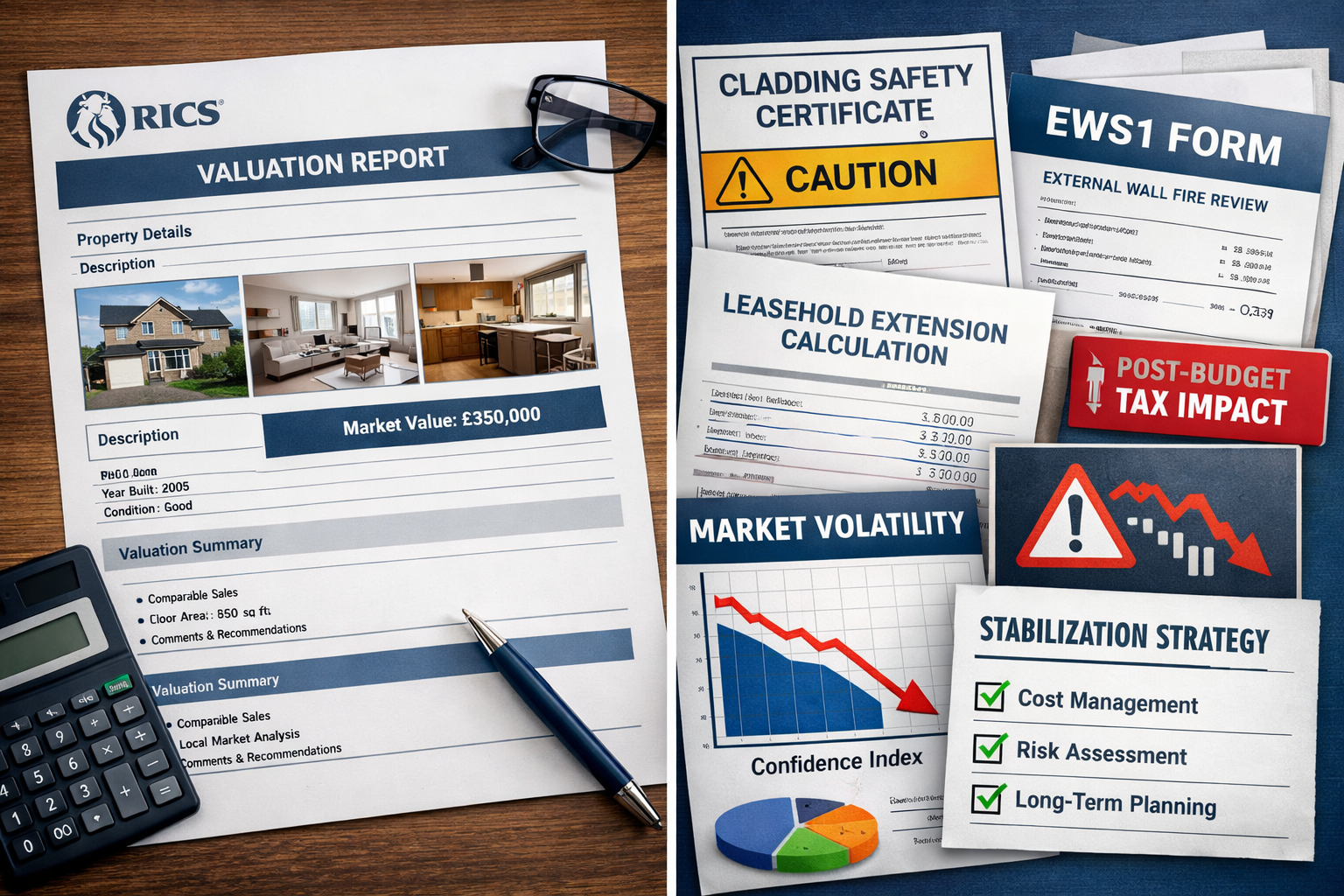
The Evergreen RICS Valuation Methods for Stabilising London Flats: 2026 Market Protocols specifically address contemporary market challenges that threaten valuation consistency and market confidence.
Post-Budget Tax Impact Considerations
Recent budget changes have created significant valuation pressure points, particularly for properties approaching key tax thresholds. The observation that 83% of offers on homes near £2 million came in below threshold demonstrates strategic buyer behavior influenced by Stamp Duty Land Tax (SDLT) rates [3].
Threshold Effect Analysis 📉
Valuers must recognize that properties valued just above major SDLT thresholds face disproportionate market resistance. The protocols recommend:
- Conservative comparable selection when properties fall within 5% of major thresholds
- Explicit disclosure of threshold proximity in valuation reports
- Market evidence analysis showing transaction patterns around threshold values
- Adjustment factors reflecting reduced buyer pool for threshold-adjacent properties
Buyer Confidence and Market Sentiment Adjustments
Market sentiment significantly influences achievable prices, particularly in discretionary purchase segments. The 2026 protocols incorporate sentiment analysis through:
Transaction Volume Indicators 📊
- Comparing current market activity levels to historical averages
- Analyzing time-on-market trends for comparable properties
- Assessing offer-to-asking price ratios across relevant market segments
Regional Recovery Disparities
The slower recovery in Southern England compared to other regions requires geographic-specific adjustments. Valuers working across West London, Islington, and other areas must apply location-appropriate market sentiment factors.
Help to Buy and Shared Ownership Valuation Complexities
Government-backed schemes introduce additional valuation complexity requiring specialized protocols. The RICS Help to Buy valuation process demands particular attention to:
Scheme-Specific Requirements 🏠
Help to Buy valuations for London properties typically cost £200-£400 depending on property value [1], but require adherence to strict timescales and documentation standards. The valuation must reflect:
- Open market value assuming 100% ownership
- Compliance with scheme eligibility criteria
- New build premium considerations
- Developer incentive adjustments
Shared Ownership Complications
Shared ownership flats require dual valuations: the share being purchased and the full market value. Staircasing opportunities and rent on retained equity significantly impact overall value assessment.
Service Charge and Reserve Fund Analysis
London flats carry ongoing service charge obligations that directly impact value and affordability. The 2026 protocols emphasize:
Service Charge Sustainability Assessment 💰
- Historical service charge trends over minimum 3-year period
- Adequacy of reserve funds for major works
- Pending major works programs and their funding mechanisms
- Management company financial health and governance quality
Excessive or rapidly increasing service charges reduce property values, while inadequate reserves signal future financial burdens. Professional valuers must obtain and analyze:
- Annual service charge accounts and budgets
- Reserve fund statements and investment policies
- Section 20 consultation notices for major works
- Management company AGM minutes highlighting upcoming expenditure
Documentation and Transparency Protocols
The Evergreen RICS Valuation Methods for Stabilising London Flats: 2026 Market Protocols demand enhanced documentation standards to support valuation conclusions:
Required Supporting Evidence 📋
- Minimum three comparable transactions with detailed adjustment explanations
- Building safety documentation including EWS1 forms where applicable
- Lease abstracts highlighting key terms affecting value
- Service charge histories and reserve fund statements
- Market sentiment indicators and transaction volume data
- Photographic evidence of property condition and location context
This comprehensive documentation approach supports valuation defensibility and provides transparency for all stakeholders, from mortgage lenders to property purchasers.
Professional Valuation Services and Quality Assurance
Implementing Evergreen RICS Valuation Methods for Stabilising London Flats: 2026 Market Protocols requires qualified professionals with current market knowledge and technical expertise.
Selecting Qualified RICS Valuers
Not all surveyors possess equal expertise in London flat valuations. When selecting a professional, consider:
Essential Qualifications ✅
- RICS membership (MRICS or FRICS designation)
- Registered valuer status on RICS public register
- Specific experience with leasehold flat valuations
- Current knowledge of building safety legislation
- Professional indemnity insurance adequate for property value
Firms offering comprehensive RICS valuations across London maintain teams with specialized expertise in different property types and valuation purposes.
Valuation Purpose and Methodology Selection
Different valuation purposes require specific approaches and reporting formats:
Mortgage Valuations 🏦
Lenders require conservative valuations protecting their security interest. These typically employ the Comparison Method with risk-adjusted assumptions, ensuring the property provides adequate collateral even in declining markets.
Reinstatement Cost Assessments
Buildings insurance requires accurate reinstatement cost valuations that calculate rebuilding costs rather than market value. This specialized assessment ensures adequate insurance coverage for flat owners and management companies.
Probate and Tax Valuations
Estate administration and tax purposes demand valuations reflecting market value at specific dates, often requiring retrospective analysis of market conditions and comparable evidence.
Quality Assurance and Review Processes
Professional valuation firms implement quality control measures ensuring consistency and accuracy:
Internal Review Protocols 🔍
- Peer review of valuation reports before issuance
- Comparable evidence verification and adjustment justification
- Calculation checking and mathematical accuracy confirmation
- Compliance verification against RICS standards and client requirements
These quality assurance processes protect both the valuer's professional reputation and the client's interests, ensuring valuations withstand scrutiny from lenders, tax authorities, and legal proceedings.
Regional Variations Across London's Flat Market
London's diverse neighborhoods demonstrate significant valuation variations requiring localized market knowledge. The Evergreen RICS Valuation Methods for Stabilising London Flats: 2026 Market Protocols acknowledge these geographic differences.
Prime Central London Considerations
Areas including Knightsbridge, Mayfair, and Belgravia demonstrate unique market characteristics:
- International buyer influence creating currency exchange rate sensitivity
- Premium pricing for lateral apartments in period buildings
- Amenity expectations including porter services and private gardens
- Lower rental yields (2-3%) reflecting capital appreciation focus
Emerging Markets and Regeneration Areas
Locations experiencing regeneration demonstrate different valuation dynamics:
- Infrastructure improvements (Crossrail, station upgrades) enhancing values
- New build premium erosion as developments mature
- Gentrification trends requiring careful comparable selection
- Higher yields (4-5%) attracting investor interest
Surveyors operating across diverse locations like Fulham, Clapham, and Putney must understand neighborhood-specific market drivers and buyer demographics.
Integration with Broader Property Assessment Services
Comprehensive property evaluation extends beyond valuation to encompass condition assessment and risk identification. The Evergreen RICS Valuation Methods for Stabilising London Flats: 2026 Market Protocols work alongside complementary survey services.
Combining Valuations with Building Surveys
While valuations focus on market worth, building surveys assess physical condition and defect identification. The Level 2 and Level 3 survey differences determine appropriate inspection depth:
Level 2 Homebuyer Surveys 🏘️
Suitable for conventional flats in reasonable condition, these surveys identify visible defects and maintenance issues without invasive investigation. Combined with valuations, they provide comprehensive purchase decision support.
Level 3 Building Surveys
Older properties, those with visible defects, or flats in converted buildings benefit from detailed Level 3 surveys. These comprehensive inspections inform valuation adjustments for repair costs and condition-related value impacts.
Specialist Assessments for Complex Properties
Certain flat types require additional specialist input:
Structural Engineering Assessments 🏗️
Properties showing structural movement, cracking, or subsidence require structural engineering evaluation to quantify repair costs and assess long-term stability. These findings directly impact valuations through repair cost deductions and marketability considerations.
Drainage and Service Investigations
Flats in older buildings may require drainage surveys to assess shared drainage systems and identify potential failure risks affecting multiple units.
Future-Proofing Valuations in an Evolving Market
The "evergreen" aspect of these protocols emphasizes methodologies that remain valid despite market evolution. Looking forward, several trends will influence London flat valuations:
Sustainability and Energy Efficiency
Energy Performance Certificate (EPC) ratings increasingly impact values as regulatory requirements tighten and buyer awareness grows. Properties achieving higher EPC ratings demonstrate:
- Lower running costs enhancing affordability and attractiveness
- Regulatory compliance avoiding future improvement mandates
- Premium positioning in environmentally conscious market segments
Technology Integration in Valuation Practice
Digital tools enhance valuation accuracy and efficiency:
- Automated Valuation Models (AVMs) providing initial value estimates
- Geographic Information Systems (GIS) improving comparable identification
- Digital documentation streamlining evidence gathering and reporting
- Market data analytics revealing pricing trends and sentiment indicators
However, professional judgment remains essential, particularly for complex properties where automated systems cannot adequately assess unique characteristics or market nuances.
Regulatory Evolution and Market Adaptation
Building safety legislation, leasehold reform proposals, and tax policy changes will continue shaping the valuation landscape. The Evergreen RICS Valuation Methods for Stabilising London Flats: 2026 Market Protocols provide frameworks adaptable to regulatory evolution while maintaining core professional standards.
Conclusion
The Evergreen RICS Valuation Methods for Stabilising London Flats: 2026 Market Protocols represent essential professional practices for navigating the capital's complex and challenging property market. By combining time-tested RICS methodologies with contemporary adaptations addressing cladding concerns, post-budget tax impacts, and buyer confidence fluctuations, these protocols deliver reliable valuations that serve all stakeholders effectively.
London's flat market faces unique pressures in 2026, from leasehold complications and building safety issues to regional recovery disparities and threshold-driven buyer behavior. Professional valuers employing these evergreen methods provide the stability and transparency necessary for maintaining market function and protecting property transactions.
Actionable Next Steps
For property owners, purchasers, and investors seeking reliable valuations in London's flat market:
- Engage qualified RICS valuers with specific London flat experience and current market knowledge
- Provide comprehensive documentation including lease details, service charge histories, and building safety certificates
- Understand valuation context including the specific purpose, methodology, and assumptions underlying value conclusions
- Consider complementary assessments such as building surveys to inform comprehensive property decisions
- Monitor market developments affecting values including regulatory changes, tax policy, and local market trends
The combination of professional expertise, robust methodology, and transparent documentation ensures valuations that withstand scrutiny, support sound decision-making, and contribute to overall market stability. Whether purchasing, refinancing, or managing property portfolios, these protocols provide the foundation for confident property transactions in London's dynamic flat market.
For professional valuation services employing these protocols, consult experienced chartered surveyors who understand the complexities of London's property landscape and maintain current expertise in evolving market conditions.
References
[1] Rics Help To Buy Valuation London Cost Process Timescales 2026 Guide – https://winfieldssurveyors.london/rics-help-to-buy-valuation-london-cost-process-timescales-2026-guide/
[2] Valuation Standards – https://www.rics.org/profession-standards/rics-standards-and-guidance/sector-standards/valuation-standards
[3] Post Budget 2026 Valuation Challenges Surveyor Strategies For High Value Properties Over 2 Million – https://nottinghillsurveyors.com/blog/post-budget-2026-valuation-challenges-surveyor-strategies-for-high-value-properties-over-2-million
[4] Lettings Market Tenant Demand 2026 Valuation Impacts And Survey Due Diligence For Rising Rents – https://nottinghillsurveyors.com/blog/lettings-market-tenant-demand-2026-valuation-impacts-and-survey-due-diligence-for-rising-rents
