
Nearly 40% of party wall disputes escalate unnecessarily due to inadequate pre-work condition documentation. When a neighbor claims your building project damaged their property, the difference between a swift resolution and costly litigation often hinges on one critical document: a professionally prepared Schedule of Condition. Yet many surveyors still produce schedules that fail under legal scrutiny—using poor photography, vague descriptions, and inconsistent methodologies that leave both parties vulnerable.
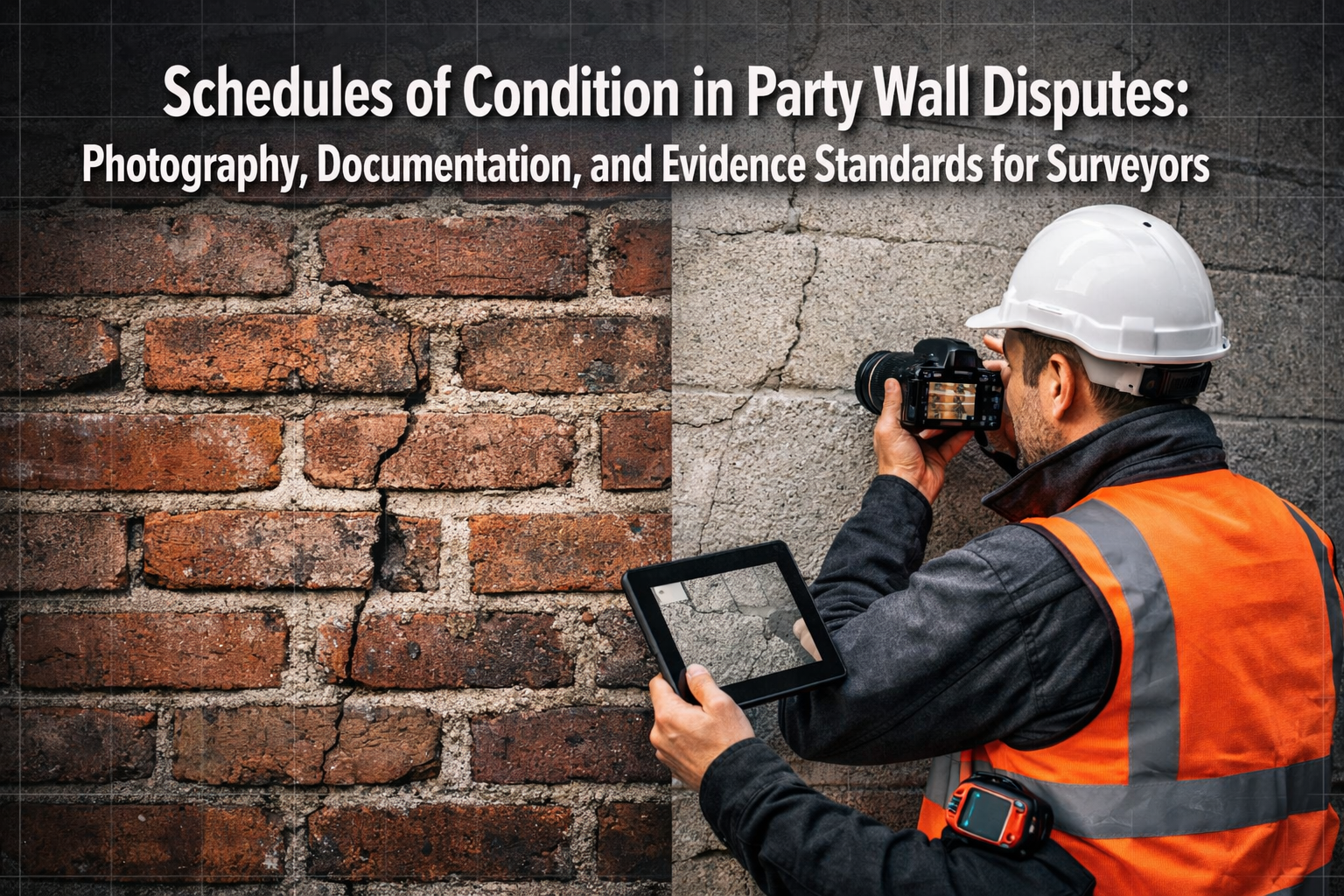
Understanding Schedules of Condition in Party Wall Disputes: Photography, Documentation, and Evidence Standards for Surveyors has become essential for construction professionals in 2026. This comprehensive guide examines the technical standards, photographic protocols, and legal requirements that transform basic condition reports into bulletproof evidence capable of withstanding courtroom examination.
Key Takeaways
- Schedules of Condition serve as legal evidence documenting property conditions before construction works begin, establishing baseline conditions crucial for resolving damage disputes
- Professional photography standards require high-resolution images with measurement scales, proper lighting, metadata timestamps, and systematic coverage of all relevant building elements
- Documentation must follow "say what you see" methodology with objective descriptions, avoiding subjective assessments while maintaining comprehensive detail
- Legal admissibility depends on consistent methodologies, proper authentication, chain of custody, and adherence to professional surveying standards
- Pre-work schedules prevent costly disputes by providing irrefutable evidence of existing conditions, protecting both building owners and adjoining property owners
Understanding Schedules of Condition in Party Wall Disputes
A Schedule of Condition represents a detailed, descriptive record of any defects or imperfections to specific parts of a property on a particular date[6]. Unlike comprehensive building surveys that assess structural integrity or provide valuations, schedules focus exclusively on documenting observable conditions at a specific moment in time.
Within the party wall context, these documents function as annexations to Party Wall Awards, establishing baseline conditions before construction works commence[4]. This temporal snapshot becomes critical evidence when disputes arise about whether damage resulted from recent works or pre-existed them.
The Legal Framework Under the Party Wall Act 1996
The Party Wall etc. Act 1996 applies specifically to England and Wales, establishing procedures for preventing and resolving disputes related to shared walls and boundaries[1]. The Act requires building owners to serve formal notices before undertaking works affecting party walls, with 2-month notice periods for party wall works and one-month periods for excavation or new boundary walls[1][5].
When neighbors consent to proposed works, formal surveyor appointments may be unnecessary. However, when disputes are anticipated or consent is withheld, professional documentation becomes essential. As one authority notes, "without a pre-work schedule, it's very difficult to establish which damage was caused by the works and what was already there"[1].
Why Inadequate Documentation Fails in Disputes
The 2023 landmark Power v Shah Court of Appeal case reinforced that proper party wall procedures must be followed from the outset[2]. When building owners fail to serve appropriate notices, neighbors lose access to the Act's dispute resolution mechanisms but retain common law remedies including claims in trespass, nuisance, negligence, and injunction rights—significantly more expensive options[2].
Even when proper notices are served, poorly prepared Schedules of Condition create vulnerability. Common deficiencies include:
- 📸 Low-resolution photography that fails to capture fine details
- 📝 Vague descriptions open to multiple interpretations
- ⏰ Missing timestamps that cannot establish precise documentation dates
- 📏 Absence of measurement references preventing scale determination
- 🗺️ Incomplete coverage leaving undocumented areas vulnerable to disputes
Professional surveyors must understand that schedules serve dual purposes: protecting clients from unfounded damage claims while providing neighbors with assurance that legitimate damage will be identifiable and compensable.
Photography Standards for Schedules of Condition in Party Wall Disputes
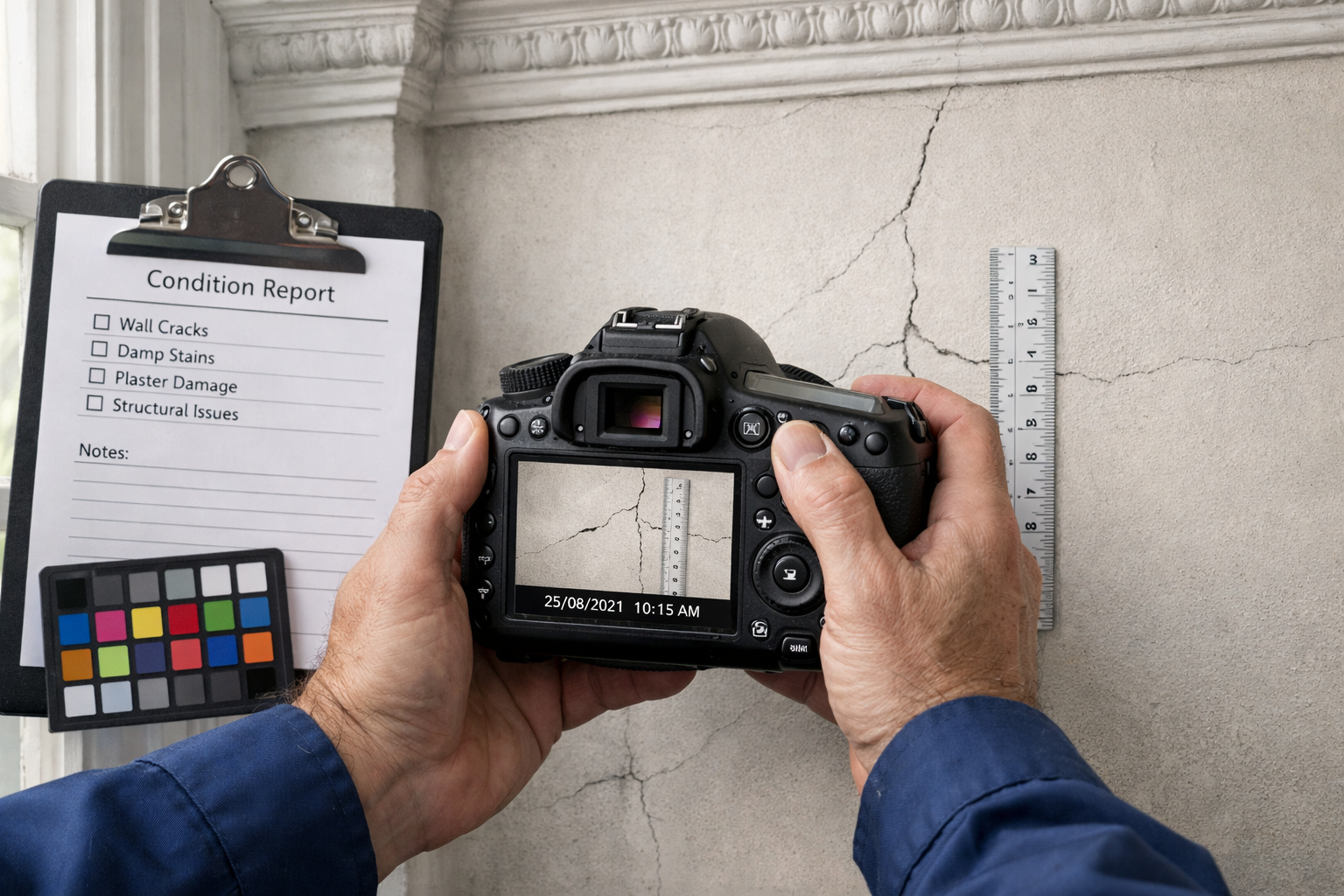
Photography forms the evidentiary backbone of any Schedule of Condition. In 2026, technological advances have raised expectations for image quality, metadata integrity, and systematic documentation protocols. Understanding photography standards for Schedules of Condition in Party Wall Disputes separates amateur documentation from professionally defensible evidence.
Essential Equipment and Technical Specifications
Professional-grade documentation requires appropriate equipment:
Camera Requirements:
- Minimum 12-megapixel resolution for capturing fine crack details
- Full-frame or APS-C sensors for superior low-light performance
- Manual exposure control for consistent lighting across image sets
- RAW format capability preserving maximum image data for analysis
- GPS tagging for location verification (where available)
Supporting Equipment:
- Wide-angle lenses (16-35mm) for room overviews
- Macro lenses (60-100mm) for detailed defect documentation
- External flash units with diffusers for even lighting
- Color calibration cards ensuring accurate color reproduction
- Measurement scales and rulers providing size references in every detailed shot
Photographic Methodology and Coverage
Systematic coverage ensures no areas are overlooked. The recommended approach follows a hierarchical structure:
1. Exterior Overview Shots 📷
- Full elevation views from multiple angles
- Street scene context establishing property location
- Boundary features and adjacent structures
- Roof lines and chimney stacks
2. Party Wall Documentation 🧱
- Both sides of party walls (where accessible)
- Full-height vertical sweeps in overlapping sections
- Corners and junctions with other structural elements
- Existing cracks, staining, or settlement evidence
3. Interior Room Documentation 🏠
- Systematic room-by-room coverage
- All four walls plus ceiling and floor
- Windows, doors, and architectural features
- Service installations (radiators, electrical fixtures)
4. Detailed Defect Photography 🔍
- Close-up shots of every identified defect
- Measurement scale visible in frame
- Multiple angles showing context and extent
- Lighting emphasizing three-dimensional characteristics
Metadata and Authentication Standards
Modern digital photography embeds extensive metadata within image files—information crucial for legal admissibility. Professional surveyors must ensure:
✅ Camera clock accuracy synchronized to official time sources
✅ EXIF data preservation throughout editing and file conversion
✅ Sequential file numbering maintaining chronological order
✅ Original file retention alongside any processed versions
✅ Chain of custody documentation tracking image handling
For homeowners managing straightforward cases, the practical recommendation is to take dated pictures of the party wall with agreed written notes of any cracks, providing copies for both parties[1]. This informal approach works when neighbors consent and disputes seem unlikely.
However, when party wall disputes are anticipated, appointing a surveyor to prepare a Schedule of Condition shortly before work starts provides the rigorous documentation standard necessary for potential legal proceedings[1].
Lighting Techniques for Accurate Documentation
Proper lighting reveals defects that might otherwise remain hidden:
Natural Light Strategies:
- Schedule photography during daylight hours
- Avoid direct sunlight creating harsh shadows
- Overcast conditions provide even, diffused lighting
- Multiple visits may be necessary for optimal conditions
Artificial Lighting Approaches:
- Raking light (angled illumination) reveals surface irregularities
- Cross-lighting from multiple angles shows three-dimensional defects
- Flash photography with bounce cards prevents harsh shadows
- Consistent color temperature (5500K daylight balanced) across all images
Documentation Protocols and Evidence Standards for Surveyors
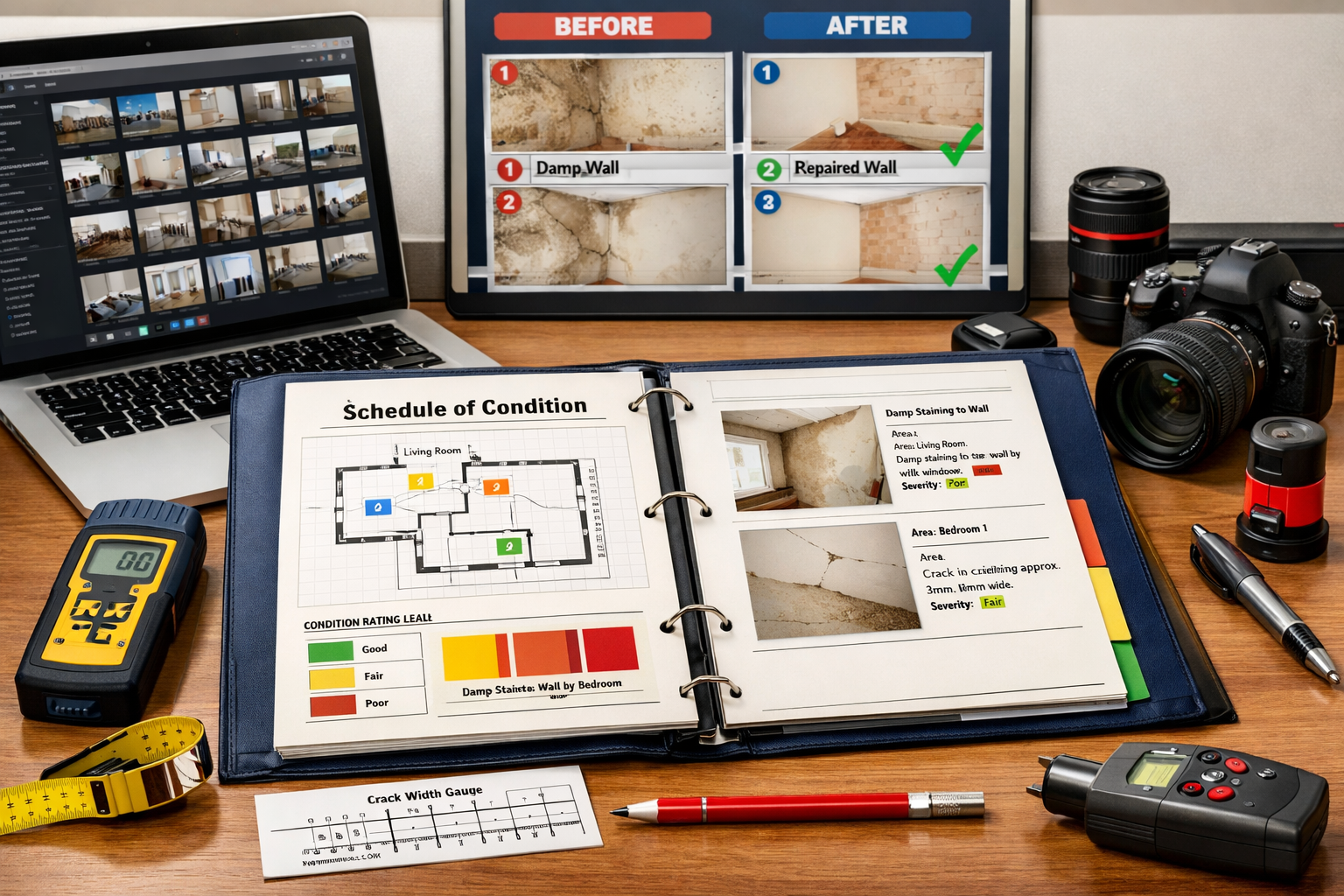
Beyond photography, comprehensive documentation protocols for Schedules of Condition in Party Wall Disputes require systematic written descriptions, consistent terminology, and organized presentation that withstands legal scrutiny.
The "Say What You See" Methodology
Schedules of Condition follow a fundamental principle: objective observation without subjective assessment[6]. This approach differs markedly from building surveys that diagnose causes and recommend remedies.
Appropriate Descriptions:
- ✅ "Vertical crack in plaster, 850mm long, 2mm maximum width, located 300mm from northeast corner"
- ✅ "Discoloration on ceiling, irregular shape approximately 400mm x 250mm, brown staining pattern"
- ✅ "Timber floor boards with 5mm gaps between boards, surface wear consistent with age"
Inappropriate Descriptions:
- ❌ "Serious structural crack requiring immediate attention"
- ❌ "Water damage from leaking roof"
- ❌ "Poor quality workmanship in original construction"
The distinction matters legally. Objective descriptions document observable facts; subjective assessments introduce opinion that can be challenged and may exceed the surveyor's appointed scope.
Systematic Room-by-Room Documentation
Professional schedules follow consistent organizational structures:
| Element | Documentation Requirements |
|---|---|
| Property Identification | Full address, title numbers, ownership details |
| Inspection Date & Time | Precise documentation of when observations occurred |
| Weather Conditions | Relevant for moisture-related observations |
| Access Limitations | Any areas not inspected with reasons |
| Room Identification | Systematic numbering or naming convention |
| Element Description | Walls, ceilings, floors, fixtures in consistent order |
| Defect Recording | Location, dimensions, characteristics, severity |
| Photographic Cross-Reference | Image numbers linked to written descriptions |
Defect Classification and Severity Rating
While maintaining objectivity, surveyors must provide sufficient detail for parties to understand condition significance. A practical classification system includes:
Category 1: Minor Cosmetic Issues 🟢
- Hairline cracks (<1mm width)
- Minor surface staining
- Typical wear and tear
- No structural implications
Category 2: Moderate Defects 🟡
- Cracks 1-5mm width
- Localized dampness
- Minor plaster damage
- Potentially requiring monitoring
Category 3: Significant Defects 🟠
- Cracks >5mm width
- Extensive staining or dampness
- Structural movement indicators
- Requiring professional assessment
Category 4: Severe Defects 🔴
- Major structural cracks
- Active water ingress
- Serious settlement evidence
- Immediate concern indicators
This classification provides context without crossing into diagnostic assessment—describing what exists rather than what caused it.
Integration with Party Wall Awards
Schedule of Condition reports become annexes to formal Party Wall Awards prepared by appointed surveyors. When understanding party wall awards, recognize that these legal documents establish:
- Scope of permitted works
- Working methods and hours
- Access arrangements
- Condition documentation baseline
- Dispute resolution procedures
Both homeowner and neighbor can appoint one agreed surveyor, usually within ten days, who can act impartially for both parties[1]. This agreed surveyor approach reduces costs while maintaining professional standards.
Neighbors have 14 days to respond to party wall notices[1]. Failure to respond triggers deemed dissent, initiating formal surveyor appointment procedures. Understanding these timelines helps surveyors schedule condition documentation appropriately within the statutory framework.
Digital Documentation and File Management
Modern practice increasingly relies on digital systems offering advantages over traditional paper-based schedules:
Digital Advantages:
- 💾 Searchable databases enabling rapid information retrieval
- 🔗 Hyperlinked cross-references between text and images
- 📊 Comparative analysis tools showing condition changes over time
- ☁️ Cloud backup systems preventing document loss
- 🔐 Encryption and security protecting confidential information
Professional surveyors should implement:
- Standardized file naming conventions (property-date-room-element)
- Version control systems tracking document revisions
- Backup protocols with offsite storage
- Access logs documenting who viewed or modified files
- Long-term archival strategies ensuring accessibility beyond immediate project completion
Legal Admissibility and Evidence Standards in Party Wall Disputes
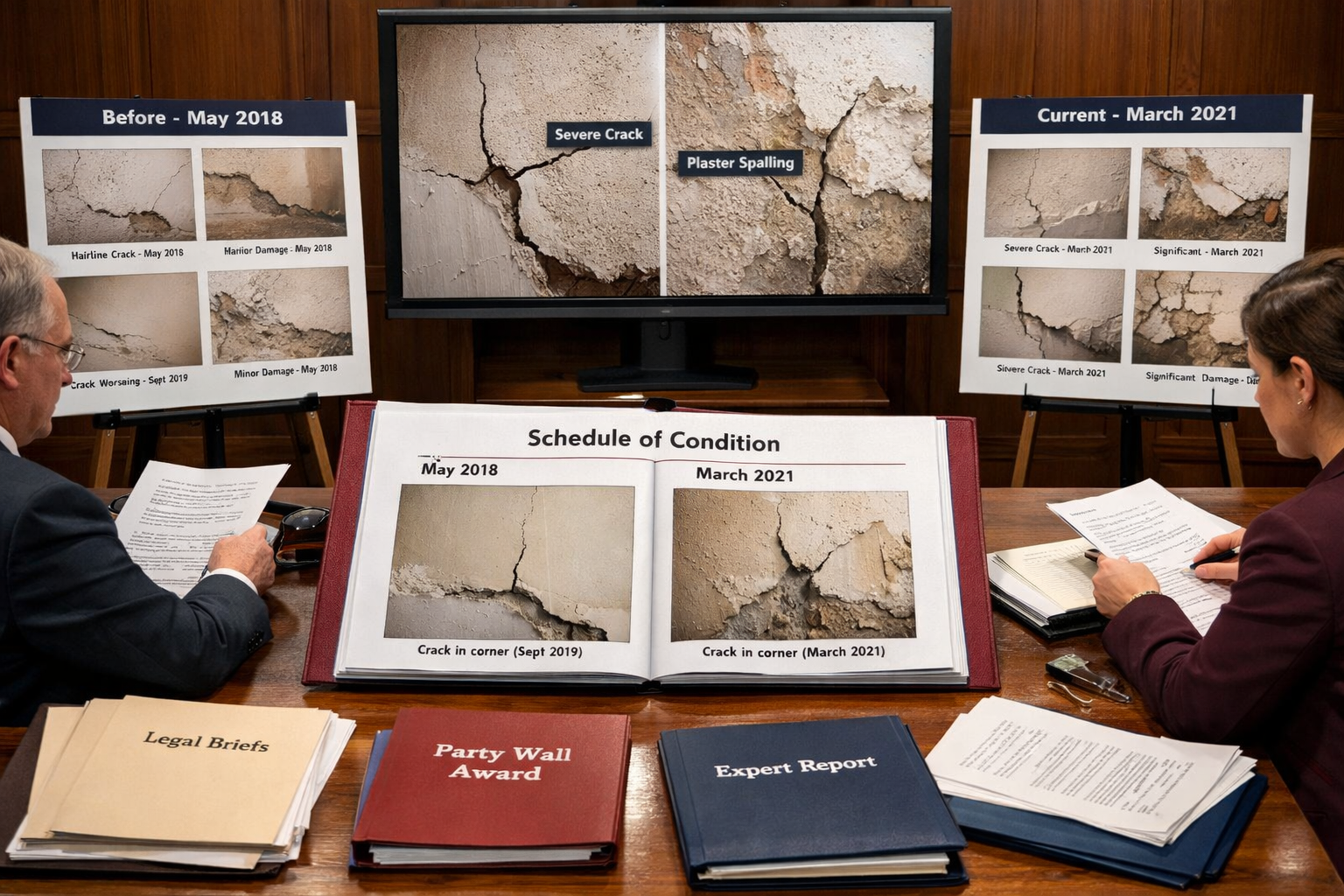
The ultimate test of any Schedule of Condition is whether it withstands legal scrutiny when disputes escalate. Understanding evidence standards for Schedules of Condition in Party Wall Disputes ensures documentation meets admissibility requirements in formal proceedings.
Authentication and Chain of Custody
Courts require evidence provenance—clear documentation of who created, handled, and stored materials. Essential authentication elements include:
Surveyor Credentials:
- Professional qualifications (RICS membership, relevant certifications)
- Professional indemnity insurance
- Expertise in party wall matters
- Independence and impartiality
Documentation Integrity:
- Original file preservation
- Metadata consistency
- Witness statements regarding creation
- Secure storage preventing tampering
When finding reliable party wall surveyors, verify credentials through professional bodies. The Royal Institution of Chartered Surveyors (RICS) maintains registers of qualified professionals adhering to ethical standards.
Expert Witness Requirements
Surveyors may be called to provide expert testimony regarding their Schedules of Condition. This role requires:
📋 Duty to the Court
Expert witnesses owe primary duty to the court, not the instructing party. Opinions must be independent, objective, and within the expert's competence area.
📋 Report Standards
Expert reports must clearly distinguish between facts observed, information provided by others, and opinions formed. Assumptions must be stated explicitly.
📋 Cross-Examination Preparation
Experts must defend their methodologies, explain technical decisions, and acknowledge limitations or uncertainties in their observations.
Understanding what party wall surveyors do helps clarify the distinction between appointed surveyors under the Act (who prepare awards) and expert witnesses (who provide court testimony).
Common Challenges to Schedule Validity
Opposing parties may challenge Schedules of Condition on various grounds:
Methodological Challenges:
- Inconsistent observation protocols
- Selective documentation
- Inadequate coverage of relevant areas
- Inappropriate equipment or techniques
Temporal Challenges:
- Documentation too far in advance of works
- Undated photographs
- Inconsistent inspection dates
- Post-work modifications claimed as pre-existing
Technical Challenges:
- Poor image quality preventing defect assessment
- Missing measurement references
- Inadequate lighting obscuring details
- Compressed file formats losing critical data
Robust methodologies addressing these potential challenges from the outset create defensible documentation.
Comparative Analysis: Before and After Documentation
The true value of pre-work Schedules emerges when compared with post-work condition assessments. This comparative analysis requires:
Matching Methodology:
Post-work documentation must replicate pre-work protocols—same angles, lighting conditions, and coverage areas enabling direct comparison.
Objective Change Identification:
New defects should be clearly distinguishable from pre-existing conditions through systematic comparison of corresponding images and descriptions.
Causation Assessment:
While Schedules themselves remain descriptive, comparative analysis enables separate expert assessment of whether observed changes could result from the documented works.
Cost Considerations and Proportionality
Party wall surveyor costs vary based on project complexity, but Schedule of Condition preparation typically represents a small fraction of overall construction costs. Consider:
Typical Cost Ranges (2026):
- Simple terraced house: £400-£800
- Semi-detached property: £600-£1,200
- Larger detached property: £1,000-£2,500
- Complex commercial properties: £2,500+
These costs prove minimal compared to potential dispute resolution expenses. Litigation costs can easily exceed £10,000-£50,000, making comprehensive pre-work documentation highly cost-effective insurance.
2026 Legislative Changes Affecting Documentation
Recent legislative reforms have impacted party wall procedures. The 2026 Renters' Rights Act changes have repositioned tenant rights as central to all party wall notices and procedures for institutional buy-to-let properties[3]. This affects surveyors documenting rental properties, requiring:
- Tenant notification procedures
- Access coordination with tenants
- Consideration of tenant rights in scheduling works
- Additional documentation regarding tenant impacts
Surveyors must stay current with evolving legal requirements affecting their documentation obligations.
Best Practices for Surveyors Preparing Schedules of Condition
Professional excellence in Schedule preparation requires systematic approaches addressing technical, legal, and practical considerations.
Pre-Inspection Planning
Effective schedules begin before arriving on site:
Information Gathering:
- Review party wall notices and proposed works
- Obtain property plans and historical documentation
- Identify specific areas requiring detailed attention
- Coordinate access with all relevant parties
Equipment Preparation:
- Verify camera functionality and settings
- Prepare measurement tools and scales
- Organize documentation templates
- Ensure adequate storage capacity for images
Timeline Coordination:
- Schedule inspection close to works commencement
- Allow sufficient time for thorough documentation
- Coordinate with party wall notice procedures
- Plan for potential follow-up visits
On-Site Documentation Protocols
Systematic site procedures ensure comprehensive coverage:
- External Inspection First – Document weather conditions and overall property context
- Systematic Interior Progression – Follow consistent room order (typically clockwise from entrance)
- Photographic Coverage Before Detailed Notes – Capture overview images before disturbing dust or moving items
- Detailed Defect Documentation – Photograph and describe each identified issue
- Witness Presence – When possible, conduct inspection with both parties present
- Contemporaneous Notes – Record observations immediately, not from memory later
Report Preparation and Presentation
Professional presentation enhances credibility and usability:
Report Structure:
- Executive summary highlighting key findings
- Methodology section explaining approach
- Property description and context
- Room-by-room detailed observations
- Photographic appendix with cross-references
- Surveyor credentials and declaration
Clarity and Accessibility:
- Plain language avoiding unnecessary jargon
- Consistent terminology throughout
- Clear section numbering and indexing
- High-quality image reproduction
- Professional binding and presentation
Quality Assurance and Peer Review
Professional firms implement quality control measures:
- Peer review of reports before finalization
- Standardized templates ensuring consistency
- Training programs for junior surveyors
- Feedback systems incorporating lessons learned
- Professional development maintaining current knowledge
Common Works Triggering Schedule Requirements
Party wall agreements are most commonly needed for:
- Loft conversions affecting party walls
- Insertion of damp proof courses requiring wall penetration
- New foundations for extensions near boundaries
- Structural alterations to shared walls
- Underpinning works affecting adjacent properties
Understanding these common scenarios helps surveyors anticipate documentation requirements.
Conclusion
Schedules of Condition represent far more than bureaucratic formalities in party wall procedures—they provide essential protection for all parties involved in construction projects affecting shared boundaries. As demonstrated throughout this guide, professional Schedules of Condition in Party Wall Disputes require rigorous photography standards, systematic documentation protocols, and adherence to evidence requirements that withstand legal scrutiny.
The key principles bear repeating:
🔑 Document objectively using "say what you see" methodology without subjective assessment
📸 Employ professional photography standards with high-resolution images, proper lighting, measurement references, and preserved metadata
📋 Follow systematic protocols ensuring comprehensive coverage and consistent methodologies
⚖️ Maintain legal admissibility through proper authentication, chain of custody, and expert witness standards
💰 Recognize cost-effectiveness as prevention against expensive dispute resolution
Actionable Next Steps for Surveyors
For Surveyors:
- Review and update your Schedule of Condition templates and methodologies
- Invest in appropriate photographic equipment meeting 2026 standards
- Implement digital documentation systems with robust backup protocols
- Pursue continuing professional development in party wall matters
- Establish peer review processes ensuring quality consistency
For Property Owners:
- Serve proper party wall notices within required timeframes
- Engage qualified surveyors early in project planning
- Ensure Schedule of Condition preparation before works commence
- Maintain your own photographic records as supplementary documentation
- Understand your rights and obligations under the Party Wall Act 1996
For Adjoining Owners:
- Respond to party wall notices within the 14-day timeframe
- Consider appointing your own surveyor or agreeing to a single agreed surveyor
- Participate in Schedule of Condition preparation when possible
- Retain copies of all documentation for future reference
- Monitor works and document any concerns contemporaneously
The investment in comprehensive, professionally prepared Schedules of Condition pays dividends when disputes arise—or better yet, prevents disputes from arising in the first place. In an era of increasing construction activity and property values, the standards outlined in this guide represent essential professional practice for surveyors and prudent risk management for property owners.
By following these evidence standards, photographic protocols, and documentation methodologies, surveyors create bulletproof records that protect their clients' interests while maintaining the professional integrity that underpins the party wall system. The Schedule of Condition may be a single document, but its quality often determines whether construction projects proceed smoothly or descend into costly legal battles.
References
[1] Party Wall Agreement – https://hoa.org.uk/advice/guides-for-homeowners/i-am-improving/party-wall-agreement/
[2] Party Wall Act Matters Schedule Of Condition – https://saulmarine.com/party-wall-act-matters-schedule-of-condition/
[3] Party Wall Surveys For Renters Rights Act Compliance Managing Notices When Landlord Initiated Works Face New Section 8 Ground Requirements – https://nottinghillsurveyors.com/blog/party-wall-surveys-for-renters-rights-act-compliance-managing-notices-when-landlord-initiated-works-face-new-section-8-ground-requirements
[4] Schedules Of Condition – https://briobc.com/services/schedules-of-condition/
[5] Understanding Party Wall Act What Homeowners Need Know Before Renovating – https://www.partywallslimited.com/blog/understanding-party-wall-act-what-homeowners-need-know-before-renovating
[6] Schedules Of Condition – https://www.peterbarry.co.uk/blog/schedules-of-condition/
