
The UK property market stands on the brink of its most significant transformation in decades. With government proposals announced in October 2025 targeting failed transactions that cost the economy £1.5 billion annually, building surveyors face a fundamental shift in how they operate.[1] The Homebuying Process Reforms 2026: How Mandatory Upfront Surveys Will Transform Building Surveyor Workloads represents not just regulatory change, but a complete reimagining of when, how, and by whom property condition assessments are commissioned and delivered.
For chartered surveyors, this isn't simply another policy adjustment—it's a potential 30-50% surge in survey demand coupled with dramatically altered client expectations, timelines, and service delivery models. As sellers rather than buyers become responsible for commissioning surveys before properties even hit the market, the entire rhythm of surveyor workloads will fundamentally change.
Key Takeaways
- 🏠 Mandatory upfront surveys will transfer responsibility from buyers to sellers, requiring property condition assessments before listing from 2026
- 💰 Average seller costs will increase from £38 to £380 for surveys, creating a significant new market for building surveyors[2]
- 📈 Survey demand projected to increase 30-50% as every listed property requires assessment, not just those reaching advanced purchase stages
- ⚖️ RICS certification requirements will become even more critical as surveys form part of legally binding upfront information packages[1][5]
- 🔄 Digital transformation through property logbooks and standardized data sharing will reshape how surveyors deliver and communicate findings[2][3]
Understanding the Homebuying Process Reforms 2026
The Government's Plan for Change
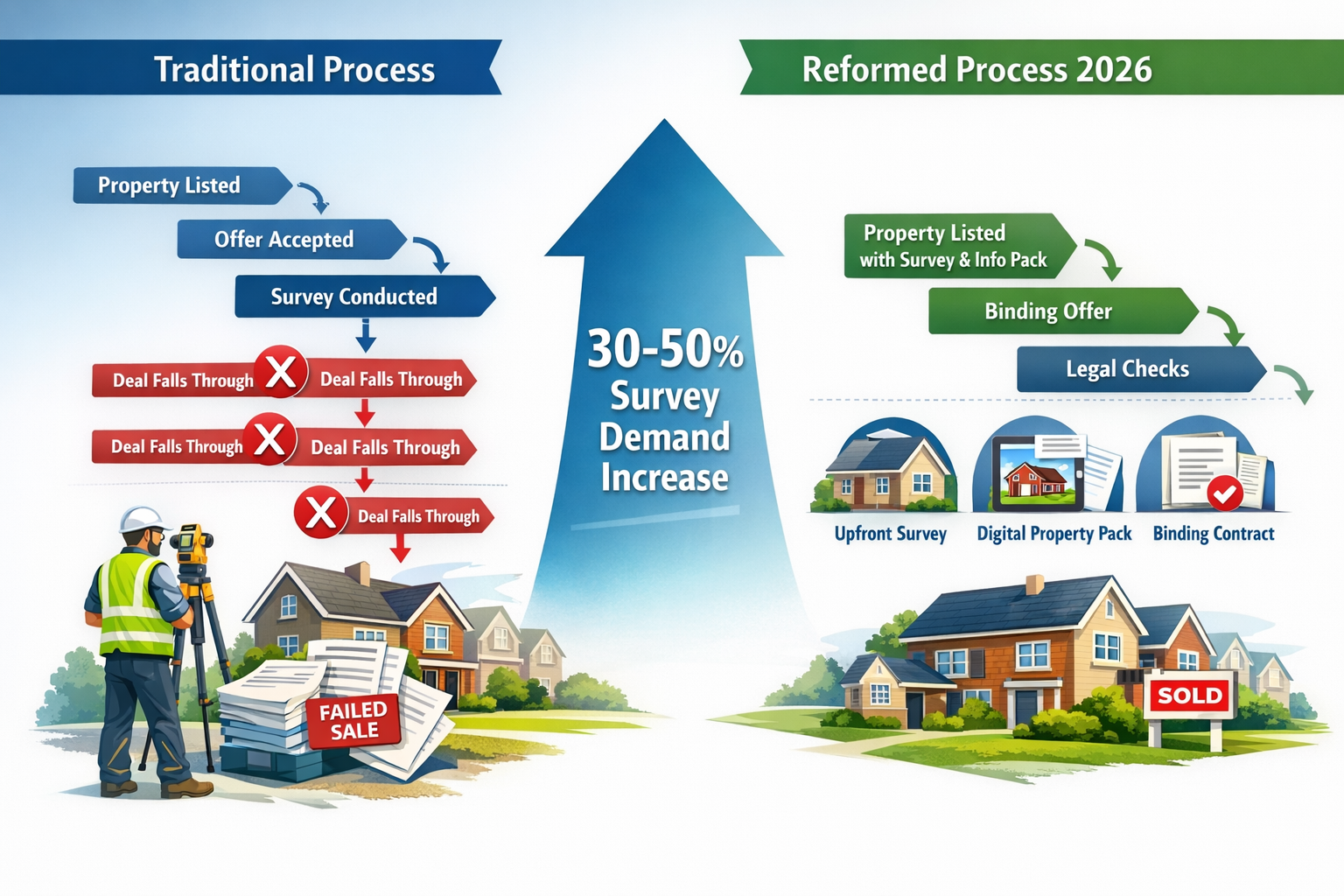
On October 6, 2025, the UK government announced comprehensive reforms designed to modernize the property transaction process as part of its broader Plan for Change.[1][6] These reforms directly address the chronic inefficiencies that plague the current system, where approximately one-third of property transactions fail after significant time and expense have been invested by all parties.
The Homebuying Process Reforms 2026: How Mandatory Upfront Surveys Will Transform Building Surveyor Workloads centers on a simple but radical principle: information transparency from the start. Rather than buyers discovering property defects weeks or months into the transaction process—often leading to renegotiations or complete transaction collapse—sellers will provide comprehensive property information upfront, including professional condition surveys.
Core Components of the Reform Package
The government consultation document outlines several interconnected reform elements:[2]
Mandatory Upfront Information Package:
- Property condition surveys conducted by qualified professionals
- Standard searches (local authority, drainage, environmental)
- Title information and ownership documentation
- Leasehold terms and service charge details
- Building safety data and certifications
- Flood risk assessments
- Accurate floor plans and property measurements
Binding Conditional Contracts:
- Legal commitments preventing gazumping (seller accepting higher offers after agreement)
- Penalties for withdrawal without legitimate cause
- Protection for both buyers and sellers once terms are agreed
Digital Infrastructure Development:
- Digital property logbooks tracking property history
- Common data standards for seamless information sharing
- AI-enabled conveyancing technology integration[2][3]
Professional Accountability:
- Estate agents' and conveyancers' track records made transparent
- Code of practice compliance requirements
- Enhanced consumer protection mechanisms[1]
For building surveyors, the property condition survey requirement represents the most immediate and impactful change. Understanding what surveyors look for in a house survey becomes essential knowledge for sellers who must now commission these assessments before listing.
Economic Justification and Expected Benefits
The government's economic analysis identifies £1.5 billion in annual costs from failed property transactions.[1] This figure encompasses:
- Wasted survey fees from buyers whose purchases collapse
- Duplicate legal work as properties re-enter the market
- Lost moving costs and temporary accommodation expenses
- Economic productivity losses from delayed relocations
- Emotional and psychological costs to families
By requiring comprehensive information upfront, the reforms aim to:
✅ Reduce transaction failures by identifying deal-breaking issues before significant investment
✅ Accelerate completion timelines through pre-assembled documentation
✅ Increase market confidence with transparent, standardized information
✅ Unlock housing market demand currently suppressed by transaction anxiety
✅ Modernize outdated processes that haven't fundamentally changed in decades
Industry leaders have endorsed these objectives. Johan Svanstrom, CEO of Rightmove, stated the changes enable "much needed modernisation," while Paul Whitehead, CEO of Zoopla, noted the potential to "unlock significant demand and reduce failed transactions."[1]
How Mandatory Upfront Surveys Will Transform Building Surveyor Workloads
The Fundamental Shift: From Buyer-Commissioned to Seller-Commissioned Surveys
Currently, building surveyors typically work with buyers who commission surveys after making an offer and achieving agreement in principle. This creates a reactive, compressed timeline where surveyors must accommodate urgent requests from anxious buyers trying to complete due diligence before exchange deadlines.
The Homebuying Process Reforms 2026: How Mandatory Upfront Surveys Will Transform Building Surveyor Workloads by inverting this model entirely. Sellers will commission surveys before listing, creating:
Earlier Engagement in the Sales Cycle:
- Surveys conducted before marketing begins
- More predictable scheduling without offer-dependent urgency
- Opportunity for sellers to address issues before listing
- Reduced pressure on compressed completion timelines
Different Client Dynamics:
- Sellers seeking to present properties favorably
- Potential tension between thoroughness and marketability
- Need for clear communication about professional obligations
- Emphasis on RICS standards and independence[5]
Changed Workload Patterns:
- Shift from reactive urgent requests to planned scheduling
- Potential for more consistent workflow distribution
- Seasonal variations tied to listing patterns rather than offer acceptance
- Opportunity for advance booking and capacity planning
For surveyors accustomed to working primarily with buyers, this represents a significant adjustment in client relationship management and service delivery expectations. Understanding the complete guide to home surveying becomes essential for educating this new client base.
Projected Demand Increase: 30-50% More Surveys
The mathematics of mandatory upfront surveys creates compelling growth projections for the surveying profession:
Current Market Dynamics:
- Approximately 1 million residential property transactions complete annually in the UK
- Roughly 30-40% of buyers commission detailed surveys (Level 2 or Level 3)
- Many properties receive multiple surveys as transactions fail and restart
- Significant proportion of properties never surveyed despite being listed
Reformed Market Projections:
- 100% of listed properties will require surveys before marketing
- Approximately 1.2-1.5 million properties listed annually (accounting for failed sales)
- Every property receives one comprehensive survey rather than multiple partial assessments
- Reduced duplication but massively expanded coverage
This translates to a 30-50% increase in total survey volume, with the exact figure depending on implementation details still under consultation.[2]
| Current Model | Reformed Model | Change |
|---|---|---|
| 300,000-400,000 buyer-commissioned surveys | 1,200,000-1,500,000 seller-commissioned surveys | +200-275% |
| Concentrated at offer stage | Distributed at listing stage | Workflow smoothing |
| Multiple surveys per property (failed sales) | Single survey per listing | -40% duplication |
| Net effective capacity demand | Net effective capacity demand | +30-50% |
For individual surveyors and surveying firms, this represents both opportunity and challenge. The opportunity lies in expanded market size and potentially more predictable workflow. The challenge involves scaling capacity, managing different client expectations, and adapting business models to serve sellers rather than buyers.
Those considering whether a Level 3 survey is worth it will find the cost-benefit analysis shifts when sellers bear the expense upfront.
Cost Implications: From £38 to £380 Per Property
The government's own analysis reveals the financial impact on sellers:[2]
Current Average Seller Costs (Information Gathering):
- Basic property information compilation: £38
- Minimal formal documentation requirements
- Ad-hoc responses to buyer inquiries
Reformed Average Seller Costs:
- Comprehensive upfront information package: £380
- Professional property condition survey: £250-£600 depending on property type
- Standard searches and documentation: £100-150
- Digital property pack preparation: £30-80
- Total estimated upfront costs: £710[2]
This tenfold increase in survey-related costs creates several important dynamics:
💡 Price Sensitivity: Sellers will scrutinize survey value and seek competitive pricing
💡 Service Differentiation: Surveyors offering clear, comprehensive reports will command premium fees
💡 Package Deals: Potential for bundled services with estate agents and conveyancers
💡 Quality Expectations: Higher costs drive demands for thorough, professional service
For surveyors, this means the quality and clarity of reporting becomes even more critical. Sellers paying £380 expect comprehensive, understandable documentation that facilitates rather than hinders their sale. The ultimate house survey checklist provides the thoroughness these clients will demand.
Timeline Transformation: From Compressed Urgency to Planned Scheduling
One of the most significant workload transformations involves when surveys occur in the property transaction timeline:
Traditional Buyer-Commissioned Timeline:
- Property listed and marketed (no survey)
- Buyer views and makes offer (no survey)
- Offer accepted, mortgage application begins
- Survey commissioned urgently (pressure to complete within 1-2 weeks)
- Survey identifies issues
- Renegotiation or transaction collapse
- Process restarts with new buyer
Reformed Seller-Commissioned Timeline:
- Survey commissioned before listing (planned, scheduled in advance)
- Survey completed and integrated into property pack
- Property marketed with survey available to all potential buyers
- Buyers review survey before making offers
- Offers reflect known property condition
- Reduced renegotiation and fewer surprises
- Faster progression to completion
For building surveyors, this shift offers several advantages:
✅ Reduced emergency scheduling pressure
✅ Better capacity planning and resource allocation
✅ More consistent workflow throughout the year
✅ Opportunity for advance booking systems
✅ Reduced client anxiety and unrealistic timeline expectations
However, it also creates new challenges:
⚠️ Sellers may delay listing until survey completed
⚠️ Seasonal listing patterns could create demand spikes
⚠️ Pressure to complete surveys quickly to avoid delaying marketing
⚠️ Need for efficient scheduling systems to manage volume
Understanding how long a Level 2 survey takes becomes crucial for setting realistic expectations with seller clients who want to list properties promptly.
RICS Standards and Professional Requirements
The reforms explicitly reference RICS (Royal Institution of Chartered Surveyors) certification as the professional standard for property condition surveys.[1][5] This elevates the importance of RICS membership and adherence to established survey protocols.
RICS Home Survey Standards provide the framework for:[5]
- Level 1 (Condition Report): Basic condition assessment, typically insufficient for upfront seller requirements
- Level 2 (HomeBuyer Report): Standard survey suitable for most conventional properties
- Level 3 (Building Survey): Comprehensive assessment for older, altered, or complex properties
For the mandatory upfront survey requirement, most properties will require Level 2 surveys as the baseline standard, with Level 3 surveys necessary for properties built before 1900, those with significant alterations, or unusual construction types.[5]
This standardization creates several implications for surveyors:
🎓 RICS qualification becomes non-negotiable for participating in this market
🎓 Continuing Professional Development (CPD) requirements gain importance
🎓 Adherence to RICS reporting templates ensures consistency
🎓 Professional indemnity insurance requirements may increase
🎓 Quality assurance processes become competitive differentiators
Buyers and sellers alike will increasingly ask is my surveyor qualified, making RICS credentials a fundamental market requirement.
Practical Implications for Building Surveyors in 2026
Capacity and Resource Planning Challenges
The government consultation explicitly acknowledges capacity concerns, asking stakeholders: "What resources and additional training would be needed" and whether surveyors have "capacity and capability" to implement these changes.[2]
This recognition of potential capacity constraints is well-founded. A 30-50% increase in survey volume cannot be absorbed without strategic planning:
Immediate Capacity Challenges:
📊 Surveyor Availability:
- Current workforce sized for 300,000-400,000 annual surveys
- Need to scale to 1,200,000-1,500,000 annual surveys
- Recruitment and training timelines of 2-3 years for qualified surveyors
- Potential short-term bottlenecks during initial implementation
📊 Geographic Distribution:
- Capacity shortages likely in high-transaction areas (London, Southeast)
- Potential oversupply in lower-activity regions
- Need for flexible deployment and regional coordination
📊 Seasonal Variations:
- Spring/summer listing peaks could create demand spikes
- Winter slowdowns may create capacity underutilization
- Need for flexible staffing models and workload smoothing
Strategic Responses for Surveying Firms:
-
Workforce Expansion:
- Accelerated recruitment of trainee surveyors
- Investment in RICS qualification pathways
- Retention strategies for experienced professionals
- Cross-training administrative staff for report preparation
-
Technology Investment:
- Digital survey tools and mobile reporting platforms
- Automated report generation systems
- Scheduling and capacity management software
- Integration with digital property logbook systems[2][3]
-
Process Optimization:
- Standardized survey protocols for efficiency
- Template-based reporting with customization
- Quality assurance workflows
- Client communication automation
-
Partnership Models:
- Collaboration with estate agents for referral pipelines
- Integration with conveyancing firms
- Regional surveyor networks for capacity sharing
- Subcontracting arrangements for peak periods
For firms offering specialized services like RICS home surveys, scaling while maintaining quality standards represents the central challenge of 2026 implementation.
Client Relationship Management: Serving Sellers Instead of Buyers
The shift from buyer clients to seller clients fundamentally alters the surveyor-client relationship:
Buyer Client Characteristics (Traditional Model):
- Seeking to identify problems and negotiate price reductions
- Aligned interest in thorough, critical assessment
- Willing to hear about every potential issue
- Using survey as risk management and negotiation tool
- Timeline pressure from mortgage and completion deadlines
Seller Client Characteristics (Reformed Model):
- Seeking to present property favorably for marketing
- Potential tension between transparency and positive presentation
- May be disappointed by identification of issues
- Using survey to demonstrate transparency and build buyer confidence
- Timeline pressure to complete before listing
This creates new professional challenges for surveyors:
⚖️ Maintaining Independence: Resisting pressure to downplay issues while working for sellers
⚖️ Clear Communication: Explaining that thoroughness benefits sales by building buyer confidence
⚖️ Managing Expectations: Helping sellers understand that transparency reduces transaction failures
⚖️ Professional Standards: Emphasizing RICS obligations regardless of who commissions the survey
Best Practices for Seller-Client Relationships:
✅ Pre-Survey Consultation: Explain the survey process, standards, and reporting approach
✅ Independence Statement: Clearly communicate professional obligations and RICS requirements
✅ Value Proposition: Emphasize how thorough surveys prevent transaction failures and build buyer confidence
✅ Issue Framing: Present identified problems as opportunities to address before listing or price accordingly
✅ Comparative Context: Provide perspective on whether issues are typical for property age/type
For surveyors accustomed to buyer clients, this represents a significant adjustment in communication style and relationship management. Understanding survey home reports comprehensively helps educate sellers about what buyers will see and expect.
Digital Integration and Property Logbooks
The reforms include development of digital property logbooks—comprehensive digital records tracking property history, improvements, surveys, and compliance documentation.[2][3]
For building surveyors, this creates both opportunities and requirements:
Digital Reporting Requirements:
- Surveys must integrate with standardized digital property pack formats
- Common data standards for sharing between professionals
- Structured data fields in addition to narrative reports
- Digital signatures and authentication protocols
- Cloud-based storage and access management
Technology Adaptation Needs:
- Investment in digital survey platforms
- Training on new reporting systems
- Integration with property logbook databases
- Cybersecurity and data protection compliance
- Mobile technology for on-site digital reporting
Efficiency Opportunities:
- Automated report generation from standardized templates
- Photo integration and annotation tools
- Direct upload to property logbooks
- Reduced administrative burden from paper-based processes
- Faster turnaround times from inspection to report delivery
The government consultation specifically addresses AI conveyancing technology integration,[2][3] suggesting that digital property data will increasingly flow through automated systems. Surveyors who adapt early to these digital requirements will gain competitive advantages in efficiency and client service.
For firms offering services like RICS HomebuYer Surveys Level 2, digital integration becomes a fundamental operational requirement rather than an optional enhancement.
Pricing Strategies and Market Positioning
With sellers now bearing survey costs averaging £380 (and ranging from £250-£600 depending on property type),[2] surveyors face important pricing strategy decisions:
Pricing Considerations:
💰 Volume vs. Premium Positioning:
- High-volume, competitive pricing to capture market share
- Premium positioning emphasizing quality, detail, and RICS expertise
- Tiered service offerings (basic, standard, comprehensive)
💰 Package Deals:
- Bundled services with estate agents (survey + marketing package)
- Combined offerings with conveyancers (survey + legal pack)
- Multi-property discounts for developers or landlords
💰 Transparent Fee Structures:
- Clear pricing based on property size, age, and complexity
- No hidden fees or unexpected charges
- Comparison with market averages to demonstrate value
💰 Value-Added Services:
- Same-day or expedited reporting for premium fees
- Pre-survey consultations to discuss property concerns
- Post-survey support for interpreting findings
- Recommendations for addressing identified issues
Market Differentiation Strategies:
🏆 Quality and Credentials: Emphasize RICS certification, experience, and professional standards
🏆 Speed and Efficiency: Offer fast turnaround without compromising thoroughness
🏆 Communication Excellence: Provide clear, accessible reports and responsive client service
🏆 Technology Leadership: Leverage digital tools for superior reporting and integration
🏆 Specialization: Develop expertise in specific property types (period properties, new builds, etc.)
For surveyors wondering what survey do you need, creating clear guidance for sellers becomes a valuable marketing tool.
Regional Variations and Implementation Timeline
The government has indicated that implementation "represents a significant change" that should not happen immediately, with detailed roadmaps promised "in the new year" (2026).[1][2]
Consultation Questions Still Open:[2]
- Questions 7-10: Mandatory information requirements and timing
- Questions 19-22: Implementation approach and phasing
- Questions 26-28: Resources, training, and capacity requirements
This suggests phased implementation is likely:
Potential Implementation Scenarios:
📅 Scenario 1: Gradual Geographic Rollout
- Pilot programs in selected regions (2026-2027)
- Evaluation and adjustment period
- Nationwide expansion (2028-2029)
📅 Scenario 2: Property Type Phasing
- Initial requirement for higher-value properties (£500k+)
- Extension to mid-market properties (£250k-£500k)
- Full implementation across all price points
📅 Scenario 3: Voluntary-to-Mandatory Transition
- Voluntary adoption period with incentives (2026-2027)
- Mandatory requirement phased in (2028+)
- Market-driven adoption accelerating timeline
Regional Considerations:
Different UK regions face varying implementation challenges:
🏴 London and Southeast: High transaction volumes, existing surveyor capacity, early adoption likely
🏴 Scotland: Already has Home Report system with similarities to proposed reforms
🏴 Wales: Moderate transaction volumes, potential capacity constraints
🏴 Northern Ireland: Distinct property market dynamics, separate regulatory considerations
For surveyors operating in specific regions like North London, Surrey, or Hertfordshire, understanding local implementation timelines and market conditions becomes crucial for capacity planning.
Preparing for the Homebuying Process Reforms 2026: Actionable Steps for Surveyors
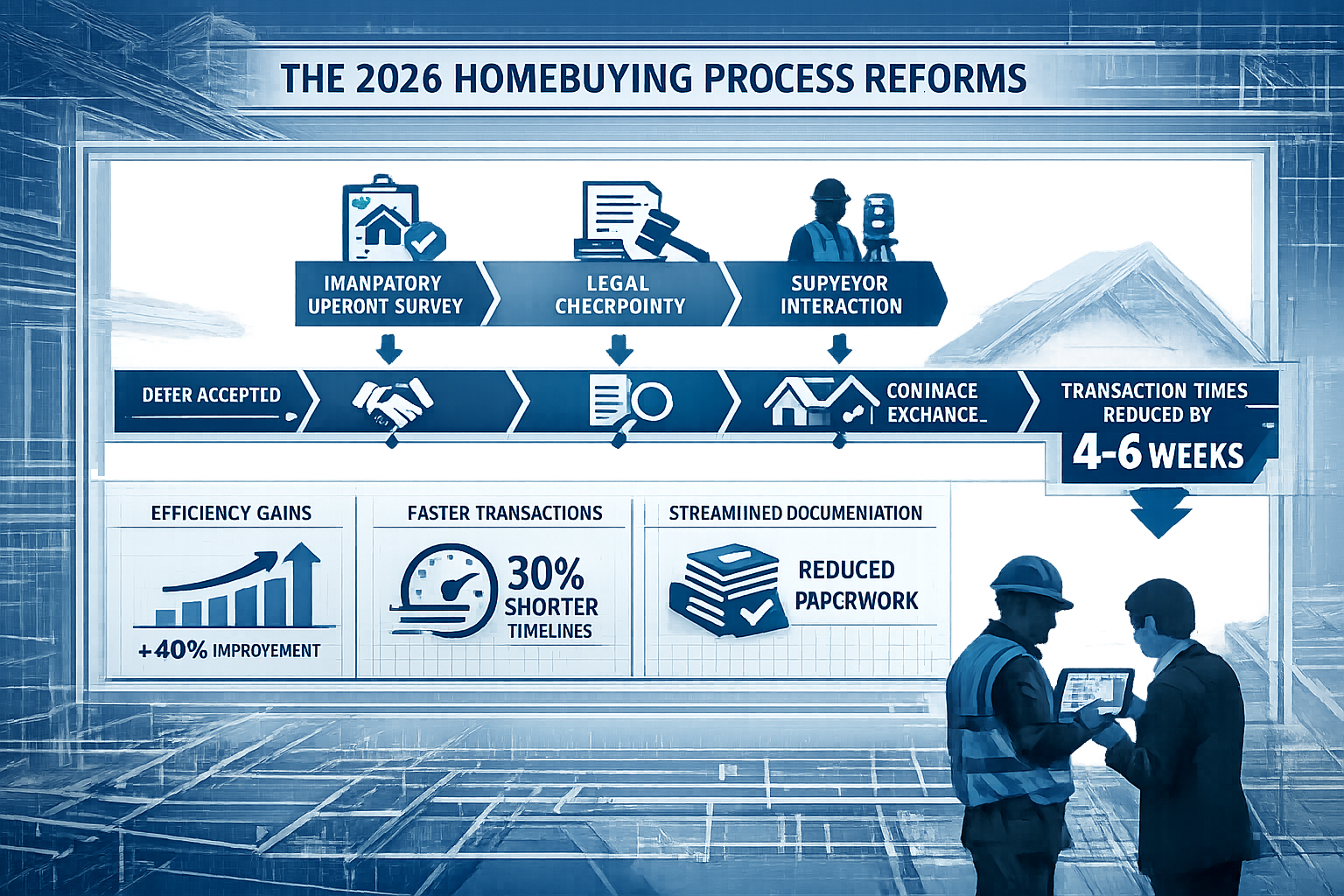
Immediate Actions (2026)
Building surveyors and surveying firms should take several immediate steps to prepare for the coming transformation:
1. Capacity Assessment and Planning
📋 Conduct Workload Analysis:
- Calculate current annual survey volume
- Project 30-50% increase scenarios
- Identify capacity constraints (personnel, equipment, scheduling)
- Develop expansion timelines and resource requirements
📋 Workforce Planning:
- Assess current surveyor qualifications and RICS status
- Identify recruitment needs for additional surveyors
- Develop training programs for existing staff
- Create retention strategies to prevent talent loss to competitors
📋 Infrastructure Evaluation:
- Review technology systems for digital reporting capabilities
- Assess office space and equipment adequacy
- Evaluate scheduling and project management tools
- Identify technology investment priorities
2. Technology Investment and Digital Readiness
💻 Digital Survey Platforms:
- Research and trial digital survey tools
- Implement mobile reporting applications
- Develop cloud-based report storage and sharing
- Ensure cybersecurity and data protection compliance
💻 Integration Preparation:
- Monitor digital property logbook development
- Prepare for common data standard requirements
- Develop structured data reporting capabilities
- Test integration with estate agent and conveyancer systems
💻 Efficiency Tools:
- Implement automated report generation systems
- Develop standardized templates while maintaining quality
- Create photo annotation and integration workflows
- Establish quality assurance digital protocols
3. Market Positioning and Business Development
🎯 Seller-Focused Marketing:
- Develop marketing materials targeting sellers rather than buyers
- Create educational content explaining survey benefits for sellers
- Build relationships with estate agents as referral partners
- Establish presence in seller-focused property forums and platforms
🎯 Service Package Development:
- Design tiered survey offerings (basic, standard, comprehensive)
- Create bundled packages with complementary services
- Develop clear, transparent pricing structures
- Prepare value propositions emphasizing quality and RICS standards
🎯 Competitive Analysis:
- Research competitor pricing and service offerings
- Identify market gaps and differentiation opportunities
- Monitor industry responses to reform announcements
- Position firm for competitive advantage in reformed market
For firms offering specialized services like new build surveys, adapting these services for seller clients requires strategic repositioning.
Medium-Term Strategies (2026-2027)
4. Professional Development and Training
🎓 RICS Qualification Enhancement:
- Ensure all surveyors maintain current RICS membership
- Invest in CPD programs focused on digital reporting
- Develop expertise in specific property types or issues
- Pursue advanced RICS credentials and specializations
🎓 Client Communication Training:
- Train surveyors on seller-client relationship management
- Develop skills for explaining findings diplomatically
- Practice independence maintenance under seller pressure
- Create communication protocols for difficult conversations
🎓 Technology Proficiency:
- Provide comprehensive training on new digital tools
- Develop expertise in property logbook systems
- Build skills in data-structured reporting
- Ensure team competency in cybersecurity practices
5. Partnership and Network Development
🤝 Estate Agent Relationships:
- Establish referral partnerships with local estate agents
- Create co-marketing opportunities and package deals
- Develop streamlined workflows for agent-surveyor collaboration
- Build reputation as reliable, quality service provider
🤝 Conveyancer Collaboration:
- Develop relationships with conveyancing firms
- Create integrated service offerings
- Establish data-sharing protocols and systems
- Coordinate on digital property pack assembly
🤝 Professional Networks:
- Join regional surveyor associations and networks
- Participate in capacity-sharing arrangements
- Collaborate on best practice development
- Share resources during peak demand periods
6. Quality Assurance and Standards Enhancement
✅ Reporting Excellence:
- Review and enhance report templates for clarity
- Ensure compliance with latest RICS standards
- Develop consistent quality across all surveyors
- Implement peer review processes
✅ Customer Service Systems:
- Create responsive client communication protocols
- Develop feedback collection and response mechanisms
- Establish complaint resolution procedures
- Build reputation management strategies
✅ Risk Management:
- Review professional indemnity insurance coverage
- Develop protocols for managing seller pressure
- Create documentation systems for independence maintenance
- Establish legal consultation resources for complex situations
Understanding the difference between Level 2 and Level 3 surveys helps surveyors guide sellers toward appropriate survey levels for their properties.
Long-Term Positioning (2027-2029)
7. Business Model Evolution
🔄 Service Diversification:
- Expand into related services (energy assessments, building safety)
- Develop specialized expertise (period properties, sustainable buildings)
- Create ongoing property monitoring services
- Offer post-survey remediation coordination
🔄 Geographic Expansion:
- Consider expansion into underserved regions
- Develop multi-location capacity for regional coverage
- Create mobile surveyor teams for flexible deployment
- Build national presence through acquisition or partnership
🔄 Technology Leadership:
- Invest in proprietary digital tools and platforms
- Develop AI-assisted survey analysis capabilities
- Create superior client portals and reporting systems
- Position as technology leader in surveying sector
8. Industry Engagement and Influence
🗣️ Consultation Participation:
- Respond to government consultation questions[2]
- Provide feedback on implementation approaches
- Share capacity and resource concerns
- Contribute to phasing and timeline discussions
🗣️ Professional Association Involvement:
- Engage with RICS on standard development
- Participate in industry working groups
- Contribute to best practice guidance
- Influence regulatory framework development
🗣️ Thought Leadership:
- Publish insights on reform implications
- Present at industry conferences and events
- Contribute to professional journals
- Build reputation as reform expert
For surveyors managing house survey anxiety among clients, the shift to seller clients requires adapting these communication strategies.
Challenges and Opportunities in the Reformed Market
Key Challenges Facing Building Surveyors
The Homebuying Process Reforms 2026: How Mandatory Upfront Surveys Will Transform Building Surveyor Workloads presents several significant challenges:
⚠️ Challenge 1: Rapid Capacity Scaling
The need to increase survey capacity by 30-50% within a compressed timeframe creates workforce and infrastructure pressures. RICS qualification pathways typically require 2-3 years, making rapid surveyor recruitment challenging. Firms may face difficult choices between:
- Maintaining quality standards vs. meeting demand
- Investing heavily in expansion vs. conservative growth
- Competing for limited qualified surveyors vs. developing internal talent
- Managing cash flow during expansion vs. missing market opportunity
⚠️ Challenge 2: Professional Independence Under Seller Pressure
Working for sellers who want favorable presentations creates tension with professional obligations to provide thorough, objective assessments. Surveyors must navigate:
- Seller disappointment when issues are identified
- Pressure to minimize or downplay problems
- Requests to modify or soften report language
- Potential disputes over professional judgments
Maintaining RICS standards and professional independence while building positive seller relationships requires skill, experience, and institutional support.
⚠️ Challenge 3: Technology Investment and Integration
Digital property logbooks and common data standards require significant technology investment at a time when firms are also investing in capacity expansion. Challenges include:
- Selecting appropriate technology platforms
- Training staff on new systems
- Managing transition from legacy processes
- Ensuring cybersecurity and data protection
- Integrating with multiple third-party systems
⚠️ Challenge 4: Market Uncertainty and Implementation Timeline
With consultation still ongoing and implementation details unclear,[2] surveyors face uncertainty in planning:
- When will mandatory requirements take effect?
- Will implementation be phased or immediate?
- What specific survey standards will be required?
- How will enforcement and compliance work?
- What happens during transition periods?
This uncertainty complicates investment decisions and strategic planning.
⚠️ Challenge 5: Pricing Pressure and Market Competition
As survey costs become more visible and seller-borne, price competition may intensify:
- Sellers seeking lowest-cost options to minimize upfront expenses
- Estate agents negotiating volume discounts
- New entrants attracted by expanded market
- Pressure to reduce fees while maintaining quality
- Risk of commoditization undermining professional standards
For surveyors offering comprehensive condition survey reports, maintaining premium positioning requires clear value demonstration.
Significant Opportunities for Forward-Thinking Surveyors
Despite challenges, the reforms create substantial opportunities:
✅ Opportunity 1: Market Expansion and Revenue Growth
A 30-50% increase in survey volume represents significant revenue potential for firms positioned to capture market share. Early movers who build capacity and establish seller relationships can achieve sustained competitive advantages.
✅ Opportunity 2: Relationship Diversification
Expanding from primarily buyer clients to include seller clients, estate agents, and conveyancers creates multiple revenue streams and reduces dependence on any single client source.
✅ Opportunity 3: Technology-Enabled Efficiency
Digital tools and automated reporting can dramatically improve efficiency, allowing surveyors to handle higher volumes while maintaining quality. Technology leaders can achieve superior margins through operational excellence.
✅ Opportunity 4: Professional Reputation Enhancement
RICS certification and professional standards become even more valuable as surveys form part of legally binding property information packages. Quality-focused surveyors can differentiate based on credentials and reputation.
✅ Opportunity 5: Service Innovation
The reformed market creates opportunities for new service models:
- Subscription-based property monitoring services
- Ongoing digital property logbook maintenance
- Specialized expertise in specific property types
- Post-survey remediation coordination
- Energy efficiency and sustainability assessments
✅ Opportunity 6: Market Consolidation Leadership
Capacity constraints may drive market consolidation, with larger firms acquiring smaller practices. Well-positioned firms can either grow through acquisition or achieve favorable exit valuations.
✅ Opportunity 7: Industry Influence
Active participation in consultation processes and standard development allows forward-thinking surveyors to shape implementation in ways that benefit their business models and professional values.
For surveyors offering specialized services like Level 3 home surveys, the reforms create opportunities to educate sellers about when comprehensive assessments add value.
Industry Perspectives and Stakeholder Responses
RICS Position and Professional Standards
The Royal Institution of Chartered Surveyors (RICS) has established Home Survey Standards that provide the professional framework for residential property surveys.[5] These standards define:
- Survey levels and scope (Level 1, 2, and 3)
- Professional competence requirements
- Reporting formats and content
- Quality assurance expectations
- Ethical obligations and independence
RICS standards emphasize that surveyors must maintain professional independence regardless of who commissions the survey. This principle becomes even more critical when sellers commission surveys, as the potential for pressure to minimize issues increases.
The RICS framework also addresses continuing professional development (CPD) requirements, ensuring surveyors maintain current knowledge of building technology, defect identification, and reporting best practices. As the market transforms, RICS will likely enhance CPD offerings focused on:
- Digital reporting and property logbook integration
- Seller-client relationship management
- Emerging building technologies and sustainability
- Legal and regulatory compliance in the reformed market
For surveyors, maintaining active RICS membership and engagement with professional standards development will be essential for credibility and market positioning.
Property Platform Responses
Major property platforms have publicly endorsed the reforms:
Rightmove CEO Johan Svanstrom stated the changes enable "much needed modernisation" of the homebuying process.[1] As the UK's largest property portal, Rightmove's support signals industry recognition that current inefficiencies harm all stakeholders.
Zoopla CEO Paul Whitehead noted the potential to "unlock significant demand and reduce failed transactions."[1] This perspective highlights the economic opportunity in reducing the £1.5 billion annual cost of failed transactions.
These platforms will likely play important roles in:
- Displaying upfront survey information to potential buyers
- Integrating digital property packs into listing presentations
- Providing transparency about property condition
- Facilitating buyer confidence through comprehensive information
For surveyors, partnership opportunities with property platforms may emerge, creating new channels for service delivery and client acquisition.
Estate Agent Sector Implications
Estate agents face significant changes under the reforms, including:
- Track record transparency and code of practice compliance[1]
- Responsibility for ensuring sellers provide required upfront information
- Potential liability for incomplete or inaccurate property packs
- Changed commission structures if binding contracts reduce transaction failures
This creates both challenges and opportunities for agent-surveyor relationships:
Challenges:
- Agents may resist reforms that increase seller costs and potentially reduce listing volumes
- Tension over responsibility for coordinating upfront information gathering
- Concerns about delays in listing properties pending survey completion
Opportunities:
- Package deals combining agent marketing and survey services
- Streamlined workflows benefiting both professions
- Shared interest in reducing transaction failures
- Collaborative approaches to digital property pack assembly
Surveyors who proactively build estate agent relationships and develop integrated service offerings will be best positioned to capitalize on these opportunities.
First-Time Buyer Considerations
While sellers bear upfront survey costs under the reforms, first-time buyers benefit significantly:[3]
✅ Reduced Financial Risk: No wasted survey fees if transactions fail
✅ Better Information: Access to professional surveys before making offers
✅ Informed Decision-Making: Understanding property condition before commitment
✅ Reduced Anxiety: Fewer surprises during the transaction process
✅ Faster Transactions: Pre-assembled information accelerates completion
However, first-time buyers may also face:
⚠️ Higher Property Prices: Sellers may factor upfront costs into asking prices
⚠️ Less Negotiation Leverage: Condition issues already reflected in pricing
⚠️ Survey Interpretation Challenges: Need to understand reports without commissioning them
For surveyors, this creates an opportunity to offer buyer consultation services—helping buyers interpret seller-commissioned surveys and understand implications for their purchase decisions.
Understanding whether a homebuyer's survey is worth it remains relevant for buyers considering additional independent assessments beyond seller-provided surveys.
Conclusion: Preparing for Transformation
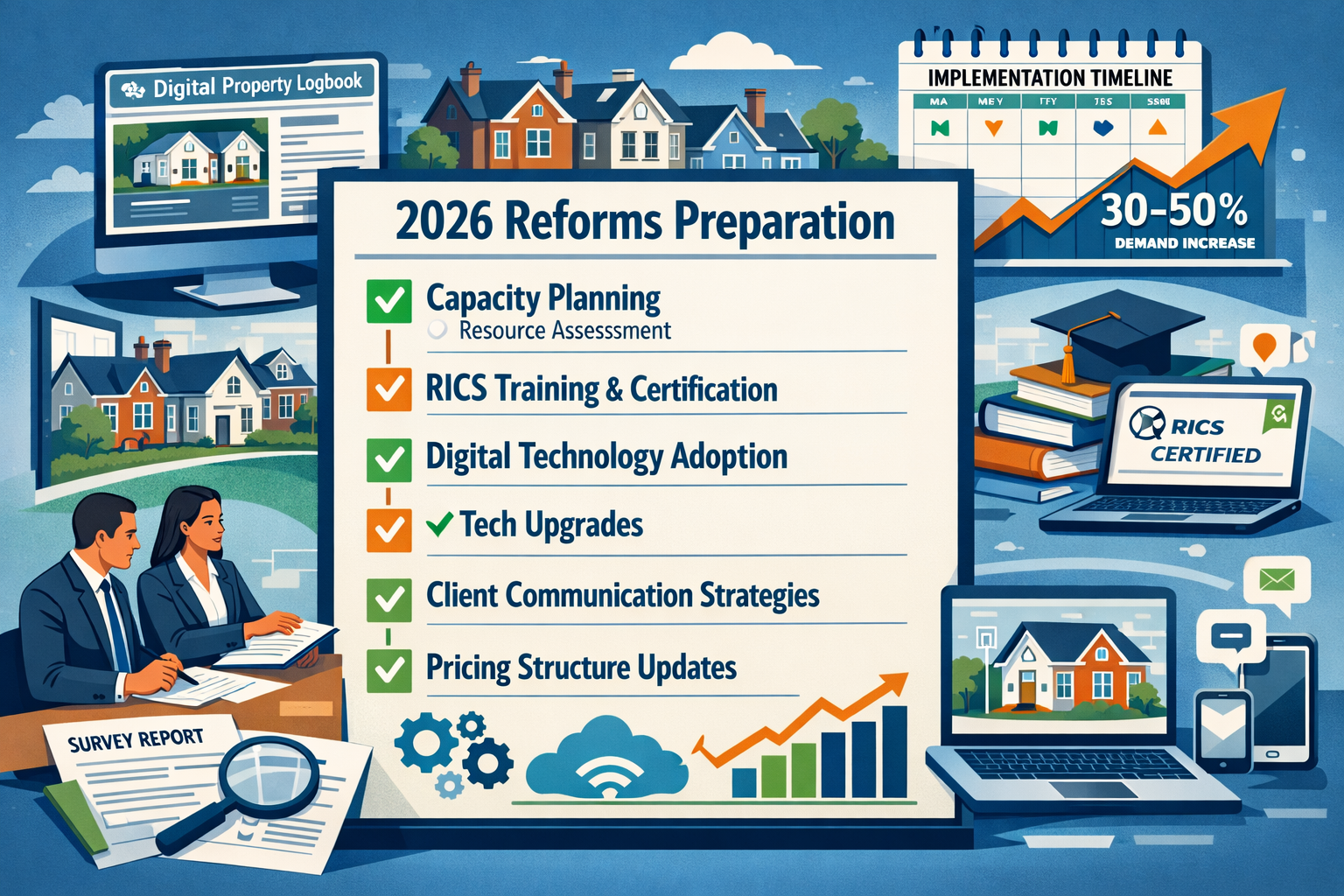
The Homebuying Process Reforms 2026: How Mandatory Upfront Surveys Will Transform Building Surveyor Workloads represents the most significant change to the UK property market in decades. For building surveyors, this transformation brings both substantial challenges and remarkable opportunities.
The shift from buyer-commissioned to seller-commissioned surveys, combined with a projected 30-50% increase in survey volume, will fundamentally reshape surveyor workloads, client relationships, and business models. Success in this reformed market will require:
🎯 Strategic capacity planning to meet dramatically increased demand
🎯 Technology investment for digital integration and efficiency
🎯 Professional development to maintain RICS standards and adapt to seller clients
🎯 Business model evolution to capitalize on new service opportunities
🎯 Industry engagement to influence implementation and standards development
The surveyors and firms that begin preparing now—building capacity, investing in technology, developing seller relationships, and enhancing professional capabilities—will be best positioned to thrive in the reformed market.
Actionable Next Steps for Building Surveyors
Immediate Actions (Next 3 Months):
- Assess Current Capacity: Calculate existing survey volume and project 30-50% increase scenarios
- Evaluate Technology: Research digital survey platforms and property logbook integration requirements
- Engage with RICS: Review current professional standards and CPD offerings related to reforms
- Monitor Consultation: Track government consultation responses and implementation timeline announcements[2]
- Build Estate Agent Relationships: Initiate conversations about partnership opportunities and service integration
Short-Term Priorities (3-12 Months):
- Develop Workforce Plan: Identify recruitment needs and training programs for capacity expansion
- Invest in Digital Tools: Implement mobile survey applications and automated reporting systems
- Create Seller-Focused Marketing: Develop materials and messaging targeting seller clients
- Design Service Packages: Create tiered offerings and transparent pricing structures
- Establish Quality Systems: Implement peer review and quality assurance processes
Medium-Term Strategies (1-2 Years):
- Scale Operations: Execute capacity expansion plans through recruitment, training, and infrastructure investment
- Build Partnerships: Formalize relationships with estate agents, conveyancers, and property platforms
- Enhance Specialization: Develop expertise in specific property types or assessment areas
- Lead Technology Adoption: Position as early adopter and technology leader in surveying sector
- Participate in Standard Development: Engage with RICS and government on implementation details
The reformed property market will reward surveyors who embrace change, invest in capability, and maintain unwavering commitment to professional standards. Those who view these reforms as opportunity rather than burden will shape the future of building surveying in the UK.
For comprehensive guidance on navigating these changes and ensuring your surveying practice is prepared for the Homebuying Process Reforms 2026, consider consulting with qualified chartered surveyors who understand both current best practices and emerging requirements.
The transformation is coming. The question is not whether the market will change, but whether your surveying practice will be ready to lead in the reformed landscape.
References
[1] Government Homebuying Reforms Upfront Surveys – https://www.surveyorlocal.co.uk/news/post/government-homebuying-reforms-upfront-surveys
[2] Home Buying And Selling Reform – https://www.gov.uk/government/consultations/home-buying-and-selling-reform/home-buying-and-selling-reform
[3] First Time Buyer 2026 Changes Challenges Solutions – https://www.homewardlegal.co.uk/guides-advice/post/first-time-buyer-2026-changes-challenges-solutions
[4] Home Buying Selling Reforms – https://www.lawsociety.org.uk/topics/property/home-buying-selling-reforms
[5] Home Survey Standards – https://www.rics.org/profession-standards/rics-standards-and-guidance/sector-standards/building-surveying-standards/home-surveys/home-survey-standards
[6] Coverage Of Our Proposals To Shakeup Home Buying And Selling Process – https://mhclgmedia.blog.gov.uk/2025/10/06/coverage-of-our-proposals-to-shakeup-home-buying-and-selling-process/
[7] How Much Does A House Survey Cost – https://hoa.org.uk/advice/guides-for-homeowners/i-am-buying/how-much-does-a-house-survey-cost/
