
Surveyor Council Housing: Your Complete Guide to Property Inspections and Assessments in 2026
When council housing tenants notice cracks in their walls or landlords plan major refurbishment projects, a critical question emerges: who ensures these properties remain safe, habitable, and compliant with regulations? The answer lies with specialized professionals who navigate the unique challenges of surveyor council housing work. These experts bridge the gap between local authorities, tenants, and regulatory requirements, ensuring that social housing stock meets modern standards while preserving public investment.
The role of surveyors in council housing has evolved dramatically over recent decades, transforming from basic property inspections to comprehensive assessments that incorporate energy efficiency, structural integrity, and tenant welfare. Understanding how these professionals operate can empower tenants, inform council decision-making, and ensure that Britain’s social housing stock remains fit for purpose in 2026 and beyond.
Key Takeaways
- Council housing surveyors perform specialized inspections focused on social housing stock, addressing unique challenges like aging infrastructure, regulatory compliance, and tenant safety requirements
- Multiple survey types exist within council housing contexts, including stock condition surveys, pre-acquisition assessments, planned maintenance inspections, and disrepair investigations
- Professional qualifications matter significantly—RICS-accredited surveyors bring standardized methodologies and legal defensibility to council housing assessments
- Tenant rights include requesting surveys for disrepair claims, understanding survey findings that affect their homes, and participating in consultation processes following major assessments
- Cost structures differ from private surveys, with councils typically funding assessments as part of asset management strategies, though tenants may commission independent surveys for specific purposes
Understanding the Role of Surveyor Council Housing Professionals
What Makes Council Housing Surveys Different?
Council housing surveys operate within a distinct framework compared to private residential assessments. While a building surveyor in London examining a private property focuses primarily on the buyer’s interests, surveyor council housing specialists must balance multiple stakeholders: the local authority as landlord, tenants as occupants, and the broader public interest in maintaining social housing stock.
These professionals encounter unique challenges that rarely appear in private sector work:
- Aging building stock with construction methods from the 1950s-1980s that may contain hazardous materials
- Regulatory complexity involving Decent Homes Standards, Housing Health and Safety Rating System (HHSRS), and fire safety legislation
- Tenant occupation requiring surveys to accommodate residents’ schedules and minimize disruption
- Budget constraints that necessitate prioritizing repairs and planned maintenance strategically
- Social responsibility to ensure vulnerable populations live in safe, healthy environments
Core Responsibilities of Council Housing Surveyors
Surveyor council housing professionals perform diverse functions throughout a property’s lifecycle:
Stock Condition Surveys 📋
These comprehensive assessments evaluate the overall state of council housing portfolios, examining thousands of properties to create databases that inform long-term investment planning. Surveyors record construction types, component conditions, and remaining service life for elements like roofs, windows, heating systems, and structural components.
Disrepair Investigations
When tenants report maintenance issues or pursue legal claims for housing disrepair, surveyors conduct detailed inspections to determine the extent of problems, identify causes, and specify remedial works. This work requires meticulous documentation and often involves preparing expert witness reports for litigation.
Pre-Acquisition Assessments
Before councils purchase properties to expand social housing stock, surveyors evaluate structural condition, identify defects, estimate repair costs, and assess suitability for conversion or refurbishment. These assessments directly impact investment decisions worth millions of pounds.
Planned Maintenance Programming
Surveyors develop cyclical maintenance schedules based on component lifecycles, preventing premature failure and optimizing expenditure. This strategic function ensures councils replace roofs, windows, and mechanical systems before catastrophic failures occur.
Compliance Inspections
Regular assessments verify that properties meet statutory requirements including fire safety standards (particularly post-Grenfell), gas safety certificates, electrical safety standards, and asbestos management protocols.
Types of Surveys in Council Housing Contexts
Stock Condition Surveys: The Foundation of Asset Management
Stock condition surveys represent the most comprehensive assessment type in council housing management. These systematic evaluations typically occur on five-year cycles, though some authorities conduct rolling programs annually covering portions of their stock.
Survey Methodology:
| Survey Component | What’s Assessed | Purpose |
|---|---|---|
| External envelope | Roof coverings, walls, windows, doors, rainwater goods | Identify weatherproofing defects and replacement needs |
| Internal elements | Walls, ceilings, floors, joinery, fixtures | Evaluate decoration cycles and structural concerns |
| Services | Heating, electrical, plumbing, ventilation | Determine replacement schedules and safety compliance |
| Energy efficiency | Insulation, glazing, heating controls | Calculate EPC ratings and improvement opportunities |
| Accessibility | Step-free access, bathroom adaptations | Assess suitability for disabled or elderly tenants |
Surveyors typically spend 45-90 minutes per property during stock condition surveys, photographing defects, measuring components, and recording data on tablets using specialized software. This information feeds into asset management databases that calculate 30-year investment requirements.
Disrepair and Responsive Surveys
When tenants report problems or pursue legal action for housing disrepair, surveyor council housing specialists conduct targeted investigations focusing on specific complaints. These surveys differ fundamentally from stock condition assessments:
✅ Immediate focus on reported defects rather than comprehensive evaluation
✅ Causation analysis to determine whether problems stem from structural issues, maintenance failures, or tenant actions
✅ Remedial specifications detailing exact works required to resolve problems
✅ Legal defensibility with documentation standards suitable for court proceedings
✅ Urgency categorization classifying repairs as emergency, urgent, or routine
Understanding what surveyors look for during inspections helps tenants prepare for these visits and understand subsequent reports.
Pre-Purchase and Acquisition Surveys
Local authorities expanding social housing stock through property acquisition commission specialized surveys before completing purchases. These assessments resemble Level 3 building surveys in thoroughness but incorporate additional considerations:
- Conversion potential for properties requiring adaptation to council housing standards
- Long-term maintenance costs projected over 30+ year ownership periods
- Compliance gaps identifying works needed to meet Decent Homes Standards
- Value for money comparing purchase price plus remedial works against new-build alternatives
- Neighbourhood sustainability assessing whether acquisitions support community cohesion
These surveys often incorporate beam calculations and structural engineering input when properties require significant alterations.
Planned Maintenance and Cyclical Surveys
Proactive councils implement rolling inspection programs targeting specific building elements on predetermined cycles:
Common Cyclical Survey Programs:
- Annual: Gas safety inspections, fire alarm testing, emergency lighting checks
- Biennial: Electrical installation condition reports, legionella risk assessments
- Five-yearly: External decoration assessments, roof condition surveys
- Ten-yearly: Structural inspections, drainage surveys, boundary wall assessments
These targeted surveys allow councils to budget accurately for component replacements and avoid reactive maintenance spikes that strain resources.
The Survey Process: From Instruction to Report
Initial Instruction and Scope Definition
The surveyor council housing process begins when local authority asset management teams, legal departments, or housing officers commission assessments. Clear instruction letters define:
- Survey purpose (stock condition, disrepair investigation, pre-acquisition, etc.)
- Property details including address, construction type, and tenant status
- Access arrangements with tenant contact information and preferred appointment times
- Specific concerns requiring focused attention during inspection
- Reporting deadlines aligned with decision-making timelines or legal proceedings
- Budget parameters for recommended works (if applicable)
Property Inspection and Data Collection
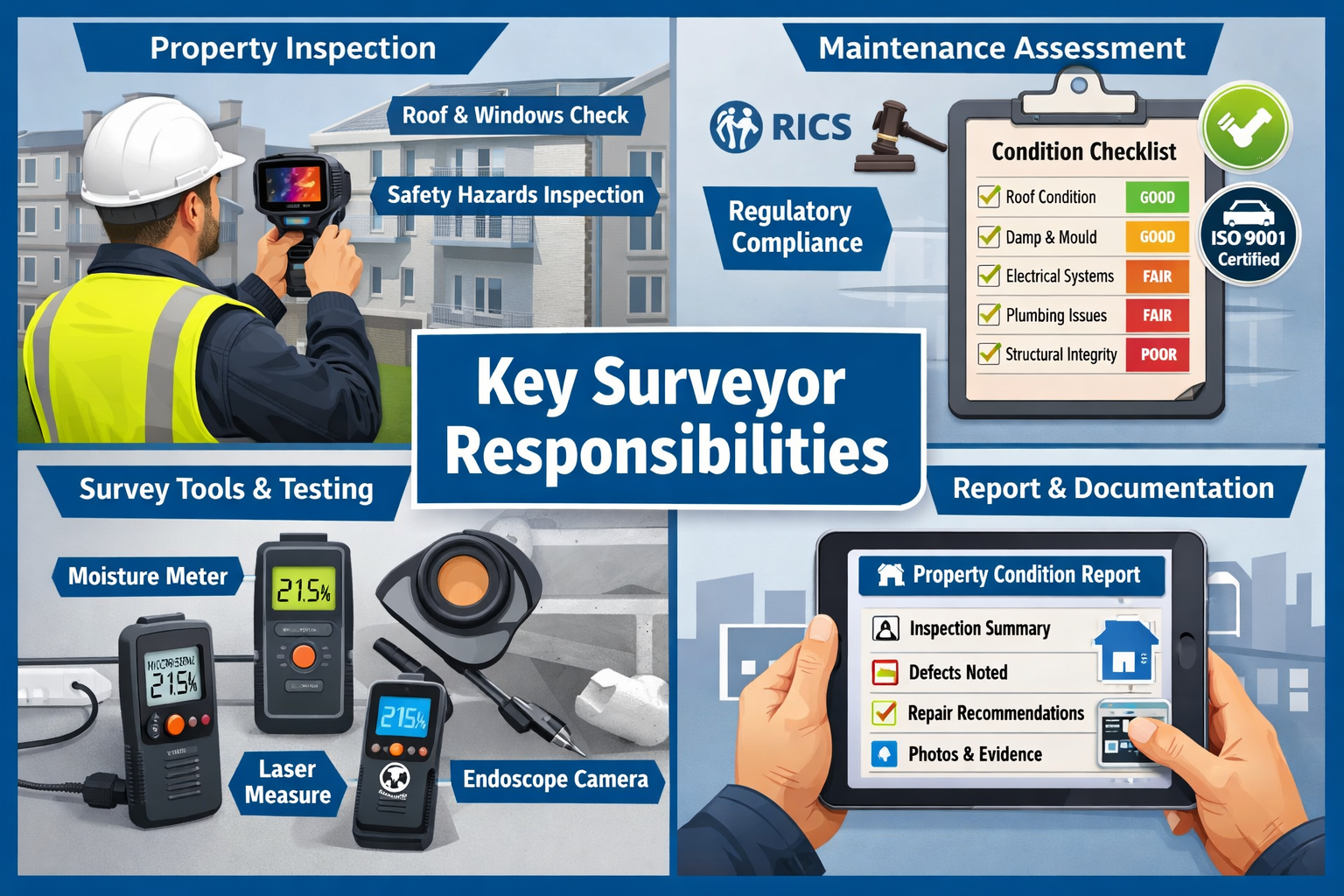
Modern surveyor council housing inspections leverage technology extensively:
Equipment and Tools:
- 📱 Tablet computers with specialized survey software
- 📸 High-resolution cameras documenting defects
- 🌡️ Thermal imaging cameras detecting insulation deficiencies and moisture penetration
- 📏 Laser distance measurers for accurate dimensional recording
- 🔍 Moisture meters identifying damp problems
- 🔦 Endoscopes examining concealed spaces
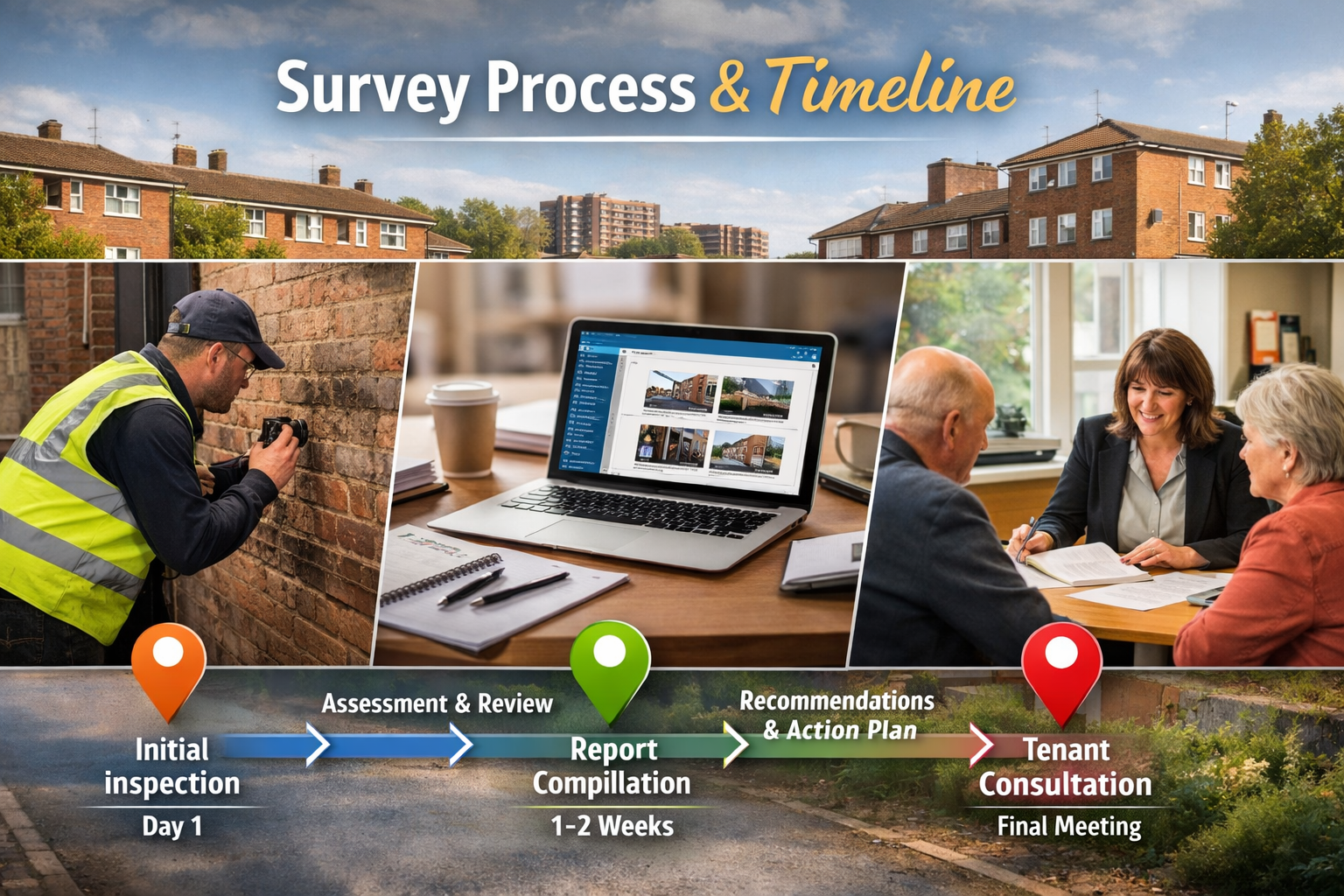
Surveyors systematically work through properties from roof to foundations, recording observations in standardized formats that enable data comparison across entire housing portfolios. Tenant interviews often supplement physical inspections, particularly for disrepair investigations where occupants provide crucial context about problem development.
Report Preparation and Recommendations
Survey reports vary in format depending on purpose, but council housing assessments typically include:
Standard Report Sections:
- Executive Summary: Key findings and priority recommendations
- Property Description: Construction details, age, accommodation layout
- Inspection Findings: Room-by-room or element-by-element defect recording
- Photographic Evidence: Annotated images illustrating significant issues
- Compliance Assessment: Regulatory standard evaluations (Decent Homes, HHSRS, fire safety)
- Remedial Specifications: Detailed descriptions of required works
- Cost Estimates: Budget projections for recommended repairs or improvements
- Priority Ratings: Urgency classifications guiding action planning
Reports for stock condition surveys often include data outputs compatible with asset management software, enabling councils to model investment scenarios and optimize spending across thousands of properties.
Qualifications and Professional Standards
RICS Accreditation and Specialist Expertise
Professional competence matters enormously in surveyor council housing work. The Royal Institution of Chartered Surveyors (RICS) sets rigorous standards for building surveyors, requiring:
- Academic qualifications: Accredited degree in building surveying or related discipline
- Practical experience: Minimum two years supervised practice through Assessment of Professional Competence (APC)
- Professional examination: Demonstrating technical knowledge and ethical understanding
- Continuing Professional Development (CPD): Ongoing learning to maintain current knowledge
Many councils specify RICS-accredited surveyors for critical assessments, ensuring professional indemnity insurance coverage and adherence to standardized methodologies. When selecting professionals, understanding how to verify surveyor qualifications protects all stakeholders.
Specialist Knowledge Requirements
Beyond general surveying competence, surveyor council housing specialists develop expertise in:
- Social housing legislation: Housing Acts, Landlord and Tenant Acts, regulatory frameworks
- Construction pathology: Identifying defects in system-built housing, concrete construction, and non-traditional builds
- Hazardous materials: Asbestos identification, lead paint recognition, radon awareness
- Energy assessment: EPC calculations, retrofit strategies, fuel poverty mitigation
- Accessibility standards: Lifetime Homes criteria, wheelchair housing requirements, adaptation design
This specialized knowledge distinguishes council housing surveyors from general practice building surveyors who may lack familiarity with social housing sector nuances.
Tenant Rights and Survey Involvement
When Tenants Can Request Surveys
Council tenants possess specific rights regarding property surveys and inspections:
Right to Repair Scheme 🔧
For qualifying repairs, tenants can request inspections if councils fail to complete works within prescribed timeframes. Surveyors verify whether repairs fall within scheme parameters and assess completion quality.
Disrepair Claims
Tenants pursuing legal action for housing disrepair can commission independent surveys to substantiate claims. These assessments provide evidence for negotiations or court proceedings, documenting how property conditions breach tenancy agreements or statutory standards.
Right to Buy Valuations
Tenants exercising Right to Buy require property valuations determining market value and applicable discounts. While technically valuations rather than surveys, these assessments often incorporate condition evaluations affecting pricing.
Mutual Exchange Inspections
When tenants arrange mutual exchanges, councils typically survey properties to ensure both parties understand condition differences and identify any works required before occupation.
Understanding Survey Reports as a Tenant
Survey reports contain technical terminology that may confuse non-specialists. Key concepts tenants should understand:
HHSRS Categories
The Housing Health and Safety Rating System classifies hazards as Category 1 (serious, requiring immediate action) or Category 2 (less serious but still requiring attention). Category 1 hazards trigger legal obligations for councils to remedy problems.
Decent Homes Standard
This benchmark requires properties to be:
- Free from Category 1 hazards
- In reasonable repair
- Equipped with reasonably modern facilities
- Providing reasonable thermal comfort
Survey reports often explicitly state whether properties meet Decent Homes criteria, directly affecting tenant rights and council obligations.
Repair Urgency Classifications
Surveyors typically categorize recommended works as:
- Emergency: Immediate action required (within 24 hours)
- Urgent: Action required within 7-28 days
- Routine: Planned maintenance within normal cycles
Understanding these classifications helps tenants gauge expected response timelines and escalate appropriately when councils fail to act.
Common Issues Identified in Council Housing Surveys
Structural and Building Fabric Defects
Surveyor council housing inspections frequently encounter specific defect patterns reflecting the age and construction methods of social housing stock:
Concrete Carbonation and Reinforcement Corrosion
Many council estates built in the 1960s-1970s used reinforced concrete construction. Surveyors test for carbonation depth and identify spalling concrete indicating corroded reinforcement—issues requiring expensive remediation.
Cavity Wall Tie Failure
Properties from the 1950s-1980s often experience cavity wall tie corrosion, causing wall bulging and structural instability. Surveyors identify characteristic horizontal cracking patterns and recommend remedial wall tie replacement.
Roof Covering Deterioration
Flat roofs common in council housing typically require replacement every 15-25 years. Surveyors assess felt condition, identify ponding areas, and evaluate whether patch repairs suffice or full replacement is necessary.
Window and Door Failures
Early replacement windows installed in the 1980s-1990s often reach end-of-life, with failed double-glazing units, deteriorated seals, and inoperable mechanisms. Surveyors evaluate whether repairs or complete replacement represents better value.
Damp, Condensation, and Mould Issues
Moisture-related problems dominate council housing disrepair claims. Surveyors distinguish between:
Penetrating Damp
Water ingress through defective roofs, walls, or windows causing internal damage. Surveyors trace moisture sources using meters and thermal imaging, specifying external repairs to resolve problems.
Rising Damp
Moisture rising through walls due to failed or absent damp-proof courses. Surveyors identify characteristic tide marks and salt deposits, recommending chemical injection or other remediation methods.
Condensation and Mould Growth
Inadequate heating, ventilation, or insulation causing surface condensation and mould development. Surveyors assess whether problems stem from building defects or lifestyle factors, recommending appropriate interventions.
Understanding the differences between these moisture sources proves crucial for effective remediation—addressing condensation with external repairs wastes resources while treating penetrating damp with ventilation improvements leaves root causes unresolved.
Fire Safety and Compliance Concerns
Post-Grenfell scrutiny has intensified fire safety assessments in council housing. Surveyors now routinely evaluate:
- Compartmentation integrity: Ensuring fire barriers prevent spread between dwellings
- Means of escape: Verifying adequate escape routes with appropriate fire doors
- External wall systems: Assessing cladding materials and construction for fire risk
- Smoke detection: Confirming adequate alarm coverage and functionality
- Emergency lighting: Testing illumination for escape routes in common areas
These assessments often require specialist fire safety consultants working alongside building surveyors to provide comprehensive evaluations.
Cost Considerations and Funding
Who Pays for Council Housing Surveys?
Survey costs typically fall to different parties depending on survey type and purpose:
Council-Funded Surveys:
- Stock condition assessments as part of asset management
- Pre-acquisition surveys before property purchases
- Planned maintenance inspections on cyclical programs
- Compliance surveys for regulatory requirements
- Initial disrepair investigations responding to tenant complaints
Tenant-Commissioned Surveys:
- Independent assessments supporting disrepair legal claims
- Pre-purchase surveys for Right to Buy transactions
- Specialist investigations when disputing council findings
Third-Party Funded:
- Grant-funded energy efficiency assessments
- Insurance company surveys following damage incidents
- Leaseholder-funded surveys in mixed-tenure blocks
Typical Survey Costs in 2026
While council procurement often achieves economies of scale, understanding typical market rates provides context:
| Survey Type | Typical Cost Range | Duration |
|---|---|---|
| Stock condition survey (per property) | £150-£350 | 45-90 minutes |
| Disrepair investigation | £400-£800 | 2-4 hours |
| Pre-acquisition survey | £600-£1,500 | 3-6 hours |
| Specialist structural survey | £1,200-£3,000 | Full day+ |
| Portfolio stock condition (bulk rates) | £100-£200 per property | Varies |
Costs vary based on property size, complexity, access challenges, and reporting requirements. Councils negotiating framework agreements with surveying firms often secure preferential rates for volume work.
Working with Notting Hill Surveyors for Council Housing Projects
Professional surveying firms like Notting Hill Surveyors bring specialized expertise to council housing assessments. With extensive experience across London’s diverse social housing stock, qualified professionals understand the unique challenges facing local authorities and housing associations.
Whether councils require comprehensive stock condition surveys, tenants need independent disrepair assessments, or authorities seek pre-acquisition evaluations, experienced surveyors provide thorough, defensible reports that inform decision-making and protect stakeholder interests.
The team at Notting Hill Surveyors maintains current knowledge of evolving regulations, construction pathologies affecting council housing, and best practices for social housing management—ensuring assessments meet the highest professional standards.
Legal Framework and Regulatory Compliance
Key Legislation Affecting Council Housing Surveys
Surveyor council housing professionals operate within a complex legal framework:
Landlord and Tenant Act 1985
Sections 11-14 establish repairing obligations for residential landlords, including councils. Surveyors assess whether properties meet these statutory standards and identify breaches triggering legal liability.
Housing Act 2004
Introduced the Housing Health and Safety Rating System (HHSRS), replacing the previous fitness standard. Surveyors evaluate properties against 29 potential hazards, determining whether Category 1 or Category 2 hazards exist.
Homes (Fitness for Human Habitation) Act 2018
Extended statutory obligations, enabling tenants to take legal action if properties fail to meet fitness standards. Surveys provide evidence supporting or defending such claims.
Building Safety Act 2022
Introduced enhanced safety requirements for higher-risk buildings, particularly regarding fire safety. Surveyors assess compliance with new standards and identify remediation requirements.
Decent Homes Standard
While not strictly legislation, this government standard establishes minimum requirements for social housing. Councils receive funding contingent on meeting these criteria, making survey assessments crucial for investment planning.
Survey Evidence in Legal Proceedings
When disrepair claims reach litigation, survey reports become critical evidence. Courts expect:
- Professional qualifications: RICS accreditation and relevant expertise
- Methodological rigor: Systematic inspection approaches and appropriate investigation techniques
- Factual accuracy: Precise defect descriptions without speculation or exaggeration
- Photographic documentation: Clear images supporting written descriptions
- Causation analysis: Logical explanations linking defects to reported problems
- Proportionate remediation: Repair specifications addressing problems without unnecessary work
Surveyors may provide expert witness testimony, explaining findings to judges and cross-examination by opposing legal teams. This forensic dimension distinguishes disrepair surveys from routine stock condition assessments.
Technology and Innovation in Council Housing Surveys
Digital Transformation of Survey Processes
Modern surveyor council housing practice increasingly leverages technology:
Mobile Survey Applications 📱
Tablet-based software enables real-time data capture, eliminating paper-based recording and subsequent transcription errors. Surveyors photograph defects, annotate images, and record observations directly into databases accessible to asset management teams.
Thermal Imaging and Diagnostic Tools
Infrared cameras reveal hidden defects invisible to visual inspection—moisture penetration, insulation gaps, thermal bridging, and air leakage. This non-invasive technology identifies problems before they cause visible damage.
Drone Surveys
Unmanned aerial vehicles safely inspect roofs, chimneys, and high-level building elements without scaffolding or access equipment. Particularly valuable for tall blocks and properties with access challenges.
3D Laser Scanning
Advanced projects employ laser scanning to create detailed three-dimensional property models, enabling precise measurements and virtual inspections. While expensive, this technology proves cost-effective for complex refurbishment planning.
Building Information Modeling (BIM)
Progressive councils develop digital twins of housing stock, integrating survey data into comprehensive building information models that inform lifecycle management and predictive maintenance.
Data Analytics and Predictive Maintenance
Large-scale stock condition survey programs generate massive datasets enabling sophisticated analysis:
- Component lifecycle modeling: Predicting when building elements will require replacement across entire portfolios
- Investment optimization: Identifying most cost-effective intervention sequences
- Energy efficiency targeting: Prioritizing properties for retrofit programs based on EPC ratings and improvement potential
- Demographic matching: Aligning property characteristics with tenant needs (accessibility, family size, etc.)
- Performance benchmarking: Comparing maintenance costs and property performance across different construction types and locations
This analytical approach transforms surveying from reactive problem-identification to proactive asset management.
Future Trends in Council Housing Surveying
Sustainability and Net Zero Commitments
Government targets for net-zero carbon emissions by 2050 fundamentally reshape surveyor council housing priorities. Assessments increasingly focus on:
Retrofit Potential Evaluations
Surveyors assess properties for insulation improvements, heating system upgrades, renewable energy installation, and ventilation enhancements—balancing carbon reduction with heritage protection and cost-effectiveness.
Whole-Life Carbon Assessment
Moving beyond operational energy consumption to evaluate embodied carbon in materials and construction methods, influencing decisions about refurbishment versus demolition and rebuild.
Climate Resilience
Evaluating properties for flood risk, overheating potential, and extreme weather vulnerability—ensuring housing stock remains habitable as climate patterns change.
Building Safety and Regulatory Evolution
The Building Safety Act 2022 continues reshaping regulatory expectations. Surveyors must maintain current knowledge of:
- Evolving fire safety standards and testing requirements
- Enhanced record-keeping obligations for building information
- Competence frameworks for construction professionals
- Resident engagement requirements in safety decision-making
These regulatory changes demand continuous professional development and adaptation of survey methodologies.
Tenant Empowerment and Transparency
Social housing reform emphasizes tenant voice and transparency. Survey processes increasingly incorporate:
- Resident involvement in survey programming and priority-setting
- Plain language reporting making technical findings accessible to non-specialists
- Digital access to survey data through tenant portals
- Outcome tracking demonstrating how survey findings translate into actual improvements
This cultural shift requires surveyors to develop communication skills alongside technical expertise, explaining findings to diverse audiences and engaging constructively with tenant concerns.
Conclusion: The Essential Role of Surveyor Council Housing Specialists
Surveyor council housing professionals occupy a critical position in Britain’s social housing ecosystem. Their assessments inform investment decisions worth billions of pounds, protect vulnerable tenants from unsafe living conditions, and ensure public assets deliver value across generations. As housing stock ages, regulatory requirements intensify, and sustainability imperatives reshape priorities, the surveying profession’s importance only grows.
For local authorities, engaging qualified surveyors represents not merely regulatory compliance but strategic asset management—transforming reactive maintenance cultures into proactive, data-driven approaches that optimize resources and improve outcomes. For tenants, understanding survey processes empowers advocacy for better housing conditions and informed participation in decisions affecting their homes.
The complexity of modern council housing surveying demands specialized expertise that general practice surveyors may lack. Whether councils seek comprehensive stock condition assessments, tenants require independent disrepair investigations, or authorities plan major refurbishment programs, partnering with experienced professionals ensures thorough, defensible evaluations that stand up to scrutiny.
Next Steps
For Local Authorities:
- Review current survey programs to ensure comprehensive coverage of housing stock
- Verify surveyor qualifications and professional indemnity insurance
- Integrate survey data into asset management systems for strategic planning
- Establish clear protocols for responding to survey findings within appropriate timeframes
For Council Tenants:
- Understand your rights regarding property inspections and disrepair claims
- Document ongoing problems with photographs and written records before survey visits
- Request copies of survey reports affecting your property
- Seek independent professional advice when disputing council survey findings
For Housing Professionals:
- Invest in continuing professional development to maintain current regulatory knowledge
- Adopt technology that enhances survey accuracy and efficiency
- Develop communication skills to explain technical findings to non-specialist audiences
- Engage with tenant representatives to understand resident priorities and concerns
The future of council housing depends on rigorous, professional surveying that balances multiple objectives—safety, sustainability, affordability, and quality of life. By recognizing the specialized expertise required for surveyor council housing work and supporting professional standards, all stakeholders contribute to social housing that truly serves its purpose: providing safe, decent, affordable homes for those who need them most.
For expert surveying services tailored to council housing requirements, explore the comprehensive range of professional surveying solutions available to local authorities, housing associations, and tenants throughout London and beyond.
