
Town Planning Surveyor: Your Complete Guide to Roles, Qualifications, and Career Pathways in 2026

Imagine standing at the intersection where property development dreams meet legal compliance reality. Every new housing estate, commercial development, and infrastructure project requires a crucial professional who ensures that ambitious plans align with zoning regulations, environmental standards, and community needs. This professional is the town planning surveyor—a specialist who shapes the built environment while safeguarding public interests and ensuring sustainable development for future generations.
A town planning surveyor plays a pivotal role in the property development landscape, bridging the gap between developers, local authorities, and communities. These professionals combine technical surveying expertise with comprehensive knowledge of planning law, environmental regulations, and urban design principles to guide projects from initial concept through to planning approval and beyond.
Key Takeaways
- 🏗️ Town planning surveyors are specialized professionals who assess land for development potential, navigate planning regulations, and ensure projects comply with local and national planning policies
- 📋 Qualification requirements include a RICS-accredited degree, Assessment of Professional Competence (APC), and ongoing professional development to maintain chartered status
- 💼 Career opportunities span private consultancies, local planning authorities, property developers, and infrastructure companies with competitive salaries ranging from £25,000 to £70,000+ depending on experience
- 🌍 Essential skills combine technical surveying knowledge, planning law expertise, negotiation abilities, and strong communication skills to manage complex stakeholder relationships
- 📈 Market demand continues to grow in 2026 as sustainable development, housing shortages, and infrastructure investment drive the need for qualified planning professionals
What Is a Town Planning Surveyor?
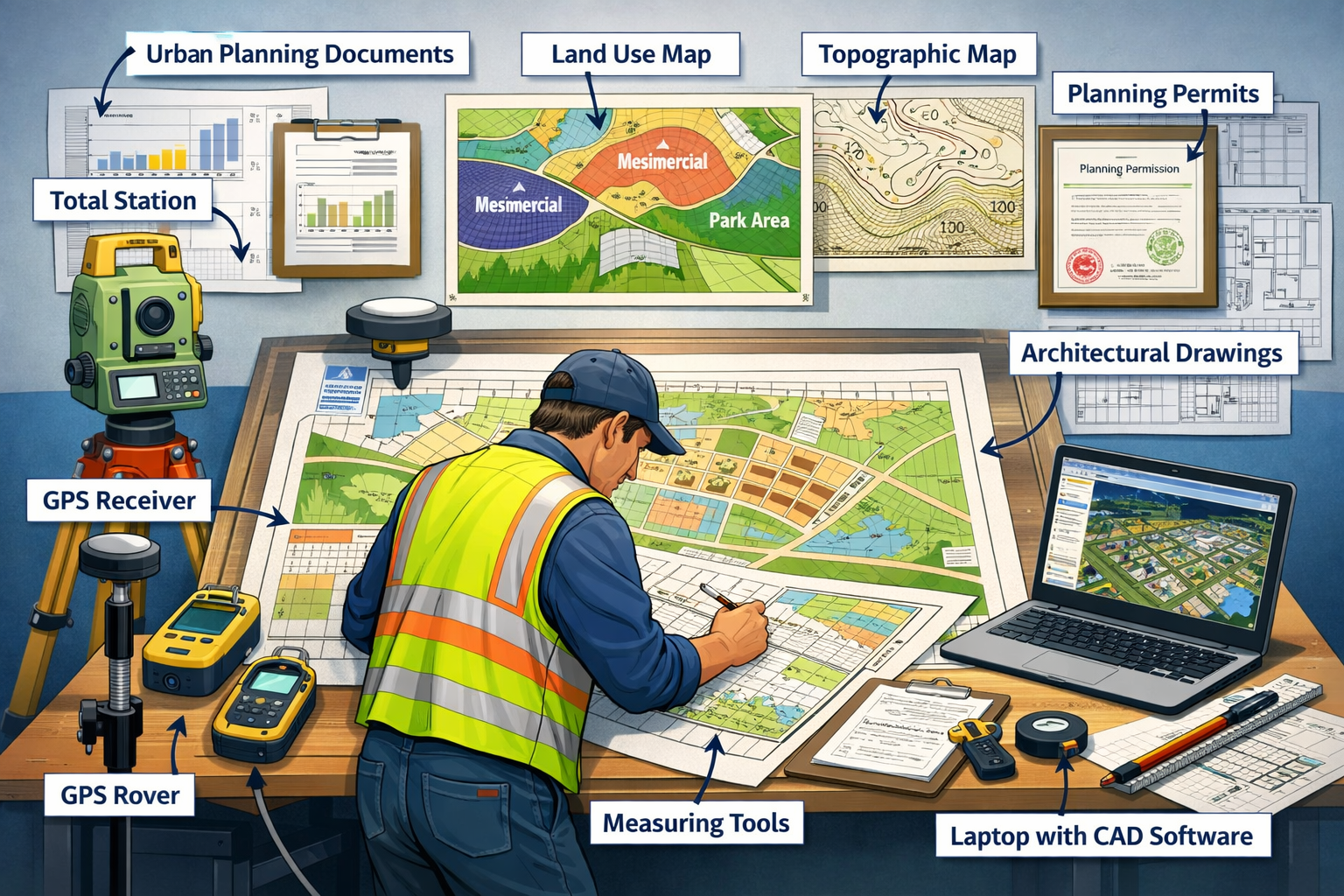
A town planning surveyor is a chartered professional who specializes in assessing land and property for development purposes while ensuring compliance with planning regulations and policies. Unlike building surveyors who focus on structural integrity and construction matters, town planning surveyors concentrate on the strategic and regulatory aspects of development.
Core Responsibilities
Town planning surveyors undertake a diverse range of responsibilities that require both technical expertise and strategic thinking:
Development Assessment
- Evaluating sites for development potential and constraints
- Conducting feasibility studies for proposed projects
- Analyzing land use patterns and zoning designations
- Assessing environmental impact and sustainability factors
Planning Applications
- Preparing and submitting planning applications to local authorities
- Compiling supporting documentation including design statements and impact assessments
- Liaising with planning officers and committee members
- Responding to objections and addressing concerns from stakeholders
Regulatory Compliance
- Ensuring projects comply with National Planning Policy Framework (NPPF)
- Interpreting local development plans and supplementary planning documents
- Advising on listed building consent and conservation area requirements
- Navigating Section 106 agreements and Community Infrastructure Levy obligations
Strategic Advice
- Providing expert testimony at planning appeals and public inquiries
- Advising clients on planning policy implications
- Negotiating with local authorities on behalf of developers
- Conducting due diligence for property acquisitions
How Town Planning Surveyors Differ from Other Surveyors
The surveying profession encompasses numerous specializations, each with distinct focuses and expertise areas. Understanding these differences helps property owners and developers engage the right professional for their needs.
| Surveyor Type | Primary Focus | Key Activities |
|---|---|---|
| Town Planning Surveyor | Development viability and planning compliance | Planning applications, policy interpretation, development strategy |
| Building Surveyor | Structural condition and construction | Building inspections, defect analysis, project management |
| Party Wall Surveyor | Boundary works and neighbor relations | Party wall agreements, dispute resolution, awards |
| Quantity Surveyor | Construction costs and contracts | Cost estimation, procurement, contract administration |
| Land Surveyor | Topographic measurement | Site surveys, boundary determination, mapping |
Town planning surveyors work closely with other surveying disciplines throughout the development process. For instance, while a town planning surveyor secures planning permission, a building surveyor might oversee the construction phase, and specialists from Notting Hill Surveyors can provide comprehensive support across multiple surveying needs.
Essential Qualifications and Professional Requirements for Town Planning Surveyors
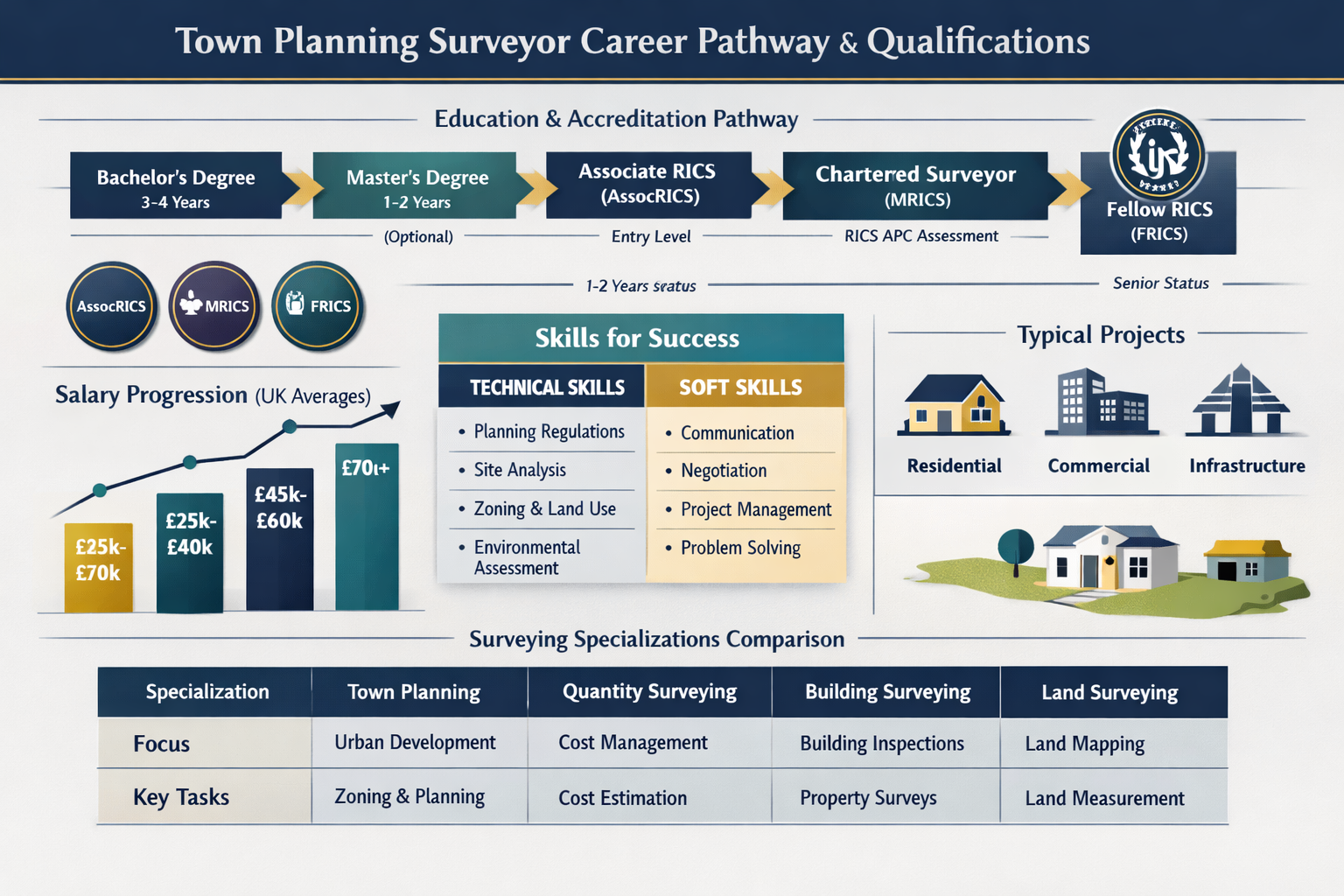
Becoming a qualified town planning surveyor requires a structured educational pathway combined with practical experience and professional accreditation. The journey typically spans 5-7 years from undergraduate study to achieving chartered status.
Educational Pathways
Undergraduate Degree (3-4 years)
Aspiring town planning surveyors typically pursue one of the following degree routes:
- BSc in Town and Country Planning
- BSc in Urban Planning and Development
- BSc in Surveying with Planning specialization
- BSc in Real Estate and Planning
The degree must be accredited by the Royal Institution of Chartered Surveyors (RICS) or the Royal Town Planning Institute (RTPI) to provide a direct pathway to professional qualification. Accredited programs cover essential subjects including:
✅ Planning law and policy
✅ Urban design and development economics
✅ Environmental assessment and sustainability
✅ Land use planning and zoning
✅ Geographic Information Systems (GIS)
✅ Research methods and statistical analysis
Postgraduate Options
For those with non-accredited undergraduate degrees, conversion master’s programs offer an alternative route:
- MSc in Town and Regional Planning (RTPI-accredited)
- MSc in Spatial Planning (RICS-accredited)
- PgDip in Planning and Development
These intensive programs typically last 1-2 years and provide comprehensive coverage of planning principles for graduates from related disciplines such as geography, architecture, or environmental science.
RICS Accreditation Process
The Assessment of Professional Competence (APC) represents the final stage in becoming a chartered town planning surveyor. This structured training program combines workplace experience with formal assessment.
APC Requirements:
- Structured Training (24 months minimum)
- Work under supervision of a qualified counselor
- Gain experience across core competencies
- Maintain detailed records in APC diary
- Complete mandatory competencies and optional pathways
- Core Competencies
- Professional ethics and conduct
- Client care and communication
- Health and safety regulations
- Sustainability principles
- Technical Competencies (Planning-specific)
- Planning policy and legislation
- Development appraisal and viability
- Planning applications and appeals
- Stakeholder engagement
- Final Assessment
- Written case study submission
- Professional interview with RICS assessors
- Demonstration of competence across all areas
Upon successful completion, candidates receive the designation MRICS (Member of the Royal Institution of Chartered Surveyors) and can use the title “Chartered Surveyor.”
Continuing Professional Development (CPD)
Professional development doesn’t end with chartership. RICS members must complete a minimum of 20 hours of CPD annually, including:
- 🎓 Formal learning (courses, seminars, webinars)
- 📚 Self-directed learning (reading, research)
- 🤝 Informal learning (mentoring, networking)
- 💼 Professional activity (writing, presenting)
This ensures town planning surveyors remain current with evolving legislation, emerging technologies, and best practices in sustainable development.
Career Opportunities and Salary Expectations for Town Planning Surveyors
The career landscape for town planning surveyors in 2026 offers diverse opportunities across public and private sectors, with strong demand driven by housing shortages, infrastructure investment, and sustainability initiatives.
Employment Sectors
Private Consultancies
The majority of town planning surveyors work for specialist planning consultancies or multidisciplinary property firms. These roles offer:
- Variety of project types and clients
- Exposure to complex development schemes
- Competitive salaries and performance bonuses
- Clear progression pathways to associate and partner levels
Major employers include national firms like Savills, Knight Frank, and Lichfields, as well as boutique specialists focusing on specific development sectors.
Local Planning Authorities
Working for local councils provides town planning surveyors with:
- Direct involvement in shaping local communities
- Public sector benefits including pension schemes
- Work-life balance and job security
- Insight into decision-making processes
These roles involve determining planning applications, developing local plans, and enforcing planning regulations.
Property Developers
In-house positions with residential and commercial developers offer:
- Strategic involvement in land acquisition
- Long-term project engagement from concept to completion
- Understanding of development economics
- Potential equity participation in projects
Infrastructure and Utilities
Major infrastructure projects require planning expertise for:
- Transport schemes (rail, highways, airports)
- Energy projects (renewable installations, grid upgrades)
- Utilities expansion (water, telecommunications)
- Public realm improvements
Salary Ranges in 2026
Town planning surveyor salaries vary significantly based on experience, location, and sector. The following table provides realistic expectations for the UK market:
| Experience Level | Typical Salary Range | Key Responsibilities |
|---|---|---|
| Graduate/Junior | £25,000 – £32,000 | Supporting applications, research, site visits |
| Mid-Level (3-5 years) | £35,000 – £48,000 | Managing applications, client liaison, appeals |
| Senior (5-10 years) | £50,000 – £65,000 | Complex projects, team leadership, business development |
| Associate/Director | £65,000 – £85,000+ | Strategic advice, major schemes, practice management |
| Partner | £85,000 – £150,000+ | Firm ownership, major clients, thought leadership |
London Premium: Salaries in London typically command a 15-25% premium over regional positions due to higher living costs and greater project complexity.
Sector Variations:
- Private consultancy: Generally highest salaries with performance bonuses
- Public sector: Lower base salaries but superior benefits packages
- In-house developer: Competitive salaries with potential profit-sharing
Career Progression Pathways
Town planning surveyors can advance their careers through several routes:
Vertical Progression
- Graduate Surveyor → Surveyor → Senior Surveyor → Associate → Director → Partner
Horizontal Specialization
- Residential development planning
- Commercial and retail schemes
- Infrastructure and energy projects
- Heritage and conservation
- Strategic land promotion
Alternative Pathways
- Moving into development management
- Transitioning to property investment
- Academic research and teaching
- Planning policy development
- Expert witness services
Many experienced town planning surveyors establish their own consultancies, leveraging their expertise and client relationships to build independent practices.
Key Skills and Competencies Required for Success
Excelling as a town planning surveyor demands a unique combination of technical knowledge, interpersonal abilities, and strategic thinking. The most successful professionals develop expertise across multiple domains.
Technical Skills
Planning Law and Policy Expertise
Mastery of the planning system forms the foundation of professional competence:
- Comprehensive understanding of the Town and Country Planning Act 1990
- Detailed knowledge of the National Planning Policy Framework (NPPF)
- Familiarity with local development plans across different authorities
- Awareness of emerging policy directions and legislative changes
Development Appraisal
Financial literacy enables town planning surveyors to assess project viability:
- Residual land valuation techniques
- Understanding development costs and timescales
- Assessing market conditions and demand
- Evaluating Section 106 and CIL implications
Technical Analysis
Analytical capabilities support evidence-based decision-making:
- GIS and mapping software proficiency
- Environmental impact assessment
- Transport and highways analysis
- Heritage and conservation evaluation
- Landscape and visual impact assessment
Interpersonal and Communication Skills
Stakeholder Management
Town planning surveyors navigate complex relationships with multiple parties:
- Clients (developers, landowners, investors)
- Local planning authorities and officers
- Elected members and planning committees
- Local communities and objectors
- Statutory consultees (Environment Agency, Highways Authority, etc.)
Negotiation Abilities
Successful outcomes often depend on skilled negotiation:
- Securing favorable planning conditions
- Agreeing Section 106 contributions
- Resolving objections and concerns
- Finding compromise solutions that satisfy multiple interests
Written Communication
Clear, persuasive writing is essential for:
- Planning statements and design and access statements
- Appeal statements and proofs of evidence
- Committee reports and officer briefings
- Client correspondence and advice notes
Presentation Skills
Oral advocacy requires confidence and clarity:
- Presenting to planning committees
- Appearing at planning appeals and public inquiries
- Client presentations and project pitches
- Public consultation events
Strategic and Commercial Awareness
Business Development
Understanding commercial realities supports practice growth:
- Identifying new opportunities and clients
- Building and maintaining professional networks
- Understanding competitive positioning
- Managing client relationships for repeat business
Project Management
Effective delivery requires organizational skills:
- Managing multiple projects simultaneously
- Coordinating multidisciplinary teams
- Meeting deadlines and managing client expectations
- Budget management and resource allocation
Strategic Thinking
Long-term perspective enhances advisory quality:
- Anticipating policy changes and market trends
- Understanding political and economic contexts
- Identifying risks and opportunities early
- Advising on optimal timing for applications
The combination of these skills enables town planning surveyors to add genuine value throughout the development process, from initial site assessment through to successful project delivery.
The Town Planning Process: How Surveyors Guide Development Projects
Understanding the typical workflow of a town planning surveyor illuminates the value these professionals provide throughout the development lifecycle. Each project presents unique challenges, but most follow a recognizable pattern.
Stage 1: Initial Site Assessment and Feasibility
The journey begins when a client approaches with a development opportunity or land holding.
Site Appraisal
The town planning surveyor conducts comprehensive due diligence:
- Reviewing planning history and previous applications
- Examining current planning designations and allocations
- Identifying physical constraints (flood risk, contamination, access)
- Assessing policy compliance and development potential
- Evaluating local market conditions and demand
Feasibility Advice
Based on this analysis, the surveyor provides strategic recommendations:
- Optimal development quantum and mix
- Likely planning requirements and constraints
- Preliminary assessment of achievability
- Risk identification and mitigation strategies
- Indicative timescales and costs
This initial stage often determines whether a project proceeds, making the town planning surveyor’s expertise critical to investment decisions.
Stage 2: Pre-Application Engagement
Before submitting formal applications, experienced surveyors engage with stakeholders to improve success prospects.
Local Authority Consultation
Pre-application discussions with planning officers provide valuable insights:
- Informal feedback on development proposals
- Identification of potential issues early
- Clarification of policy requirements
- Guidance on supporting information needed
Community Engagement
For significant schemes, public consultation demonstrates commitment to local concerns:
- Public exhibitions and consultation events
- Stakeholder meetings with community groups
- Addressing objections proactively
- Building support for proposals
Technical Studies
The surveyor coordinates specialist assessments:
- Transport assessments and travel plans
- Ecological surveys and biodiversity net gain calculations
- Heritage impact assessments
- Flood risk assessments
- Landscape and visual impact studies
These preparatory activities significantly improve application quality and determination prospects.
Stage 3: Planning Application Preparation and Submission
With groundwork complete, the town planning surveyor orchestrates the formal application.
Application Documentation
Comprehensive submissions typically include:
- Completed application forms and certificates
- Site location and block plans
- Design and access statement
- Planning statement demonstrating policy compliance
- Supporting technical reports and assessments
- Architectural drawings and visualizations
Submission and Validation
The surveyor ensures:
- All required information is provided
- Application fees are calculated correctly
- Statutory consultees are identified
- Neighbors are properly notified
Case Management
Throughout determination, the surveyor:
- Responds to officer queries and requests for information
- Negotiates amendments to address concerns
- Monitors consultation responses
- Provides additional justification where needed
- Advises clients on likely outcomes and timing
Stage 4: Determination and Beyond
The application reaches its conclusion through committee decision or delegated approval.
Committee Presentations
For controversial or significant applications, the surveyor may:
- Prepare speaking notes for applicants
- Attend committee meetings
- Address member concerns
- Clarify technical matters
Discharge of Conditions
Following approval, the surveyor assists with:
- Submitting details to satisfy pre-commencement conditions
- Negotiating Section 106 agreements
- Coordinating with building surveyors for construction phase
- Ensuring compliance with approved plans
Appeals and Reviews
When applications are refused, the surveyor can:
- Advise on appeal prospects and strategy
- Prepare appeal statements and evidence
- Coordinate expert witnesses
- Represent clients at hearings or inquiries
- Consider judicial review in exceptional cases
Throughout this process, town planning surveyors from firms like Notting Hill Surveyors provide expert guidance that maximizes approval prospects while protecting client interests.
Challenges and Opportunities in Town Planning Surveying
The town planning profession in 2026 faces both significant challenges and exciting opportunities as the built environment sector adapts to changing priorities and technologies.
Current Challenges
Policy Complexity and Change
The planning system continues to evolve, creating challenges for practitioners:
- Frequent policy updates and revisions
- Inconsistent interpretation across local authorities
- Tension between national targets and local policies
- Complexity of environmental and sustainability requirements
Resource Constraints
Local planning authorities face ongoing pressures:
- Understaffing leading to determination delays
- Inconsistent quality of case officer expertise
- Backlogs affecting application timescales
- Reduced capacity for proactive plan-making
Political Uncertainty
Planning decisions increasingly involve political considerations:
- Local opposition to development proposals
- Changing political priorities at local and national levels
- Media scrutiny of controversial applications
- Balancing competing community interests
Sustainability Imperatives
Climate change and environmental concerns raise the bar:
- Biodiversity net gain requirements
- Carbon reduction targets
- Circular economy principles
- Adaptation to climate risks
Emerging Opportunities
Housing Demand
The UK’s persistent housing shortage creates sustained demand for planning expertise:
- Government targets for new housing delivery
- Brownfield regeneration initiatives
- Build-to-rent sector growth
- Affordable housing requirements
Infrastructure Investment
Major infrastructure programs require planning support:
- HS2 and rail network expansion
- Renewable energy installations
- Electric vehicle charging infrastructure
- Digital connectivity projects
Urban Regeneration
Town centers and commercial areas are being reimagined:
- Conversion of retail to residential
- Mixed-use development schemes
- Public realm improvements
- Heritage-led regeneration
Technology Integration
Digital tools are transforming planning practice:
- GIS and spatial analysis software
- 3D visualization and virtual reality
- Digital planning portals and e-submissions
- Data analytics for evidence-based policy
Specialization Opportunities
Niche expertise commands premium fees:
- Permitted development rights and prior approval
- Energy and renewable projects
- Heritage and conservation
- Strategic land promotion
- Expert witness services
Town planning surveyors who embrace these opportunities while navigating challenges position themselves for long-term career success in a dynamic and rewarding profession.
How to Choose the Right Town Planning Surveyor for Your Project
Selecting an appropriate town planning surveyor significantly influences project outcomes. Whether you’re a developer, landowner, or investor, these considerations help identify the right professional for your needs.
Essential Selection Criteria
Professional Qualifications
Verify credentials before engaging a surveyor:
- ✅ RICS chartership (MRICS or FRICS designation)
- ✅ RTPI membership where applicable
- ✅ Professional indemnity insurance
- ✅ Membership of relevant professional bodies
Check qualifications through the RICS directory or professional body websites to ensure legitimacy.
Relevant Experience
Match expertise to your project type:
- Track record with similar developments
- Experience with the specific local authority
- Understanding of relevant sectors (residential, commercial, industrial)
- Success rate with comparable applications
Request case studies and references from previous clients to assess capabilities.
Local Knowledge
Familiarity with the area provides advantages:
- Understanding of local planning policies and priorities
- Relationships with planning officers
- Knowledge of local political dynamics
- Awareness of successful precedents and sensitive issues
While national firms offer breadth, local specialists like Notting Hill Surveyors combine professional expertise with invaluable area-specific knowledge.
Communication Style
Effective collaboration requires clear communication:
- Responsiveness to queries and concerns
- Ability to explain complex matters in accessible language
- Proactive updates on progress
- Transparency about risks and challenges
Initial consultations reveal whether the surveyor’s communication approach aligns with your preferences.
Questions to Ask Potential Surveyors
Before appointing a town planning surveyor, consider asking:
- What is your experience with projects similar to mine?
- What is your success rate with this local authority?
- Who will be the main point of contact throughout the project?
- What are your fee structures and what services are included?
- What is the realistic timeline for achieving planning permission?
- What are the main risks you foresee with this project?
- Can you provide references from recent clients?
- How do you approach pre-application consultation?
- What is your policy on managing conflicts of interest?
- Do you have capacity to take on my project within the required timeframe?
Fee Structures and Costs
Town planning surveyor fees vary based on project complexity and scope:
Typical Fee Arrangements:
- Fixed Fees: Agreed price for defined scope (suitable for straightforward applications)
- Hourly Rates: £150-£350 per hour depending on seniority (flexible for uncertain scope)
- Percentage Fees: 1-3% of development value (aligned with project success)
- Retainer Arrangements: Monthly fees for ongoing advisory services
Cost Factors:
- Project size and complexity
- Number of dwellings or commercial floorspace
- Likely level of opposition
- Technical studies required
- Appeal prospects if refused
Request detailed fee proposals that clearly specify what services are included and what might incur additional charges.
Red Flags to Avoid
Be cautious of surveyors who:
- ❌ Guarantee planning permission (outcomes are never certain)
- ❌ Lack appropriate professional qualifications
- ❌ Have no demonstrable experience with similar projects
- ❌ Provide vague or unrealistic timescales
- ❌ Refuse to provide references or case studies
- ❌ Offer fees significantly below market rates
- ❌ Show poor understanding of local planning context
Taking time to select the right town planning surveyor pays dividends through smoother processes, better outcomes, and reduced risk of costly mistakes or delays.
Conclusion: The Vital Role of Town Planning Surveyors in Shaping Our Built Environment
The town planning surveyor stands at the crucial intersection of development ambition and regulatory reality, serving as both advocate and advisor in the complex journey from land opportunity to realized project. As this comprehensive guide has demonstrated, these professionals bring far more than technical knowledge—they provide strategic insight, stakeholder management, and the nuanced understanding of planning systems that transforms development aspirations into tangible outcomes.
In 2026, the demand for skilled town planning surveyors continues to grow as housing shortages, infrastructure needs, and sustainability imperatives drive development activity across the UK. Whether guiding a small residential extension through permitted development or steering a major mixed-use regeneration scheme through committee approval, these chartered professionals add measurable value at every stage of the development lifecycle.
Key Takeaways for Different Stakeholders
For Aspiring Town Planning Surveyors:
- Pursue RICS or RTPI-accredited education
- Gain diverse experience during your APC period
- Develop both technical expertise and interpersonal skills
- Commit to lifelong learning through CPD
- Build professional networks early in your career
For Property Developers and Landowners:
- Engage qualified town planning surveyors early in project conception
- Select professionals with relevant experience and local knowledge
- Invest in pre-application consultation to improve success prospects
- Maintain realistic expectations about timescales and outcomes
- View planning fees as investment in project success, not cost to minimize
For Local Communities:
- Understand that town planning surveyors represent client interests within regulatory frameworks
- Engage constructively during consultation processes
- Recognize the role of planning policy in shaping development outcomes
- Appreciate that professional surveyors must balance multiple considerations
Next Steps: Taking Action
If you’re considering a development project or career in town planning surveying, take these practical steps:
- Research thoroughly – Understand the planning context for your area or career interests
- Seek professional advice – Consult with experienced practitioners like those at Notting Hill Surveyors for project-specific guidance
- Invest in preparation – Whether pursuing qualifications or preparing applications, thorough groundwork yields better outcomes
- Build relationships – Networking with planning professionals, local authorities, and industry bodies opens opportunities
- Stay informed – Follow planning policy developments, case law, and industry trends through professional publications and industry blogs
The town planning profession offers intellectually stimulating work, meaningful impact on communities, and rewarding career prospects for those with the right combination of skills and dedication. For those navigating the planning system, engaging qualified town planning surveyors represents a strategic investment that significantly improves the prospects of achieving development goals while contributing positively to the built environment.
As urban areas continue to evolve and development pressures intensify, the expertise of town planning surveyors will remain essential to creating sustainable, well-designed places that serve current needs without compromising future generations. Whether you’re embarking on a career in this field or seeking professional support for a development project, understanding the role, qualifications, and value of town planning surveyors positions you for success in the dynamic world of property development and planning.
SEO Meta Title and Description
Meta Title: Town Planning Surveyor Guide 2026: Roles, Qualifications & Careers
Meta Description: Comprehensive guide to town planning surveyors: qualifications, career paths, salaries, and how to choose the right professional for your development project.
{“@context”:”https://schema.org”,”@type”:”Article”,”headline”:”Town planning surveyor”,”description”:”Comprehensive guide to town planning surveyors: qualifications, career paths, salaries, and how to choose the right professional for your development project.”,”image”:”https://zsxkvszxbhpwnvzxdydv.supabase.co/storage/v1/object/public/generated-images/kie/d9430726-9b4e-4273-bd54-8b98b005beb5/slot-0-1768516458451.png”,”datePublished”:”2026-01-15T22:30:53.769438+00:00″,”dateModified”:”2026-01-15T22:34:21.048Z”,”author”:{“@type”:”Organization”,”name”:”Notting Hill Surveyors”},”publisher”:{“@type”:”Organization”,”name”:”Notting Hill Surveyors”}}
