
The Private Rented Sector (PRS) landscape shifted dramatically on May 1st, 2026, when the Renters' Rights Act fundamentally restructured how landlords conduct rent reviews and how surveyors value rental portfolios. With rent increases now restricted to once annually and tenants wielding enhanced tribunal challenge rights, valuing PRS properties under new rent review rules: RICS tactics post-Renters' Rights Act 2026 requires a complete recalibration of traditional valuation methodologies. The March 2026 RICS Residential Market Survey revealed a net balance of -15% in house prices, signaling that the market has already begun pricing in these regulatory changes.[3]
For property investors, landlords, and chartered surveyors, understanding how to accurately assess rental property values under this new framework isn't just technical compliance—it's the difference between sound investment decisions and significant financial miscalculation. This comprehensive guide explores the practical RICS valuation tactics that professionals must now employ to navigate annual rent review restrictions, periodic tenancy conversions, and heightened tenant protections.

Key Takeaways
- Annual rent review restrictions fundamentally change income projection models, requiring surveyors to adjust capitalization rates and yield calculations for reduced rental income flexibility
- Periodic tenancy conversions from May 1st, 2026, introduce shorter effective contract periods that impact valuation stability and risk assessments
- Enhanced tenant tribunal rights create additional uncertainty in rental income streams that must be quantified through adjusted risk premiums in valuation models
- RICS comparative method adaptations now require specific adjustments for properties under new regulatory frameworks versus legacy tenancies
- Market evidence gathering has become more complex, requiring surveyors to distinguish between pre- and post-Act comparable transactions when establishing rental values
Understanding the Legislative Changes: How the Renters' Rights Act 2026 Transforms PRS Valuations
The Renters' Rights Act 2026 represents the most significant regulatory overhaul of the UK rental market in decades. For surveyors conducting RICS valuations, these changes directly impact every component of the traditional valuation framework—from income capitalization to comparable analysis.
The Annual Rent Review Restriction
Under the new legislation, landlords can only increase rent once per year through a formal Section 13 notice.[1] This restriction eliminates the flexibility that many landlords previously enjoyed under Assured Shorthold Tenancies (ASTs), where rent reviews could be conducted more frequently based on contractual terms.
Impact on Valuation: Traditional PRS valuation models often assumed landlords could respond to market changes with semi-annual or quarterly rent adjustments. The annual restriction means:
- 📉 Reduced income flexibility during periods of rapid rental market appreciation
- ⏱️ Timing risk if market rents increase significantly between allowable review dates
- 💰 Lower effective yields when compared to commercial properties with more frequent review mechanisms
Surveyors must now build these constraints into their discounted cash flow (DCF) models and adjust yield expectations accordingly. A property that might have commanded a 4.5% yield under the old regime may now require a 5.0% yield to account for reduced income optimization potential.
Conversion to Assured Periodic Tenancies
Perhaps the most transformative change is the automatic conversion of all existing ASTs to Assured Periodic Tenancies effective May 1st, 2026.[1] These rolling month-to-month agreements fundamentally alter the landlord-tenant relationship by:
- ✅ Eliminating fixed-term security for landlords
- 🔄 Creating perpetual tenancies with no predetermined end date
- 🚪 Increasing tenant mobility and turnover probability
- ⚖️ Shifting power dynamics toward tenant protections
Valuation Implications: Chartered surveyors must now account for:
- Shorter effective contract periods in income stability assessments
- Higher void period probabilities due to increased tenant mobility
- Reduced covenant strength when tenants can terminate with minimal notice
- Increased management costs associated with higher turnover rates
When preparing comprehensive property valuations, these factors must be explicitly quantified rather than treated as general market conditions.
Enhanced Tenant Tribunal Challenge Rights
The Act significantly strengthens tenant rights to challenge rent increases at tribunal.[1] Tenants can now contest proposed increases more easily, and tribunals have expanded authority to:
- 🔍 Scrutinize landlord justifications for rent increases
- 📊 Compare proposed rents against broader market evidence
- ⚖️ Reduce or reject increases deemed excessive
- 💼 Consider tenant financial circumstances in certain situations
Valuation Adjustments: This introduces income uncertainty that must be reflected in risk premiums. Surveyors should:
- Apply higher discount rates to projected rent increases
- Include probability-weighted scenarios for tribunal outcomes
- Factor in potential legal costs associated with contested reviews
- Adjust comparable evidence to reflect successful tenant challenges
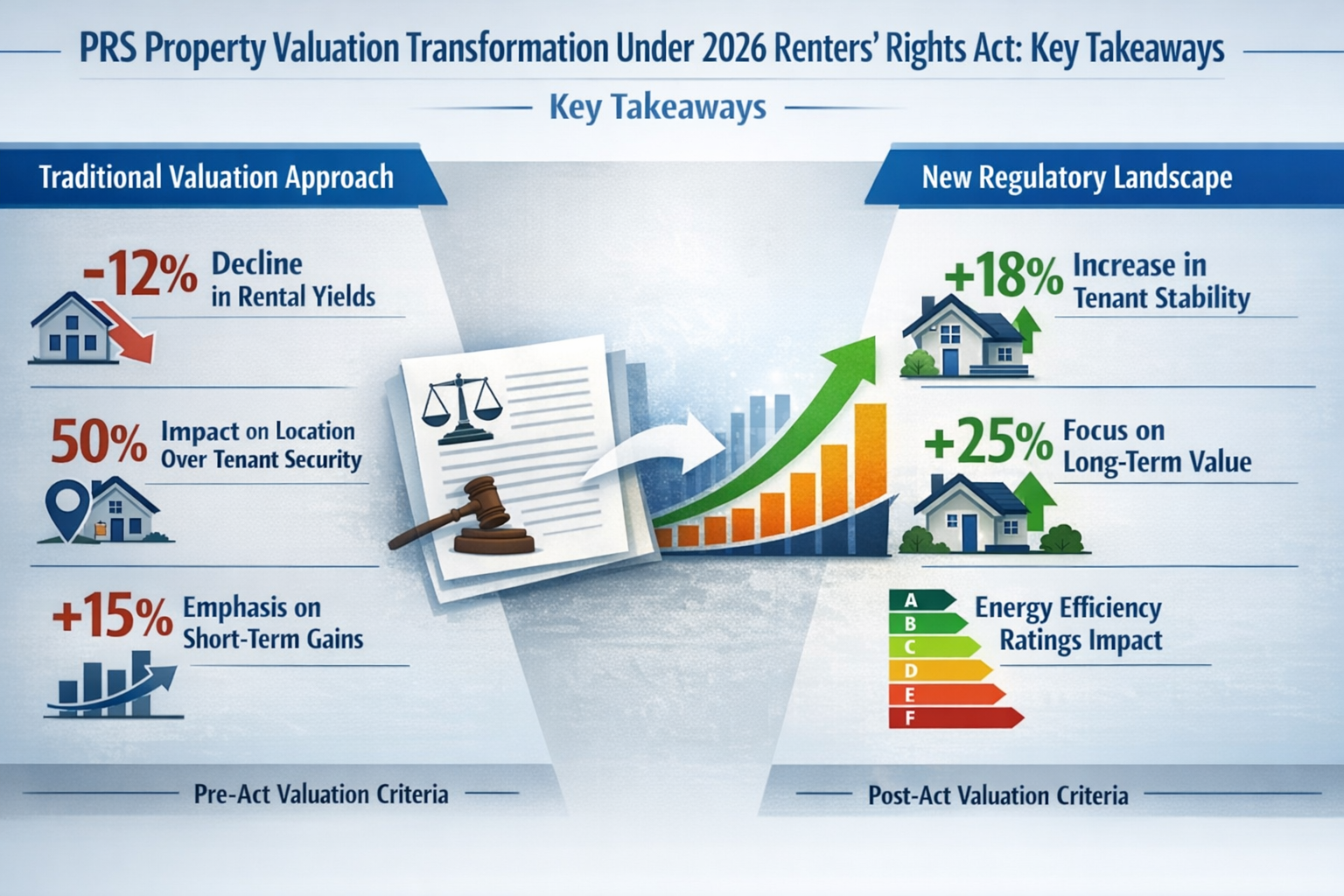
RICS Valuation Methodology Adaptations: Valuing PRS Properties Under New Rent Review Rules
The Royal Institution of Chartered Surveyors (RICS) Red Book provides the professional standards framework for property valuations. However, valuing PRS properties under new rent review rules: RICS tactics post-Renters' Rights Act 2026 requires specific adaptations to traditional methodologies.
The Comparative Method: Adjusting for Regulatory Differences
The comparative method remains the primary valuation approach for residential investment properties, but surveyors must now make explicit adjustments for regulatory status.
Legacy vs. New Framework Comparables
When selecting comparable properties, surveyors must distinguish between:
Legacy Properties:
- ASTs executed before May 1st, 2026, with grandfathered provisions
- Properties with existing fixed-term agreements still in effect
- Portfolios with established rent review patterns
New Framework Properties:
- All tenancies commenced after May 1st, 2026
- Converted periodic tenancies under the new Act
- Properties subject to annual review restrictions
Adjustment Methodology:
| Property Feature | Legacy AST Adjustment | New Framework Adjustment | Differential |
|---|---|---|---|
| Rent Review Frequency | 0% (baseline) | -3% to -5% | Reduced income flexibility |
| Tenancy Security | 0% (baseline) | -2% to -4% | Increased void risk |
| Tribunal Challenge Risk | -1% | -3% to -5% | Enhanced tenant rights |
| Management Intensity | 0% (baseline) | -1% to -2% | Higher administrative burden |
These adjustments should be applied to the capital value derived from comparable transactions. A property that would have valued at £400,000 under legacy rules might now be adjusted to £368,000-£384,000 under the new framework (8-12% total reduction).
Income Capitalization: Adjusting Yields for Regulatory Risk
The income capitalization method (also known as the investment method) values properties based on their income-generating capacity. The formula is:
Market Value = Net Annual Income ÷ Capitalization Rate (Yield)
Under the new regulatory environment, surveyors must adjust both components:
Net Annual Income Adjustments
-
Rental Income Projection: Apply conservative growth assumptions
- Pre-2026: 3-5% annual rental growth assumption
- Post-2026: 2-3% annual rental growth (accounting for tribunal challenge risk)
-
Void Period Allowance: Increase expected vacancy rates
- Pre-2026: 4-6 weeks annually (8-12% of rental income)
- Post-2026: 6-8 weeks annually (12-16% of rental income)
-
Management Costs: Factor increased administrative burden
- Pre-2026: 10-12% of gross rental income
- Post-2026: 12-15% of gross rental income
Capitalization Rate Adjustments
Yields must reflect the increased risk profile of PRS investments:
Prime London Zone 1-2:
- Pre-2026 yield: 3.5-4.0%
- Post-2026 yield: 4.0-4.5%
Outer London/Major Cities:
- Pre-2026 yield: 4.5-5.5%
- Post-2026 yield: 5.0-6.0%
Regional Markets:
- Pre-2026 yield: 5.5-6.5%
- Post-2026 yield: 6.0-7.0%
These yield adjustments reflect the market's pricing of regulatory risk, reduced income flexibility, and increased tenant protections. When conducting professional property valuations, these adjustments must be explicitly documented and justified.
The Discounted Cash Flow Method: Scenario Modeling
For larger portfolios or complex PRS investments, the DCF method provides the most sophisticated valuation approach. This method requires:
- Multi-year income projections with explicit assumptions
- Probability-weighted scenarios for tenant challenges and void periods
- Terminal value calculations reflecting long-term regulatory environment
- Appropriate discount rates incorporating systematic and property-specific risks
Scenario Framework:
Base Case (60% probability):
- Annual rent increases at 2.5%
- 10% of increases challenged, 30% of challenges successful
- Standard void periods of 6 weeks
- Exit yield at Year 10: 5.5%
Optimistic Case (20% probability):
- Annual rent increases at 3.5%
- 5% of increases challenged, 20% of challenges successful
- Void periods of 4 weeks
- Exit yield at Year 10: 5.0%
Pessimistic Case (20% probability):
- Annual rent increases at 1.5%
- 20% of increases challenged, 50% of challenges successful
- Void periods of 8 weeks
- Exit yield at Year 10: 6.5%
The probability-weighted average of these scenarios provides a more robust valuation than single-point estimates.
Market Evidence Gathering: Post-Act Transaction Analysis
The March 2026 RICS survey showing -15% net balance in house prices[3] reflects the market's initial response to the legislative changes. Surveyors must carefully analyze transaction evidence to distinguish between:
- Pre-announcement transactions (before legislative details were known)
- Transition period transactions (between announcement and implementation)
- Post-implementation transactions (after May 1st, 2026)
Only post-implementation transactions provide reliable comparable evidence for properties now subject to the new framework. When reviewing different types of property surveys, ensure that valuation reports explicitly identify which transaction cohort was used for comparable analysis.
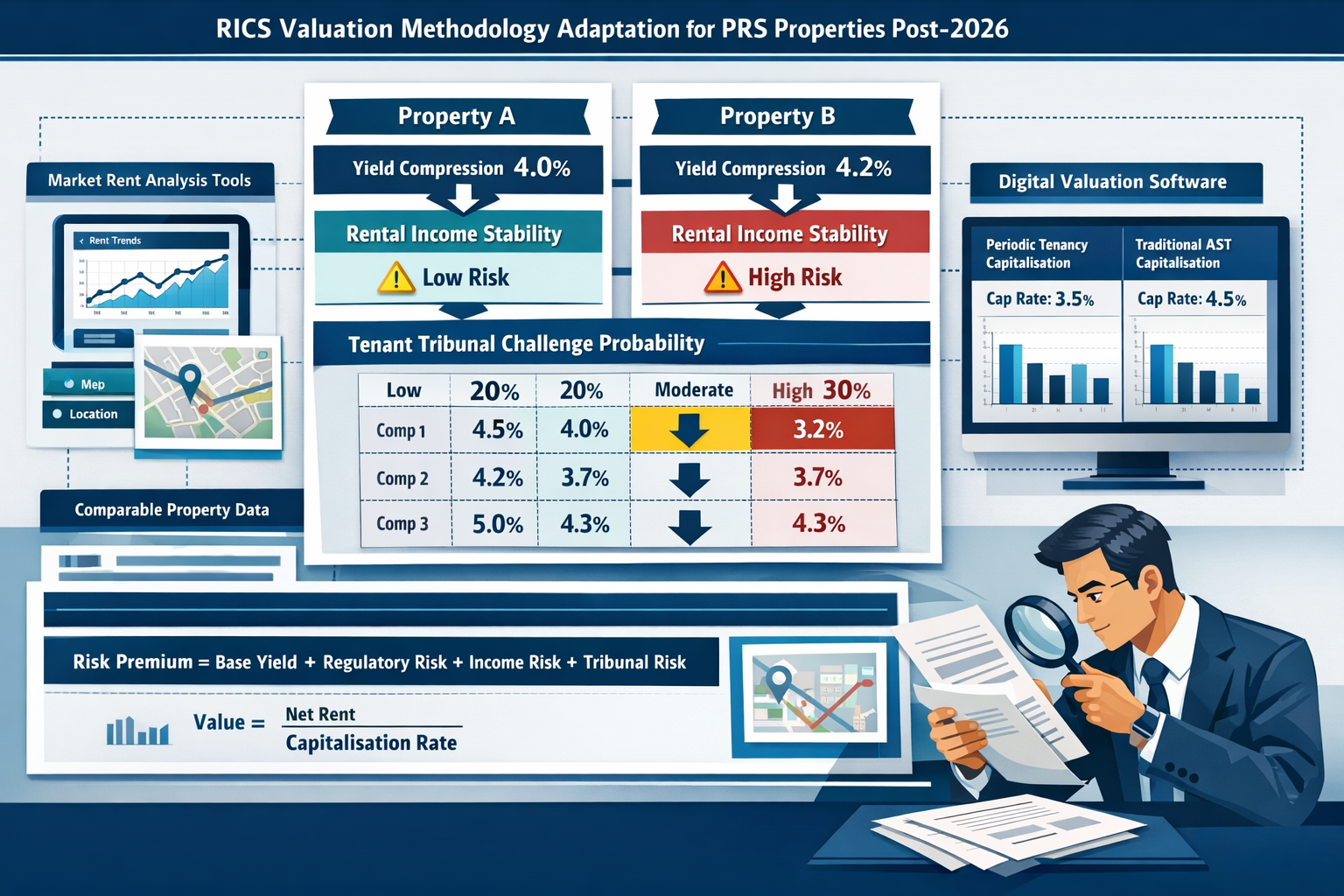
Practical Scenarios: Valuing PRS Properties Under New Rent Review Rules and Tenant Challenge Dynamics
Understanding theoretical adjustments is essential, but practical application requires analyzing real-world scenarios where valuing PRS properties under new rent review rules: RICS tactics post-Renters' Rights Act 2026 intersect with tenant behavior and tribunal outcomes.
Scenario 1: First-Time Tenant Challenging Market-Rate Increase
Property Details:
- Two-bedroom flat in Hammersmith, West London
- Current rent: £1,800 per month
- Landlord proposes increase to £1,950 (8.3% increase)
- Tenant has occupied property for 18 months
- Local market rents: £1,850-£2,000 for comparable properties
Tenant Challenge Basis:
The tenant argues that the increase exceeds the annual inflation rate (4.2%) and that comparable properties in the immediate area are available at £1,850-£1,900.
Tribunal Considerations:
- Market evidence: Tribunal reviews comparable rental listings and recent lettings
- Property condition: Assessment of whether improvements justify premium pricing
- Landlord costs: Consideration of increased mortgage rates, maintenance, and regulatory compliance costs
- Proportionality: Whether the increase is reasonable given market conditions
Likely Outcome:
Tribunal reduces the increase to £1,875 (4.2% increase), aligning with inflation and mid-market comparable evidence.
Valuation Impact:
When valuing similar properties in Hammersmith, surveyors should:
- Apply a 30-40% probability that aggressive rent increases will be moderated by tribunal
- Use conservative rental growth assumptions (2-3% annually rather than 5-7%)
- Include a risk premium of 0.25-0.5% in yield calculations to account for challenge uncertainty
Scenario 2: Experienced Landlord with Documented Improvements
Property Details:
- Three-bedroom Victorian terrace in Battersea
- Current rent: £2,400 per month
- Landlord proposes increase to £2,650 (10.4% increase)
- Landlord has invested £15,000 in property improvements (new kitchen, bathroom renovation, energy efficiency upgrades)
- Property now has EPC rating B (improved from D)
Tenant Challenge Basis:
Tenant argues that the increase is excessive and that comparable properties without improvements rent for £2,450-£2,500.
Tribunal Considerations:
- Improvement justification: Landlord provides receipts, before/after photos, and professional valuations
- Energy efficiency benefits: Tenant's reduced utility costs offset portion of rent increase
- Market positioning: Property now commands premium due to superior condition
- Amortization period: Whether landlord can recover improvement costs over reasonable timeframe
Likely Outcome:
Tribunal approves increase to £2,600 (8.3% increase), recognizing legitimate improvement-driven value enhancement but moderating the proposed amount.
Valuation Impact:
For properties in Battersea and similar areas, surveyors should:
- Differentiate between improvement-justified and market-driven increases in rental growth projections
- Apply lower challenge risk (15-20% probability) when landlords can document substantial improvements
- Consider capital expenditure recovery periods in DCF models (typically 5-7 years for major improvements)
- Adjust yields based on property condition relative to local stock
Scenario 3: Portfolio Landlord with Multiple Properties
Portfolio Details:
- 12-property portfolio across North London
- Mix of one, two, and three-bedroom flats
- Current aggregate annual rental income: £288,000
- Landlord proposes 6% average increase across portfolio
Tenant Response:
- 4 tenants accept increase without challenge
- 5 tenants negotiate directly, settling at 3-4% increases
- 3 tenants formally challenge at tribunal
Tribunal Outcomes:
- 1 challenge results in 2% increase (tribunal finds market evidence doesn't support 6%)
- 1 challenge results in 4% increase (tribunal finds partial justification)
- 1 challenge results in 0% increase (tribunal finds property condition issues must be addressed first)
Portfolio Valuation Impact:
When valuing multi-property PRS portfolios, surveyors must:
-
Model tenant response distributions:
- 30-40% accept proposed increases
- 40-50% negotiate informal reductions
- 10-20% pursue formal tribunal challenges
-
Apply weighted average outcomes:
- Proposed increase: 6%
- Realized increase after challenges: 3.8%
- Valuation should use 3.8% rental growth, not 6%
-
Account for legal and administrative costs:
- Tribunal filing fees: £100-300 per case
- Professional representation: £500-1,500 per case
- Management time and opportunity cost
- Deduct estimated annual challenge costs from net income (typically £500-1,000 per property annually)
-
Portfolio risk diversification:
- Larger portfolios benefit from statistical averaging of outcomes
- Apply slightly lower risk premiums (0.25-0.4% yield adjustment) compared to single properties (0.4-0.6% adjustment)
For landlords managing portfolios across North London and other regions, understanding these dynamics is crucial for accurate financial planning and investment decision-making.
Scenario 4: New Build Property with Premium Positioning
Property Details:
- Brand new two-bedroom apartment in Kilburn regeneration area
- Initial letting at £2,000 per month
- After 12 months, landlord proposes increase to £2,200 (10% increase)
- Property features smart home technology, concierge service, gym access
Tenant Challenge Basis:
Tenant argues that the property is no longer "new" and that the 10% increase exceeds market norms for established properties in the area (£1,850-£2,050 for comparable non-new builds).
Tribunal Considerations:
- New build premium depreciation: How quickly does "new build" status lose market value?
- Amenity value: Quantifiable benefit of smart home features, concierge, gym
- Market segmentation: Whether new build and established stock constitute separate markets
- Landlord's premium positioning strategy: Commercial reasonableness of maintaining premium pricing
Likely Outcome:
Tribunal approves increase to £2,100 (5% increase), recognizing some premium for superior amenities but rejecting full new-build premium after first year.
Valuation Impact:
For properties in Kilburn and other regeneration areas:
- New build premium decays more rapidly under new regulatory framework (50% decay in Year 2 vs. 30% under previous regime)
- Amenity premiums must be justified with specific comparable evidence
- Apply higher yield requirements for premium-positioned properties (additional 0.3-0.5%) due to greater challenge risk
- Consider market cycle positioning—premium properties face higher downside risk in softening markets
Advanced RICS Tactics: Risk Mitigation and Value Optimization Strategies
Beyond fundamental valuation adjustments, experienced chartered surveyors employ sophisticated tactics to accurately assess PRS properties under the new regulatory environment.
Covenant Strength Analysis Under Periodic Tenancies
Traditional ASTs with fixed terms provided a degree of income certainty based on lease covenants. Periodic tenancies eliminate this security, requiring surveyors to assess tenant covenant strength differently:
Tenant Categorization Framework:
Category A: High Covenant Strength (Risk Adjustment: -0.1% yield)
- Long-term occupancy history (3+ years)
- Professional employment with stable income
- Excellent payment record
- Low probability of challenge or termination
Category B: Standard Covenant Strength (Risk Adjustment: 0%)
- 1-2 years occupancy
- Stable employment
- Satisfactory payment record
- Moderate probability of challenge
Category C: Lower Covenant Strength (Risk Adjustment: +0.3-0.5% yield)
- New tenancy (<12 months)
- Variable income or employment uncertainty
- Payment issues or disputes
- Higher probability of challenge or early termination
When conducting RICS commercial building surveys or residential valuations, explicitly categorizing tenant covenant strength provides more accurate risk-adjusted valuations.
Geographic Market Segmentation
The impact of the Renters' Rights Act varies significantly by location. Surveyors should apply location-specific adjustments:
Prime Central London:
- Lower regulatory impact due to international tenant base
- Higher tenant sophistication and legal representation
- Yield adjustment: +0.2-0.3%
Outer London/Major Cities:
- Moderate regulatory impact
- Mixed tenant sophistication
- Yield adjustment: +0.4-0.6%
Regional/Secondary Markets:
- Higher regulatory impact due to lower rent levels and tighter tenant margins
- Lower tenant legal representation
- Yield adjustment: +0.5-0.8%
Improvement-Linked Rent Review Strategies
Forward-thinking landlords are restructuring their investment strategies to align with the new regulatory environment. Surveyors should recognize and value these approaches:
Strategy 1: Scheduled Improvement Programs
- Landlords plan significant improvements to coincide with annual review dates
- Improvements provide tribunal-defensible justification for above-market increases
- Valuation approach: Capitalize planned improvement costs and associated rent uplifts with lower risk premiums
Strategy 2: Energy Efficiency Focus
- Targeting EPC B or A ratings to command premium rents
- Tenant utility savings provide objective value justification
- Valuation approach: Apply green premium (5-10% capital value uplift) with lower challenge risk
Strategy 3: Amenity Enhancement
- Adding value through services rather than base rent increases
- Concierge, maintenance packages, smart home technology
- Valuation approach: Separate amenity income streams with distinct risk profiles
Legal and Compliance Cost Capitalization
The new regulatory environment introduces ongoing compliance costs that must be capitalized into property values:
Annual Compliance Cost Budget (per property):
- Tribunal challenge reserve: £500-1,000
- Enhanced tenancy documentation: £200-400
- Professional advice and updates: £300-500
- Database registration and compliance: £100-200[2]
- Total: £1,100-2,100 per property annually
These costs should be deducted from net operating income before applying capitalization rates. For a property generating £24,000 annual rent, compliance costs represent 4.5-8.8% of gross income—a material impact on valuation.
Portfolio Optimization Through Selective Disposal
Savvy investors are using current market conditions to optimize portfolios. Surveyors should recognize value implications:
Properties to Retain (Lower Yield Requirements):
- Modern, high-quality stock with low maintenance requirements
- Properties in strong rental markets with low void risk
- Assets with recent improvements and tribunal-defensible rent levels
Properties to Dispose (Higher Yield Requirements):
- Older stock requiring significant capital expenditure
- Properties in weak rental markets with high tenant challenge risk
- Assets with rent levels significantly above current market
When preparing valuations for portfolio analysis, explicitly categorize properties within this framework to provide actionable investment guidance.
Conclusion: Navigating the New PRS Valuation Landscape
Valuing PRS properties under new rent review rules: RICS tactics post-Renters' Rights Act 2026 represents a fundamental shift in how chartered surveyors assess residential investment properties. The combination of annual rent review restrictions, periodic tenancy conversions, and enhanced tenant tribunal rights has introduced new layers of complexity and risk that must be explicitly quantified in professional valuations.
The key principles for accurate PRS valuation in 2026 and beyond include:
✅ Apply regulatory-specific adjustments to comparable evidence, distinguishing between legacy and new framework properties
✅ Increase capitalization rates by 0.4-0.8% to reflect reduced income flexibility and heightened tenant protections
✅ Use conservative rental growth assumptions (2-3% annually) that account for tribunal challenge probability
✅ Incorporate scenario modeling for larger portfolios, with probability-weighted outcomes for tenant challenges
✅ Differentiate tenant covenant strength under periodic tenancies, applying appropriate risk premiums
✅ Capitalize compliance costs as ongoing operational expenses that reduce net income
✅ Recognize improvement-justified increases as lower-risk income enhancements with tribunal support
The March 2026 RICS survey data showing -15% net balance in house prices[3] confirms that the market is actively repricing PRS assets to reflect these new realities. Surveyors who fail to incorporate these adjustments risk materially overstating property values, potentially exposing clients to poor investment decisions.
Actionable Next Steps
For property investors and landlords:
- Commission updated valuations for existing PRS portfolios using post-Act methodologies
- Review rent review strategies to align with annual restriction and tribunal challenge dynamics
- Develop improvement programs that provide tribunal-defensible rent increase justifications
- Assess portfolio composition to identify properties with higher regulatory risk profiles
For chartered surveyors:
- Update valuation templates to include explicit regulatory adjustment sections
- Build comparable databases that distinguish pre- and post-Act transactions
- Develop tribunal outcome tracking to refine challenge probability assumptions
- Enhance client reporting to explain regulatory impact on values clearly
For prospective buyers:
- Verify surveyor qualifications and ensure they understand post-Act valuation requirements by checking surveyor credentials
- Request scenario analysis showing range of potential values under different regulatory outcomes
- Understand yield expectations for target properties given location and tenant profile
- Factor compliance costs into investment return calculations
The PRS market will continue evolving as tribunal precedents develop and market participants adapt to the new regulatory framework. Surveyors who master these valuation tactics will provide invaluable guidance to clients navigating this transformed investment landscape. By applying rigorous, evidence-based methodologies that explicitly account for regulatory constraints, RICS-qualified professionals can deliver valuations that accurately reflect both current market realities and future income potential under the Renters' Rights Act 2026.
References
[1] The May 1st Countdown Is Your Rental Portfolio Ready For The Renters Rights Act – https://awh.co.uk/2026/04/10/the-may-1st-countdown-is-your-rental-portfolio-ready-for-the-renters-rights-act/
[2] Party Wall Notice Requirements For Prs Database Compliance Works Surveyor Tactics Post Renters Rights Act Registration In 2026 – https://nottinghillsurveyors.com/blog/party-wall-notice-requirements-for-prs-database-compliance-works-surveyor-tactics-post-renters-rights-act-registration-in-2026
[3] Valuation Adjustments For March 2026 Rics Survey Navigating Softer House Prices And Middle East Conflict Impacts – https://nottinghillsurveyors.com/blog/valuation-adjustments-for-march-2026-rics-survey-navigating-softer-house-prices-and-middle-east-conflict-impacts
