
The UK saw a 76% surge in garden room and home office installations between 2020 and 2023, and that trend has continued into 2026 — yet a significant proportion of those projects were completed without the owners ever considering whether the Party Wall etc. Act 1996 applied [2]. The assumption is almost universal: a timber-framed garden studio is a small, simple structure, so it cannot possibly trigger formal legal obligations. That assumption is frequently wrong, and the consequences of getting it wrong range from injunctions and costly demolition orders to neighbour disputes that drag on for years.
Party wall surveying for garden rooms, outbuildings and home offices sits in a grey area that catches even experienced builders off guard. The Act was drafted with extensions and basement excavations in mind, but its provisions apply equally to modest outbuildings when certain physical conditions are met. Understanding exactly when those conditions are triggered — and what notices must be served — is the focus of this guide.
Key Takeaways
- The Party Wall etc. Act 1996 can apply to garden rooms, home offices and outbuildings even when they appear to be minor structures.
- Foundation type and depth, proximity to the boundary, and whether any shared structure is affected are the three primary notifiability tests.
- Failing to serve notice does not make a project illegal, but it removes important legal protections and can expose building owners to injunctions and claims.
- Notice periods under the Act range from one to two months depending on the section triggered, and notices must contain specific prescribed information.
- Professional party wall surveying advice should be sought before any ground is broken, not after a dispute has already arisen.
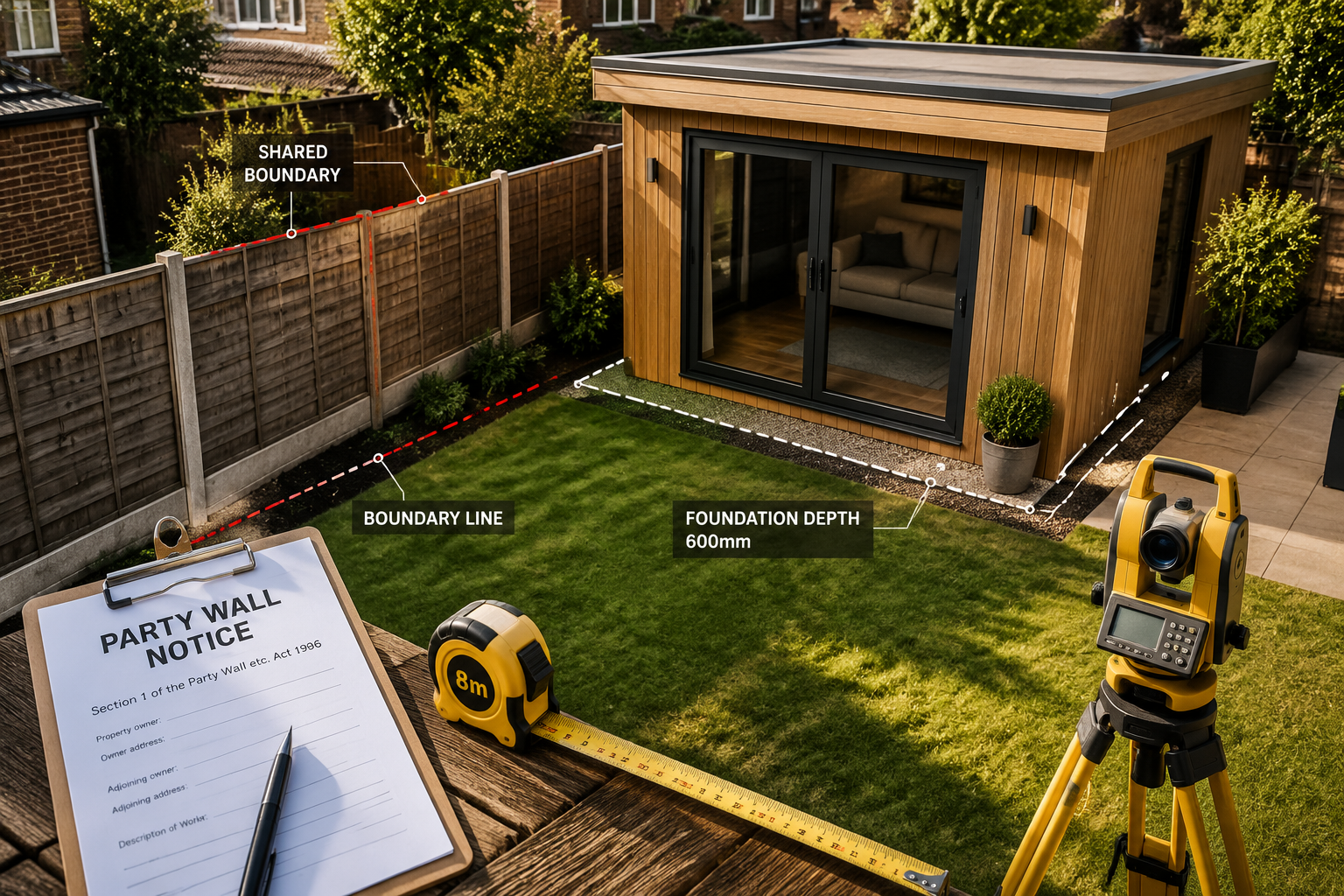
Understanding the Party Wall etc. Act 1996 and Its Scope
The Party Wall etc. Act 1996 governs three distinct categories of work, each addressed by a separate section:
| Section | Trigger | Notice Period |
|---|---|---|
| Section 1 | Building on or at the line of junction (boundary) | 1 month minimum |
| Section 2 | Works to an existing party wall or party structure | 2 months minimum |
| Section 6 | Excavation within 3 or 6 metres of a neighbour's structure | 1 month minimum |
The critical point for garden room and outbuilding projects is that all three sections can be engaged simultaneously, or independently, depending on the specifics of the scheme. A garden office built right against a shared fence with concrete strip foundations could trigger Section 1 (building at the line of junction) and Section 6 (excavating near the neighbour's foundations) at the same time.
For a thorough grounding in when these obligations arise, the complete guide to when you need a party wall agreement sets out the full framework in accessible terms.
What Counts as an "Adjoining Owner"?
The Act defines an adjoining owner as anyone who has an interest (freehold or leasehold) in land or buildings within the zone of influence of the proposed works. For Section 6 excavation notices, this can extend to neighbours whose foundations sit within 3 metres of the proposed excavation measured horizontally — or within 6 metres if the excavation is deeper than the bottom of those foundations projected at 45 degrees [1]. This means a garden room built at the far end of a long garden could still engage the Act if the foundations are deep enough and a neighbour's outbuilding or extension sits within that zone.
The Three Notifiability Tests for Garden Rooms and Outbuildings
Party wall surveying for garden rooms, outbuildings and home offices essentially comes down to applying three sequential tests to any proposed scheme. Each test corresponds to a different section of the Act.
Test 1: Is the Structure Being Built on or at the Line of Junction?
Section 1 applies when a building owner proposes to build a wall astride the boundary line, or a wall up to (but not over) the boundary. For garden rooms, this is most commonly triggered when:
- The structure is designed to sit flush against the boundary fence or wall.
- The building owner wants to use the boundary wall as one face of the outbuilding.
- Overhanging eaves, gutters or footings extend across the boundary line.
Common mistake: Many homeowners assume that because the main structure sits within their land, Section 1 does not apply. However, if the foundations or footings of the garden room cross the boundary — even by a few centimetres — the Act is engaged [1]. Surveyors routinely identify this issue during pre-commencement checks, particularly where timber-framed structures are set on concrete pads that spread laterally.
Test 2: Are Works Being Carried Out to an Existing Party Structure?
Section 2 is less commonly triggered by new garden rooms, but it becomes relevant when:
- An existing shared garden wall is being incorporated into the new structure.
- The outbuilding is being attached to or built against a party fence wall (a wall that stands on the boundary and is used by both owners).
- Openings, fixings or penetrations are being made into a shared structure.
A party fence wall is not the same as a garden fence. It is a masonry wall that stands on the line of junction and is used by both owners. Attaching a garden room to such a wall, or cutting into it for structural support, clearly engages Section 2 and requires a two-month notice [2].
Test 3: Does the Excavation Come Within 3 or 6 Metres of a Neighbour's Structure?
This is the test that most frequently surprises homeowners undertaking party wall surveying for garden rooms, outbuildings and home offices. Section 6 applies when:
- Excavation is proposed within 3 metres of a neighbouring structure, and the bottom of the excavation will be lower than the bottom of the neighbour's foundations.
- Excavation is proposed within 6 metres of a neighbouring structure, and the bottom of the excavation will be lower than a point on a 45-degree line drawn downward from the bottom of the neighbour's foundations.
The 3-metre rule explained is a useful reference for understanding exactly how this distance is measured in practice.
Foundation type is decisive. Lightweight garden rooms on surface-mounted timber bearers sitting on compacted gravel or paving slabs typically do not involve any excavation at all, and Section 6 is not triggered [1]. However, the moment a building owner opts for:
- Concrete pad foundations
- Concrete strip foundations
- Screw pile foundations (which can reach considerable depths)
- Retaining walls with concrete bases
…the excavation question must be assessed against the neighbour's existing foundation depths. The problem is that the neighbour's foundation depth is rarely known without investigation, which is precisely why professional surveying input is valuable at the design stage.
Foundation Types and Their Impact on Party Wall Obligations
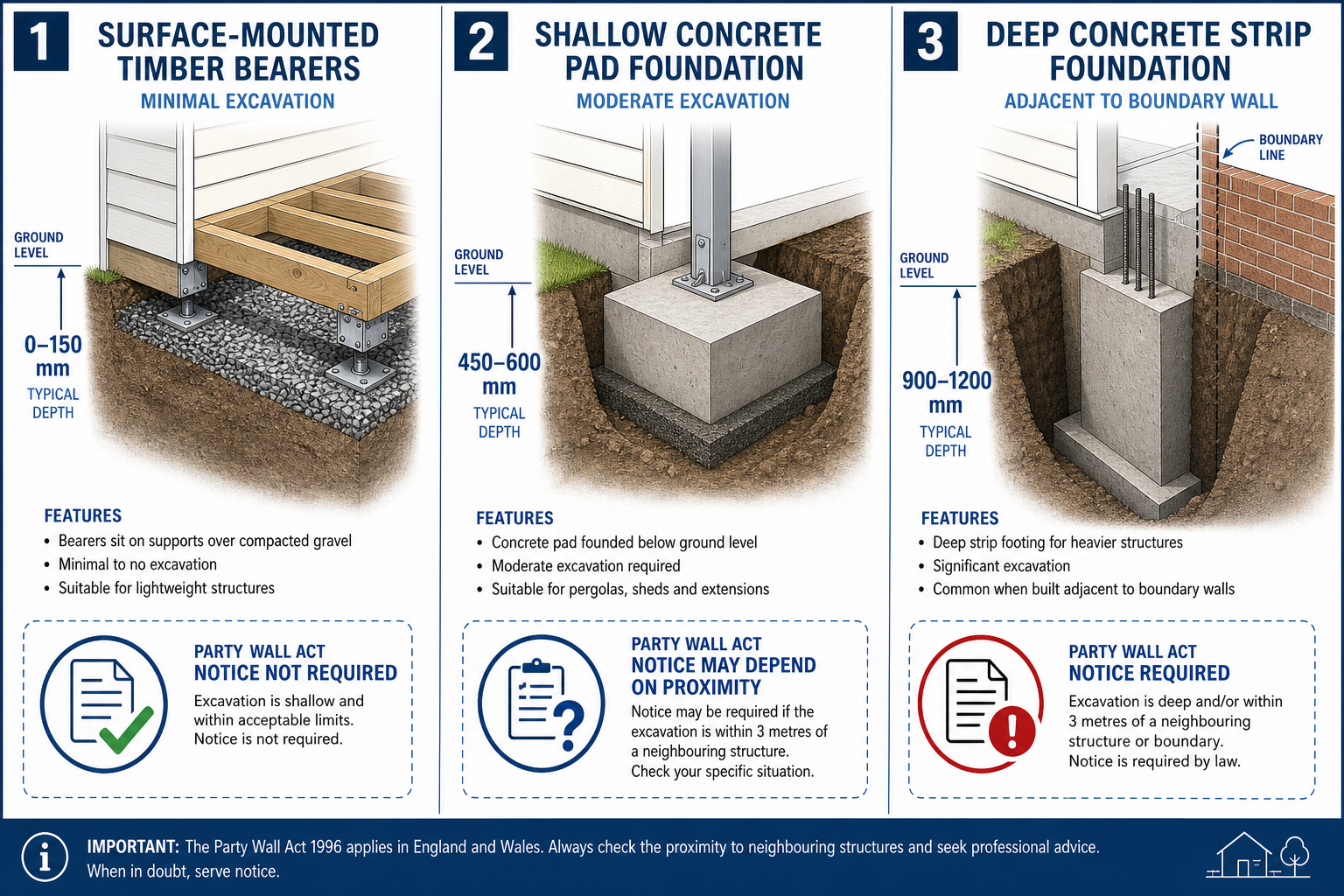
The choice of foundation system for a garden room or home office is the single most important factor in determining whether the Act applies. The table below summarises the most common approaches and their typical notifiability implications.
| Foundation Type | Typical Depth | Section 6 Risk | Recommended Action |
|---|---|---|---|
| Surface-mounted timber bearers on gravel | 0 mm (no excavation) | Very low | Confirm no boundary issues |
| Concrete pad foundations | 300-600 mm | Moderate | Check neighbour's foundation depth |
| Concrete strip foundations | 600-1000 mm | High if near boundary | Serve Section 6 notice |
| Screw piles | 1500-3000 mm+ | High | Almost certainly requires notice |
| Retaining wall with concrete base | Variable | High | Specialist assessment required |
The shift toward screw pile foundations in the garden room industry has created a new category of risk. Screw piles are marketed as a minimally invasive, no-dig solution, but they can penetrate to depths of 2-3 metres or more. At those depths, the 45-degree rule under Section 6 can draw in neighbours whose structures are 5-6 metres away [2].
Retaining Walls: A Frequently Overlooked Trigger
Garden rooms on sloping plots often require retaining walls to create a level base. These walls involve significant excavation and lateral earth pressure that can directly affect neighbouring land. Even where the retaining wall itself sits entirely within the building owner's land, the excavation required to construct it may well trigger Section 6 — and in some cases, the wall's influence on ground movement can affect neighbouring structures in ways that Section 2 also addresses [1].
If a neighbour's garden or outbuilding is uphill from the proposed retaining wall, the risk of differential settlement and ground movement is real. A party wall surveyor will typically commission a schedule of condition of the neighbour's property before work begins, providing a baseline record that protects both parties if any damage is later alleged. Understanding what a party wall dispute involves helps illustrate why that baseline record matters so much.
Common Mistakes in Contemporary Domestic Schemes
The boom in garden offices and outbuildings has generated a predictable set of recurring errors. Recognising them in advance is far more cost-effective than resolving them after the fact.
Mistake 1: Relying on Planning Permission as a Proxy for Party Wall Compliance
Planning permission (or permitted development rights) and the Party Wall etc. Act are entirely separate legal regimes. A garden room can be built under permitted development with no planning application required, yet still trigger the Act in full [3]. Conversely, a project may require full planning permission but have no party wall implications at all. The two systems operate independently, and compliance with one does not imply compliance with the other [4].
Mistake 2: Assuming "No Shared Wall" Means No Notice Required
As the three-test framework above demonstrates, a garden room that does not touch any shared wall can still trigger Section 6 if its foundations are deep enough and close enough to the neighbour's property. The absence of a shared wall removes Section 2 from consideration but leaves Sections 1 and 6 fully in play [2].
Mistake 3: Serving an Invalid Notice
When building owners do recognise the need to serve notice, they sometimes attempt to do so without professional guidance. A valid notice must include [1]:
- The full address of the property where works are proposed.
- The legal names of both the building owner and the adjoining owner.
- A detailed description of the proposed works, including foundation details and dimensions.
- The date on which the notice is served.
- A clear statement that the notice is served under the Party Wall etc. Act 1996.
Omitting any of these elements renders the notice invalid. An invalid notice is legally equivalent to no notice at all, and the clock does not start running on the notice period until a valid notice is served. For guidance on navigating this without professional help, the article on party wall agreements without a surveyor sets out the risks and limitations clearly.
Mistake 4: Starting Work Before the Notice Period Expires
Even where a valid notice is served, work cannot begin until the prescribed notice period has elapsed or the adjoining owner has given written consent. The mandatory periods are:
- Section 1 notice: Minimum 1 month before work starts.
- Section 2 notice: Minimum 2 months before work starts.
- Section 6 notice: Minimum 1 month before work starts.
Starting work early — even by a single day — constitutes a breach of the Act and can result in an injunction requiring work to stop immediately. In practice, this can cause significant delays and additional costs that far exceed the original surveying fees [2].
Mistake 5: Ignoring the Neighbour's Response
If an adjoining owner does not respond to a notice within 14 days, a dispute is deemed to have arisen automatically under the Act. This triggers the appointment of a party wall surveyor (or surveyors) to resolve the matter by way of a Party Wall Award. Many building owners assume that silence from a neighbour means consent — it does not [2]. Understanding how a neighbour can respond to a party wall agreement is essential reading before serving any notice.
What Happens When the Act Is Triggered: The Surveying Process

When a notifiable project is identified, the process follows a well-established sequence. Understanding it removes much of the anxiety that surrounds party wall surveying for garden rooms, outbuildings and home offices.
Step 1: Pre-notice assessment. A party wall surveyor reviews the proposed plans, assesses which sections of the Act apply, and advises on the content and timing of notices. This is the most cost-effective point at which to seek professional input.
Step 2: Notice service. Valid notices are served on all adjoining owners. For Section 6 notices, this includes anyone whose structure falls within the 3-metre or 6-metre zones.
Step 3: Adjoining owner response. The adjoining owner has 14 days to consent in writing or to dissent (or to do nothing, which triggers a deemed dispute). Consent allows work to proceed after the notice period. Dissent triggers the appointment of surveyors.
Step 4: Schedule of condition. Before work begins, the surveyor prepares a photographic and written record of the adjoining owner's property. This is a critical protective document for both parties.
Step 5: Party Wall Award. If surveyors are appointed, they produce a legally binding Award setting out the manner in which the works are to be carried out, working hours, access arrangements and any protective measures required.
For a detailed breakdown of what this process costs, the party wall surveyor cost guide provides current pricing benchmarks. For those who want to understand the Award document itself, the complete guide to party wall awards covers the key provisions in detail.
Practical Checklist: Assessing Notifiability Before Breaking Ground
Use the following checklist when planning any garden room, outbuilding or home office project in 2026:
- Is any part of the structure (including foundations, footings or eaves) within 50mm of the boundary? Consider Section 1.
- Will the structure attach to, cut into or bear on any existing shared wall or party fence wall? Consider Section 2.
- Will any excavation be required within 3 metres of a neighbouring structure? Consider Section 6 (3-metre rule).
- Will any excavation be required within 6 metres of a neighbouring structure, and will it be deeper than the 45-degree projection from the neighbour's foundations? Consider Section 6 (6-metre rule).
- Are screw pile foundations proposed? Treat as a Section 6 risk until depths are confirmed.
- Is a retaining wall required? Seek specialist assessment for both Section 2 and Section 6 implications.
- Have all adjoining owners been identified, including those to the rear and at an angle?
If the answer to any of these questions is yes or uncertain, professional party wall surveying advice should be obtained before work commences. Finding the right professional is straightforward with the guide to finding a reliable party wall surveyor near you.
Conclusion
The popularity of garden rooms, home offices and outbuildings shows no sign of slowing in 2026, and neither does the rate of party wall compliance failures associated with them. The core lesson from party wall surveying for garden rooms, outbuildings and home offices is that the size of a structure is not the determining factor — foundation depth, proximity to boundaries and the involvement of shared structures are what matter under the Act.
Actionable next steps for building owners:
- Commission a pre-notice assessment from a qualified party wall surveyor before finalising the design, particularly the foundation specification.
- Identify all adjoining owners who may fall within the 3-metre or 6-metre zones and factor notice periods into the project programme.
- Ensure any notice served contains all prescribed information to avoid invalidity.
- Do not start work until the notice period has expired and written consent has been received, or a Party Wall Award has been made.
- Request a schedule of condition of the adjoining property before any ground is broken.
Taking these steps costs a fraction of the expense involved in resolving a dispute after the fact — and preserves the neighbourly relationships that make living and working from home genuinely enjoyable.
References
[1] Party Wall Notices For Garden Rooms Outbuildings And Home Offices Do Modern Projects Trigger The Act – https://partywallsurveyorlondon.uk/blogs/party-wall-notices-for-garden-rooms-outbuildings-and-home-offices-do-modern-projects-trigger-the-act/?utm_source=openai
[2] Party Wall Surveying For Garden Rooms Outbuildings And Home Offices When 2026 Homeowners Still Need To Serve Notice – https://princesurveyors.co.uk/blog/party-wall-surveying-for-garden-rooms-outbuildings-and-home-offices-when-2026-homeowners-still-need-to-serve-notice/?utm_source=openai
[3] Garden Room Outbuilding – https://planwatch.co.uk/guides/garden-room-outbuilding?utm_source=openai
[4] London Planning Permission When Does A Garden Room Need A Full Application – https://www.londongardenrooms.uk/blog/london-planning-permission-when-does-a-garden-room-need-a-full-application/?utm_source=openai
