
Roughly one in five property transactions in the UK is delayed or renegotiated after a building survey raises concerns about structural movement — yet the majority of cracks found in residential buildings are cosmetic and pose no structural threat whatsoever. Understanding how surveyors can assess subsidence, settlement, and movement without overstating risk is therefore one of the most practically valuable skills a chartered surveyor can demonstrate, and one of the most important things a property buyer or owner can understand before making decisions that could cost tens of thousands of pounds.
This article explains the key distinctions between types of movement, the diagnostic tools and methods surveyors use, and the criteria that justify further investigation versus a straightforward reassurance.
Key Takeaways
- Settlement and subsidence are fundamentally different processes with different causes, risk profiles, and insurance implications — conflating them overstates risk.
- The width, pattern, and location of a crack are more diagnostic than its mere presence; most residential cracks are cosmetic.
- Monitoring over multiple seasons is often the most proportionate response when movement cannot immediately be classified as historic or active.
- A structured, evidence-based assessment framework helps surveyors communicate risk clearly without alarming clients unnecessarily.
- Specialist input — from structural engineers or geotechnical consultants — is justified only when specific indicators of active, progressive movement are confirmed.
Settlement vs. Subsidence: Why the Distinction Matters
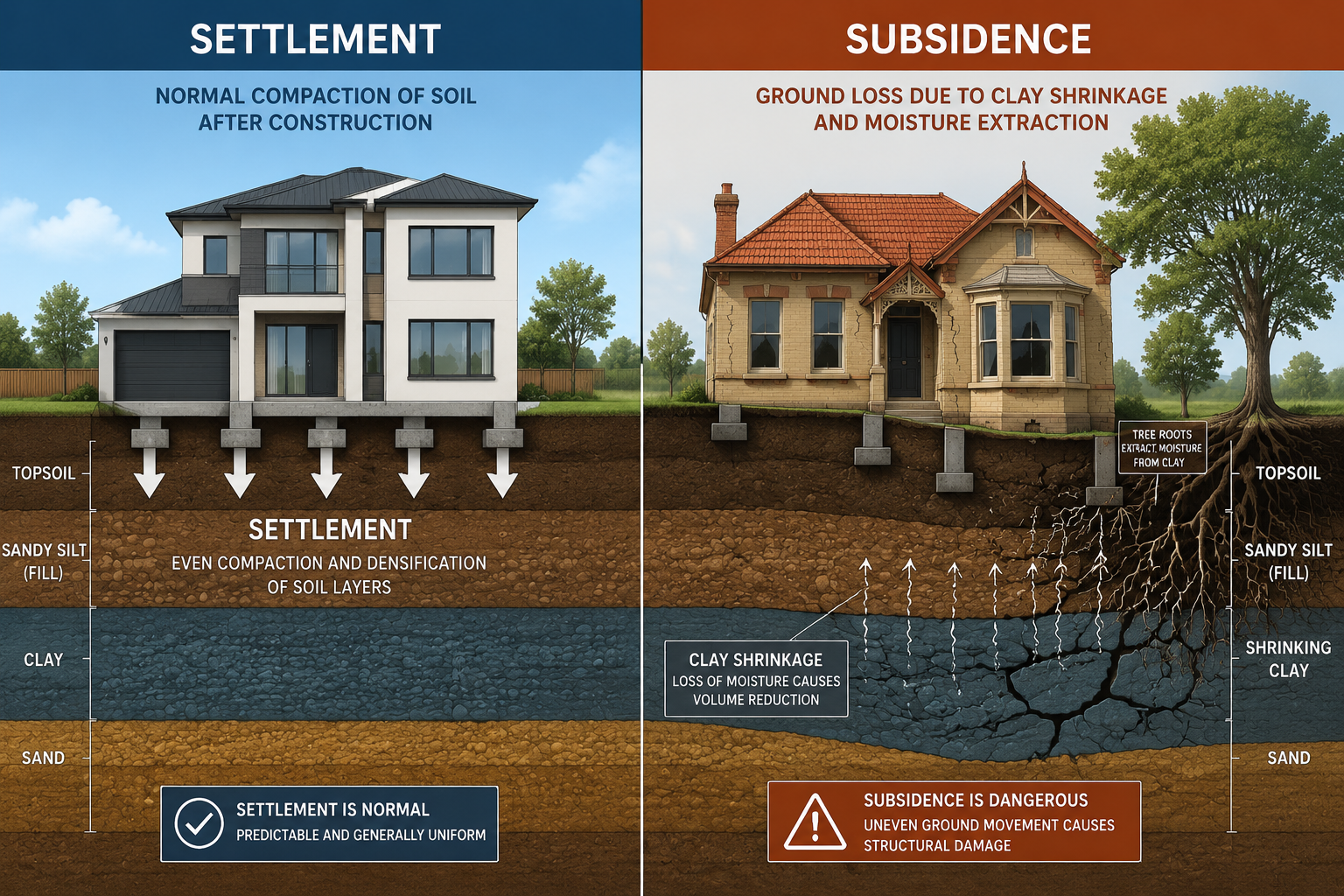
Before examining how surveyors can assess subsidence, settlement, and movement without overstating risk, it is essential to understand what each term actually means — because they are frequently confused, even in professional contexts.
Settlement is the downward movement of a building caused by the weight of the structure itself compressing the soil beneath its foundations. This is a normal, expected process that typically occurs within the first few years after construction. In most cases, settlement is uniform, gradual, and self-limiting. It does not indicate a defect [2].
Subsidence, by contrast, is the downward movement of the ground beneath a building's foundations — independent of the building's own weight. The ground moves, and the building follows. Common causes include:
- Clay soil shrinkage during dry summers
- Tree roots extracting moisture from clay subsoil
- Defective or leaking drainage undermining the soil
- Poor or shallow original foundations
- Mining activity or natural voids [2]
This distinction carries significant practical consequences. Settlement is generally not covered by buildings insurance, while subsidence typically is [2]. A surveyor who misclassifies historic settlement as active subsidence can trigger unnecessary insurance claims, remediation costs, and collapsed property transactions.
Differential Settlement: The Nuance Between the Two
A further complication is differential settlement — where one part of a building settles more than another, producing racking, distortion, and cracking that superficially resembles subsidence. Differential settlement is common in properties with mixed foundation types, extensions built on different soil profiles, or buildings that have undergone significant alterations. Recognising this pattern prevents a surveyor from recommending subsidence investigation when the cause is structural geometry rather than ground failure.
Reading the Evidence: How Surveyors Diagnose Movement
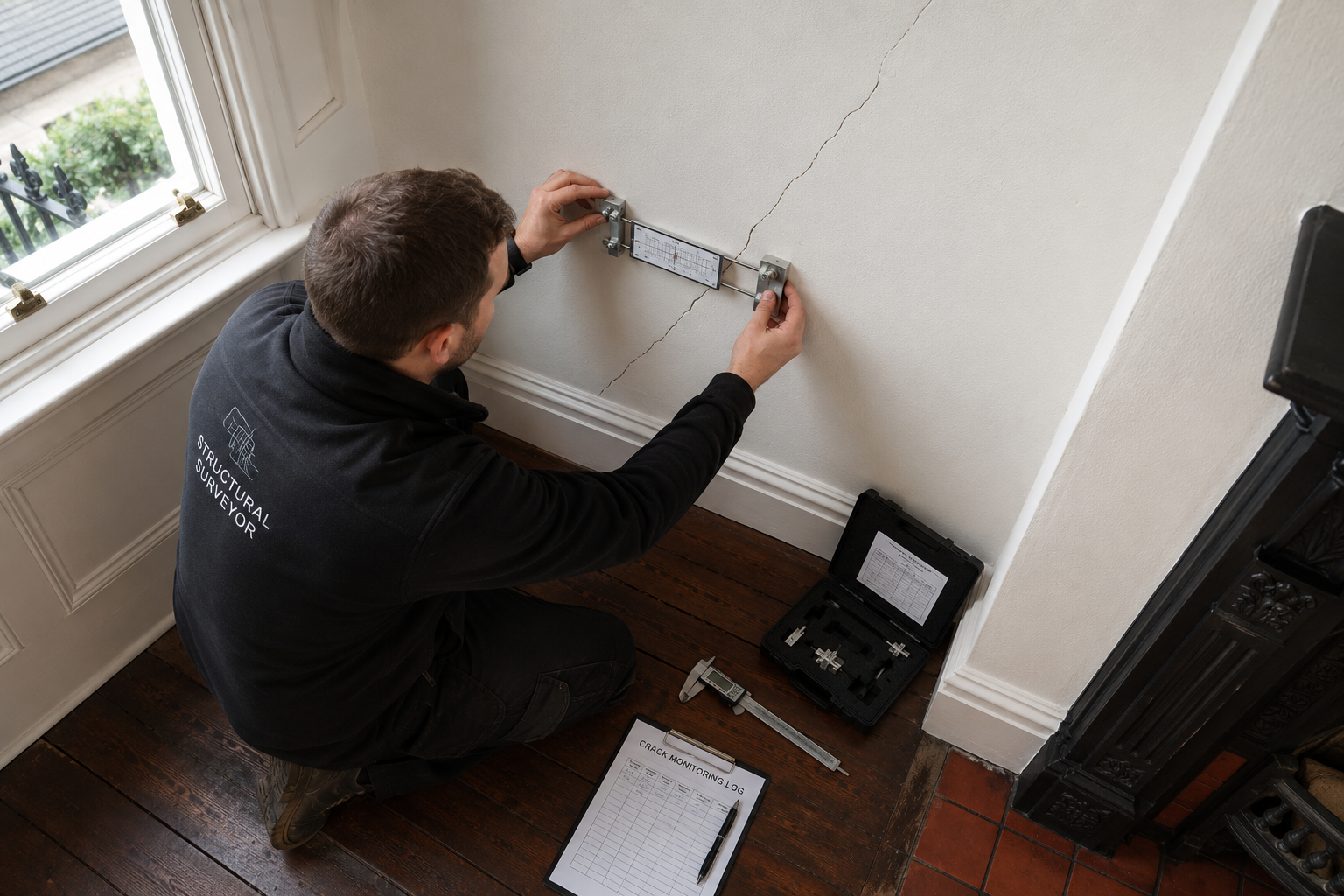
The core of how surveyors can assess subsidence, settlement, and movement without overstating risk lies in a systematic, evidence-based inspection process. Rather than treating every crack as a red flag, experienced surveyors evaluate multiple lines of evidence simultaneously.
Crack Classification: The BRE Scale
The Building Research Establishment (BRE) crack classification system provides a widely accepted framework for categorising visible cracking:
| Category | Crack Width | Description | Action Typically Required |
|---|---|---|---|
| 0 | Hairline (< 0.1 mm) | Negligible | None |
| 1 | Up to 1 mm | Fine | Redecoration only |
| 2 | 1–5 mm | Slight | Minor repairs |
| 3 | 5–15 mm | Moderate | Investigation warranted |
| 4 | 15–25 mm | Severe | Structural assessment needed |
| 5 | > 25 mm | Very severe | Major repairs, possible demolition |
Most cracks found in residential surveys fall into Categories 0–2 and require nothing beyond routine maintenance. Surveyors who report Category 1 cracks with the same urgency as Category 4 cracks are overstating risk and undermining client trust.
Pattern Recognition: What the Shape of a Crack Reveals
The geometry of a crack is frequently more informative than its width alone [8]:
- Diagonal cracks radiating from corners of windows or doors — classic sign of differential settlement or subsidence, particularly if they taper toward one end
- Horizontal cracks in brick mortar joints — may indicate lateral pressure from soil or roof thrust
- Vertical cracks at junctions of extensions — often differential settlement between two structural elements built at different times
- Stepped cracks following mortar joints — typically settlement-related in older properties
- Fine map cracking (crazing) on render — almost always thermal movement or carbonation, not structural
A surveyor examining a diagonal crack running from the top corner of a window opening should note its width at the widest point, whether it tapers, whether it passes through brick or only mortar, and whether there is any displacement (one side higher than the other). Displacement indicates three-dimensional movement and elevates the concern level significantly.
Assessing Whether Movement Is Historic or Active
This is the most critical judgement a surveyor makes. Historic movement has ceased; the building has reached equilibrium. Active movement is ongoing and may worsen. The indicators that help distinguish the two include:
- Crack edges: Rounded, weathered, or painted-over edges suggest old movement. Sharp, fresh edges suggest recent activity.
- Debris in cracks: Old mortar dust, spider webs, or paint bridging a crack indicate it has been stable for some time.
- Redecoration history: If cracks have been filled and have re-opened, movement is likely ongoing.
- Seasonal patterns: Cracks that open in summer and close in winter on clay soils are characteristic of seasonal clay shrinkage — a manageable condition rather than progressive failure [4].
- Door and window operation: Sticking doors and windows that worsen in summer may reflect seasonal thermal or moisture movement rather than structural failure [8].
For a detailed explanation of what a surveyor checks during a property inspection, see what a surveyor checks during a property inspection.
Soil and Ground Conditions
Surveyors assess the likely ground conditions using available evidence: the age and construction type of the property, local geology maps, proximity to trees (particularly willows, oaks, and poplars on clay), and visible drainage condition. Soil sampling around a property can determine soil type and moisture content, providing direct evidence of whether the subsoil is capable of supporting the building or is actively contributing to movement [3].
Properties on shrinkable clay soils in areas such as South East London, Essex, and parts of Surrey face a higher baseline risk of seasonal movement. A chartered surveyor in South East London or chartered surveyor in Essex will factor local geology into their risk assessment rather than applying a uniform national standard.
Identifying Previous Underpinning
Underpinning — the process of strengthening or deepening existing foundations — is a significant material fact that must be identified and disclosed. Because the work is concealed below ground, surveyors cannot directly observe it, but they look for indirect evidence [6]:
- Differences in floor level between underpinned and non-underpinned sections
- Patches of newer brickwork at low level on external walls
- Changes in floor finish or screed thickness
- Disclosure in the property's legal documentation or insurance history
The key question is not simply whether a property has been underpinned, but whether the underpinning resolved the problem. A property that was underpinned 30 years ago and has shown no movement since may present lower risk than one with no underpinning history but active seasonal cracking [6].
When to Monitor, When to Investigate, and When to Reassure
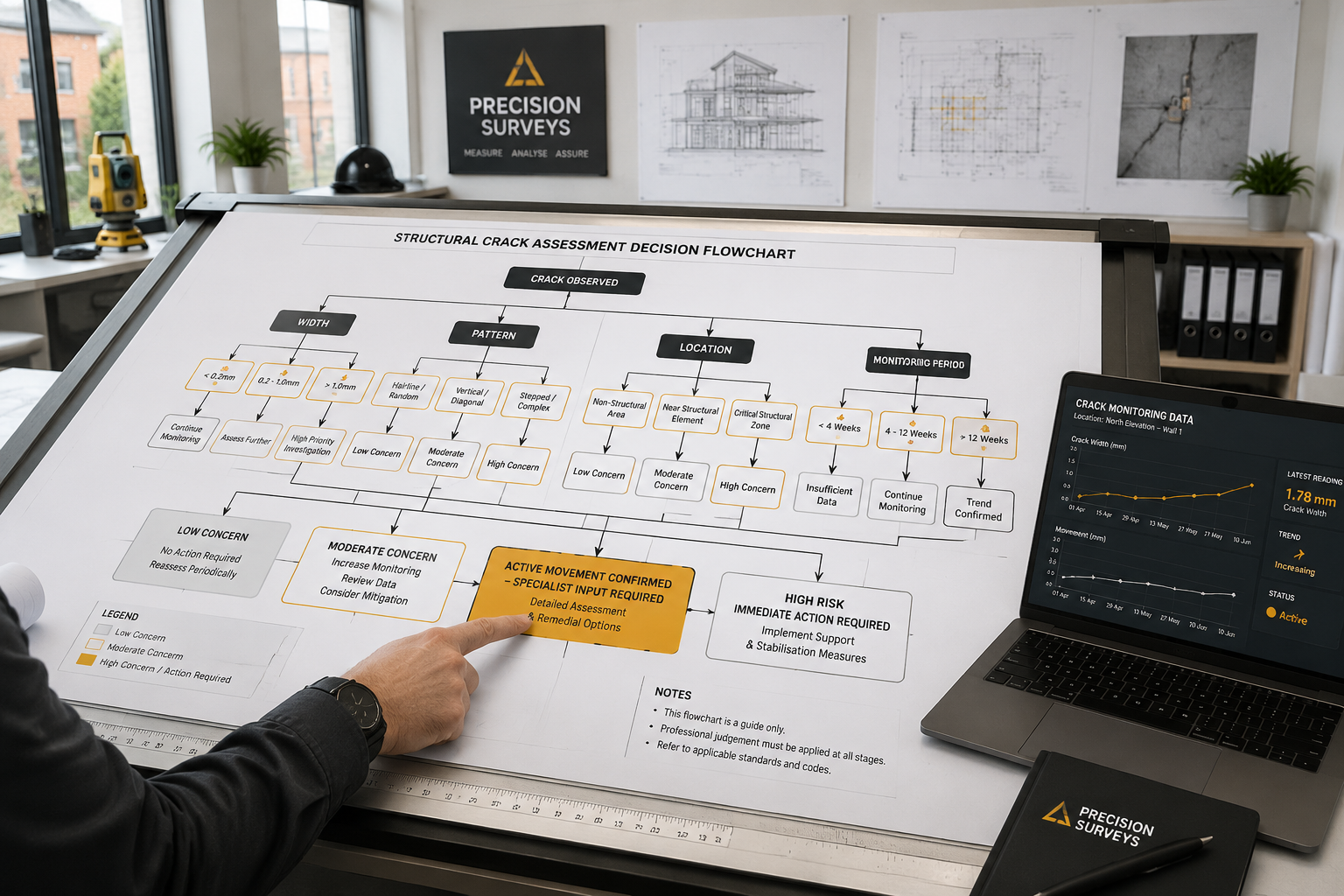
The structured approach to how surveyors can assess subsidence, settlement, and movement without overstating risk culminates in a clear decision framework. Not every crack warrants the same response, and proportionality is essential.
The Three-Response Model
Reassure: Where cracks are Category 0–2, patterns are consistent with thermal or cosmetic movement, edges are weathered, and there is no displacement or door/window distortion, the appropriate response is clear reassurance with a brief explanation of why the movement is not structurally significant.
Monitor: When cracks are Category 2–3, patterns are ambiguous, or movement cannot be clearly classified as historic or active, a period of monitoring is the most proportionate response [4]. Monitoring typically involves:
- Installing tell-tales (crack monitors) across cracks to measure any change in width
- Recording measurements at regular intervals — typically monthly — over a minimum of 12 months to capture seasonal variation
- Comparing readings against weather data (rainfall, temperature) to identify seasonal correlation
Modern deformation monitoring combines traditional levelling with automated sensor systems, GPS structural monitoring, and data-logging equipment that can detect sub-millimetre movements across multiple monitoring cycles [1][7]. This level of precision allows surveyors to distinguish genuine progressive movement from normal thermal expansion and contraction.
Investigate: Where cracks are Category 3 or above, there is clear displacement, multiple indicators of active movement are present, or monitoring confirms progressive movement, specialist structural or geotechnical investigation is justified. This may include:
- Trial pits to inspect foundation depth and condition
- Borehole investigations to assess soil profile
- Drain CCTV surveys to identify leaking or collapsed drainage
- Structural engineer's assessment of load paths and bearing capacity
For properties where a RICS building survey has identified potential movement, commissioning a structural movement survey from a RICS Chartered Surveyor provides a detailed investigation into likely causes — including drainage failure, ground conditions, thermal movement, or historic settlement — and advises on appropriate remedial action [5].
The Role of RICS Survey Levels
The level of survey commissioned affects how thoroughly movement is assessed. A Level 2 home survey provides a condition rating and flags significant concerns but does not include the detailed investigation of a Level 3 building survey. For properties showing any signs of movement — particularly older properties, those on clay soils, or those near large trees — a Level 3 survey is strongly advisable. RICS standards require that all cracks and possible subsidence signs are reported, but the depth of investigation and the quality of contextual analysis depend significantly on the survey level and the surveyor's experience [3].
Buyers uncertain about which level of survey is appropriate can find detailed guidance in this homebuyer survey overview.
Communicating Risk Without Alarming Clients
A critical but often underappreciated skill is translating technical findings into language that clients can understand and act on proportionately. Surveyors who use phrases like "possible subsidence" without qualification, or who recommend specialist investigation for Category 1 cracks, create unnecessary anxiety and can derail transactions that should proceed normally.
Best practice includes:
- Explaining the BRE classification used and where the observed cracking sits within it
- Distinguishing clearly between "this requires monitoring" and "this requires immediate remediation"
- Providing context — for example, noting that diagonal cracking at window corners is extremely common in Victorian terraced properties and does not automatically indicate subsidence
- Quantifying the risk where possible — "this type of movement is consistent with normal thermal expansion and has not progressed in the time since the property was last decorated"
"The most valuable thing a surveyor can offer is not a list of problems, but a calibrated judgement about which problems actually matter and why."
Insurance, Disclosure, and the Broader Risk Picture
Subsidence carries insurance implications that settlement does not. Buildings insurance policies typically cover subsidence damage, but a property with a history of subsidence claims may face higher premiums, exclusions, or difficulty obtaining cover at all [2]. Surveyors should note where a property's movement history may affect insurability and advise clients to make enquiries before exchange of contracts.
Equally, sellers have a legal obligation to disclose known subsidence or structural movement in the property information forms submitted during conveyancing. A surveyor who identifies evidence of past movement that has not been disclosed should flag this as a matter requiring legal clarification.
For buyers concerned about survey outcomes and what they mean in practice, the guide on whether a homebuyers survey is worth it provides useful context on interpreting survey findings proportionately.
Conclusion
Assessing structural movement accurately — and communicating that assessment without overstating risk — is one of the most demanding and consequential tasks a chartered surveyor performs. The key is a structured, evidence-based approach: classifying cracks by the BRE system, reading their pattern and geometry, distinguishing historic from active movement, evaluating ground conditions and drainage, and applying a proportionate response that matches the level of concern to the weight of evidence.
Actionable next steps for property buyers and owners:
- Commission the right level of survey for the property type — a Level 3 building survey for older, extended, or clay-soil properties.
- Ask the surveyor to explain the BRE crack classification used and what it means in practical terms.
- If monitoring is recommended, agree a clear monitoring protocol with defined timescales and decision triggers.
- Before commissioning specialist investigation, confirm that the surveyor has ruled out cosmetic and thermal causes.
- Check the property's insurance and legal disclosure history for any previous subsidence claims or remediation work.
Working with an experienced RICS chartered surveyor who understands local geology, construction history, and proportionate risk communication is the single most effective way to ensure that structural movement is assessed accurately — and that neither buyers nor sellers make costly decisions based on overstated or understated risk.
References
[1] Deformation Monitoring Surveying Techniques – https://surveyingpedia.com/article/deformation-monitoring-surveying-techniques?utm_source=openai
[2] Settlement And Subsidence What You Need To Know – https://www.structuralengineersreports.org/settlement-and-subsidence-what-you-need-to-know/?utm_source=openai
[3] How Do Surveyors Check For Subsidence Expert Advice From Subsidence Surveyors – https://www.surveymerchant.com/blog/how-do-surveyors-check-for-subsidence-expert-advice-from-subsidence-surveyors?utm_source=openai
[4] Subsidence Monitoring – https://www.mypropertyscan.com/survey-decoder/subsidence-monitoring?utm_source=openai
[5] West – https://www.buildingsurvey.co.uk/West.html?utm_source=openai
[6] How Do Surveyors Spot Underpinning – https://www.reallymoving.com/surveyors/faq/how-do-surveyors-spot-underpinning?utm_source=openai
[7] Deformation Settlement Monitoring – https://www.govargo.com/solutions/deformation-settlement-monitoring?utm_source=openai
[8] How To Spot Signs Of Subsidence – https://goreport.com/how-to-spot-signs-of-subsidence/?utm_source=openai
