
The 2026 expansion of Awaab's Law introduced five new hazard categories and triggered an estimated 40% increase in landlord–tenant disputes — a surge that has placed chartered surveyors acting as expert witnesses under unprecedented scrutiny [4]. At the same moment, the Renters' Rights Act has reshaped the tenancy landscape by abolishing fixed-term assured shorthold tenancies and introducing rent control mechanisms that create genuine valuation conflicts between landlords and tenants [4]. For valuers instructed to provide expert evidence in rent disputes, disrepair claims, and loss-of-amenity cases, the stakes have never been higher.
Valuation and expert witness work in residential landlord–tenant disputes: building a robust evidence base under new renting rules demands a disciplined, step-by-step approach. This article sets out a practical framework covering inspection strategy, schedule preparation, comparable selection, and CPR-compliant report structure — equipping valuers to withstand the heightened scrutiny now applied by courts and tribunals in 2026.
Key Takeaways
- The Renters' Rights Act and expanded Awaab's Law have fundamentally changed the evidence requirements for expert witnesses in landlord–tenant disputes.
- RICS is consulting on a fifth edition of its expert witness standard in 2026, addressing artificial intelligence use, conditional fees, and global applicability.
- Courts now expect expert reports to include clearly stated instructions, independence declarations, methodology explanations, comparable evidence schedules, regulatory impact commentary, and sensitivity analysis.
- A structured inspection strategy — covering condition, hazard categories, and rental evidence — is the foundation of a defensible expert opinion.
- CPR Part 35 compliance is non-negotiable; any deviation risks the report being excluded or given diminished weight.

The Regulatory Landscape Reshaping Expert Evidence in 2026
The Renters' Rights Act and Its Valuation Consequences
The Renters' Rights Act, which came into full effect in 2026, abolished assured shorthold tenancies and replaced them with periodic tenancies as the default arrangement. Landlords can no longer serve a Section 21 notice to recover possession without a specified ground. Rent increases are now subject to a statutory process, and tenants can challenge proposed increases at the First-tier Tribunal (Property Chamber).
These changes create direct valuation conflicts. When a landlord proposes a rent increase and a tenant contests it, the tribunal must determine the market rent for the property. Expert witnesses are increasingly called upon to provide and defend valuations in these formal proceedings [8]. The challenge is that "market rent" under the new periodic tenancy framework is not simply the open-market figure — it must account for the regulatory context, including any applicable rent control caps and the property's condition.
Awaab's Law Expansion and Hazard Integration
The 2026 expansion of Awaab's Law added five new hazard categories to the existing Housing Health and Safety Rating System (HHSRS) framework. Landlords are now required to remediate specified hazards within defined timeframes. When they fail to do so, tenants can bring disrepair claims that intersect directly with valuation questions: what reduction in rent is appropriate for the period of disrepair, and what is the diminution in the property's value or amenity?
Expert witnesses must now integrate hazard assessments into their valuation work [4]. A valuer who addresses only the rental figures without engaging with the condition evidence will produce a report that courts and tribunals are likely to find incomplete.
RICS Expert Witness Standards Under Revision
In April 2026, RICS initiated a major consultation on the fifth edition of its expert witness standard — the first update since 2014 [1]. The revised standard is expected to address:
- The use of artificial intelligence tools in evidence preparation
- Conditional fee arrangements and their impact on perceived independence
- Global applicability across different legal jurisdictions
Until the fifth edition is finalised, valuers must comply with the current fourth edition while remaining alert to the direction of travel indicated by the consultation. Courts are already applying heightened scrutiny to expert reports, and the Emmons v. Jesso decision in March 2026 demonstrated how expert analysis of lease terms and industry standards can be decisive in shaping both jury verdicts and judicial reasoning [3].
Step-by-Step Framework: From Instruction to Inspection
Step 1 — Accepting Instructions and Confirming Independence
Before any site visit, the valuer must confirm that the instruction does not create a conflict of interest. Under CPR Part 35, the expert's duty is to the court, not to the instructing party. This principle is reinforced by the current RICS expert witness standard and will be central to the forthcoming fifth edition [1].
A written instruction letter should confirm:
- The identity of the instructing party and any opposing party
- The specific questions the expert is asked to address
- The relevant date or dates of valuation
- Any documents the expert is expected to review
Practical tip: If instructed by one party but likely to be cross-examined on comparables sourced from the opposing party's evidence, state this in the acceptance letter. Transparency at the outset protects the expert's credibility throughout the proceedings.
For a thorough understanding of the types of valuations that may be relevant to these disputes, the RICS valuation services overview provides a useful reference point.
Step 2 — Inspection Strategy for Disrepair and Loss-of-Amenity Cases
The inspection is the foundation of the entire evidence base. A poorly documented inspection cannot be rescued by sophisticated analysis. The following checklist sets out the minimum inspection requirements for residential landlord–tenant disputes in 2026:
| Inspection Element | Purpose | Documentation Method |
|---|---|---|
| Photographic schedule | Records condition at inspection date | Timestamped digital photographs with location references |
| HHSRS hazard assessment | Identifies new Awaab's Law categories | Completed HHSRS scoring sheet |
| Room-by-room condition notes | Supports disrepair and amenity reduction claims | Annotated floor plan |
| Services and installations check | Boiler, electrics, plumbing | Written notes with age and condition ratings |
| External envelope inspection | Roof, walls, windows | Photographs and condition ratings |
| Comparable rental evidence | Anchors the market rent opinion | Schedule of comparables with adjustment notes |
Where damp or structural issues are suspected, a specialist damp survey or structural engineer report should be commissioned to support the valuer's condition evidence. Expert witnesses who rely solely on visual observation without specialist input risk having their condition findings challenged.
Step 3 — Preparing the Comparable Evidence Schedule
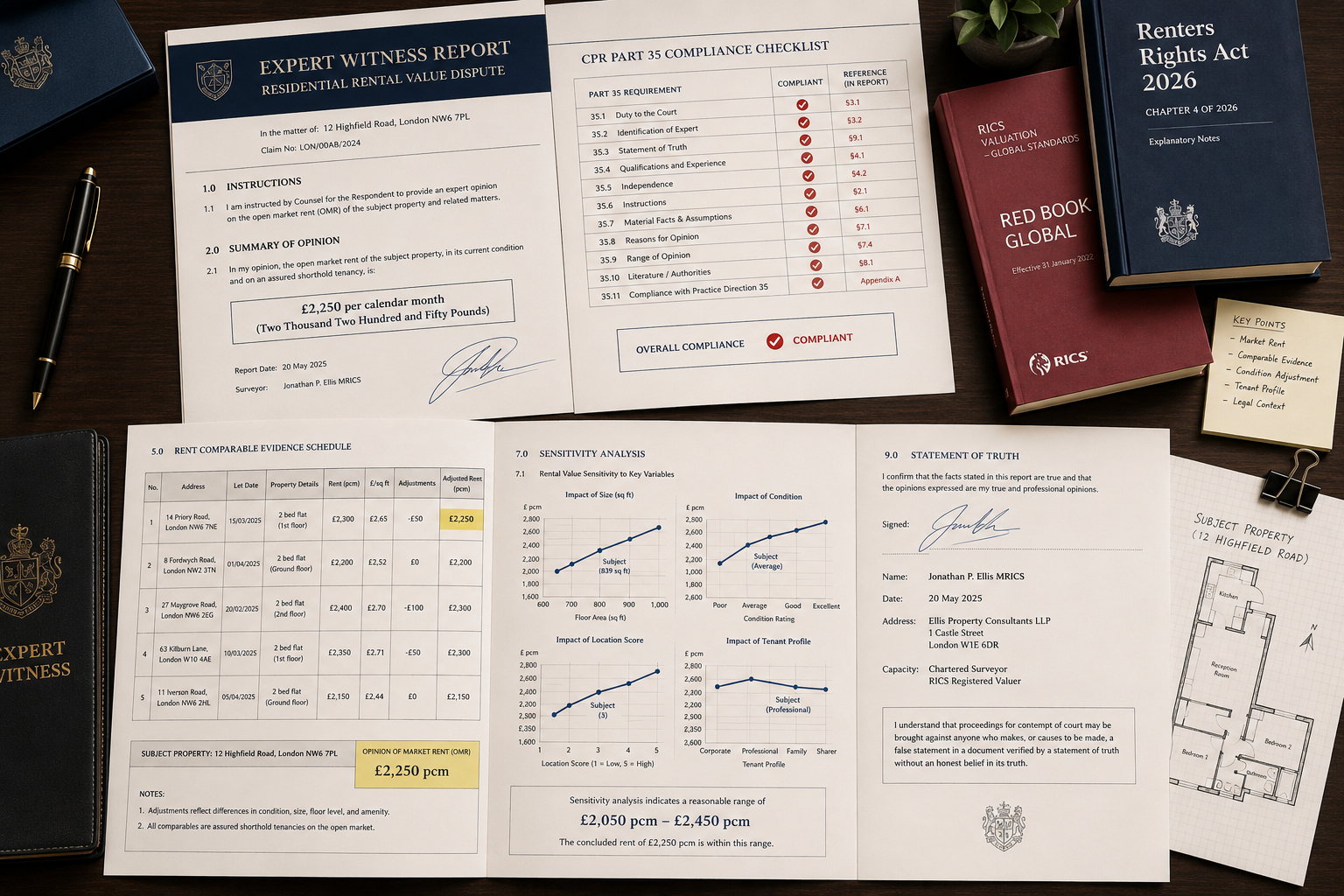
Comparable selection is the area most frequently challenged in cross-examination. Courts and tribunals in 2026 are more exacting than ever about the content and structure of comparable evidence [2]. The schedule must include:
- Property address and description — size, type, age, condition, and location
- Lease terms — rent, lease length, rent-free periods, and any incentives
- Transaction date — adjusted to the relevant valuation date using a recognised index
- Source — Land Registry, VOA, letting agent records, or tribunal decisions
- Adjustments applied — with reasoned explanations for each adjustment
"A comparable that is not explained is a comparable that will be discounted. The valuer's job is not merely to find evidence but to translate it into a reasoned opinion the tribunal can follow."
The adjustment process must be transparent. If a comparable property is larger, older, or in a superior location, the valuer must state the adjustment applied and why. Sensitivity analysis — showing how the final opinion changes if key comparables are excluded or adjusted differently — is now considered a baseline requirement by many tribunals [2].
For disputes involving shared ownership properties, the shared ownership valuation process raises additional complexity around the treatment of the staircasing premium in rental calculations.
Building a CPR-Compliant Expert Witness Report
The Mandatory Components of a Compliant Report
Courts and tribunals now apply a checklist approach to expert reports. A report that omits any of the following components is at risk of being excluded or given reduced weight [2]:
- Title and instructions — who instructed the expert, when, and for what purpose
- Statement of independence — the expert's duty to the court, not the client
- Qualifications and experience — relevant to the specific type of dispute
- Documents reviewed — a complete list of all materials considered
- Inspection details — date, time, who was present, and the scope of the inspection
- Methodology — how the opinion was formed, including the valuation approach adopted
- Comparable evidence schedule — presented as an appendix with full details
- Regulatory impact commentary — addressing the Renters' Rights Act and Awaab's Law implications
- Sensitivity analysis — showing the range of defensible opinions
- Statement of Truth — signed and dated, in the form required by CPR Part 35
Addressing Regulatory Impact in the Report Body
One of the most significant changes in 2026 is the expectation that expert reports will engage directly with the regulatory environment. A rent review opinion that ignores the periodic tenancy framework, or a disrepair valuation that does not address the new Awaab's Law hazard categories, will be seen as incomplete [4].
The regulatory impact section should address:
- Whether the property is subject to any applicable rent control mechanism
- Whether any Awaab's Law hazard categories are present and, if so, how they affect the rental value
- Whether the landlord has complied with the statutory remediation timeframes
- How the regulatory context affects the range of comparable evidence considered
For rent review disputes specifically, the rent review service framework provides a useful structure for understanding how market rent is assessed in a regulated environment.
Valuation Approaches for Different Dispute Types
Different types of landlord–tenant dispute call for different valuation approaches:
Rent disputes (market rent determination)
Use the comparative method, drawing on recent lettings of similar properties. Adjust for condition, location, size, and lease terms. Apply the regulatory framework to confirm whether the market rent figure is consistent with any applicable cap.
Disrepair claims (rental diminution)
Assess the market rent of the property in its actual condition and compare it with the market rent of the property in the condition it should have been in. The difference is the rental diminution. This requires two separate valuation exercises, each supported by comparable evidence.
Loss-of-amenity claims
Quantify the reduction in the tenant's enjoyment of the property caused by the landlord's breach. This may overlap with the disrepair calculation but can also include elements such as noise, loss of access to communal facilities, or temporary displacement.
For cases where the property condition is central to the dispute, a dilapidations survey provides a structured basis for quantifying the scope and cost of outstanding repairs, which in turn informs the rental diminution calculation.
Giving Evidence and Withstanding Cross-Examination
Preparing for Tribunal Hearings
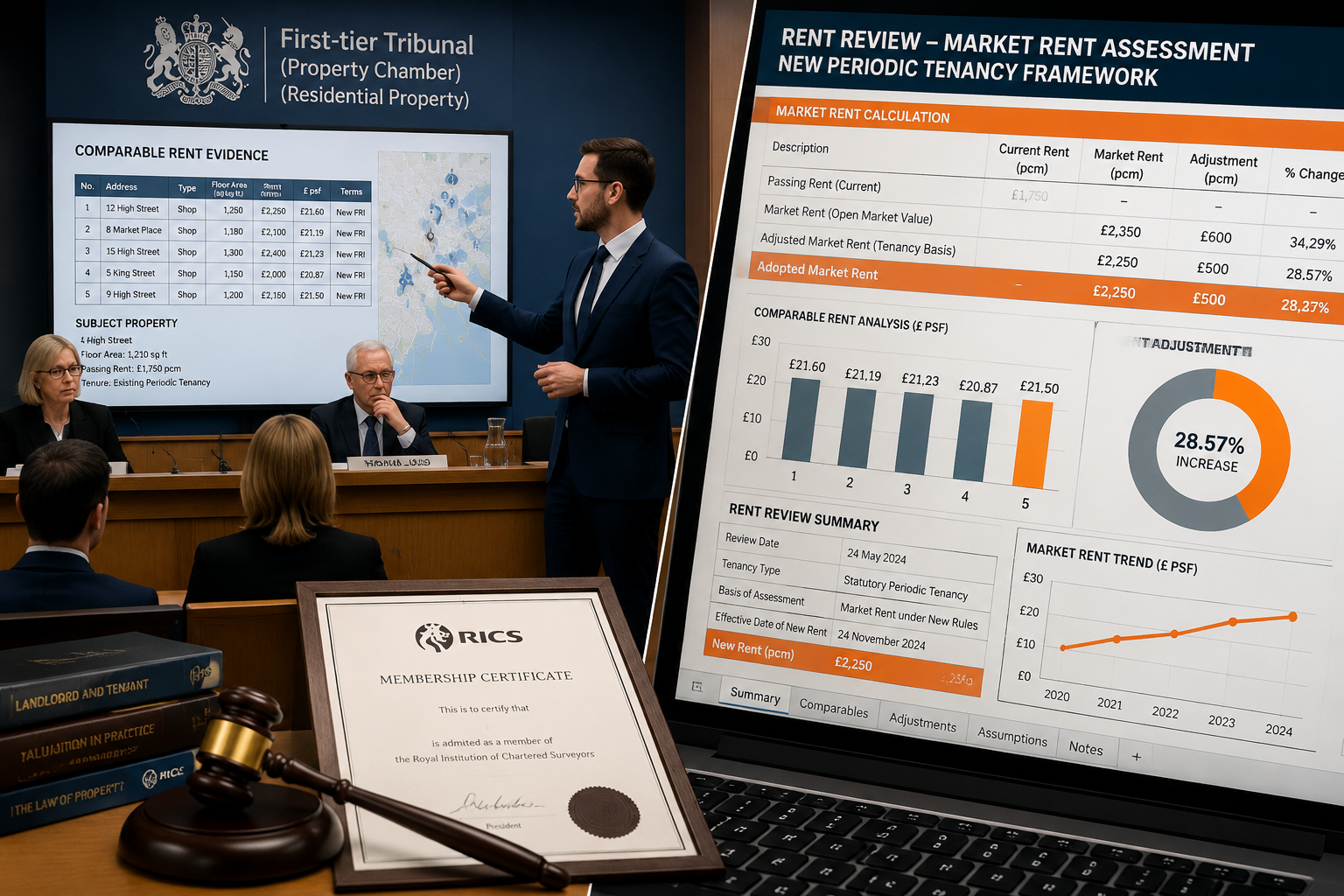
The First-tier Tribunal (Property Chamber) is the primary forum for residential landlord–tenant valuation disputes in England. Proceedings are less formal than the High Court, but the evidential standards applied to expert reports are rigorous. Valuers should expect to be questioned on:
- The selection and weighting of comparables
- The adjustments applied and the reasoning behind them
- The methodology used to assess disrepair or amenity loss
- The regulatory framework and its impact on the opinion
The Emmons v. Jesso case in 2026 illustrated how expert testimony on lease interpretation and industry standards can directly influence the outcome of complex residential disputes [3]. Similarly, the eminent domain inventory dispute decided in May 2026 reinforced the principle that expert methodologies must be clearly articulated and defensible under examination [9].
Common Challenges and How to Address Them
| Challenge | Recommended Response |
|---|---|
| Comparable is too old | Show time adjustment using a recognised index; explain why no more recent evidence exists |
| Comparable is in a different location | Apply a location adjustment with supporting evidence; reference tribunal decisions on similar adjustments |
| Condition assessment disputed | Refer to the photographic schedule and any specialist survey reports |
| Regulatory impact not addressed | Provide a supplementary note if permitted; otherwise acknowledge the gap and explain why it does not affect the core opinion |
| AI tools used in preparation | Disclose fully; explain how outputs were verified by the expert personally |
The use of AI in expert report preparation is a live issue in 2026. The RICS consultation specifically addresses this point [1], and valuers who use AI tools to assist with comparable analysis or report drafting must be prepared to explain and defend every output as their own professional opinion.
Maintaining Independence Under Pressure
"The expert who shifts their opinion under cross-examination without a principled reason destroys their credibility not just in the current case but in every future instruction."
Independence is the expert witness's most valuable asset. Courts have become increasingly alert to experts who appear to advocate for their instructing party rather than assist the tribunal [2]. The key is to acknowledge genuine uncertainty — through sensitivity analysis and a stated range of opinion — rather than presenting a single figure as the only defensible answer.
For valuers seeking a comprehensive understanding of how expert witness reports are structured and presented, the expert witness report service provides detailed guidance on the components required for court and tribunal proceedings.
Valuation and Expert Witness Work in Residential Landlord–Tenant Disputes: Building a Robust Evidence Base Under New Renting Rules — Practical Checklist
The following checklist consolidates the framework set out in this article into a practical tool for valuers accepting instructions in 2026:
Pre-instruction
- Confirm no conflict of interest
- Obtain written instruction letter with defined questions
- Agree the relevant valuation date(s)
Inspection
- Complete photographic schedule with timestamps
- Complete HHSRS hazard assessment including new Awaab's Law categories
- Prepare room-by-room condition notes
- Commission specialist surveys where needed
Comparable research
- Identify a minimum of five comparables
- Record full details for each comparable
- Apply and explain all adjustments
- Prepare sensitivity analysis
Report drafting
- Include all ten mandatory components
- Address regulatory impact explicitly
- Attach comparable evidence schedule as appendix
- Sign Statement of Truth
Hearing preparation
- Review all comparables and be ready to defend each one
- Prepare concise answers to anticipated cross-examination questions
- Confirm AI disclosure requirements if applicable
Conclusion
Valuation and expert witness work in residential landlord–tenant disputes: building a robust evidence base under new renting rules is not simply a matter of producing a valuation figure and attaching it to a report. In 2026, courts and tribunals expect a structured, transparent, and independently verified evidence base that engages directly with the Renters' Rights Act, the expanded Awaab's Law hazard categories, and the RICS expert witness standards currently under revision.
Actionable next steps for valuers accepting instructions in this area:
- Review the current RICS expert witness standard (fourth edition) and monitor the consultation on the fifth edition for changes to AI disclosure and independence requirements.
- Develop a standardised inspection checklist that incorporates the new Awaab's Law hazard categories alongside the traditional HHSRS assessment.
- Build a comparable evidence database specific to the local rental market, updated quarterly, so that comparable selection can be defended under cross-examination.
- Adopt sensitivity analysis as a standard component of every expert report, not an optional addition.
- Engage specialist surveyors — for damp, structural, or dilapidations issues — at the inspection stage rather than after the report is challenged.
The regulatory environment will continue to evolve. Valuers who invest in rigorous evidence-gathering processes now will be best placed to provide authoritative, court-ready opinions as the new renting rules bed in.
References
[1] Expert Witness Preparation For 2026 UK Valuation Disputes RICS Standards In A Recovering Market – https://www.canterburysurveyors.com/blog/expert-witness-preparation-for-2026-uk-valuation-disputes-rics-standards-in-a-recovering-market/?utm_source=openai
[2] Expert Witness Valuations For 2026 Rental Market Disputes Navigating Tenant Demand And Landlord Instructions – https://manchestersurveyors.com/expert-witness-valuations-for-2026-rental-market-disputes-navigating-tenant-demand-and-landlord-instructions/?utm_source=openai
[3] Leasing Expert Witness Testimony Shapes Outcome In Emmons V Jesso A Landmark Expert Witness Case – https://www.expertwitnessblog.com/leasing-expert-witness-testimony-shapes-outcome-in-emmons-v-jesso-a-landmark-expert-witness-case/?utm_source=openai
[4] Expert Witness Valuations In Renters Rights Act Disputes Building Cases When Periodic Tenancies And Rent Controls Create Valuation Conflicts – https://www.canterburysurveyors.com/blog/expert-witness-valuations-in-renters-rights-act-disputes-building-cases-when-periodic-tenancies-and-rent-controls-create-valuation-conflicts/?utm_source=openai
[8] Mortgage Valuation Disputes In Early Recovery Expert Witness Evidence Standards Amid Stabilizing House Prices – https://www.canterburysurveyors.com/blog/mortgage-valuation-disputes-in-early-recovery-expert-witness-evidence-standards-amid-stabilizing-house-prices/?utm_source=openai
[9] Personal Property Valuation Expert Witness Testimony Decisive In Eminent Domain Inventory Dispute – https://www.expertwitnessblog.com/personal-property-valuation-expert-witness-testimony-decisive-in-eminent-domain-inventory-dispute/?utm_source=openai
