
Fewer than one in three RAAC-affected property owners who pursue legal claims without specialist expert witness support achieve a full cost recovery — a sobering statistic that underscores why rigorous preparation is not optional in these disputes. As remediation programmes accelerate across the UK's public and private building stock, the volume of insurance claims, defect disputes, and diminution-of-value cases reaching tribunals has grown sharply. Expert Witness Preparation for RAAC Remediation Claims: Building Robust Cases with 2026 Post-Remedy Valuations sits at the intersection of structural surveying, RICS valuation methodology, and litigation support — and getting it right demands a disciplined, evidence-led approach from the very first instruction.
Key Takeaways
- RAAC remediation costs typically range from £50,000 to £150,000 per residential property, making accurate post-remedy valuations critical to quantifying loss [1]
- Expert witnesses owe their primary duty to the tribunal, not the instructing party — independence is non-negotiable [5]
- A defensible valuation report must follow a clear structure: instructions, valuation date, methodology, comparable evidence, and opinion of value [4]
- Level 3 building surveys with RAAC-specific inspection protocols form the evidential backbone of any robust claim [1]
- Updated 2026 market data and post-dated evidence guidance from RICS are reshaping how valuers approach diminution claims [6]
Understanding RAAC: The Structural and Legal Context in 2026
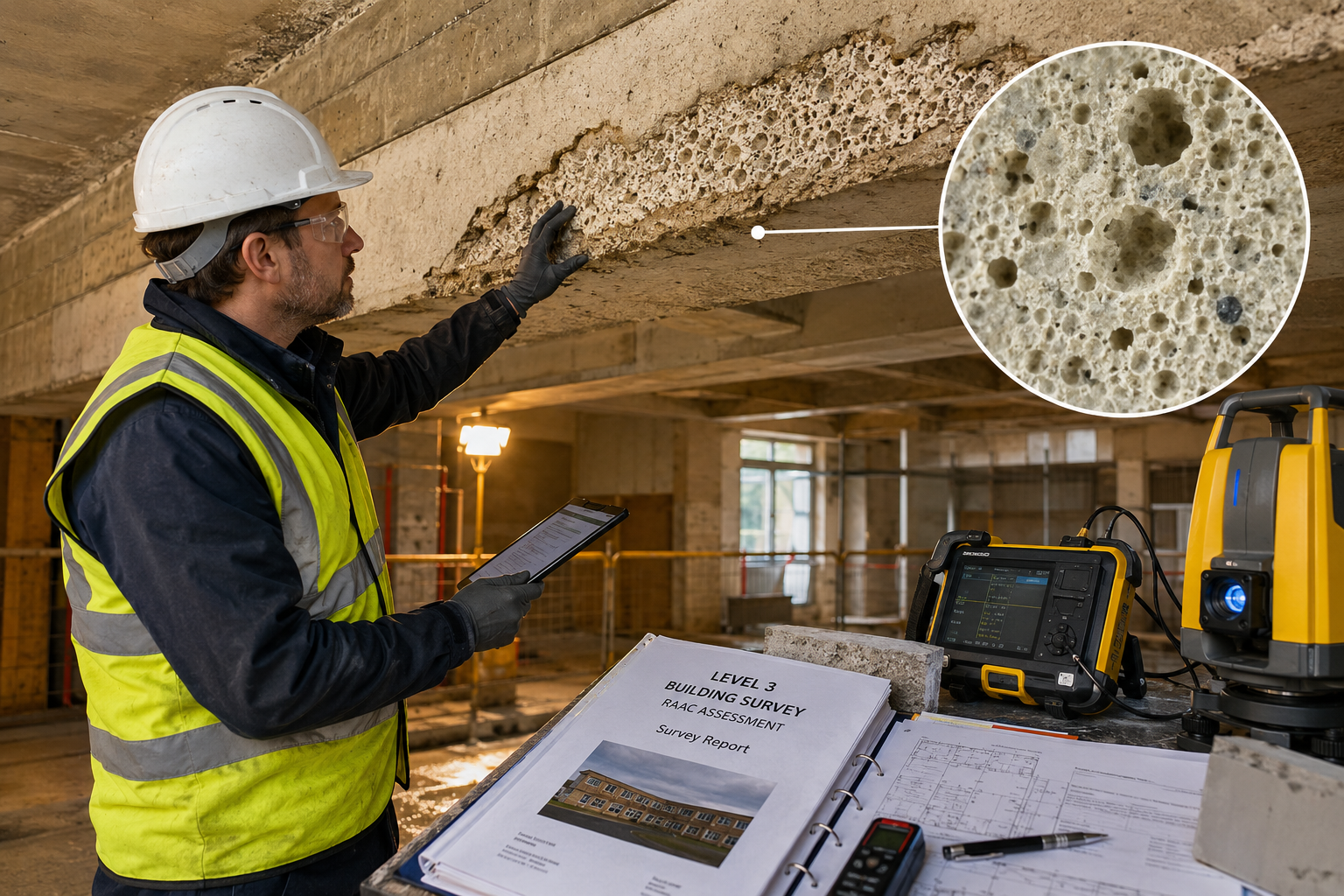
Reinforced Autoclaved Aerated Concrete (RAAC) is a lightweight, bubbly form of concrete used extensively in UK construction between the 1950s and 1990s. It was popular for flat roofs, floors, and wall panels in schools, hospitals, and residential blocks. The problem is that RAAC has a design lifespan of roughly 30 years and is now well past that threshold in most buildings where it was installed.
The Royal Institution of Chartered Surveyors (RICS) has confirmed that the presence of RAAC can materially affect a valuer's professional opinion of value [3]. This is not a minor caveat. Where RAAC is identified, lenders may refuse to lend, insurers may impose exclusions, and buyers may withdraw entirely — all of which translate directly into quantifiable financial loss for property owners.
Browne Jacobson's 2026 horizon-scanning analysis of the construction sector confirms that RAAC continues to generate significant legal exposure, with recent government announcements highlighting the scale of remediation required across both public and private estates [2]. The legal disputes arising from this situation fall into several categories:
- Defect claims against original builders or developers
- Professional negligence claims against surveyors who failed to identify RAAC
- Insurance disputes where policy coverage of remediation costs is contested
- Diminution-of-value claims where a property has been sold at a discount due to RAAC presence
- Landlord and tenant disputes over remediation liability under lease terms
Each of these claim types requires a different emphasis in expert witness preparation, but all share a common need: a watertight, independently defensible valuation that reflects 2026 market realities.
Why Non-Standard Construction Matters to Valuers
RAAC falls squarely within the category of non-standard construction, which presents particular challenges for valuers. Standard comparable evidence drawn from conventional brick-and-block properties is rarely directly applicable. Expert witnesses must demonstrate that they have applied appropriate adjustments and that those adjustments are supported by market evidence — not assumption.
Evidence Gathering: The Foundation of Expert Witness Preparation for RAAC Remediation Claims
No expert witness report is stronger than the evidence underpinning it. In RAAC claims, evidence gathering is a multi-stage process that begins long before any legal proceedings are formally issued.
Stage 1: Commissioning the Right Survey
A Level 3 building survey is the minimum appropriate survey type for any property where RAAC is suspected or confirmed. These surveys provide a detailed structural assessment and are specifically designed to identify defects that could affect value or safety. For a thorough understanding of what this entails, the essential guide to Level 3 building surveys provides useful context on scope and methodology.
Surveyors in 2026 are integrating rigorous RAAC-specific assessment protocols within Level 3 surveys. Best practice now includes:
- Inspecting a minimum of 10% of RAAC panels present in the structure
- Using non-destructive testing (NDT) techniques including radar scanning and carbonation depth testing
- Providing a comprehensive written report within one week of assessment completion [1]
- Classifying panels by condition rating (stable, at risk, or failed) using a standardised framework
This structured approach ensures that the survey output can withstand cross-examination. A surveyor who inspected only visually accessible panels without NDT testing, or who failed to document their sampling methodology, will face serious challenge in a tribunal setting.
Stage 2: Quantifying Remediation Costs
Cost quantification is where many RAAC claims either succeed or unravel. Residential remediation costs are estimated between £50,000 and £150,000 per property, depending on the extent of RAAC present, access constraints, and the chosen remediation strategy [1]. Commercial properties can attract significantly higher figures.
The expert witness must present cost evidence that is:
| Cost Evidence Type | Purpose | Typical Source |
|---|---|---|
| Contractor quotes (minimum 3) | Establish market rate for remediation | Specialist RAAC contractors |
| Quantity surveyor's assessment | Independent cost verification | RICS-regulated QS |
| Actual invoices (post-remediation) | Confirm costs incurred | Property owner's records |
| Residual cost estimates | Where remediation is partial | Expert's own calculation |
Where remediation has already been completed, actual invoiced costs form the strongest evidence. Where it is ongoing or planned, a quantity surveyor's independently prepared schedule of works and cost plan is essential.
Stage 3: Establishing Pre- and Post-Remedy Values
This is the core valuation exercise. The expert witness must establish:
- The value of the property as if RAAC-free (the "but for" value)
- The value of the property with RAAC present and unresolved (the diminished value)
- The value of the property following successful remediation (the post-remedy value)
The difference between figures 1 and 3 represents the residual diminution, if any, that persists even after remediation — sometimes called "stigma" or "market perception" discount. This is a contested area, and expert witnesses must be prepared to defend any stigma adjustment with robust comparable evidence.
For commercial valuations, the analysis becomes more complex, incorporating yield adjustments, rental evidence, and void period assumptions.
Building the Expert Witness Report: Structure, Standards, and 2026 Post-Remedy Valuations
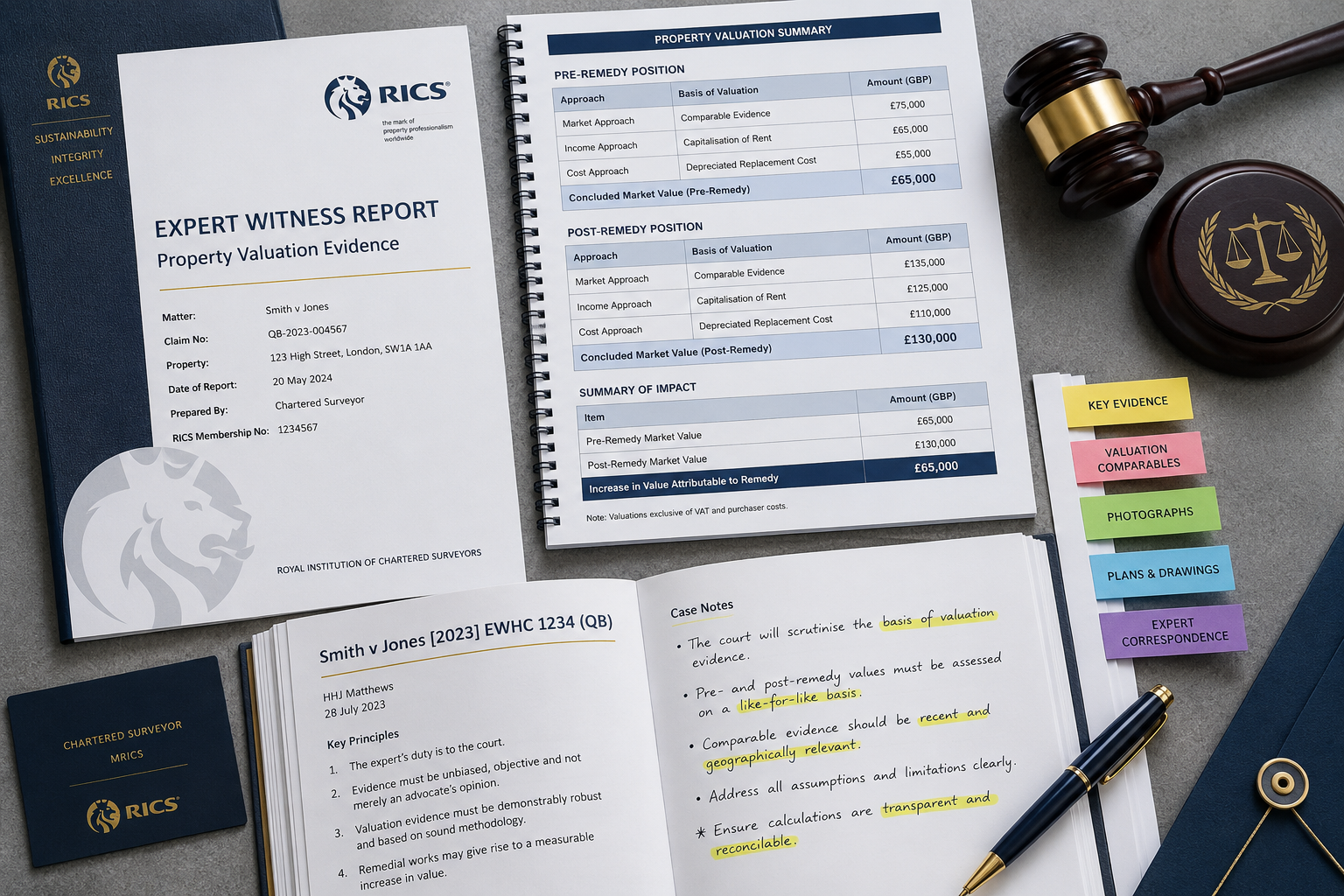
The expert witness report is the centrepiece of any RAAC remediation claim. Expert Witness Preparation for RAAC Remediation Claims: Building Robust Cases with 2026 Post-Remedy Valuations requires that the report meets both RICS professional standards and the procedural requirements of the relevant court or tribunal.
The Duty of Independence
Expert witnesses must understand that their primary duty is to the tribunal, not to the party instructing them [5]. This is not merely an ethical principle — it is a legal requirement under CPR Part 35 in England and Wales. Any report that reads as advocacy rather than independent analysis will be challenged, and the expert's credibility will suffer accordingly.
"An expert witness who loses their independence loses their value. The moment a report becomes a tool of persuasion rather than a source of evidence, it undermines the very claim it was prepared to support."
RICS provides clear guidance on this point, and expert witnesses are expected to include a declaration of independence within their report, confirming that their opinion has not been influenced by the instructions or the outcome of the case [3].
Recommended Report Structure
In 2026, expert witnesses are expected to follow a clear and consistent report structure that can withstand rigorous scrutiny [4]. The recommended framework includes:
- Instructions and scope — what the expert was asked to do and any limitations on their inspection
- Summary of facts — property details, RAAC identification, remediation history
- Valuation date — clearly stated, with justification for the chosen date
- Methodology — the valuation approach adopted and why
- Market commentary — current 2026 market conditions relevant to the subject property
- Comparable evidence — transactions and listings used to support the opinion
- Opinion of value — the expert's concluded figure, with reasoning
- Statement of truth — the required declaration under CPR Part 35
Each section must be internally consistent. Inconsistencies between the methodology section and the comparable evidence section are a common source of cross-examination challenge.
Using Post-Dated Evidence
One of the more technically complex aspects of 2026 RAAC valuations is the use of post-dated evidence — that is, market transactions that occurred after the valuation date but which shed light on value at that date. RICS has an Expert Working Group examining this issue, with a final guidance note expected later in 2026 [6]. Until that guidance is published, expert witnesses should approach post-dated evidence cautiously, disclosing its use transparently and explaining the weight attributed to it.
Comparable Evidence in a Thin Market
RAAC-affected properties represent a relatively thin market segment, meaning that directly comparable sales evidence may be limited. Expert witnesses should:
- Widen the geographic search to include similar property types in comparable locations
- Apply reasoned adjustments for differences in construction type, condition, and location
- Document the adjustment methodology clearly so that it can be tested in cross-examination
- Avoid over-reliance on a single comparable — three or more transactions are the minimum acceptable evidential base
For properties where specific defect reports have been prepared as part of the pre-litigation process, these documents can provide valuable supporting evidence for the valuation assumptions made.
Presenting Evidence in Court: Cross-Examination Readiness and 2026 Best Practice
The best-prepared expert witness report can still be undermined by poor performance under cross-examination. Preparation for court presentation is as important as the written report itself.
Anticipating Challenges
Common lines of cross-examination in RAAC valuation disputes include:
- Challenging the remediation cost estimate: Was it based on like-for-like specifications? Were the quotes obtained competitively?
- Challenging the comparable evidence: Are the comparables truly comparable? Were appropriate adjustments made?
- Challenging the stigma discount: Is there empirical evidence of persistent market perception discount post-remediation, or is this speculative?
- Challenging independence: Did the expert have any prior relationship with the instructing party?
Expert witnesses should prepare written responses to each of these anticipated challenges before attending court. Reviewing the opposing expert's report carefully and identifying areas of disagreement — which should be recorded in a joint statement following a without-prejudice meeting — is standard practice.
The Joint Expert Meeting
Under CPR Part 35, experts for opposing parties are typically required to meet and produce a joint statement identifying areas of agreement and disagreement. This process is often where RAAC cases are effectively won or lost. A well-prepared expert who can articulate the basis for their opinion clearly and concisely will often persuade the opposing expert to narrow the areas of dispute, reducing the issues the tribunal must resolve.
For disputes involving shared building elements — for example, RAAC panels in a block of flats where remediation liability is contested between landlord and tenants — the party wall and dispute resolution framework provides a useful parallel for understanding how multi-party building disputes are structured and resolved.
Monitoring and Ongoing Evidence
Where RAAC remediation is ongoing at the time of the hearing, monitoring surveys can provide contemporaneous evidence of structural condition changes. This type of evidence is particularly valuable in cases where the defendant disputes the urgency or extent of the remediation required.
Similarly, dilapidations surveys are relevant in commercial lease disputes where RAAC remediation intersects with end-of-lease obligations. Expert witnesses in these cases must carefully distinguish between items that represent genuine breach of covenant and those that fall within the scope of RAAC-related structural failure — a distinction that can significantly affect the quantum of any award [9].

Expert Witness Preparation for RAAC Remediation Claims: A 2026 Checklist
The following checklist consolidates the key preparation steps for expert witnesses instructed in RAAC remediation claims in 2026.
Pre-Instruction
- Confirm RICS membership and relevant specialism (valuation, building surveying, or both)
- Check for conflicts of interest with any party to the dispute
- Review the scope of instruction carefully and identify any gaps
Evidence Gathering
- Commission or review a Level 3 building survey with RAAC-specific protocols
- Obtain a minimum of three contractor quotes or a QS cost plan
- Compile pre- and post-remedy comparable transaction evidence
- Obtain any relevant planning, building regulation, or insurance documentation
Report Preparation
- Follow the recommended RICS report structure [4]
- Include a clear statement of the valuation methodology adopted
- Disclose any post-dated evidence and explain the weight given to it [6]
- Include a signed declaration of independence [5]
Court Preparation
- Review the opposing expert's report and identify areas of disagreement
- Prepare written responses to anticipated cross-examination challenges
- Attend the joint expert meeting and produce a clear joint statement
- Bring all source documents to the hearing for reference
Conclusion
RAAC remediation disputes are among the most technically demanding cases in the current UK property litigation landscape. The combination of structural complexity, significant remediation costs, and contested valuation methodology creates a challenging environment for expert witnesses — but also one where thorough preparation delivers a decisive advantage.
The actionable steps are clear. Instruct a Level 3 building survey with RAAC-specific inspection protocols as early as possible. Quantify remediation costs with independent contractor and quantity surveyor evidence. Build the valuation report around the RICS-recommended structure, using 2026 market data and properly disclosed comparable evidence. Prepare rigorously for cross-examination, and approach the joint expert meeting as an opportunity to narrow the issues rather than entrench positions.
Expert Witness Preparation for RAAC Remediation Claims: Building Robust Cases with 2026 Post-Remedy Valuations is ultimately about credibility — the credibility of the evidence, the methodology, and the expert presenting it. Property owners, legal teams, and instructing solicitors who invest in this preparation from the outset are significantly better placed to achieve fair outcomes in what will remain a busy area of dispute for years to come.
For properties requiring formal valuation reports in support of litigation or insurance claims, RICS-compliant valuation reports provide the structured, defensible documentation that tribunals require.
References
[1] Building Survey Protocols For Raac Remediation In 2026 Level 3 Insights Post Reform – https://manchestersurveyors.com/building-survey-protocols-for-raac-remediation-in-2026-level-3-insights-post-reform/?utm_source=openai
[2] Reinforced Autoclaved Aerated Concrete Raac – https://www.brownejacobson.com/insights/2026-horizon-scanning-in-construction/reinforced-autoclaved-aerated-concrete-raac?utm_source=openai
[3] Reinforced Autoclaved Aerated Concrete Raac – https://www.rics.org/consumer-guides/reinforced-autoclaved-aerated-concrete-raac?utm_source=openai
[4] Expert Witness Roles In Post Budget Property Valuations Adapting To Tax Changes And Market Stabilisation – https://nottinghillsurveyors.com/blog/expert-witness-roles-in-post-budget-property-valuations-adapting-to-tax-changes-and-market-stabilisation?utm_source=openai
[5] Higher Risk Building Valuations Post 2026 Reforms Expert Witness Preparation For Safety Compliance Disputes – https://princesurveyors.co.uk/blog/higher-risk-building-valuations-post-2026-reforms-expert-witness-preparation-for-safety-compliance-disputes/?utm_source=openai
[6] Post Dated Evidence In Valuation – https://community.rics.org/viewdocument/post-dated-evidence-in-valuation?utm_source=openai
[7] Expert Witness – https://www.rei-valuations.com/expert-witness?utm_source=openai
[8] ricsus – https://ricsus.com/?utm_source=openai
[9] Dilapidations Expert Witness Reports In 2026 Commercial Leases Rics Valuation Protocols Amid End Of Lease Disputes – https://nottinghillsurveyors.com/blog/dilapidations-expert-witness-reports-in-2026-commercial-leases-rics-valuation-protocols-amid-end-of-lease-disputes?utm_source=openai
