
More than 60% of England's housing stock currently sits below an EPC C rating — and with regulatory pressure mounting toward minimum energy standards, 2026 has become the year when retrofit activity is colliding head-on with party wall law. The result is a sharp rise in neighbour disputes, stalled projects, and costly legal delays that could have been avoided with proper planning. Understanding the Party Wall Act Essentials for 2026 Retrofit Projects: Avoiding Disputes in EPC-Driven Upgrades is no longer optional for homeowners, landlords, or contractors — it is a legal and financial necessity.
The Party Wall etc. Act 1996 provides a structured legal framework to prevent and resolve disputes between neighbours when building work affects shared walls, party structures, boundary walls, and excavations near adjoining buildings [5]. As retrofit projects grow more ambitious — from external wall insulation to solar installations on shared roofs — the Act's provisions are being tested in new and complex ways.
Key Takeaways
- The Party Wall etc. Act 1996 applies to a wide range of retrofit works, including external wall insulation, loft conversions, and solar panel installations on shared roofs.
- Serving the correct notice at the right time is the single most effective step a building owner can take to prevent disputes.
- Adjoining owners can now request EPC-related conditions within Party Wall Awards to protect their property's thermal envelope.
- Routine maintenance costs are typically shared, but improvement costs — such as adding insulation — fall to the initiating owner unless agreed otherwise.
- Engaging a qualified party wall surveyor early reduces the risk of injunctions, delays, and neighbour litigation.
Why 2026 Is a Turning Point for Retrofit and Party Wall Disputes
The 2030 EPC B target for commercial properties and the broader push toward EPC C for residential lettings are reshaping the construction pipeline across England and Wales. In London alone, a significant portion of existing office stock falls below the EPC B threshold, creating urgency among landlords to retrofit or face stranded assets [6]. Residential landlords face similar pressure, and owner-occupiers are responding to rising energy costs by insulating walls, upgrading heating systems, and installing renewable energy technology.
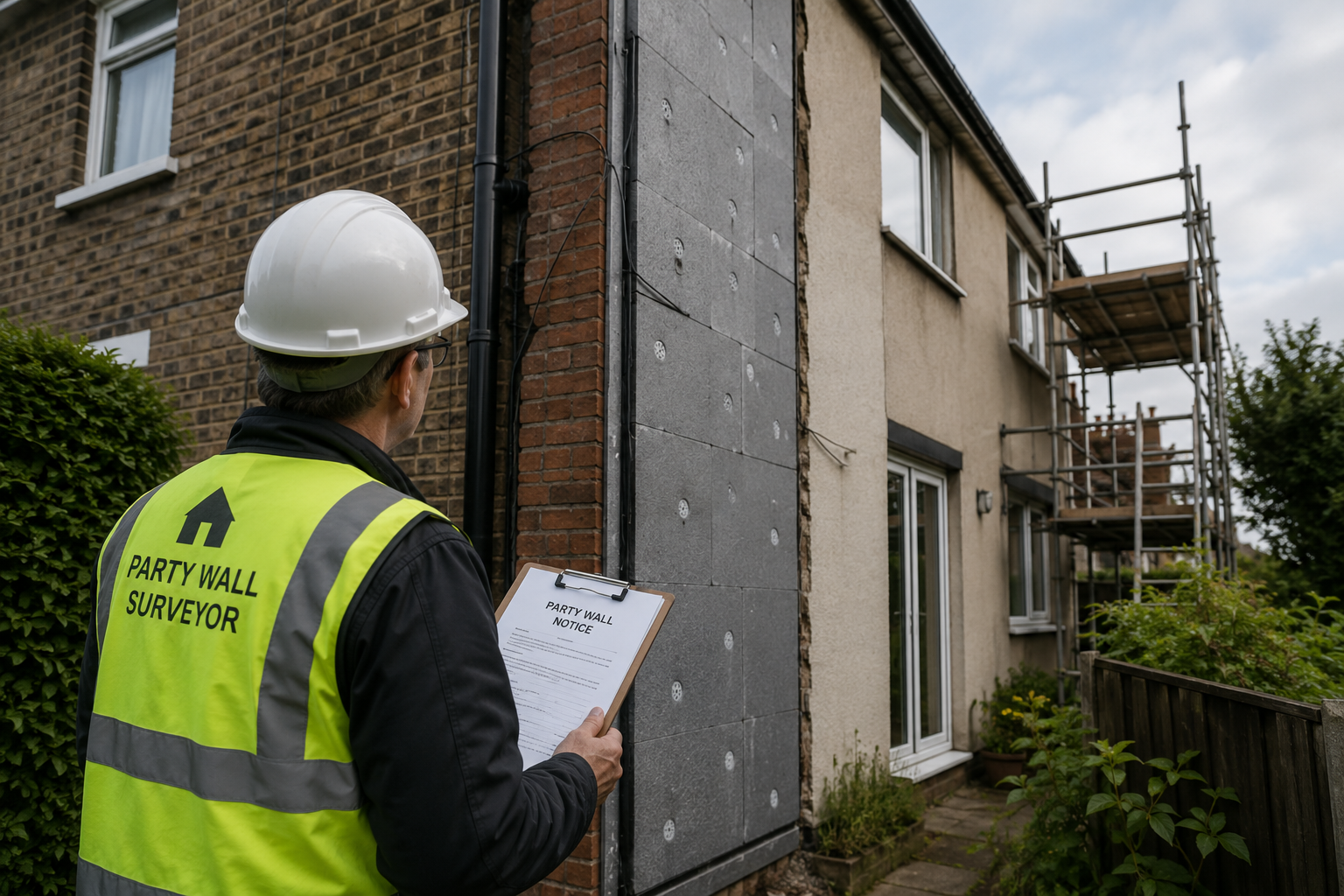
This surge in activity is generating friction. When one half of a semi-detached house installs external wall insulation (EWI) on a shared wall, or when a terraced homeowner mounts solar panels on a roof that sits above a shared chimney stack, the legal position of the adjoining owner becomes immediately relevant. The RICS Quality in Retrofit Summit, held in January 2026, specifically highlighted the need for Party Wall Agreements as a quality assurance mechanism in retrofit delivery [7].
The core problem is straightforward: many homeowners and even some contractors assume that energy efficiency improvements are exempt from party wall procedures. They are not.
Which Retrofit Works Trigger the Party Wall Act
The following retrofit activities commonly trigger notice obligations under the Act:
| Retrofit Work | Relevant Section of the Act | Notice Period Required |
|---|---|---|
| External wall insulation on a party wall | Section 2 | 2 months |
| Solar panels on a shared or party roof | Section 2 / Section 6 | 2 months / 1 month |
| Loft conversion involving a party wall | Section 2 | 2 months |
| New beam or lintel in a party wall | Section 2 | 2 months |
| Excavation within 3 metres of neighbour's foundations | Section 6 | 1 month |
| Shared chimney modifications | Section 2 | 2 months |
For a detailed breakdown of how the Act applies to specific structural scenarios, the comprehensive guide to the Party Wall etc. Act 1996 provides authoritative coverage of each section.
The Notice Process: Getting It Right from the Start
Serving the correct notice is the foundation of every compliant retrofit project. A defective or missing notice does not simply delay a project — it can expose the building owner to injunctions, civil liability for damage, and the full cost of any surveyor fees incurred by the adjoining owner [4].
Step 1: Identify the Correct Notice Type
Three types of notice exist under the Act:
- Party Structure Notice (Section 3): For works to an existing party wall or party fence wall.
- Line of Junction Notice (Section 1): For building a new wall at or on the boundary.
- Adjacent Excavation Notice (Section 6): For excavations near a neighbour's foundations.
For most EPC-driven retrofit projects, the Party Structure Notice under Section 3 is the relevant instrument.
Step 2: Serve Notice with Adequate Lead Time
Notice must be served at least two months before the planned start date for most party wall works, or one month for excavation notices. For solar panel installations on shared roofs, RICS protocols require 14 days' written notice before accessing a neighbouring property, in addition to any formal party wall notice requirements [1]. Failing to observe these timelines is one of the most common and easily avoided causes of dispute.
Step 3: Await Consent or Dissent
Once notice is served, the adjoining owner has 14 days to respond. Three outcomes are possible:
- Consent in writing — works can proceed without a formal award.
- Dissent with agreement to appoint an agreed surveyor — a single surveyor acts for both parties.
- Dissent and appointment of their own surveyor — a two-surveyor process leading to a Party Wall Award.
If no response is received within 14 days, a dispute is deemed to have arisen automatically, and the surveyor appointment process begins [5].
For guidance on drafting a compliant notice, the resource on how to write a party wall letter covers the legal requirements and practical templates in detail.
EPC Conditions in Party Wall Awards: A 2026 Development
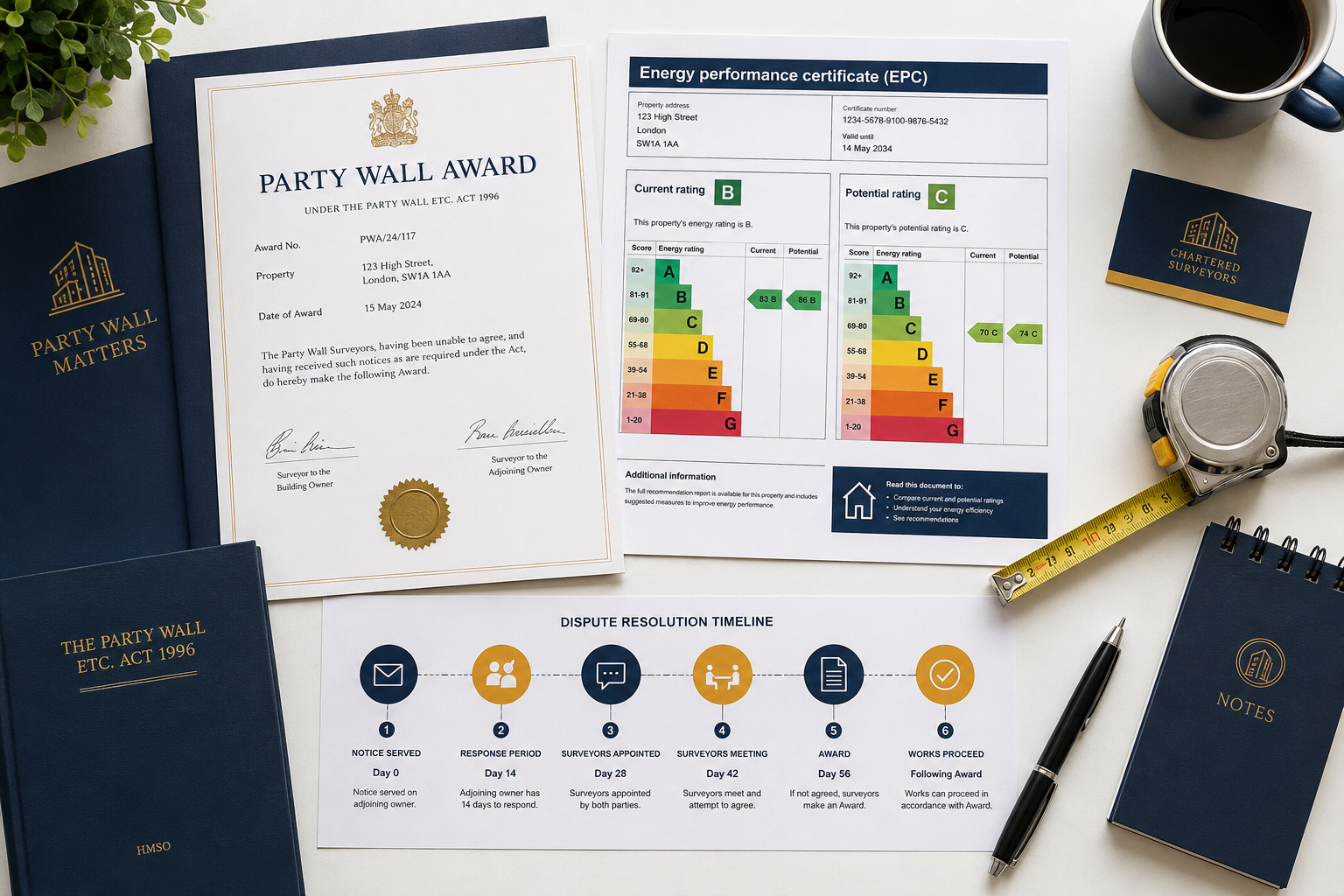
One of the most significant developments shaping Party Wall Act Essentials for 2026 Retrofit Projects: Avoiding Disputes in EPC-Driven Upgrades is the integration of energy performance considerations directly into Party Wall Awards. This reflects growing recognition that retrofit works can inadvertently degrade a neighbouring property's thermal performance.
Adjoining owners now have the right to request conditions within a Party Wall Award that protect their property's energy performance and structural integrity [2]. This can include:
- Pre-works thermal imaging surveys to establish a baseline for the adjoining property's thermal envelope.
- Post-works EPC assessments to confirm that retrofit activities have not degraded the neighbour's energy rating.
- Moisture monitoring conditions where EWI is applied to a shared wall, addressing the risk of moisture entrapment.
- Passageway width protections where insulation boards reduce access to shared side passages.
"Adjoining owners have the right to request conditions that protect their property's energy performance and structural integrity — including requiring a post-works EPC to ensure retrofit activities do not degrade the thermal envelope of their property." [2]
This development means that surveyors drafting awards in 2026 must be fluent in both party wall law and energy performance standards. A surveyor who understands only one of these disciplines is likely to produce an award that either fails to protect the adjoining owner adequately or imposes unreasonable restrictions on the building owner.
External Wall Insulation: The Highest-Risk Retrofit Scenario
EWI applied to a shared or party wall is arguably the most dispute-prone retrofit activity in 2026. The concerns are legitimate:
- Moisture entrapment: If insulation is applied incorrectly or without adequate detailing at the junction with the adjoining property, moisture can become trapped in the wall cavity, causing damp and structural deterioration.
- Reduced passageway width: In terraced properties, EWI can encroach on shared side passages, creating access disputes.
- Thermal bridging at the boundary: Poor detailing at the party wall junction can create cold bridges that affect both properties.
Adjoining owners who dissent from proposed EWI works are entitled to appoint their own surveyor to protect their interests [2]. The cost of that surveyor is typically borne by the building owner initiating the works.
For properties involving shared chimney stacks — a common feature in Victorian and Edwardian terraces — the guide to party walls and shared chimneys explains the specific obligations that apply when retrofit works affect these structures.
Cost Allocation and Financial Protections in Retrofit Awards
Understanding who pays for what is critical in any EPC-driven retrofit project involving shared structures. The legal position is clear in principle but frequently misunderstood in practice.
Routine maintenance of a party wall is a shared obligation, with costs split equally between owners [4]. However, improvements that benefit only one party — such as adding insulation to a shared wall to improve the building owner's EPC rating — are the financial responsibility of the initiating owner, unless a written agreement states otherwise [4].
This distinction has practical consequences:
- A building owner cannot compel a neighbour to contribute to insulation costs simply because the work is carried out on a shared wall.
- If the works incidentally benefit the adjoining owner (for example, by improving their wall's thermal performance), a contribution may be negotiated but cannot be demanded.
- Any damage caused to the adjoining property during retrofit works is the liability of the building owner, regardless of whether a formal written agreement is in place [4].
Cost Volatility Protections in Party Wall Awards
Given the material cost fluctuations that have characterised the construction sector in recent years, experienced surveyors are now drafting awards with explicit cost volatility provisions. These may include:
- Indexed cost schedules that adjust contractor rates in line with published indices if works are delayed.
- Contingency provisions for unforeseen structural conditions discovered during insulation removal or installation.
- Defined scope limitations that prevent the building owner from extending works beyond what was notified without serving fresh notice.
For a clear overview of what a Party Wall Award contains and how it protects both parties, the complete guide to understanding Party Wall Awards is an essential reference.
Dispute Resolution: From Award to Appeal
Even with proper notices and well-drafted awards, disputes can escalate. The Act provides a structured resolution pathway that avoids the need for immediate court action [5].
The Surveyor-Led Resolution Process
When an adjoining owner dissents, the appointed surveyors (whether agreed or separately appointed) prepare a Party Wall Award. This document sets out:
- The precise scope of permitted works
- The timing and hours of work
- Access arrangements for surveyors and contractors
- Protective measures for the adjoining property
- A schedule of condition to record the pre-works state of the adjoining property
The schedule of condition is particularly important in retrofit projects. If an adjoining owner later claims that retrofit works caused cracking, damp, or settlement, the pre-works schedule provides the evidential baseline for assessing that claim.
Appealing a Party Wall Award
If either party believes the award contains a legal or factual error, there is a strict 14-day window from the date the award is served to appeal to the county court [3]. This deadline is absolute. Appeals must be grounded in genuine legal or factual flaws within the award — not simply a preference for a different outcome [3].
Key grounds for appeal include:
- The award was made without jurisdiction (for example, if proper notice was never served)
- The award contains a material error of fact
- The surveyors acted outside the scope of the Act
- There was procedural unfairness in the surveyor appointment process
Appeals are relatively rare because the surveyor-led process is designed to be proportionate and expert-driven. However, in high-value retrofit projects — particularly commercial properties pursuing EPC B compliance — the financial stakes can justify a legal challenge.
Practical Steps for Building Owners in 2026

The following checklist distills the Party Wall Act Essentials for 2026 Retrofit Projects: Avoiding Disputes in EPC-Driven Upgrades into actionable steps:
- Identify all notifiable works before engaging contractors. Use the table above as a starting point, and consult a qualified surveyor if the scope is unclear.
- Serve notice at the correct time. Two months is the standard lead time for most party wall works. Do not rely on verbal agreements with neighbours.
- Appoint a qualified party wall surveyor early. Early appointment allows the surveyor to advise on notice content, scope limitations, and EPC-related conditions before disputes arise.
- Commission a schedule of condition for all adjoining properties before works begin. This protects both parties.
- Budget for adjoining owner surveyor costs. If the neighbour dissents and appoints their own surveyor, those fees are typically your responsibility.
- Ensure contractor compliance with the award. The award is a legally binding document. Deviations from its terms can expose the building owner to injunctions and compensation claims.
- Retain all documentation — notices, consents, awards, schedules of condition, and correspondence — for at least six years after completion.
For those seeking professional support, the resource on how to find a reliable party wall surveyor provides practical guidance on selecting a qualified professional.
Homeowners planning loft conversions as part of a wider retrofit programme should also review the specific obligations covered in the party wall guide for loft conversions, as these projects frequently involve notifiable works on party walls and party structures.
Conclusion
The convergence of EPC-driven retrofit demand and the legal framework of the Party Wall etc. Act 1996 is creating a more complex operating environment for property owners, landlords, and contractors in 2026. The good news is that the Act's dispute resolution mechanisms are well-suited to handling these challenges — provided they are engaged correctly and early.
Actionable next steps for property owners:
- Before commissioning any retrofit work involving a shared wall, roof, or boundary, obtain professional advice on whether the Party Wall Act applies.
- Serve the correct notice with adequate lead time — two months for most party wall works.
- Engage a RICS-qualified party wall surveyor to draft an award that addresses both structural and energy performance considerations.
- If you receive a party wall notice as an adjoining owner, respond within 14 days and consider appointing your own surveyor to ensure your interests — including your property's EPC rating — are protected.
- If an award is served and you believe it contains an error, act within the strict 14-day appeal window.
The retrofit boom is not slowing down. Properties that fail to reach minimum energy standards face significant financial consequences, and the pressure to act is real. But speed without process creates disputes that cost far more in time and money than the original notice procedure would have required. The Party Wall Act exists precisely to make ambitious building work possible while protecting everyone involved.
References
[1] Party Wall Act Notices For Solar Panel Retrofits Rics Protocols Amid 2026 Net Zero Roof Works Surge – https://www.canterburysurveyors.com/blog/party-wall-act-notices-for-solar-panel-retrofits-rics-protocols-amid-2026-net-zero-roof-works-surge/?utm_source=openai
[2] Energy Performance Certificates In Party Wall Awards 2026 Retrofit Compliance For Neighbour Dispute Resolutions – https://nottinghillsurveyors.com/blog/energy-performance-certificates-in-party-wall-awards-2026-retrofit-compliance-for-neighbour-dispute-resolutions?utm_source=openai
[3] Appealing A Party Wall Award Grounds Process And Deadline – https://legalclarity.org/appealing-a-party-wall-award-grounds-process-and-deadline/?utm_source=openai
[4] Your Party Wall Rights And Responsibilities – https://legalclarity.org/your-party-wall-rights-and-responsibilities/?utm_source=openai
[5] The Party Wall Act Explained – https://www.localpartywallsurveyors.com/the-party-wall-act-explained/?utm_source=openai
[6] London Office Retrofit Epc B Stranded Assets Cost 2026 – https://www.constructionmagazine.uk/2026/02/london-office-retrofit-epc-b-stranded-assets-cost-2026.html?utm_source=openai
[7] Party Wall Agreements For Retrofit And Renovation Projects Meeting 2026 Rics Retrofit Summit Standards – https://kingstonsurveyors.com/party-wall-agreements-for-retrofit-and-renovation-projects-meeting-2026-rics-retrofit-summit-standards/?utm_source=openai
