
Across England and Wales in 2026, permitted development rights continue to drive a surge in commercial-to-residential conversions, with thousands of former offices, retail units, and light industrial buildings being transformed into flats and houses. Every one of those conversions that shares a wall, floor, or ceiling with a neighbouring property triggers obligations under the Party Wall etc. Act 1996 — and a significant proportion escalate into formal disputes. When those disputes reach the courts or formal arbitration, the role of expert witness surveyors in party wall disputes: RICS standards for commercial-to-residential conversions becomes central to how liability, damage, and remedy are determined.
This article explains how RICS professional standards govern expert witness surveyors in these complex cases, what CPR Part 35 compliance demands in practice, and how damage quantum is assessed for 2026 urban conversion projects.
Key Takeaways
- RICS "Surveyors Acting as Expert Witnesses" (4th edition, amended February 2023) is the current binding standard; a 5th edition is in active consultation and will tighten independence and transparency requirements further.
- Expert witness surveyors in party wall disputes owe an overriding duty to the court, not to the instructing party — a distinction that is especially critical in contentious commercial-to-residential conversion cases.
- CPR Part 35 sets the procedural framework for expert evidence in civil proceedings; RICS standards operate alongside it and must be read together with it.
- Commercial-to-residential conversions generate specific technical issues — structural movement, vibration, noise, and access — that require specialist scoping of instructions.
- Early neutral evaluation and alternative dispute resolution (ADR) are increasingly preferred over litigation, reducing cost and delay for all parties.
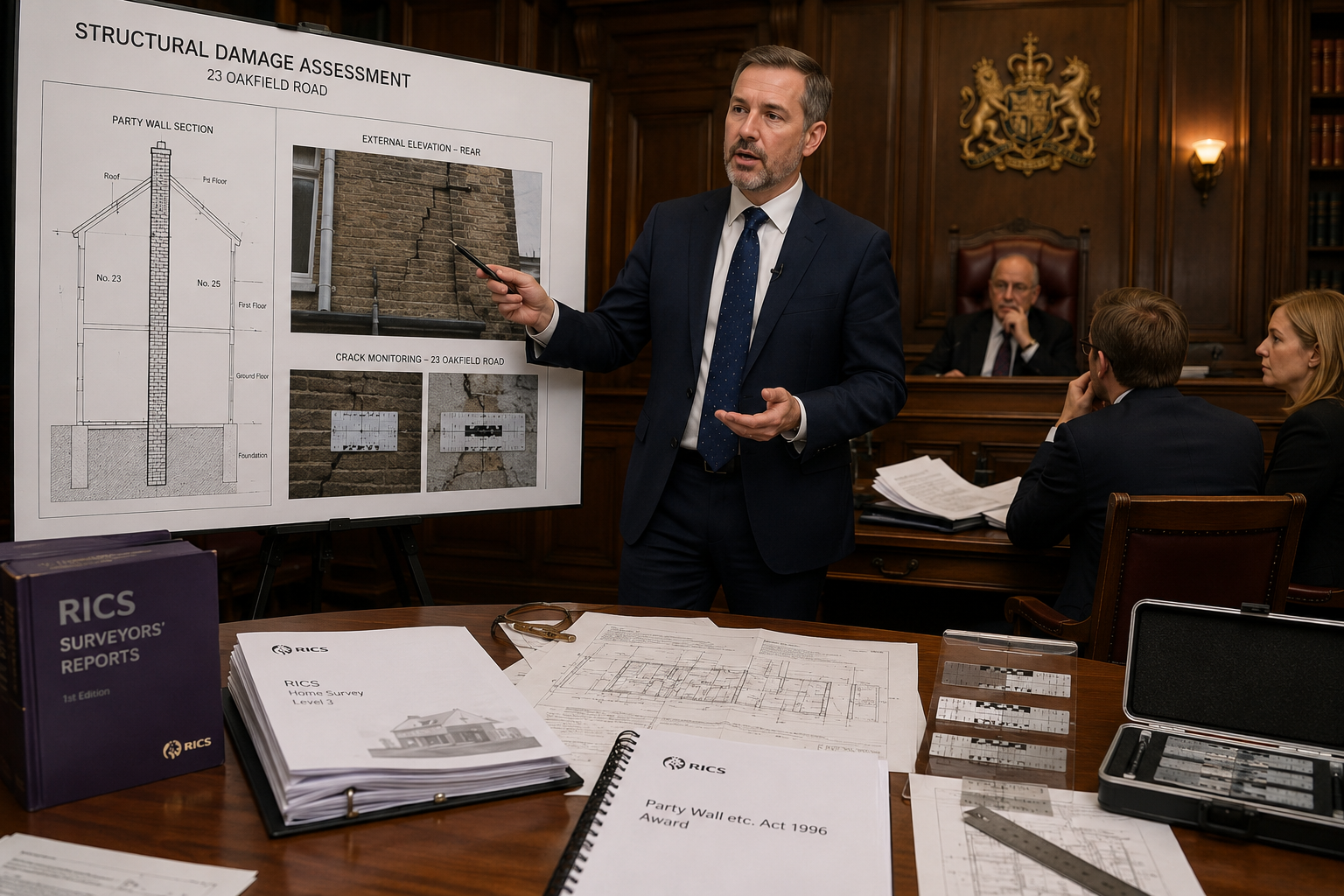
The Statutory Foundation: Party Wall Act Obligations in Conversion Projects
Before an expert witness surveyor is ever appointed, the Party Wall etc. Act 1996 creates a structured framework of notice, consent, and award that governs virtually every commercial-to-residential conversion affecting a shared structure. Understanding this framework is essential context for any expert witness instruction.
A building owner converting a commercial property to residential use must serve the appropriate notices — a Party Structure Notice for works to the party wall itself, and a Line of Junction Notice where a new wall is to be built at or astride the boundary. Adjoining owners then have 14 days to consent or dissent. Dissent triggers the appointment of surveyors and, ultimately, a Party Wall Award. For a detailed breakdown of how this process works, the complete guide to party wall surveys provides a useful starting point.
The 7th edition of the RICS guidance note "Party Wall Legislation and Procedure" (January 2022) remains the authoritative professional reference for surveyors navigating these statutory obligations [2]. It covers the procedural steps, the content of awards, and the duties of appointed surveyors — all of which feed directly into any subsequent expert witness instruction if the matter escalates.
Key triggers for expert witness involvement in conversion disputes include:
- Structural damage to the adjoining owner's property alleged to have been caused by conversion works
- Disputes over the adequacy of a Schedule of Condition prepared before works commenced
- Challenges to the terms of a Party Wall Award in the County Court
- Claims for compensation or injunctive relief where works have proceeded without a valid award
For property owners who are new to this process, understanding what a party wall surveyor does in terms of roles and legal requirements is a valuable first step before engaging specialist expert witness services.
RICS Standards Governing Expert Witness Surveyors in Party Wall Disputes
The 4th Edition Standard and Its February 2023 Amendment
The primary RICS professional standard governing expert witnesses is "Surveyors Acting as Expert Witnesses," currently in its 4th edition (August 2020) with a February 2023 amendment [6][1]. This is a mandatory standard — not guidance — which means all RICS members acting as expert witnesses must comply with it.
The standard establishes several non-negotiable principles:
Overriding duty to the court. The expert witness surveyor's primary obligation is to assist the court or tribunal impartially, regardless of who is paying their fees. This duty supersedes any duty to the instructing party [6]. In party wall disputes arising from commercial-to-residential conversions, where developers with significant financial interests are often the building owner, this independence requirement is particularly important.
Scope of instructions. The standard requires that instructions be carefully scoped and that the expert only opines on matters within their expertise [1]. A party wall surveyor instructed as an expert witness in a conversion dispute involving complex structural engineering should be clear about where their expertise ends and where a structural engineer's begins.
Report content requirements. Expert witness reports must include a statement of truth, a declaration of independence, a summary of instructions, the expert's qualifications, the facts relied upon, the methodology used, and a clear distinction between facts and opinion [6].
Dealing with disputed facts. Where facts are in dispute, the expert must set out the range of possible conclusions and explain which they consider most likely and why, rather than simply asserting the most favourable position for the instructing party [1].
The Forthcoming 5th Edition: What Is Changing
RICS launched a global consultation on a new 5th edition of the expert witness standard in 2025 [4][3]. The draft standard keeps the overriding duty to the court at its core but introduces tighter requirements around:
- Transparency of methodology: Experts will be required to be more explicit about how they reached their conclusions, making their reasoning auditable.
- Independence declarations: The new edition strengthens requirements to disclose any prior relationship with the instructing party.
- Conflicts of interest: Surveyors who have previously acted as the appointed party wall surveyor in the same matter will need to consider carefully whether they can then act as an independent expert witness.
"The overriding duty to the court is not merely procedural — it is the ethical foundation on which all expert witness work rests. Any surveyor who treats it as secondary to their client's interests risks both professional sanction and the exclusion of their evidence."
For surveyors and legal teams involved in 2026 conversion disputes, it is prudent to anticipate the 5th edition's requirements even before it is formally adopted, given that courts will increasingly expect the higher standards it signals [3].
RICS Practice Alerts: Risk Management for Expert Witnesses
RICS has issued a Practice Alert specifically addressing risk management for expert witnesses [5]. Key warnings relevant to conversion disputes include:
- Avoid "expert shopping" — surveyors should not accept instructions where they know a previous expert has been replaced for giving an unfavourable opinion
- Do not allow draft reports to be substantively altered by the instructing solicitor
- Maintain contemporaneous notes of all site visits and inspections
- Be alert to the risk of becoming an advocate rather than an independent expert
CPR Part 35 Compliance in Commercial-to-Residential Conversion Disputes
What CPR Part 35 Requires
Civil Procedure Rules Part 35 governs expert evidence in English and Welsh civil proceedings. It applies whenever an expert witness surveyor gives evidence in the County Court, High Court, or any civil tribunal. The key requirements are:
| CPR Part 35 Requirement | Practical Implication for Party Wall Expert Witnesses |
|---|---|
| Single joint expert preferred | Courts may direct a single jointly instructed expert, limiting each party's ability to present partisan evidence |
| Written questions to experts | Opposing parties may submit written questions; answers become part of the expert's evidence |
| Discussions between experts | Courts may order expert discussions and a joint statement identifying agreed and disputed issues |
| Overriding duty to the court | Mirrors the RICS standard; must be stated explicitly in the report |
| Permission required | Expert evidence requires court permission; scope is defined by the court's order |
For party wall disputes escalating from commercial conversion projects, the practical effect of CPR Part 35 is that expert witness surveyors must be prepared to engage in without-prejudice discussions with opposing experts and to produce a joint statement that honestly identifies where they agree and disagree. This requires both technical rigour and professional confidence.
Scoping Instructions for Conversion-Specific Technical Issues
Commercial-to-residential conversions present a distinct set of technical issues that differ from standard residential extension disputes. Expert witness surveyors must ensure their instructions are properly scoped to cover the specific matters in issue. Common technical areas include:
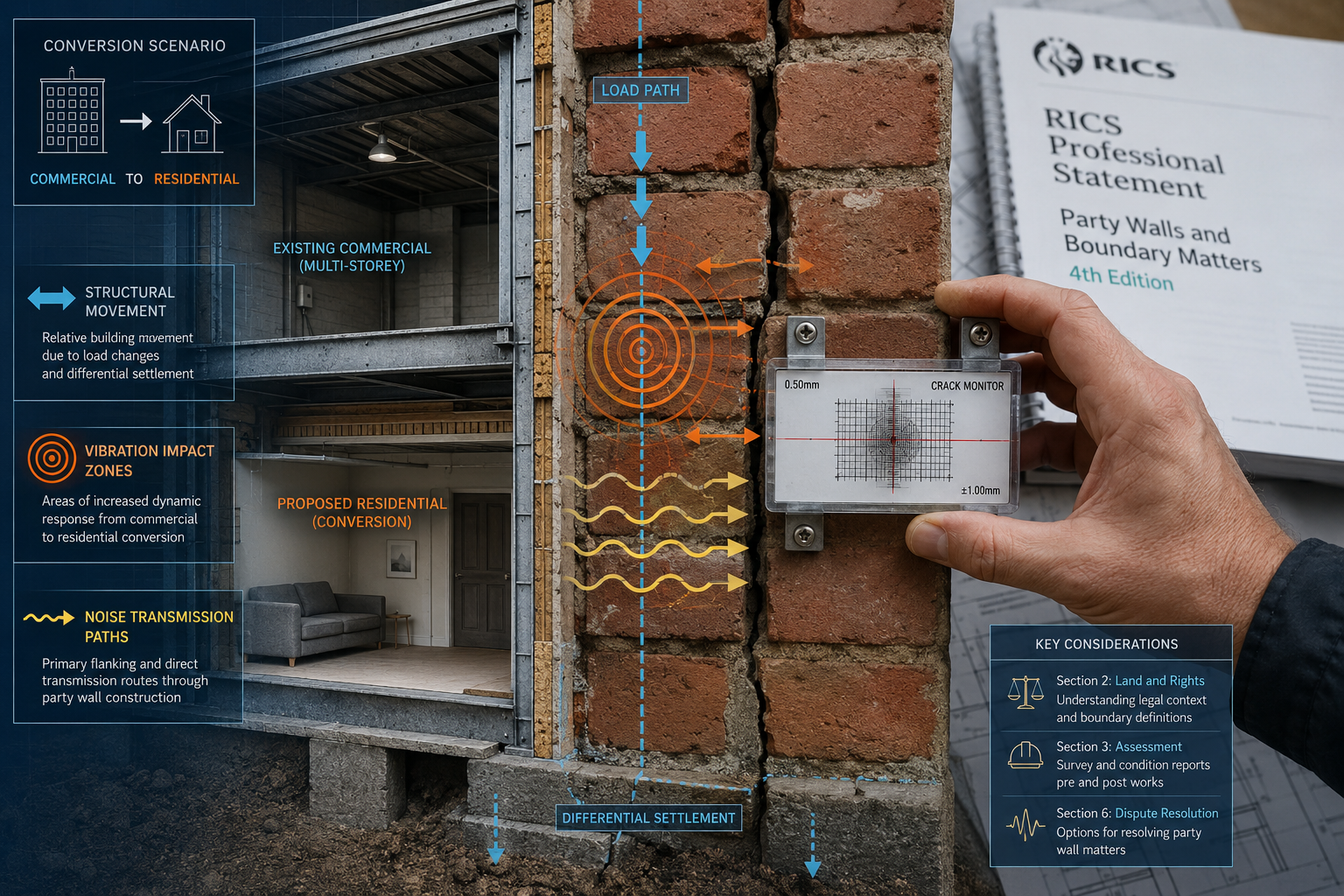
Structural movement and settlement. The change of use from commercial to residential often involves significant alterations to floor loading, removal of internal walls, and insertion of new openings in party walls. These can cause differential settlement or deflection that damages the adjoining property. An expert witness surveyor must be able to assess whether observed cracking or movement is attributable to the conversion works, pre-existing conditions, or other causes.
Vibration and noise. Commercial-to-residential conversions frequently involve heavy demolition and mechanical cutting of party walls. Vibration monitoring data, if available, can be central to establishing whether damage thresholds were exceeded. Where no monitoring was carried out, the expert must assess the likely vibration levels from the nature of the works and the equipment used.
Access and temporary works. Conversion projects often require access to the adjoining owner's property for scaffolding, underpinning, or temporary support. Disputes about the adequacy of temporary works or the condition of the adjoining property after access can require detailed expert analysis.
Schedule of Condition disputes. If the pre-works Schedule of Condition is inadequate or contested, the expert witness surveyor may need to assess the likely pre-existing condition of the adjoining property from photographic evidence, building records, and comparable properties. For more on how party wall awards and conditions are documented, see this complete guide to party wall awards.
Assessing Damage Quantum in 2026 Urban Conversion Projects
The Framework for Quantum Assessment
Damage quantum in party wall disputes is assessed on the basis of the cost of reinstatement — restoring the adjoining owner's property to the condition it was in before the works. In 2026, with construction costs remaining elevated across urban markets, accurate quantum assessment requires current market data, not historic rates.
Expert witness surveyors assessing quantum in conversion disputes should:
- Obtain competitive tender evidence where possible, rather than relying solely on pricing guides
- Apply appropriate regional uplifts — London and South East costs typically run 15–25% above national averages
- Distinguish between cosmetic and structural damage — courts will not award the cost of structural remediation for damage that is purely cosmetic
- Account for betterment — where reinstatement would improve the adjoining owner's property beyond its pre-works condition, a betterment deduction may be appropriate
- Address consequential losses — temporary accommodation costs, loss of rent, and professional fees are recoverable heads of loss in appropriate cases
Typical Damage Categories and Indicative Costs (2026)
The following table illustrates typical damage categories encountered in commercial-to-residential conversion disputes and indicative cost ranges for 2026 urban projects. These are illustrative only; actual costs will depend on the specific property, location, and extent of damage.
| Damage Category | Indicative Cost Range (2026, London) | Notes |
|---|---|---|
| Hairline cracking to plaster (cosmetic) | £500 – £2,500 per room | Often disputed as pre-existing |
| Structural cracking to masonry (Category 3–4) | £5,000 – £25,000+ | Requires structural engineer input |
| Settlement/subsidence to foundations | £15,000 – £80,000+ | Highly variable; monitoring required |
| Vibration damage to finishes | £2,000 – £15,000 | Dependent on monitoring data |
| Temporary accommodation (residential) | £1,500 – £4,000 per month | Only where property uninhabitable |
| Professional fees (surveys, reports) | 10–15% of reinstatement cost | Recoverable as a head of loss |
The Role of Schedules of Condition
A properly prepared Schedule of Condition, prepared before conversion works commence, is the single most important document in any subsequent quantum dispute. It establishes the baseline against which damage is measured. Expert witness surveyors frequently encounter cases where the Schedule of Condition is inadequate — either because it was prepared too quickly, lacked sufficient photographic coverage, or failed to record pre-existing defects.
Where the Schedule of Condition is disputed or inadequate, the expert witness surveyor must apply professional judgment to reconstruct the likely pre-works condition. This is one of the most technically demanding aspects of party wall expert witness work and requires both surveying expertise and forensic analytical skills. A schedule of dilapidations assessment can provide a useful methodological parallel for this type of condition analysis.

ADR, Early Neutral Evaluation, and the Expert's Role
Why Courts and Parties Increasingly Prefer ADR
Litigation in party wall disputes is expensive, slow, and unpredictable. In 2026, courts actively encourage parties to attempt alternative dispute resolution before trial. RICS dispute resolution standards reflect this shift, emphasising early neutral evaluation (ENE), mediation, and expert determination as preferred routes for resolving technical disputes [9].
For commercial-to-residential conversion disputes, ADR offers particular advantages:
- Speed: ENE or mediation can resolve a dispute in weeks rather than years
- Cost: ADR costs a fraction of full litigation
- Preservation of relationships: Where the building owner and adjoining owner are neighbours who will continue to share a wall, preserving a working relationship has practical value
- Technical focus: Expert determination allows the technical issues to be resolved by a specialist, rather than a generalist judge
Expert witness surveyors in party wall disputes increasingly find themselves instructed to provide early neutral evaluations or to act as expert determiners, in addition to their traditional role as litigation experts. The RICS expert witness standard applies to both roles [6].
When Disputes Cannot Be Resolved by ADR
Some disputes cannot be resolved without judicial determination — particularly where there is a fundamental disagreement about liability, where the quantum is very large, or where one party is acting in bad faith. In these cases, the expert witness surveyor's report and oral evidence at trial become decisive.
Expert witnesses in party wall cases should be prepared for robust cross-examination. Courts have excluded expert evidence where the expert has strayed outside their expertise, adopted an advocacy role, or failed to comply with CPR Part 35 [10]. RICS members who act as expert witnesses should ensure they are familiar with both the RICS standard and the CPR requirements before accepting instructions. For those seeking qualified surveyors with the right expertise, finding qualified party wall surveyors provides practical guidance on what to look for.
Practical Guidance for Building Owners and Adjoining Owners in 2026
For Building Owners Undertaking Conversions
- Serve valid notices before works commence — invalid notices can invalidate the entire Party Wall Award process and expose the building owner to injunction risk. The party wall notices guide explains the requirements in detail.
- Commission a thorough Schedule of Condition before any works begin
- Appoint a competent party wall surveyor with experience in commercial conversion projects
- If a dispute arises, consider ADR before committing to litigation
- If litigation is unavoidable, instruct an expert witness surveyor who is RICS-compliant and has specific experience in party wall and construction disputes
For Adjoining Owners
- Do not ignore Party Wall Notices — dissenting and appointing your own surveyor protects your interests
- Ensure the Schedule of Condition adequately records the current state of your property
- If damage occurs, document it thoroughly with dated photographs and professional surveys
- Seek legal advice early if you believe the building owner has caused damage or failed to comply with the Act
- When instructing an expert witness surveyor, check their RICS membership, relevant experience, and familiarity with CPR Part 35
For a broader understanding of how to resolve party wall disputes effectively, the complete guide for property owners on resolving party wall disputes covers the full range of options available.
Conclusion
The intersection of expert witness surveying and party wall law in commercial-to-residential conversion projects is one of the most technically demanding areas of property dispute practice in 2026. Expert witness surveyors in party wall disputes operating under RICS standards for commercial-to-residential conversions must navigate a dual framework: the statutory obligations of the Party Wall etc. Act 1996 on one side, and the professional and procedural demands of RICS standards and CPR Part 35 on the other.
Actionable next steps for those involved in conversion disputes:
- Verify RICS compliance: Ensure any expert witness surveyor instructed holds current RICS membership and can demonstrate familiarity with the 4th edition standard (amended February 2023) and the forthcoming 5th edition requirements.
- Scope instructions carefully: Define precisely what technical issues the expert is being asked to address, and ensure those issues fall within their expertise.
- Prioritise ADR: Before committing to litigation, explore early neutral evaluation or mediation — the costs and timescales of court proceedings in complex conversion disputes are substantial.
- Document everything: Schedules of Condition, vibration monitoring records, photographic evidence, and contemporaneous notes are the building blocks of any successful expert witness report.
- Act early: The sooner expert witness surveyors are engaged after a dispute arises, the better the evidence base they will have to work with.
The RICS consultation on the 5th edition expert witness standard signals that professional expectations in this field are rising. Surveyors, developers, and legal advisers who stay ahead of these changes will be best placed to navigate the complex party wall disputes that urban commercial conversion projects will continue to generate throughout 2026 and beyond.
References
[1] Surveyors Acting as Expert Witnesses (Feb 2023 Amendment) – https://www.rics.org/content/dam/ricsglobal/documents/standards/Surveyors%20acting%20as%20expert%20witnesses_Feb2023amend.pdf
[2] Party Wall Legislation and Procedure, 7th Edition (January 2022) – https://www.rics.org/content/dam/ricsglobal/documents/standards/jan_22_party_wall_legislation_and_procedure_7th_edition.pdf
[3] RICS Consultation on Professional Standard for Surveyors Acting as Expert Witnesses, 5th Edition 2025 – https://portal.ewi.org.uk/News/Case-Updates/rics-consultation-on-professional-standard-for-surveyors-acting-as-expert-witnesses-5th-edition-2025
[4] RICS Launches Global Consultation on Updated Expert Witness Standard – https://www.rics.org/news-insights/rics-launches-global-consultation-on-updated-expert-witness-standard
[5] RICS Practice Alert: Expert Witnesses (V2) – https://www.rics.org/content/dam/ricsglobal/documents/regulation/Practice-Alert-Expert-Witnesses_V2.pdf
[6] Surveyors Acting as Expert Witnesses, 4th Edition (August 2020) – https://www.rics.org/content/dam/ricsglobal/documents/standards/August_2020_Surveyors_Acting_As_Expert_Witnesses_4th_Edition.pdf
[9] Surveyors Acting as Expert Witnesses (RICS Standards Page) – https://www.rics.org/profession-standards/rics-standards-and-guidance/sector-standards/dispute-resolution-standards/surveyors-acting-as-expert-witnesses
[10] Expert Witness Duties and Responsibilities (RICS Built Environment Journal) – https://ww3.rics.org/uk/en/journals/built-environment-journal/expert-witness-duties-responsibilities.html
