
When property markets shift from uncertainty to recovery, the stakes for accurate valuations rise dramatically. In 2026, as markets across the UK demonstrate clear signs of stabilisation after years of volatility, expert witnesses face unprecedented opportunities—and challenges. The difference between a compelling, court-ready valuation and one that crumbles under cross-examination often lies in how effectively professionals leverage regional data and understand price stabilisation patterns.
Expert Witness Valuations in Recovering 2026 Markets: Building Robust Cases with Regional Data and Stabilising Prices requires a sophisticated approach that combines traditional valuation methodology with contemporary market intelligence. As RICS survey data reveals significant price divergences across regions, expert witnesses must adapt their strategies to reflect these nuanced market conditions while maintaining the rigorous standards courts demand.

Key Takeaways
✅ Regional price divergences in 2026 require expert witnesses to use granular, location-specific data rather than national averages when building valuation cases
✅ Market stabilisation patterns vary significantly across UK regions, demanding tailored methodological approaches that account for local recovery trajectories
✅ RICS Red Book compliance combined with forensic documentation of regional data sources creates defensible expert witness reports that withstand judicial scrutiny
✅ Comparable sales analysis must now incorporate recovery-phase adjustments to accurately reflect the transitional nature of 2026 market conditions
✅ Cross-examination preparation should anticipate challenges about data recency, regional applicability, and stabilisation assumptions in recovering markets
Understanding the 2026 Market Recovery Landscape 📊
The property market landscape of 2026 presents a fundamentally different environment compared to the turbulent years of 2022-2024. Market stabilisation has emerged as the defining characteristic, yet this stability manifests differently across regions, creating complexity for valuation professionals.
Regional Price Stabilisation Patterns
Current RICS survey data demonstrates that price stabilisation is not uniform across the United Kingdom. While some regions have achieved equilibrium with modest, sustainable growth, others continue experiencing adjustment phases. Understanding these patterns is critical for Expert Witness Valuations in Recovering 2026 Markets: Building Robust Cases with Regional Data and Stabilising Prices.
Key regional characteristics in 2026 include:
- London and Southeast: Moderate stabilisation with 2-4% annual growth following previous corrections
- Midlands: Strong recovery momentum with 5-7% growth as affordability attracts buyers
- Northern regions: Steady stabilisation with 3-5% growth supported by infrastructure investment
- Scotland and Wales: Variable patterns requiring hyper-local analysis
- Coastal and rural areas: Mixed performance based on remote work trends and lifestyle migration
The Impact of Stabilising Prices on Valuation Methodology
Stabilising prices create unique challenges for expert witnesses. Unlike rapidly rising or falling markets where trends are clear, recovering markets require nuanced interpretation of whether observed price movements represent genuine stabilisation or temporary pauses in longer-term trends.
Expert witnesses must address:
| Challenge | Implication for Valuations |
|---|---|
| Data recency | Comparables older than 3-6 months may not reflect current stabilisation |
| Seasonal variations | Normal fluctuations can be mistaken for instability |
| Transaction volume | Lower volumes in some areas reduce comparable evidence |
| Buyer confidence | Psychological factors influence pricing beyond fundamentals |
| Mortgage availability | Lending criteria changes affect achievable prices |
When preparing structural surveys or comprehensive valuation reports, understanding these market dynamics becomes essential to defensible expert opinions.

Building Robust Expert Witness Cases with Regional Data 🏛️
The foundation of credible Expert Witness Valuations in Recovering 2026 Markets: Building Robust Cases with Regional Data and Stabilising Prices lies in meticulous data collection and analysis. Courts increasingly scrutinise the sources, recency, and relevance of data underlying expert opinions.
Sourcing and Validating Regional Data
Primary data sources for 2026 expert witness valuations should include:
- Land Registry Price Paid Data – Actual transaction evidence with precise location and timing
- RICS Residential Market Surveys – Professional sentiment and forward-looking indicators
- Local estate agent intelligence – Market knowledge about specific neighbourhoods
- Mortgage lender valuations – Conservative estimates reflecting lending risk assessments
- Planning authority data – Development activity indicating market confidence
- Economic indicators – Employment, wages, and demographic trends affecting demand
"The credibility of an expert witness valuation stands or falls on the quality and relevance of the underlying data. In recovering markets, recency and regional specificity are paramount."
Creating Location-Specific Comparable Evidence
Generic national data holds little weight in court when building survey reports address specific properties. Expert witnesses must demonstrate hyper-local market knowledge through:
Comparable selection criteria for 2026 markets:
- ✅ Geographic proximity: Preferably within 0.5 miles for urban areas, 2-3 miles for rural
- ✅ Transaction timing: Ideally within 3 months, maximum 6 months for stable markets
- ✅ Property characteristics: Similar size, age, condition, and features
- ✅ Market conditions: Transactions reflecting similar buyer motivations and financing
- ✅ Adjustment transparency: Clear documentation of differences and valuation impacts
Documenting Regional Market Trends
Courts expect expert witnesses to demonstrate understanding of broader market context. Comprehensive trend analysis should include:
📈 Quantitative evidence:
- Price indices for the specific postcode district over 12-24 months
- Days on market trends showing absorption rates
- Sale-to-asking price ratios indicating negotiation dynamics
- Transaction volume changes reflecting market liquidity
📊 Qualitative factors:
- Local infrastructure developments affecting desirability
- Planning policy changes influencing supply
- Demographic shifts impacting demand profiles
- Economic developments affecting employment and incomes
When conducting Level 3 building surveys, this contextual understanding enhances the credibility of condition-adjusted valuations.
Methodological Frameworks for Expert Witness Valuations in Recovering 2026 Markets 🔍
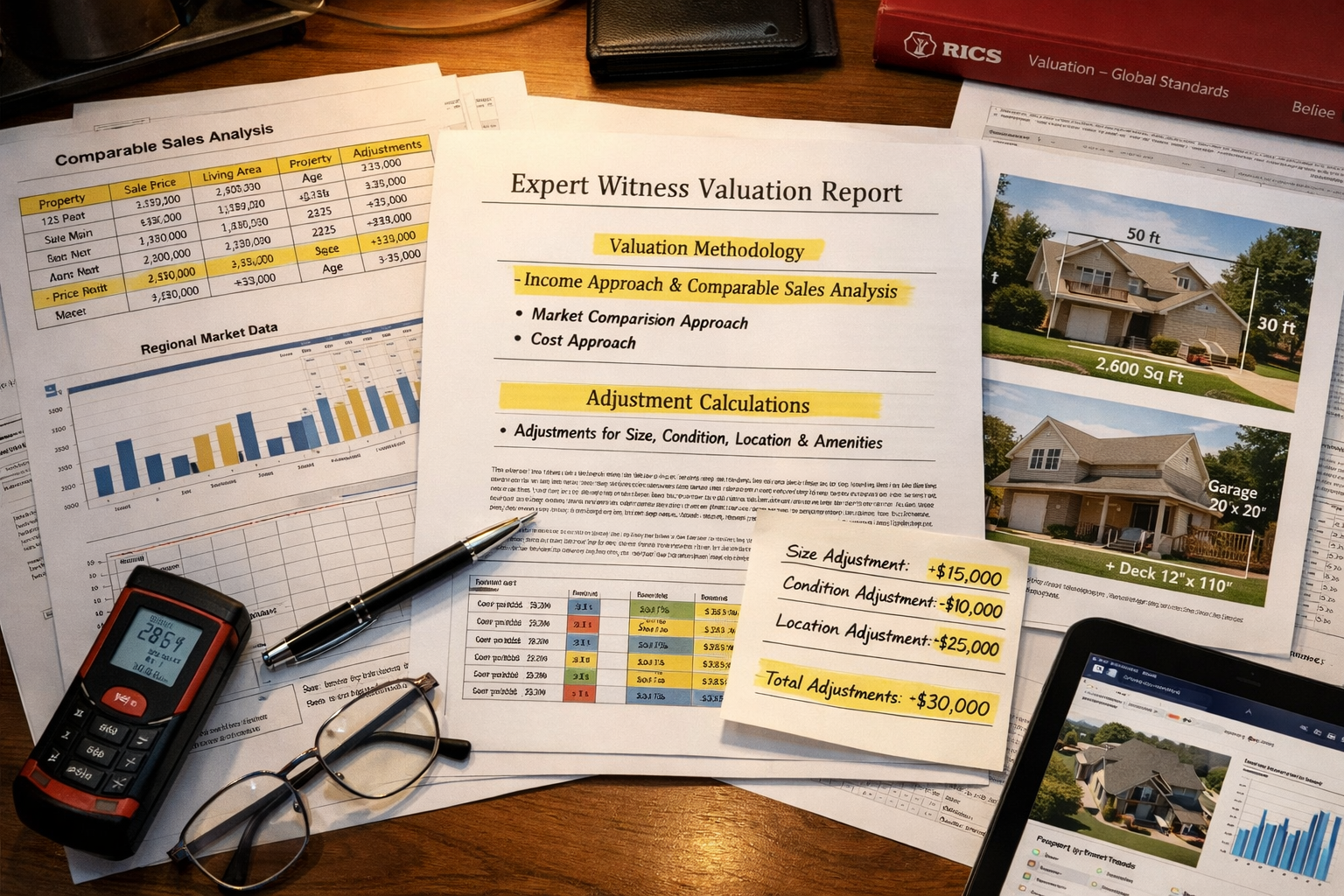
Expert Witness Valuations in Recovering 2026 Markets: Building Robust Cases with Regional Data and Stabilising Prices demands rigorous methodological frameworks that courts recognise and respect. The RICS Valuation – Global Standards (Red Book) provides the foundation, but expert witnesses must adapt these principles to recovering market conditions.
The Comparative Method in Stabilising Markets
The comparative method remains the primary approach for residential valuations, but recovering markets require enhanced adjustments:
Step 1: Identify truly comparable transactions
- Focus on completed sales rather than asking prices
- Verify transaction circumstances (arm's length, market exposure)
- Exclude distressed sales or unique buyer motivations
Step 2: Apply systematic adjustments
- Time adjustments: Account for market movement between comparable sale and valuation date
- Location adjustments: Reflect micro-location differences within the same area
- Physical adjustments: Size, condition, features, and improvements
- Market condition adjustments: Buyer sentiment shifts during recovery phase
Step 3: Weight evidence appropriately
- Give greater weight to recent, closely comparable transactions
- Consider multiple comparables to establish a range
- Document reasoning for final value selection within the range
Income and Residual Approaches
For investment properties or development sites, additional methodologies supplement comparative analysis:
Income capitalisation approach:
- Current rental evidence from the specific locality
- Capitalisation rates reflecting 2026 risk perceptions
- Adjustments for lease terms, tenant quality, and void periods
- Growth assumptions aligned with regional economic forecasts
Residual valuation for development sites:
- Current construction costs (noting 2026 material and labour markets)
- Realistic development timelines in current planning environment
- End values based on stabilised market conditions
- Developer's profit reflecting current risk-return expectations
Similar rigour applies when preparing dilapidations surveys where repair costs must reflect current market pricing.
Addressing Uncertainty and Limitations
Transparency about valuation uncertainty strengthens rather than weakens expert credibility. Courts appreciate honest acknowledgment of:
- Data limitations in markets with low transaction volumes
- Uncertainty ranges in rapidly changing conditions
- Assumptions requiring validation as more evidence emerges
- Alternative scenarios if key assumptions prove incorrect
"An expert witness who acknowledges reasonable uncertainty and explains their analytical approach earns far more judicial respect than one who presents false precision."
Preparing Court-Ready Valuation Reports 📋
The difference between a technically sound valuation and a court-ready expert witness report lies in presentation, documentation, and anticipation of challenges.
Essential Report Components
Executive summary:
- Clear statement of the valuation figure and effective date
- Brief property description and location
- Summary of methodology and key assumptions
- Concise explanation of regional market conditions
Detailed property description:
- Comprehensive physical characteristics
- Location analysis including micro-location factors
- Planning status and development potential
- Condition assessment (referencing detailed surveys where applicable)
Market analysis section:
- Regional market overview with supporting data
- Specific locality trends and characteristics
- Supply and demand dynamics in 2026
- Transaction evidence and pricing patterns
Valuation methodology:
- Step-by-step explanation of approach
- Comparable evidence with full details and adjustments
- Alternative methodologies considered and reasons for selection
- Calculations shown transparently
Supporting documentation:
- Comparable transaction evidence sheets
- Market data sources and extracts
- Photographs and location maps
- Professional qualifications and experience statement
When expert witnesses also provide party wall surveying services, the same documentation standards apply to those specialist reports.
Compliance with Professional Standards
RICS Red Book compliance is non-negotiable for expert witness valuations. Key requirements include:
✅ Terms of engagement: Clear scope, purpose, and basis of valuation
✅ Independence: Disclosure of any conflicts or prior involvement
✅ Competence: Demonstration of relevant qualifications and experience
✅ Inspection: Adequate property inspection appropriate to the valuation purpose
✅ Assumptions: Clear statement of special assumptions or departures from standard practice
✅ Reporting: Comprehensive documentation meeting minimum content requirements
Visual Presentation and Clarity
Courts value clear, accessible presentation that non-specialist judges and juries can understand:
- Use tables and charts to present complex data
- Include annotated photographs highlighting key features
- Provide location maps showing comparable properties
- Use consistent formatting and logical structure
- Define technical terms when first used
- Employ executive summaries and section headings
Cross-Examination Preparation and Defensive Strategies ⚖️
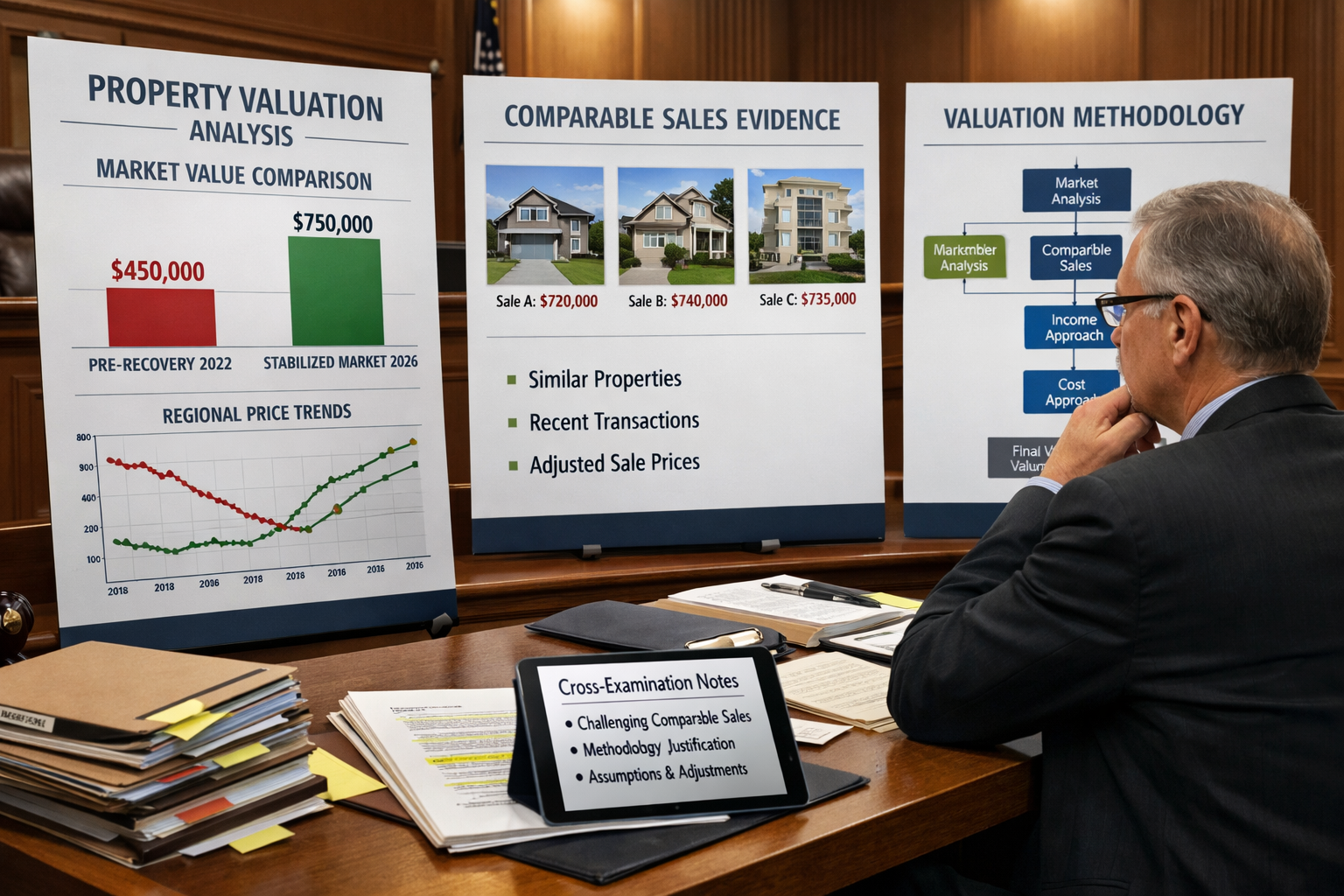
Even the most meticulously prepared valuation report faces scrutiny during cross-examination. Anticipating challenges and preparing robust defenses separates competent expert witnesses from truly effective ones.
Common Challenges in Recovering Market Cases
Expert witnesses should prepare for these frequent lines of questioning:
1. Data recency and relevance
- "Aren't these comparables from before the market stabilised?"
- "How do you know the market hasn't changed since your valuation date?"
- Defense: Document continuous market monitoring, explain stabilisation indicators, show multiple data points confirming trend
2. Regional applicability
- "This data is from a different postcode—how is it relevant?"
- "National trends don't apply to this specific location, do they?"
- Defense: Demonstrate hyper-local analysis, explain geographic boundaries of comparable search, show locality-specific trends
3. Adjustment methodology
- "How did you calculate this 15% adjustment for condition?"
- "Aren't these adjustments just guesswork?"
- Defense: Reference market evidence for adjustments, cite professional guidance, explain reasoning transparently
4. Alternative valuations
- "Another expert valued this property £50,000 higher—why are you wrong?"
- "Couldn't a reasonable expert reach a different conclusion?"
- Defense: Explain methodology differences, acknowledge reasonable ranges, demonstrate superior data or analysis
5. Professional bias
- "You're being paid by one party—doesn't that affect your opinion?"
- "Have you ever changed a valuation to help your client's case?"
- Defense: Emphasise professional independence, reference RICS ethical standards, demonstrate objective methodology
Building Defensible Positions
Strategies for robust expert witness testimony:
🛡️ Comprehensive documentation: Every opinion should trace back to documented evidence
🛡️ Transparent assumptions: Clearly state and justify all assumptions made
🛡️ Acknowledged limitations: Proactively address data gaps or uncertainties
🛡️ Consistent methodology: Apply the same standards regardless of which party instructs
🛡️ Professional detachment: Maintain objectivity about the outcome of the case
When dealing with complex cases involving structural engineer reports, coordination between different expert disciplines strengthens the overall case.
Maintaining Credibility Under Pressure
Effective courtroom demeanour enhances the impact of sound technical work:
- Answer questions directly without evasion
- Admit when you don't know something rather than speculate
- Avoid defensive or argumentative responses
- Speak in plain language accessible to non-specialists
- Maintain professional composure regardless of aggressive questioning
- Refer to your report and supporting documents when needed
Leveraging Technology and Data Analytics 💻
The 2026 landscape for Expert Witness Valuations in Recovering 2026 Markets: Building Robust Cases with Regional Data and Stabilising Prices increasingly incorporates advanced technology and data analytics to enhance accuracy and defensibility.
Digital Tools for Regional Data Analysis
Modern expert witnesses utilise sophisticated platforms:
Geographic Information Systems (GIS):
- Visualise comparable transactions on interactive maps
- Analyse spatial patterns in pricing and market activity
- Identify micro-location factors affecting values
- Present evidence visually in court
Automated Valuation Models (AVMs):
- Provide initial value estimates for sense-checking
- Identify outlier transactions requiring investigation
- Support rather than replace professional judgment
- Demonstrate market-wide pricing patterns
Market intelligence platforms:
- Real-time tracking of asking prices and transaction volumes
- Sentiment analysis from property portals and social media
- Demographic and economic data integration
- Forecasting tools for market trajectory assessment
Data Visualisation for Court Presentations
Compelling visual evidence enhances jury and judicial understanding:
- Heat maps showing price variations across neighbourhoods
- Time-series charts demonstrating stabilisation trends
- Comparative bar charts showing adjustment impacts
- Annotated property photographs highlighting value factors
- Interactive presentations allowing real-time data exploration
These technological capabilities complement traditional expertise from chartered surveyors who understand both methodology and local market nuances.
Blockchain and Transaction Verification
Emerging in 2026, blockchain-based property registries offer:
- Immutable transaction records reducing fraud risk
- Faster access to verified comparable evidence
- Enhanced transparency in property ownership and encumbrances
- Reduced disputes over transaction authenticity
Regional Case Studies: Applying Best Practices 🗺️
Examining specific regional examples illustrates how Expert Witness Valuations in Recovering 2026 Markets: Building Robust Cases with Regional Data and Stabilising Prices translates theory into practice.
Case Study 1: London Residential Dispute
Scenario: Divorce settlement requiring valuation of £2.5M family home in Kensington during Q1 2026.
Challenges:
- Limited comparable transactions in exclusive postcode
- Market recovering from 2023-2024 correction
- Conflicting valuations from parties' initial surveyors
Approach:
- Expanded geographic search to adjacent prime postcodes
- Applied time adjustments to 2024-2025 comparables reflecting recovery
- Weighted recent transactions more heavily than historical data
- Documented micro-location factors justifying premium positioning
- Provided valuation range acknowledging market uncertainty
Outcome: Court accepted the methodology and adopted the mid-point of the presented range, citing the transparent documentation of regional recovery patterns.
Case Study 2: Commercial Property in Manchester
Scenario: Lease renewal dispute for retail premises in Northern Quarter.
Challenges:
- Changing retail landscape post-pandemic
- Mixed signals about high street recovery in 2026
- Limited directly comparable lease transactions
Approach:
- Analysed broader Manchester retail market trends
- Incorporated footfall data and retail sales statistics
- Adjusted comparables for location quality and tenant covenant strength
- Considered alternative use values reflecting mixed-use development potential
- Addressed uncertainty through scenario analysis
Outcome: Tribunal praised the comprehensive regional analysis and adopted the valuation for determining fair market rent.
Case Study 3: Development Site in Surrey
Scenario: Compulsory purchase compensation for development land.
Challenges:
- Planning permission granted but market conditions changed
- Construction cost inflation affecting residual values
- Competing expert opinions differing by 40%
Approach:
- Updated residual valuation with current 2026 construction costs
- Analysed recent new-build sales in locality for end values
- Adjusted development timelines for current market absorption rates
- Provided sensitivity analysis showing impact of key assumptions
- Referenced local chartered surveyor expertise for regional market intelligence
Outcome: Lands Tribunal accepted the comprehensive regional data approach and awarded compensation close to the expert's valuation.
Future-Proofing Expert Witness Practice 🔮
As markets continue evolving beyond 2026, expert witnesses must adapt their practices to maintain relevance and credibility.
Emerging Trends Affecting Valuations
Climate risk integration:
- Flood risk, energy efficiency, and climate resilience increasingly affect values
- Expert witnesses must incorporate environmental data into regional analysis
- Courts expect consideration of long-term sustainability factors
Hybrid working impact:
- Continued evolution of location preferences affecting regional demand
- Home office requirements influencing property characteristics valued
- Transport infrastructure importance shifting in some markets
Regulatory changes:
- Building safety regulations post-Grenfell affecting valuations
- Energy Performance Certificate requirements influencing marketability
- Planning reforms creating new development opportunities and constraints
Continuing Professional Development
Essential competencies for expert witnesses in 2026 and beyond:
📚 Technical knowledge: Regular updates on valuation methodology and market analysis
📚 Legal awareness: Understanding of civil procedure and expert witness duties
📚 Technology proficiency: Capability with data analytics and presentation tools
📚 Communication skills: Ability to explain complex concepts clearly
📚 Regional expertise: Deep knowledge of specific geographic markets
📚 Ethical standards: Unwavering commitment to independence and objectivity
Professional development opportunities include RICS courses, legal training, and market-specific seminars that enhance expertise in Expert Witness Valuations in Recovering 2026 Markets: Building Robust Cases with Regional Data and Stabilising Prices.
Building a Reputation for Excellence
Long-term success as an expert witness depends on:
- Consistently delivering thorough, well-documented reports
- Maintaining absolute professional independence
- Developing recognised expertise in specific property types or regions
- Building relationships with legal professionals based on reliability
- Publishing thought leadership on valuation methodology
- Participating in professional organisations and standard-setting
Those seeking expert witness services increasingly value professionals who also provide comprehensive property surveying services, demonstrating practical market engagement alongside theoretical expertise.
Conclusion: Excellence in Expert Witness Valuations for 2026 Markets
Expert Witness Valuations in Recovering 2026 Markets: Building Robust Cases with Regional Data and Stabilising Prices represents both a significant opportunity and a professional responsibility. As property markets demonstrate clear stabilisation patterns across UK regions, the demand for credible, defensible expert opinions has never been higher.
The foundation of excellence rests on four pillars:
- Rigorous regional data analysis that moves beyond national trends to understand hyper-local market dynamics
- Transparent methodological frameworks that courts can understand and respect
- Comprehensive documentation that withstands the most aggressive cross-examination
- Professional independence that prioritises objective truth over client preference
The recovering market conditions of 2026 create unique challenges—from interpreting stabilisation signals to adjusting comparables in transitional markets—but also opportunities for expert witnesses who invest in understanding these nuances. Those who combine traditional valuation expertise with contemporary data analytics, maintain unwavering professional standards, and communicate complex concepts clearly will find themselves in high demand.
Actionable Next Steps
For property professionals seeking to enhance their expert witness capabilities:
✅ Invest in regional market intelligence: Develop deep knowledge of specific geographic areas rather than superficial national coverage
✅ Enhance technical skills: Master data analytics tools and visualisation platforms that strengthen evidence presentation
✅ Pursue relevant qualifications: Ensure RICS registration and consider specialist expert witness training
✅ Build documentation systems: Create templates and processes that ensure comprehensive, consistent reporting
✅ Network strategically: Develop relationships with legal professionals who value quality expert opinions
✅ Commit to continuous learning: Stay current with market developments, legal precedents, and methodological advances
For those requiring expert witness services, prioritise professionals who demonstrate these qualities and can provide evidence of successful court testimony in similar market conditions.
The property markets of 2026 present a dynamic landscape where expertise, integrity, and analytical rigour separate exceptional expert witnesses from merely competent ones. By embracing the principles outlined in this guide and maintaining unwavering commitment to professional excellence, expert witnesses can build robust cases that serve justice while advancing their professional reputation.
Whether you're preparing your first expert witness report or refining established practices, the recovering markets of 2026 demand nothing less than your best work—supported by comprehensive regional data, transparent methodology, and absolute professional independence.
For professional assistance with property valuations, surveys, or expert witness services, contact qualified chartered surveyors who understand the complexities of 2026 market conditions and can provide the rigorous analysis courts demand.
