
The UK rental market in 2026 presents a complex landscape where tenant demand dynamics and constrained landlord supply are reshaping rental valuations. As disputes between landlords and tenants intensify amid evolving market conditions, the role of qualified expert witnesses has never been more critical. Understanding Expert Witness Roles in Lettings Tenant Demand Surge: Valuations for 2026 Rental Price Rises per RICS is essential for property professionals, institutional investors, and legal practitioners navigating this challenging terrain.
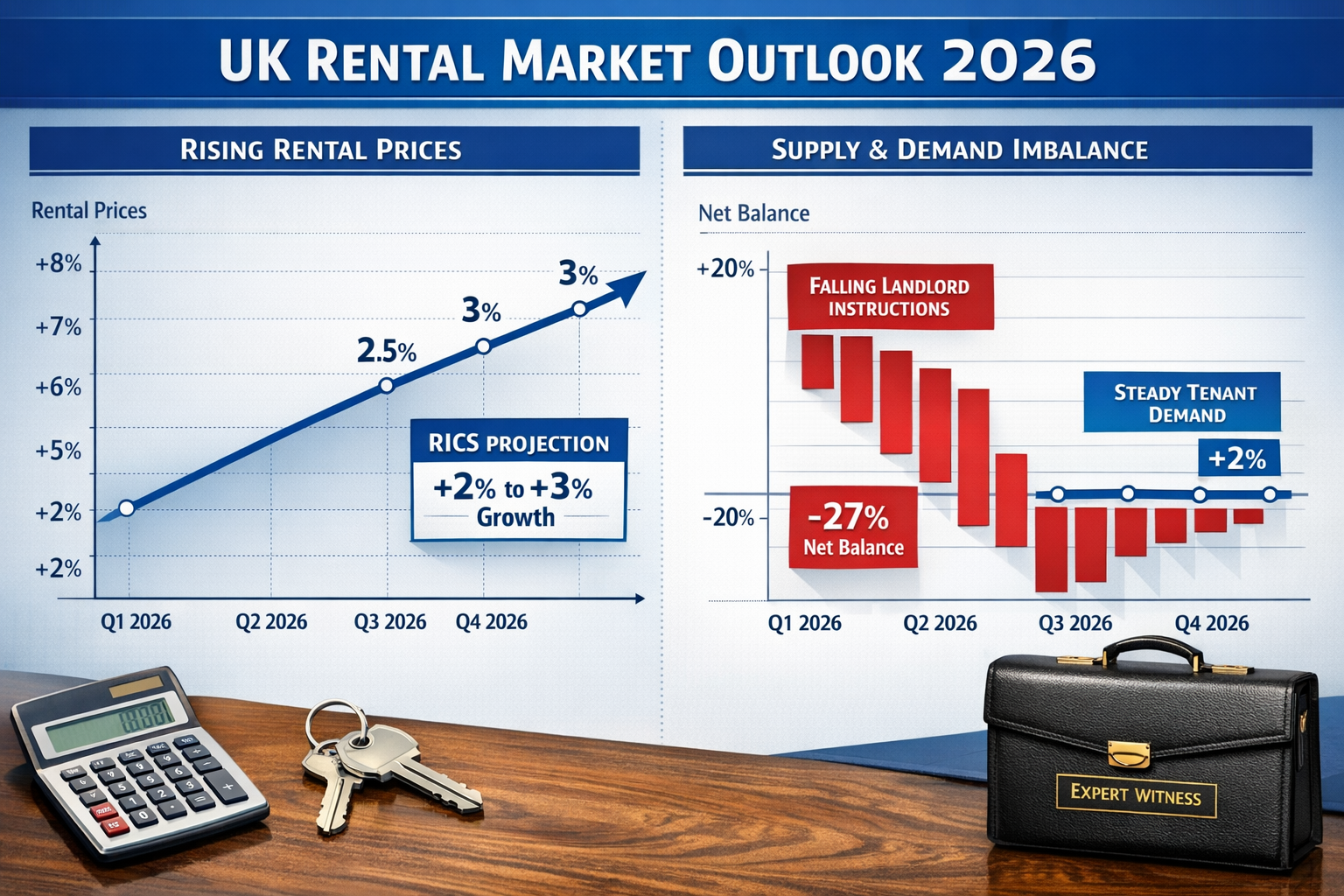
Recent RICS data reveals that while tenant demand has stabilized rather than surged dramatically, the persistent supply shortage continues to exert upward pressure on rental prices. With rental growth forecast at 2-3% for 2026 and landlord instructions remaining at a firmly negative net balance of -27%, expert witnesses must provide authoritative valuations that reflect these nuanced market conditions[2]. This professional guidance becomes particularly vital in landlord-tenant disputes, rent review proceedings, and institutional Build-to-Let (BTL) investment decisions.
Key Takeaways
- 📊 Tenant demand stabilized at a net balance of +2% through February 2026, ending earlier declines but not showing significant surge
- 🏠 Rental supply remains 23% below pre-pandemic levels despite an 11% year-over-year increase in available properties
- 💰 RICS forecasts 2-3% rental price growth for 2026, with expert witnesses playing crucial roles in validating these valuations for disputes
- ⚖️ Expert witness testimony is increasingly essential for landlord-tenant tribunals, rent reviews, and institutional BTL investment decisions
- 📈 Landlord instructions remain negative at -27% net balance, creating ongoing supply constraints that impact rental yield calculations
Understanding the 2026 UK Rental Market Landscape According to RICS
The foundation for Expert Witness Roles in Lettings Tenant Demand Surge: Valuations for 2026 Rental Price Rises per RICS begins with understanding current market conditions. Contrary to headlines suggesting a dramatic tenant demand surge, RICS data paints a more nuanced picture.
Current Tenant Demand Metrics
According to the February 2026 RICS UK Residential Market Survey, tenant demand was "largely stable" over the three months to February, registering a net balance of just +2%[2]. This represents a modest improvement from the flat or negative readings observed in late 2025, but falls short of constituting a genuine surge. In January 2026, demand "edged higher" after two quarters of stagnation[3], suggesting gradual stabilization rather than explosive growth.
Key demand indicators include:
- Net balance of +2% for tenant demand (February 2026)[2]
- 14% year-over-year decline in demand for rented homes[1]
- Gradual recovery from previous quarters of negative sentiment
- Regional variations with stronger demand in certain urban centers
The Persistent Supply Constraint Challenge
The more significant story lies on the supply side. Landlord instructions to letting agents continued at a "firmly negative net balance of -27%" as of February 2026[2]. This persistent reluctance to bring properties to market reflects several factors:
✅ Regulatory pressures including enhanced energy efficiency requirements
✅ Tax changes affecting landlord profitability
✅ Market uncertainty prompting portfolio exits
✅ Mortgage rate concerns impacting BTL investment decisions
Despite an 11% year-over-year increase in homes available for rent, the absolute number remains 23% below pre-pandemic levels[1]. This structural deficit creates the conditions for sustained rental price growth, even without dramatic demand increases.
Rental Price Growth Projections for 2026
Multiple authoritative sources project modest but sustained rental inflation throughout 2026:
| Source | 2026 Forecast | Methodology |
|---|---|---|
| RICS Survey Participants | +20% net balance expect rises in next 3 months[2] | Survey sentiment |
| UK Rental Market Report | 2-3% annual growth[1] | Market analysis |
| Capital Economics | 2.8% growth (accelerating to 4.0% in 2027)[7] | Economic modeling |
| Actual March 2026 Data | +1.9% annual inflation for new lets[1] | Transaction data |
These projections form the evidential basis that expert witnesses must evaluate when providing testimony in rental disputes and valuation matters.
"The rental market continues to be shaped by a structural imbalance between supply and demand, with landlord instructions remaining subdued despite tenant demand stabilizing." — RICS UK Residential Market Survey, February 2026[2]
Expert Witness Roles in Rental Valuation Disputes and Tribunal Proceedings

The complexity of the 2026 rental market makes qualified expert witness testimony indispensable in various legal and commercial contexts. Understanding Expert Witness Roles in Lettings Tenant Demand Surge: Valuations for 2026 Rental Price Rises per RICS requires examining how these professionals apply market data to real-world disputes.
Primary Functions of Expert Witnesses in Lettings Matters
Expert witnesses in the rental sector provide several critical services:
1. Independent Market Rent Determinations
When landlords and tenants disagree about appropriate rental levels, RICS-qualified expert witnesses provide objective assessments based on:
- Comparable rental evidence from similar properties
- Adjustment factors for property condition, location, and amenities
- Market trend analysis incorporating RICS survey data
- Regional and micro-market variations
2. Rent Review Proceedings
Commercial and some residential leases contain rent review clauses requiring periodic adjustments. Expert witnesses assist in rent review proceedings by:
- Interpreting lease terms and review mechanisms
- Applying appropriate valuation methodologies
- Presenting evidence to arbitrators or independent experts
- Defending valuations under cross-examination
3. Tribunal and Court Testimony
First-tier Tribunal (Property Chamber) cases frequently involve expert evidence on:
- Service charge disputes where rental values affect apportionment
- Lease extension valuations requiring rental income projections
- Dilapidations claims involving rental loss calculations
- Possession proceedings where market rent is contested
4. Landlord-Tenant Dispute Resolution
Beyond formal proceedings, expert witnesses facilitate alternative dispute resolution through:
- Mediation support with objective market data
- Expert determination appointments
- Pre-action advisory opinions
- Settlement negotiation assistance
Qualifications and Standards for Expert Witnesses
The credibility of expert testimony depends on proper qualifications and adherence to professional standards:
Essential qualifications include:
🎓 RICS membership (MRICS or FRICS designation)
🎓 Specialist knowledge in residential or commercial lettings
🎓 Expert witness training in legal procedures and report writing
🎓 Professional indemnity insurance with expert witness coverage
🎓 CPD compliance demonstrating current market knowledge
Expert witnesses must follow the RICS Practice Statement and Guidance Note on Surveyors Acting as Expert Witnesses, which emphasizes:
- Duty to the tribunal or court above client interests
- Objectivity and independence in all opinions
- Clear statement of assumptions and limitations
- Transparent methodology and reasoning
When preparing expert witness reports, professionals must demonstrate comprehensive understanding of current market conditions, including the stabilized tenant demand and constrained supply documented in 2026 RICS surveys.
Application of RICS Data in Expert Testimony
Expert witnesses leverage RICS market survey data to support their opinions:
Market context evidence:
- Citing the +2% net balance for tenant demand to contextualize local market conditions[2]
- Referencing the -27% landlord instruction balance to explain supply constraints[2]
- Applying the 2-3% rental growth forecast to future income projections[1]
Comparative analysis:
- Adjusting comparable evidence for market movement since transaction dates
- Explaining regional variations against national RICS trends
- Distinguishing between new let inflation (+1.9%) and existing tenancy renewals[1]
Yield calculations:
- Incorporating projected rental growth into discounted cash flow models
- Assessing investment returns for institutional BTL portfolios
- Evaluating risk premiums based on supply-demand dynamics
Valuation Strategies for Institutional BTL Investments Amid 2026 Market Conditions
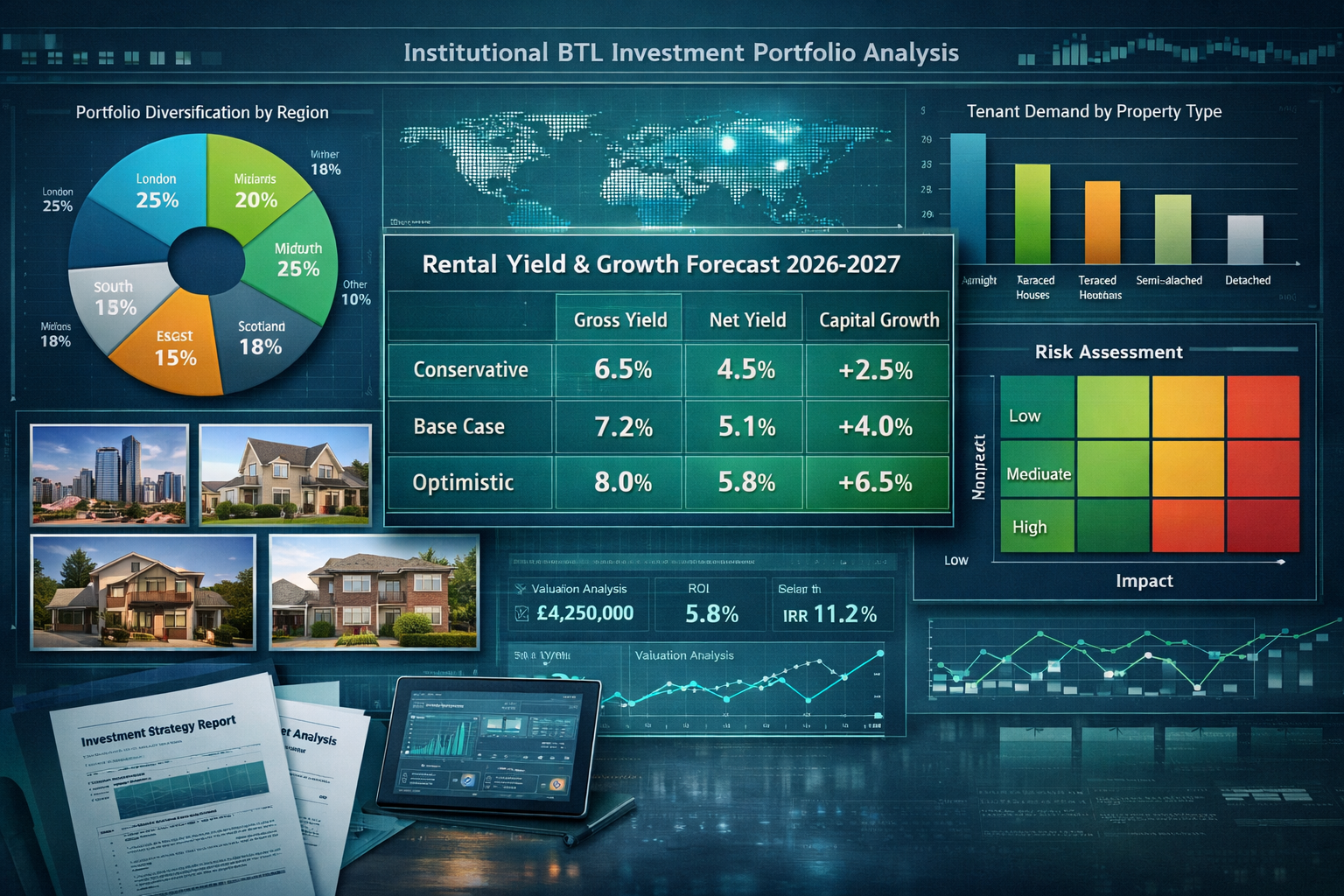
Institutional investors in the Build-to-Let sector require sophisticated valuation approaches that reflect Expert Witness Roles in Lettings Tenant Demand Surge: Valuations for 2026 Rental Price Rises per RICS within investment decision-making frameworks.
Yield Calculation Methodologies for BTL Portfolios
Professional valuers employ several yield metrics when assessing institutional rental portfolios:
Gross Rental Yield
The simplest metric calculates annual rental income as a percentage of property value:
Gross Yield = (Annual Rental Income ÷ Property Value) × 100
For 2026 market conditions:
- Typical gross yields range from 4-6% depending on location
- Higher yields in regional markets offset by lower capital appreciation
- London and Southeast yields compressed by higher property values
Net Rental Yield
A more accurate measure accounts for operating expenses:
Net Yield = [(Annual Rent – Operating Costs) ÷ Property Value] × 100
Operating costs include:
- Property management fees (typically 10-15% of rent)
- Maintenance and repairs
- Insurance premiums
- Ground rent and service charges (leasehold properties)
- Void periods and bad debt provisions
With the 23% supply shortage, void periods have decreased, improving net yields[1].
Discounted Cash Flow (DCF) Analysis
Institutional investors employ DCF models incorporating:
- Rental growth projections: Using RICS 2-3% forecast for 2026[1]
- Exit yields: Terminal capitalization rates for portfolio disposal
- Discount rates: Reflecting risk premium and cost of capital
- Hold periods: Typically 10-15 years for institutional portfolios
Sample DCF inputs for 2026:
| Parameter | Conservative | Moderate | Optimistic |
|---|---|---|---|
| 2026 Rental Growth | 2.0% | 2.5% | 3.0% |
| 2027 Rental Growth | 2.5% | 3.5% | 4.5% |
| Discount Rate | 7.5% | 7.0% | 6.5% |
| Exit Yield | 5.0% | 4.5% | 4.0% |
The moderate scenario aligns with Capital Economics' projection of 2.8% growth in 2026 accelerating to 4.0% in 2027[7].
Risk Assessment in Current Market Conditions
Expert witnesses evaluating BTL investments must address multiple risk factors:
Supply-Side Risks
The -27% landlord instruction balance creates both opportunities and risks[2]:
✅ Upside: Sustained rental growth from supply shortage
✅ Upside: Reduced competition for quality tenants
⚠️ Downside: Potential regulatory intervention to increase supply
⚠️ Downside: Political pressure on landlord taxation
Demand-Side Risks
While demand has stabilized at +2%, vulnerabilities remain[2]:
⚠️ Economic sensitivity: Recession could reduce tenant affordability
⚠️ Mortgage rate impact: Higher rates may force renters into ownership
⚠️ Demographic shifts: Remote work affecting location preferences
Regulatory and Legislative Risks
The 2026 environment includes:
- Energy Performance Certificate (EPC) requirements potentially requiring property upgrades
- Tenant rights legislation affecting possession procedures
- Local authority licensing schemes adding compliance costs
- Tax policy uncertainty around capital gains and income tax treatment
RICS valuations must explicitly address these risk factors and their impact on investment returns.
Comparable Evidence Selection and Adjustment
Expert witnesses must carefully select and adjust comparable rental transactions:
Selection criteria:
- Geographic proximity (preferably same postcode sector)
- Property type and size comparability
- Transaction recency (ideally within 3-6 months)
- Lease terms similarity (furnished/unfurnished, length)
Adjustment factors for 2026 market:
- Time adjustments: Apply 2-3% annual growth rate to older comparables[1]
- Condition adjustments: Account for refurbishment and specification differences
- Location adjustments: Micro-market variations within broader areas
- Size adjustments: Per-square-foot analysis for different property sizes
The 14% year-over-year decline in tenant demand must be contextualized against the 23% supply shortage when making time adjustments[1]. This explains why rental growth continues despite weakening demand.
Expert Witness Testimony on Institutional Investment Values
When providing expert evidence on BTL portfolio valuations, witnesses must address:
Market Positioning
- How does the subject portfolio compare to institutional benchmarks?
- What is the tenant profile and covenant strength?
- How does geographic diversification affect risk-adjusted returns?
Operational Performance
- What are actual void rates versus market assumptions?
- How do management costs compare to industry standards?
- What is the tenant retention rate and its impact on costs?
Future Prospects
- How will RICS-projected 2-3% rental growth affect portfolio value?[1]
- What capital expenditure is required for regulatory compliance?
- How might the -27% landlord instruction trend impact exit strategies?[2]
Expert witnesses providing commercial valuations for institutional BTL portfolios must demonstrate comprehensive understanding of these factors while maintaining objectivity and independence.
Practical Applications: Case Studies and Expert Witness Scenarios
Understanding Expert Witness Roles in Lettings Tenant Demand Surge: Valuations for 2026 Rental Price Rises per RICS becomes clearer through practical examples.
Case Study 1: Rent Review Arbitration in Central London
Scenario: A commercial landlord seeks a rent review on a ground-floor retail unit with residential accommodation above. The lease provides for review to market rent every five years.
Expert witness role:
- Analyze comparable lettings in the immediate vicinity
- Apply RICS market data showing stabilized demand (+2%) and supply constraints (-27%)[2]
- Adjust for the 2-3% annual rental growth since last review[1]
- Present evidence under cross-examination from opposing expert
Outcome: The expert's testimony, grounded in RICS survey data and adjusted comparables, supported a 7.5% rental increase reflecting three years of market growth at approximately 2.5% annually.
Case Study 2: Institutional BTL Portfolio Acquisition
Scenario: A pension fund considers acquiring a 250-unit BTL portfolio across three UK cities, requiring independent valuation.
Expert witness role:
- Conduct RICS-compliant valuation of the entire portfolio
- Calculate net yields accounting for management costs and void periods
- Project rental income growth using RICS 2-3% forecast and Capital Economics 2.8% projection[1][7]
- Assess risk factors including the 23% supply shortage and 14% demand decline[1]
Outcome: The expert's DCF analysis, incorporating conservative 2.0% growth for 2026 and 3.0% for 2027, supported an acquisition price yielding 5.2% net initial yield with projected IRR of 8.5% over 10 years.
Case Study 3: First-tier Tribunal Lease Extension Valuation
Scenario: A leaseholder seeks a statutory lease extension, with parties disagreeing on the rental value of the property for calculation purposes.
Expert witness role:
- Determine market rent for the property in its current condition
- Consider RICS data on tenant demand stabilization and supply constraints[2]
- Apply appropriate deferment and relativity rates
- Prepare expert witness report for tribunal
Outcome: The tribunal accepted the expert's market rent assessment, which properly reflected the +1.9% annual inflation for new lets documented in March 2026 data[1], resulting in a fair lease extension premium.
Challenges and Best Practices for Expert Witnesses in 2026
Common Challenges in Rental Market Expert Testimony
Data interpretation complexity:
- Distinguishing between stabilized demand (+2%) and genuine surge[2]
- Explaining the paradox of declining demand (-14%) alongside rental growth[1]
- Addressing regional variations within national RICS trends
Conflicting evidence:
- Reconciling different rental growth forecasts (2-3% vs. 2.8%)[1][7]
- Dealing with limited comparable evidence in supply-constrained markets
- Addressing opposing expert opinions with alternative methodologies
Regulatory uncertainty:
- Accounting for potential legislative changes affecting landlord returns
- Evaluating impact of evolving EPC requirements on property values
- Assessing political risk in rental market interventions
Best Practices for Expert Witnesses
✅ Maintain rigorous documentation of all research, comparables, and calculations
✅ Use multiple data sources including RICS surveys, Land Registry data, and local market intelligence
✅ Clearly state assumptions and sensitivity analysis showing impact of variable inputs
✅ Update knowledge continuously through CPD and market monitoring
✅ Communicate clearly using plain language accessible to non-technical tribunal members
✅ Remain objective even when instructed by one party to a dispute
✅ Acknowledge limitations of available data and methodology constraints
Professional Development and Market Knowledge
Expert witnesses must stay current with:
- RICS monthly surveys providing up-to-date sentiment and trend data
- Land Registry price paid data for transaction evidence
- Rental index publications from major property portals and research firms
- Legislative developments affecting landlord-tenant relationships
- Economic indicators impacting tenant affordability and demand
Participation in RICS working groups, attendance at property conferences, and engagement with academic research all contribute to expert witness credibility.
The Future Landscape: Expert Witness Roles Beyond 2026
Emerging Trends Affecting Expert Testimony
Technology integration:
- Use of AI-powered comparable search tools
- Blockchain-based transaction verification
- Virtual tribunal hearings and remote expert testimony
Market evolution:
- Continued institutional investment in BTL sector
- Build-to-Rent developments changing supply dynamics
- ESG considerations in property valuations
Regulatory developments:
- Potential rent control discussions
- Enhanced tenant protection legislation
- Landlord licensing expansion
Preparing for 2027 and Beyond
Capital Economics projects rental growth acceleration to 4.0% in 2027[7], suggesting expert witnesses should:
- Develop scenario planning for multiple growth trajectories
- Enhance understanding of institutional investor requirements
- Build expertise in specialist sectors (student accommodation, co-living, senior housing)
- Strengthen knowledge of sustainability and ESG valuation factors
The role of expert witnesses in rental market disputes will likely expand as market complexity increases and institutional investment grows. Those who combine technical valuation expertise with clear communication and rigorous methodology will remain in high demand.
Conclusion
Expert Witness Roles in Lettings Tenant Demand Surge: Valuations for 2026 Rental Price Rises per RICS represents a critical intersection of market analysis, professional valuation, and legal testimony. While RICS data reveals that tenant demand has stabilized rather than surged dramatically—registering just +2% net balance through February 2026[2]—the persistent supply shortage with landlord instructions at -27%[2] continues driving rental price growth projected at 2-3% for the year[1].
Expert witnesses play indispensable roles in:
🎯 Providing objective rental valuations for landlord-tenant disputes and tribunal proceedings
🎯 Supporting institutional BTL investment decisions through sophisticated yield analysis and risk assessment
🎯 Interpreting complex market data including the paradox of declining demand (-14%) alongside rental growth[1]
🎯 Applying professional standards that ensure credible, defensible testimony
The 23% supply shortage relative to pre-pandemic levels[1] creates ongoing upward pressure on rents despite moderating demand, making expert analysis essential for fair dispute resolution and informed investment decisions.
Actionable Next Steps
For property professionals:
- Obtain or maintain RICS membership and expert witness training
- Stay current with monthly RICS survey data and market reports
- Develop specialization in either residential or commercial lettings valuation
- Build a portfolio of comparable evidence and market intelligence
For landlords and investors:
- Engage qualified expert witnesses early in disputes to assess case strength
- Commission independent RICS valuations for portfolio acquisitions and disposals
- Understand the methodologies and data sources supporting rental projections
- Consider expert determination clauses in new lease agreements
For legal practitioners:
- Select expert witnesses with appropriate specialization and credentials
- Provide comprehensive instructions including all relevant lease terms and market context
- Allow sufficient time for thorough research and report preparation
- Understand the distinction between expert witnesses and advocates
The rental market in 2026 presents both challenges and opportunities. With rental supply remaining 23% below pre-pandemic levels despite an 11% year-over-year increase[1], and with RICS projecting continued price growth through 2026 and beyond, the demand for qualified expert witness services will remain robust. Those who combine technical expertise, market knowledge, and professional integrity will continue to provide essential guidance in this evolving landscape.
References
[1] Uk Rental Market Report March 2026 – https://assets.ctfassets.net/2zc2pc2uwamh/4ytGOrzcBHJCz2biMu14Ea/aead7412968a18fcf1123c37e8ece446/UK_Rental_Market_Report_March_2026.pdf
[2] Uk Residential Market Survey February 2026 – https://www.rics.org/content/dam/ricsglobal/documents/market-surveys/uk-residential-market-survey/UK-Residential-Market-Survey_February-2026.pdf
[3] Uk Resi Survey Jan 2026 Report Shows Early Signs Market Recovery Despite Caution – https://www.rics.org/news-insights/uk-resi-survey-jan-2026-report-shows-early-signs-market-recovery-despite-caution
[7] Uk Rics Residential Market Survey Feb 2026 – https://www.capitaleconomics.com/publications/uk-housing-market-update/uk-rics-residential-market-survey-feb-2026
