
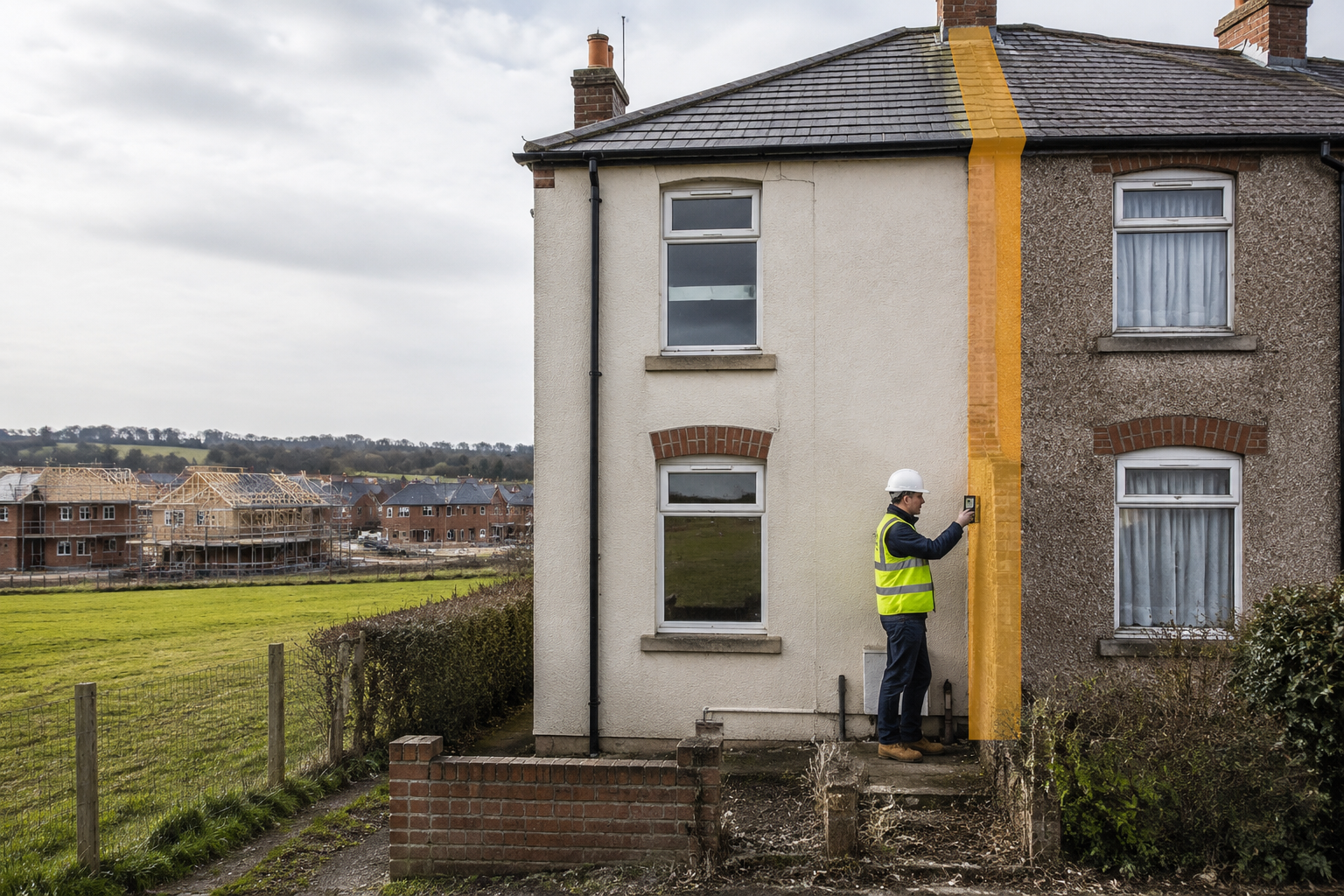
Government reforms aimed at loosening green belt restrictions have quietly repositioned party wall law from a routine urban concern into a frontline issue for edge-of-town development. As the 2026 housing recovery unfolds with cautious optimism, thousands of new homes are being planned on land that previously sat beyond the reach of developers. That shift creates a specific and underappreciated challenge: when new builds meet existing properties at former green belt boundaries, the Party Wall etc. Act 1996 applies with full force, and both developers and homeowners need to understand what that means in practice.
Party Wall Agreements for Green Belt Loosening Projects: Survey Protocols Amid 2026 Housing Recovery is not merely a compliance topic. It is a practical framework that determines whether construction proceeds smoothly or collapses into costly disputes. This article explains the legal foundations, survey protocols, and market context that every stakeholder in 2026 edge-of-town development should understand.
Key Takeaways
- Green belt loosening under 2026 planning reforms is generating new categories of party wall disputes at the urban fringe.
- The Party Wall etc. Act 1996 applies to all notifiable works near shared boundaries, regardless of whether the site was previously green belt land.
- Statutory notice periods of one or two months must be served before works begin, and failure to do so creates significant legal and financial risk.
- RICS-accredited surveyors play a central role in producing schedules of condition, negotiating party wall awards, and protecting both building owners and adjoining owners.
- The 2026 housing market remains volatile, with mixed signals from RICS, Rightmove, and Nationwide, making early legal preparation even more important for developers managing tight timelines.
The 2026 Housing Market Context: Why Green Belt Land Is Back in Focus
The 2026 housing recovery is best described as fragile and uneven. RICS reported early signs of improvement in January 2026, with new buyer enquiries rising for a third consecutive month and agreed sales reaching their least negative reading since June 2025 [2]. However, by March 2026, momentum had already stalled. New buyer enquiries fell to a net balance of -39%, the weakest reading since August 2023, driven by rising borrowing costs and geopolitical uncertainty [6].
Asking prices told a similarly mixed story. In June 2026, UK property asking prices recorded their largest drop in 14 years, falling 0.6% to an average of £376,191 [1]. Nationwide Building Society had projected modest price growth of 1% to 3% for the year [4], while Rightmove predicted a 2% increase in new seller asking prices following a 0.6% decline in 2025 [9]. CBRE noted that ongoing supply shortages would support rental growth but that elevated stock levels would temper house price gains [5].
Against this backdrop, the government's decision to loosen green belt restrictions represents a structural supply-side intervention. The logic is straightforward: if the market cannot generate enough homes through urban densification alone, releasing carefully selected green belt land for development becomes politically and economically necessary. Experts predicted a "bottom-up" recovery for 2026, with first-time buyers as a driving force and UK Finance forecasting around 1.20 million house sales in both 2026 and 2027 [3].
What this means for party wall practitioners is a pipeline of edge-of-town projects where the legal and physical boundaries between new development and existing residential properties are untested, often poorly documented, and frequently contested.
"Without a recovery in consumer confidence, the pattern for the coming year is likely to be modest nominal price growth, real terms price falls, while rental increases continue to moderate." – Handelsbanken UK Chief Economist [7]
What the Party Wall etc. Act 1996 Requires on Green Belt Edge Developments
The Party Wall etc. Act 1996 does not distinguish between urban infill and green belt edge development. Its obligations apply wherever notifiable works are proposed near a shared boundary or party structure. For developers building on former green belt land adjacent to existing residential properties, three categories of work are most commonly triggered:
Section 1 – New walls on or at the boundary line: When a developer proposes to build a new wall astride or adjacent to the boundary with a neighbouring property, a Section 1 notice must be served at least one month before works begin.
Section 2 – Works to an existing party structure: Where an existing shared wall, fence wall, or party fence wall is affected by proposed construction, a Section 2 notice is required at least two months before works commence.
Section 6 – Excavations near neighbouring buildings: Where excavations are proposed within three metres of a neighbouring structure (to a depth greater than that structure's foundations) or within six metres (where excavations cut a line drawn downward at 45 degrees from the base of the neighbour's foundations), a Section 6 notice must be served at least one month in advance.
For a comprehensive overview of when these obligations arise, the complete guide to party wall surveys for homeowners provides detailed worked examples. Developers who are uncertain whether their specific works are notifiable should also consult the do you need a party wall agreement guide before proceeding.
Notice Timelines: A Practical Summary
| Work Type | Relevant Section | Notice Period |
|---|---|---|
| New wall on boundary | Section 1 | 1 month |
| Works to party structure | Section 2 | 2 months |
| Excavations near foundations | Section 6 | 1 month |
Failure to serve valid notices does not make works unlawful in the criminal sense, but it exposes the building owner to injunctions, damages claims, and the significant practical disruption of having works halted mid-project. The consequences of proceeding without a party wall agreement are well-documented and consistently costly.
Survey Protocols for Party Wall Agreements for Green Belt Loosening Projects: Survey Protocols Amid 2026 Housing Recovery
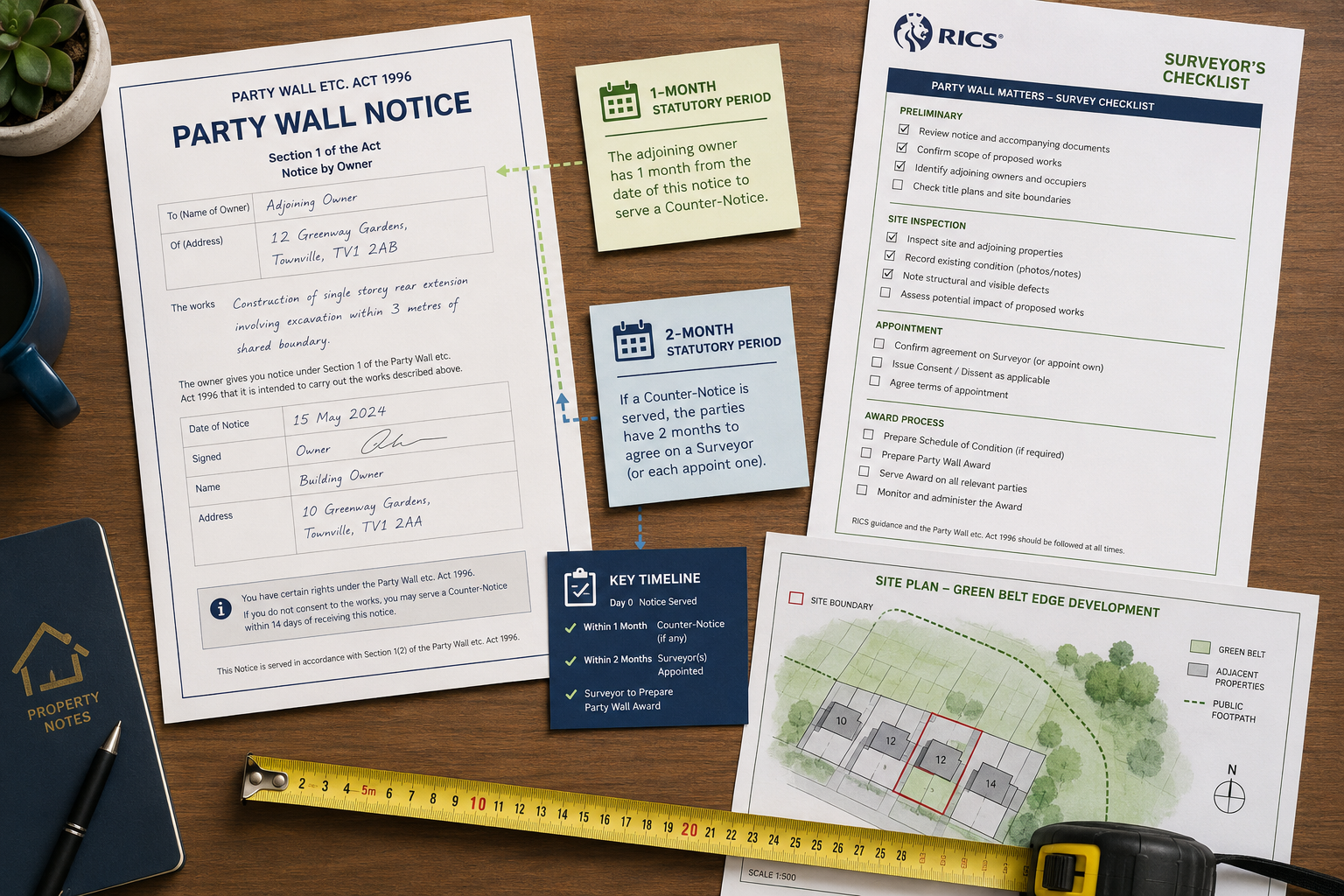
The survey protocol for green belt edge development differs in several important respects from standard urban party wall practice. The key distinctions relate to site documentation, the condition of adjoining properties, and the complexity of boundary evidence.
Schedule of Condition
Before any notifiable works begin, a thorough schedule of condition must be prepared for all adjoining properties within the zone of influence. On green belt edge sites, this is particularly important because:
- Adjoining properties are often older rural or semi-rural dwellings with pre-existing structural vulnerabilities that may not be immediately visible.
- Drainage systems, foundations, and boundary structures on older properties may be less well-documented than those in urban areas.
- The absence of prior development nearby means there is no comparative baseline from previous party wall awards.
The schedule of condition should be photographic, written, and ideally video-recorded. It forms the evidential foundation for any future dispute about whether damage was caused by the notified works. Surveyors should pay particular attention to existing cracking patterns, settlement, and the condition of any boundary walls or outbuildings.
Appointing Surveyors
When an adjoining owner dissents from a party wall notice (or fails to respond within 14 days, which is treated as dissent), the dispute resolution mechanism under the Act is triggered. Both parties must appoint surveyors. The options are:
- Each party appoints their own surveyor (the most common arrangement).
- Both parties agree to appoint a single agreed surveyor.
On large green belt development sites with multiple adjoining owners, the logistics of surveyor appointment can become complex. A developer with ten adjoining neighbours may face ten separate surveyor appointments and ten separate party wall awards. Early engagement with a qualified party wall surveyor is essential to manage this process efficiently.
The Party Wall Award
The party wall award (also called a determination) is the formal document produced by the appointed surveyors that governs how notifiable works are to be carried out. A well-drafted award for a green belt edge development project should address:
- The specific works permitted and the manner in which they must be executed.
- Hours of working, noise management, and dust suppression.
- Access rights for the building owner and their contractors.
- The schedule of condition as an appended document.
- Provisions for making good any damage caused.
- The surveyor's fees and who bears them.
For a detailed explanation of what a party wall award contains and how it is enforced, the complete guide to party wall awards for UK homeowners is an authoritative resource.
RICS Framework and Professional Standards
RICS-accredited surveyors operating under the RICS Party Wall Surveyor guidance note are expected to act impartially, even when appointed by one party. This is a statutory requirement under the Act and a professional obligation under RICS standards. On green belt edge sites, where the power imbalance between a large developer and a single residential neighbour can be pronounced, adherence to RICS frameworks is not merely procedural – it is the mechanism that ensures fair outcomes.
Surveyors should also be aware that the RICS guidance on party wall matters has been updated to reflect modern construction techniques, including piled foundations, basement excavations, and modular construction methods increasingly used in volume housebuilding on former green belt land.
Managing Neighbour Disputes in Edge-of-Town Developments

Green belt loosening projects generate a specific type of neighbour dispute that differs from the typical urban party wall disagreement. Existing residents near former green belt land often have strong emotional and financial attachments to the open character of their surroundings. The arrival of a large development on previously open land can generate hostility that goes beyond the technical scope of the Party Wall etc. Act.
Party wall surveyors working on these projects need to manage the distinction between what the Act covers and what it does not. The Act governs physical works to shared structures and excavations near boundaries. It does not govern planning permission, noise from construction traffic, or the general amenity impact of development. Surveyors who conflate these issues risk extending the scope of awards beyond their legal authority, which can render the award vulnerable to appeal.
Common Dispute Triggers on Green Belt Sites
Boundary uncertainty: Former agricultural land often has poorly defined boundaries. Historic hedgerows, ditches, and fence lines may not correspond to the legal boundary shown on title documents. A surveyor must establish the correct legal boundary before determining whether any structure qualifies as a party wall or party fence wall.
Foundation depth: New homes built on former green belt land frequently require deeper foundations than adjacent older properties, particularly where ground conditions include clay shrinkage, made ground, or tree root influence. Section 6 notices are therefore more commonly triggered on these sites.
Access disputes: The Act grants a right of access to adjoining land for the purposes of carrying out notifiable works, but this right must be exercised reasonably. Disputes about the extent and duration of access are common on edge-of-town sites where the adjoining owner's garden or outbuildings may be the only practical route for plant and equipment.
For guidance on what happens when a neighbour refuses to engage with the party wall process, the resource on whether a neighbour can legally refuse a party wall agreement sets out the legal position clearly.
Practical Steps for Developers
Developers working on green belt loosening projects in 2026 should adopt the following approach to minimise party wall disputes:
- Identify all adjoining owners early – before planning permission is granted if possible.
- Engage informally before serving notices – a brief explanation of the project and its likely impact can reduce hostility significantly.
- Serve notices in good time – the statutory minimum is a floor, not a target. Serving notices three to four months before works begin allows time for disputes to be resolved without delaying the programme.
- Commission a thorough schedule of condition – this protects both the developer and the adjoining owner.
- Appoint experienced surveyors – party wall practice on green belt edge sites requires knowledge of both the Act and the specific construction challenges of these locations.
Developers who are also navigating the costs of the party wall process should review the party wall surveyor cost guidance to budget accurately.
Party Wall Agreements for Green Belt Loosening Projects: Survey Protocols Amid 2026 Housing Recovery – Key Legal Risks
The combination of a volatile housing market, ambitious development programmes, and unfamiliar site conditions creates a specific set of legal risks that practitioners and developers must actively manage.
Injunctions: Courts have shown willingness to grant injunctions restraining works where valid party wall notices have not been served. On a large green belt site, an injunction affecting even one plot can cascade into programme delays across the entire development.
Damages: Adjoining owners who suffer damage as a result of notifiable works carried out without a valid award are entitled to claim damages. The absence of a schedule of condition makes quantifying those damages significantly easier for the claimant.
Invalid awards: Awards that exceed the surveyors' jurisdiction, fail to follow the correct procedure, or are made by surveyors with a conflict of interest can be appealed to the County Court within 14 days of service. An invalid award provides no protection to the building owner.
Trespass: Entering an adjoining owner's land to carry out works without the authority of a party wall award (or the owner's consent) constitutes trespass, regardless of whether the works themselves are lawful.
Understanding the Party Wall etc. Act 1996 in full is the foundation for managing these risks effectively.
Conclusion
The intersection of green belt loosening, a recovering but volatile housing market, and the Party Wall etc. Act 1996 creates a complex operating environment for developers, surveyors, and adjoining owners in 2026. The housing market signals are mixed: RICS data shows momentum stalling [6], Nationwide projects modest price growth [4], and asking prices recorded their sharpest June decline in 14 years [1]. Yet the structural imperative to build more homes – particularly on released green belt land – is not diminishing.
For developers, the actionable priorities are clear. Identify adjoining owners and boundary conditions before the programme begins. Serve notices well in advance of statutory minimums. Commission detailed schedules of condition. Appoint RICS-accredited surveyors with experience in edge-of-town development. Budget for party wall costs as a standard project line item, not an afterthought.
For adjoining owners, the message is equally direct. Engage with the process rather than ignoring notices. Appoint your own surveyor if you have concerns about the proposed works. Ensure a schedule of condition is prepared before works begin. Understand that the party wall award is your primary legal protection.
For surveyors, green belt loosening projects in 2026 demand a higher standard of site investigation, boundary analysis, and award drafting than routine urban party wall work. The combination of unfamiliar ground conditions, emotionally engaged neighbours, and large-scale development programmes makes thorough preparation and strict adherence to RICS frameworks non-negotiable.
Party Wall Agreements for Green Belt Loosening Projects: Survey Protocols Amid 2026 Housing Recovery will remain a defining professional challenge for the surveying sector as long as planning reform and housing demand continue to push development toward the urban fringe. Those who prepare properly will protect their clients, their programmes, and their professional reputations.
References
[1] Rightmove Asking Prices Fall June Dip – https://moneyweek.com/investments/house-prices/rightmove-asking-prices-fall-june-dip?utm_source=openai
[2] Residential Market Shows Signs Of Early Recovery In January 2026 Rics – https://theintermediary.co.uk/2026/02/residential-market-shows-signs-of-early-recovery-in-january-2026-rics/?utm_source=openai
[3] Housing Market Recovery Predicted – https://www.lbc.co.uk/article/housing-market-recovery-predicted-5HjdQ5Z_2/?utm_source=openai
[4] Nationwide Says UK Housing Resilient Expects 2-4 Growth 2026 – https://www.ajbell.co.uk/news/articles/nationwide-says-uk-housing-resilient-expects-2-4-growth-2026?utm_source=openai
[5] UK Residential Forecasts Q1 2026 – https://www.cbre.co.uk/insights/reports/uk-residential-forecasts-q1-2026?utm_source=openai
[6] UK Housing Market Slows As Ongoing Middle East Conflict Raises Borrowing Costs – https://www.rics.org/news-insights/uk-housing-market-slows-as-ongoing-middle-east-conflict-raises-borrowing-costs?utm_source=openai
[7] Outlook For UK House Prices 2026 – https://www.handelsbanken.co.uk/en/insights/blog/outlook-for-uk-house-prices-2026?utm_source=openai
[8] Lansha Group 2026 UK Residential Market Annual Strategic Outlook – https://www.lansha.co.uk/news-detail/221?utm_source=openai
[9] House Prices Set For Measured Recovery In 2026 – https://www.mpamag.com/uk/news/general/house-prices-set-for-measured-recovery-in-2026/560735?utm_source=openai
