
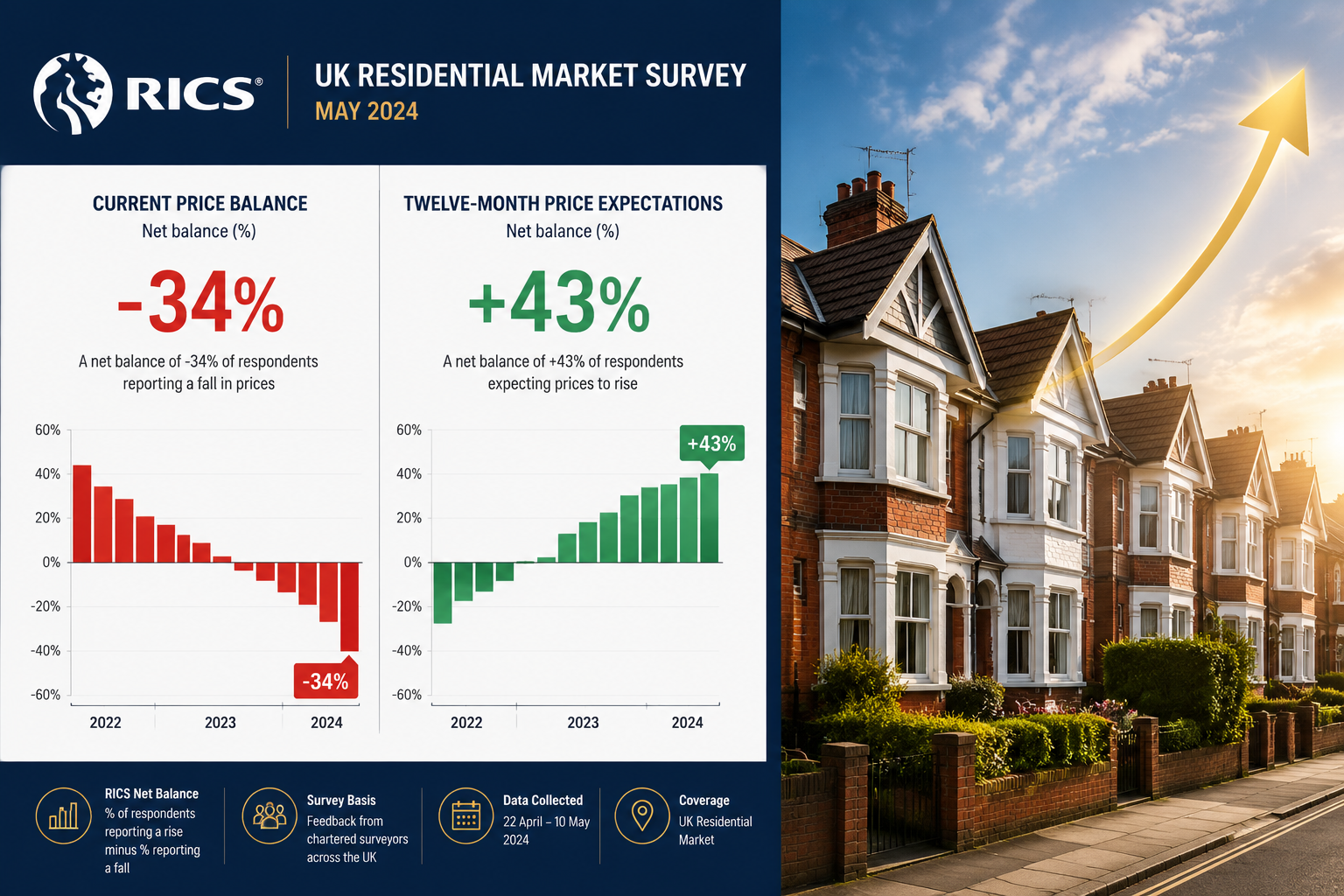
A net balance of +43% of surveyors expect UK house prices to be higher twelve months from now — the most optimistic twelve-month reading since early 2025, and a striking contrast to the -34% price balance recorded in April 2026 [1]. That gap between short-term pain and medium-term confidence is not a contradiction. It is a signal, and for buyers, sellers, and chartered surveyors alike, understanding how to act on it is what separates informed decisions from costly mistakes.
The RICS Price Expectations +43% Outlook: Valuation Techniques for 12-Month UK House Price Recovery in 2026 framework explored in this article brings together the latest survey data, regional market dynamics, and the valuation methodologies that professionals are using to navigate a market caught between present weakness and future recovery.
Key Takeaways
- The RICS April 2026 survey shows a +43% net balance for twelve-month price expectations, the strongest forward-looking reading since 2025, even as current prices face a -34% net balance decline.
- Short-term headwinds — including a -38% near-term price expectation and -34% buyer enquiry balance — are driven by elevated mortgage rates and geopolitical uncertainty.
- Regional divergence is significant: the North West and North of England show marginal positive readings, while London, the South East, East Anglia, and the South West remain negative.
- Accurate valuation in 2026 requires combining comparable sales analysis, income-based approaches, and hedonic pricing models to capture rapid market shifts.
- Surveyors who understand the gap between current sentiment and twelve-month forecasts are better positioned to advise clients on timing, pricing strategy, and risk management.
Understanding the RICS April 2026 Data: What the Numbers Actually Mean
The RICS UK Residential Market Survey is one of the most closely watched barometers of property market health in Britain. Each month, chartered surveyors across England, Scotland, and Wales report on price movements, buyer enquiries, agreed sales, and forward expectations. The April 2026 results present a market under genuine stress — but one with a visible path forward.
Current price balance: -34%
This is the weakest reading since November 2023, meaning a significant majority of surveying professionals reported falling rather than rising prices at the point of sale [1]. This reflects the cumulative impact of elevated borrowing costs and reduced buyer confidence.
Buyer enquiries: -34%
New buyer enquiries fell sharply, reflecting reduced appetite from purchasers facing high mortgage rates and broader economic uncertainty, including the ongoing impact of geopolitical tensions on global borrowing costs [2].
Agreed sales: -36%
Transaction volumes have slowed considerably, with a net balance of -36% in April 2026 [1]. Fewer deals are completing, which in turn limits the volume of fresh comparable sales data available for accurate valuations.
Near-term price expectations: -38%
Surveyors expect further downward pressure in the months immediately ahead — a reflection of the current environment rather than a structural shift in the market [1].
Twelve-month price expectations: +43%
This is the headline figure that demands attention. Despite near-term pessimism, the forward-looking consensus among RICS professionals points firmly toward recovery within the next year [1]. This is the strongest twelve-month optimism reading since 2025, and it underpins the valuation strategies discussed throughout this article.
"The divergence between near-term negativity and twelve-month optimism is not unusual in property cycles — but the magnitude of that gap in 2026 is notable and actionable."
Regional Divergence: Where Recovery Will Begin
Not all parts of the UK are moving in the same direction, and the RICS April 2026 data makes regional variation clear [1].
| Region | Current Price Balance | Outlook |
|---|---|---|
| North West | Marginally positive | Stable to improving |
| North of England | Marginally positive | Stable to improving |
| London | Negative | Cautious recovery expected |
| South East | Negative | Under pressure |
| East Anglia | Negative | Under pressure |
| South West | Negative | Moderate headwinds |
The North West and North of England are outperforming largely because affordability remains more accessible in those areas. Lower average house prices mean that even at elevated mortgage rates, monthly repayments stay within reach for a broader pool of buyers.
London and the South East face a more complex picture. High absolute prices amplify the effect of rate increases, and geopolitical uncertainty has a disproportionate impact on international buyer demand in prime central London [2]. However, the structural undersupply of housing in these regions means that any easing of mortgage conditions is likely to trigger a faster price response — which is partly why the twelve-month outlook remains positive even in these currently stressed markets.
For surveyors operating across multiple regions, understanding what surveyors look for in a house survey becomes even more critical when market conditions vary so sharply by postcode. A property in Manchester may warrant a very different valuation approach than an equivalent-sized home in Surrey.
RICS Price Expectations +43% Outlook: Valuation Techniques for 12-Month UK House Price Recovery in 2026
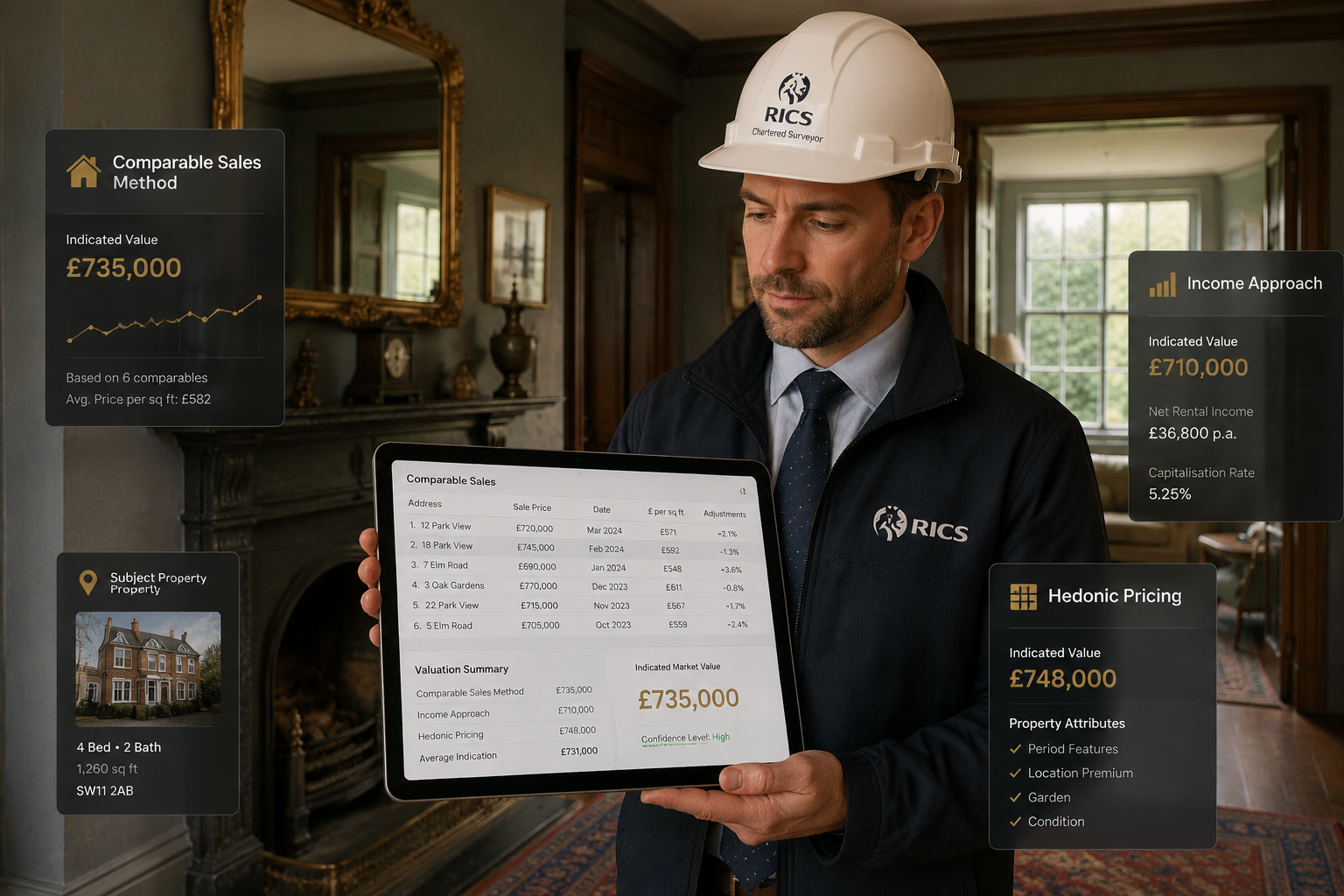
The +43% twelve-month price expectation is not simply a forecast to note and file away. It is a working assumption that should actively inform how surveyors approach valuations, how sellers set asking prices, and how buyers assess purchase decisions in 2026. Three core valuation techniques are particularly relevant to this environment.
Comparable Sales Analysis in a Thin Market
The comparable sales method — matching a subject property against recently sold homes of similar size, condition, and location — remains the foundation of residential valuation. However, the -36% agreed sales balance in April 2026 means the pool of fresh comparables is shrinking [1].
In practice, this requires surveyors to:
- Extend the search window for comparables from three months to six months, while applying time adjustments to account for price movement.
- Weight condition more heavily, since buyers in a cautious market are particularly sensitive to maintenance costs. A Level 3 building survey can provide the detailed condition data needed to justify valuation adjustments.
- Flag distressed sales carefully, as forced sales or quick-sale transactions in the current environment may not represent true market value.
Accurate valuation in 2026 emphasizes using recent sold prices of similar homes, considering local demand conditions, and avoiding overpricing — which can stall a sale and ultimately reduce the final achieved price [3].
Income-Based Approaches and the Rental Market Signal
The RICS April 2026 data reveals an important secondary signal: tenant demand rose to a net balance of +14%, while landlord instructions remained negative at -17% [1]. This tightening rental market has direct implications for income-based valuations, particularly for buy-to-let properties and mixed-use assets.
The income approach to valuation — estimating value based on the rental income a property can generate, discounted at an appropriate yield — becomes more powerful when rental demand is structurally strong. Surveyors applying this technique in 2026 should:
- Use current market rent evidence rather than passing rents, since rental growth has been significant.
- Apply yields that reflect the risk premium associated with the current sales market weakness.
- Consider the impact of potential mortgage rate reductions on yield compression over the twelve-month horizon.
For landlords and investors seeking a formal assessment, a RICS Help to Buy valuation or a full market valuation from a chartered surveyor provides the evidenced basis needed for financing and strategic decisions.
Hedonic Pricing Models for Granular Accuracy
Hedonic pricing breaks a property's value into its constituent attributes — floor area, number of bedrooms, garden size, proximity to transport, school catchment, energy efficiency rating — and assigns a price contribution to each. This technique is particularly valuable in 2026 because market conditions are affecting different property attributes unevenly.
For example:
- Energy efficiency is commanding a growing premium as buyers factor in running costs against a backdrop of elevated energy prices.
- Home office space continues to influence buyer decisions post-pandemic, maintaining a measurable price premium for properties with dedicated workspace.
- Proximity to transport remains a key driver in commuter belt areas, particularly as hybrid working patterns stabilise.
Surveyors using hedonic models can produce more defensible valuations in a market where comparable evidence is limited, by building up value from verified attribute data rather than relying solely on direct comparison.
How Surveyors Should Report in a 4-5% Growth Environment
Analysts and market commentators have flagged potential price declines of up to 5% in 2026 in some scenarios [4], while the RICS twelve-month balance points toward positive growth. The most credible central scenario sits in the range of 4-5% price growth over the next twelve months, contingent on mortgage rate stabilisation and continued employment resilience.
This creates specific reporting obligations and opportunities for chartered surveyors.
Valuation reports must reflect current market conditions, not aspirational pricing. The -38% near-term expectation means that a property valued today at a figure that assumes immediate recovery will likely be overvalued in the short term [1]. Reports should clearly distinguish between current market value and the twelve-month forward outlook.
Sensitivity analysis is increasingly important. A well-constructed valuation report in 2026 should include commentary on how the valuation might change under different interest rate scenarios — for example, if the Bank of England base rate falls by 50 basis points versus remaining flat.
Survey depth matters more in volatile markets. Buyers relying on a Level 2 house survey for a property with any structural complexity may be exposed to risks that only a more detailed inspection would reveal. Surveyors have a professional duty to recommend the appropriate level of inspection for the property type and condition.
Understanding the full structural survey cost in the UK is an important first step for buyers who want comprehensive protection in an uncertain market.
Practical Strategies for Buyers and Sellers in 2026
The RICS Price Expectations +43% Outlook: Valuation Techniques for 12-Month UK House Price Recovery in 2026 analysis has direct practical implications beyond the surveying profession.

For buyers:
- The current market offers negotiating leverage that has not existed since late 2023. A -34% buyer enquiry balance means competition for most properties is reduced.
- Securing a property now at a price that reflects current market weakness, while the twelve-month outlook points to recovery, represents a potentially strong entry point.
- Commission a thorough survey before exchanging contracts. Understanding how long house surveys take helps with transaction planning and avoids delays.
For sellers:
- Overpricing in the current environment is counterproductive. Properties that sit on the market without offers accumulate stigma that makes eventual price reductions more damaging.
- Accurate, evidence-based pricing aligned with current comparable sales gives a property the best chance of transacting before the market firms up.
- Consider the condition of the property carefully. In a buyer's market, condition defects are used aggressively in price negotiations.
For investors:
- The tightening rental market — +14% tenant demand against -17% landlord instructions — supports the investment case for well-located residential assets [1].
- The twelve-month price recovery outlook, if realised, would add capital growth to strong rental income, improving total returns.
- Regional selection is critical. North West and Northern England assets offer better current value; London and South East assets offer higher recovery potential once mortgage conditions ease.
The Role of Professional Surveyors in Market Recovery
Market recoveries do not happen uniformly, and they do not happen without the infrastructure of professional advice that helps buyers, sellers, lenders, and investors make informed decisions. Chartered surveyors, regulated by RICS, sit at the centre of that infrastructure.
In a 4-5% growth environment, the quality of valuation evidence directly affects:
- Mortgage lending decisions, since lenders rely on RICS-compliant valuations to set loan-to-value ratios.
- Buyer confidence, since a credible survey report reduces the uncertainty that is currently suppressing demand.
- Price discovery, since accurate valuations help the market find equilibrium faster than it would through unaided negotiation.
For those considering professional surveying services, understanding the difference between Level 2 and Level 3 surveys is an essential starting point for choosing the right level of protection.
Working with qualified chartered surveyors who hold current RICS accreditation ensures that valuations and survey reports meet the professional standards that lenders, solicitors, and courts recognise.
Conclusion
The RICS Price Expectations +43% Outlook: Valuation Techniques for 12-Month UK House Price Recovery in 2026 presents a clear picture: the UK residential market is navigating a difficult short-term period, but the professional consensus points firmly toward recovery within twelve months. The -34% current price balance and -38% near-term expectations reflect real pressures from elevated mortgage rates and geopolitical uncertainty [1][2]. The +43% twelve-month outlook reflects equally real structural factors — undersupply, resilient employment, and the expectation of easing borrowing costs [1].
Actionable next steps for different stakeholders:
- Buyers should engage a RICS-accredited surveyor now, use the current buyer's market to negotiate, and commission a survey appropriate to the property's age and complexity.
- Sellers should price accurately based on current comparable evidence, not aspirational recovery values, and present properties in the best possible condition to minimise negotiation exposure.
- Surveyors should apply comparable sales analysis with time-adjusted evidence, incorporate income-based and hedonic approaches where direct comparables are limited, and provide clear sensitivity commentary in valuation reports.
- Investors should focus on regions with positive current readings and assets that benefit from the tightening rental market, while positioning for capital growth in the twelve-month recovery window.
The gap between today's market weakness and tomorrow's recovery is where informed decisions are made. Professional valuation expertise is the tool that bridges that gap.
References
[1] UK Residential Survey April 2026 – https://www.rics.org/news-insights/uk-residential-survey-april-2026?utm_source=openai
[2] UK Housing Market Slows As Ongoing Middle East Conflict Raises Borrowing Costs – https://www.rics.org/news-insights/uk-housing-market-slows-as-ongoing-middle-east-conflict-raises-borrowing-costs?utm_source=openai
[3] What's My House Worth: Accurate UK Valuation Guide 2026 – https://www.smith-and-friends.co.uk/news/whats-my-house-worth-accurate-uk-valuation-guide-2026?utm_source=openai
[4] Could House Prices Fall – https://moneyweek.com/investments/house-prices/could-house-prices-fall?utm_source=openai
