

More than 175,000 boundary disputes are estimated to arise in England and Wales every year, yet a significant proportion of them could be resolved far earlier — and far more cheaply — if the right professional were called in at the right moment. Neighbour disputes over boundaries and rights of way: when a party wall or boundary surveyor should step in is a question that property owners consistently ask too late, after tensions have hardened and legal costs have begun to mount.
This article explains the legal framework that governs shared walls, boundary lines, and rights of way, identifies the precise triggers that call for professional surveyor involvement, and sets out practical steps to resolve disagreements before they become courtroom battles.
Key Takeaways
- The Party Wall etc. Act 1996 creates a mandatory legal process for work affecting shared walls, boundary walls, and excavations near neighbouring buildings — ignoring it carries real legal risk.
- Land Registry title plans show only general boundaries; they are not legally definitive, and a professional survey is often required to establish the exact line.
- A party wall surveyor and a boundary surveyor serve different but complementary functions — knowing which one to appoint matters.
- Early professional intervention almost always costs less than litigation, which can run into tens of thousands of pounds even for small strips of disputed land.
- Mediation and agreed surveyor appointments are underused tools that can preserve neighbourly relationships while still producing legally binding outcomes.
Understanding the Legal Landscape: Party Walls, Boundaries, and Rights of Way
What Is a Party Wall?
A party wall is a wall that stands on the boundary between two properties and is shared by the owners of those properties. The concept dates back to at least the 11th century in London, where shared walls between terraced houses served as firebreaks [10]. Today, the legal framework governing them is the Party Wall etc. Act 1996, which applies across England and Wales [5].
The Act covers three main scenarios:
| Scenario | Description |
|---|---|
| Party structure work | Work on an existing wall or floor shared with a neighbour |
| Boundary wall work | Building a new wall at or astride the boundary line |
| Excavation near a neighbour's building | Digging within 3 or 6 metres of an adjoining structure, depending on depth |
Before any such work begins, the building owner must serve a formal Party Wall Notice on the adjoining owner. If the neighbour consents in writing, work can proceed. If they dissent — or fail to respond within 14 days — a dispute is deemed to have arisen, and surveyors must be appointed [9]. For a detailed breakdown of the Act's requirements, the comprehensive guide to the Party Wall etc. Act 1996 is an essential starting point.
What Is a Boundary Dispute?
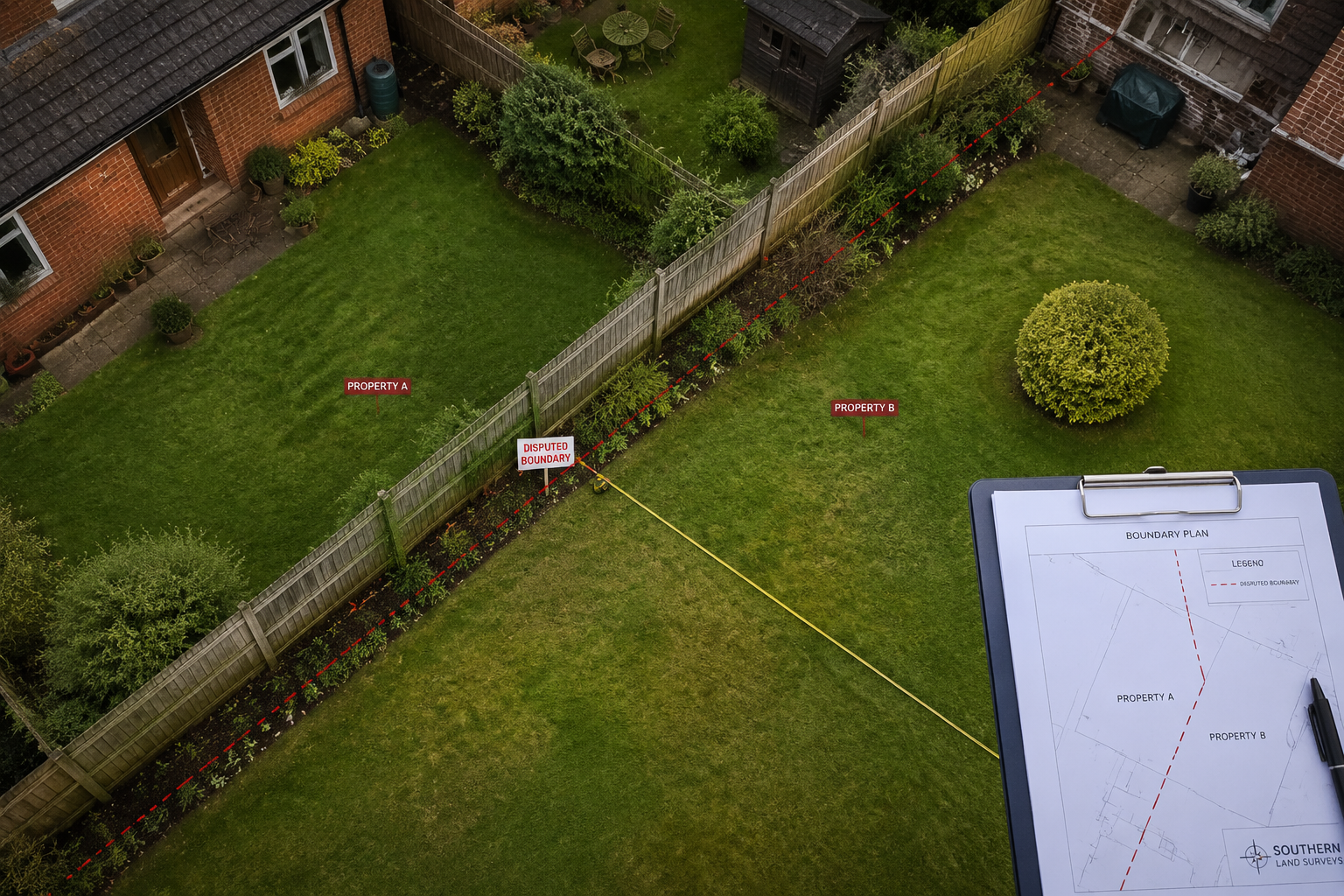
A boundary dispute arises when two neighbours disagree about the exact line dividing their properties, or about who owns a boundary feature such as a fence, hedge, or wall [2]. These disputes are surprisingly common and can be triggered by:
- A new fence erected in the wrong position
- A building extension that appears to encross onto neighbouring land
- Overgrown hedges or trees that shift the perceived boundary over time
- Conflicting information in title deeds from different eras
A critical point that many property owners do not appreciate: Land Registry title plans are not definitive. They show the general position of a boundary but do not fix its exact legal location [7]. Determining the true boundary line often requires examining the original conveyancing documents, old photographs, physical features on the ground, and — crucially — a professional measured survey.
Rights of Way and Easements
An easement is a legal right that one property owner holds over a neighbouring property. The most common examples include:
- Rights of way — the right to cross another's land on foot or by vehicle
- Rights of light — the right to receive natural light through a window
- Drainage easements — the right to run pipes or drains under a neighbour's land
- Shared driveway rights — access arrangements over jointly used surfaces [3]
Easements are usually created in the original title deeds or by long use (known as prescriptive easements). Disputes arise when one party blocks or obstructs the easement, or when the scope of the right is unclear. Unlike party wall matters, easement disputes are not governed by the Party Wall etc. Act 1996 — they fall under general property law and often require a boundary surveyor or solicitor to resolve.
The Role of Party Wall and Boundary Surveyors in Neighbour Disputes
Understanding neighbour disputes over boundaries and rights of way — and when a party wall or boundary surveyor should step in — requires a clear picture of what each type of surveyor actually does.
Party Wall Surveyors: Function and Authority
A party wall surveyor is appointed specifically to resolve disputes arising under the Party Wall etc. Act 1996. Their duty is not to either neighbour — it is to the Act itself, which means they must act impartially regardless of who appointed them [1]. This is a fundamental and often misunderstood point: even a surveyor appointed solely by the building owner is legally obliged to be fair to both sides.
When a dispute is deemed to have arisen, there are two appointment routes:
- Agreed surveyor — both parties appoint a single surveyor jointly, which is often faster and cheaper
- Two surveyors — each party appoints their own, and the two then select a third surveyor in case of disagreement
The surveyors produce a Party Wall Award — a legally binding document that specifies the time and manner in which the notifiable work may be carried out, along with any protective conditions for the adjoining owner's property [9]. For more on what this process involves in practice, see this guide on what a party wall surveyor does, including their roles and legal responsibilities.
A Schedule of Condition is typically prepared before work begins, recording the existing state of the neighbouring property. This protects both parties if damage claims arise later.
Boundary Surveyors: Function and Evidence
A boundary surveyor's role is different. Rather than administering a statutory process, a boundary surveyor investigates and reports on the likely position of a legal boundary. Their work involves:
- Examining title deeds, conveyancing plans, and historical documents
- Measuring the physical features on the ground against the documentary evidence
- Applying RICS professional standards for boundary identification and demarcation [6]
- Producing an expert report that can be used in negotiations, mediation, or court proceedings
The Royal Institution of Chartered Surveyors (RICS) has published detailed professional standards emphasising the need for precise boundary identification to prevent disputes from escalating [6]. A qualified RICS surveyor's report carries significant evidential weight, whether in a formal dispute resolution process or in court.
When Should Each Be Appointed?
| Situation | Appropriate Professional |
|---|---|
| Planned building work near or on a shared wall | Party wall surveyor |
| Neighbour has not responded to a Party Wall Notice | Party wall surveyor |
| Uncertainty about where the legal boundary runs | Boundary surveyor |
| Neighbour's fence, wall, or extension appears to encroach | Boundary surveyor |
| Right of way is being blocked or disputed | Boundary surveyor or solicitor |
| Damage caused during construction work | Party wall surveyor |
Practical Guidance: Early Intervention and Avoiding Escalation

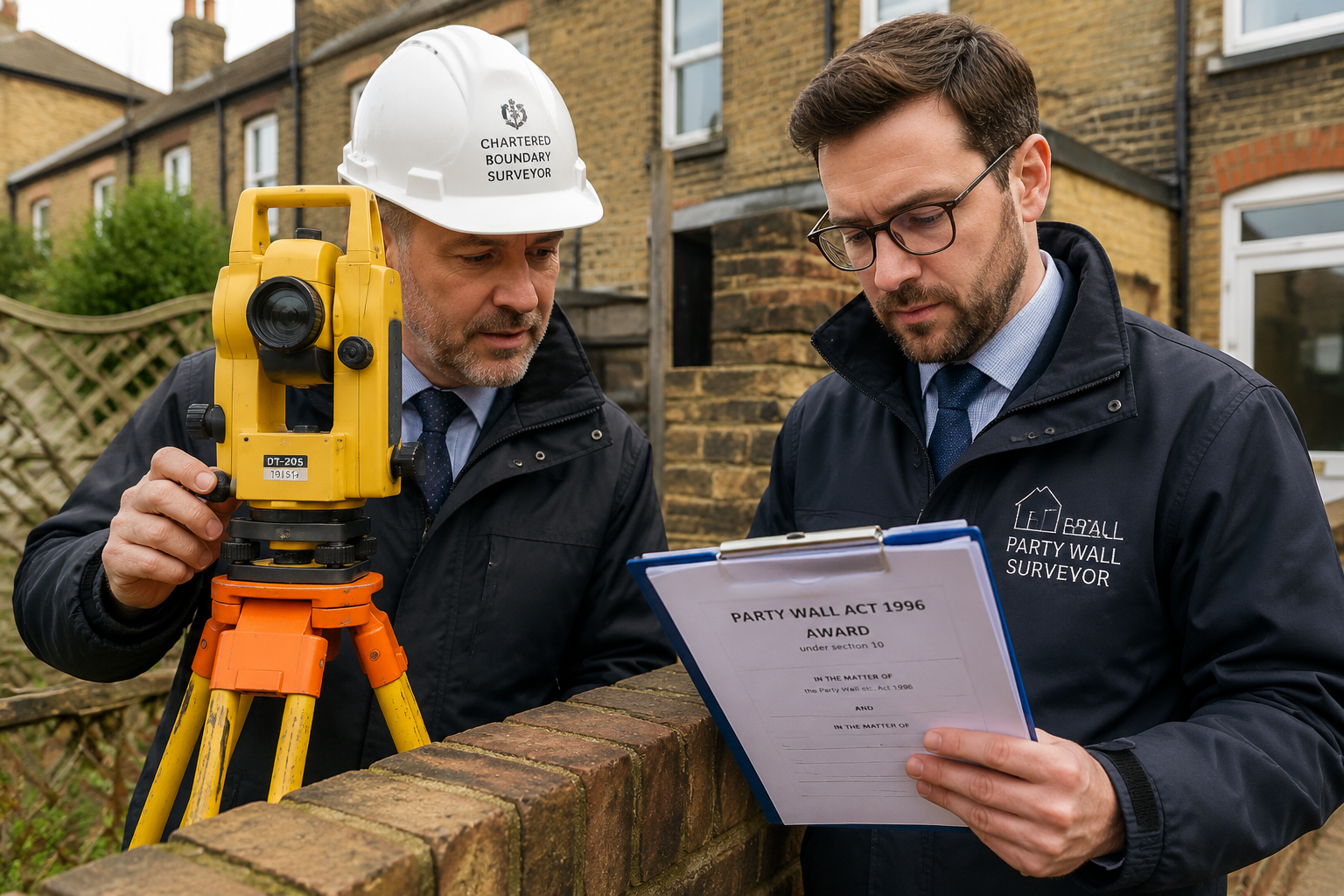
The most important lesson from neighbour disputes over boundaries and rights of way — and when a party wall or boundary surveyor should step in — is that early action almost always saves money and relationships. Legal costs in boundary disputes can easily exceed the value of the disputed land itself [8]. A strip of garden worth a few hundred pounds can generate solicitor and barrister fees running into the tens of thousands if the matter reaches the First-tier Tribunal (Property Chamber) or the High Court.
Serve Notices Correctly and on Time
The single most common trigger for unnecessary party wall disputes is a failure to serve the correct notice before work begins. Under the Act:
- A Party Structure Notice must be served at least two months before work on a party wall begins
- A Line of Junction Notice must be served at least one month before building a new wall at the boundary
- An Excavation Notice must be served at least one month before excavating within the relevant distances [5]
Failing to serve notice does not make the work illegal, but it removes the legal protection the Act provides and can expose the building owner to injunctions and damages claims. Details on excavation notices and their requirements are covered in the party wall excavation notice guidance.
Consider an Agreed Surveyor
Where both parties are willing to cooperate, appointing a single agreed surveyor is usually the most cost-effective route. The agreed surveyor acts for both parties and can often produce a Party Wall Award more quickly than a two-surveyor process. This approach works best when the relationship between neighbours is still reasonably amicable and both sides trust a neutral professional.
For guidance on finding a suitably qualified professional, the resource on finding a reliable party wall surveyor near you provides a useful checklist of credentials and questions to ask.
Use Mediation Before Litigation
For boundary and rights of way disputes that fall outside the Party Wall Act's scope, mediation is a highly effective alternative to court proceedings. A trained mediator helps both parties reach a negotiated agreement, which can then be formalised as a legally binding boundary agreement registered at the Land Registry [4].
The advantages of mediation include:
- Cost — typically a fraction of litigation costs
- Speed — disputes can be resolved in days rather than years
- Confidentiality — unlike court proceedings, mediation is private
- Preservation of relationships — a negotiated outcome is far less damaging to neighbourly relations than a judge's ruling [4]
Mediation does not require both parties to have legal representation, though having a surveyor's expert report available significantly strengthens any party's negotiating position.
Encroachment: Act Promptly
Encroachment — where a neighbour's structure physically crosses the boundary line — is one of the most contentious forms of boundary dispute [7]. If a new extension, fence, or outbuilding appears to encroach onto a property, the affected owner should:
- Obtain a measured boundary survey from a qualified RICS surveyor before making any accusation
- Write a formal letter to the neighbour setting out the concern, supported by the survey evidence
- Propose mediation as a first step
- If the encroachment is confirmed and the neighbour refuses to engage, seek legal advice about an injunction or damages claim
Acting promptly matters because, in some circumstances, a neighbour who has occupied land adversely for 10 years (registered land) or 12 years (unregistered land) may be able to claim title to it under adverse possession rules.
What Happens When a Neighbour Refuses to Engage?
A common concern is whether a neighbour can simply refuse to participate in the party wall process. The short answer is that they cannot block it entirely. Under the Act, if an adjoining owner dissents or fails to respond, the dispute resolution machinery is automatically triggered and surveyors are appointed [1]. For a detailed explanation of this scenario, the article on whether a neighbour can legally refuse a party wall agreement sets out the options clearly.
For rights of way and boundary disputes outside the Act, a neighbour's refusal to engage means the matter will likely need to go to the First-tier Tribunal or court — another reason why early professional involvement is so valuable.
Expert Witness Evidence in Serious Disputes
When a boundary or party wall dispute does reach a formal legal or tribunal process, the quality of expert evidence becomes decisive. A chartered surveyor who has prepared a thorough, RICS-compliant boundary report, or who has administered the party wall process correctly, can provide expert witness testimony that carries significant weight [6]. Instructing a surveyor early — before positions harden — means that evidence is gathered while it is still fresh and physical features are undisturbed.
Conclusion
Neighbour disputes over boundaries and rights of way — and the question of when a party wall or boundary surveyor should step in — rarely have simple answers, but they do have clear professional solutions. The Party Wall etc. Act 1996 provides a robust, well-tested framework for managing work near shared structures, provided notices are served correctly and surveyors are appointed promptly. Boundary and rights of way disputes, while falling outside that statutory framework, are equally amenable to early professional resolution through measured surveys, expert reports, and mediation.
Actionable next steps for property owners in 2026:
- Before starting any building work near a shared wall or boundary, check whether the Party Wall etc. Act applies and serve the correct notices on time.
- If a boundary disagreement arises, commission a measured survey from a qualified RICS boundary surveyor before making any formal allegations.
- Explore mediation as a first resort for rights of way and boundary disputes — it is faster, cheaper, and less damaging to neighbourly relations than litigation.
- If appointing surveyors under the Act, consider the agreed surveyor route where both parties are willing to cooperate.
- Seek professional advice early. The cost of a surveyor's report or a Party Wall Award is almost always a fraction of the cost of resolving the same dispute after it has escalated.
For those seeking professional assistance, chartered surveyors in London and across the wider region are well placed to provide both party wall and boundary surveying services.
References
[1] Party Wall Surveyor – https://en.wikipedia.org/wiki/Party_wall_surveyor?utm_source=openai
[2] Boundary Disputes – https://www.complexlaw.co.uk/service/boundary-disputes?utm_source=openai
[3] Neighbour Disputes – https://www.biscoes-law.co.uk/site/private-solicitors/dispute-resolution/property/neighbour-disputes/?utm_source=openai
[4] boundarymediation – https://www.boundarymediation.com/?utm_source=openai
[5] Party Wall And Boundary Disputes – https://www.david-cooper.co.uk/services/residential/party-wall-and-boundary-disputes/?utm_source=openai
[6] Boundaries procedures for boundary identification, demarcation and dispute resolution, October 2022 – https://www.rics.org/content/dam/ricsglobal/documents/standards/Boundaries%2520procedures%2520for%2520boundary%2520identification_%2520demarcation%2520and%2520dispute%2520resolution_October%25202022.pdf?utm_source=openai
[7] Boundary Disputes – https://www.darwingray.com/services/property-disputes/boundary-disputes/?utm_source=openai
[8] Boundary Disputes – https://pdalaw.co.uk/dispute-resolution/boundary-disputes?utm_source=openai
[9] Party Wall Surveying And Boundary Disputes – https://www.rectorysurveyors.co.uk/services/party-wall-surveying-and-boundary-disputes?utm_source=openai
[10] Party Wall – https://en.wikipedia.org/wiki/Party_wall?utm_source=openai
