
Fewer than 30% of local governments worldwide had fully digitized their land parcel records as of the early 2020s — yet the decisions made from those records affect trillions of dollars in property value every year. That gap between data quality and decision stakes is precisely why GIS expansion in property surveying: data management for smarter land use decisions has become one of the most consequential shifts in modern real estate and planning practice.
Geographic Information Systems (GIS) are no longer a niche technology reserved for government mapping agencies. They now sit at the center of how surveyors collect, analyze, and communicate spatial data — from boundary disputes and zoning compliance to infrastructure planning and investment due diligence. This article explores how GIS is reshaping property surveying, what data management capabilities are driving the change, and what property professionals need to know to stay ahead in 2026.

Key Takeaways
- GIS enables surveyors to overlay cadastral, zoning, environmental, and utility data in a single spatial framework, revealing patterns invisible in isolated datasets.
- Centralized parcel data management through platforms like ArcGIS Parcel Fabric reduces discrepancies and supports a single authoritative system of record.
- Real estate teams, planners, and developers are using GIS-powered tools to accelerate site selection, due diligence, and land use analysis.
- Right-of-way, easement, and subdivision data can now be managed systematically, reducing legal and boundary risk.
- The integration of GIS with traditional surveying workflows transforms surveyors from data collectors into strategic advisors.
How GIS Is Redefining the Role of Property Surveyors
For most of the twentieth century, a surveyor's core output was a paper plan — precise, legally defensible, but static. Once filed, that plan sat in an archive, disconnected from every other dataset that might affect the land it described. GIS changes that relationship fundamentally.
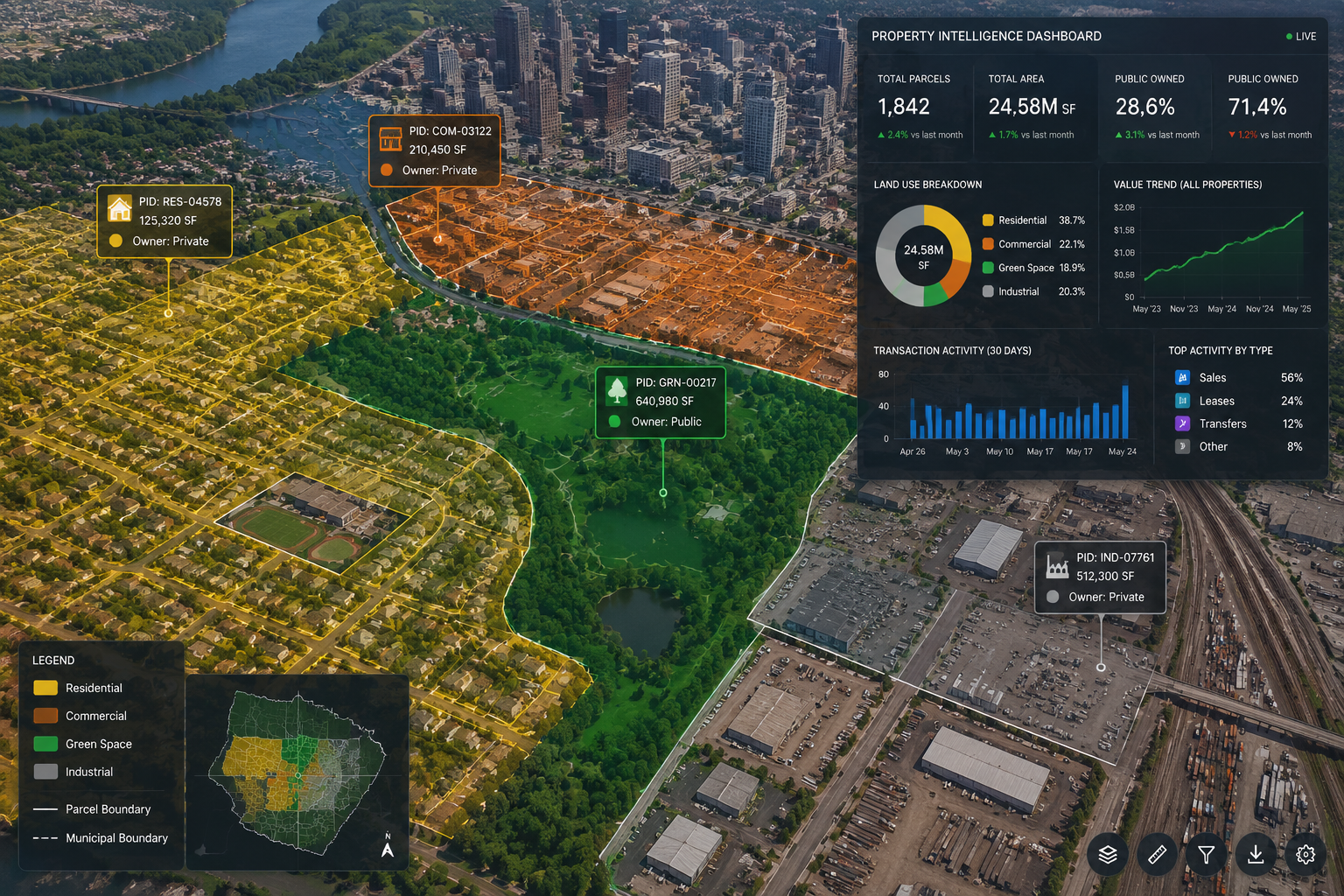
Surveyors are increasingly integrating GIS to overlay multiple data layers — cadastral boundaries, zoning classifications, utility corridors, environmental constraints, and flood risk zones — within a unified spatial framework [6]. The result is not just a more detailed map. It is a dynamic intelligence tool that reveals relationships and conflicts that would remain hidden when examining individual datasets in isolation [10].
What this means in practice:
- A boundary survey can be cross-referenced instantly against historic deed records and adjacent parcel ownership.
- A development feasibility study can incorporate zoning rules, infrastructure capacity, and environmental designations simultaneously.
- A dilapidations assessment can be spatially linked to lease boundaries and condition data for the same property.
For clients commissioning a comprehensive condition survey report, the addition of GIS context means the surveyor can flag not just physical defects but spatial constraints — such as proximity to a right-of-way or a flood zone — that affect remediation options and property value.
"The integration of GIS transforms surveyors into strategic communicators, facilitating better stakeholder engagement and more defensible professional opinions." [10]
This shift is also changing career expectations. Understanding what surveyors do in their day-to-day roles now increasingly includes spatial data literacy alongside traditional measurement skills.
The Data Management Architecture Behind GIS Expansion in Property Surveying
The technical backbone of GIS expansion in property surveying: data management for smarter land use decisions rests on three pillars — parcel fabric management, multi-layer data integration, and interoperability across agencies and platforms.
Parcel Fabric and the Single System of Record
Esri's ArcGIS Parcel Fabric provides a comprehensive framework for managing parcel data integrity, survey records, and parcel history [1]. Before tools like this existed, land registries and local authorities often maintained multiple, conflicting versions of parcel boundaries across different departments. Discrepancies between the planning database, the tax assessment roll, and the legal title register were common — and costly.
A parcel fabric system consolidates all of this into one authoritative record. It includes configurable rules for data quality, workflow management for surveyors updating records, and a complete audit trail of how parcel boundaries have changed over time [1].
Key capabilities of modern parcel fabric systems:
| Feature | Benefit |
|---|---|
| Configurable data rules | Prevents entry of geometrically inconsistent boundaries |
| Survey record linkage | Ties every parcel to its underlying survey evidence |
| Parcel history tracking | Shows how land has been subdivided or merged over time |
| Workflow management | Coordinates multi-user data entry across departments |
| Single system of record | Eliminates conflicting versions across agencies |
This architecture is particularly valuable for managing rights-of-way and easements. ArcGIS Solutions' ROW and Easement Data Management solution includes foundational feature classes covering rights-of-way, easements, subdivisions, tax parcels, and condominium parcels — all organized to support efficient inventory and retrieval [7]. For property professionals dealing with boundary surveys, this kind of structured data environment dramatically reduces the risk of missing an easement that affects a client's development plans.
Multi-Layer Data Integration
The real analytical power of GIS comes from layering. Esri's land administration platform integrates systems of record, insight, and engagement on a single platform, enabling governments and private sector users to manage land tenure, value, land use, and infrastructure data together [2].
Platforms like Geo-Lab.NET demonstrate the scale of what is now possible — providing access to thousands of GIS layers sourced from federal, state, and local agencies, covering historical records, civic infrastructure, and population data for any given location [3]. For a surveyor or planner conducting due diligence, this means the ability to interrogate a site from dozens of angles without leaving the desktop.
enCodePlus takes this further with Esri-powered GIS planning and zoning tools that require no technical GIS expertise to operate [4]. These tools support dynamic 3D simulation, interactive web mapping, and automated zoning analysis — making GIS accessible to planners and real estate professionals who are not trained cartographers.
Interoperability: The FAIR Data Principle
The U.S. Department of Transportation has emphasized that geospatial datasets should be "findable, accessible, interoperable, and reusable" across agencies [6]. This FAIR data principle is becoming the benchmark for how GIS data is shared between surveyors, planners, local authorities, and private developers.
In practice, interoperability means that a survey conducted for a highway authority can feed directly into a local planning database, which in turn informs a developer's site selection model — without manual re-entry or format conversion at each step. This reduces error, accelerates timelines, and creates a richer cumulative dataset with every transaction.
GIS in Real Estate, Planning, and Commercial Decision-Making
GIS expansion in property surveying: data management for smarter land use decisions is not confined to government land registries. It is reshaping how private sector actors — from individual investors to large real estate funds — approach site selection, asset management, and planning applications.
Accelerating Site Selection and Due Diligence
Monarcha's land and zoning digitization service illustrates the commercial demand clearly. The platform converts county land records into actionable spatial data, extracting zoning classifications, parcel boundaries, and land use designations to accelerate site selection and due diligence for data center developers, energy companies, and real estate teams [8].
What previously required weeks of manual title searching and planning inquiry can now be completed in hours. This speed advantage is significant in competitive acquisition markets, where the ability to identify and assess a site quickly can determine whether a deal is won or lost.
For commercial property professionals, this capability connects directly to the kind of analysis covered in a commercial building survey — where understanding the spatial context of a property is as important as its physical condition.
Asset Portfolio Management at Scale
LANDCLAN, integrated with ArcGIS, enables property investors and asset managers to index, analyze, score, and report on land parcels globally through a single dashboard [5]. This gives institutional investors visibility and control over multiple property assets simultaneously — tracking performance, identifying disposal candidates, and flagging acquisition opportunities based on spatial criteria.
The ability to score parcels against configurable criteria — proximity to infrastructure, zoning flexibility, development potential — transforms GIS from a mapping tool into a strategic asset management platform [5].
Planning Applications and Stakeholder Engagement
For planning consultants and local authorities, GIS-powered 3D simulation and interactive web mapping tools are changing how planning applications are presented and assessed [4]. Stakeholders who struggle to interpret a two-dimensional site plan can engage meaningfully with a 3D model that shows massing, shadow impact, and relationship to surrounding buildings.
This has practical implications for understanding the party wall process, where spatial visualization of proposed works and their impact on adjoining properties can reduce disputes and speed up agreement.
Practical Applications: From Boundary Surveys to Dilapidations
The translation of GIS capability into everyday surveying practice is accelerating across multiple service lines.
Boundary and Title Surveys
SelectROW's GIS surveying services create centralized locations for data collection and analysis, enhancing survey accuracy and reducing costs [9]. For boundary surveyors, a GIS-backed workflow means that field measurements are immediately referenced against existing parcel fabric data, historical deed plans, and adjacent survey records — catching discrepancies before they become disputes.
A dilapidations survey benefits similarly. When lease boundaries are spatially defined in a GIS system, the surveyor can precisely identify which elements of a building fall within the demise and which are the landlord's responsibility — a distinction that can have significant financial consequences at lease end.
Construction and Infrastructure Surveys
GIS integration is equally valuable in construction surveying, where the ability to overlay proposed works against existing utility records, topographic data, and planning constraints reduces the risk of costly surprises. For a detailed look at how surveys support construction projects, the complete guide to construction surveys provides useful context on how spatial data underpins every stage of the process.
Structural and Building Surveys
Even at the individual property level, GIS context adds value. A Level 3 building survey that incorporates GIS data can flag whether a property sits within a flood risk zone, a conservation area, or an area subject to ground movement — all of which affect the surveyor's recommendations and the client's risk assessment.

Challenges and Considerations in GIS Data Management
Despite its advantages, GIS expansion in property surveying: data management for smarter land use decisions brings genuine challenges that professionals must manage carefully.
Data quality and legacy records. Many land registries still hold records in formats that are difficult to digitize accurately. Converting paper deeds, hand-drawn plans, and scanned documents into spatially accurate GIS data requires significant investment and expert validation. A study in the Journal of Surveying Engineering highlights the dynamic nature of cadastral data and the importance of functional requirements that address spatial and temporal characteristics in parcel-based land information systems [6].
Data governance and access. As GIS datasets become more valuable, questions of ownership, access rights, and data security become more complex. Surveyors working across jurisdictions must navigate different data licensing regimes and privacy requirements.
Skills and training. While tools like enCodePlus are designed to be accessible without technical GIS expertise [4], more advanced applications — parcel fabric management, spatial analysis, 3D modeling — require dedicated training. Firms that invest in GIS capability now will have a competitive advantage as client expectations rise.
Integration with existing workflows. Embedding GIS into established surveying practice requires more than software adoption. It demands a rethinking of data collection protocols, report formats, and quality assurance processes.
Conclusion
The expansion of GIS in property surveying is not a future trend — it is a present reality reshaping how land is measured, recorded, analyzed, and managed. For surveyors, the shift means moving beyond point-in-time measurement toward continuous, layered spatial intelligence. For developers, investors, and planners, it means faster decisions, lower risk, and better outcomes from every parcel of land they touch.
Actionable next steps for property professionals in 2026:
- Audit your current data infrastructure. Identify where parcel, boundary, and condition data is held and whether it is spatially referenced and interoperable.
- Engage GIS-capable surveyors. When commissioning surveys, ask specifically how spatial data will be captured, stored, and delivered.
- Invest in GIS literacy. Even basic familiarity with GIS tools improves a professional's ability to interpret survey outputs and communicate with planners and engineers.
- Explore integrated platforms. Tools like ArcGIS Parcel Fabric, LANDCLAN, and enCodePlus offer scalable entry points depending on organizational size and need.
- Prioritize data quality. The value of GIS is only as good as the underlying data. Legacy record digitization and ongoing data validation should be treated as strategic investments, not administrative tasks.
The professionals and organizations that treat GIS data management as a core competency — not an optional add-on — will be best positioned to deliver smarter land use decisions for their clients and communities.
References
[1] Overview – https://www.esri.com/en-us/arcgis/products/arcgis-parcel-fabric/overview?utm_source=openai
[2] Overview – https://www.esri.com/en-us/industries/land-administration/overview?utm_source=openai
[3] geo-lab – https://geo-lab.net/?utm_source=openai
[4] encodeplus – https://www.encodeplus.com/gis/?utm_source=openai
[5] Overview – https://www.esriuk.com/en-gb/arcgis/products/landclan/overview?utm_source=openai
[6] Gis Integration For Surveyors Overlaying Data Layers To Optimize Land Use Planning And Development Decisions – https://www.canterburysurveyors.com/blog/gis-integration-for-surveyors-overlaying-data-layers-to-optimize-land-use-planning-and-development-decisions/?utm_source=openai
[7] Configure Row And Easement Data Management – https://doc.arcgis.com/en/arcgis-solutions/11.4/reference/configure-row-and-easement-data-management.htm?utm_source=openai
[8] Land And Zoning – https://monarcha.ai/solutions/land-and-zoning?utm_source=openai
[9] Gis Survey – https://selectrow.com/gis-survey/?utm_source=openai
[10] Gis Integration In Land Surveying Enhancing Data Visualization And Decision Making – https://kingstonsurveyors.com/gis-integration-in-land-surveying-enhancing-data-visualization-and-decision-making/?utm_source=openai
