
Over 4,600 high-rise residential buildings in England remain under active scrutiny for fire safety defects as of 2026 — and for every one of those properties caught in litigation or tribunal proceedings, an expert witness valuation sits at the heart of the dispute. Getting that valuation wrong, or failing to demonstrate full Building Safety Act 2022 compliance in expert witness reports: fire safety valuations for high-rise conversions 2026, can mean the difference between a sound legal outcome and a catastrophically flawed submission.
This guide breaks down exactly what RICS-registered valuers and expert witnesses must do to meet the new compliance landscape — from Safety Case Reports to Gateway approvals, courtroom strategy, and the criminal sanctions now looming over non-remediation.
Key Takeaways 📋
- Safety Case Reports are mandatory under Section 85 of the Building Safety Act 2022 and must be evidenced, not merely declared.
- Expert witnesses must demonstrate comprehensive knowledge of BSA 2022 compliance pathways, fire engineering standards, and regulatory obligations.
- The 30 September 2026 deadline for single-staircase guidance under Approved Document B is a critical valuation trigger for converted high-rise properties.
- Criminal sanctions — including unlimited fines and imprisonment — now apply to landlords who obstruct remediation of unsafe buildings over 18 metres by 2029.
- RICS Red Book protocols must be integrated with BSA 2022 compliance evidence to produce defensible expert witness valuations in 2026 tribunal cases.
What the Building Safety Act 2022 Demands from Expert Witnesses
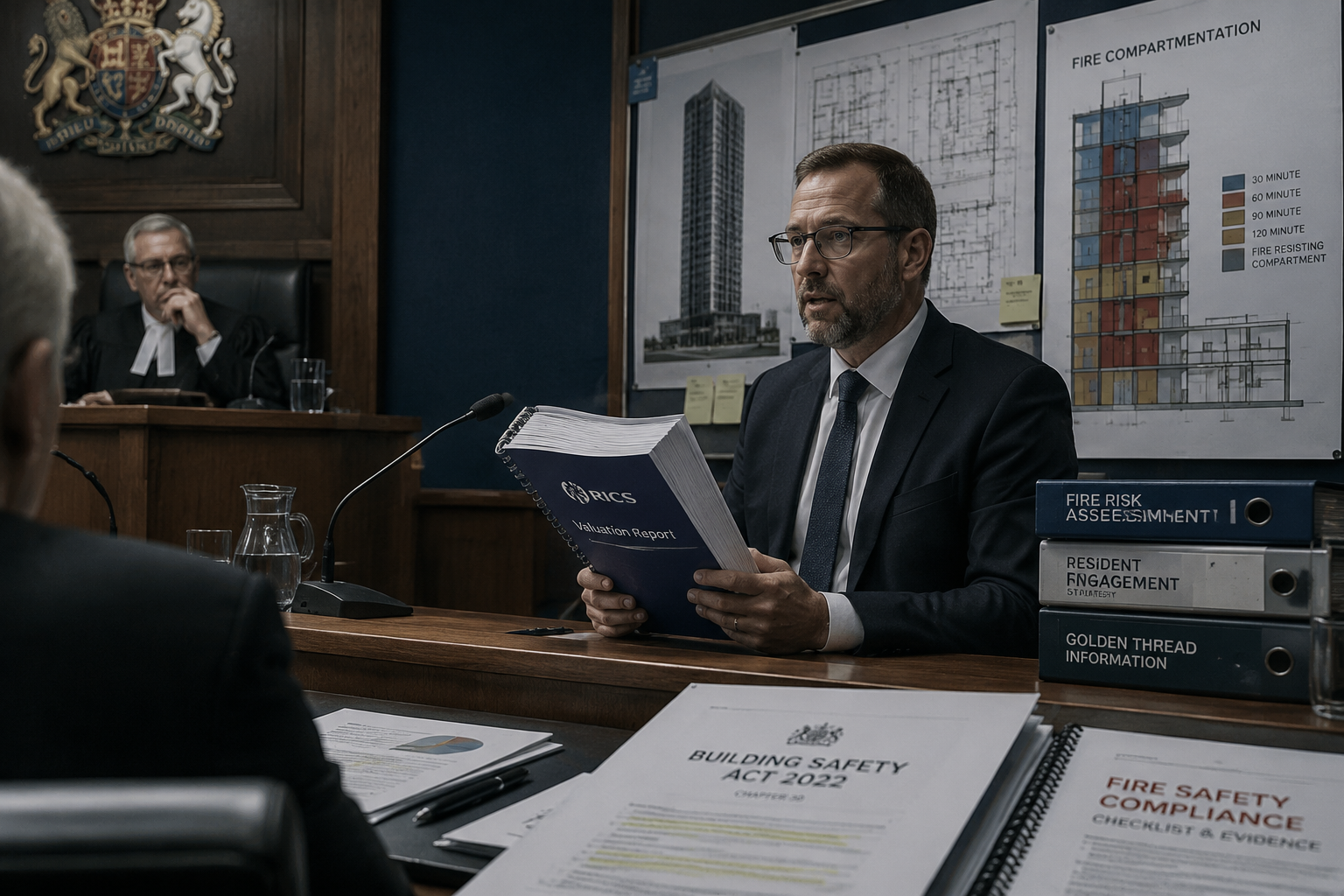
The Building Safety Act 2022 fundamentally changed how high-rise residential buildings are designed, built, managed, and — critically for valuers — assessed in disputes. Expert witnesses involved in building safety cases must now demonstrate a comprehensive understanding of BSA 2022 requirements, compliance pathways, fire safety engineering standards, and regulatory obligations [1].
This is not a minor update to existing practice. It represents a wholesale shift in what a credible expert witness report must contain.
The Evidence-Over-Intention Standard
One of the most significant shifts in 2026 is the move from intention to evidence. Courts and tribunals are no longer satisfied with declarations that a building intends to comply. How decisions were reached — and what documentation supports them — is now as important as the decisions themselves [6].
For expert witnesses preparing fire safety valuations for high-rise conversions, this means:
- Every valuation adjustment must be traceable to a specific compliance finding
- Fire risk assessments must be current, not historical
- Remediation cost estimates must reference live contractor quotes or industry benchmarks
- Deficiencies must be mapped against the five BSR assessment areas (see below)
💬 Pull Quote: "The industry emphasis is shifting from demonstrating intention to demonstrating evidence — how decisions were reached is now as important as the decisions themselves." [6]
Five BSR Assessment Areas That Drive Valuation Adjustments
The Building Safety Regulator evaluates Safety Case Reports across five key areas [4]. Each area directly informs how an expert witness should quantify fire safety deficiencies in a valuation:
| BSR Assessment Area | Valuation Relevance |
|---|---|
| 1. Expected safety measures for building type | Benchmark comparison for deficiency identification |
| 2. Effectiveness and maintenance of measures | Ongoing cost liability assessment |
| 3. Action on legacy issues | Historical defect discount calculation |
| 4. Aspects not built to current standards | Remediation cost quantification |
| 5. Evaluation of additional measures | Capital expenditure forecasting |
Documentation must cover fire doors, compartmentation, smoke ventilation, structural fire protection, alarm systems, sprinklers, and dry risers [4]. Any gap in this documentation weakens both the Safety Case Report and the expert witness submission built upon it.
For valuers working on complex high-rise cases, a RICS Red Book valuation provides the methodological foundation, but it must now be layered with BSA 2022 compliance evidence to be court-ready.
Gateway Compliance and Its Impact on Fire Safety Valuations for High-Rise Conversions 2026
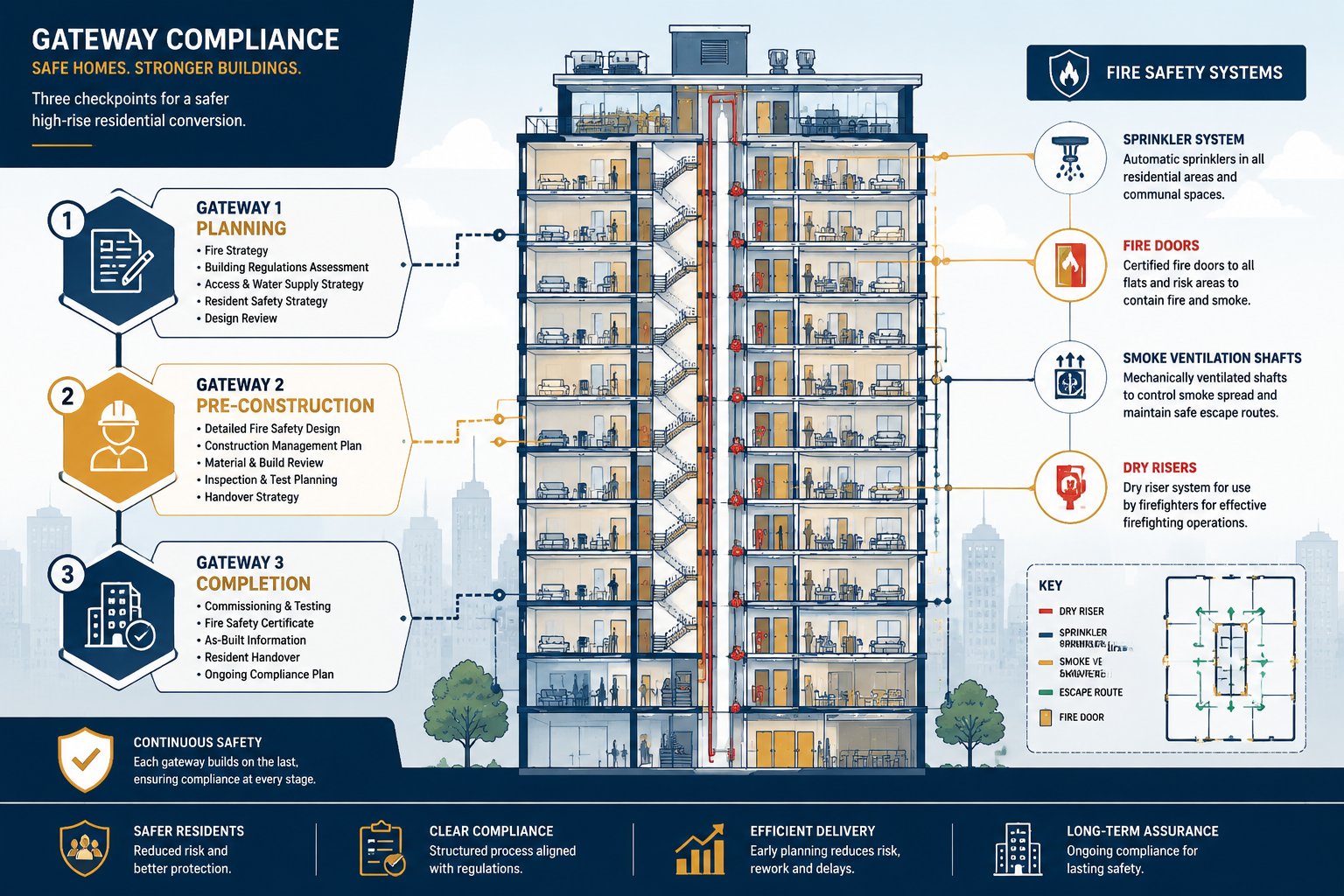
The BSA 2022 established three mandatory gateways that apply directly to high-rise conversions and are central to Building Safety Act 2022 compliance in expert witness reports: fire safety valuations for high-rise conversions 2026 [5].
The Three Gateways Explained 🔑
Gateway 1 — Planning Stage
Fire safety considerations must be embedded at the planning application stage. For converted properties, this means demonstrating that the proposed use is compatible with the building's fire safety infrastructure.
Gateway 2 — Before Building Work Starts
Detailed fire safety plans must be submitted to and approved by the Building Safety Regulator before any construction or conversion work commences. This approval is not automatic — it requires substantive technical documentation.
Gateway 3 — Completion
A Completion Certificate is only issued after the BSR confirms that the building has been constructed or converted in accordance with the approved plans. This is the point at which a Building Assessment Certificate (BAC) application process begins for higher-risk buildings.
The BAC Application Timeline
Principal Accountable Persons (PAPs) must apply for a Building Assessment Certificate within 28 days of being directed to do so by the Building Safety Regulator [2]. The current priority order focuses on buildings over 30 metres high with more than 11 residential units — but the categories being called in are widening throughout 2026 [2].
For expert witnesses, the BAC status of a building is a material valuation factor. A building without a BAC, or one where the BAC application has been rejected or is under review, carries a measurably different risk profile than a compliant building.
The Single Staircase Deadline: 30 September 2026
Until 30 September 2026, existing guidance in Approved Document B (2019 edition with 2020 and 2022 amendments) allowing single staircases can be followed — but only if a building notice or control approval was submitted by that date and work has sufficiently progressed [2].
🚨 This is a critical valuation trigger. Converted high-rise properties that relied on single-staircase designs and cannot demonstrate compliance with this transition deadline face significant value impairment. Expert witnesses must explicitly address this in their reports.
For buildings with structural concerns related to staircase configurations, a structural engineer report should be commissioned and referenced within the expert witness submission.
Building Regulations Review: Spring 2026 Interim Findings
The Building Safety Regulator appointed an expert panel in July 2025 to conduct a fundamental review of Building Regulations guidance — including Approved Documents, BS 9414, and existing practices. Interim findings are expected in spring 2026, with a final report scheduled for summer 2026 [2].
Expert witnesses must monitor these findings closely. Any interim guidance issued before a tribunal hearing could affect the standards against which a converted high-rise is assessed.
RICS Protocols, Safety Case Reports, and Courtroom Strategy for 2026
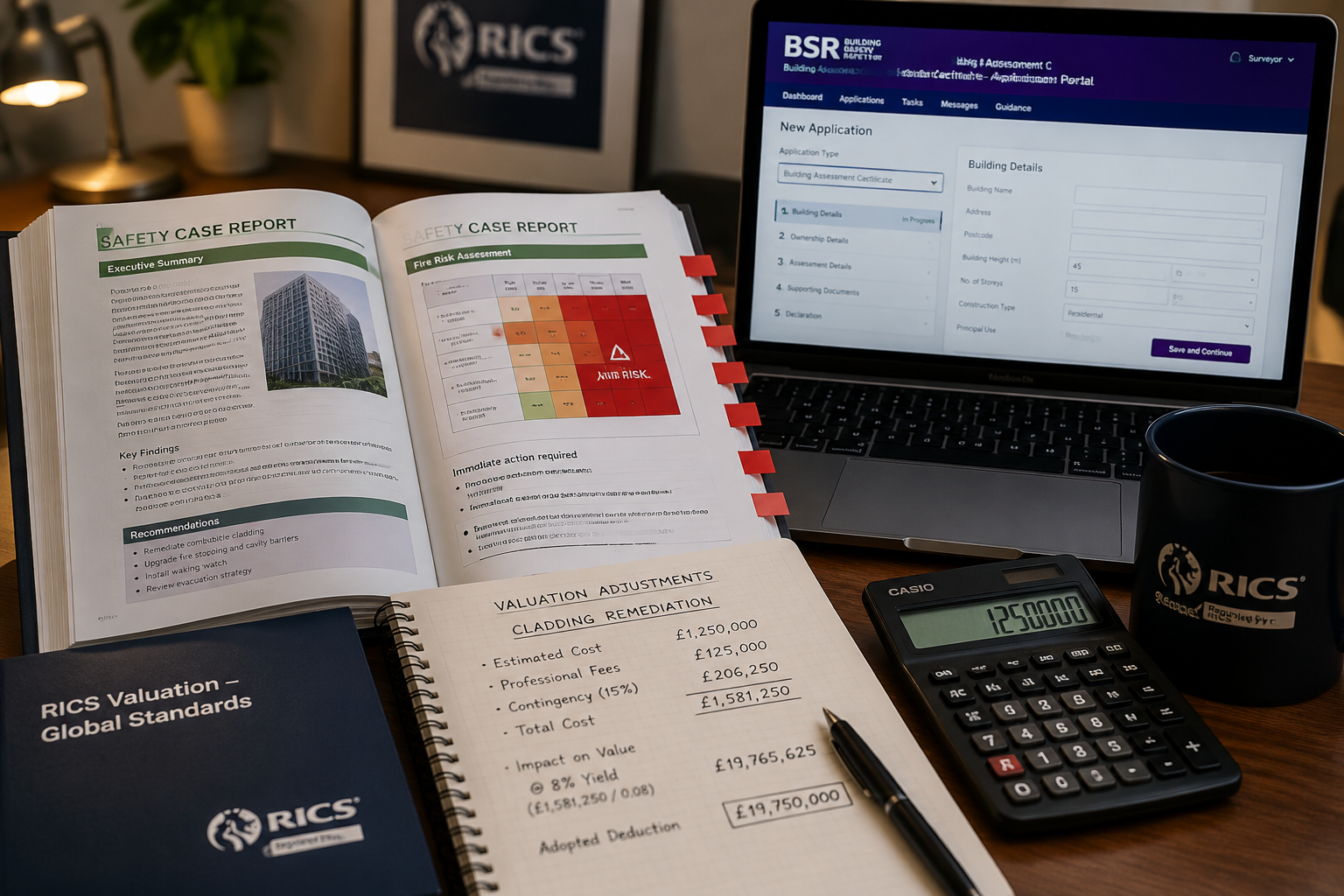
Achieving defensible Building Safety Act 2022 compliance in expert witness reports: fire safety valuations for high-rise conversions 2026 requires a structured approach that integrates RICS protocols with BSA 2022 compliance documentation. Here is how to build a report that holds up in court.
Safety Case Reports: The Foundation of Every Expert Witness Submission
Safety Case Reports are mandatory under Section 85 of the Building Safety Act 2022, which commenced on 16 January 2024 [4]. These reports must demonstrate:
- Understanding of building safety risks
- Reasonable management steps taken
- Incident reduction plans for higher-risk buildings
For expert witnesses, the Safety Case Report is not just background documentation — it is primary evidence. A valuation that references a Safety Case Report without interrogating its contents will not withstand cross-examination.
Key questions an expert witness must answer from the Safety Case Report:
- ✅ Are all fire safety systems documented and current?
- ✅ Has the building been assessed against all five BSR areas?
- ✅ Are remediation timelines realistic and funded?
- ✅ Does the report address the specific conversion risks (e.g., original structural elements, repurposed compartmentation)?
Quantifying Fire Safety Deficiencies in Valuations
When quantifying the impact of fire safety deficiencies on value, expert witnesses should apply a structured methodology:
Step 1: Identify all non-compliant elements against current BSA 2022 standards and Approved Document B requirements.
Step 2: Obtain remediation cost estimates — ideally from at least two specialist contractors. For reinstatement cost benchmarking, a reinstatement cost valuation provides a useful cross-reference point.
Step 3: Apply a risk-adjusted discount to the open market value, reflecting:
- Probability of enforcement action
- Timeline to remediation
- Lender appetite for the property in its current state
- Tenant/occupier impact during remediation works
Step 4: Document the decision trail — every adjustment must be traceable to a specific deficiency, a specific standard, and a specific cost estimate.
New Accreditation Requirements in 2026 🏅
Anticipated 2026 developments include new accreditation and licensing schemes for fire risk assessors and principal contractors undertaking work on higher-risk buildings [7]. Expert witnesses who rely on fire risk assessments in their valuations must verify that the assessor holds — or will soon be required to hold — the relevant accreditation.
The BSR or its successor body will also oversee testing and certification across all construction products, maintaining a publicly available library of test data, serious fire reports, and academic papers [7]. Expert witnesses should reference this library when supporting their technical findings.
For properties where specific defects have been identified — such as inadequate cladding, failed compartmentation, or non-compliant fire doors — a specific defect report provides the granular technical evidence that courts expect to see alongside a valuation.
Criminal Sanctions: The Enforcement Context for Valuations
Expert witnesses must understand the enforcement landscape that gives their valuations urgency and legal weight:
- New criminal offences are being created for obstructing building assessment or remediation of unsafe buildings over 11 metres [2]
- By end of 2029, landlords failing to remediate buildings over 18 metres face criminal prosecution with unlimited fines and/or imprisonment [2]
- Buildings between 11–18 metres will be escalated for investigation if not remediated by the same deadline [2]
This enforcement context directly affects valuation. A building where the owner faces potential criminal liability is not valued the same way as one on a clear remediation pathway. Expert witnesses must address this explicitly.
For properties caught in disputes involving party wall issues alongside fire safety concerns, guidance from RICS party wall surveyors may also be relevant to the overall case strategy.
Courtroom Strategies: Presenting BSA 2022 Compliance Evidence
When presenting fire safety valuations in tribunal or court proceedings, expert witnesses should follow these strategies:
1. Lead with the regulatory framework — establish the BSA 2022 compliance standard before presenting findings. Judges and tribunal members need context before numbers.
2. Use the five BSR assessment areas as a structure — this mirrors the regulator's own framework and demonstrates methodological rigour [4].
3. Anticipate challenges to remediation cost estimates — have contractor quotes, industry benchmarks, and methodology notes ready for cross-examination.
4. Address the BAC status explicitly — state whether the building has applied for, received, or been refused a Building Assessment Certificate, and what this means for value [2].
5. Reference interim Building Regulations guidance — if spring 2026 interim findings have been published, address whether they affect the assessment.
For valuers working across London and the South East on high-rise conversion cases, chartered surveyors in London and chartered surveyors in Central London offer specialist expertise in navigating these complex compliance requirements.
Where a building's condition requires a comprehensive structural and safety assessment, a RICS commercial building survey can provide the technical underpinning for expert witness submissions involving mixed-use or commercial high-rise conversions.
Conclusion: Actionable Next Steps for Expert Witnesses in 2026
The convergence of BSA 2022 enforcement, new accreditation requirements, and the 30 September 2026 Approved Document B deadline creates a uniquely demanding environment for expert witnesses preparing fire safety valuations for high-rise conversions. The stakes — financially, legally, and professionally — have never been higher.
Immediate Actions for Expert Witnesses and Valuers ✅
-
Audit your methodology — ensure every valuation adjustment is traceable to a specific BSA 2022 compliance finding, not a general market assumption.
-
Verify Safety Case Report currency — reports must reflect the building's current state, not its condition at the time of conversion.
-
Check BAC status — confirm whether the building has been directed to apply for a Building Assessment Certificate and what stage the application is at.
-
Monitor the 30 September 2026 deadline — for any conversion involving single-staircase design, confirm whether the transition provisions apply.
-
Watch for spring 2026 interim findings — the Building Safety Regulator's expert panel review may shift the standards against which conversions are assessed mid-year.
-
Commission specialist reports where needed — structural engineer reports, specific defect reports, and reinstatement cost valuations all strengthen the expert witness submission.
-
Understand the criminal sanctions landscape — valuations must reflect the enforcement risk facing building owners, not just the physical defects.
The era of box-ticking compliance is over. In 2026, Building Safety Act 2022 compliance in expert witness reports: fire safety valuations for high-rise conversions demands evidence, rigour, and a deep understanding of the regulatory machinery that now governs every higher-risk building in England.
References
[1] Expert Witness Challenges In Building Safety Disputes Preparing Evidence For 2026 Tribunal Cases – https://princesurveyors.co.uk/blog/expert-witness-challenges-in-building-safety-disputes-preparing-evidence-for-2026-tribunal-cases/
[2] Building Safety Act 2022 What To Expect In 2026 – https://gowlingwlg.com/en/insights-resources/articles/2025/building-safety-act-2022-what-to-expect-in-2026
[4] Safety Case Report – https://brocade.app/guides/safety-case-report
[5] Building Safety Regulator Strategic Plan 2026 To 2027 – https://www.gov.uk/government/publications/building-safety-regulator-strategic-plan-2026-to-2027/building-safety-regulator-strategic-plan-2026-to-2027
[6] Building Safety Act 2026 What Surveying Firms Must Do Now – https://goreport.com/building-safety-act-2026-what-surveying-firms-must-do-now/
[7] Biz Const Building Safety Act 2026 Key Developments And What To Expect – https://www.rwkgoodman.com/info-hub/biz-const-building-safety-act-2026-key-developments-and-what-to-expect/
