
Nearly one in three party wall disputes in England escalates unnecessarily — not because the legal framework is unclear, but because property owners skip proper survey protocols at the outset. Party Wall Surveys by Chartered Surveyors: Regional Case Studies from Cornwall and Best Practices for Dispute Resolution sits at the intersection of legal compliance, technical expertise, and neighbour relations. Cornwall, with its dense stock of historic granite terraces, converted farmhouses, and coastal cottages, presents some of the most instructive examples of how these surveys should — and should not — be handled. Drawing on the practices of firms like Cockrams Chartered Surveyors, AW Surveyors in Falmouth, and Crossley Hill, this article outlines site investigation protocols, condition schedule preparation, and solicitor collaboration strategies that lead to successful outcomes. [7]

Key Takeaways 📌
- The Party Wall etc. Act 1996 is the governing legislation for all notifiable works affecting shared walls, boundary structures, and excavations near neighbouring properties.
- Cornwall's unique building stock — granite terraces, historic boundary walls, converted barns — creates specialist challenges that require locally experienced chartered surveyors.
- A robust schedule of condition (with photography and written records) is the single most important document for preventing and resolving disputes.
- Expert witness services, like those offered by Cockrams Chartered Surveyors, provide a structured route to resolution when disputes reach solicitor or court level. [4]
- Selecting a RICS-registered surveyor with regional experience is essential; over 40,000 firms are searchable through the RICS directory. [7]
Understanding the Party Wall etc. Act 1996: A Foundation for Cornwall's Surveyors
The Party Wall etc. Act 1996 governs three categories of notifiable work: [8]
| Category | Description | Common Cornwall Examples |
|---|---|---|
| Section 1 | New walls on or at the boundary line | Garden walls between granite cottages |
| Section 2 | Works to existing party walls or structures | Underpinning, cutting into shared walls |
| Section 3 | Excavations near neighbouring foundations | Extensions, basement conversions |
When a building owner plans notifiable work, they must serve formal party wall notices on all adjoining owners. Failure to do so can result in injunctions, legal costs, and damaged neighbour relationships. Understanding what happens when no party wall notice has been served is critical for any property owner planning construction.
💬 "The Act exists not to create bureaucracy, but to protect both building owners and their neighbours from the financial and structural consequences of poorly managed construction." — Dr Stephen Cornish, Woodward Chartered Surveyors [1]
Who Appoints the Surveyor?
Three appointment models exist under the Act:
- Agreed surveyor — a single RICS-registered surveyor appointed by both parties
- Two surveyors — each party appoints their own, and they jointly produce the award
- Third surveyor — called upon when the two appointed surveyors cannot agree
In Cornwall, the agreed surveyor model is particularly common for straightforward residential cases, given the relatively tight-knit nature of communities in towns like Falmouth, Truro, and Penzance. [3]
Party Wall Surveys by Chartered Surveyors: Regional Case Studies from Cornwall
Cornwall's property landscape is unlike most of England. Granite construction dominates, boundary walls are often centuries old, and many properties share walls that have never been formally documented. These conditions make party wall surveys by chartered surveyors both more complex and more consequential than in newer suburban developments.
Case Study 1: Falmouth Terrace — Loft Conversion Dispute 🏠
A homeowner in Falmouth sought to convert a loft space, requiring steel beam installation through a shared party wall. The adjoining owner — a retired couple — had no prior knowledge of the Party Wall Act and initially refused to engage.
What went wrong initially:
- No formal party wall notice was served before scaffolding was erected
- No schedule of condition was prepared for the adjoining property
- Cracks appeared in the neighbouring bedroom ceiling within two weeks of works commencing
How Cockrams Chartered Surveyors resolved it: [4]
- Conducted a detailed site investigation, including photographic documentation of pre-existing and new damage
- Produced a formal schedule of condition retrospectively, distinguishing old cracks from new
- Collaborated with local solicitors to prepare an expert witness report
- A party wall award was issued retrospectively, with agreed compensation for minor remedial works
Key lesson: A schedule of condition prepared before works begin is far easier to defend than one produced after a dispute arises.
Case Study 2: Truro Semi-Detached — Boundary Wall Excavation 🧱
A property developer in Truro planned a rear extension requiring excavation within three metres of the shared boundary wall — a classic Section 3 scenario. AW Surveyors in Falmouth were appointed as the agreed surveyor. [9]
Challenges specific to Cornwall:
- The boundary wall was over 150 years old with no formal ownership documentation
- Soil conditions (Cornish killas slate) created unusual load-bearing concerns
- The adjoining owner disputed the logical boundary position, claiming the wall belonged entirely to them
Resolution approach by AW Surveyors: [9]
- Researched historic title deeds and Land Registry records
- Produced a detailed boundary dispute preparation report identifying the most logical boundary position based on physical evidence
- Issued formal party wall notices under both Section 2 and Section 3
- Agreed a party wall award covering excavation methodology, monitoring protocols, and reinstatement obligations
💡 Pro Tip: In Cornwall, many boundary walls predate modern title registration. Always commission a boundary investigation alongside the party wall survey when ownership is unclear.
Case Study 3: Penzance Converted Farmhouse — Expert Witness Engagement ⚖️
A converted farmhouse in the Penzance area became the subject of a formal legal dispute after a neighbour alleged that extension works had caused subsidence to a shared outbuilding wall. Cockrams Chartered Surveyors were engaged as expert witnesses. [4]
Site investigation protocol used:
- 📷 Comprehensive photographic survey of all affected walls, floors, and ceilings
- 📋 Written condition schedule cross-referenced with pre-works photographs
- 🔍 Crack monitoring gauges installed at key locations
- 📄 Structural engineer consultation for root cause analysis
- 🤝 Joint meetings with solicitors for both parties to review findings
The case was settled without going to court, saving both parties an estimated £15,000–£25,000 in legal fees.
For property owners wondering about what a party wall dispute actually involves, these Cornwall case studies illustrate the real-world stakes clearly.
Best Practices for Dispute Resolution: What Party Wall Surveys by Chartered Surveyors Must Include
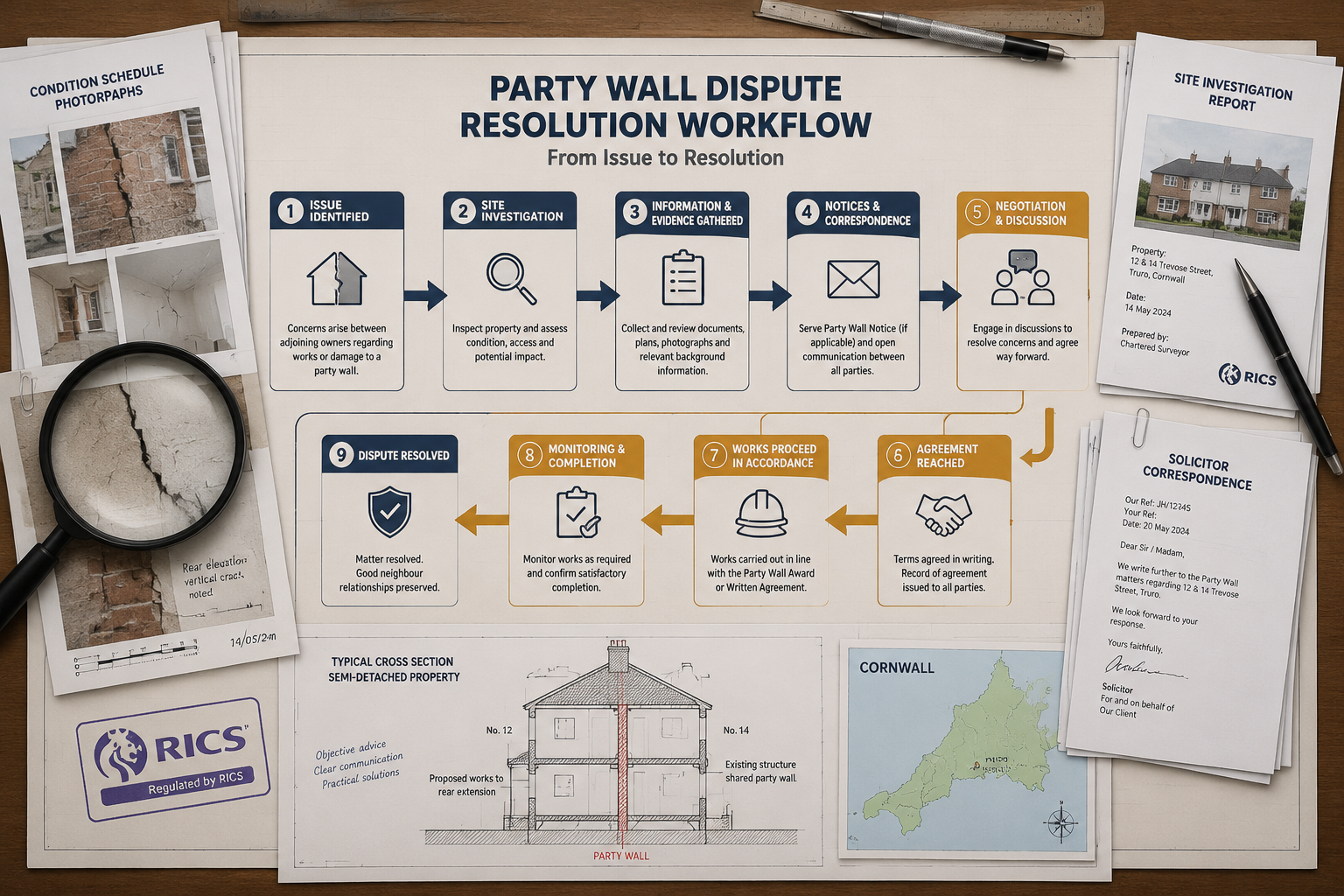
The Cornwall case studies above point to a consistent set of best practices that distinguish effective party wall surveys from inadequate ones. These practices apply nationally but are especially critical in regions with complex historic building stock. [5] [6]
1. The Schedule of Condition: Your Most Valuable Document 📋
A schedule of condition is a detailed record of the adjoining property's state before any notifiable works begin. It should include:
- Room-by-room written descriptions of walls, ceilings, floors, and structural elements
- Timestamped, geotagged photographs of every relevant surface
- Close-up images of pre-existing cracks, damp patches, or defects
- External elevations including boundary walls, outbuildings, and garden structures
💬 "The schedule of condition is not a formality — it is the evidence base that determines liability if anything goes wrong." — Dr Stephen Cornish, Woodward Chartered Surveyors [2]
Without this document, proving whether damage was caused by construction works or was pre-existing becomes almost impossible.
2. Photography Protocols for Party Wall Surveys 📸
Effective photographic documentation follows a clear hierarchy:
| Level | What to Capture | Purpose |
|---|---|---|
| Wide shots | Full room elevations | Establish spatial context |
| Mid shots | Wall sections, ceiling areas | Show condition of surfaces |
| Close-ups | Individual cracks, stains, defects | Baseline damage record |
| Macro shots | Crack width measurements with scale | Quantify pre-existing damage |
All photographs should be stored with metadata intact and referenced within the written schedule by room and location code.
3. Solicitor Collaboration: When and How 🤝
Not every party wall matter requires solicitor involvement — but knowing when to bring legal professionals in is a critical skill for chartered surveyors. The threshold for solicitor collaboration typically arises when:
- A formal party wall award is disputed by either party
- An adjoining owner refuses to respond to notices within the statutory 14-day period
- Allegations of negligence or structural damage are made
- The matter involves boundary disputes running concurrently with party wall proceedings
Cockrams Chartered Surveyors' model of producing detailed site investigation reports specifically designed for solicitor review represents best practice in this area. [4] Their expert witness reports are structured to be legally admissible, clearly separating factual findings from professional opinion.
For those considering the cost of a party wall survey, it is worth noting that early investment in a thorough survey almost always costs less than dispute resolution after the fact.
4. Selecting a Qualified Surveyor: The RICS Standard 🏅
The RICS directory lists over 40,000 firms across England, Wales, and Scotland, with specific filters for party wall specialists. [7] When selecting a surveyor in Cornwall or elsewhere, look for:
- ✅ Full RICS membership (MRICS or FRICS designation)
- ✅ Demonstrated experience with the Party Wall etc. Act 1996
- ✅ Local knowledge of regional building types and soil conditions
- ✅ Clear fee structures communicated upfront
- ✅ Professional indemnity insurance
Understanding what a chartered surveyor does helps property owners ask the right questions when appointing a professional.
5. The Party Wall Award: Structure and Content 📄
A party wall award is the formal document that governs how notifiable works are to be carried out. It should include:
- Description of the proposed works
- Working hours and access arrangements
- Methodology for protecting the adjoining property
- Monitoring requirements during construction
- Reinstatement obligations if damage occurs
- Fee arrangements between the surveyors
Firms like Metcalfe Briggs and CWC Party Walls maintain documented case study libraries demonstrating how awards are structured across different project types. [5] [6]
Common Mistakes and How to Avoid Them ⚠️
Even experienced builders and developers make avoidable errors in the party wall process. The most common include:
1. Starting works without serving notice
This is the single most common mistake. Proceeding without a party wall agreement exposes building owners to injunctions and liability for all costs associated with stopping and restarting works.
2. Assuming verbal consent is sufficient
Verbal agreements have no legal standing under the Party Wall etc. Act 1996. All consent must be in writing. Understanding party wall consent requirements is essential before any works begin.
3. Using an unqualified surveyor to reduce costs
An unqualified surveyor's award may be challenged and overturned, negating any cost savings. Always verify RICS credentials.
4. Failing to serve notice on all adjoining owners
In terraced properties — common in Cornwall — there may be two or more adjoining owners, each requiring separate notice.
5. Not retaining the schedule of condition
Schedules of condition should be retained for at least six years after completion of works, as latent defect claims can arise long after construction ends.
Regional Considerations: Why Cornwall Requires Specialist Knowledge
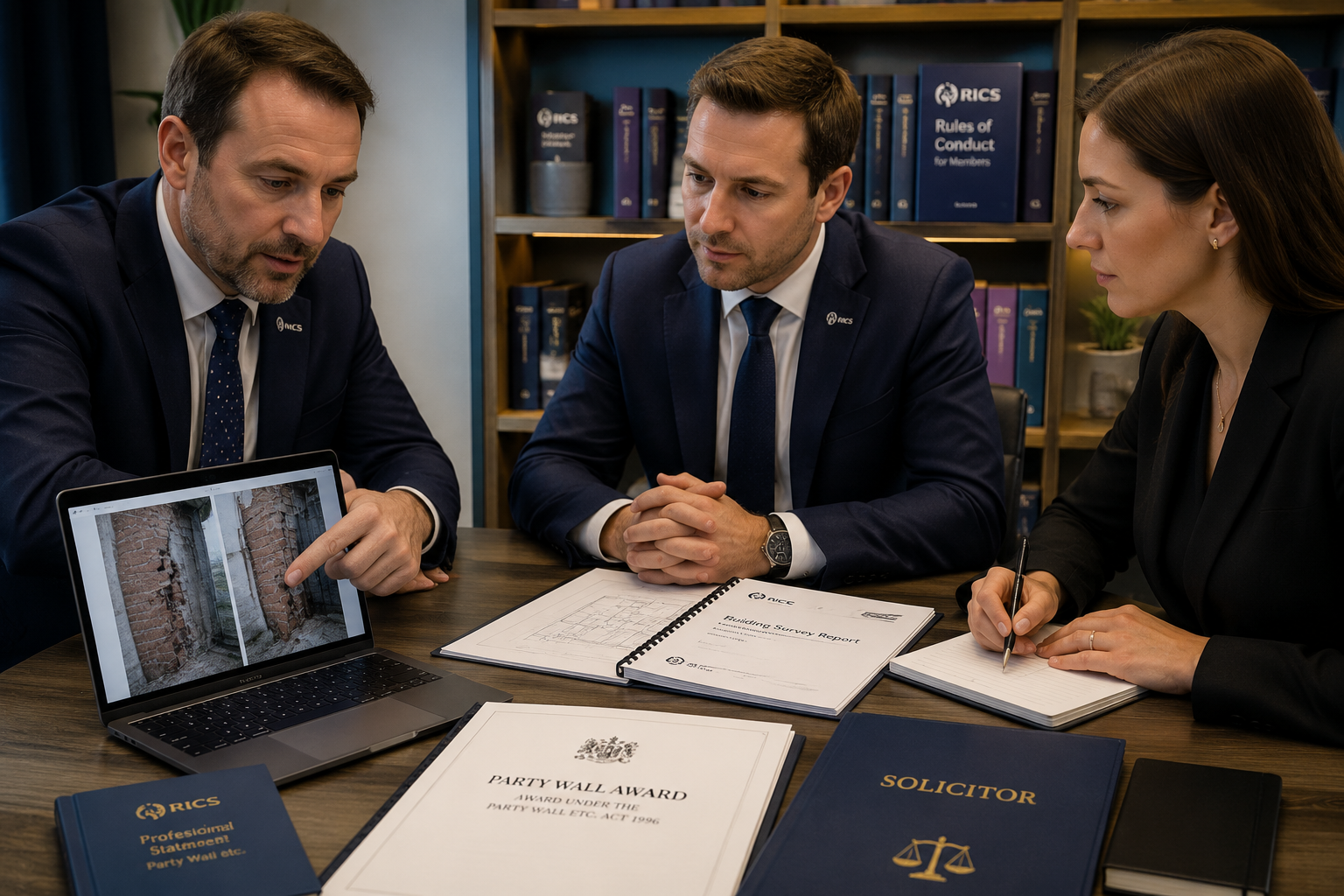
Cornwall's built environment presents challenges that generic party wall training does not always address. Key regional factors include:
Granite Construction 🪨
Cornish granite is extremely hard but brittle at mortar joints. Vibration from cutting or drilling can cause cracking along historic mortar lines that may appear unrelated to the works. Surveyors must understand how granite behaves under construction stress.
Historic Boundary Walls
Many boundary walls in Cornwall predate the Land Registry. Ownership is often unclear, and the logical boundary position must be determined from physical evidence, historic maps, and title deeds. AW Surveyors in Falmouth specialise in exactly this type of investigation. [9]
Coastal Exposure and Damp
Properties near Cornwall's coastline often have pre-existing damp issues caused by salt-laden winds and driving rain. Without a detailed schedule of condition, new damp appearing during works can be incorrectly attributed to construction activity.
Agricultural Conversions
Converted barns and farm buildings — increasingly common in rural Cornwall — often have non-standard wall construction, shared drainage, and ambiguous ownership of outbuildings. These require particularly careful party wall assessment.
For a broader understanding of the party wall process, including timelines and legal obligations, property owners should consult a RICS-registered surveyor with relevant regional experience before any works are planned.
Conclusion: Actionable Next Steps for Property Owners and Surveyors
Party Wall Surveys by Chartered Surveyors: Regional Case Studies from Cornwall and Best Practices for Dispute Resolution demonstrates one central truth: the quality of the survey process determines the quality of the outcome. Cornwall's case studies — from Falmouth loft conversions to Penzance farmhouse disputes — show that thorough documentation, early legal collaboration, and RICS-qualified expertise consistently produce faster, cheaper, and less stressful resolutions.
Actionable Next Steps ✅
For property owners planning works:
- Determine whether your project triggers the Party Wall etc. Act 1996 before appointing a contractor
- Appoint a RICS-registered surveyor with local experience — use the RICS firms directory to find Cornwall specialists [7]
- Serve formal notices at least two months before planned start dates for party wall works
- Request a comprehensive schedule of condition covering all adjoining properties
- Keep all documentation — notices, awards, schedules, and photographs — for a minimum of six years
For surveyors handling party wall matters:
- Establish a standardised photography protocol for every schedule of condition
- Build relationships with local solicitors who specialise in property disputes
- Consider expert witness accreditation to expand service offerings
- Stay current with technical guidance from resources like Dr Stephen Cornish's training materials [1] [2]
- Maintain a case study library to demonstrate competence to prospective clients [5] [6]
The Party Wall etc. Act 1996 exists to protect everyone involved in construction — building owners, adjoining owners, and the built environment itself. Engaging a qualified chartered surveyor early is not a cost; it is an investment in certainty.
References
[1] Watch – https://www.youtube.com/watch?v=CTII3jkpxKo
[2] Watch – https://www.youtube.com/watch?v=IyiA_G7gVqk
[3] Party Wall – https://chsurveyors.com/party-wall/
[4] Expert Witness – https://cockrams-surveyors.co.uk/expert-witness/
[5] Case Studies – https://www.cwcpartywalls.com/case-studies.php
[6] Party Walls – https://www.metcalfebriggs.co.uk/party-walls
[7] Party Walls – https://www.ricsfirms.com/residential/legal-issues/party-walls/?search=true&location=Cornwall&all=yes
[8] Party Wall Act 1996 – https://akt-surveyors.com/party-wall-act-1996/
[9] Party Wall And Boundary Disputes – https://www.awsurveyors.com/party-wall-and-boundary-disputes
[10] Pt Journal 2024 – https://pyramusandthisbesociety.org/wp-content/uploads/2024/11/PT_Journal_2024.pdf
