
Over 40% of party wall disputes that escalate to formal adjudication involve inadequate pre-construction documentation — yet a well-prepared Schedule of Condition costs a fraction of what a single legal dispute can reach. In 2026, as urban construction activity continues to intensify across the UK, the stakes for getting this document right have never been higher.
Schedule of Condition Best Practices: Photography, Documentation, and Dispute Prevention in Party Wall Surveys 2026 is not just a procedural checklist. It is the definitive framework that separates surveyors who prevent disputes from those who inadvertently fuel them. This article breaks down exactly what quality documentation looks like, how photography standards have evolved, and what both building owners and adjoining owners need to know to stay protected.
Key Takeaways 📋
- A Schedule of Condition is a legally significant document — vague or informal records may not hold up in dispute resolution.
- High-resolution, timestamped photography is the single most important element of a defensible schedule.
- Floor plans, written descriptions, and reference diagrams must accompany every photograph.
- Both parties must formally sign off on the schedule before construction begins.
- Digital tools and structured condition rating systems are transforming documentation quality in 2026.
What Is a Schedule of Condition and Why Does It Matter?
A Schedule of Condition is a formal record of the existing state of an adjoining property before construction work begins under the Party Wall etc. Act 1996. It captures the condition of walls, ceilings, floors, structural elements, and external surfaces — creating a defensible baseline that can be referenced if damage claims arise after the build.
For anyone navigating the party wall process, understanding this document is essential. The Party Wall etc. Act 1996 guidance explains the broader legal framework that makes schedules not just advisable, but critical to compliance.
💬 "A properly prepared Schedule of Condition is more than a formality — it's a key part of managing liability and protecting both parties." [1]
Without a robust schedule, determining whether a crack in a neighbour's wall existed before or after excavation work becomes a matter of opinion rather than evidence. That ambiguity is where disputes are born and legal costs begin to mount.
To understand what can go wrong without proper documentation, the complete guide to resolving party wall disputes outlines common escalation paths and how they can be avoided.
Photography Standards: The Foundation of Schedule of Condition Best Practices
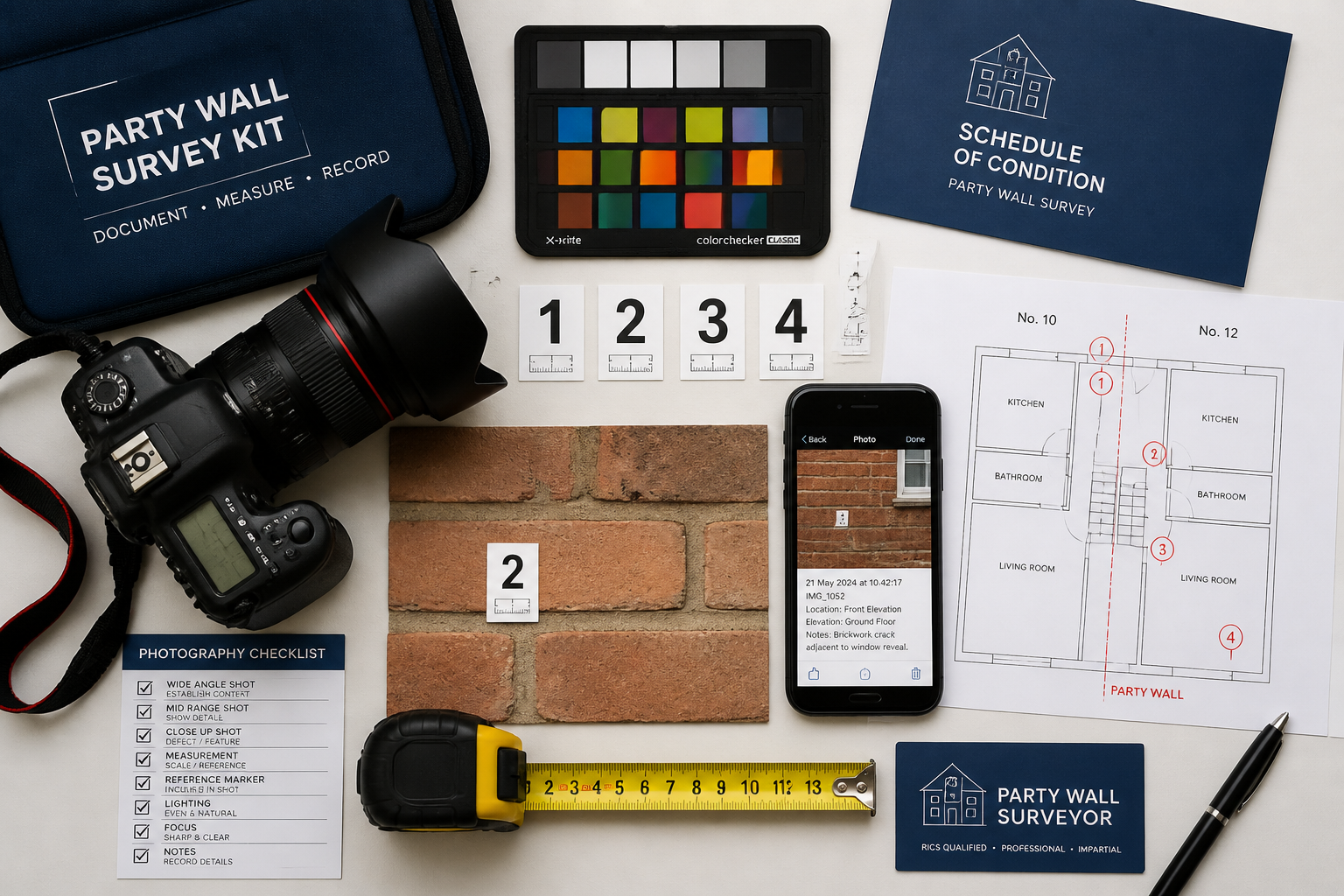
Photography is the backbone of any credible Schedule of Condition. Yet many surveyors still rely on smartphone snapshots taken in poor lighting with no reference markers. In 2026, that approach is no longer acceptable — and courts agree.
Resolution and Equipment Requirements
High-resolution images must be taken of every room, corridor, ceiling, wall, floor, and external surface to create a defensible record [3]. The minimum recommended standard for professional party wall photography includes:
| Requirement | Minimum Standard |
|---|---|
| Image resolution | 12 megapixels or higher |
| File format | RAW or high-quality JPEG |
| Lighting | Supplemental flash or LED panel |
| Lens type | Wide-angle for rooms; macro for crack detail |
| Color calibration | Reference card in first frame of each area |
Timestamping and Metadata
All records must include timestamps and dates — this is essential if the schedule is ever relied upon in dispute resolution [1]. Modern DSLR cameras and professional survey apps automatically embed EXIF metadata, including date, time, and GPS coordinates, directly into each image file. This metadata is difficult to falsify and carries significant evidential weight.
Best practice steps for timestamped photography:
- ✅ Set camera clock to sync with an atomic time source before each survey
- ✅ Photograph a printed date card in the first image of each room
- ✅ Use a survey app that generates a tamper-evident digital log
- ✅ Back up all files to a secure cloud server immediately after the survey
- ✅ Retain original files — never delete or overwrite source images
Reference Markers and Labelling
Every photograph must be labelled and cross-referenced to a floor plan or location diagram. Unlabelled images — even high-resolution ones — may not stand up in disputes because there is no way to confirm exactly where in the property the photo was taken [1].
Use numbered evidence markers (similar to forensic photography practice) placed adjacent to any defect, crack, or area of concern. These markers should correspond directly to entries in the written schedule.
Documentation Protocols: Building a Comprehensive and Defensible Record
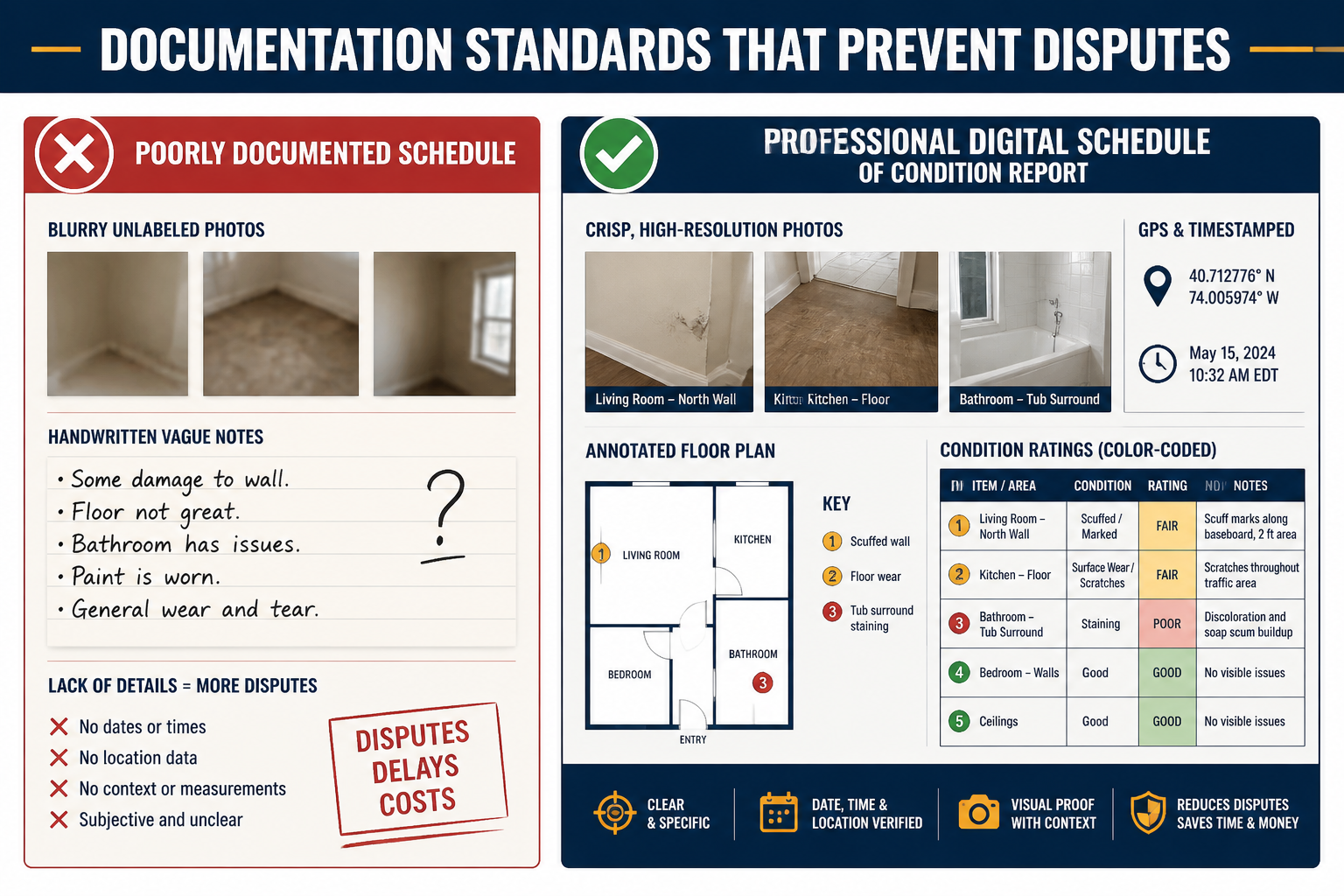
Photography alone is not enough. Schedule of Condition Best Practices: Photography, Documentation, and Dispute Prevention in Party Wall Surveys 2026 demands a multi-layered documentation approach that combines images, written notes, diagrams, and formal sign-off procedures.
Written Descriptions Must Accompany Every Photo
Notes should explain the nature and extent of any damage or imperfections to provide comprehensive documentation [3]. A photograph of a hairline crack in plasterwork means very little without a written entry that records:
- The location (e.g., "North elevation, bedroom 2, 1.2m above floor level")
- The dimensions (e.g., "Hairline crack, approximately 180mm in length")
- The condition rating (e.g., Category 1 — negligible, cosmetic only)
- Any relevant context (e.g., "Pre-existing crack consistent with thermal movement, no structural significance")
Condition Rating Systems
Structured condition ratings bring consistency and objectivity to the schedule. The most widely used system in UK party wall practice draws from the BRE Digest 251 crack classification scale:
| Category | Width | Description |
|---|---|---|
| 0 | Hairline | Negligible — no repair needed |
| 1 | < 0.1mm | Fine — easily filled |
| 2 | < 5mm | Slight — easily filled |
| 3 | 5–15mm | Moderate — requires opening up |
| 4 | 15–25mm | Severe — structural investigation needed |
| 5 | > 25mm | Very severe — requires structural repair |
Applying this system consistently throughout the schedule ensures that any post-construction comparison is objective and defensible rather than subjective.
Floor Plans and Reference Diagrams
Including floor plans and reference diagrams clarifies exactly where in the property each photo was taken [1]. A well-prepared schedule will include:
- A dimensioned floor plan for each level of the property
- Annotated elevation drawings for external walls
- A numbered photo index keyed to each plan location
- A site location plan showing the relationship between the building owner's and adjoining owner's properties
For surveyors seeking detailed guidance on preparing these documents, the Schedule of Condition guidance resource provides a practical framework aligned with current RICS standards.
Digital Tools Transforming Documentation in 2026
The shift toward digital survey platforms has significantly raised the baseline for schedule quality. Tools such as StructureScan, Kykloud, and specialist party wall apps now allow surveyors to:
- 🖥️ Build structured reports with drag-and-drop photo placement
- 📍 Embed GPS coordinates into each image entry
- 📊 Apply condition ratings from drop-down menus linked to standard scales
- 🔒 Generate tamper-evident PDF reports with digital signatures
- ☁️ Store and share documents securely via encrypted cloud platforms
These tools reduce human error, improve consistency, and produce reports that are far more likely to withstand scrutiny in formal dispute proceedings.
Dispute Prevention: How Robust Schedules Protect All Parties

The ultimate purpose of Schedule of Condition Best Practices: Photography, Documentation, and Dispute Prevention in Party Wall Surveys 2026 is to prevent disputes before they start — and to resolve them quickly when they do arise.
The Formal Sign-Off Process
The full schedule must be signed off by both parties and appropriately referenced in the party wall award to provide contractual relevance and evidential strength [1]. This step is frequently overlooked, yet it is arguably the most important procedural requirement.
The sign-off process should include:
- The surveyor presenting the completed schedule to both the building owner and the adjoining owner
- Both parties reviewing the document and raising any queries before signing
- Each party receiving a certified copy of the signed schedule
- The schedule being formally referenced and appended to the party wall award
If a neighbour refuses access for the schedule to be prepared, this creates a significant risk for the adjoining owner. The guidance on obstruction in party wall matters explains what steps can be taken in such circumstances.
What Courts Look For
If a dispute escalates to formal adjudication or county court proceedings, judges and appointed surveyors will scrutinise the schedule carefully. Courts require clarity, consistency, and documented agreement — vague, unlabelled, or informal schedules may not stand up in disputes [1].
Specifically, decision-makers will look for:
- ✔️ Evidence that both parties understood and agreed to the document's content
- ✔️ Clear, labelled photographs with timestamps and location references
- ✔️ Written descriptions that are specific, objective, and consistent with the photographic evidence
- ✔️ A condition rating system applied uniformly throughout the document
- ✔️ Formal signatures from both parties or their appointed surveyors
The Role of the Party Wall Surveyor
A qualified party wall surveyor plays a central role in ensuring the schedule meets the required standard. Understanding what a party wall surveyor does — including their responsibilities around schedule preparation — helps both building owners and adjoining owners set appropriate expectations.
The surveyor's duty is to act impartially, producing a schedule that accurately reflects the condition of the property without bias toward either party. This impartiality is what gives the document its legal weight.
Post-Construction Comparison: Closing the Loop
A Schedule of Condition only fulfils its protective function if a post-construction inspection is carried out using the same methodology. After works are complete, the surveyor should:
- Revisit every location documented in the original schedule
- Photograph the same surfaces using the same reference markers
- Prepare a comparative report noting any changes in condition
- Identify whether any new defects are consistent with the construction works undertaken
This closing inspection is what determines whether damage occurred during construction and who is responsible [1][3]. Without it, even a perfect pre-construction schedule loses much of its value.
For adjoining owners concerned about their rights throughout this process, the guide to party wall surveyor roles and legal requirements provides a clear overview of protections available under the Act.
Common Mistakes That Undermine Schedule Quality
Even experienced surveyors can fall into patterns that weaken their schedules. The most frequent errors include:
- Insufficient coverage — skipping rooms or areas deemed "unlikely to be affected"
- Poor lighting — dark or shadowed photographs that obscure existing defects
- No written notes — relying entirely on photographs without descriptive text
- Missing signatures — failing to obtain formal acknowledgement from both parties
- No floor plan cross-reference — photographs that cannot be located within the property
- Delayed preparation — carrying out the schedule after construction has already begun
Each of these errors creates a vulnerability that can be exploited in a dispute — and each is entirely avoidable with proper planning and professional discipline.
Conclusion: Actionable Next Steps for 2026
A Schedule of Condition is only as strong as the methodology behind it. In 2026, the combination of rising construction activity, increasingly sophisticated dispute resolution processes, and readily available digital tools means there is no excuse for sub-standard documentation.
Here are the actionable steps every party involved in a party wall matter should take:
- Appoint a qualified surveyor early — before any works begin, not after a dispute arises. Review what party wall surveyors do to find the right professional.
- Insist on a comprehensive schedule — covering every room, surface, and external element with high-resolution, timestamped photography.
- Demand floor plan cross-referencing — every photograph should be locatable on a dimensioned plan.
- Use a structured condition rating system — objective, consistent ratings protect both parties equally.
- Sign the schedule before works begin — unsigned schedules carry significantly less evidential weight.
- Commission a post-construction inspection — close the loop and formally compare pre- and post-construction conditions.
- Retain all original files — digital records, metadata, and signed copies should be stored securely for a minimum of six years.
The investment in a properly prepared Schedule of Condition is modest compared to the cost of a single contested claim. Done right, it protects the building owner from unfounded allegations, protects the adjoining owner from genuine damage going uncompensated, and gives both parties the clarity they need to move forward with confidence.
References
[1] Watch – https://www.youtube.com/watch?v=a6-CftqnWEk
[2] About 4 1 – https://www.partywallservice.com/about-4-1
[3] Schedules Of Condition For Tenants Why They Matter – https://www.adamjoseph.co.uk/schedules-of-condition-for-tenants-why-they-matter
[4] Party Wall Surveys And Neighbour Disputes During 2026s Construction Uptick Rics Compliance Framework – https://nottinghillsurveyors.com/blog/party-wall-surveys-and-neighbour-disputes-during-2026s-construction-uptick-rics-compliance-framework
