
Nearly one in three UK property transactions collapsed before completion in recent years — not because buyers changed their minds, but because hidden defects, unclear risk profiles, and inadequate due diligence eroded confidence at the worst possible moment. In 2026's volatile property landscape, that statistic is no longer just a cautionary tale. It is a commercial opportunity for surveyors who understand that building survey certainty as a competitive advantage is now one of the most powerful tools for reducing transaction risk and winning client trust.
Global construction costs are rising 2.4% this year, driven by labour shortages, supply chain disruptions, and geopolitical pressures [4]. Demand uncertainty is actively reshaping buyer and builder strategies across capital planning, land acquisition, and investment decisions [2]. Against this backdrop, the surveyors and firms that deliver structured, transparent, and rigorously standardised assessments are not simply providing a service — they are providing the confidence that makes deals happen.
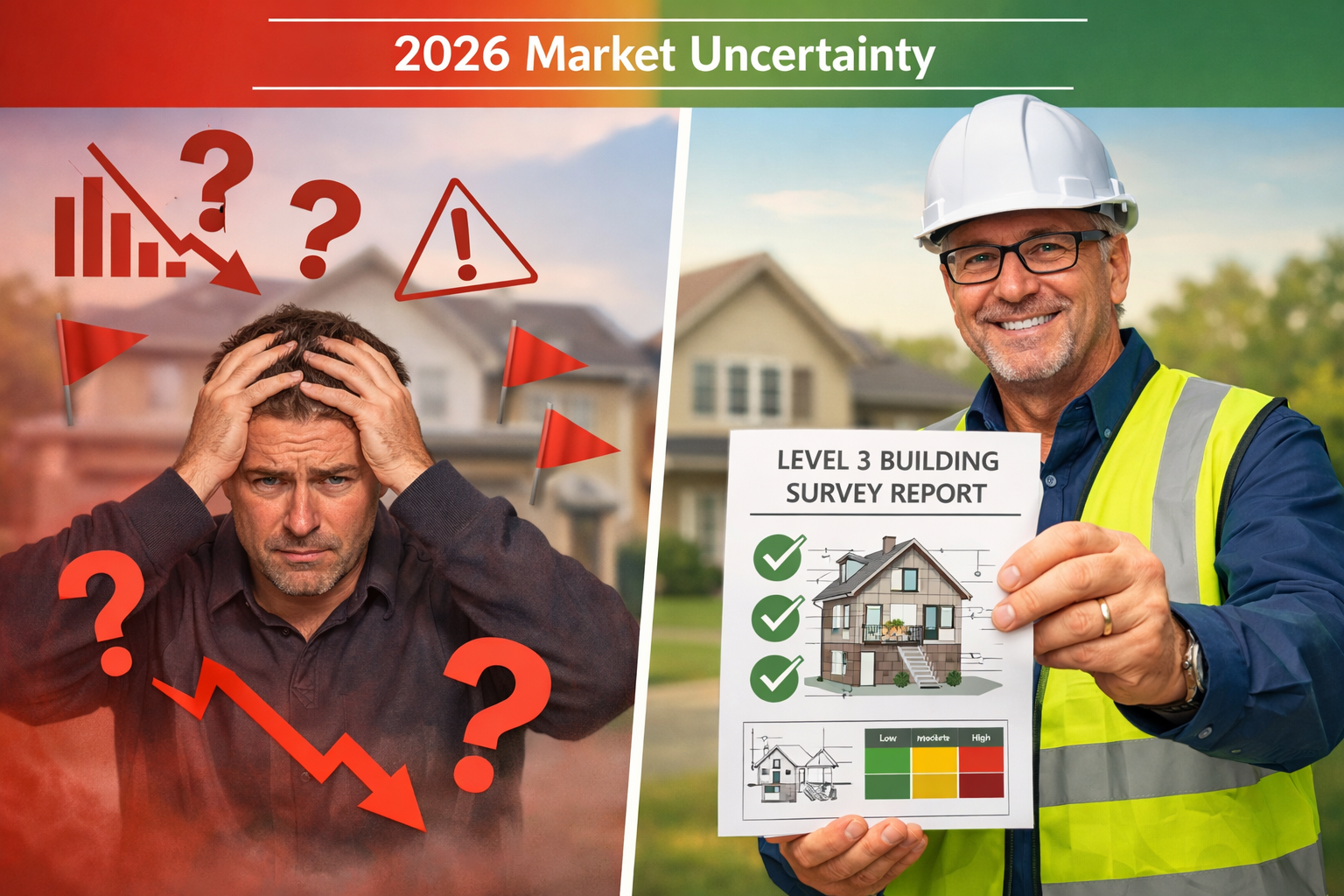
Key Takeaways 📋
- Certainty is now a competitive differentiator: In a risk-averse market, buyers, lenders, and investors actively favour professionals who reduce ambiguity through clear protocols.
- Standardised reporting builds trust: Consistent, structured survey reports reduce perceived transaction risk before legal commitments are made.
- Early engagement prevents costly surprises: Commissioning surveys earlier in the transaction process protects all parties from late-stage deal collapse.
- Professional credentials matter more than ever: RICS-qualified surveyors carry institutional credibility that directly reduces lender and buyer hesitation.
- Specialised surveys add measurable value: Drainage, structural, and dilapidation surveys provide layers of certainty that generic valuations cannot match.
Why 2026's Market Demands a New Standard of Survey Certainty
The property market entering 2026 is not simply "uncertain" in the abstract sense. It is uncertain in ways that directly affect transaction behaviour. Buyers are more risk-averse. Lenders are scrutinising asset quality more carefully. Investors are demanding clearer due diligence trails before committing capital [5].
"Trust is emerging as a primary competitive differentiator in uncertain markets, where buyers rely on accurate information and strong professional credibility to guide decisions." [5]
This shift is not temporary. According to industry analysis, organisations that plan for change, understand where pressure is likely to build, and maintain flexibility where it matters most will be most successful in 2026 [4]. For building surveyors, this translates directly: the firms that invest in rigorous professional protocols, clear risk communication, and standardised reporting will win more instructions, retain more clients, and support more successful completions.
The Cost of Uncertainty in Property Transactions
When a survey is vague, incomplete, or poorly communicated, the consequences cascade:
- Buyers hesitate or withdraw, triggering abortive costs for all parties
- Lenders reduce loan-to-value ratios or decline to lend entirely
- Sellers face renegotiation at a late stage, often at significant discounts
- Solicitors face delays as they seek clarification on ambiguous findings
The financial exposure from a single collapsed transaction — legal fees, survey costs, mortgage arrangement fees, and lost time — can easily exceed £5,000 to £15,000 per party. Multiply that across a portfolio of transactions and the case for investing in survey quality becomes undeniable.
Understanding the importance of a survey home report is therefore not just good practice — it is financial risk management.
Professional Protocols That Deliver Building Survey Certainty as Competitive Advantage
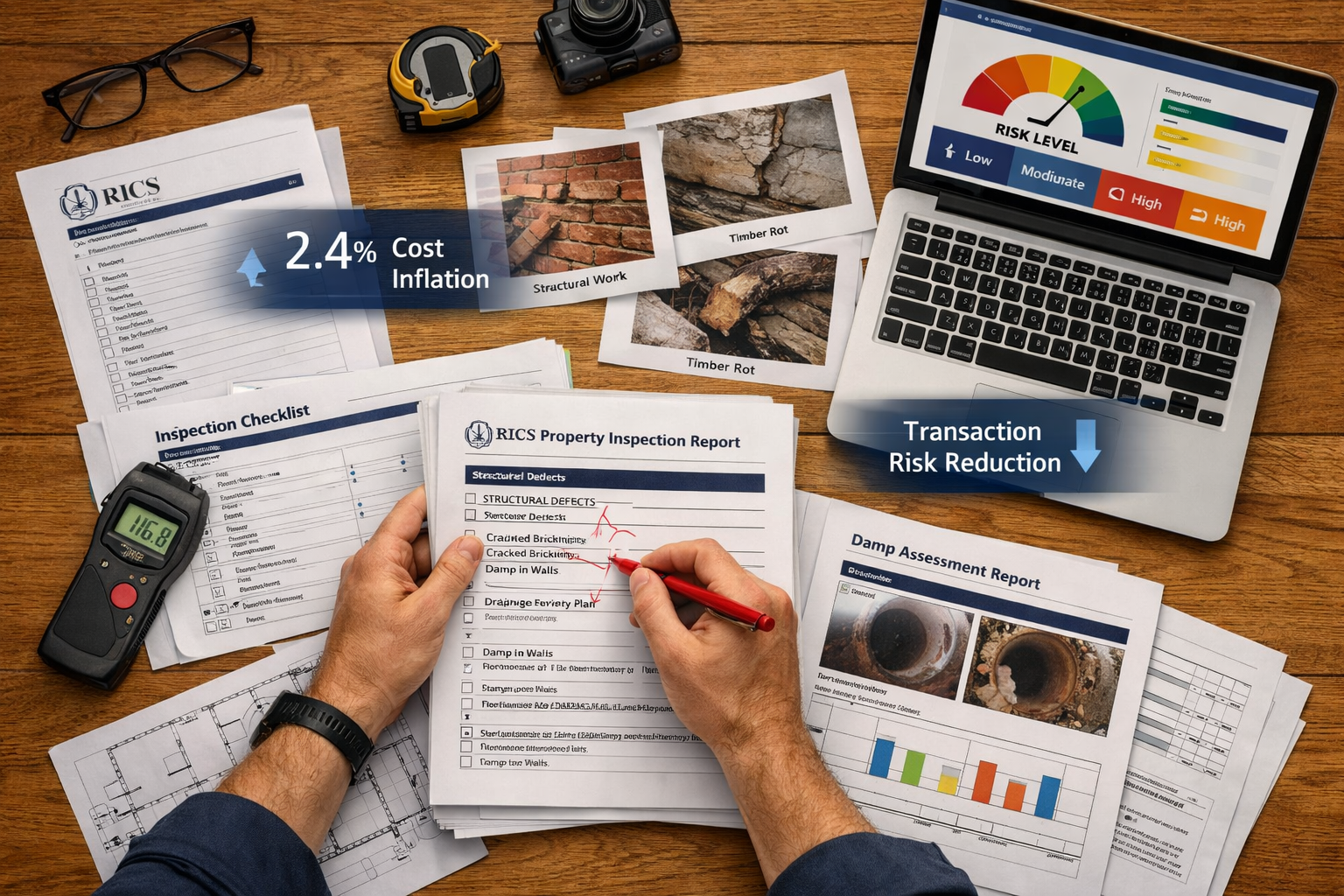
The foundation of survey certainty is not technology alone, nor experience alone. It is the combination of structured methodology, qualified professionals, and clear communication — applied consistently across every instruction.
1. Choosing the Right Survey Level for the Property
One of the most common sources of transaction risk is a mismatch between survey type and property complexity. A Level 2 HomeBuyer Report may be appropriate for a modern flat in good condition. But for a Victorian terrace, a period conversion, or any property showing visible defects, a Level 3 Building Survey is the appropriate standard.
| Survey Type | Best For | Risk Reduction Level |
|---|---|---|
| RICS Level 2 (HomeBuyer) | Modern, standard properties in good condition | Moderate |
| RICS Level 3 (Building Survey) | Older, larger, or complex properties | High |
| Specific Defect Survey | Known or suspected single issues | Targeted |
| Structural Survey | Properties with visible structural concerns | High |
The Level 3 Building Survey essential guide for property buyers explains in detail why this comprehensive inspection is increasingly the preferred choice for buyers who cannot afford post-purchase surprises in 2026's cost-pressured environment.
2. Standardised Risk Communication
The language of a survey report is as important as its technical content. Reports that use inconsistent terminology, bury critical findings in dense paragraphs, or fail to prioritise issues by severity leave readers — and their solicitors — unable to make informed decisions quickly.
Best-practice survey reports in 2026 should include:
- ✅ Traffic-light condition ratings (1, 2, 3) applied consistently
- ✅ Clear cost estimate ranges for identified remedial works
- ✅ Prioritised action lists distinguishing urgent from routine maintenance
- ✅ Photographic evidence linked directly to written findings
- ✅ Plain-English summaries accessible to non-specialist readers
This level of structured clarity is what separates a survey that enables a transaction from one that stalls it.
3. Specialist Surveys as Risk Reduction Layers
A standard building survey provides a strong foundation. But in 2026's market, buyers, lenders, and investors increasingly expect additional specialist investigations for higher-risk properties or transactions.
Key specialist surveys that add certainty include:
- Drainage surveys: CCTV inspection of underground drainage systems to identify blockages, root ingress, or structural failure — issues that can cost tens of thousands to remediate.
- Structural surveys: Detailed assessment of load-bearing elements, foundations, and structural integrity for properties with visible movement or unusual construction.
- Dilapidations surveys: Critical for commercial transactions, identifying the condition obligations and potential liabilities attached to a lease.
- Subsidence surveys: Essential for properties in areas with known ground movement risk, particularly relevant as climate-related ground conditions evolve.
Each of these specialist investigations adds a documented layer of certainty that lenders and buyers can rely upon. They also demonstrate a surveyor's commitment to comprehensive due diligence — a powerful differentiator in a competitive professional market.
4. Early Engagement as Standard Protocol
One of the clearest lessons from 2026's construction and property sector research is that early decision-making reduces exposure. Successful organisations are confirming requirements and identifying risks earlier to reduce their vulnerability as conditions change [4]. Early contractor engagement is becoming standard practice for mitigating emerging challenges [3].
The same principle applies directly to surveying. When a survey is commissioned early in the transaction — ideally before exchange of contracts and before significant legal costs are incurred — all parties benefit:
- Buyers can negotiate price adjustments based on documented findings
- Sellers can address issues proactively or price accordingly
- Lenders receive risk intelligence before making lending decisions
- Solicitors can factor known issues into contract conditions
Hiring a residential surveyor early could save thousands on a property purchase — a principle that is more financially significant in 2026 than ever before.
5. Verified Professional Credentials
In a market where trust is the primary competitive differentiator [5], professional credentials are not bureaucratic formalities. They are commercial signals that reduce perceived risk for every party in a transaction.
RICS (Royal Institution of Chartered Surveyors) membership carries institutional credibility that lenders, solicitors, and sophisticated buyers actively look for. Before instructing any surveyor, buyers and their advisors should verify:
- RICS membership and current registration
- Relevant experience with the property type and location
- Professional indemnity insurance coverage
- Clear complaints and dispute resolution procedures
Understanding how to verify a surveyor's credentials in the UK is a straightforward step that dramatically reduces the risk of receiving an inadequate or unenforceable survey report.
Building Survey Certainty as Competitive Advantage: Practical Strategies for Surveyors and Buyers in 2026
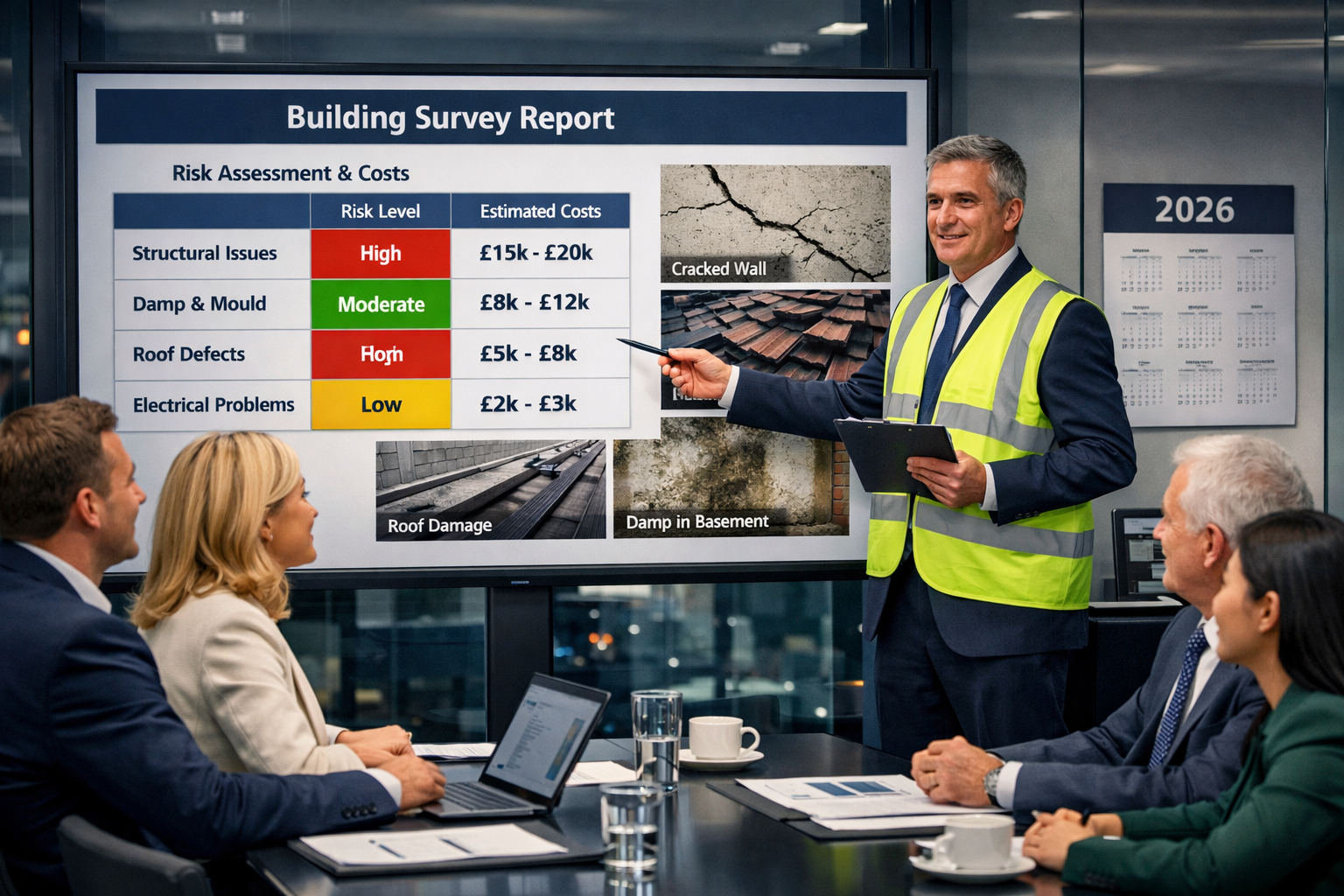
The concept of building survey certainty as a competitive advantage operates on two levels simultaneously: it benefits the professionals who deliver it, and it protects the clients who commission it. Understanding both perspectives reveals why rigorous survey protocols are not a cost centre — they are a value creation mechanism.
For Surveying Firms: Differentiation Through Protocol
In a market where demand uncertainty is reshaping strategies across the property sector [2], surveying firms that invest in consistent, high-quality protocols will attract and retain clients who cannot afford ambiguity.
Practical differentiation strategies include:
- Standardise report templates aligned with current RICS guidance to ensure consistency across all surveyors within a firm
- Invest in continuing professional development to stay current with emerging defect types, construction methods, and regulatory changes
- Build clear client communication workflows that set expectations before, during, and after the inspection
- Develop specialist capability in high-demand areas such as drainage, structural assessment, and energy performance
- Leverage digital tools for report delivery, photographic documentation, and client follow-up
The firms that treat survey quality as a marketing asset — not just a professional obligation — will find that reputation compounds over time, generating referrals from solicitors, mortgage brokers, and estate agents who trust their work.
For Buyers and Investors: Certainty as Risk Management
From the buyer's perspective, commissioning a thorough survey from a qualified chartered surveyor is one of the highest-return investments available in any property transaction.
Consider the risk calculus:
| Scenario | Survey Cost | Potential Saving | ROI |
|---|---|---|---|
| Level 3 Survey reveals £40,000 structural issue | £800–£1,200 | £40,000+ negotiation or withdrawal | 33x–50x |
| Drainage survey identifies collapsed pipe | £300–£500 | £8,000–£15,000 remediation avoided | 16x–50x |
| No survey commissioned | £0 | £0 (full risk retained) | Negative |
The numbers make the case clearly. In 2026's market, where construction costs are rising and remediation budgets are under pressure [4], the financial case for comprehensive survey coverage is stronger than at any point in recent memory.
The Role of Location-Specific Expertise
Survey certainty is also a function of local knowledge. A surveyor familiar with the specific construction methods, ground conditions, and planning history of a particular area will identify risks that a generalist might miss.
This is why location-specific expertise — whether in Putney, Richmond, Hammersmith, or across Hertfordshire — is a genuine differentiator, not simply a marketing claim. Local surveyors understand which streets have subsidence histories, which building types carry recurring defect patterns, and which local authorities have specific planning constraints that affect property condition and value.
Communicating Certainty to Lenders and Investors
For commercial and investment transactions, the audience for a survey report extends beyond the buyer. Lenders, institutional investors, and asset managers all need survey intelligence that is structured, credible, and defensible.
This means survey reports for commercial properties should:
- Reference relevant British Standards and RICS guidance explicitly
- Include quantified cost estimates with stated assumptions
- Address environmental and regulatory compliance issues
- Provide clear recommendations with timelines and priorities
Commercial property surveyors who understand the institutional audience for their reports — and structure their work accordingly — will consistently win higher-value instructions in 2026's competitive market.
Conclusion: Certainty Is the Product 🏆
The most important insight from 2026's property market research is straightforward: certainty is not a byproduct of good surveying — it is the product itself. Buyers, lenders, and investors are not simply purchasing an inspection. They are purchasing the confidence to proceed with one of the largest financial decisions of their lives.
Building survey certainty as a competitive advantage — through professional protocols that reduce transaction risk in 2026's uncertain market — is therefore both a professional obligation and a commercial strategy. The surveyors and firms that embrace this reality will find that rigorous methodology, clear communication, and verified credentials are not just good practice. They are the foundation of a sustainable, high-value professional business.
Actionable Next Steps
For buyers and investors:
- Commission a Level 3 Building Survey for any property that is older, larger, or shows visible defects
- Engage a surveyor early — before significant legal costs are committed
- Verify RICS credentials before instructing any professional
- Consider specialist surveys (drainage, structural, subsidence) for higher-risk properties
For surveying professionals:
- Standardise report formats to RICS current guidance
- Invest in specialist capability in high-demand survey types
- Build referral relationships with solicitors and mortgage brokers who value quality
- Communicate the risk-reduction value of thorough surveys — not just the technical findings
In a market defined by uncertainty, the professionals who deliver certainty will always have a competitive advantage.
References
[1] 2026 Construction Outlook – https://sips.premierbuildingsystems.com/blog/2026-construction-outlook
[2] Survey Reveals Demand Uncertainty Is Changing 2026 Homebuilding Strategy – https://www.housingwire.com/articles/survey-reveals-demand-uncertainty-is-changing-2026-homebuilding-strategy/
[3] 2026 Us Construction Perspective – https://www.jll.com/en-us/insights/2026-us-construction-perspective
[4] Construction In 2026 Where Certainty Comes From Agility – https://www.curriebrown.com/insights/construction-in-2026-where-certainty-comes-from-agility/
[5] 2026 Building Products Industry Predictions – https://truedigitalcom.com/2026-building-products-industry-predictions/
[6] 2026 Real Estate Construction Industry Predictions – https://www.ssccpas.com/insights/2026-real-estate-construction-industry-predictions/
[7] Us Real Estate Market Outlook 2026 – https://www.cbre.com/insights/books/us-real-estate-market-outlook-2026
