
Cold homes kill approximately 10,000 people in England every year — and from May 2026, private landlords who fail to act on excess cold and fall hazards face enforceable legal consequences under Awaab's Law Phase 2. Building surveys for excess cold and fall hazards in PRS: pre-May 2026 Awaab's Law compliance checklists are no longer a best-practice recommendation. They are the foundation of a defensible compliance position.
This guide gives RICS-aligned surveyors and private landlords a structured, practical framework for assessing and documenting excess cold, bath hazards, stair falls, and level-change risks before the Phase 2 deadline arrives.
Key Takeaways 📋
- Awaab's Law Phase 2 (May 2026) extends legal obligations to excess cold, fall hazards (baths, stairs, level surfaces), fire, electrical, and hygiene risks in the Private Rented Sector (PRS).
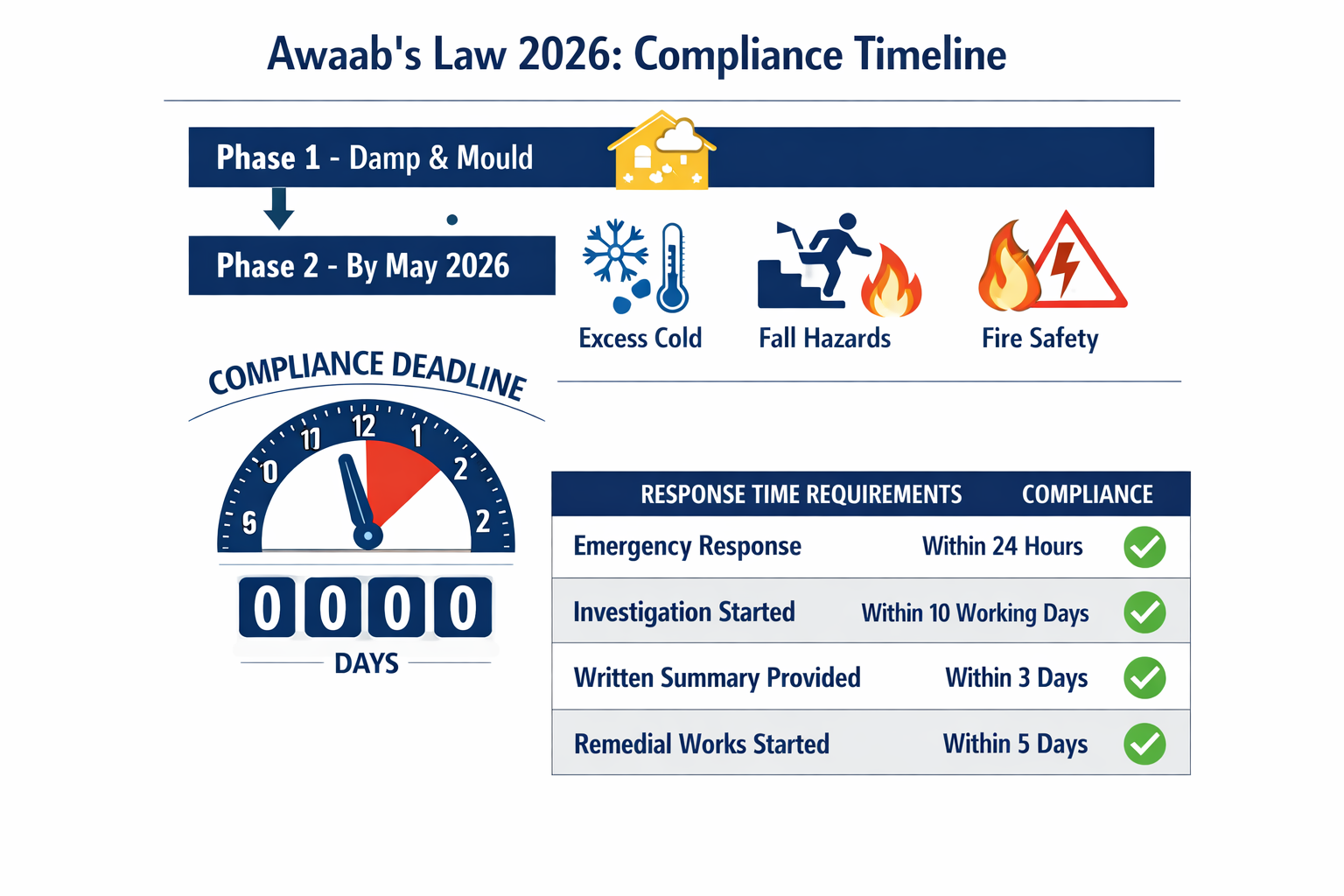
- Landlords must investigate significant hazards within 10 working days, begin remedial works within 5 working days of investigation, and respond to emergencies within 24 hours. [2]
- A Level 3 building survey is the most appropriate tool for identifying and documenting HHSRS-relevant hazards before the deadline.
- Non-compliance can result in enforcement orders, compensation payments, tenants' legal costs, and loss of rent. [2]
- Acting before May 2026 gives landlords time to remediate defects without the pressure of statutory response windows.
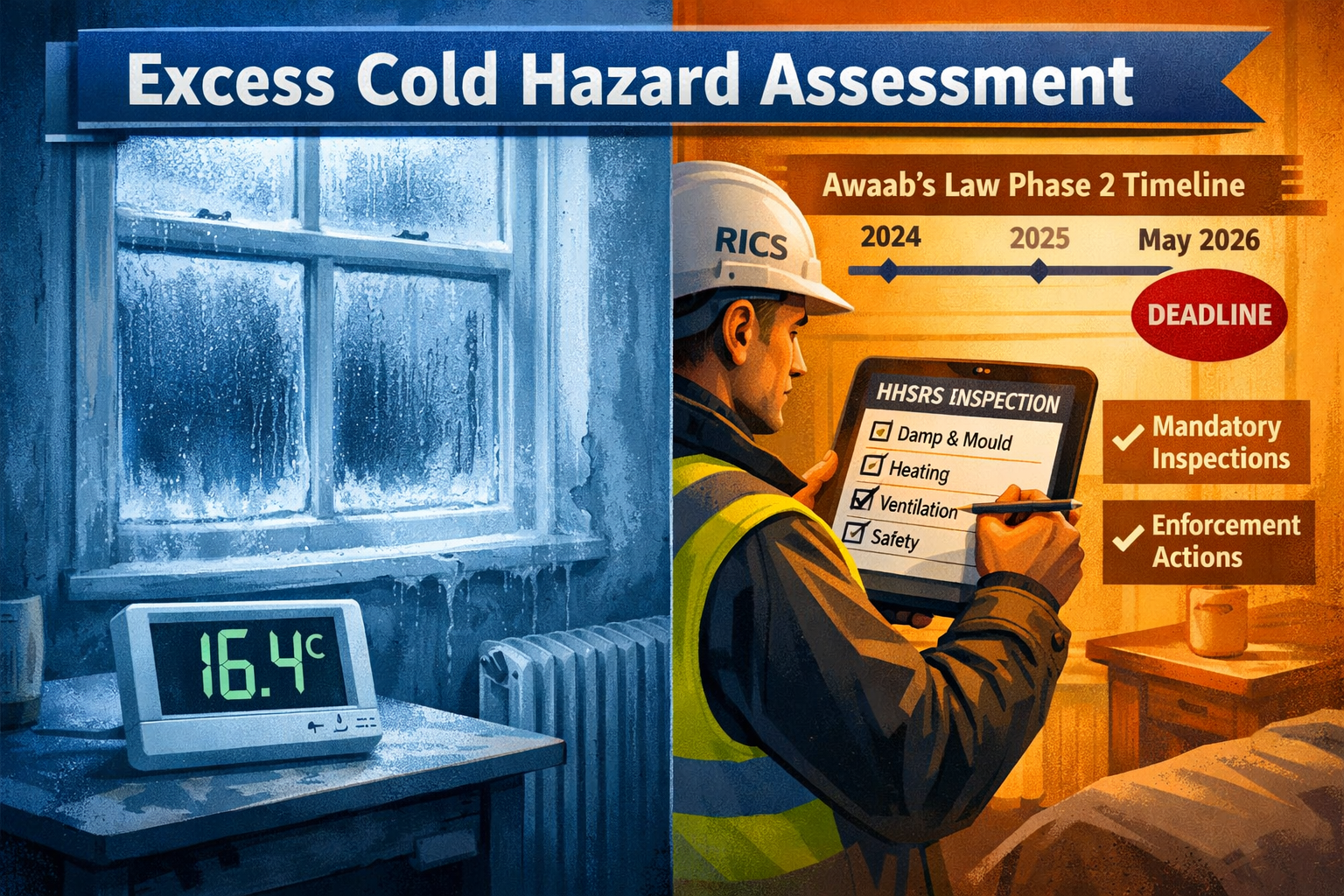
What Awaab's Law Phase 2 Actually Requires From Private Landlords
From Social Housing to the PRS: The Regulatory Shift
Awaab's Law was born from the tragic death of two-year-old Awaab Ishak, who died in 2020 from prolonged exposure to mould in a social housing property. Phase 1, which came into force in late 2024, focused on damp and mould in the social housing sector.
Phase 2 changes the picture entirely. Scheduled to commence in 2026, it extends the scope to include: [2]
- ❄️ Excess cold
- 🔥 Excess heat
- 🚿 Falls associated with baths and level surfaces
- 🪜 Falls on stairs and between levels
- 🏗️ Structural collapse
- 💥 Explosions
- 🔌 Fire and electrical hazards
- 🧼 Domestic hygiene and food safety
For the PRS, this represents a fundamental shift. Building surveys for excess cold and fire hazards in PRS properties are no longer optional under post-Awaab's Law 2026 protocols. [1]
The Statutory Response Timeline
Understanding the legal timelines is critical for any landlord or surveyor preparing a compliance strategy.
| Trigger Event | Required Action | Timeframe |
|---|---|---|
| Emergency hazard identified | Investigate and remedy | 24 hours |
| Significant hazard reported | Investigate | 10 working days |
| Investigation concluded | Provide written summary to tenant | 3 working days |
| Investigation concluded | Begin remedial works | 5 working days |
💬 "The reforms are designed not only to keep tenants safer but also to hold landlords accountable." — MHCLG, October 2025 [2]
These timelines are tight. A landlord who has not already surveyed their stock and identified likely hazards will struggle to meet the investigation window once a tenant complaint is received. Pre-emptive surveying is the only rational approach.
Phase 3 and Beyond
Phase 3, scheduled for 2027, will extend coverage to all remaining significant hazards under the Housing Health and Safety Rating System (HHSRS), with the sole exception of overcrowding. [2] The direction of travel is clear: comprehensive, evidenced hazard management is the new baseline for PRS compliance.
Building Surveys for Excess Cold and Fall Hazards in PRS: The RICS-Aligned Assessment Framework
Why a Level 3 Survey Is the Right Tool
Not all surveys are created equal. A basic Level 2 HomeBuyer Report provides a condition rating but lacks the depth needed to document HHSRS hazard categories with the specificity Awaab's Law demands. For compliance purposes, a Level 3 building survey is the appropriate instrument.
A Level 3 survey provides: comprehensive building surveys
- Detailed inspection of fabric, structure, and services
- Specific defect identification with cause and consequence analysis
- Recommendations for remedial action with urgency grading
- Documentary evidence suitable for legal and regulatory purposes
For landlords uncertain about the difference in scope, the comparison between Level 2 and Level 3 surveys makes the case clearly. When statutory timelines and enforcement penalties are in play, the more comprehensive option is not a luxury — it is a necessity.
Excess Cold: What Surveyors Must Assess
Excess cold under HHSRS is defined as a dwelling that cannot be maintained at a minimum of 18°C in living rooms and 16°C in bedrooms during cold weather. The hazard score rises with the age and vulnerability of occupants.
Key inspection elements for excess cold:
-
Thermal envelope integrity
- Wall insulation type and condition (cavity, solid, or uninsulated)
- Roof and loft insulation depth and coverage
- Floor insulation presence, particularly in suspended timber floors
- Window specification (single, double, or triple glazing; frame condition)
-
Heating system assessment
- Boiler age, condition, and output adequacy
- Radiator sizing relative to room volume
- Thermostatic controls and programmability
- Evidence of heating system failure or inadequacy
-
Draught and air infiltration
- Door and window seals
- Letterbox and loft hatch draught-proofing
- Exposed pipework and service penetrations
-
Energy Performance Certificate (EPC) correlation
- Current EPC rating and whether it reflects actual thermal performance
- Minimum Energy Efficiency Standards (MEES) compliance (EPC Band E or above)
⚠️ Important: A passing EPC rating does not guarantee HHSRS excess cold compliance. The two systems use different methodologies. Surveyors must assess both independently.
A damp survey often runs alongside excess cold assessments, since cold surfaces accelerate condensation and interstitial moisture — creating compound hazard risk.
Pre-May 2026 Awaab's Law Compliance Checklists for Fall Hazards
Understanding the Three Fall Hazard Categories
Phase 2 of Awaab's Law distinguishes between three distinct fall hazard types, each requiring its own inspection protocol:
- Falls on level surfaces — trips and slips on floors
- Falls associated with baths — entry/exit from baths and showers
- Falls on stairs and between levels — stair geometry, handrails, and level changes
✅ Checklist 1: Level Surface Fall Hazards
| Item | Inspection Point | Pass/Fail/Action Required |
|---|---|---|
| Floor coverings | Check for lifted edges, tears, or uneven joins | |
| Threshold strips | Ensure all door thresholds are flush or ramped | |
| Kitchen and bathroom floors | Assess slip resistance when wet (R-value) | |
| External steps and paths | Check for cracking, heave, or moss growth | |
| Lighting adequacy | Test lux levels in corridors and landings |
✅ Checklist 2: Bath and Shower Fall Hazards
| Item | Inspection Point | Pass/Fail/Action Required |
|---|---|---|
| Bath/shower tray condition | Check for cracks, flex, or instability | |
| Non-slip surfaces | Assess presence and condition of non-slip mat or surface | |
| Grab rails | Check for presence, fixing security, and load rating | |
| Bath panel and surround | Confirm stability and absence of sharp edges | |
| Floor surface adjacent to bath | Assess slip resistance when wet | |
| Step access to bath | Measure step height and check for handholds |
✅ Checklist 3: Stair and Level-Change Fall Hazards
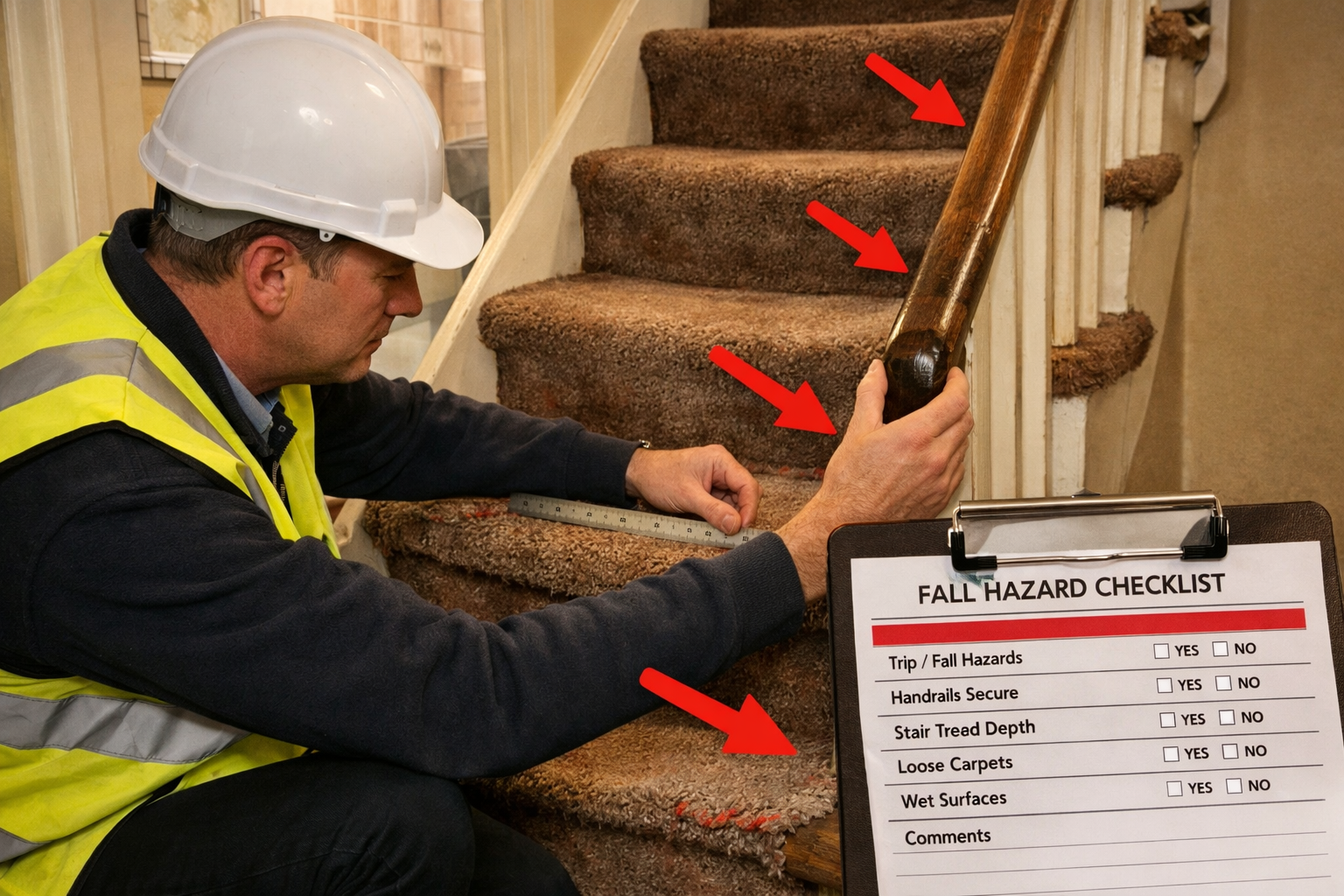
Stair falls are among the most serious hazards in residential properties. The HHSRS assigns significant weighting to stair geometry defects, particularly in older housing stock common in the PRS.
Geometric standards to check:
- Rise height: Should not exceed 220mm; consistency across all treads is critical
- Going (tread depth): Minimum 220mm recommended; less than 190mm is a significant hazard
- Pitch angle: Should not exceed 42°
- Handrail height: Between 900mm and 1,000mm from pitch line
- Balustrade spacing: Maximum 100mm between balusters (prevents child entrapment)
| Item | Inspection Point | Pass/Fail/Action Required |
|---|---|---|
| Tread and riser dimensions | Measure and record all variations | |
| Handrail presence and continuity | Check both sides where width exceeds 1m | |
| Handrail fixing security | Test for movement under load | |
| Nosing condition | Check for worn, loose, or missing nosings | |
| Carpet and covering | Assess for lifting, wear, or poor fixing | |
| Headroom clearance | Minimum 2,000mm on pitch line | |
| Lighting at head and foot | Confirm switch accessibility from both ends | |
| Loft hatch ladder | Check stability, fixing, and step condition |
For properties with complex structural configurations, a structural survey may be warranted alongside the standard building survey to assess load-bearing implications of any proposed remedial works.
Documentation, Reporting, and Landlord Compliance Evidence
The Written Summary Obligation
Once an investigation is concluded, landlords must provide tenants with a written summary of findings within 3 working days. [2] This is not a courtesy — it is a statutory requirement. The survey report produced by a RICS-qualified surveyor serves as the evidential backbone of this obligation.
A compliant survey report for Awaab's Law purposes should include:
- Hazard identification — clearly categorised by HHSRS hazard type
- Hazard scoring — likelihood of harm and range of outcomes
- Photographic evidence — dated, geotagged where possible
- Remedial recommendations — with urgency grading (emergency, urgent, routine)
- Specification for works — sufficient detail for contractor quotation
Connecting Survey Evidence to Compliance Records
Building survey defect documentation under the Renters' Rights Act 2026 and Awaab's Law creates a dual-purpose compliance record. [3] Landlords who maintain structured survey evidence are better positioned to:
- Demonstrate proactive hazard management to local authority enforcement officers
- Defend against tenant compensation claims by evidencing timely investigation and remediation
- Support Section 8 possession proceedings where tenant behaviour has contributed to hazard conditions
💡 Pro tip: Commission surveys before a tenant complaint is received. The 10-working-day investigation window begins from the moment the landlord becomes aware of a hazard — not from when a formal complaint is submitted. [2]
Non-Compliance Consequences
The penalties for failing to meet Awaab's Law obligations are significant: [2]
- 📋 Enforcement orders requiring specific works within set timeframes
- 💷 Compensation payments to affected tenants
- ⚖️ Payment of tenants' legal costs
- 🏠 Loss of rent if the property becomes uninhabitable
For landlords managing multiple PRS properties, the cumulative financial exposure from non-compliance across a portfolio could be substantial. Investing in pre-May 2026 building surveys is a straightforward risk-mitigation measure.
Building Surveys for Excess Cold and Fall Hazards in PRS: Preparing Your Property Portfolio Before May 2026
Prioritising the Survey Programme
Not all properties carry equal risk. When planning a pre-May 2026 survey programme, prioritise:
- Pre-1919 properties — solid wall construction, no cavity insulation, steep staircases
- Properties with vulnerable tenants — elderly, disabled, or young children (higher HHSRS hazard scores)
- Properties with known maintenance history — previous complaints about cold or falls
- Converted properties — non-standard floor layouts, altered staircases, added bathrooms
Selecting the Right Surveyor
For Awaab's Law compliance purposes, the surveyor should be:
- RICS-qualified (Member or Fellow)
- Experienced in HHSRS assessments and residential PRS stock
- Able to produce reports in a format suitable for regulatory evidence
- Familiar with Phase 2 hazard categories and the associated scoring methodology
A complete guide to building surveyors in London covers how to evaluate surveyor credentials and what to expect from the instruction process.
Integrating Electrical and Fire Hazard Assessments
Phase 2 also covers fire and electrical hazards. [2] While these may require specialist assessors (e.g., a qualified electrician for an Electrical Installation Condition Report), the building surveyor plays a coordinating role — identifying physical conditions that increase fire or electrical risk.
For properties where fire risk assessment is required, responsible persons must conduct person-centred fire risk assessments as conversations with residents to understand specific risks and identify evacuation improvements. [2] Where residents have mobility limitations, Personal Emergency Evacuation Plans (PEEPs) must be identified and documented. [2]
Electrical hazard and fire risk assessment obligations under Awaab's Law 2026 extensions create additional surveyor liability considerations that should be understood before instruction. [4]
For properties with roof structures that may affect fire compartmentation or thermal performance, a roof survey can provide targeted evidence on these specific elements.
Solid Floor and Specific Defect Assessments
Where fall hazards on level surfaces relate to floor slab movement, cracking, or differential settlement, a solid floor slab survey provides the specialist evidence needed to quantify the hazard and specify appropriate remediation. Similarly, a specific defect report can be commissioned to focus exclusively on a single identified hazard where a full Level 3 survey has already been completed.
Conclusion: Act Before the Clock Starts
The May 2026 Phase 2 commencement date is not a distant horizon — it is an immediate operational deadline for every private landlord in England with tenants at risk from excess cold, fall hazards, or related HHSRS categories.
Here are the actionable next steps for landlords and surveyors:
- ✅ Audit your portfolio — identify properties with pre-1919 construction, single glazing, steep staircases, or vulnerable tenants first.
- ✅ Commission Level 3 building surveys now, before the statutory response windows create time pressure.
- ✅ Use HHSRS-aligned checklists for excess cold, bath falls, level surface falls, and stair falls — the three checklists in this guide provide a starting framework.
- ✅ Document everything — survey reports, photographs, contractor quotes, and completion certificates form the compliance evidence chain.
- ✅ Understand the timelines — 24 hours for emergencies, 10 working days to investigate, 3 working days for written summary, 5 working days to begin remedial works. [2]
- ✅ Engage a RICS-qualified surveyor with specific HHSRS and PRS experience.
Building surveys for excess cold and fall hazards in PRS: pre-May 2026 Awaab's Law compliance checklists are the practical tool that converts a legal obligation into a manageable, evidenced process. The landlords who act now will be the ones best positioned when Phase 2 comes into force — and when Phase 3 follows in 2027.
References
[1] Building Surveys For Excess Cold And Fire Hazards In Prs Post Awaabs Law 2026 Protocols For Private Landlord Compliance – https://nottinghillsurveyors.com/blog/building-surveys-for-excess-cold-and-fire-hazards-in-prs-post-awaabs-law-2026-protocols-for-private-landlord-compliance
[2] Awaabs Law Comes Into Force What Does It Mean For Construction – https://www.trowers.com/insights/2025/november/awaabs-law-comes-into-force-what-does-it-mean-for-construction
[3] Building Survey Defect Documentation Under New Renters Rights Act 2026 Landlord Compliance Evidence For Section 8 Eviction Grounds – https://nottinghillsurveyors.com/blog/building-survey-defect-documentation-under-new-renters-rights-act-2026-landlord-compliance-evidence-for-section-8-eviction-grounds
[4] Electrical Hazards And Fire Risk Assessment In Building Surveys Awaabs Law 2026 Extensions And Surveyor Liability – https://nottinghillsurveyors.com/blog/electrical-hazards-and-fire-risk-assessment-in-building-surveys-awaabs-law-2026-extensions-and-surveyor-liability
