
Only 24 hours. That is the maximum time a private landlord now has to investigate and begin remedying an emergency hazard under Awaab's Law — a legal reality that fundamentally reshapes how building surveys must be conducted across the private rented sector (PRS) in 2026. With Phase 2 of Awaab's Law now extending mandatory timelines to cover electrical faults, structural collapse, and explosion risks, the stakes for surveyors and landlords have never been higher.
This guide addresses building survey protocols for new Awaab's Law hazards in PRS: electrical, structural collapse, and explosion risks post-2026 extensions — providing RICS-aligned checklists, compliance timelines, and liability mitigation strategies that every surveyor inspecting rental properties must understand today.
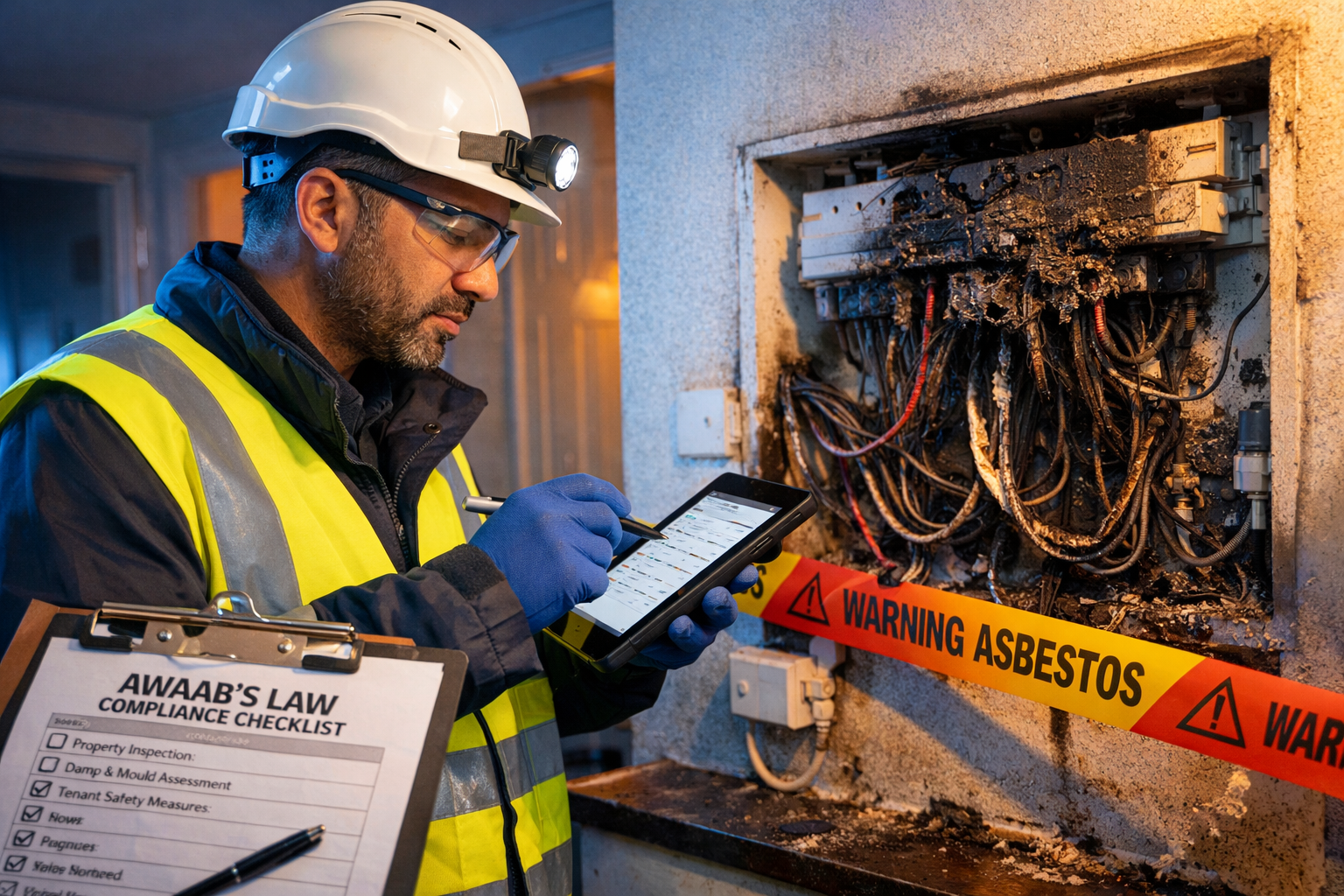
Key Takeaways 📋
- Phase 2 of Awaab's Law (2026) extends mandatory hazard response requirements to electrical, structural collapse, explosion, excess cold/heat, and falls hazards in the PRS.
- Emergency hazards must be investigated and remedied within 24 hours; significant hazards within 10 working days.
- Survey reports must now explicitly document hazard existence, severity, required action, and urgency — vague language is no longer acceptable.
- Non-compliance exposes landlords to unlimited fines, compensation claims, enforcement orders, and potential loss of rental income.
- Surveyors must adopt a person-centred risk lens, not just technical HHSRS scoring, when assessing whether a hazard falls within scope.
What the 2026 Phase 2 Extensions Actually Cover
Awaab's Law was initially introduced following the tragic death of two-year-old Awaab Ishak, who died from prolonged exposure to mould in a social housing property. Phase 1 focused primarily on damp and mould. The 2026 Phase 2 extensions dramatically broaden the scope of hazards that surveyors must identify and document during property inspections in the PRS, moving well beyond that initial focus [1].
The Phase 2 hazard categories now include:
| Hazard Category | Examples |
|---|---|
| ⚡ Electrical hazards | Faulty wiring, overloaded circuits, unsafe consumer units |
| 💥 Explosion risks | Gas leaks, faulty boilers, unsafe appliances |
| 🏚️ Structural collapse | Subsidence, failing load-bearing walls, roof instability |
| 🥶 Excess cold | Inadequate heating, poor insulation, single glazing |
| 🔥 Excess heat | Lack of ventilation, overheating in top-floor flats |
| 🪜 Falls | Unsafe stairs, baths, level surfaces, and between levels |
| 🧼 Hygiene and food safety | Domestic hygiene failures, vermin, inadequate sanitation |
Source: Trowers & Hamlins [4]
"The 2026 extensions move Awaab's Law from a damp-and-mould framework into a comprehensive hazard-response regime that touches almost every element of a building survey."
A Phase 3 implementation from 2027 will extend coverage further still, encompassing all remaining Housing Health and Safety Rating System (HHSRS) hazards — including asbestos, biocides, and carbon monoxide — with the exception of overcrowding [2].
For surveyors already conducting building surveys across the PRS, this trajectory means that comprehensive hazard identification is no longer optional — it is a legal imperative.
Understanding the Compliance Timeline: What Surveyors Must Know
The Four Critical Response Windows
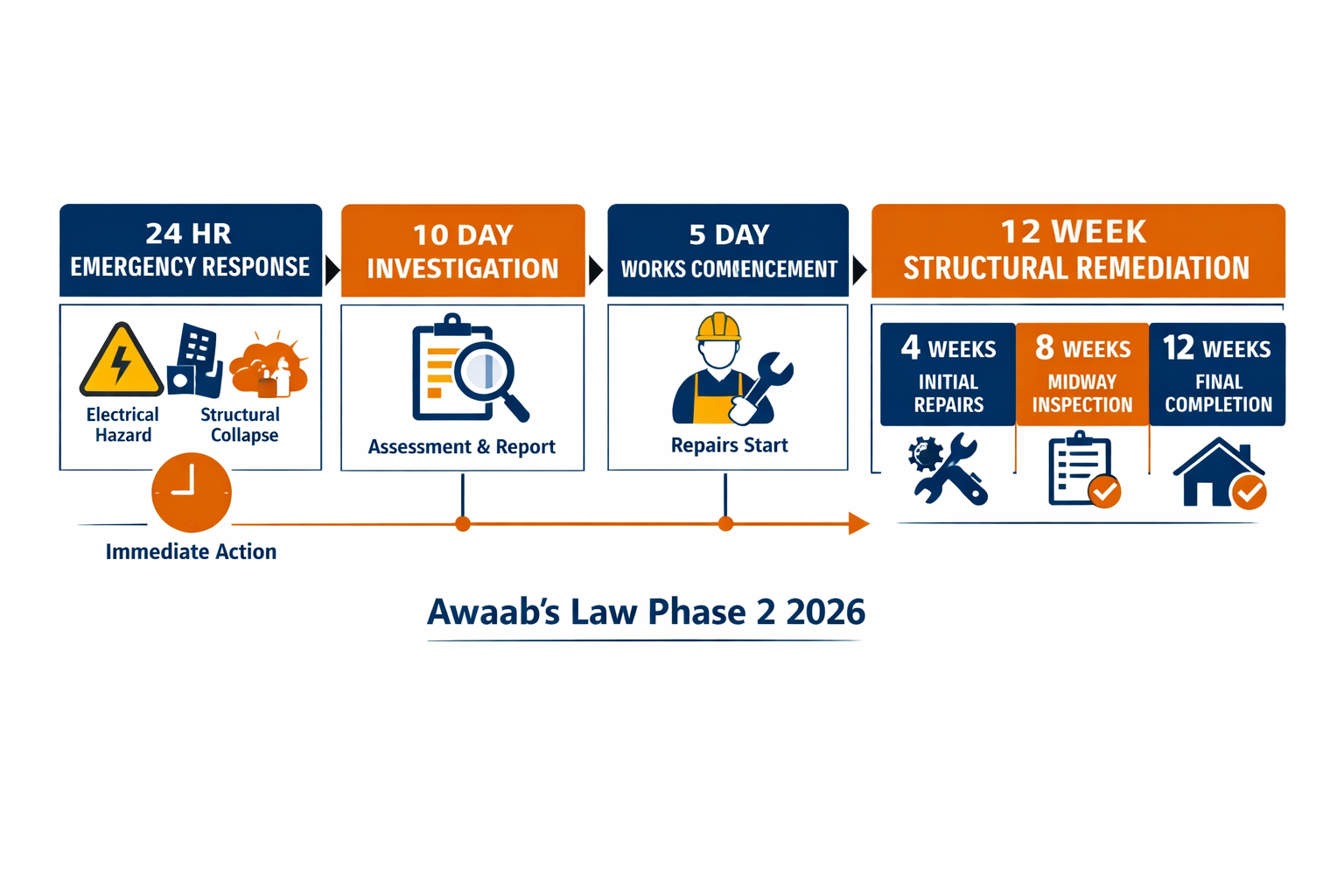
Awaab's Law establishes strict, non-negotiable timelines. Understanding these windows is essential for structuring survey reports and advising landlord clients accurately [2][4].
🚨 Emergency Hazards — 24-Hour Rule
Any hazard that poses an immediate risk of serious harm must be investigated and remediation work must begin within 24 hours of identification. Electrical faults causing live exposed wiring, gas leaks, and imminent structural collapse all fall into this category.
🔍 Significant Hazards — 10 Working Days
For hazards that are serious but not immediately life-threatening, landlords have 10 working days from becoming aware of the issue to complete a full investigation [2].
📄 Tenant Communication — 3 Working Days Post-Investigation
Once an investigation concludes, a written summary must be provided to the tenant within 3 working days. This places a clear documentation burden on the surveyor to produce timely, clear written findings [2].
🔧 Remedial Works Commencement — 5 Working Days
Safety works must begin within 5 working days of the investigation conclusion. For complex structural or long-term works, commencement must occur no later than 12 weeks after the investigation closes [2].
The Compliance Timeline at a Glance
Hazard Identified
      ↓
[Emergency?] → YES → Investigate & Begin Works: 24 HOURS
      ↓ NO
[Significant?] → Investigation Complete: 10 WORKING DAYS
      ↓
Written Summary to Tenant: 3 WORKING DAYS after investigation
      ↓
Remedial Works Begin: 5 WORKING DAYS after investigation
      ↓
Complex/Structural Works Start: NO LATER THAN 12 WEEKS
These timelines are not aspirational targets — failure to meet them exposes landlords to enforcement orders, unlimited fines, compensation payments to tenants, potential legal proceedings, and loss of rental income if properties become uninhabitable [4].
Building Survey Protocols for New Awaab's Law Hazards in PRS: Electrical, Structural Collapse, and Explosion Risks Post-2026 Extensions
Electrical Hazard Inspection Protocols
Electrical hazards now sit firmly within the Awaab's Law framework, requiring surveyors to go beyond a surface-level visual check. A structural survey alone is no longer sufficient — electrical assessment must be integrated into the inspection methodology.
Key checklist items for electrical hazard assessment:
- ✅ Age and condition of the consumer unit (fuse box)
- ✅ Presence of Residual Current Devices (RCDs) and circuit breakers
- ✅ Visible signs of overloading, scorching, or damaged wiring
- ✅ Adequacy of socket provision (overloaded extension leads as a proxy indicator)
- ✅ Condition of fixed electrical installations, particularly in kitchens and bathrooms
- ✅ Compliance with BS 7671 (18th Edition Wiring Regulations)
- ✅ Presence and validity of an Electrical Installation Condition Report (EICR)
- ✅ Earthing and bonding arrangements
Important: Under Awaab's Law, a hazard is considered "in scope" if it presents a significant risk of harm, assessed through a person-centred lens rather than purely technical HHSRS scoring criteria [2]. This means surveyors must consider the vulnerability of the occupants — a family with young children or elderly tenants raises the risk threshold considerably.
Surveyors should flag any electrical installation older than 10 years without a current EICR as a significant hazard requiring investigation within the 10-working-day window.
Structural Collapse Risk Protocols
Structural collapse represents one of the most serious hazard categories under Phase 2. The structural engineering assessment must now be explicitly linked to Awaab's Law compliance documentation.
Structural collapse inspection checklist:
- ✅ Foundation movement indicators: stepped cracking in brickwork, door/window distortion
- ✅ Load-bearing wall integrity — any removal or modification without structural support
- ✅ Roof structure condition: sagging ridgelines, rafter spread, purlin failure
- ✅ Lintels over openings — signs of deflection or cracking
- ✅ Chimney stack stability, particularly in older Victorian and Edwardian stock
- ✅ Cellar and basement wall bulging or inward lean
- ✅ Evidence of previous underpinning or structural repair
- ✅ Party wall condition (relevant where shared structures exist)
For complex structural findings, surveyors should recommend a dedicated structural engineer report to support the Awaab's Law investigation documentation. The 12-week commencement window for complex structural works provides some breathing room, but the investigation itself must still conclude within 10 working days [2].
Severity classification for structural findings:
| Finding | Classification | Response Window |
|---|---|---|
| Imminent collapse risk (active movement) | Emergency | 24 hours |
| Significant cracking with progressive movement | Significant hazard | 10 working days |
| Historic cracking, stable, monitoring required | Lower priority | Standard survey follow-up |
Explosion Risk and Gas Safety Protocols
Explosion risks — primarily from gas installations, boilers, and unsafe appliances — require a specific inspection methodology that complements, rather than replaces, mandatory Gas Safety Certificates.
Explosion risk checklist items:
- ✅ Validity of current Gas Safety Certificate (CP12)
- ✅ Visual condition of gas pipework and meter installation
- ✅ Boiler flue condition and termination point
- ✅ Adequate ventilation for gas appliances
- ✅ Carbon monoxide detector presence and positioning
- ✅ Condition of gas cooker connections (flexible hoses)
- ✅ Any evidence of DIY gas work or unauthorised modifications
- ✅ LPG storage if applicable — safe distances and ventilation
Where a Gas Safety Certificate is absent or expired, this should be flagged as a significant hazard under Awaab's Law, triggering the 10-working-day investigation timeline. Active gas leaks or evidence of combustion spillage from boiler flues constitute emergency hazards requiring the 24-hour response [4].
What Survey Reports Must Now Include: Documentation Standards
The Four Non-Negotiable Report Elements
Awaab's Law has fundamentally changed what a compliant survey report must contain. Under the 2026 framework, building survey reports must clearly document four critical elements [6]:
- Whether a hazard exists — a definitive finding, not a hedged observation
- The severity of the risk — emergency, significant, or lower priority
- What action is required — specific remediation, not vague recommendations
- How urgently that action must take place — tied explicitly to the legal timelines
"Vague language such as 'monitor and review' is no longer adequate where a hazard falls within the Awaab's Law framework. Reports must be actionable, time-bound, and unambiguous." [6]
This represents a significant shift from traditional survey report conventions, where cautious, hedged language was standard practice. Surveyors conducting RICS home surveys for PRS properties must now ensure their report templates are updated to reflect these requirements.
Adopting a Person-Centred Risk Assessment Approach
The shift away from pure HHSRS technical scoring toward a person-centred lens is one of the most important methodological changes under Awaab's Law [2]. Surveyors must now consider:
- Who is living in the property? (Families with young children, elderly tenants, and those with disabilities face elevated risk)
- How long have they been exposed? (Chronic exposure to a hazard increases severity classification)
- What is the likelihood of harm given the specific occupants? (Not just the statistical average)
This approach aligns with the spirit of Awaab's Law — which was born from a recognition that technical compliance scores can mask real-world harm to vulnerable people.
Building Survey Protocols for New Awaab's Law Hazards in PRS: Liability Mitigation for Surveyors
Updating Level 3 Survey Checklists
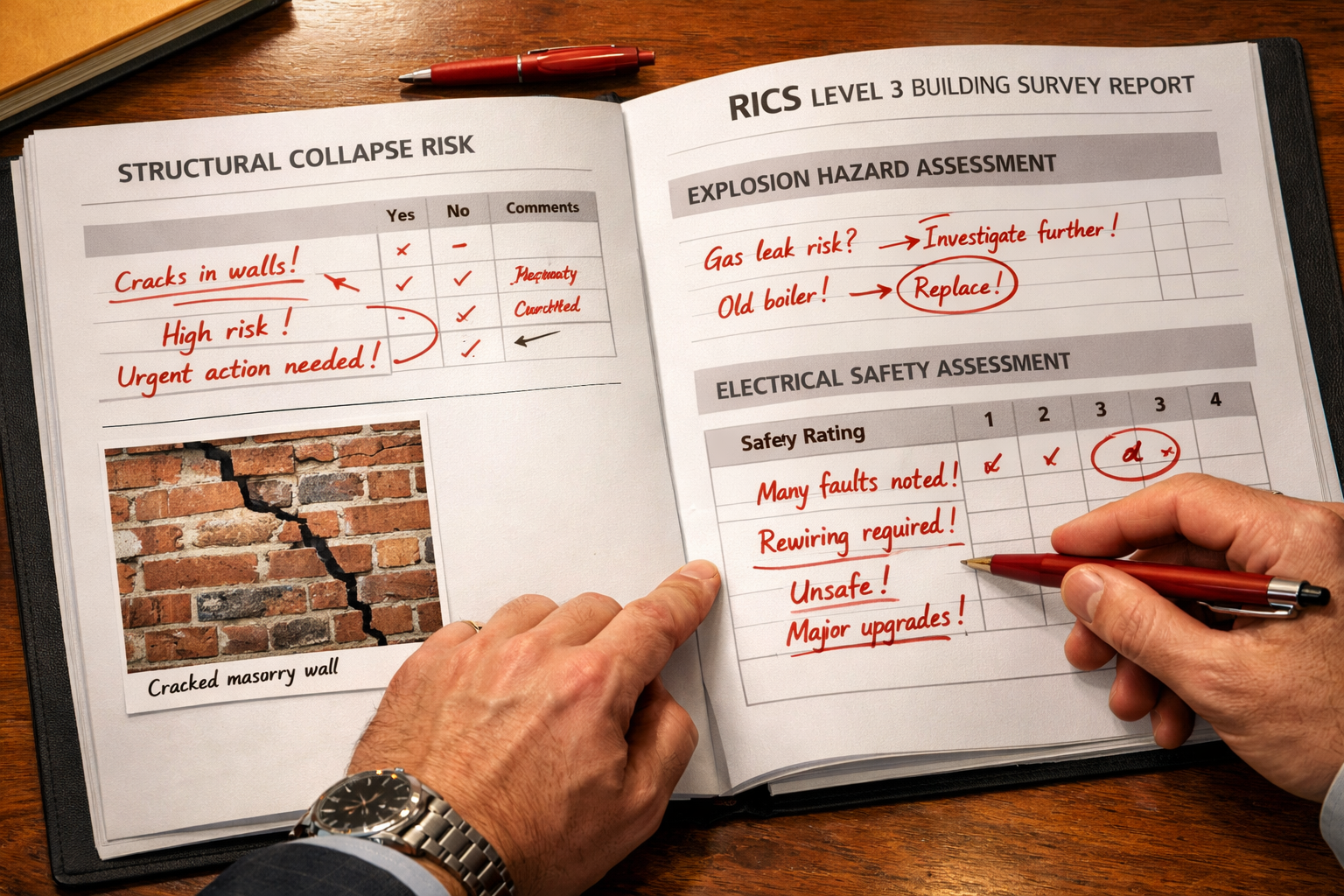
A Level 3 building survey is the most appropriate survey type for PRS properties where Awaab's Law compliance is a concern. The comprehensive nature of a Level 3 inspection — covering all accessible elements of the structure, fabric, and services — aligns well with the breadth of Phase 2 hazard categories.
Recommended Level 3 checklist updates for 2026 compliance:
- Add a dedicated Awaab's Law Hazard Assessment section to all PRS survey reports
- Classify each identified hazard as Emergency, Significant, or Lower Priority
- Include explicit response timeline recommendations tied to legal requirements
- Document the person-centred risk factors relevant to the property
- Cross-reference findings with relevant Phase 2 hazard categories
- Include a tenant communication checklist for landlord clients
Professional Indemnity and Liability Considerations
Surveyors who fail to identify and correctly classify Phase 2 hazards face significant professional liability exposure. Key risk mitigation steps include:
- Scope of instruction clarity: Ensure engagement letters explicitly state whether the survey includes Awaab's Law hazard assessment
- Limitations of inspection: Document clearly where access was restricted and what could not be assessed
- Referral protocols: Where specialist assessment is needed (e.g., full EICR, gas engineer inspection), make referrals explicit and time-bound
- Report review: Have all PRS survey reports reviewed against the four mandatory documentation elements before issue [6]
For landlords with larger portfolios, a schedule of condition report at the start of a tenancy provides a baseline that can significantly support compliance documentation and liability management.
The Role of Specialist Surveys
Awaab's Law compliance will increasingly require surveyors to coordinate with specialists. Key specialist surveys that complement building survey protocols include:
- Damp surveys — for moisture-related hazards that may interact with electrical installations
- Asbestos surveys — particularly relevant ahead of Phase 3 implementation in 2027
- Drainage surveys — where hygiene and sanitation hazards are identified
- Electrical Installation Condition Reports — commissioned alongside the building survey where EICR is absent or expired
Building surveyors should position themselves as the central coordinator of this multi-specialist approach, ensuring that all findings feed back into a single, Awaab's Law-compliant report.
Preparing for Phase 3 and Beyond
Phase 3 of Awaab's Law, extending from 2027, will cover all remaining HHSRS hazards excluding overcrowding — including asbestos, biocides, and carbon monoxide [2]. Surveyors who build robust Phase 2 protocols now will be well-positioned to absorb Phase 3 requirements with minimal disruption.
Proactive steps to take in 2026:
- Audit existing report templates against the four mandatory documentation elements
- Train inspection teams on person-centred risk assessment methodology
- Establish referral networks with electrical, gas, and structural specialists
- Update engagement letters to clearly define Awaab's Law assessment scope
- Review professional indemnity cover to ensure it reflects expanded PRS survey obligations
Conclusion: Actionable Next Steps for Surveyors and Landlords
The 2026 Phase 2 extensions to Awaab's Law represent the most significant expansion of building survey obligations in the PRS in a generation. Building survey protocols for new Awaab's Law hazards in PRS: electrical, structural collapse, and explosion risks post-2026 extensions are no longer a future consideration — they are a present legal requirement.
For surveyors, the immediate priorities are clear:
- Update Level 3 survey checklists to capture all Phase 2 hazard categories
- Restructure report formats to include the four mandatory documentation elements
- Adopt person-centred risk assessment as standard methodology
- Build specialist referral pathways into standard PRS inspection workflows
For landlords, the message is equally direct:
- Commission comprehensive building surveys before tenancies begin or renew
- Ensure all identified hazards are addressed within the legally mandated timelines
- Maintain documented evidence of investigation and remediation for every reported hazard
- Seek professional advice from RICS-qualified surveyors who understand the 2026 framework
The cost of non-compliance — unlimited fines, compensation claims, enforcement orders, and reputational damage — far exceeds the cost of proactive, protocol-driven surveying. The time to act is now.
References
[1] Awaabs Law Extensions To Prs In 2026 Party Wall And Building Survey Protocols For New Hazard Categories – https://nottinghillsurveyors.com/blog/awaabs-law-extensions-to-prs-in-2026-party-wall-and-building-survey-protocols-for-new-hazard-categories
[2] Awaabs Law Is Here The Surveyors Guide For Compliance – https://www.surventrix.com/blog/awaabs-law-is-here-the-surveyors-guide-for-compliance
[4] Awaabs Law Comes Into Force What Does It Mean For Construction – https://www.trowers.com/insights/2025/november/awaabs-law-comes-into-force-what-does-it-mean-for-construction
[5] Building Surveys For Excess Cold And Fire Hazards In Prs Post Awaabs Law 2026 Protocols For Private Landlord Compliance – https://nottinghillsurveyors.com/blog/building-surveys-for-excess-cold-and-fire-hazards-in-prs-post-awaabs-law-2026-protocols-for-private-landlord-compliance
[6] Awaabs Law And Surveyors What Your Reports Must Include In 2026 – https://goreport.com/awaabs-law-and-surveyors-what-your-reports-must-include-in-2026/
