
The UK construction sector is experiencing unprecedented growth in 2026, with residential extensions, loft conversions, and basement excavations reaching record levels across London and the Home Counties. Yet this building boom has triggered a 40% surge in party wall disputes compared to 2024, costing property owners an average of £3,500 in additional surveyor fees and project delays. For surveyors navigating this challenging landscape, mastering notice procedures and early neighbour engagement has become essential to protecting client interests and maintaining professional reputation.
Avoiding Party Wall Disputes in 2026 Construction Boom: Surveyor Best Practices for Notice Procedures and Early Neighbour Engagement requires a strategic approach that combines legal compliance with proactive communication. The Party Wall etc. Act 1996 establishes clear procedural requirements, but successful surveyors recognize that technical compliance alone rarely prevents conflict. Instead, the most effective practitioners blend statutory obligations with relationship-building techniques that transform potential adversaries into collaborative partners.

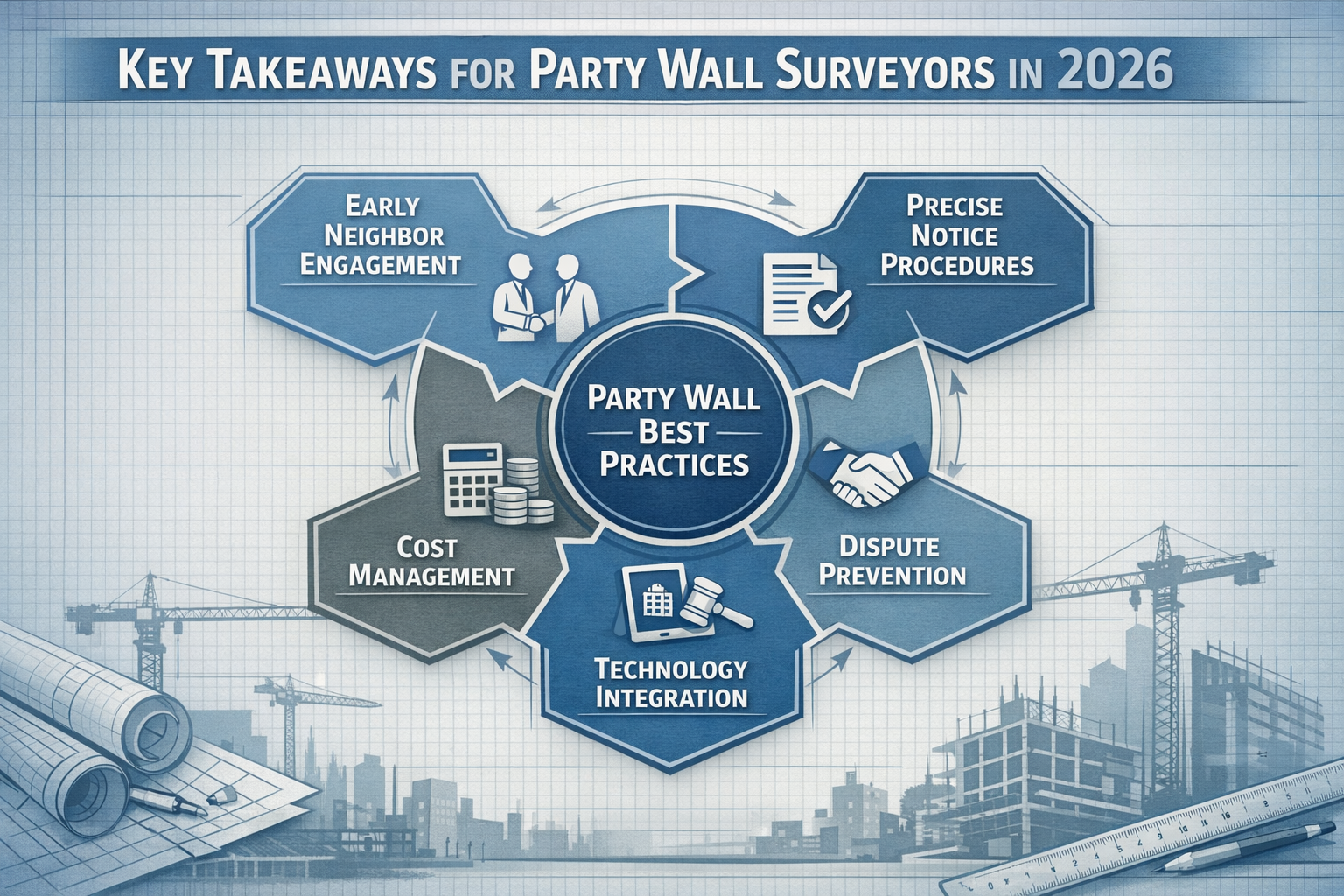
Key Takeaways
- Two-month notice periods for party structure works and one-month for excavations are mandatory minimums that require careful timeline planning to avoid project delays [3]
- The 14-day response window creates a critical decision point where non-response automatically triggers dispute status, making early informal engagement essential [4]
- Schedule of Condition documentation prepared before work commences provides crucial evidence protection and demonstrates professional diligence to all parties [3]
- Informal pre-notice discussions with neighbours can reduce surveyor appointment costs by up to 70% while accelerating consent timelines [4]
- Section-specific notice requirements (Sections 1, 3, and 6) demand precise identification of work types to ensure legal validity and neighbour understanding [4]
Understanding the 2026 Construction Landscape and Party Wall Implications
The construction boom sweeping through UK residential areas in 2026 stems from multiple converging factors: increased property values making extensions economically attractive, post-pandemic home working requirements driving space demands, and planning policy reforms encouraging densification. This surge has placed unprecedented pressure on party wall procedures, with surveyors reporting workload increases of 60% year-on-year.
For surveyors, this environment presents both opportunity and risk. Building owners increasingly seek professional guidance to navigate complex neighbour relationships, while adjoining owners demand robust protection of their property interests. The surveyor's role has evolved from simple technical assessment to strategic advisor, mediator, and risk manager.
The Party Wall etc. Act 1996 establishes three distinct notice categories, each with specific requirements and timelines [6]:
| Notice Type | Section | Work Covered | Notice Period | Common Examples |
|---|---|---|---|---|
| Line of Junction | Section 1 | New walls on/astride boundary | 1 month | Garden walls, new boundary structures |
| Party Structure | Section 3 | Work to existing party walls | 2 months | Loft conversions, wall raising, beam insertions |
| Adjacent Excavation | Section 6 | Digging near neighbours | 1 month | Basement excavations, foundation work |
Understanding which section applies requires careful analysis of proposed works. Many projects trigger multiple notice types simultaneously—for example, a rear extension with basement excavation affecting a party wall may require both Section 3 and Section 6 notices [4]. Surveyors must identify all applicable sections during initial consultations to ensure comprehensive compliance.
The two-month notice requirement for party structure works often surprises building owners accustomed to faster residential timelines [3]. This extended period exists to allow neighbours adequate time to:
✅ Seek independent professional advice
✅ Review detailed plans and specifications
✅ Consider potential impacts on their property
✅ Arrange surveyor appointments if needed
Surveyors serving building owners must incorporate these statutory periods into project schedules, advising clients that notice service represents a critical path activity that cannot be compressed.
Best Practices for Notice Procedures: Avoiding Party Wall Disputes in 2026 Construction Boom
Proper notice procedure execution forms the foundation of dispute avoidance. While free notice templates are readily available, surveyors add significant value through customization, accuracy verification, and strategic timing [3].
Crafting Comprehensive Party Wall Notices
Effective notices contain far more detail than statutory minimums require. Best-practice surveyors include:
📋 Essential Notice Components:
- Precise work descriptions using plain language alongside technical terminology
- Detailed architectural drawings showing existing structures and proposed alterations
- Anticipated start dates with realistic timelines accounting for planning and building control
- Contact information for both building owner and appointed surveyor
- Acknowledgement form for neighbour to complete and return [3]
- Explanatory cover letter outlining the Act's purpose and neighbour's rights
The acknowledgement letter serves a crucial dual purpose: it creates documentary evidence that notice was received and understood, while providing neighbours with a simple response mechanism that encourages timely engagement [3].
Managing the Critical 14-Day Response Window
Once served, neighbours have exactly 14 days to respond to party wall notices [4]. This seemingly brief window creates significant strategic implications:
If neighbours consent in writing within 14 days, works may proceed without surveyor appointment, saving substantial costs for all parties. However, consent must be explicit and documented—verbal agreements hold no legal weight under the Act [2].
If neighbours dissent or raise concerns within 14 days, the dispute resolution process begins, requiring surveyor appointments and potentially delaying commencement.
If neighbours fail to respond within 14 days, they are deemed to be in dispute by default, triggering mandatory surveyor appointment regardless of their actual intentions [4]. This "deemed dissent" provision catches many property owners by surprise and represents a common source of unnecessary costs.
Surveyors can mitigate deemed dissent scenarios through proactive follow-up:
- Day 1-3: Deliver notice via multiple methods (hand delivery, recorded post, email where appropriate)
- Day 7: Informal contact to confirm receipt and offer to answer questions
- Day 10: Gentle reminder of approaching deadline if no response received
- Day 14: Final confirmation of response status
This structured approach demonstrates professional diligence while providing neighbours multiple opportunities to engage constructively. For more information on managing responses, see our guide on party wall disputes and resolution.
Leveraging the One-Year Commencement Window
Once valid notice is served, building owners have up to one year to commence works [3]. This flexibility allows strategic timing around:
- Seasonal considerations (avoiding winter for external works)
- Neighbour circumstances (delaying during neighbour's personal events)
- Market conditions (adjusting for material costs or contractor availability)
- Planning and building control approval timelines
However, surveyors must advise clients that if works don't commence within 12 months, fresh notices must be served, restarting the entire timeline. This requirement makes accurate project scheduling essential during the planning phase.
Early Neighbour Engagement Strategies: The Surveyor's Competitive Advantage
While statutory notice procedures provide the legal framework, informal pre-notice engagement represents the single most effective dispute prevention strategy available to surveyors in 2026 [4]. Research indicates that building owners who engage neighbours before formal notice service experience dispute rates 65% lower than those who rely solely on statutory procedures.
The Pre-Notice Consultation Approach
Effective pre-notice engagement occurs in three phases:
Phase 1: Initial Informal Discussion (2-4 weeks before notice)
Contact neighbours informally to:
- Introduce the building owner and project concept
- Explain the general scope and anticipated timeline
- Gauge initial reactions and concerns
- Establish preferred communication channels
This conversation should be friendly, non-technical, and exploratory. The goal is relationship-building, not legal compliance. Surveyors can coach building owners on effective communication approaches or, where appropriate, facilitate these discussions directly.
Phase 2: Detailed Information Sharing (1-2 weeks before notice)
Provide neighbours with:
- Preliminary architectural drawings
- Written project summary in plain language
- Explanation of Party Wall Act requirements
- Timeline showing notice periods and anticipated work phases
- Contact details for questions
This phase demonstrates transparency and respect for neighbour interests while preparing them for formal notice receipt. When neighbours understand the process before receiving legal documentation, anxiety and defensive reactions decrease significantly [4].
Phase 3: Formal Notice Service with Personal Touch
Deliver statutory notices alongside:
- Personal cover letter referencing previous discussions
- Offer to meet and review plans in detail
- Clear explanation of the 14-day response requirement
- Reassurance about protection mechanisms (Schedule of Condition, insurance coverage)
Addressing Common Neighbour Concerns Proactively
Experienced surveyors anticipate and address standard concerns before they escalate into formal disputes:
🏗️ Construction Impact Concerns:
- Noise and disruption: Provide specific working hours, duration estimates, and noise mitigation measures
- Access requirements: Clarify if/when access to neighbouring property is needed and how it will be managed
- Structural safety: Explain protective measures, insurance coverage, and professional oversight
- Property value: Address concerns about temporary disruption versus long-term area enhancement
📸 Schedule of Condition: The Surveyor's Essential Tool
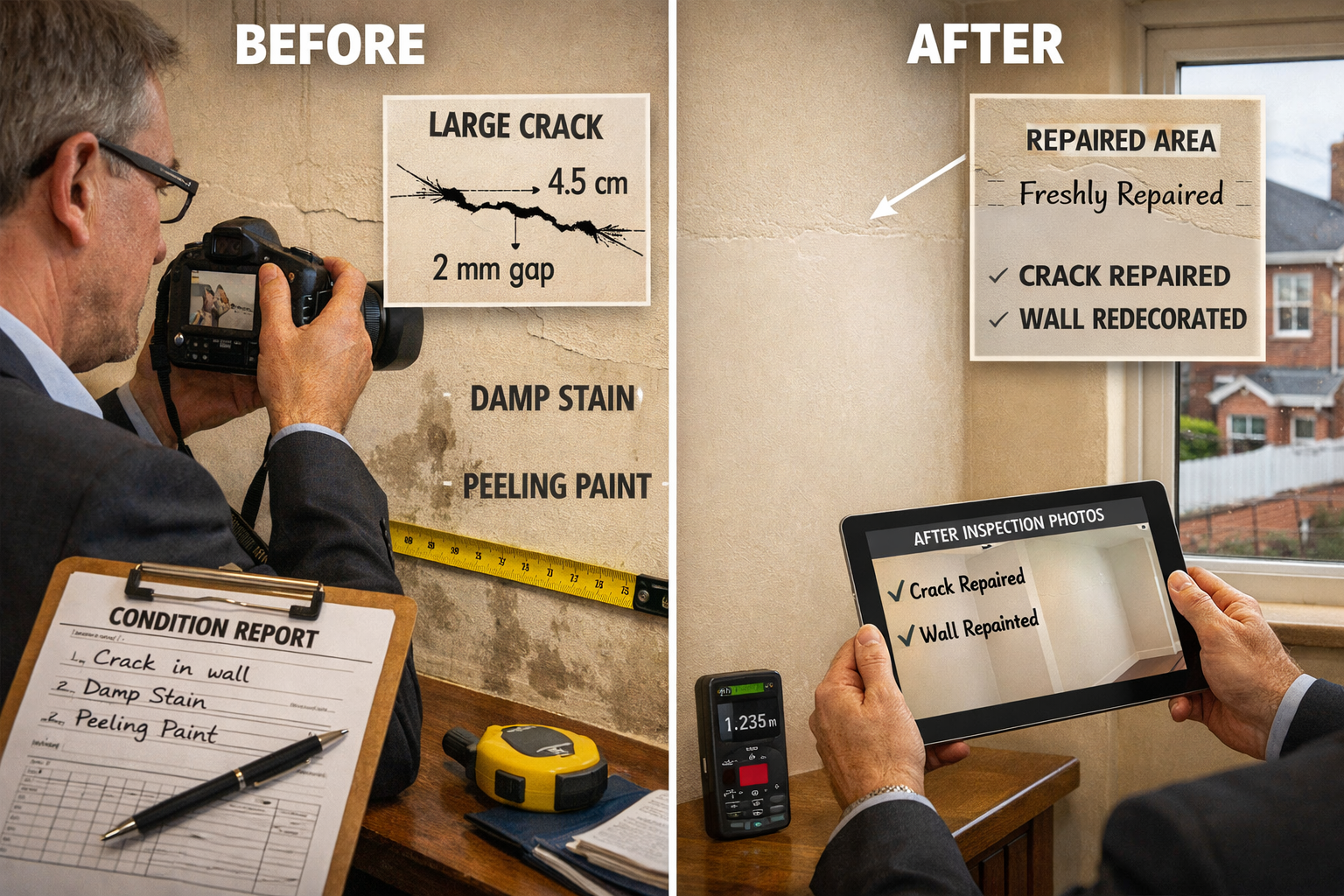
The Schedule of Condition represents the most powerful dispute prevention tool in the surveyor's arsenal [3]. This detailed photographic and written record documents the pre-work condition of adjoining properties, creating objective evidence that protects all parties.
Best-practice Schedules of Condition include:
✓ Comprehensive photography of all potentially affected areas
✓ Detailed written descriptions of existing defects and conditions
✓ Date-stamped evidence with witness signatures
✓ Focus on party walls, adjacent structures, and decorative finishes
✓ Baseline measurements for monitoring movement
When disputes arise about alleged damage, the Schedule of Condition provides irrefutable evidence distinguishing pre-existing conditions from work-related impacts. This documentation often resolves disagreements immediately, avoiding costly expert determinations [2].
Surveyors should prepare Schedules of Condition before work commences and share copies with all parties. This transparency demonstrates professional integrity and reassures neighbours that their interests are protected. Learn more about what constitutes a party wall dispute and how proper documentation prevents escalation.
Surveyor Appointment Strategies and Cost Management
When disputes arise or neighbours choose to appoint surveyors, understanding appointment procedures and cost responsibilities becomes critical. Under the Party Wall Act, building owners bear all reasonable surveyor costs, including fees for surveyors appointed by adjoining owners [4].
The Three Surveyor Appointment Models
1. Agreed Surveyor Approach (Most Cost-Effective)
Both parties jointly appoint a single surveyor to prepare the Party Wall Award. This approach:
- Minimizes costs (one surveyor fee instead of two or three)
- Accelerates timeline (no inter-surveyor coordination required)
- Works best when relationships are cooperative
However, the agreed surveyor must maintain strict impartiality, which some neighbours find uncomfortable. Surveyors accepting agreed appointments must demonstrate independence and communicate equally with all parties.
2. Two Surveyor Approach (Most Common)
Each party appoints their own surveyor, who then work collaboratively to prepare the Award. This model:
- Provides each party with dedicated representation
- Creates checks and balances in the Award preparation
- Increases costs but enhances confidence in fairness
The two appointed surveyors must select a Third Surveyor at the outset to resolve any disagreements that arise during Award preparation [2]. While Third Surveyor involvement is rare (occurring in fewer than 5% of cases), their appointment is mandatory.
3. Building Owner Appoints for Non-Responding Neighbour
When neighbours fail to respond within 14 days and are deemed to be in dispute, building owners may appoint a surveyor on their behalf [4]. This surveyor must act impartially despite being selected and paid by the building owner—a situation requiring careful professional judgment.
For guidance on cost responsibilities, see our detailed article on who pays for a party wall surveyor.
Managing Surveyor Costs Transparently
Building owners frequently express shock at party wall surveyor costs, particularly when neighbours appoint separate representation. Surveyors serving building owners should:
📊 Provide upfront cost estimates including worst-case scenarios
📊 Explain fee structures (hourly rates versus fixed fees)
📊 Itemize disbursements (Schedule of Condition photography, Award production)
📊 Clarify payment timing (typically upon Award service)
Typical surveyor fees for standard residential projects in 2026 range from £800-£1,500 per surveyor for straightforward extensions, rising to £2,500-£5,000 for complex basement excavations or multiple-party scenarios [2]. Understanding the cost of party wall procedures helps clients budget appropriately.
Preparing Effective Party Wall Awards

The Party Wall Award represents the legally binding document that authorizes works to proceed while protecting adjoining owner interests [2]. Awards must balance building owner rights to develop their property against neighbour rights to protection from damage and disruption.
Essential Award Components
Comprehensive Awards address:
1. Work Authorization
- Detailed description of permitted works
- Specific methodologies and construction techniques
- Access rights and limitations
- Working hours and duration restrictions
2. Protection Measures
- Temporary support requirements
- Vibration and noise limits
- Dust and debris control measures
- Emergency contact procedures
3. Condition Recording
- Reference to Schedule of Condition
- Monitoring requirements during works
- Damage notification procedures
- Repair standards and timelines
4. Cost Provisions
- Surveyor fee responsibilities
- Damage repair cost allocation
- Dispute resolution procedures
5. Special Conditions
- Property-specific concerns
- Neighbour accommodation requirements
- Insurance evidence requirements
Awards must be served on all parties before works commence. Once served, Awards become legally binding and enforceable through county court proceedings if necessary [2].
For detailed information on Award content and templates, review our comprehensive guide to Party Wall Awards.
Technology and Documentation Best Practices for 2026
Modern surveyors leverage technology to enhance efficiency and transparency throughout party wall procedures:
📱 Digital Documentation Tools:
- Tablet-based Schedule of Condition apps with GPS-tagged photography
- Cloud storage for instant document sharing with all parties
- Electronic signature platforms for Award service
- Project management software tracking notice periods and deadlines
🎥 Video Documentation:
- Pre-work video walkthroughs of adjoining properties
- Time-lapse construction monitoring
- Damage assessment video evidence
- Virtual meetings with overseas property owners
📊 Communication Platforms:
- Dedicated project portals for document access
- Automated notice period reminders
- Progress update distribution systems
- Transparent cost tracking dashboards
These tools enhance professionalism while creating comprehensive audit trails that protect all parties. However, surveyors must ensure digital processes comply with data protection requirements and maintain appropriate backups of critical documentation.
Handling Complex Scenarios: Multiple Neighbours and Mixed-Use Properties
The 2026 construction boom increasingly involves complex scenarios requiring sophisticated surveyor management:
Multiple Adjoining Owners
Terraced properties and semi-detached conversions often affect multiple neighbours simultaneously. Best practices include:
- Coordinated notice service to all affected parties on the same day
- Group information sessions explaining works to all neighbours collectively
- Individual follow-up addressing specific concerns
- Staggered work phases minimizing cumulative disruption
When multiple neighbours appoint separate surveyors, coordination complexity increases exponentially. Lead surveyors must establish clear communication protocols and decision-making procedures to prevent paralysis.
Commercial and Mixed-Use Properties
Party walls between residential and commercial properties present unique challenges:
- Different operational hours requiring customized working time restrictions
- Business interruption concerns demanding detailed impact assessments
- Higher damage exposure necessitating enhanced insurance requirements
- Corporate decision-making extending response timelines
Surveyors must adapt engagement strategies to organizational contexts, often liaising with property managers, legal departments, and facilities teams rather than individual owners.
Common Pitfalls and How to Avoid Them
Even experienced surveyors encounter party wall challenges. Recognizing common pitfalls enables proactive avoidance:
❌ Inadequate Work Description in Notices
Vague or incomplete work descriptions create confusion and increase dispute likelihood. Always provide detailed specifications with supporting drawings rather than generic descriptions.
❌ Premature Work Commencement
Starting work before the notice period expires or before Award service constitutes a breach of the Act and exposes building owners to injunction risk [6]. Maintain strict timeline discipline regardless of client pressure.
❌ Insufficient Schedule of Condition Coverage
Cursory photographic records that miss critical areas provide inadequate protection. Invest time in comprehensive documentation that withstands scrutiny.
❌ Poor Communication During Works
Even with Awards in place, maintaining regular communication with neighbours during construction prevents minor issues escalating. Weekly progress updates and prompt response to concerns demonstrate respect and professionalism.
❌ Delayed Damage Repairs
When work-related damage occurs, immediate acknowledgment and prompt repair preserve relationships and prevent formal disputes. Delays breed resentment and legal action.
For a step-by-step overview of managing the entire process, consult our guide on understanding the party wall process.
Building Long-Term Professional Reputation Through Party Wall Excellence
In 2026's competitive surveying market, party wall expertise represents a key differentiator. Surveyors who consistently deliver smooth, dispute-free outcomes build reputations that generate referrals and premium fees.
🌟 Reputation-Building Strategies:
Professional Development
- Maintain current knowledge of case law developments
- Attend specialist party wall training and conferences
- Obtain Faculty of Party Wall Surveyors membership
- Develop specialized expertise in complex scenarios (basements, commercial)
Client Education
- Publish guidance materials explaining party wall procedures
- Offer free initial consultations to assess project requirements
- Provide realistic timeline and cost expectations
- Educate clients about neighbour relationship importance
Collaborative Approach
- Build professional networks with other party wall surveyors
- Establish reputation for fairness when appointed by adjoining owners
- Resolve inter-surveyor disagreements constructively
- Avoid unnecessary Third Surveyor references
Documentation Excellence
- Maintain meticulous records of all communications
- Produce professional, comprehensive Awards
- Create detailed Schedule of Condition reports
- Provide clear cost breakdowns and invoices
Conclusion
Avoiding Party Wall Disputes in 2026 Construction Boom: Surveyor Best Practices for Notice Procedures and Early Neighbour Engagement requires a sophisticated blend of legal compliance, technical expertise, and interpersonal skill. As construction activity continues accelerating across UK residential areas, surveyors who master these competencies will thrive while those relying solely on statutory minimums will struggle with disputes, delays, and dissatisfied clients.
The most successful surveyors recognize that party wall procedures represent relationship management challenges as much as technical exercises. By combining rigorous notice procedures with proactive neighbour engagement, comprehensive documentation, and transparent communication, surveyors transform potential conflicts into collaborative partnerships.
Actionable Next Steps for Surveyors
✅ Immediate Actions:
- Review current notice templates against best-practice standards outlined above
- Develop pre-notice engagement protocols for building owner clients
- Invest in digital documentation tools for Schedule of Condition preparation
- Create client education materials explaining party wall timelines and costs
✅ Medium-Term Development:
5. Build relationships with other party wall surveyors for complex multi-party projects
6. Develop specialized expertise in high-demand areas (basement excavations, loft conversions)
7. Establish systematic follow-up procedures for the 14-day response window
8. Create template Award clauses addressing common 2026 construction scenarios
✅ Long-Term Strategic Goals:
9. Pursue professional accreditation through the Faculty of Party Wall Surveyors
10. Build reputation as dispute-avoidance specialist through case studies and referrals
11. Develop training programs for junior surveyors and construction professionals
12. Contribute to industry knowledge through publications and presentations
The 2026 construction boom presents unprecedented opportunities for surveyors who approach party wall work strategically. By prioritizing early engagement, comprehensive documentation, and collaborative problem-solving, surveyors protect client interests while building sustainable professional practices that thrive in any market condition.
For surveyors seeking to expand their expertise, understanding when party wall agreements are necessary and mastering the full scope of the Party Wall Act provides the foundation for excellence in this specialized field.
References
[1] Party Wall Notice Requirements For Prs Database Compliance Works Surveyor Tactics Post Renters Rights Act Registration In 2026 – https://nottinghillsurveyors.com/blog/party-wall-notice-requirements-for-prs-database-compliance-works-surveyor-tactics-post-renters-rights-act-registration-in-2026
[2] Party Wall Disputes – https://collyerbristow.com/real-estate/real-estate-disputes/party-wall-disputes/
[3] Party Wall Agreement – https://hoa.org.uk/advice/guides-for-homeowners/i-am-improving/party-wall-agreement/
[4] Watch – https://www.youtube.com/watch?v=kpVuuXAZayI
[5] What Is The Party Wall Act – https://buonconstruction.com/what-is-the-party-wall-act/
[6] Understanding%20the%20party%20wall%20act – https://www.designingbuildings.co.uk/wiki/Understanding%20the%20party%20wall%20act
