
Bungalows account for approximately 9% of the UK housing stock, yet they represent a disproportionately high percentage of subsidence claims—nearly 15% according to insurance industry data. This structural vulnerability, combined with aging building stock and climate-related ground movement, makes comprehensive assessment protocols essential for property transactions in 2026. Building Survey Protocols for Bungalows: Advanced Level 3 Assessments for Subsidence and Structural Risks in 2026 have evolved to address these specific challenges, providing buyers and owners with critical information about structural integrity, foundation stability, and long-term maintenance requirements.
A Level 3 Building Survey, officially designated as a Building Survey by RICS (Royal Institution of Chartered Surveyors), represents the most thorough inspection available for residential properties.[2] For bungalows—particularly those built before 1990 or featuring extensions—this comprehensive assessment is not merely recommended but often essential for identifying hidden structural vulnerabilities that could cost tens of thousands of pounds to remedy.[1]
Key Takeaways
- Level 3 surveys cost £700–£1,200 in 2026 and are specifically recommended for bungalows built before 1990 or those with structural modifications[1]
- Comprehensive subsidence assessment includes detailed crack pattern analysis, ground movement evaluation, and structural monitoring recommendations beyond basic visual inspection[2]
- Roof structure inspection protocols require surveyors to physically enter roof spaces and examine structural integrity, identifying roof spread—a common bungalow defect[3]
- Reports typically span 20–30+ pages with detailed documentation of defects, remedial recommendations, and triggers for specialist investigations[2]
- Non-invasive methodology means surveys don't include destructive testing, but provide clear guidance on when specialist structural engineering or soil analysis is needed[2]
Understanding Level 3 Building Survey Protocols for Bungalows in 2026
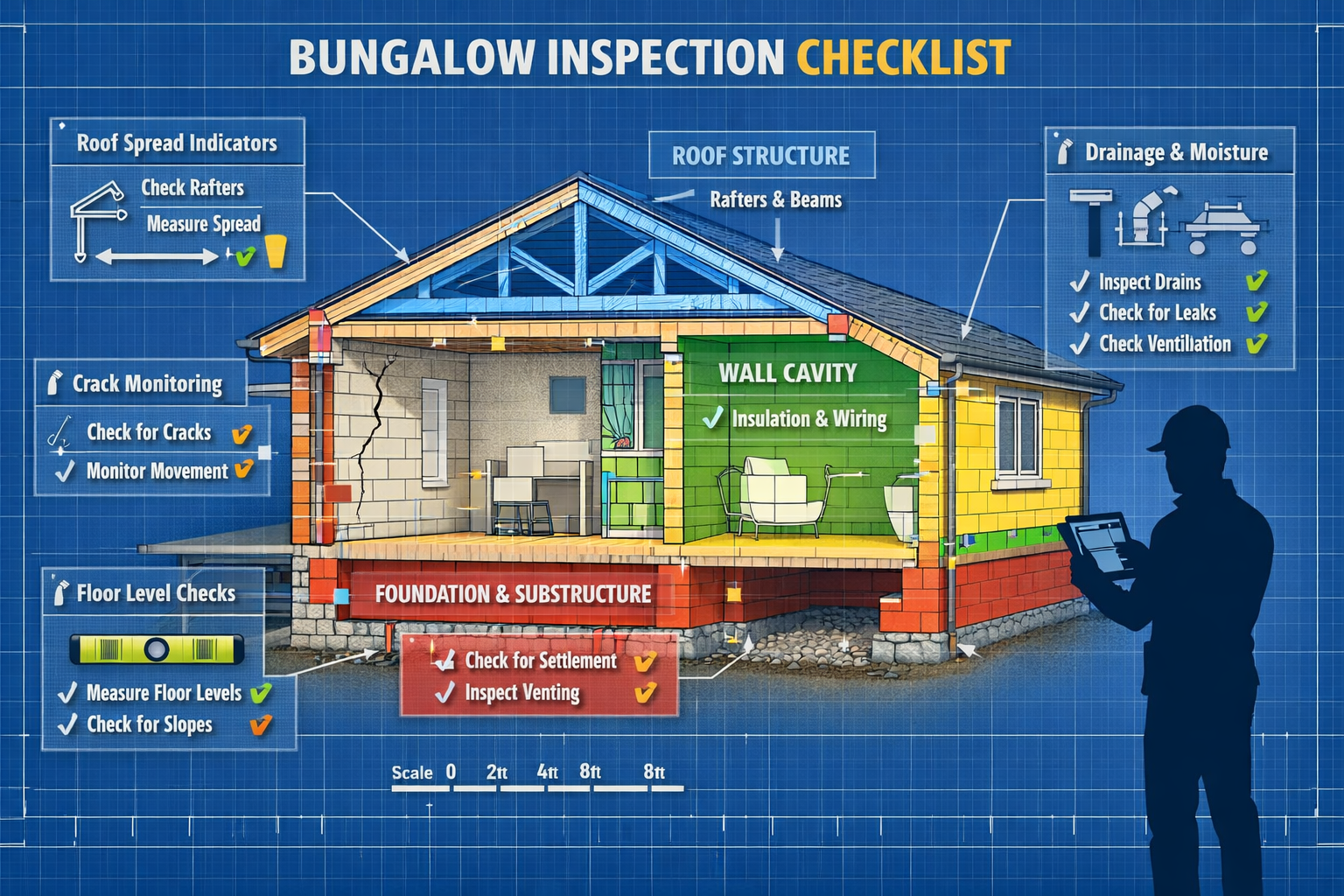
The Level 3 Building Survey differs fundamentally from lower-tier assessments in both scope and depth. While Level 2 Homebuyer Reports provide condition ratings and basic defect identification, Level 3 surveys deliver forensic-level investigation specifically designed to uncover hidden structural issues that plague single-story construction.
What Makes Bungalows Structurally Unique? 🏠
Bungalows present distinct structural characteristics that demand specialized assessment protocols:
Foundation Loading Patterns: Unlike multi-story buildings where load is distributed vertically, bungalows concentrate structural loads across a broader foundation footprint, making them more susceptible to differential settlement and ground movement.
Roof Spread Vulnerability: The absence of upper-floor walls to provide lateral restraint means bungalow roof structures are prone to "roof spread"—where roof weight pushes external walls outward, creating characteristic cracking patterns at eaves level.
Extended Ground Contact: With all living spaces at ground level, bungalows have greater exposure to rising damp, ground moisture, and soil-related movement issues.
Aging Building Stock: Many UK bungalows were constructed during the 1960s-1980s building boom, meaning they're now reaching ages where original materials, foundations, and structural elements require critical assessment.
Core Components of Level 3 Survey Protocols
According to RICS standards, Building Survey protocols for bungalows must address these essential elements:
| Survey Component | Assessment Scope | Bungalow-Specific Considerations |
|---|---|---|
| Foundation & Substructure | Visual inspection of accessible areas, crack pattern analysis | Clay soil shrinkage, tree root damage, drainage failures |
| External Walls | Material condition, structural movement indicators | Roof spread cracking, cavity wall tie failure, render defects |
| Roof Structure | Physical entry and inspection of roof space | Purlin sagging, rafter spread, inadequate bracing |
| Internal Structure | Floor levels, wall plumbness, ceiling condition | Settlement indicators, partition wall cracking |
| Dampness Assessment | Rising damp, penetrating damp, condensation | Ground-level vulnerability, ventilation issues |
| Services Observation | Visual assessment of plumbing, electrical, heating | Aging systems in older properties |
The RICS Inspection Protocol Framework
RICS standards mandate that Level 3 surveyors must be prepared to "follow suspected problem trails more extensively" than in lower-level surveys.[3] For bungalows, this means:
✅ Roof space entry is mandatory (where safe access exists), with surveyors lifting corners of thermal insulation to assess roof structure thickness, type, and underlying ceiling conditions[3]
✅ Comprehensive grounds inspection extending beyond the immediate building footprint to identify drainage issues, tree proximity risks, and ground level variations[3]
✅ Detailed crack mapping documenting location, width, orientation, and progression indicators for all structural cracks
✅ Floor level surveys using spirit levels or laser equipment to identify differential settlement patterns
✅ Moisture meter readings at multiple locations to establish damp patterns and severity
Subsidence and Structural Movement Assessment in Bungalow Surveys
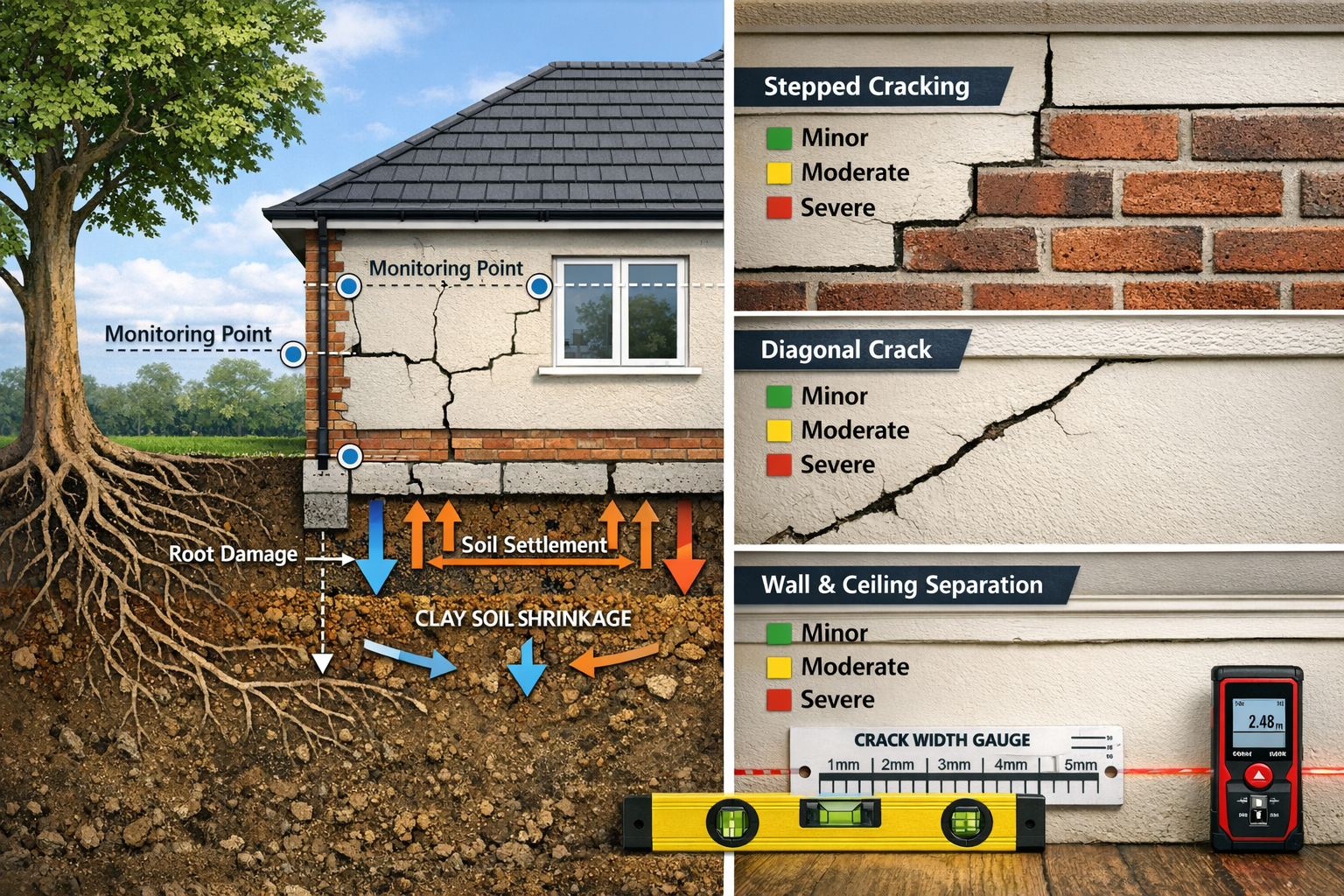
Subsidence remains the most financially significant structural risk in bungalow purchases, with repair costs frequently exceeding £20,000-£50,000 for severe cases. Building Survey Protocols for Bungalows: Advanced Level 3 Assessments for Subsidence and Structural Risks in 2026 have become increasingly sophisticated in identifying and quantifying these risks.
Understanding Structural Movement Types
Level 3 surveys specifically address four distinct movement categories:[2]
1. Subsidence 💧
Downward ground movement caused by soil shrinkage (typically clay soils during drought), soil consolidation, or underground voids. Creates diagonal cracking typically wider at top, often near building corners.
2. Heave
Upward ground movement from soil expansion (clay soils absorbing moisture after tree removal) or frost action. Produces horizontal or upward-angled cracking, floor level rises.
3. Settlement
Natural consolidation of soil under building weight, usually occurring within first 10-15 years. Generally uniform and non-progressive if foundation design was adequate.
4. Differential Settlement
Uneven settlement across different parts of the building, creating stepped cracking in brickwork and distorted door/window frames. More concerning than uniform settlement.
Crack Analysis Protocols for Bungalows
Professional surveyors employ systematic crack assessment methodologies:
Crack Width Classification:
- Hairline (<0.1mm): Negligible, typically cosmetic
- Fine (0.1-1mm): Minor, monitor for progression
- Moderate (1-5mm): Potentially significant, investigation recommended
- Severe (5-15mm): Serious structural concern, specialist assessment essential
- Very Severe (>15mm): Critical structural failure, immediate action required
Crack Pattern Interpretation:
🔍 Diagonal Stepped Cracking: Following mortar joints in staircase pattern—classic subsidence indicator, particularly when wider at top and located at building corners
🔍 Horizontal Cracking: At or near eaves level—indicates roof spread or wall plate movement, common in bungalows with inadequate roof bracing
🔍 Vertical Cracking: Often related to thermal movement, settlement, or structural alterations rather than subsidence
🔍 Tapered Cracking: Wider at one end—indicates differential movement direction and potential cause location
Clay Soil and Tree-Related Subsidence Risk
Bungalows on clay soils face elevated subsidence risk due to:
- Seasonal moisture variation causing soil volume changes of 10-15%
- Tree root water extraction creating localized soil shrinkage zones extending 1.5x tree height
- Drought conditions (increasingly common with climate change) triggering widespread clay shrinkage
Level 3 surveys assess tree proximity using the formula: Risk Zone = Tree Height × 1.5
High-risk species include:
- Oak (Quercus) 🌳
- Willow (Salix)
- Poplar (Populus)
- Ash (Fraxinus)
- Elm (Ulmus)
Our subsidence survey specialists employ advanced assessment techniques including historical crack monitoring data analysis and soil type evaluation to quantify subsidence risk levels.
When Specialist Investigations Are Triggered
Level 3 surveys don't include invasive testing, but surveyors will recommend specialist investigations when:[2]
Structural Engineering Assessment: For significant cracking, unusual structural configurations, or suspected foundation inadequacy
Soil Analysis: When clay soil subsidence is suspected, to determine soil plasticity index and shrinkage potential
Drain Survey (CCTV): If drain leakage could be contributing to ground movement or undermining foundations
Monitoring Programme: For active or recently active movement, establishing crack monitoring stations over 6-12 months
Arboricultural Survey: For tree-related subsidence risk assessment and management recommendations
Advanced Assessment Areas: Roof Spread, Damp, and Hidden Defects
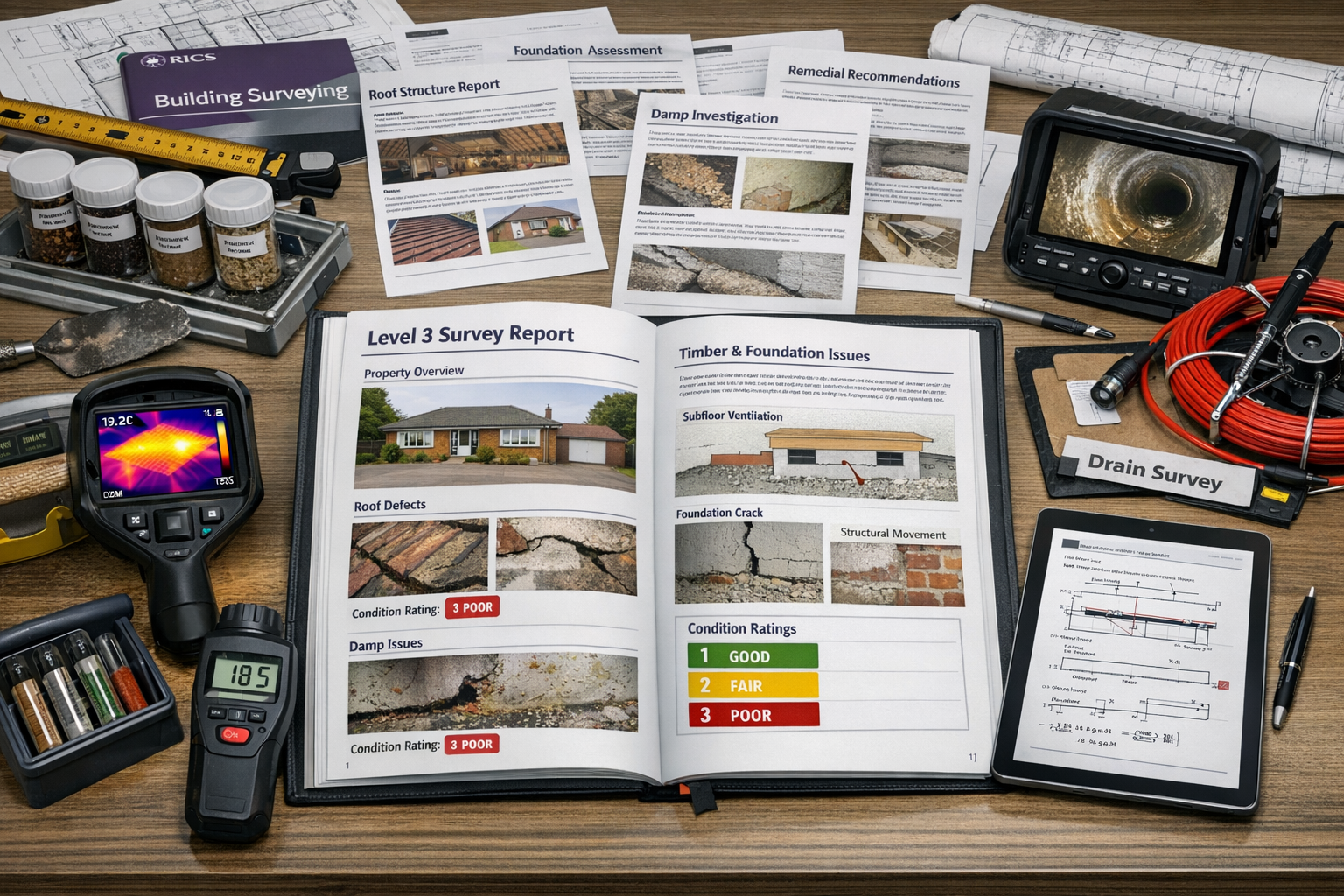
Beyond subsidence, Building Survey Protocols for Bungalows: Advanced Level 3 Assessments for Subsidence and Structural Risks in 2026 address multiple structural vulnerabilities unique to single-story construction.
Roof Spread: The Silent Bungalow Defect
Roof spread occurs when inadequate structural bracing allows roof weight to push external walls outward at eaves level. This defect is particularly common in:
- Bungalows built 1950s-1970s with minimal roof bracing
- Properties where loft conversions added weight without structural reinforcement
- Buildings with cut roof structures (individual rafters) rather than trussed roofs
Identification Protocol:
✓ Horizontal cracking at wall-ceiling junction internally
✓ Stepped cracking in external brickwork below eaves
✓ Visible wall bulging or lean when sighted along wall length
✓ Roof ridge sagging or distortion
✓ Inadequate collar ties or purlins visible in roof space
RICS standards require surveyors to physically enter roof spaces to assess structural adequacy.[3] This inspection reveals:
- Rafter size and spacing adequacy
- Presence and condition of collar ties, purlins, and struts
- Signs of previous movement or distortion
- Adequacy of wall plate fixing and bearing
Remedial Approaches: Roof spread correction typically involves installing steel tie rods or additional timber bracing, costing £2,000-£8,000 depending on severity and access.
Comprehensive Damp Assessment Protocols
Bungalows' ground-level construction makes them particularly vulnerable to moisture-related deterioration. Level 3 surveys include detailed assessment of:[2]
Rising Damp 💦
- Moisture meter readings at multiple heights on external walls
- Visual inspection for tide marks, salt deposits, and plaster deterioration
- Damp-proof course (DPC) condition and level assessment
- Ground level relationship to DPC (should be 150mm minimum)
Penetrating Damp
- Roof covering condition and water ingress points
- Chimney stack condition and flashing integrity
- Window and door frame seal condition
- External wall render or pointing defects
- Cavity wall construction and cavity tray functionality
Condensation Issues
- Ventilation adequacy assessment
- Cold bridging identification
- Mold growth patterns indicating condensation rather than water ingress
Timber Decay and Infestation
Ground-level timber elements in bungalows face elevated decay risk. Surveyors assess:
- Floor joists and floorboards (where accessible)
- Roof timbers for fungal decay or beetle infestation
- Window and door frames for wet rot
- Skirting boards and architraves for decay indicators
"Level 3 surveys provide detailed assessment of cracks and movement patterns, enabling identification of subsidence risks, though further soil or structural engineering reports may be recommended if issues are suspected."[2]
Hidden Defects in Extended or Altered Bungalows
Many bungalows have been extended or significantly altered, creating potential structural complications:
Extension Foundation Adequacy: Different foundation depths between original building and extension can create differential settlement issues
Structural Connection Quality: Poor integration between original structure and extension, particularly at roof junction points
Building Regulation Compliance: Older extensions may not meet current standards, particularly for structural stability, insulation, and damp-proofing
Concealed Structural Alterations: Removed or cut structural walls, inadequate beam installations, or unauthorized modifications
Level 3 surveyors examine these areas specifically, though they note that "surveys do not include invasive checks such as lifting floors or drilling walls."[2]
Service Installation Assessment
While Level 3 surveys observe services "in normal operation," they don't include formal testing.[3] For bungalows, this assessment covers:
Electrical Systems: Visual inspection of consumer unit, visible wiring condition, socket and switch condition—with recommendations for NICEIC testing if installations appear outdated
Plumbing: Pipe material identification, visible leak evidence, water pressure observation, drainage system functionality
Heating Systems: Boiler age and condition, radiator functionality, system type and efficiency considerations
Ventilation: Adequacy for building size and use, particularly important for preventing condensation issues
Report Delivery, Interpretation, and Next Steps
Understanding Your Level 3 Survey Report
Level 3 Building Survey reports for bungalows typically span 20-30+ pages and include:[2]
📋 Executive Summary: Key findings, priority defects, and overall condition assessment
📋 Detailed Room-by-Room Analysis: Condition descriptions, defect identification, and photographic evidence
📋 Structural Assessment Section: Foundation condition, wall stability, roof structure evaluation, movement analysis
📋 Services Overview: Observations on electrical, plumbing, heating, and drainage systems
📋 External Elements: Roof covering, rainwater goods, external walls, windows, doors, boundaries
📋 Grounds and Drainage: Site levels, drainage adequacy, tree proximity, outbuildings
📋 Remedial Recommendations: Prioritized repair suggestions with urgency indicators
📋 Specialist Investigation Triggers: Clear guidance on when further assessment is needed
Cost Expectations for 2026
Level 3 surveys for bungalows in 2026 typically cost £700–£1,200, reflecting property size, location, age, and complexity.[1] This investment provides:
- Comprehensive structural risk assessment
- Negotiation leverage for purchase price reductions
- Prioritized maintenance planning
- Insurance claim support documentation
- Long-term property management guidance
Compare this to potential remedial costs:
| Defect Type | Typical Repair Cost Range |
|---|---|
| Minor subsidence repairs | £5,000 – £15,000 |
| Major underpinning works | £20,000 – £50,000+ |
| Roof spread correction | £2,000 – £8,000 |
| Rising damp treatment | £1,500 – £5,000 |
| Roof structure repairs | £3,000 – £12,000 |
| Re-roofing (complete) | £8,000 – £15,000 |
| Cavity wall tie replacement | £2,000 – £6,000 |
When to Commission Specialist Follow-Up Investigations
Your Level 3 survey may recommend additional specialist assessments:
Structural Engineering Report: For significant movement, unusual structural configurations, or proposed alterations—typically £500-£1,500
Soil Investigation and Foundation Assessment: For suspected subsidence, including trial pits and soil analysis—typically £1,200-£3,000
Drainage Survey (CCTV): For suspected drain defects or leakage—typically £200-£500
Timber and Damp Specialist Report: For extensive decay or infestation—typically £300-£800
Asbestos Survey: For pre-2000 bungalows with suspected asbestos-containing materials—typically £250-£600
Electrical Installation Condition Report (EICR): For aging electrical systems—typically £200-£400
These investigations provide the detailed technical information needed for accurate repair cost estimation and remedial specification.
Using Survey Findings in Property Negotiations
Level 3 survey findings provide powerful negotiation tools:
Price Reduction Negotiations: Use documented defects and estimated repair costs to justify purchase price reductions, typically achieving 50-100% of anticipated repair costs
Contractual Conditions: Request sellers complete specific repairs before completion, with retention clauses ensuring work quality
Insurance Considerations: Identify defects requiring disclosure to insurers, avoiding future claim rejection risks
Completion Timeline Adjustments: Allow additional time for specialist investigations or remedial works before exchange
Walk-Away Decisions: Severe structural issues may justify transaction withdrawal, protecting against catastrophic financial exposure
For detailed guidance on interpreting survey findings, see our comprehensive guide on understanding Level 3 building surveys.
Long-Term Property Management Planning
Beyond immediate purchase decisions, Level 3 surveys provide valuable maintenance planning information:
🔧 Immediate Actions (0-12 months): Urgent repairs affecting structural integrity or weather-tightness
🔧 Short-Term Planning (1-3 years): Important maintenance preventing deterioration
🔧 Medium-Term Planning (3-7 years): Component replacement and system upgrades
🔧 Long-Term Considerations (7+ years): Major refurbishment and modernization projects
This prioritized approach enables budget planning and prevents small defects escalating into major structural problems.
Selecting the Right Surveyor for Bungalow Assessments
Essential Qualifications and Experience
Not all surveyors possess equal expertise in bungalow-specific structural issues. When selecting a surveyor for Building Survey Protocols for Bungalows: Advanced Level 3 Assessments for Subsidence and Structural Risks in 2026, verify:
✅ RICS Membership: Ensure your surveyor is a Chartered Surveyor (MRICS or FRICS) with current professional indemnity insurance
✅ Building Survey Specialism: Confirm experience specifically with Level 3 Building Surveys rather than just valuation work
✅ Bungalow Experience: Ask about previous bungalow surveys and familiarity with common defects like roof spread
✅ Local Knowledge: Local surveyors understand regional soil conditions, construction methods, and common defect patterns
✅ Subsidence Expertise: For properties on clay soils or with visible cracking, ensure specific subsidence assessment experience
✅ Professional Standards Compliance: Verification of adherence to current RICS Home Survey Standards
Questions to Ask Before Commissioning
Before engaging a surveyor, clarify:
- What is included in the survey scope and what is excluded?
- Will you physically enter the roof space and inspect the structure?
- How long will the inspection take and when will the report be delivered?
- Are repair cost estimates included or available as an add-on?
- What triggers would lead to specialist investigation recommendations?
- Can you provide example reports demonstrating thoroughness?
- What is your experience with bungalow structural assessments?
Understanding Survey Limitations
Even comprehensive Level 3 surveys have defined limitations:
⚠️ Non-Invasive Nature: Surveyors don't lift floorboards, remove fixed coverings, or conduct destructive testing[2]
⚠️ Inaccessible Areas: Spaces that cannot be safely accessed (boarded lofts, sealed underfloor voids) receive limited assessment
⚠️ Concealed Defects: Problems hidden behind finishes, within walls, or underground cannot be definitively identified
⚠️ Services Testing: Electrical, plumbing, and heating systems are observed but not formally tested[3]
⚠️ Specialist Knowledge: Surveys identify when specialist investigation is needed but don't replace detailed structural engineering or environmental assessments
Understanding these limitations helps set realistic expectations and explains why follow-up investigations may be recommended.
Conclusion
Building Survey Protocols for Bungalows: Advanced Level 3 Assessments for Subsidence and Structural Risks in 2026 represent an essential investment for anyone purchasing or maintaining a single-story property, particularly those built before 1990 or featuring structural modifications. The comprehensive nature of these assessments—spanning foundation stability, structural movement analysis, roof spread identification, damp evaluation, and hidden defect detection—provides the detailed information needed for informed decision-making and long-term property management.
The £700–£1,200 cost of a Level 3 survey pales in comparison to the potential £20,000-£50,000+ costs of undetected subsidence, roof spread, or structural deterioration. By employing RICS-qualified surveyors who physically inspect roof spaces, conduct detailed crack pattern analysis, and provide comprehensive 20-30+ page reports, property buyers gain critical negotiation leverage and avoid catastrophic financial exposure.
For bungalows on clay soils, those with visible cracking, properties near significant trees, or buildings showing signs of roof spread or damp issues, the Level 3 Building Survey is not optional—it's essential protection against structural risks that could render a property unmortgageable or require extensive remedial works.
Your Next Steps
If you're purchasing a bungalow:
- Commission a Level 3 Building Survey from a RICS-qualified surveyor with bungalow experience
- Review the survey report carefully, focusing on structural movement, roof condition, and damp issues
- Obtain quotes for any recommended specialist investigations
- Use findings to negotiate purchase price or request remedial works
- Plan long-term maintenance based on survey recommendations
If you own a bungalow:
- Consider commissioning a Level 3 survey if your property is over 30 years old or showing defect signs
- Monitor any identified cracks or movement patterns regularly
- Address priority defects promptly to prevent escalation
- Maintain adequate drainage and manage tree growth near the property
- Keep survey documentation for future sale or insurance purposes
For properties showing subsidence signs:
- Commission a specialist subsidence survey immediately
- Notify your insurance company if you own the property
- Avoid purchasing until specialist investigation confirms the issue is resolved or stabilized
- Obtain detailed repair specifications and guarantees
- Ensure any remedial works are covered by appropriate insurance-backed guarantees
The structural integrity of your bungalow is too important to leave to chance. Invest in comprehensive Level 3 assessment protocols that identify risks before they become financial disasters, and work with experienced professionals who understand the unique vulnerabilities of single-story construction in the 2026 property market.
References
[1] Building Survey Checklists For Bungalow Purchases 2026 Rics Guidance On Structural Risks And Costs – https://nottinghillsurveyors.com/blog/building-survey-checklists-for-bungalow-purchases-2026-rics-guidance-on-structural-risks-and-costs
[2] What Does A Level 3 Survey Include 2025 – https://surveymatch.co.uk/what-does-a-level-3-survey-include-2025/
[3] Scope Of Inspection Home Survey Level Three – https://www.rics.org/profession-standards/rics-standards-and-guidance/sector-standards/building-surveying-standards/home-surveys/scope-of-inspection-home-survey-level-three
