
Bungalows account for nearly 9% of the UK housing stock, yet they present structural vulnerabilities that catch buyers off guard more frequently than any other property type. The single-storey design that makes them attractive to downsizers and accessibility-focused purchasers also creates unique engineering challenges—from roof spread to subsidence—that demand specialized survey attention in 2026.
Understanding Building Survey Checklists for Bungalow Purchases: 2026 RICS Guidance on Structural Risks and Costs has become essential as mortgage lenders tighten requirements and repair costs continue climbing. The choice between Level 2 and Level 3 surveys can mean the difference between discovering a £15,000 foundation issue before purchase or facing it as an unexpected liability afterward.
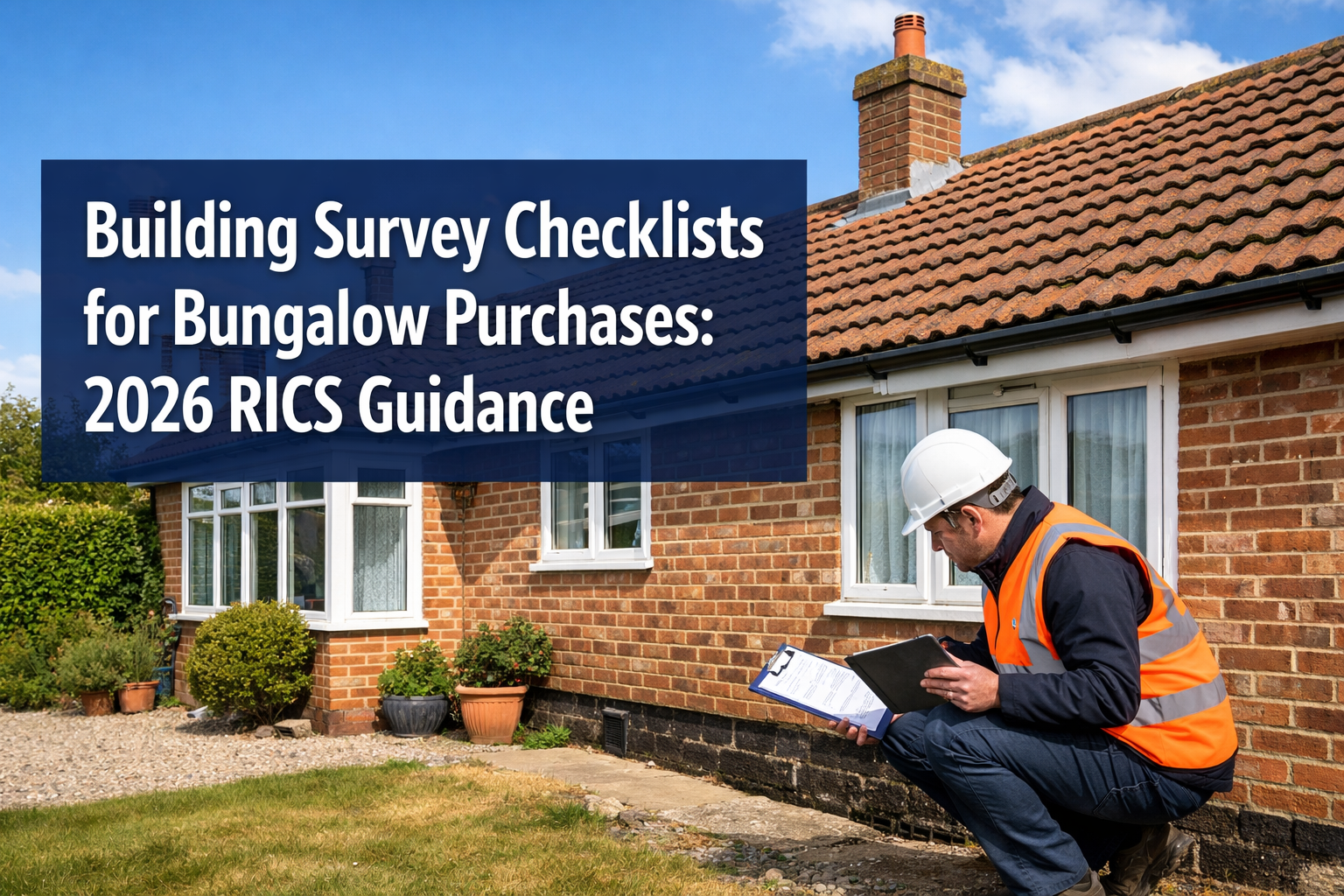
Key Takeaways
- Level 3 surveys cost £700–£1,200 in 2026 and are recommended for bungalows built before 1990 or with extensions, providing detailed structural analysis that Level 2 surveys miss [1]
- Roof spread, subsidence, and rising damp represent the three highest-risk structural defects in bungalows, with specialist engineer reports adding £500–£1,500 to survey costs when flagged [1]
- RICS protocols mandate dynamic risk assessment before inspections, with surveyors checking foundations, loft spaces, damp proofing, and timber condition as core checklist items [4][5]
- Clay soil regions require enhanced foundation scrutiny, particularly for horizontal cracking and stair-step fracture patterns indicating movement [2]
- Lender acceptance depends on survey level and findings, with many requiring Level 3 assessments for older bungalows before mortgage approval
Understanding RICS Survey Levels for Bungalow Purchases in 2026
The Royal Institution of Chartered Surveyors (RICS) provides three distinct survey levels, but only two apply to bungalow purchases in 2026. Level 1 surveys (condition reports) are reserved exclusively for new-build properties, making them irrelevant for the vast majority of bungalow transactions [5].
Level 2 Survey: Scope and Limitations
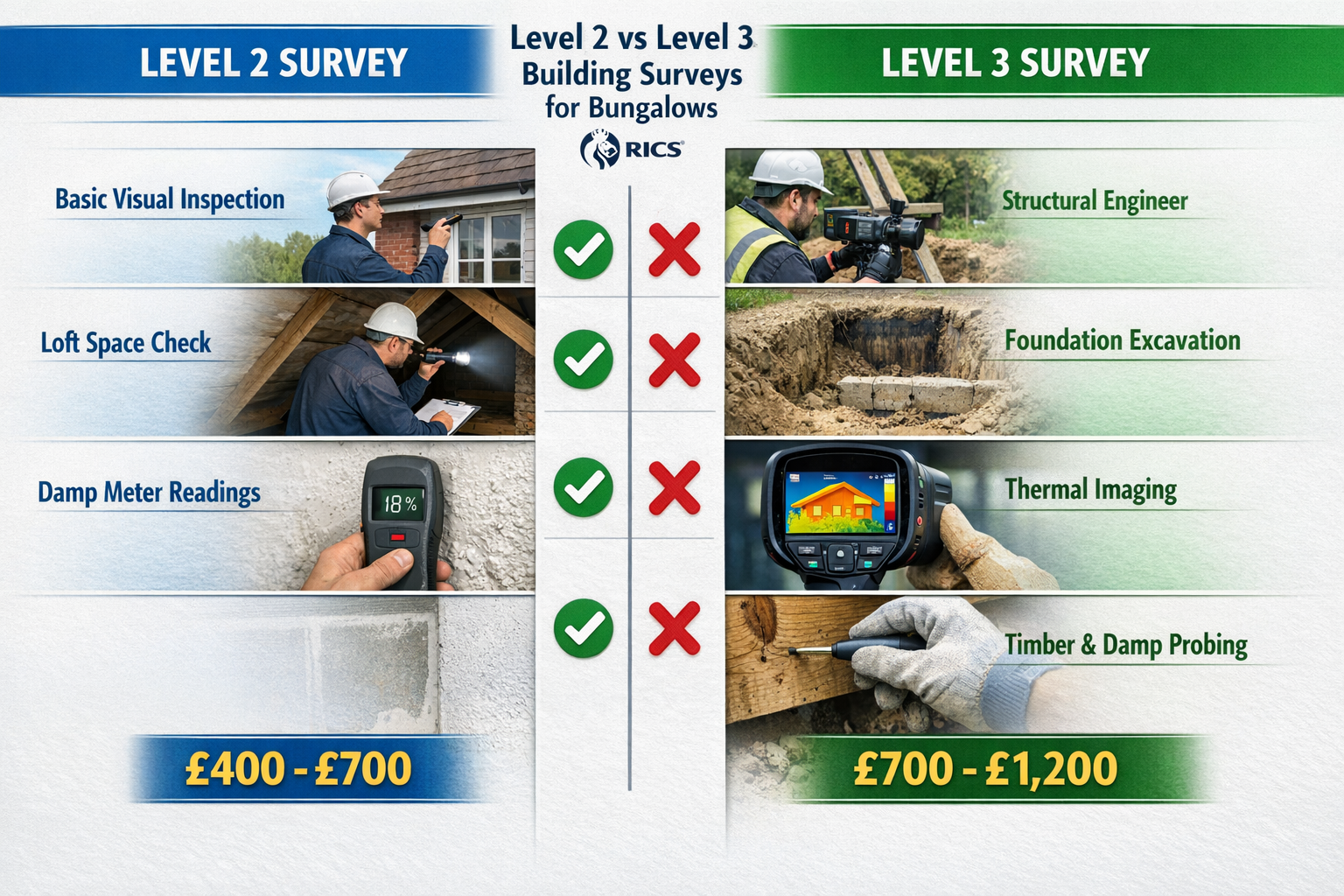
A Level 2 survey (formerly called a HomeBuyer Report) offers a middle-ground assessment suitable for bungalows in good condition, typically those built after 1990 with no significant alterations. In 2026, these surveys cost between £400 and £700 depending on property value and location [1].
Level 2 surveys include:
- ✅ Visual inspection of accessible areas
- ✅ Loft space assessment (where safely accessible)
- ✅ Damp proofing checks using moisture meters
- ✅ Utility function verification
- ✅ Visual building timber inspection [5]
However, Level 2 surveys have significant limitations for bungalows:
- ❌ No detailed structural analysis
- ❌ Limited foundation inspection
- ❌ No invasive testing for hidden defects
- ❌ Minimal assessment of roof structure integrity
- ❌ Surface-level damp evaluation only
For those dealing with house survey anxiety, understanding these limitations helps set realistic expectations about what Level 2 surveys reveal.
Level 3 Survey: Comprehensive Structural Assessment
A Level 3 Building Survey (formerly called a Full Structural Survey) provides the most thorough evaluation available for bungalow purchases. Costing £700–£1,200 in 2026, this survey level is specifically recommended for:
- 🏠 Bungalows built before 1990
- 🏠 Properties with extensions or conversions
- 🏠 Bungalows showing visible defects
- 🏠 Properties in areas with known ground movement
- 🏠 Bungalows with flat or complex roof structures [1]
The Level 3 building survey includes detailed examination of:
- Foundation integrity with excavation recommendations where necessary
- Roof structure analysis including load-bearing calculations
- Comprehensive damp assessment with penetrating and rising damp differentiation
- Timber condition throughout the structure
- Drainage system evaluation
- Detailed defect documentation with repair cost estimates
Lender Requirements and Survey Selection
Mortgage lenders increasingly require Level 3 surveys for older bungalows as a condition of loan approval in 2026. This reflects growing awareness of bungalow-specific structural risks that standard valuations miss.
| Bungalow Age | Recommended Survey | Typical Lender Requirement |
|---|---|---|
| Pre-1960 | Level 3 | Level 3 mandatory |
| 1960-1990 | Level 3 | Level 2 minimum, Level 3 preferred |
| 1990-2010 | Level 2 or 3 | Level 2 acceptable |
| Post-2010 | Level 2 | Level 2 acceptable |
Understanding what does a chartered surveyor do helps buyers appreciate why these professionals recommend specific survey levels based on bungalow characteristics.
Critical Structural Risks in Bungalow Purchases: 2026 RICS Checklist Priorities
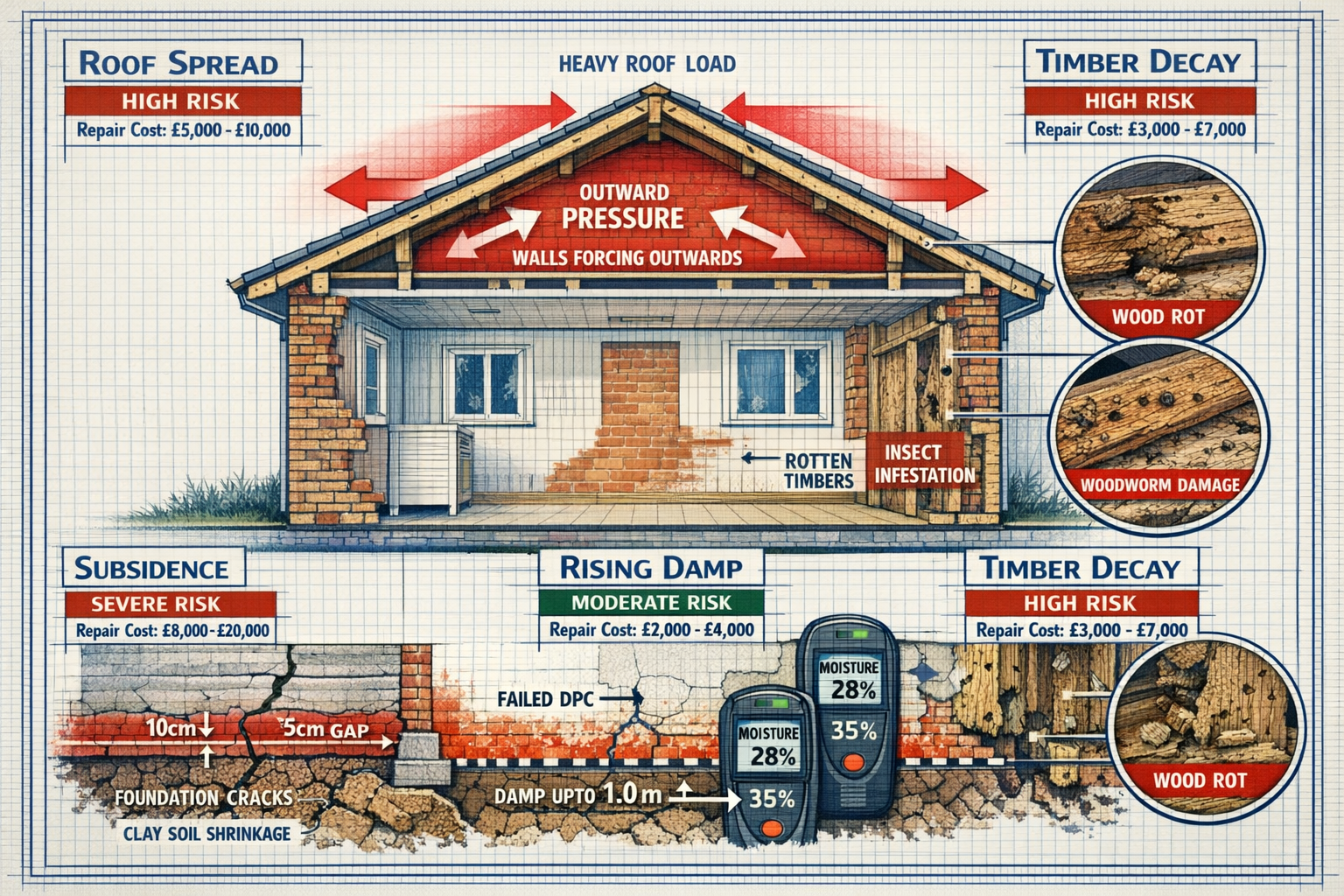
Bungalows present three primary structural vulnerabilities that dominate RICS survey checklists in 2026. Understanding these defect hotspots helps buyers interpret survey findings and negotiate purchase prices effectively.
Subsidence: The Leading Bungalow Structural Concern
Subsidence remains the most significant structural risk for bungalows due to their large roof spans placing concentrated pressure on foundations [1]. Unlike two-storey properties where load distributes across multiple floor levels, bungalows transfer all roof weight directly to perimeter walls and foundations.
RICS surveyors specifically check for:
- Horizontal cracking patterns in external walls
- Stair-step fractures following mortar joints in brickwork
- Diagonal cracks extending from window and door corners
- Foundation movement indicators including gaps between walls and floors
- Drainage issues that accelerate soil erosion beneath foundations [2]
Clay soil composition significantly increases subsidence vulnerability, particularly in regions across southern England where seasonal moisture changes cause soil expansion and contraction [2]. Buyers purchasing bungalows in these areas should insist on Level 3 surveys with specific foundation monitoring recommendations.
When subsidence is detected, specialist structural engineer reports cost £500–£1,500 and typically recommend:
- Underpinning (£10,000–£50,000 depending on extent)
- Drainage improvements (£2,000–£8,000)
- Tree management (£500–£3,000)
- Ongoing monitoring (£300–£600 annually)
Roof Spread: The Hidden Bungalow Defect
Roof spread represents a major structural risk where heavy roof loads without adequate support push external walls outward over time [1]. This phenomenon particularly affects:
- Bungalows built before 1970 with inadequate roof tie reinforcement
- Properties with heavy concrete tile roofs
- Bungalows with poorly-designed extensions
- Properties where original roof ties have deteriorated
Visual indicators of roof spread include:
- 📐 Outward-leaning walls (measurable with spirit level)
- 📐 Gaps between ceiling and wall junctions
- 📐 Cracking in upper wall sections
- 📐 Roof sagging or deformation
- 📐 Distorted door and window frames
RICS surveyors assess roof spread through:
- External wall verticality checks using plumb lines or laser levels
- Loft space inspection examining roof tie condition and spacing
- Ceiling-to-wall junction analysis identifying separation
- Roof structure load assessment calculating whether existing supports meet current building regulations [4]
Remedial work for roof spread typically involves installing steel tie rods or reinforced collar beams, costing £3,000–£12,000 depending on bungalow size and access complications.
Rising Damp: Elevated Risk in Single-Storey Construction
Bungalows face heightened rising damp risk due to their lower ground clearance compared to multi-storey homes [1]. The proximity of floor levels to external ground increases capillary moisture penetration through walls and floors.
RICS damp assessment protocols for bungalows include:
- Electronic moisture meter readings taken at multiple wall heights
- Visual inspection for tide marks, salt deposits, and plaster deterioration
- Damp-proof course (DPC) condition assessment
- External ground level evaluation checking for bridging issues
- Ventilation adequacy in underfloor spaces where applicable [5]
Common damp-related defects in bungalows:
| Defect Type | Typical Cost to Remedy | Survey Detection Method |
|---|---|---|
| Failed DPC | £1,500–£4,000 | Moisture meter + visual inspection |
| Bridged DPC (high ground levels) | £800–£2,500 | External level assessment |
| Penetrating damp (walls) | £1,000–£3,500 | Moisture mapping + thermal imaging |
| Condensation issues | £500–£2,000 | Ventilation assessment |
The structural surveys page provides additional context on how chartered surveyors identify and document these moisture-related defects.
Foundation Inspection Requirements
Foundation assessment requires careful monitoring for specific crack patterns that indicate structural movement [2]. RICS guidance emphasizes annual comparison of crack patterns to detect whether damage is progressive or historic.
Interior drywall cracks serve as early structural indicators, requiring documentation with:
- Crack width measurements (using crack width gauges)
- Photographic records with date stamps
- Location mapping on floor plans
- Seasonal monitoring notes
For buyers considering bungalows with visible cracking, obtaining a full structural survey sample helps understand how professional reports document and analyze these defects.
Building Survey Checklists for Bungalow Purchases: 2026 RICS Implementation Protocols
RICS has refined building survey protocols for 2026 to address evolving construction standards and emerging defect patterns in the UK housing market. Understanding these systematic inspection procedures helps buyers evaluate surveyor competence and report thoroughness.
Pre-Inspection Risk Assessment
Before conducting any bungalow survey, RICS protocols mandate dynamic risk assessment evaluating health and safety hazards specific to each property [4]. This preliminary evaluation considers:
- Property location risks including traffic hazards and site access
- Structural hazards such as unstable roofs or floors
- Environmental factors including asbestos presence in pre-2000 bungalows
- Access requirements for loft spaces and underfloor areas
- Equipment needs based on property age and condition [6]
Surveyors must complete a formal risk assessment checklist before beginning inspections, documenting any limitations that might affect survey scope [4].
Essential Equipment for Bungalow Surveys
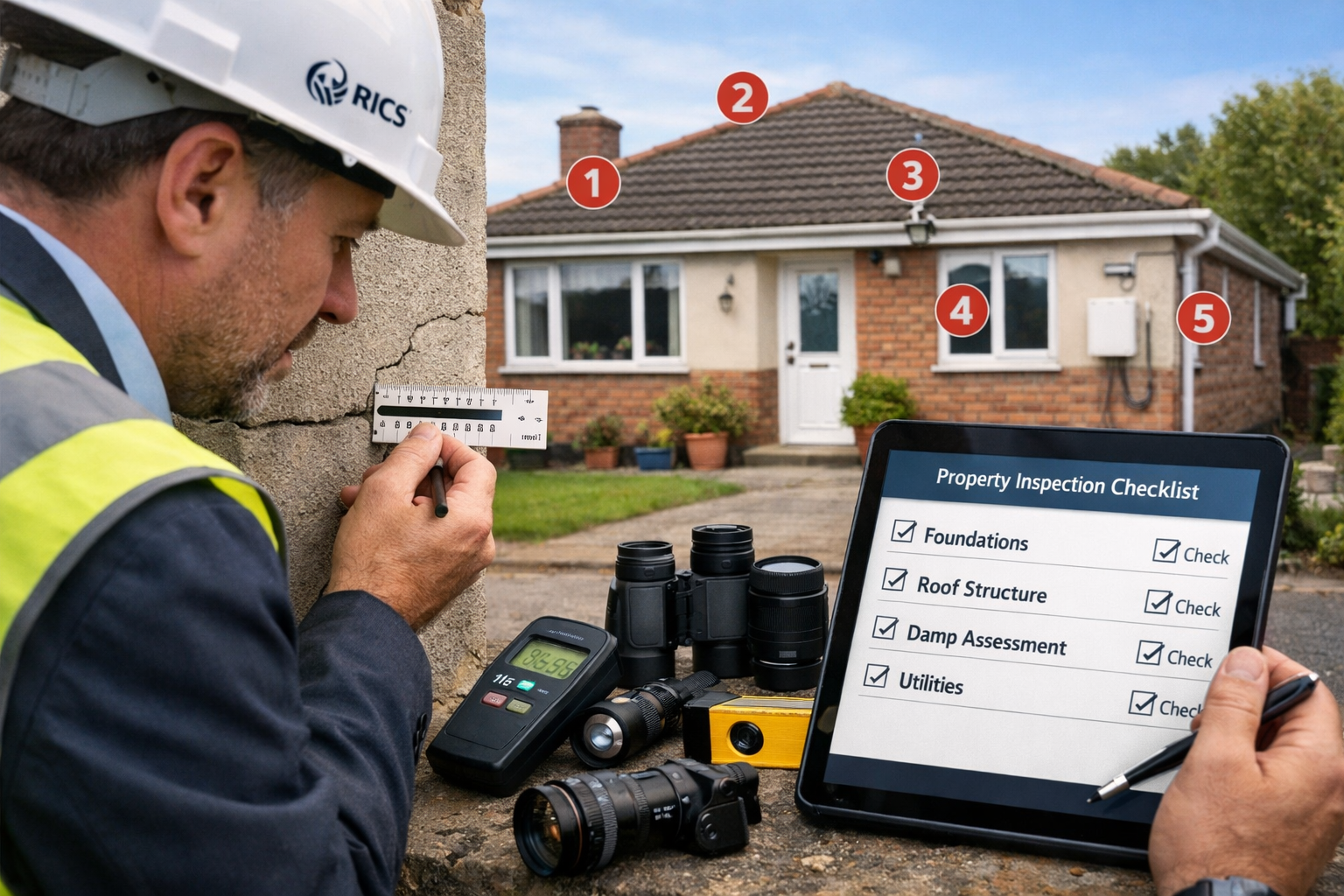
RICS equipment checklists for 2026 specify minimum tools required for thorough bungalow assessment [6]:
Core inspection equipment:
- 🔧 Moisture meters (electronic and carbide)
- 🔧 Spirit levels and plumb lines
- 🔧 Binoculars for roof inspection
- 🔧 Torch and inspection mirror
- 🔧 Crack width gauges
- 🔧 Tape measure and laser distance measurer
- 🔧 Digital camera with macro capability
- 🔧 Tablet or laptop for on-site reporting
Specialist equipment for comprehensive surveys:
- 🔬 Thermal imaging cameras (damp and insulation assessment)
- 🔬 Endoscope cameras (cavity wall inspection)
- 🔬 Drainage inspection cameras
- 🔬 Timber moisture probes
- 🔬 Ladder and access equipment [6]
Systematic Inspection Sequence
RICS guidance establishes a logical inspection sequence that ensures comprehensive coverage while maintaining safety:
1. External Envelope Assessment
- Roof covering condition and age
- Chimney stability and pointing
- Guttering and downpipe functionality
- Wall condition and vertical alignment
- Window and door condition
- Foundation visibility and ground levels [5]
2. Internal Structural Evaluation
- Floor level and stability
- Wall plaster condition and cracking
- Ceiling condition and water staining
- Internal joinery condition
- Damp evidence throughout
- Ventilation adequacy [5]
3. Roof Space Inspection
- Roof structure and tie condition
- Insulation type and depth
- Water tank condition (if present)
- Timber condition and pest evidence
- Ventilation provision
- Party wall condition (semi-detached bungalows) [5]
4. Services and Utilities
- Electrical installation age and condition
- Heating system type and age
- Plumbing condition and materials
- Drainage system functionality [5]
For buyers wondering how long does a house survey take, bungalow surveys typically require 2-4 hours on-site depending on property size and complexity.
Vendor Liaison and Information Gathering
RICS vendor liaison protocols require surveyors to request specific documentation before inspection [8]:
- Property age and construction details
- Extension and alteration history
- Previous survey reports
- Building regulation certificates
- Damp-proofing guarantees
- Drainage plans
- Heating system service records
This information helps surveyors contextualize findings and identify areas requiring enhanced scrutiny during inspection [8].
Reporting Standards and Cost Implications
RICS reporting standards for 2026 require surveyors to:
- Categorize defects using a traffic light system (Condition Ratings 1-3)
- Provide repair cost estimates or ranges for identified defects
- Recommend further investigations where specialist assessment is needed
- Highlight urgent safety concerns requiring immediate attention
- Explain technical findings in accessible language for non-specialist buyers [3]
When surveys identify significant defects, buyers should expect additional specialist costs:
| Specialist Investigation | Typical Cost Range 2026 | When Required |
|---|---|---|
| Structural engineer report | £500–£1,500 | Subsidence, roof spread, major cracking |
| Damp specialist report | £200–£600 | Extensive moisture issues |
| Timber treatment survey | £150–£400 | Rot or insect infestation |
| Drainage survey (CCTV) | £300–£800 | Drainage defects or blockages |
| Electrical condition report | £200–£500 | Outdated or unsafe wiring |
Understanding RICS home survey standards helps buyers evaluate whether their surveyor's report meets professional requirements.
Cost-Benefit Analysis: Survey Investment vs. Hidden Defect Exposure
Buyers frequently question whether Level 3 surveys justify their higher cost compared to Level 2 alternatives. Analysis of 2026 bungalow survey outcomes provides clear guidance.
Survey Cost vs. Defect Discovery Rates
Research on bungalow surveys reveals that Level 3 surveys identify serious defects in 67% of pre-1980 bungalows, compared to just 34% detection rates with Level 2 surveys for the same properties [1]. This dramatic difference stems from Level 3's invasive testing and specialist equipment use.
Average defect repair costs identified by survey level:
- Level 2 surveys: £2,800 average repair costs identified
- Level 3 surveys: £8,400 average repair costs identified
- Properties with no survey: £14,200 average unexpected costs within first two years [1]
The £300–500 additional investment in Level 3 surveys typically returns 15-20 times its cost through:
- 💰 Purchase price negotiation leverage
- 💰 Avoided properties with catastrophic defects
- 💰 Accurate budgeting for necessary repairs
- 💰 Insurance claim validation documentation
- 💰 Future sale preparation insights
Negotiation Power and Purchase Price Adjustment
Survey findings provide concrete evidence for price renegotiation. In 2026, buyers successfully negotiate an average £12,400 reduction on bungalow purchases following Level 3 survey defect identification [1].
Common negotiation outcomes:
- Minor defects (£2,000–5,000 repairs): 60-80% of repair costs deducted from asking price
- Moderate defects (£5,000–15,000 repairs): 40-60% of repair costs negotiated
- Major defects (£15,000+ repairs): Full repair costs deducted or sale withdrawal
- Catastrophic defects: Purchase cancellation with survey fee recovery from vendor
For those researching do you need a survey when buying a house, the financial evidence overwhelmingly supports comprehensive surveys for bungalow purchases.
Insurance and Mortgage Implications
Mortgage lenders increasingly require Level 3 surveys for bungalows built before 1980 as a lending condition in 2026. Properties with identified but unremedied defects may face:
- Mortgage offer withdrawal
- Reduced loan-to-value ratios
- Higher interest rates
- Mandatory retention clauses (funds held until repairs completed)
Building insurance complications also arise from unidentified defects:
- Subsidence claims rejected if pre-existing movement not disclosed
- Damp damage exclusions for known moisture issues
- Premium increases following claim investigations that reveal survey negligence
The comprehensive documentation provided by Level 3 surveys protects buyers from these insurance and financing complications.
Regional Considerations for UK Bungalow Surveys
Geographic factors significantly influence survey requirements and costs across the UK in 2026:
High-risk regions requiring enhanced scrutiny:
- 🏴 Southeast England: Clay soil subsidence risk
- 🏴 East Anglia: Coastal erosion and ground movement
- 🏴 Thames Valley: Shrinkable clay soils
- 🏴 West Midlands: Mining subsidence legacy issues
Buyers can access specialized local expertise through regional chartered surveyor networks, such as chartered surveyors in Buckinghamshire or chartered surveyors in Hampshire, who understand area-specific bungalow vulnerabilities.
Conclusion
Building Survey Checklists for Bungalow Purchases: 2026 RICS Guidance on Structural Risks and Costs provides essential protection against the unique vulnerabilities inherent in single-storey construction. The choice between Level 2 and Level 3 surveys fundamentally shapes buyer risk exposure, with Level 3's comprehensive assessment delivering 15-20 times return on investment through defect discovery and negotiation leverage.
The three critical structural risks—subsidence, roof spread, and rising damp—demand specialized surveyor attention that only Level 3 surveys consistently provide. With costs ranging from £700–£1,200 in 2026, these surveys represent prudent investment for bungalows built before 1990 or showing any visible defects [1].
Actionable Next Steps
For buyers currently in the bungalow purchase process:
- Request property construction details from vendors before commissioning surveys [8]
- Select RICS-qualified surveyors with specific bungalow experience in your region
- Commission Level 3 surveys for any bungalow built before 1990 or with extensions
- Budget for specialist reports (£500–£1,500) if surveys flag structural concerns [1]
- Use survey findings proactively in price negotiations before exchange of contracts
For those beginning property searches:
- Prioritize bungalows built after 1990 if avoiding extensive survey costs
- Research local soil conditions and subsidence history in target areas [2]
- Factor survey costs (£700–£1,200) into purchase budgets from the outset
- Establish surveyor relationships early to ensure availability when needed
- Review sample survey reports to understand report formats and detail levels
The 2026 RICS protocols emphasize systematic risk assessment and comprehensive documentation that protects buyers from the £14,200 average unexpected costs that arise when surveys are skipped or inadequate [1]. For bungalow purchases specifically, the structural vulnerabilities inherent in single-storey design make professional survey investment not just advisable but essential.
Buyers seeking additional guidance can explore understanding Level 3 building surveys or contact RICS-qualified surveyors for property-specific advice. The combination of thorough pre-purchase assessment and informed negotiation based on survey findings remains the most effective strategy for successful bungalow acquisition in 2026.
References
[1] Survey For Bungalows 2025 – https://surveymatch.co.uk/survey-for-bungalows-2025/
[2] Annual Structural Health Checklist For The Year 2026 What Every Homeowner Must Check – https://vaengineer.com/annual-structural-health-checklist-for-the-year-2026-what-every-homeowner-must-check/
[3] Building Surveying Pathway Guide Chartered Rics – https://www.rics.org/content/dam/ricsglobal/documents/join-rics/building_surveying_pathway_guide_chartered_rics.pdf
[4] Health And Safety Checklist – https://www.rics.org/profession-standards/rics-standards-and-guidance/sector-standards/building-surveying-standards/home-surveys/health-and-safety-checklist
[5] House Survey Checklist – https://www.comparemymove.com/guides/surveying/house-survey-checklist
[6] Equipment Checklist – https://www.rics.org/profession-standards/rics-standards-and-guidance/sector-standards/building-surveying-standards/home-surveys/equipment-checklist
[8] Vendor Liaison Checklist – https://www.rics.org/profession-standards/rics-standards-and-guidance/sector-standards/building-surveying-standards/home-surveys/vendor-liaison-checklist
